1893 Barber Half Dollar Coin Value: How Much Is It Worth?
The 1893 Barber Half Dollar is a three-mint-issue year with Philadelphia, New Orleans, and San Francisco strikes. Based on a USA Coin Book retail guide snapshot, values for ordinary business strikes range from about $52 at G4 for the Philadelphia issue up through $5,238 at MS63 for the scarcer San Francisco coin.
Proofs were struck at Philadelphia and carry separate pricing. Keep in mind that the 1893 Columbian Exposition commemorative half dollar is a completely different coin and not a Barber variant.
Fast Way to Identify Your 1893 Barber Half Dollar
The quickest way to start figuring out what your 1893 Barber Half Dollar is worth is to upload clear photos of the front and back. Our identifier can provide a preliminary identification of your coin's mint version and general condition from those images.
Snap both sides in good lighting and avoid glare on the surfaces.
1893 Barber Half Dollar Value
Upload both sides of your 1893 Barber Half Dollar.
Front Obverse
Upload photo
Back Reverse
Upload photo
Which 1893 Barber Half Dollar Versions Are Worth Money?
- The San Francisco (S) mint issue is the scarcest of the three and starts around $211 at G4, climbing to roughly $5,238 at MS63 per the USA Coin Book guide.
- New Orleans (O) coins carry a moderate premium over Philadelphia pieces, with guide values from about $79 at G4 to $1,617 at MS63.
- Philadelphia Proofs in PR63 condition are listed at approximately $1,363, and confirming genuine Proof surfaces is essential before claiming that value.
- Original, problem-free coins in upper circulated and Mint State grades can be dramatically more valuable than heavily worn or cleaned examples.
- A Tripled Die Reverse error has been reported for this date and can add a premium depending on visibility and condition.
- Always confirm the exact mint and finish before consulting value charts; an unusual mark alone does not establish a valuable error.
Step 1: Identify Your 1893 Barber Half Dollar Mint Mark and Version
First, confirm your coin shows the date 1893 with a right-facing Liberty head on the obverse and a heraldic eagle on the reverse, along with the HALF DOLLAR denomination. All regular 1893 Barber halves are struck in 90% silver and 10% copper, weighing about 12.5 grams with a 30.6 mm diameter and a reeded edge.
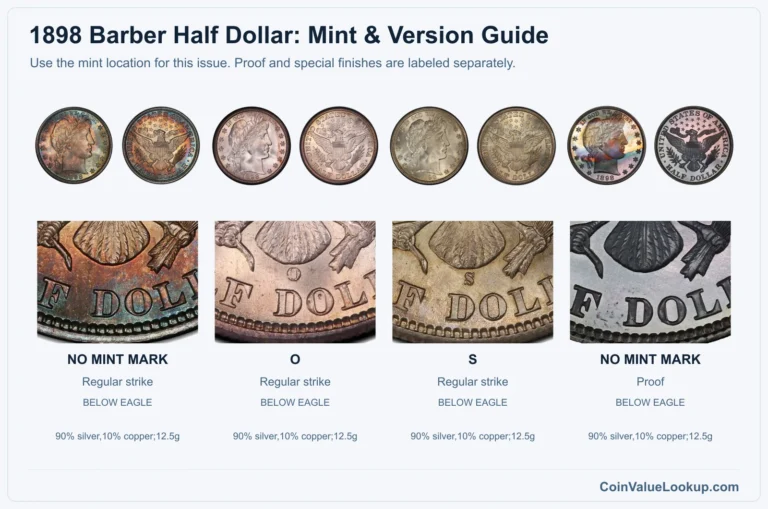
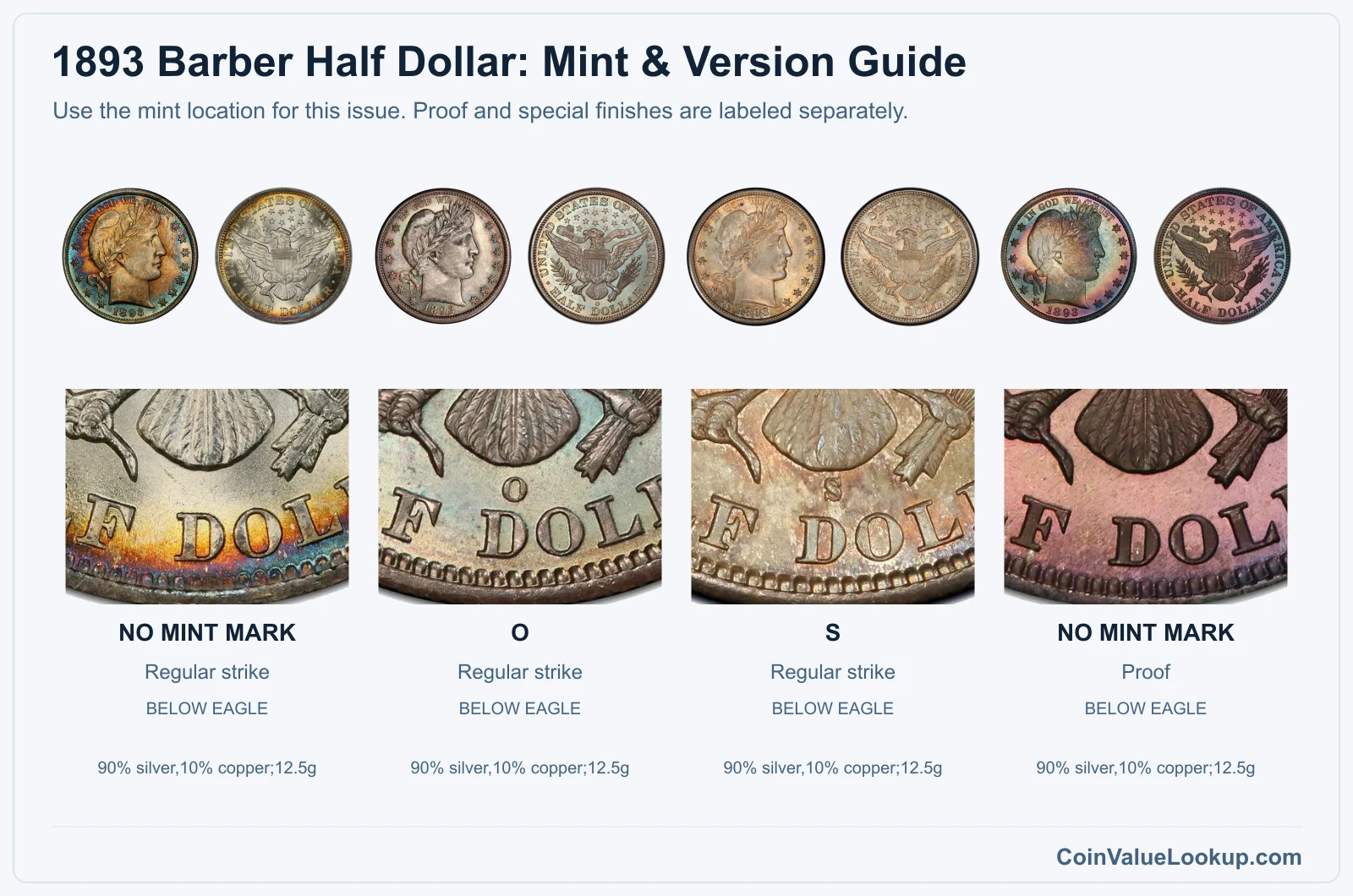
The mintmark is the critical detail. Look on the reverse, just below the eagle's tail feathers and above the words HALF DOLLAR.
A small "O" means New Orleans, an "S" means San Francisco, and no letter at all means Philadelphia.
Of the three mints, the S issue is the scarcest and commands a significant premium even in low grades. The O mint coin sits in the middle, while the Philadelphia piece is the most available.
Make sure you identify the mintmark before looking up values, because confusing these three branches will give you the wrong number every time.
Step 2: Check Your 1893 Barber Half Dollar Grade
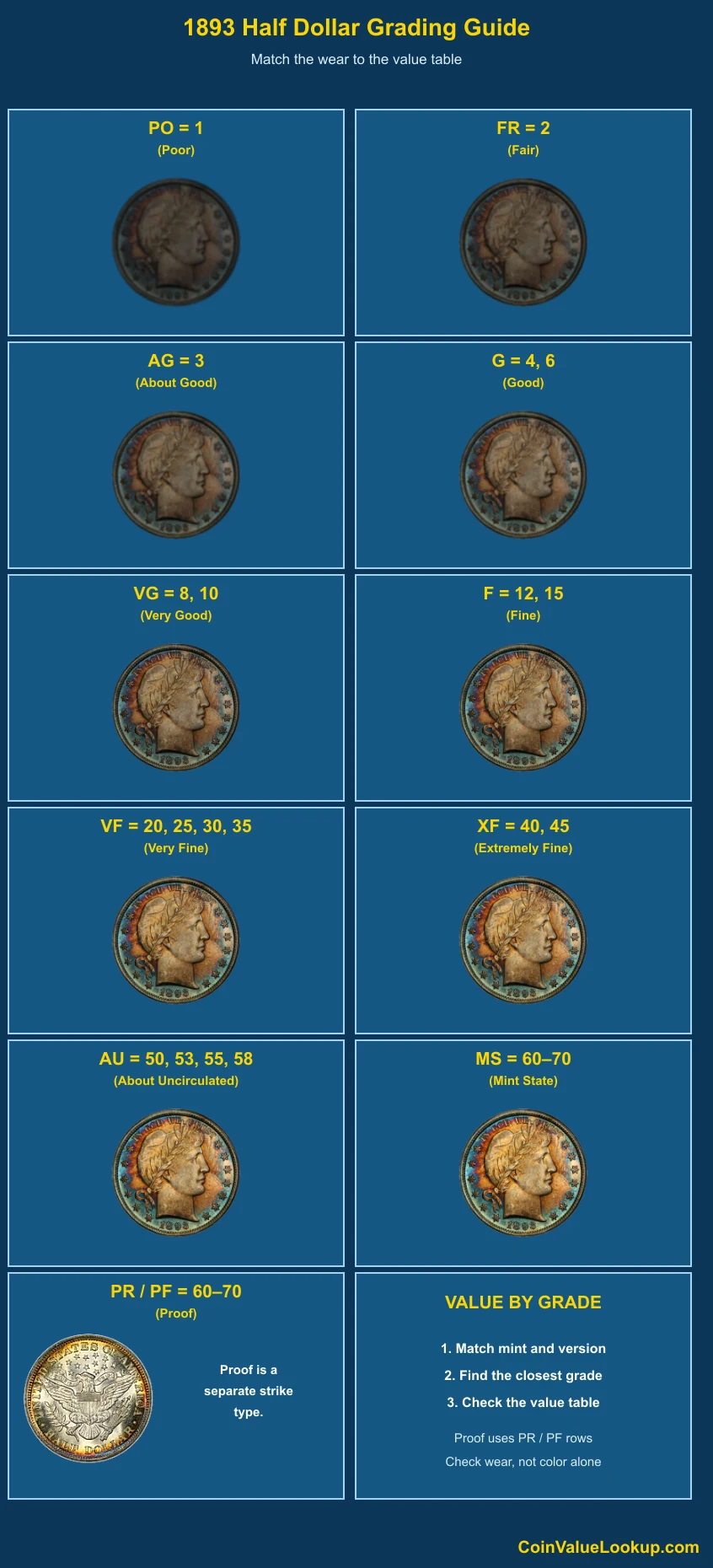
When grading an 1893 Barber half, start with Liberty's cheek and the hair detail above her ear on the obverse, then check the headband for remaining sharpness. On the reverse, examine the eagle's head, wing tips, and tail feathers.
Do not rely solely on how many letters of LIBERTY remain visible on the headband. Hub changes during the Barber series affected how quickly those letters wore, so that shortcut can mislead you.
New Orleans coins in particular can show weak detail at the eagle's claws and arrow feathers even on higher-grade pieces. That is a strike characteristic, not wear.
Separating genuine friction from original strike softness or loss of luster takes a careful side-by-side look.
Use the comparison image to match your coin's overall wear pattern. And remember that a Proof is a special manufacturing finish with mirrored fields and sharp rims, not simply a grade above Mint State.
A polished coin is not a Proof.
Step 3: Check 1893 Barber Half Dollar Value by Mint and Version
1893 Barber Half Dollar — No Mint Mark — Regular Issue
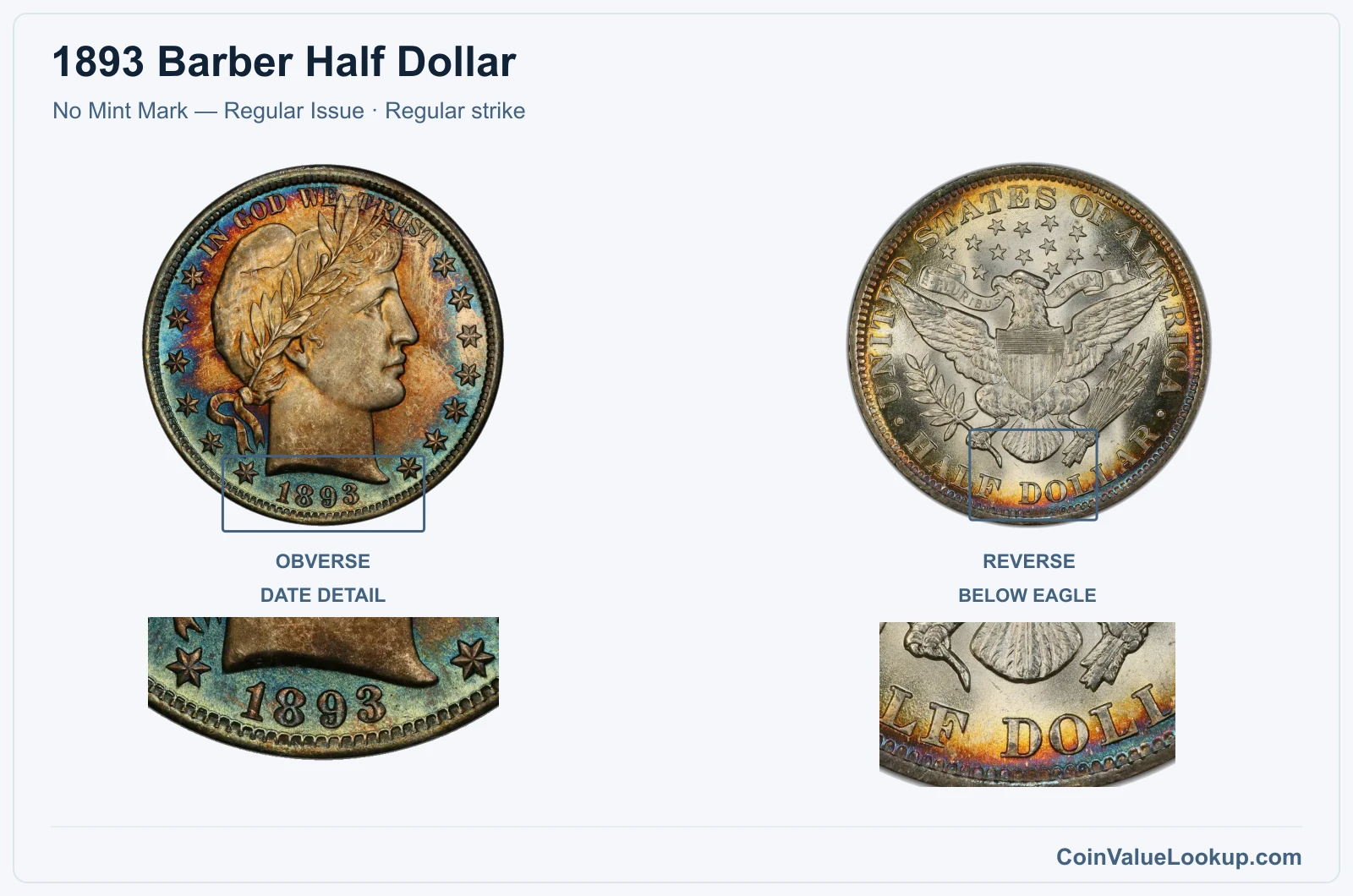
The 1893 Philadelphia Barber Half Dollar carries no mintmark. You will see a blank space below the eagle's tail on the reverse.
This is the most available of the three mint issues for the year.
A USA Coin Book guide estimate places this coin at about $52 in G4 and around $1,314 in MS63. These are guide snapshots, not guaranteed sale prices.
Condition and original surfaces matter enormously across that spread.
Look for honest wear rather than signs of cleaning or tooling. A coin with original gray or lightly toned surfaces in a mid-circulated grade is far more desirable to collectors than a scrubbed example that technically shows less wear.
Range Grade
Price Auction Records Appraisal PO PO 1
—
Coin Identifier FR FR 2
—
Coin Identifier AG AG 3
—
Coin Identifier G G 4
—
Coin Identifier
G 6
—
Coin Identifier VG VG 8
—
Coin Identifier
VG 10
—
Coin Identifier F F 12
Coin Identifier
F 15
Coin Identifier VF VF 20
Coin Identifier
VF 25
Coin Identifier
VF 30
Coin Identifier
VF 35
Coin Identifier XF XF 40
Coin Identifier
XF 45
Coin Identifier AU AU 50
Coin Identifier
AU 53
Coin Identifier
AU 55
Coin Identifier
AU 58
Coin Identifier MS MS 60
—
Coin Identifier
MS 61
Coin Identifier
MS 62
Coin Identifier
MS 63
Coin Identifier
MS 64
Coin Identifier
MS 65
Coin Identifier
MS 66
Coin Identifier
MS 67
Coin Identifier
MS 68
—
Coin Identifier
MS 69
—
—
—
MS 70
—
—
—
1893 Barber Half Dollar — O — Regular Issue
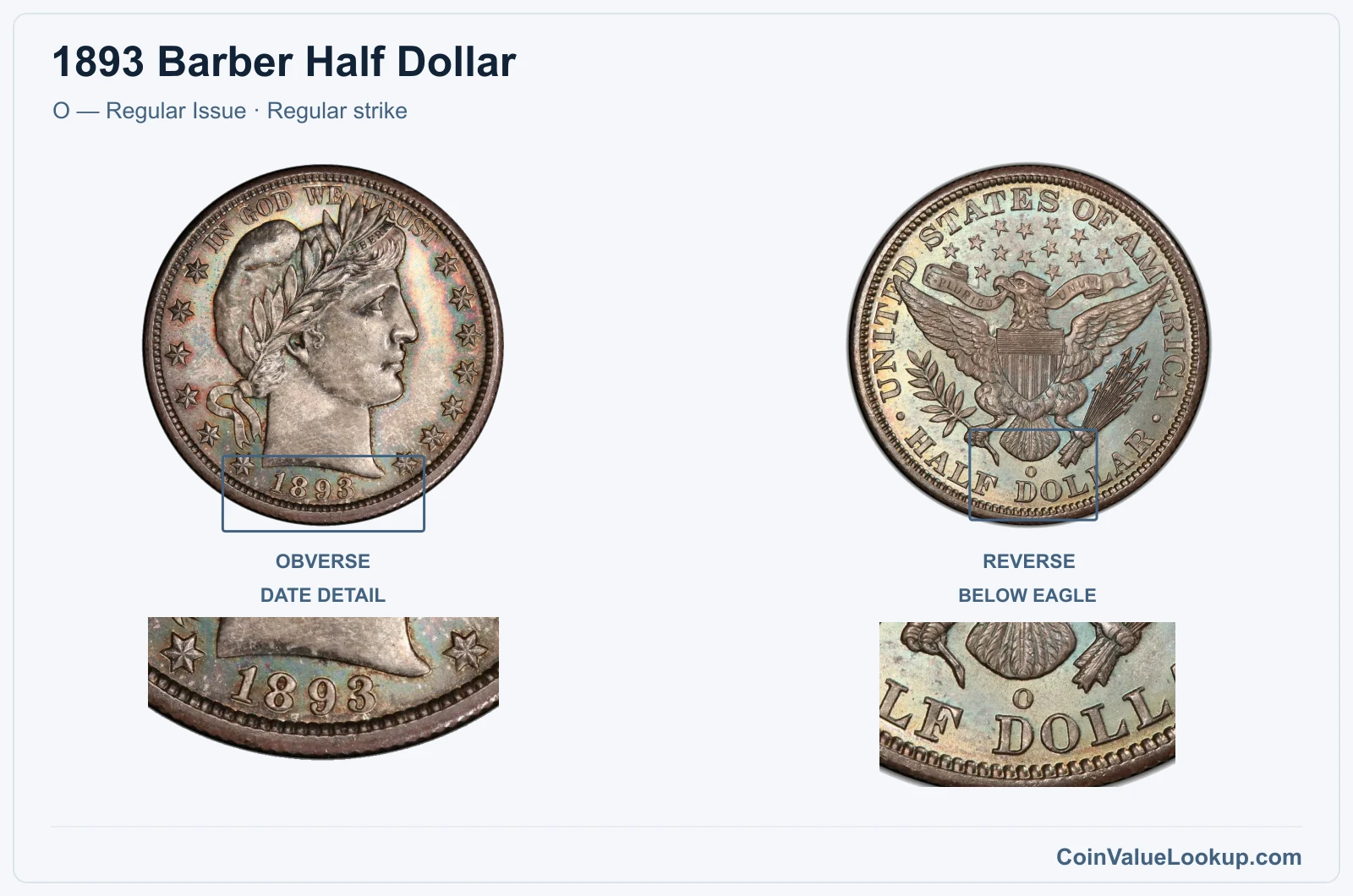
The 1893-O was struck at the New Orleans Mint and carries a small "O" mintmark on the reverse below the eagle's tail feathers. It trades at a premium over the Philadelphia issue.
Guide values from USA Coin Book place the 1893-O at roughly $79 in G4 and about $1,617 in MS63. As with all guide estimates, actual transaction prices depend on the individual coin.
New Orleans Barber halves are known for inconsistent strike quality. Softness in the eagle's claws and arrow feathers is common and does not necessarily mean the coin is heavily worn.
Compare the obverse wear indicators carefully before downgrading a coin that may simply have a weaker strike.
Coin Value Lookup is a useful starting point if you are researching other Barber half dollar dates or want to look up coin guides across different series.
Range Grade
Price Auction Records Appraisal PO PO 1
—
Coin Identifier FR FR 2
—
Coin Identifier AG AG 3
—
Coin Identifier G G 4
Coin Identifier
G 6
—
Coin Identifier VG VG 8
—
Coin Identifier
VG 10
Coin Identifier F F 12
Coin Identifier
F 15
Coin Identifier VF VF 20
Coin Identifier
VF 25
—
Coin Identifier
VF 30
Coin Identifier
VF 35
Coin Identifier XF XF 40
Coin Identifier
XF 45
Coin Identifier AU AU 50
Coin Identifier
AU 53
Coin Identifier
AU 55
Coin Identifier
AU 58
Coin Identifier MS MS 60
Coin Identifier
MS 61
Coin Identifier
MS 62
Coin Identifier
MS 63
Coin Identifier
MS 64
Coin Identifier
MS 65
Coin Identifier
MS 66
Coin Identifier
MS 67
—
—
—
MS 68
—
—
—
MS 69
—
—
—
MS 70
—
—
—
1893 Barber Half Dollar — S — Regular Issue
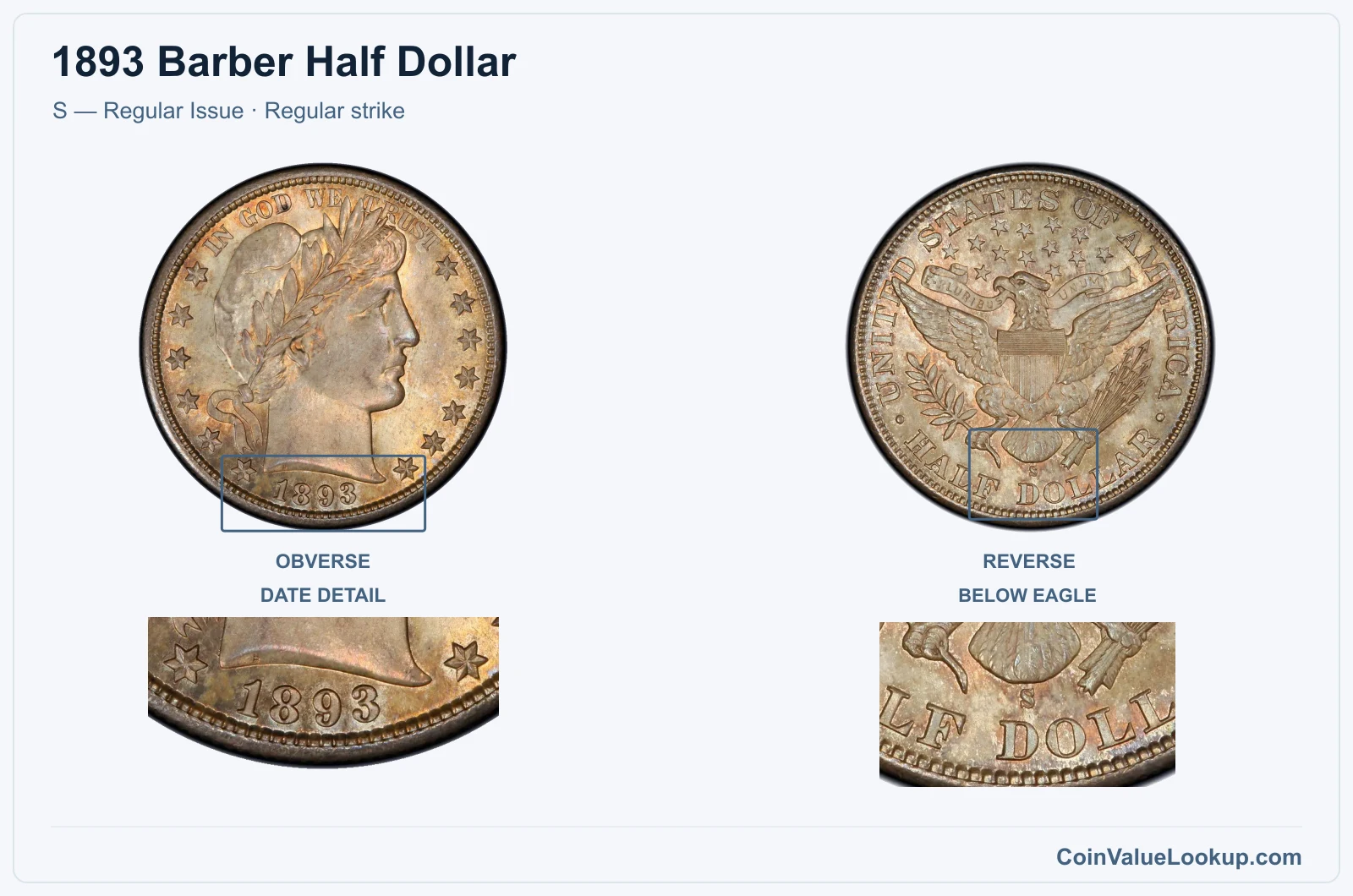
The 1893-S, struck at the San Francisco Mint, is the scarce issue of this year. Its "S" mintmark sits in the usual spot below the eagle's tail on the reverse.
This coin commands the highest premiums among the three regular business strikes. USA Coin Book lists it at about $211 in G4 and approximately $5,238 in MS63.
That G4 figure alone is roughly four times the Philadelphia coin in the same grade.
Because of the premium, precise grading and surface quality are critical. Problem-free examples with original surfaces are especially sought by Barber series collectors.
Verify the mintmark carefully under magnification, since a misidentified O or worn-off letter could cost you real money or lead to overpaying.
Range Grade
Price Auction Records Appraisal PO PO 1
—
Coin Identifier FR FR 2
Coin Identifier AG AG 3
Coin Identifier G G 4
Coin Identifier
G 6
Coin Identifier VG VG 8
Coin Identifier
VG 10
Coin Identifier F F 12
Coin Identifier
F 15
Coin Identifier VF VF 20
Coin Identifier
VF 25
Coin Identifier
VF 30
Coin Identifier
VF 35
Coin Identifier XF XF 40
Coin Identifier
XF 45
Coin Identifier AU AU 50
Coin Identifier
AU 53
Coin Identifier
AU 55
Coin Identifier
AU 58
Coin Identifier MS MS 60
Coin Identifier
MS 61
Coin Identifier
MS 62
Coin Identifier
MS 63
Coin Identifier
MS 64
Coin Identifier
MS 65
Coin Identifier
MS 66
Coin Identifier
MS 67
—
—
—
MS 68
—
—
—
MS 69
—
—
—
MS 70
—
—
—
1893 Barber Half Dollar — No Mint Mark — Proof
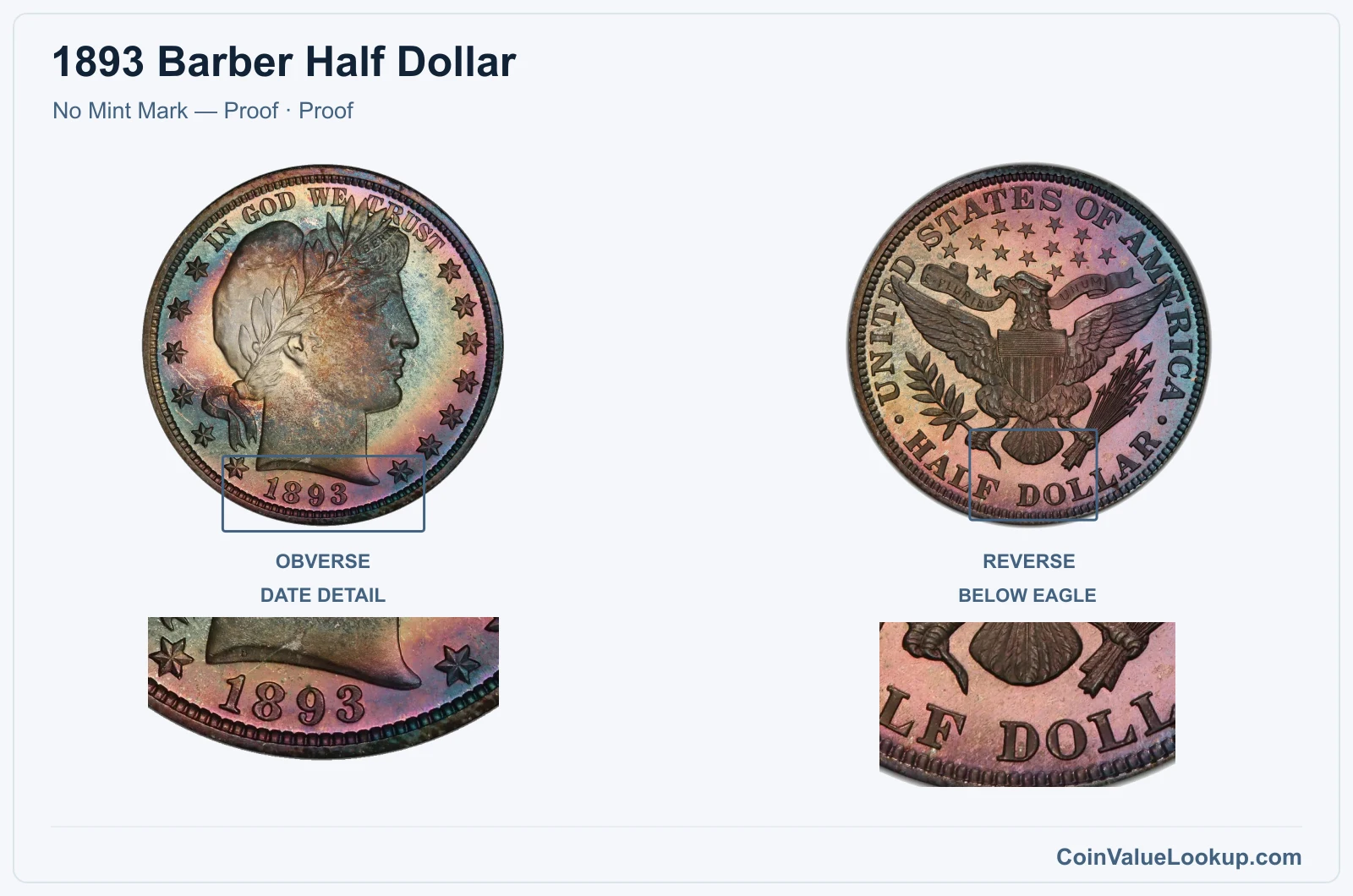
Proof 1893 Barber Half Dollars were produced at the Philadelphia Mint and carry no mintmark, just like the business strike. The difference is in the finish: genuine Proofs display deeply mirrored fields, sharp squared-off rims, and crisp design detail that business strikes simply do not achieve.
A USA Coin Book guide places the PR63 value at approximately $1,363. Proof status must be confirmed by examining the fields and rims rather than just overall sharpness.
A polished business strike can superficially resemble a Proof but will lack the characteristic die preparation marks and field depth.
Compare any cameo contrast within the Proof category itself, not against business strikes. Proofs are their own branch with their own grading scale.
Range Grade
Price Auction Records Appraisal PR PR 1
—
Coin Identifier
PR 2
—
Coin Identifier
PR 3
—
Coin Identifier
PR 4
—
Coin Identifier
PR 6
—
Coin Identifier
PR 8
—
Coin Identifier
PR 10
—
Coin Identifier
PR 12
—
Coin Identifier
PR 15
—
Coin Identifier
PR 20
—
Coin Identifier
PR 25
—
Coin Identifier
PR 30
—
Coin Identifier
PR 35
—
Coin Identifier
PR 40
—
Coin Identifier
PR 45
—
Coin Identifier
PR 50
—
Coin Identifier
PR 53
—
Coin Identifier
PR 55
—
Coin Identifier
PR 58
—
Coin Identifier
PR 60
Coin Identifier
PR 61
Coin Identifier
PR 62
Coin Identifier
PR 63
Coin Identifier
PR 64
Coin Identifier
PR 65
Coin Identifier
PR 66
Coin Identifier
PR 67
Coin Identifier
PR 68
Coin Identifier
PR 69
—
—
—
PR 70
—
—
—
1893 Barber Half Dollar Error List
1. 1893 Barber Half Dollar — Tripled Die Reverse
A Tripled Die Reverse has been reported for the 1893 Half Dollar by NGC's variety listings. On an affected coin, you would see repeated impressions in the reverse outer lettering and possibly in the arrow details, giving a distinct layered or shelf-like appearance to the affected design elements.
Compare your coin's reverse lettering carefully against a known normal example. The doubling from a tripled die is consistent and raised, following the contour of the original design.
Machine doubling, by contrast, tends to look flat, shelf-like in a different direction, and less sharply defined. Random scratches or reflections in photographs can also mimic doubling.
No specific price range is available for this variety. The value of any confirmed example depends on the visibility of the tripling, overall coin condition, and collector demand for the specific die pairing.
2. 1893 Barber Half Dollar — Misplaced Date
A Misplaced Date variety has been reported for the 1893-O Barber Half Dollar. The diagnostic to look for is extra numeral fragments visible in or near the denticles below the date on the obverse.
These fragments result from an initial date punch landing in the wrong position before the final placement was made.
To identify this, examine the area just below and between the date digits under magnification. You are looking for faint remnants of a number partially embedded in the denticle area.
This is different from a repunched date, where the secondary impression appears beside or overlapping the final digits in their normal position. Rim nicks and contact damage can also create misleading shapes in that area.
No adopted price range exists for this variety. Value depends on the clarity of the misplacement, overall grade, and the individual coin's surfaces.
3. 1893 Barber Half Dollar — Struck-Through Error
A Struck-Through error on the 1893-O Barber Half Dollar has been reported by a collector source, describing an obstruction impression on the face of the coin. Struck-through errors occur when foreign material sits between the die and the planchet during striking, leaving a localized depression or incomplete design area on the finished coin.
Look for a distinct depressed area that interrupts the normal design flow. Grease-filled dies tend to create smooth, rounded soft spots, while a retained foreign object can leave a sharper, more defined impression.
Either way, the affected area should look pressed in, not scratched or scraped.
Do not confuse ordinary wear, cleaning marks, or localized weak strike with a struck-through error. Genuine examples show a clear interruption that does not follow normal wear patterns.
No specific price data is available for this error, and individual assessment based on the error's visibility and the coin's condition is essential.