1893 Liberty Nickel Coin Value: How Much Is It Worth?
The 1893 Liberty Nickel is a Philadelphia-only issue with guide values running from about $7.29 in G4 to $194 in MS63 for business strikes, while a proof example anchors around $344 in PR63. These are retail guide estimates from USA Coin Book, not guaranteed sale prices.
Only the With CENTS reverse exists for this date — the No CENTS design was an 1883-only affair.
Fast Way to Identify Your 1893 Liberty Nickel
Upload clear photos of both the front and back of your coin, and our identifier can offer a preliminary read on which version you have and its general condition. Good lighting and a steady shot help — try to capture the full rim on each side.
This is not a substitute for professional authentication, but it gets you pointed in the right direction quickly.
1893 Liberty Nickel Value
Upload both sides of your 1893 Liberty Nickel.
Front Obverse
Upload photo
Back Reverse
Upload photo
Which 1893 Liberty Nickel Versions Are Worth Money?
- Business strikes in MS63 or higher carry guide values well above circulated examples — about $194 at MS63 versus roughly $7.29 at G4.
- Proof examples graded PR63 anchor around $344 according to the guide, reflecting their limited original mintage and collector demand.
- Error coins such as broadstrikes, off-center strikes, or brockages can carry premiums when properly attributed, though condition and visibility of the error matter greatly.
- Original, uncleaned surfaces on any grade tend to be preferred by collectors over coins that have been polished or artificially toned.
Step 1: Identify Your 1893 Liberty Nickel Mint Mark and Version
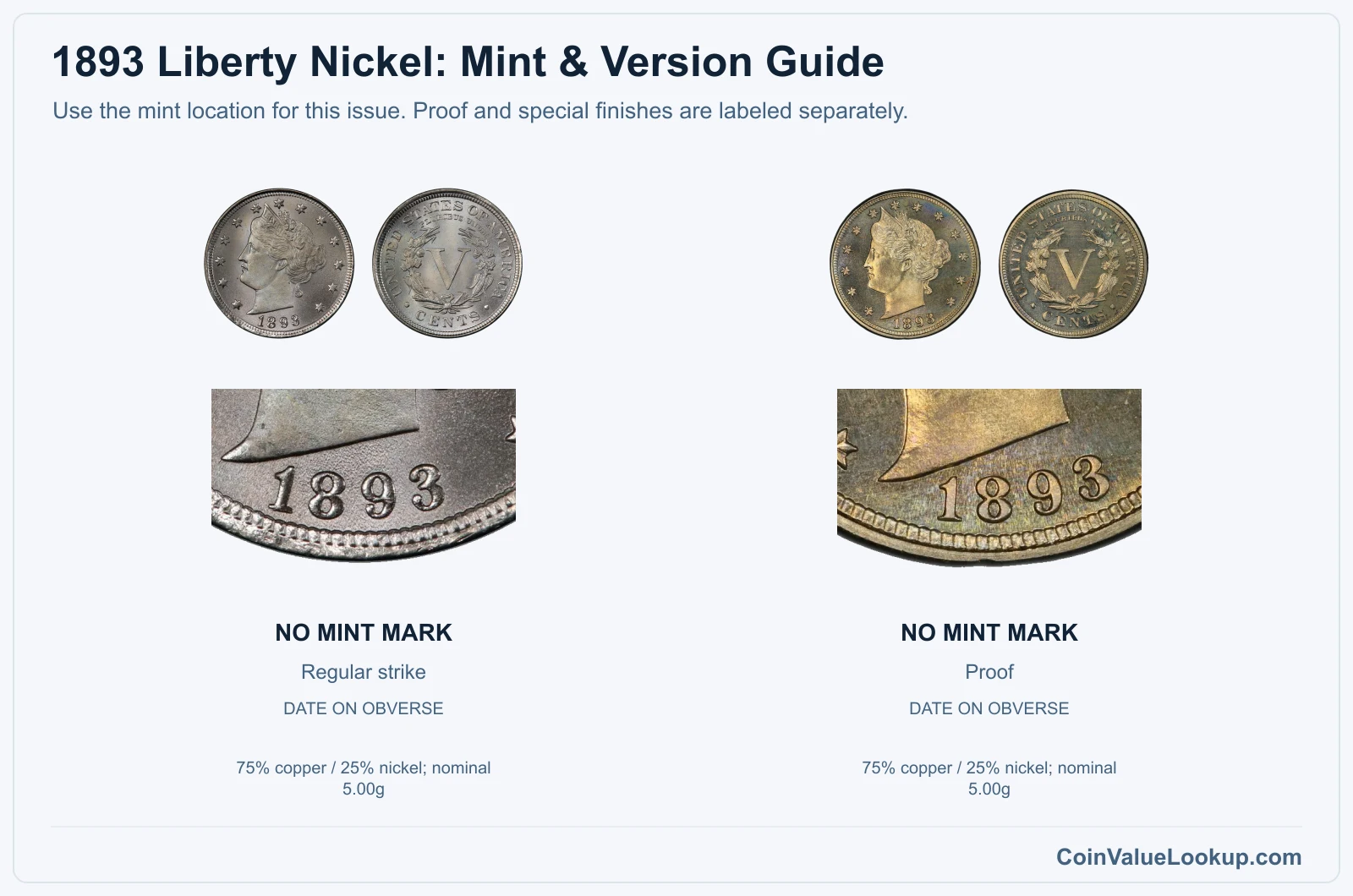
Every 1893 Liberty Nickel was struck at Philadelphia. There is no mintmark, so do not look for a D or S — those branches did not exist for this series in this year.
The coin is 75% copper and 25% nickel, weighs nominally 5 grams, measures 21.2 mm across, and has a plain edge. If your coin is noticeably lighter, heavier, or a different color, that could signal an alteration or a wrong-planchet error worth investigating further.
All genuine 1893 nickels carry the words CENTS on the reverse wreath. The famous No CENTS variety belongs exclusively to 1883, the first year of the series.
If someone offers you an 1893 "No CENTS" nickel, walk away — it does not exist.
Coin Value Lookup is a handy starting point for looking up guides across different coin series if you are sorting through a mixed group of old coins.
Step 2: Check Your 1893 Liberty Nickel Grade
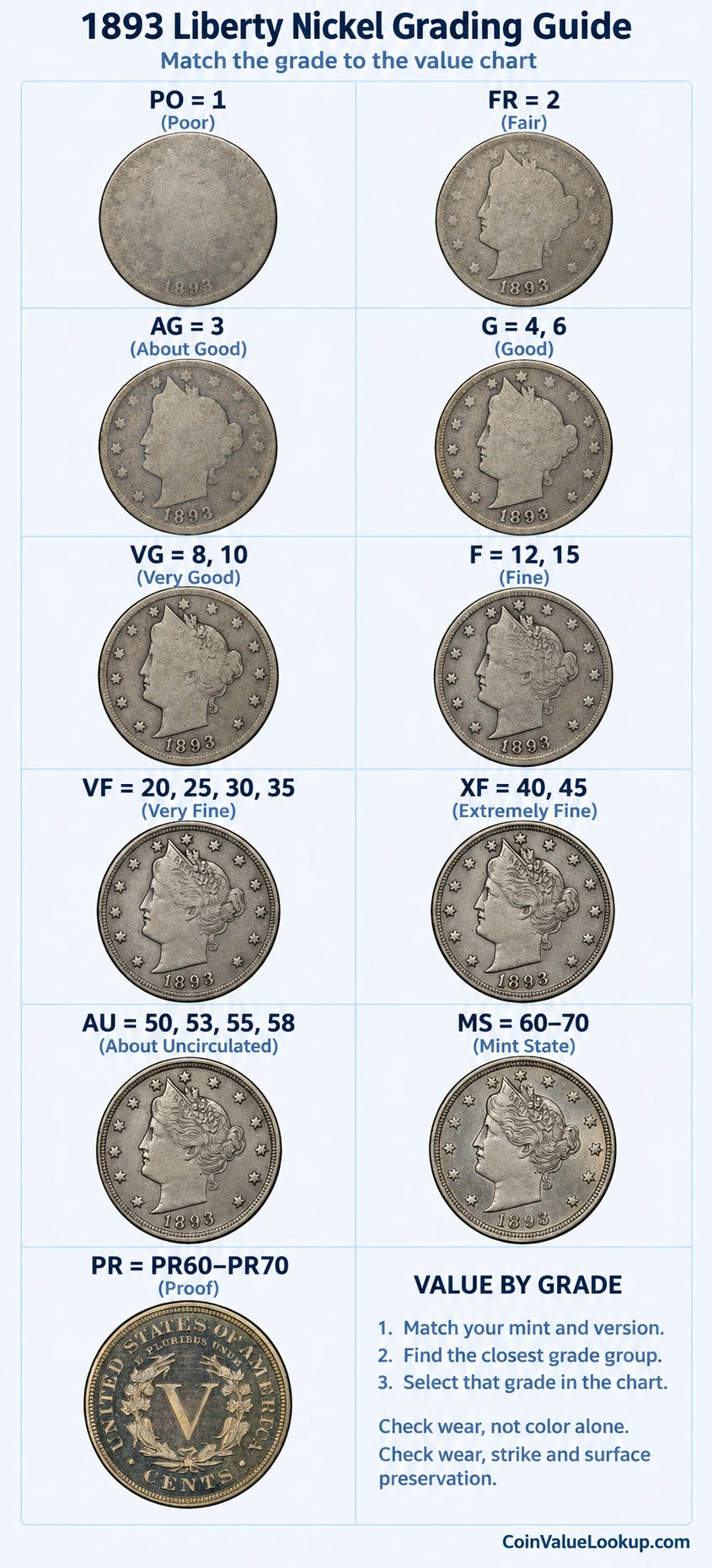
Start with the word LIBERTY on the coronet. On a well-worn coin those letters blur together or vanish entirely; a Good-4 example will show a readable date but a mostly flat headband.
Move to the high points: the hair curls above the forehead and behind the ear, plus the cheek. These wear first.
On the reverse, check the individual kernels of the corn ears and the fine lines of the wreath leaves.
Strike weakness can mimic wear, so look at the fields too. A coin that never circulated should show unbroken cartwheel luster across the flat areas, even if the highest hair detail is soft from a lazy strike.
Compare your coin against the reference image to judge where metal loss is from handling versus the die simply not filling completely.
Proofs are a separate category. They were manufactured with polished dies and specially prepared planchets, producing mirror-like fields.
Proof is not a grade above Mint State — it is a different manufacturing finish. Examine the fields for hairlines from cleaning, and inspect the rims for sharpness.
Hairlines and haze drop a proof's grade quickly.
Step 3: Check 1893 Liberty Nickel Value by Mint and Version
1893 Liberty Nickel — No Mint Mark — With CENTS Circulation
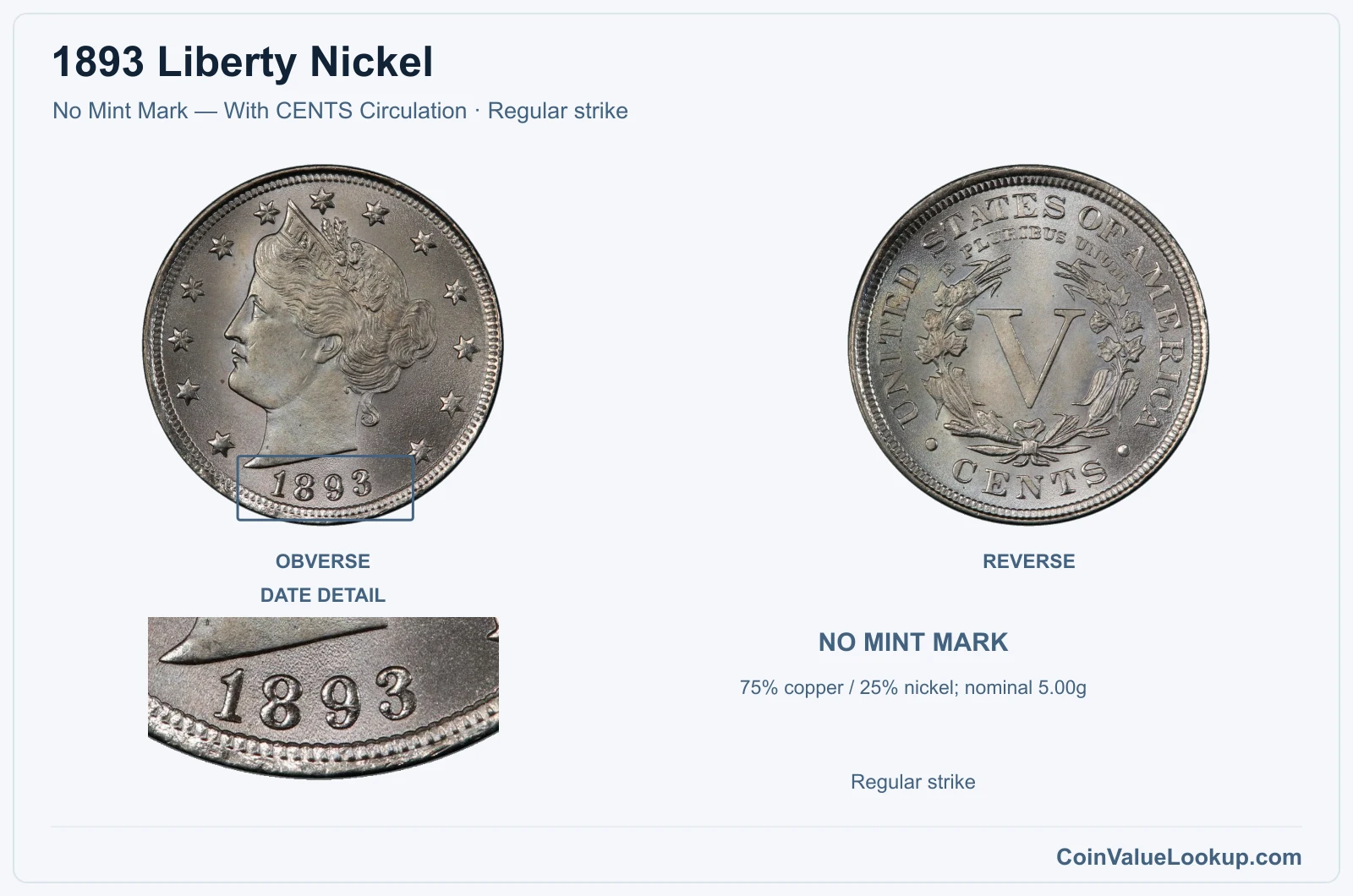
This is the standard 1893 Liberty Nickel struck for circulation at Philadelphia. No mintmark appears on the coin.
The reverse displays the Roman numeral V inside a wreath with the word CENTS below, the design used from late 1883 onward.
A guide snapshot from USA Coin Book places a G4 example at about $7.29 and an MS63 at roughly $194. That is a wide spread, and most surviving examples fall somewhere in the circulated range.
Coins with full, original luster and minimal contact marks at the Mint State level are where the real jump in value happens. Weak strikes on the hair curls are common for the date, so do not mistake soft detail for wear without checking the fields.
Range Grade
Price Auction Records Appraisal PO PO 1
—
Coin Identifier FR FR 2
—
Coin Identifier AG AG 3
—
Coin Identifier G G 4
—
Coin Identifier
G 6
—
Coin Identifier VG VG 8
—
Coin Identifier
VG 10
—
Coin Identifier F F 12
—
Coin Identifier
F 15
—
Coin Identifier VF VF 20
—
Coin Identifier
VF 25
Coin Identifier
VF 30
—
Coin Identifier
VF 35
—
Coin Identifier XF XF 40
Coin Identifier
XF 45
—
Coin Identifier AU AU 50
—
Coin Identifier
AU 53
—
Coin Identifier
AU 55
Coin Identifier
AU 58
Coin Identifier MS MS 60
Coin Identifier
MS 61
Coin Identifier
MS 62
Coin Identifier
MS 63
Coin Identifier
MS 64
Coin Identifier
MS 65
Coin Identifier
MS 66
Coin Identifier
MS 67
Coin Identifier
MS 68
—
—
—
MS 69
—
—
—
MS 70
—
—
—
1893 Liberty Nickel — No Mint Mark — With CENTS Proof
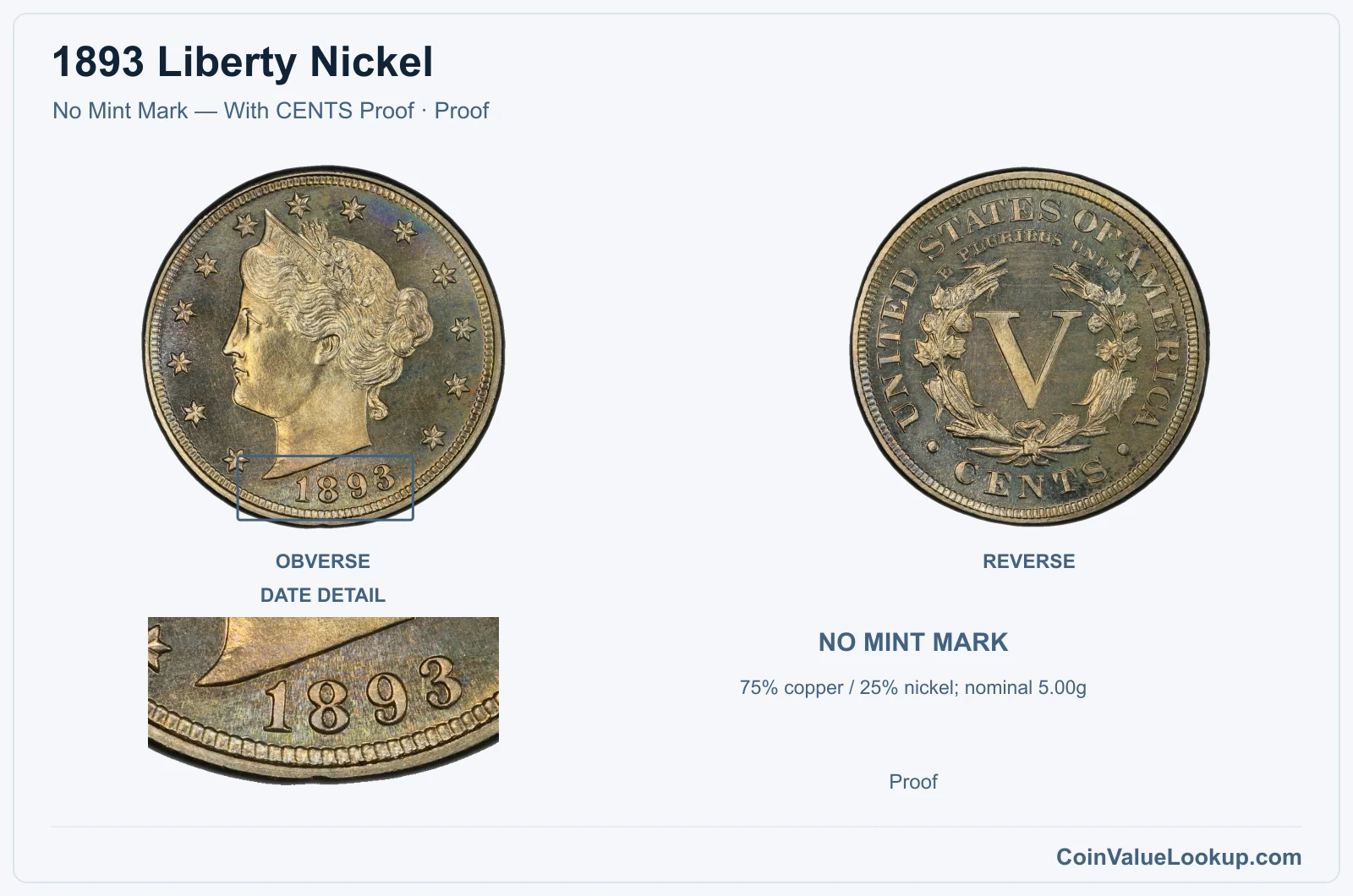
Philadelphia produced proof Liberty Nickels for collectors in 1893, struck from polished dies on prepared planchets. These coins display deeply mirrored fields and sharp rims that business strikes simply do not have.
A PR63 example carries a guide value of about $344 per USA Coin Book. When photographing a proof for identification, capture the reflective fields and the rim profile — those details separate a genuine proof from a well-preserved business strike.
Hairlines from old cleanings are the most common grade killer on proofs, so examine the fields under angled light. The word CENTS is present on the reverse of every 1893 proof; again, the No CENTS design is strictly an 1883 issue and does not apply here.
Range Grade
Price Auction Records Appraisal PR PR 1
—
Coin Identifier
PR 2
—
Coin Identifier
PR 3
—
Coin Identifier
PR 4
—
Coin Identifier
PR 6
—
Coin Identifier
PR 8
—
Coin Identifier
PR 10
—
Coin Identifier
PR 12
—
Coin Identifier
PR 15
—
Coin Identifier
PR 20
—
Coin Identifier
PR 25
—
Coin Identifier
PR 30
—
Coin Identifier
PR 35
—
Coin Identifier
PR 40
—
Coin Identifier
PR 45
—
Coin Identifier
PR 50
—
Coin Identifier
PR 53
—
Coin Identifier
PR 55
—
Coin Identifier
PR 58
Coin Identifier
PR 60
Coin Identifier
PR 61
—
Coin Identifier
PR 62
Coin Identifier
PR 63
Coin Identifier
PR 64
Coin Identifier
PR 65
Coin Identifier
PR 66
Coin Identifier
PR 67
Coin Identifier
PR 68
Coin Identifier
PR 69
—
—
—
PR 70
—
—
—
1893 Liberty Nickel Error List
1. 1893 Liberty Nickel — Broadstrike
A broadstrike happens when a coin is struck without the retaining collar that normally forms the rim and controls the diameter. The result is a coin that spreads outward, appearing slightly larger than normal with a weak or missing rim.
On an 1893 Liberty Nickel, check the edge profile and overall diameter. The design should still be roughly centered but the rim will look flattened or absent, and letters near the edge may trail off.
Do not confuse this with a coin that was flattened after it left the mint — post-mint damage will usually show uneven pressure and lack the uniform metal flow of a broadstrike. Condition and how dramatic the spread is both affect value; no specific price range is established here.
2. 1893 Liberty Nickel — Clipped Planchet
A clipped planchet error occurs when the blank was improperly punched from the metal strip before striking, leaving a missing curved, straight, or irregular section along the edge.
On an 1893 nickel, look for a bite-shaped absence along the rim. Genuine clips often show a slight area of weakness in the design directly opposite the missing metal, called the Blaine-Crawford effect.
Compare the edge texture at the clip boundary with the rest of the coin — a real clip will have a distinctive flow, while a filed notch or post-mint cut will look sharp and artificial. Corrosion can also eat away an edge and mimic a clip.
Value depends on size, type, and overall coin condition.
3. 1893 Liberty Nickel — Lamination / Split Planchet
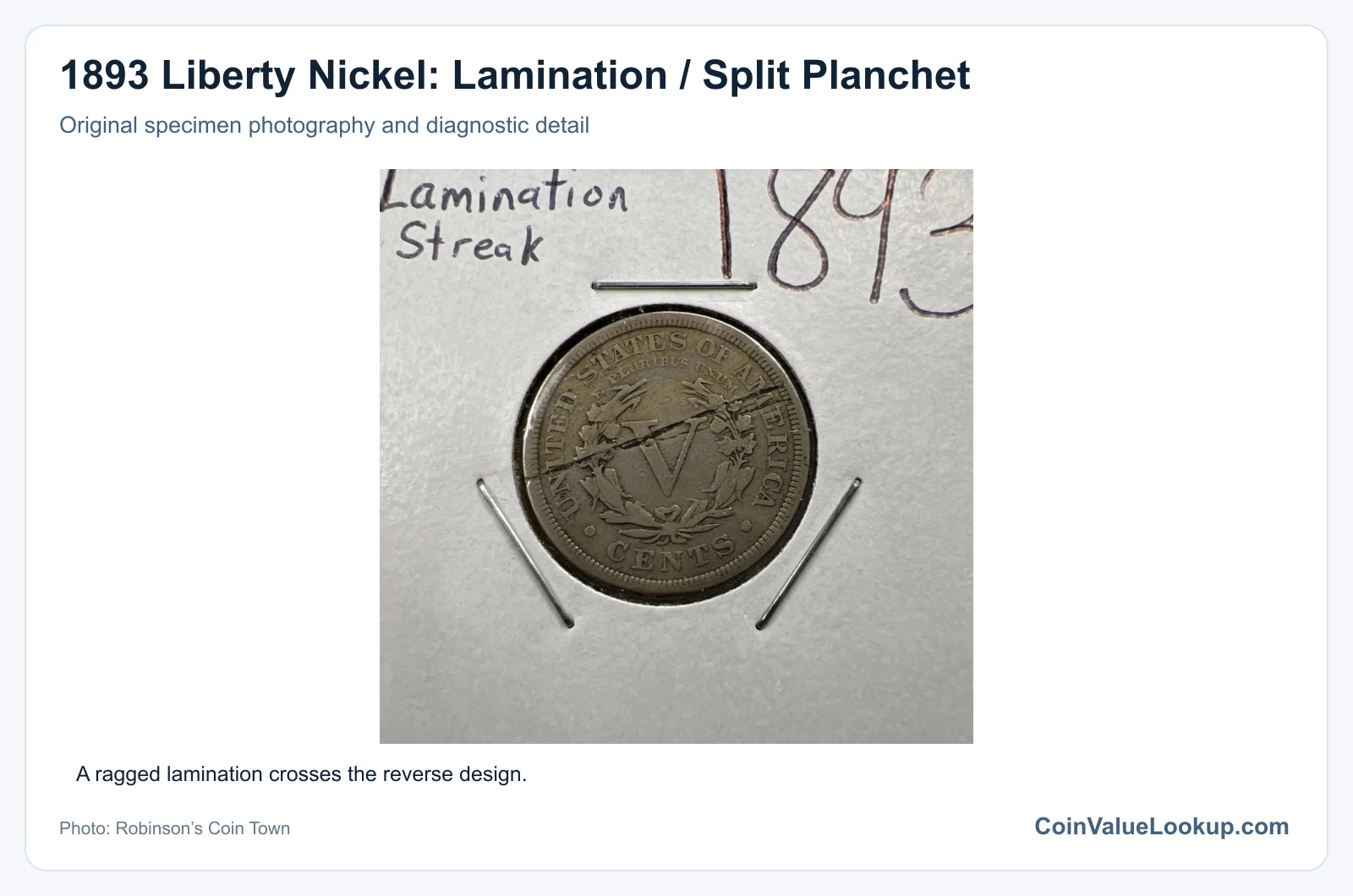
Lamination errors show up as peeling flaps, cracks, or separations within the metal of the planchet. On an 1893 Liberty Nickel, this might appear as a raised sliver of metal that lifts away from the surface or a visible split along the edge.
Photograph both the affected face and the edge together so the depth of the separation is clear. A retained flap — one still attached — is generally more collectible than a missing chunk.
Be careful not to confuse lamination with surface scraping, corrosion pitting, or deliberate cutting. Genuine laminations follow the metal's internal structure and usually have smooth, rounded edges where they separate.
The value of a lamination error depends on its visibility and the coin's overall condition.
4. 1893 Liberty Nickel — Brockage
A brockage occurs when a previously struck coin fails to eject and acts as a die against the next blank. The result is one normal side and one side bearing an incuse, mirror-image impression of the design.
On an 1893 nickel, a full brockage is dramatic — you will see Liberty's portrait sunk into the surface in reverse on one face. Partial brockages show only a portion of the transferred design.
This is different from a die clash, where faint ghost impressions appear from the dies hitting each other without a planchet. It is also different from two coins pressed together after minting, which lacks the struck-in quality.
Value depends heavily on how complete and clear the brockage image is, plus the coin's overall preservation.
5. 1893 Liberty Nickel — Indented Strike
An indented strike results when a blank planchet overlaps onto another blank during striking, leaving a smooth, depressed area on the finished coin. The key detail: the depression is bounded and the underlying design is missing in that zone, but the rest of the coin looks normal.
On an 1893 Liberty Nickel, check whether the indented area has any design transfer inside it. If it does, you may be looking at a brockage instead.
A plain, featureless depression without mirrored design is the hallmark of an indent. Post-mint dents from being dropped or hit will usually show sharper, irregular edges.
Value varies with the size of the indent and the coin's condition; no specific price range is adopted here.
6. 1893 Liberty Nickel — Off-Center Strike
An off-center strike happens when the planchet is not properly seated between the dies, so part of the design is missing and a blank crescent of unstruck metal appears on one side.
For an 1893 Liberty Nickel, the most collectible off-center errors retain a readable date — without it, attribution to a specific year is impossible, and value drops significantly. A 5–10% off-center coin may look subtle, while a 50% off-center piece is visually dramatic.
Do not confuse an off-center strike with a clipped planchet, which removes metal before striking, or with post-mint flattening, which distorts the design without creating that characteristic unstruck crescent. Condition, percentage of displacement, and date visibility all influence value.
7. 1893 Liberty Nickel — Wrong Planchet / Off-Metal Strike
A wrong-planchet error means the nickel dies struck a blank intended for a different denomination or even a different country's coin. The telltale signs are unusual weight, diameter, edge type, or color compared to a standard 1893 nickel.
Weigh and measure the coin carefully. A normal Liberty Nickel should be about 5 grams and 21.2 mm across with a plain edge.
If the numbers are off, compare them against known planchet specifications for other denominations of the era. Do not assume a coin is off-metal just because it looks discolored — plating, corrosion, and acid exposure can all change a coin's appearance without it being a mint error.
Confirmed wrong-planchet errors are scarce and individually assessed.
8. 1893 Liberty Nickel — Die Crack / Die Chip
Die cracks and die chips appear as raised lines or small raised lumps on the coin's surface, transferred from fractures in the steel die. On an 1893 Liberty Nickel, look for thin raised lines connecting design elements or running from the rim inward.
A die chip will look like a small raised blob, often inside a letter or near a star.
A rim-connected break large enough to displace metal is sometimes called a cud — these are more dramatic and generally more collectible than a hairline crack. Do not confuse die cracks with scratches; scratches are incuse (cut into the surface), while die cracks are raised above it.
Value depends on prominence, location, and coin condition.
9. 1893 Liberty Nickel — Rotated Dies
Rotated dies means the obverse and reverse are misaligned from the normal orientation. On a standard US coin, if you hold the obverse upright and flip the coin top-to-bottom, the reverse should also appear upright.
If the reverse is tilted — say 15, 45, or even 180 degrees off — you have a rotation error.
For an 1893 Liberty Nickel, check this carefully by flipping the coin along a vertical axis. Small rotations of a few degrees are relatively common and carry modest interest.
Larger rotations — particularly near 180 degrees — are much scarcer and more desirable. Make sure you are not simply rotating the coin in your photo; the physical coin itself must show the misalignment.
Value depends on the degree of rotation and overall condition.