1906 Liberty Nickel Coin Value: How Much Is It Worth?
A 1906 Liberty Nickel in well-worn Good-4 condition books at about $2.50 according to a USA Coin Book guide estimate, while an uncirculated MS63 example reaches roughly $154. Proof strikes carry a higher anchor, with a PR63 listed around $344.
These are retail guide snapshots, not guaranteed sale prices, and the actual amount your coin brings depends on its specific condition and market timing.
Fast Way to Identify Your 1906 Liberty Nickel
The quickest way to get a preliminary read on your 1906 Liberty Nickel is to upload clear photos of both the front and the back. Good lighting and a steady shot help capture the details that matter, like the sharpness of LIBERTY on the headband and the condition of the reverse wreath.
From those images, you can start narrowing down whether your coin is a business strike, a proof, or something more unusual.
1906 Liberty Nickel Value
Upload both sides of your 1906 Liberty Nickel.
Front Obverse
Upload photo
Back Reverse
Upload photo
Which 1906 Liberty Nickel Versions Are Worth Money?
- Business strikes jump from about $2.50 in G4 to roughly $154 in MS63; original uncirculated surfaces carry the premium.
- Proof examples list around $344 at PR63, reflecting their separate collector market.
- A doubled die reverse has been reported for the 1906 date and is worth checking under magnification.
- Wrong-planchet and die-cap errors are documented for this year and can carry significant premiums depending on condition and visibility.
- Off-center strikes and clipped planchets are also reported categories; dramatic examples with a readable date tend to be the most desirable.
Step 1: Identify Your 1906 Liberty Nickel Mint Mark and Version
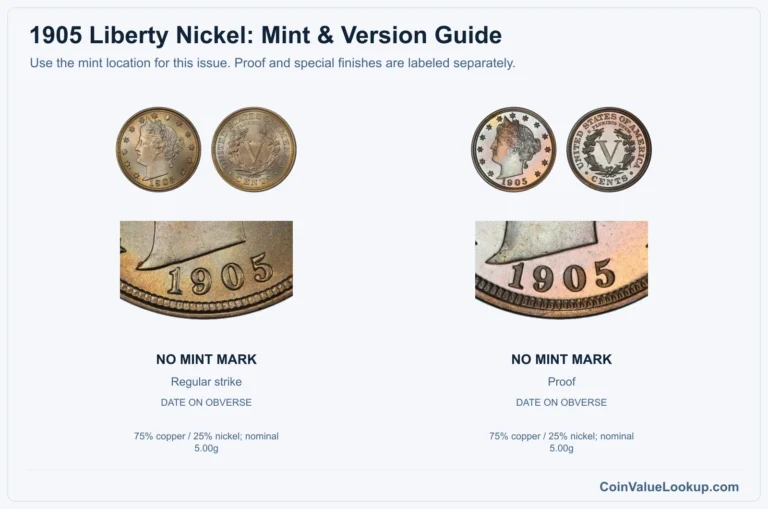
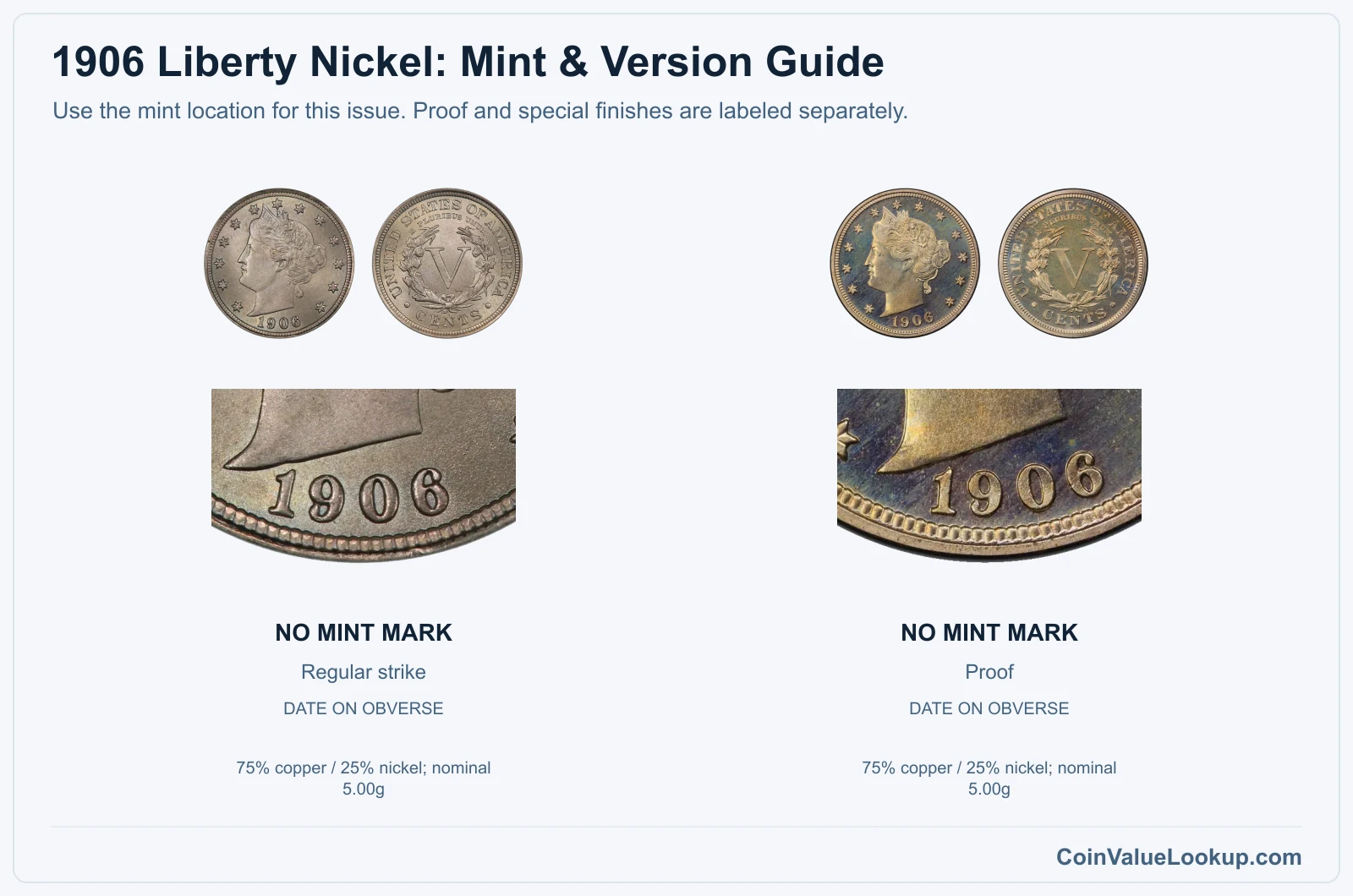
Every regular 1906 Liberty Nickel was struck at the Philadelphia Mint, so there is no mintmark to hunt for on this date. Do not expect a D or S below the reverse wreath; those branch-mint marks did not appear on Liberty Nickels until 1912.
The coin is composed of 75% copper and 25% nickel, weighs about 5 grams, measures 21.2 mm across, and has a plain edge. It carries the "With CENTS" reverse design, meaning the word CENTS appears clearly on the back within the wreath.
That design detail has been standard since 1883, after the Mint corrected the original "No CENTS" issue.
Two normal categories exist for this year: business strikes and proofs. Both were made in Philadelphia.
Proofs are a manufacturing method, not a higher grade, so identifying one requires examining the fields and rims rather than just the sharpness of detail.
Step 2: Check Your 1906 Liberty Nickel Grade
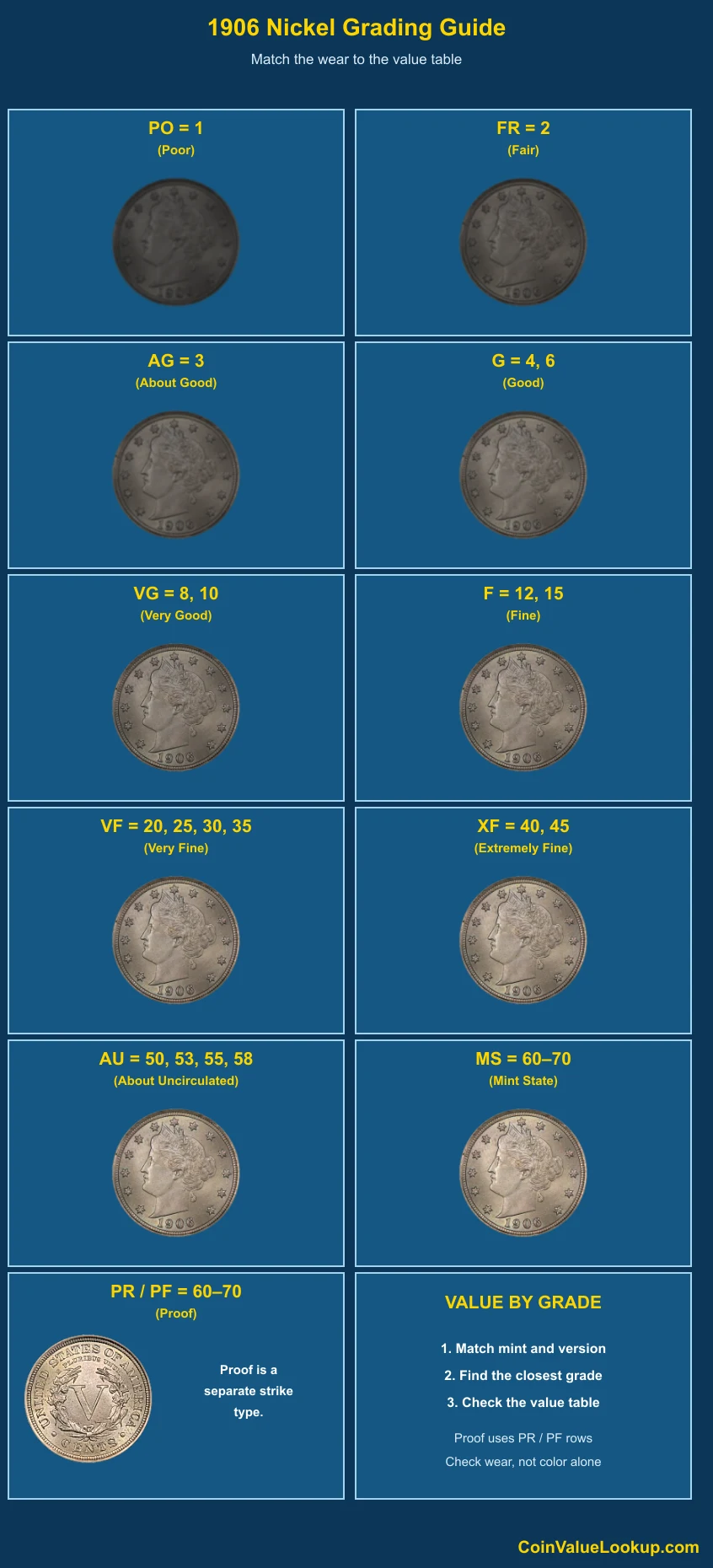
Start by checking the word LIBERTY on the coronet above the forehead. On a well-circulated coin those letters wear down progressively, with the B and E often the first to soften.
A coin grading Good-4 will show a readable but faint LIBERTY, while a Fine example retains all letters with moderate crispness.
Look at the high points of the hair curls above the ear and the cheek area. These are the first spots to lose definition from wear.
On the reverse, inspect the corn ears inside the wreath and the tips of the wheat stalks.
Weak details alone do not mean a coin circulated. Some Liberty Nickels left the press with soft strikes, particularly in the hair and wreath.
Compare your coin's fields and luster against the comparison image to separate genuine wear from strike weakness.
For proof identification, examine the flatness and reflectivity of the fields, the sharpness of the rims, and any fine hairlines from handling. A proof should show mirror-like surfaces when tilted under a light.
Hairlines reduce the grade but do not disqualify the proof designation.
Step 3: Check 1906 Liberty Nickel Value by Mint and Version
1906 Liberty Nickel — No Mint Mark — With CENTS Circulation
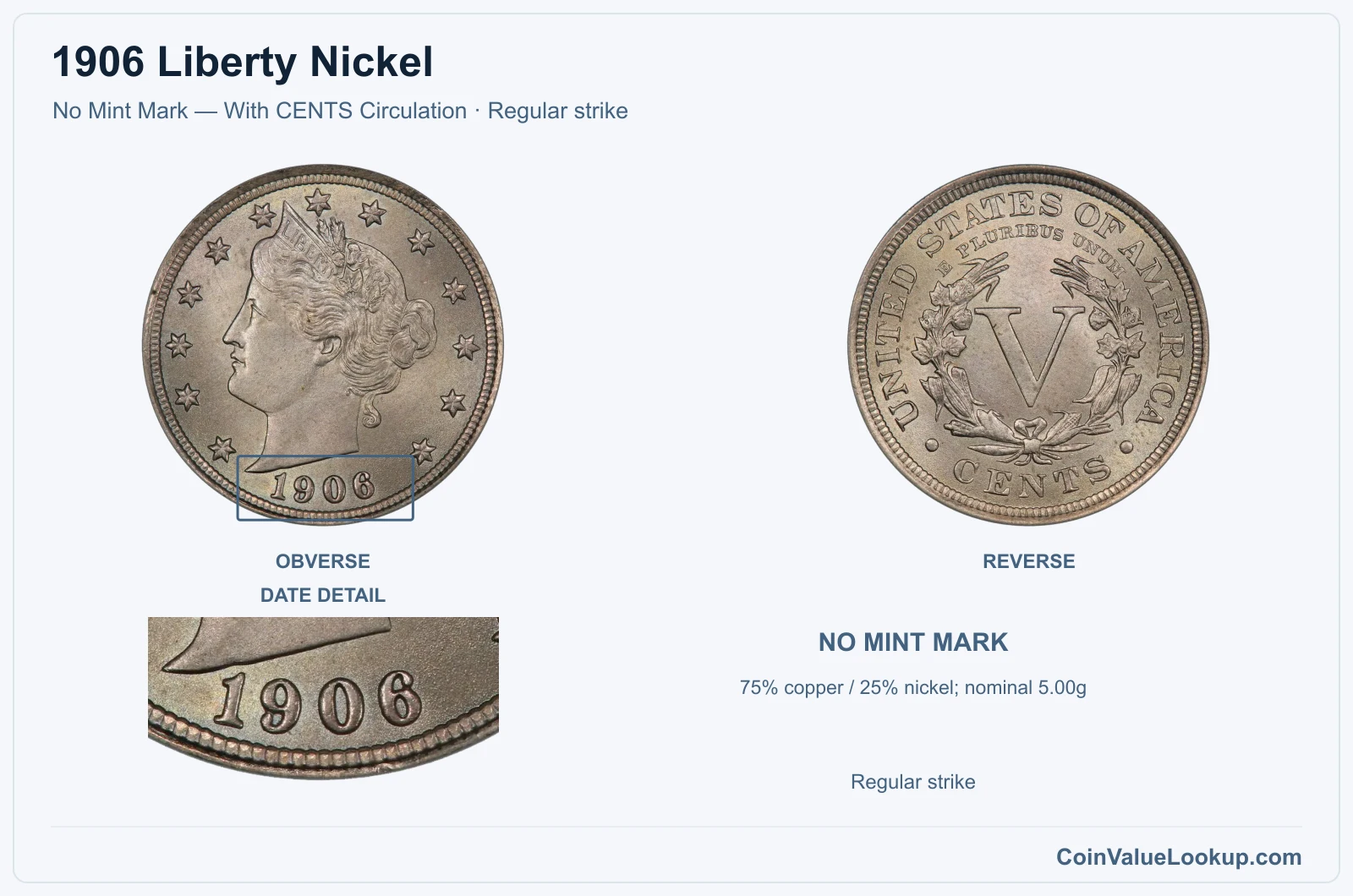
The standard 1906 Liberty Nickel is a Philadelphia business strike in 75% copper and 25% nickel with the "With CENTS" reverse. No other mint produced this denomination in 1906.
A USA Coin Book guide estimate places the coin at about $2.50 in Good-4 and around $154 in MS63.
The spread between those grades is substantial, and for good reason. Millions of these saw heavy pocket use, so finding one with full original luster and minimal contact marks takes patience.
When grading, focus on the hair detail, cheek, and wreath sharpness, and compare against the fields for signs of friction.
Coin Value Lookup is a handy starting point if you want to look up values for other dates and denominations in the Liberty Nickel series. It can save you time when sorting through a group of coins.
Range Grade
Price Auction Records Appraisal PO PO 1
—
Coin Identifier FR FR 2
—
Coin Identifier AG AG 3
—
Coin Identifier G G 4
—
Coin Identifier
G 6
—
Coin Identifier VG VG 8
—
Coin Identifier
VG 10
—
Coin Identifier F F 12
—
Coin Identifier
F 15
Coin Identifier VF VF 20
—
Coin Identifier
VF 25
—
Coin Identifier
VF 30
—
Coin Identifier
VF 35
—
Coin Identifier XF XF 40
—
Coin Identifier
XF 45
—
Coin Identifier AU AU 50
—
Coin Identifier
AU 53
Coin Identifier
AU 55
Coin Identifier
AU 58
Coin Identifier MS MS 60
Coin Identifier
MS 61
Coin Identifier
MS 62
Coin Identifier
MS 63
Coin Identifier
MS 64
Coin Identifier
MS 65
Coin Identifier
MS 66
Coin Identifier
MS 67
Coin Identifier
MS 68
—
—
—
MS 69
—
—
—
MS 70
—
—
—
1906 Liberty Nickel — No Mint Mark — With CENTS Proof
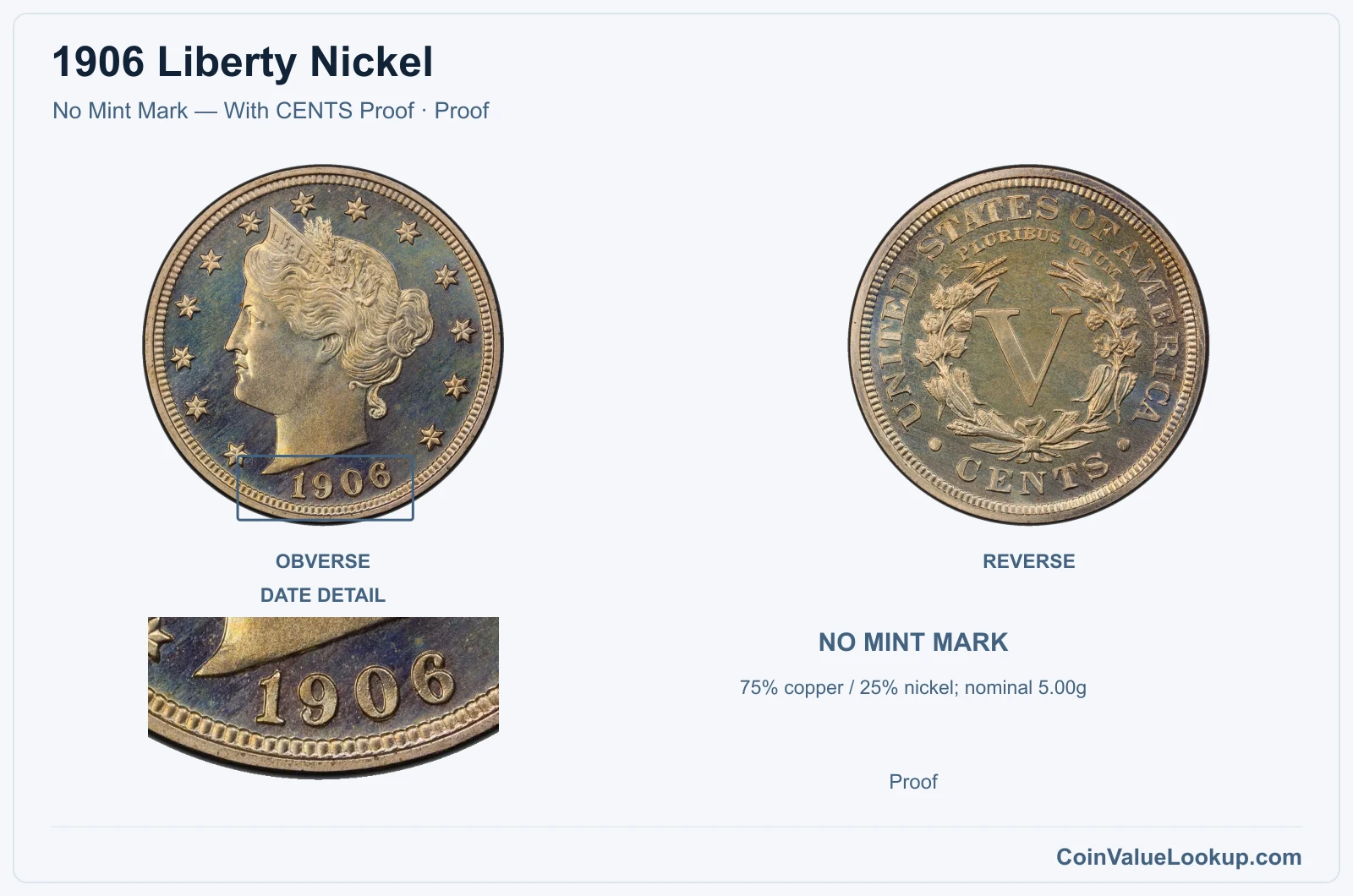
Philadelphia also produced proof Liberty Nickels in 1906, struck with polished dies on prepared planchets for collectors. A PR63 example is listed at roughly $344 in the USA Coin Book guide.
That figure reflects a single published estimate, not a guaranteed sale price.
Proof identification means looking at the coin's surfaces, not just its sharpness. Genuine proofs display mirror-like fields, squared-off rims, and a level of detail that even a nice business strike cannot match.
Hairlines from past cleaning or improper storage lower the proof grade but do not change the manufacturing designation.
When photographing a suspected proof, try to capture the reflective fields at an angle. That reflectivity is the single best visual clue separating a proof from a well-preserved business strike.
Range Grade
Price Auction Records Appraisal PR PR 1
—
Coin Identifier
PR 2
—
Coin Identifier
PR 3
—
Coin Identifier
PR 4
—
Coin Identifier
PR 6
—
Coin Identifier
PR 8
—
Coin Identifier
PR 10
—
Coin Identifier
PR 12
—
Coin Identifier
PR 15
—
Coin Identifier
PR 20
—
Coin Identifier
PR 25
—
Coin Identifier
PR 30
—
Coin Identifier
PR 35
—
Coin Identifier
PR 40
—
Coin Identifier
PR 45
—
Coin Identifier
PR 50
—
Coin Identifier
PR 53
—
Coin Identifier
PR 55
—
Coin Identifier
PR 58
—
Coin Identifier
PR 60
—
Coin Identifier
PR 61
—
Coin Identifier
PR 62
Coin Identifier
PR 63
Coin Identifier
PR 64
Coin Identifier
PR 65
Coin Identifier
PR 66
Coin Identifier
PR 67
Coin Identifier
PR 68
Coin Identifier
PR 69
—
—
—
PR 70
—
—
—
1906 Liberty Nickel Error List
1. 1906 Liberty Nickel — Doubled Die Reverse
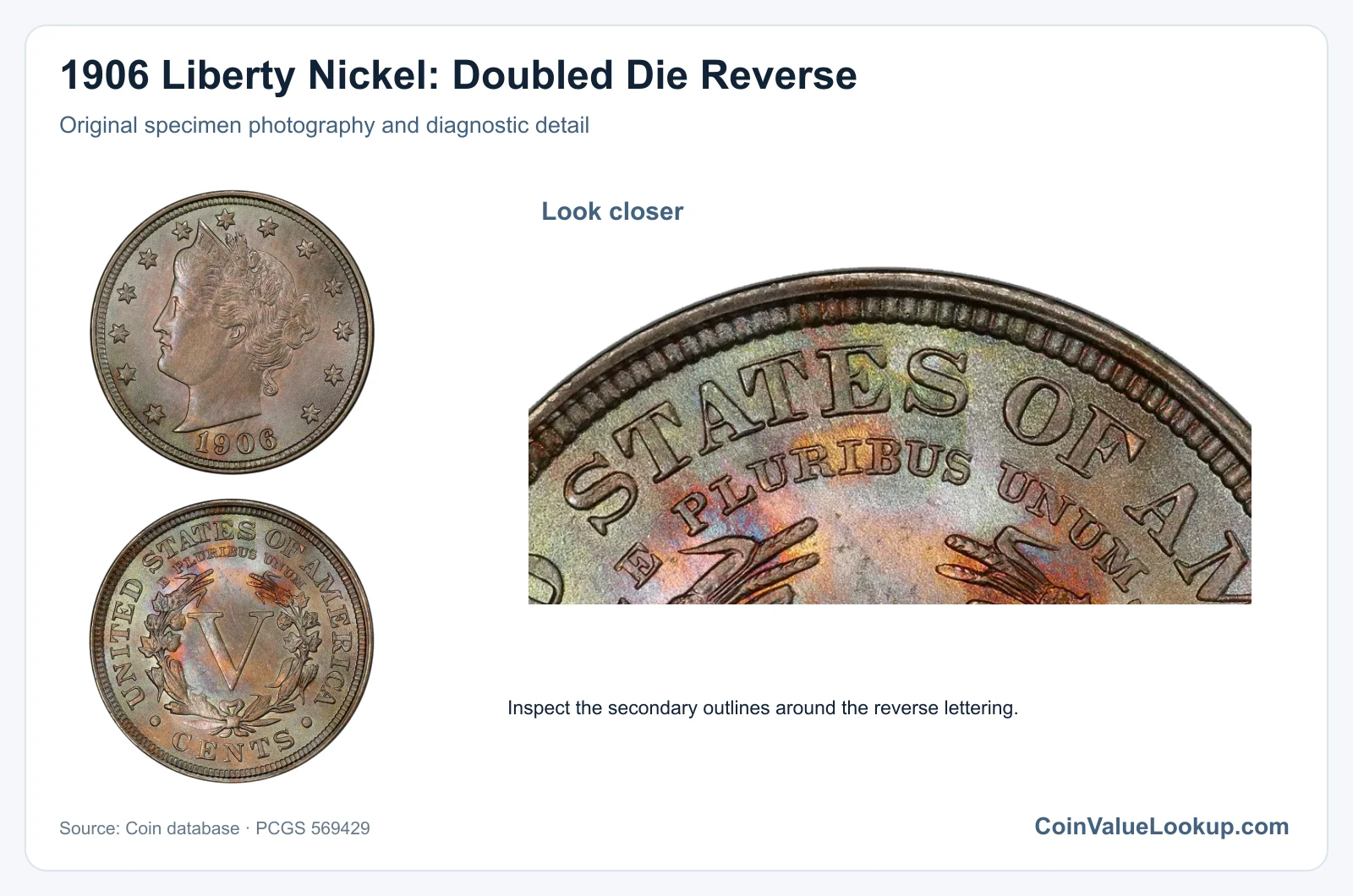
A doubled die reverse has been reported for the 1906 Liberty Nickel. This type of error occurs when design elements on the reverse show a secondary, slightly offset impression.
To check, compare your coin's reverse lettering, wreath details, and the word CENTS against a known normal example. Under magnification, genuine doubling will appear as a consistent secondary image on affected design elements.
The strength and location of the doubling directly affect desirability.
Be careful not to confuse this with machine doubling, which tends to produce flat, shelf-like distortion rather than a crisp secondary image. Random marks, reflections under certain lighting, and post-strike damage can also mimic doubling to the untrained eye.
No specific price is adopted for this error; value depends on the clarity of the doubling and the coin's overall condition. Professional attribution is recommended before assuming a premium.
2. 1906 Liberty Nickel — Off-Center Strike
Off-center strikes have been reported on the 1906 Liberty Nickel. This error happens when the planchet is not properly seated between the dies at the moment of striking, producing a design that is shifted to one side with an unstruck crescent of blank metal on the opposite edge.
The percentage of off-center displacement matters enormously. A 5% shift is barely noticeable; a 50% shift with a fully visible date is a different conversation entirely.
Collectors want the date readable, so that is the key detail to preserve and photograph.
Do not confuse an off-center strike with a clipped planchet, a one-sided misalignment, or post-mint flattening from a vise or similar tool. A genuine off-center coin shows a complete but displaced design on both sides.
No specific price is adopted; value depends on the degree of displacement, date visibility, and surface condition.
3. 1906 Liberty Nickel — Clipped Planchet
Clipped planchet errors are reported for the 1906 Liberty Nickel. A clip occurs when a portion of the original blank is missing before the coin is struck, leaving a curved, straight, or irregular section absent from the finished coin.
To identify one, examine the edge carefully. A genuine clip often produces a characteristic area of metal weakness on the opposite side of the coin, sometimes called a Blakesley effect.
The edge at the clip site will show the natural metal flow of the blank, not the sharp or rough texture left by a file or cutting tool.
Post-mint damage such as filed notches, corrosion pitting along the rim, or deliberate edge cuts can look similar at first glance. Compare edge texture closely.
No specific price is adopted for clipped planchet 1906 nickels; the premium depends on the size and type of clip, the coin's grade, and overall eye appeal.
4. 1906 Liberty Nickel — Wrong Planchet / Off-Metal Strike
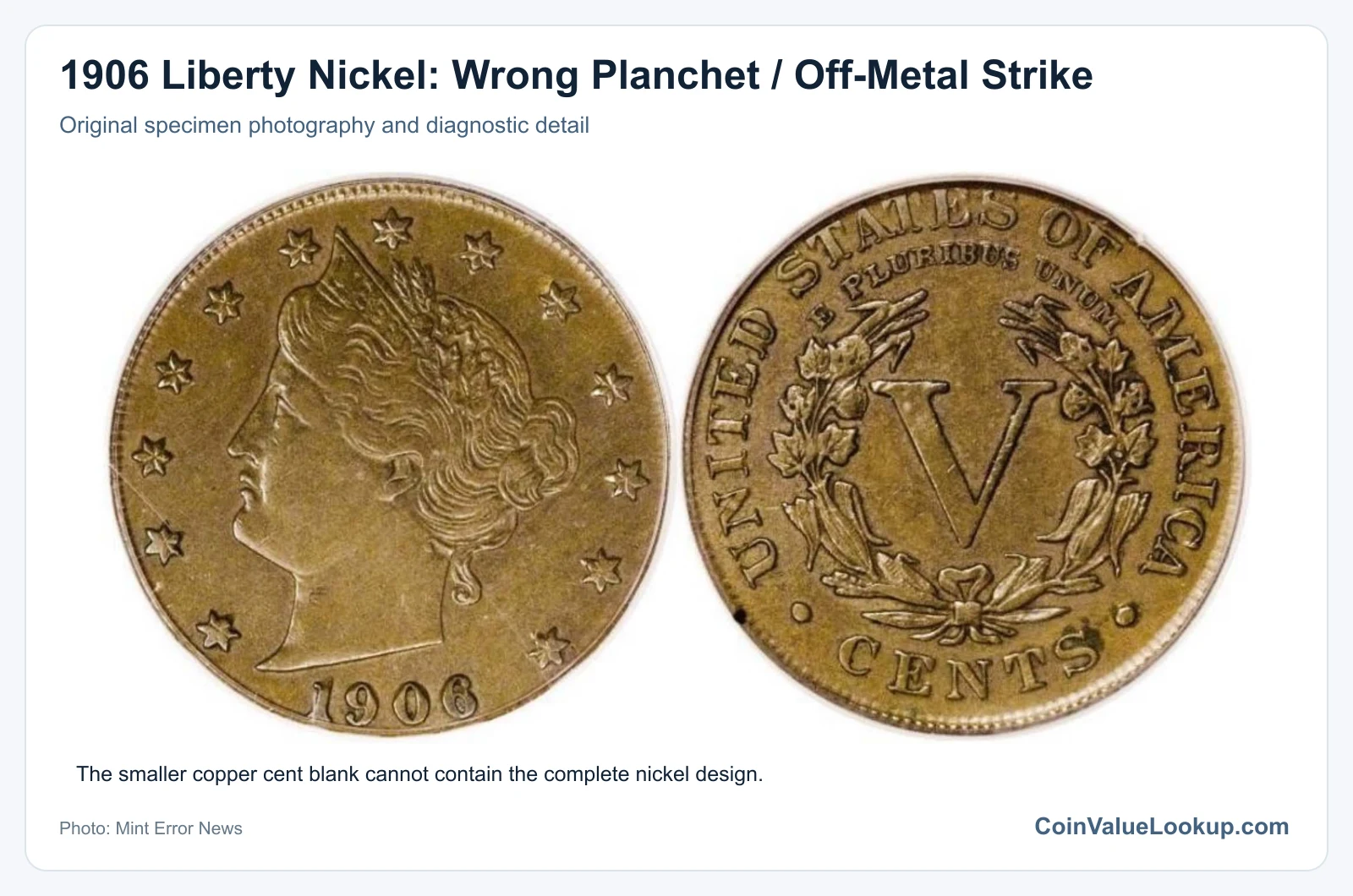
A 1906 Liberty Nickel struck on a cent planchet has been documented, with an NGC-attributed example on record. This is an off-metal error, meaning the nickel dies struck a blank intended for a different denomination.
The most direct way to check is by weighing and measuring your coin and comparing those numbers against the normal specifications of 5 grams and 21.2 mm. A cent planchet would differ in weight, diameter, and potentially edge characteristics.
Because the blank is the wrong size, the design may appear incomplete or distorted at the rims.
Do not confuse a wrong-planchet strike with a coin that has been plated, chemically treated, acid-thinned, or deliberately altered. Genuine off-metal errors show consistent design impressions appropriate to the die pair used.
No numerical price is adopted; value depends on the specific planchet, the completeness of the design, and the coin's condition.
5. 1906 Liberty Nickel — Die Cap / Capped-Die Strike
A die cap error involving a 1906 obverse die has been reported, also struck on a cent planchet, making it a compound error that overlaps with the wrong-planchet category. A die cap forms when a struck coin adheres to the upper die and is carried upward, acting as a makeshift die face for subsequent strikes.
The adhered coin gradually cups around the die, producing a distinctive bowl shape. Coins struck through that cap receive a mushy, mirrored-image impression of the obverse rather than the normal sharp design.
Both the cap itself and the coins struck beneath it are collectible errors.
To tell a genuine die cap from a bent coin, vise damage, or a weak strike, look at the cupping pattern and the character of the obverse impression on surrounding strikes. Bending from external force will not produce the progressive cupping and brockage design transfer that a real cap shows.
No specific price is adopted; condition, visibility, and the compound nature of the error all influence value.