1938 Jefferson Nickel Coin Value: How Much Is It Worth?
The 1938 Jefferson nickel holds a special place as the first year of a design that's still in production. Ordinary circulated examples in VF20 condition carry guide estimates from roughly $0.74 to $3.62 depending on mint, while uncirculated MS65 pieces reach about $19.
Proofs, Full Steps designations, and authenticated varieties or errors occupy separate price tiers. Your specific coin's value depends on its mint, condition, and any unusual features.
Fast Way to Identify Your 1938 Jefferson Nickel
The quickest way to start figuring out what you have is to upload clear photos of both sides of your coin. A sharp image of the front (obverse) and back (reverse) allows preliminary identification of the mint, general condition, and any visible variety markers.
Snap both sides in good light and submit them for a first look.
1938 Jefferson Nickel Value
Upload both sides of your 1938 Jefferson Nickel.
Front Obverse
Upload photo
Back Reverse
Upload photo
Which 1938 Jefferson Nickel Versions Are Worth Money?
- Uncirculated examples with full original luster and strong Monticello steps can command premiums, but a Full Steps claim should be certified before assuming premium value.
- Philadelphia proof strikes are a separate finish and price category from business strikes, with PR65 guides around $144.
- The 1938-S carries the highest circulated guide value among business strikes, at roughly $3.62 in VF20.
- A recognized doubled die obverse from the Philadelphia mint shows visible doubling on the date and motto; value depends on authenticated identity and condition.
- Genuine mint errors such as off-metal strikes or dramatically off-center coins are rare and individually assessed.
Step 1: Identify Your 1938 Jefferson Nickel Mint Mark and Version
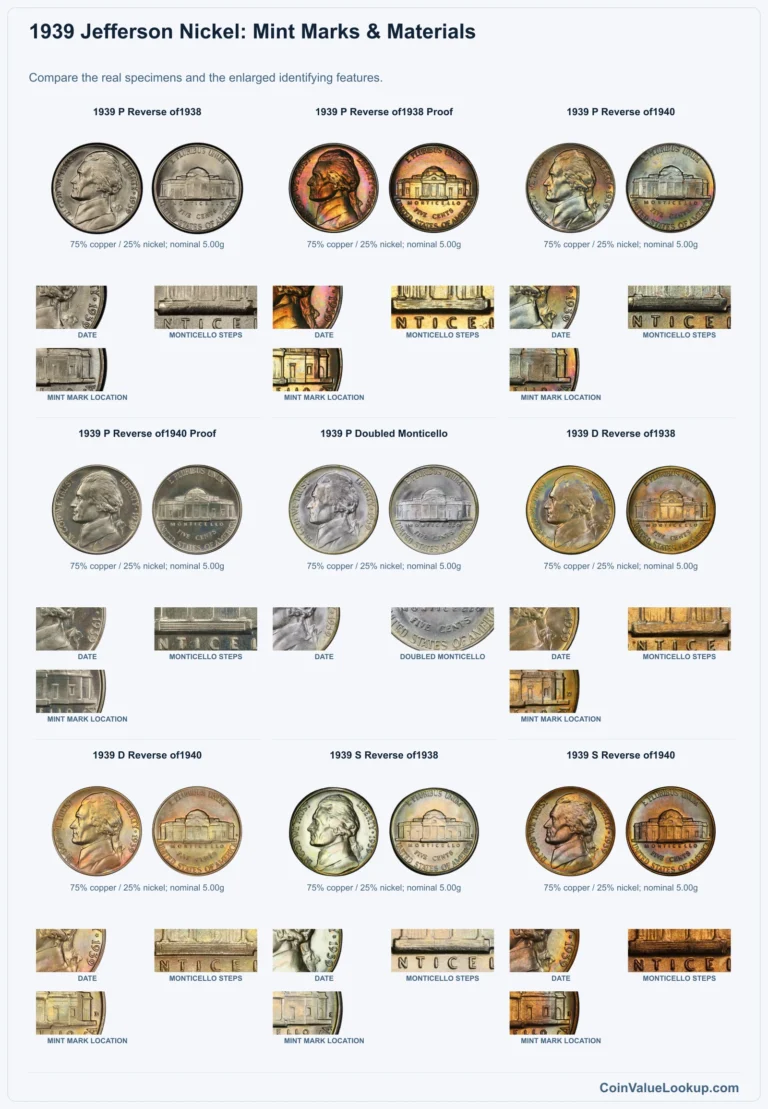
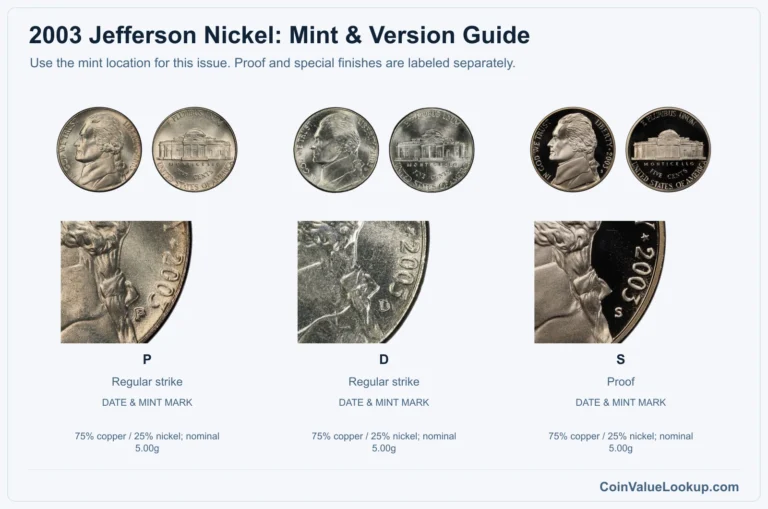
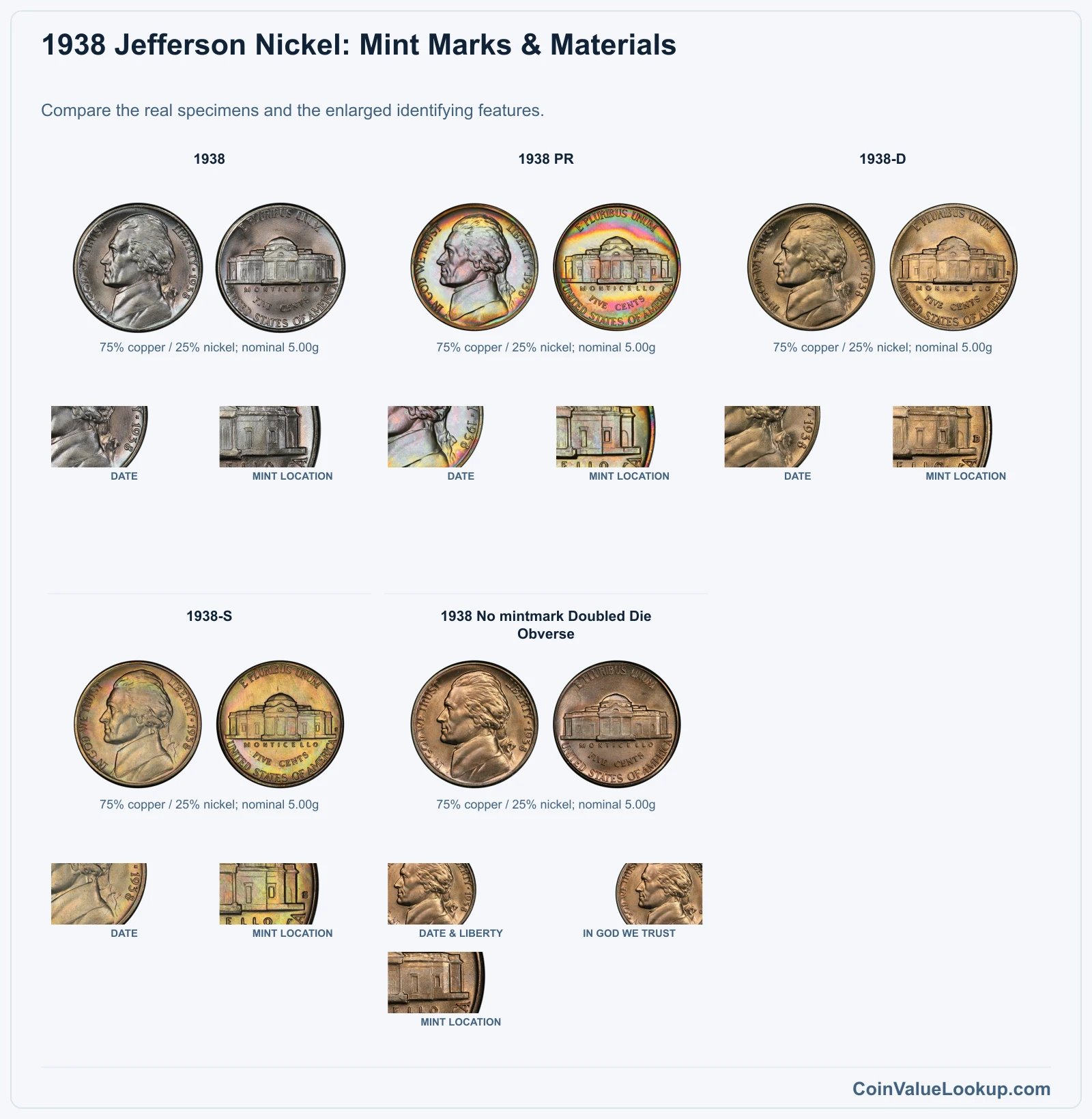
All 1938 Jefferson nickels are struck in 75% copper and 25% nickel, weigh a nominal 5.00 grams, and measure 21.2 mm across. Philadelphia coins carry no mintmark at all.
Denver and San Francisco pieces show a small D or S to the right of Monticello on the reverse.
Don't confuse the small copper-nickel-era mintmark position with the large mintmark above the dome that appeared on wartime silver-alloy nickels a few years later. If you see a big letter up top, you're looking at a different issue.
Photograph the date, the mintmark area, and both full sides. Color alone can't confirm composition, so weight matters if something looks off.
Also separate honest circulation wear from corrosion, old polishing, or damage from jewelry mounting, because those affect value very differently.
Step 2: Check Your 1938 Jefferson Nickel Grade
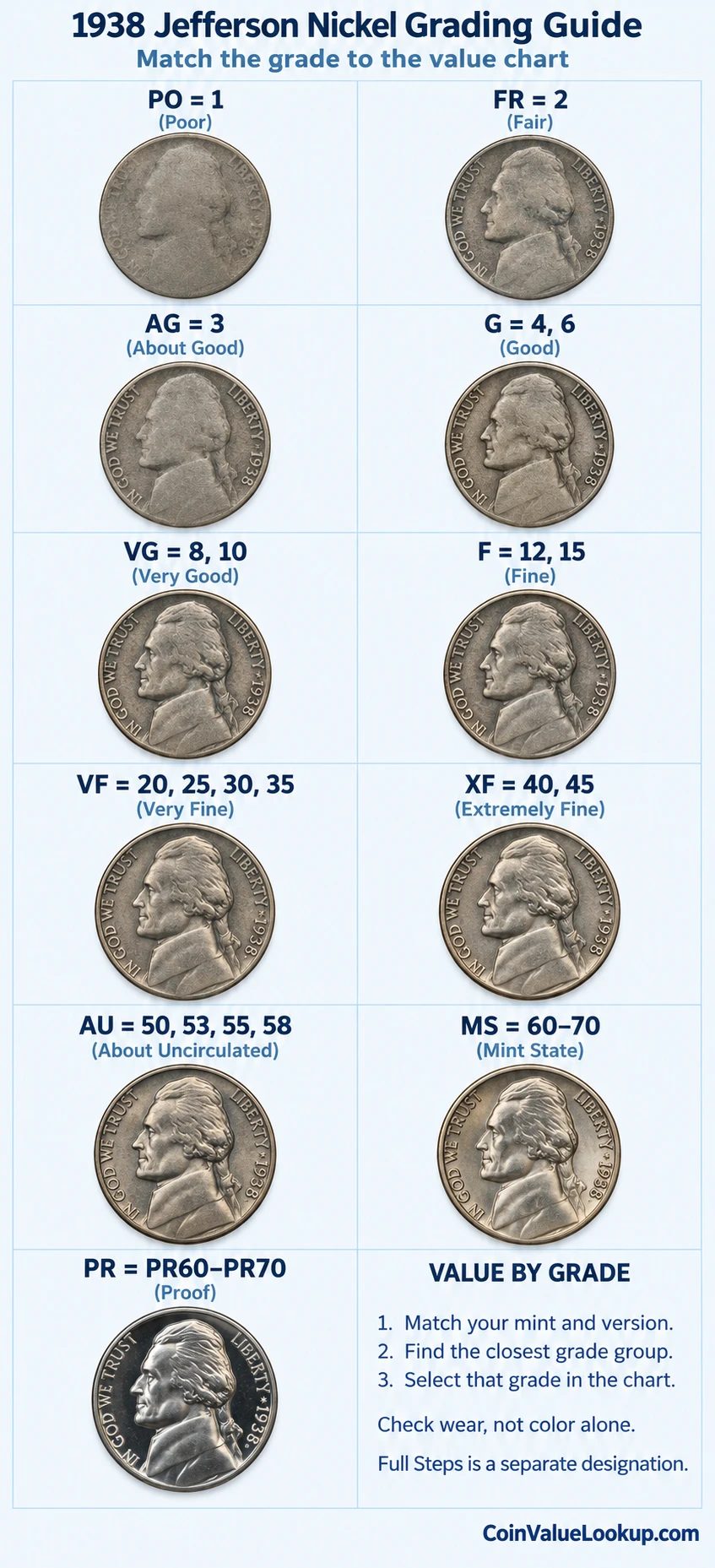
Start on the obverse. Jefferson's cheekbone and the hair directly above his ear are the first spots to lose detail.
If those areas are flat and smooth, you're in well-circulated territory. Then flip the coin and check Monticello's roof lines and columns for remaining sharpness.
Luster is the dividing line between circulated and Mint State. A coin with full, undisturbed cartwheel luster across both sides is a candidate for an MS grade.
Compare your coin to the reference image to gauge where it falls.
Full Steps is a separate designation applied only to qualifying Mint State coins. It requires at least five clearly separated steps on Monticello's base under PCGS criteria.
Weak steps usually result from a soft strike at the mint, not from wear, so a coin can be technically uncirculated yet still lack Full Steps. Don't use step clarity alone as a grading shortcut.
Step 3: Check 1938 Jefferson Nickel Value by Mint and Version
1938 Jefferson Nickel
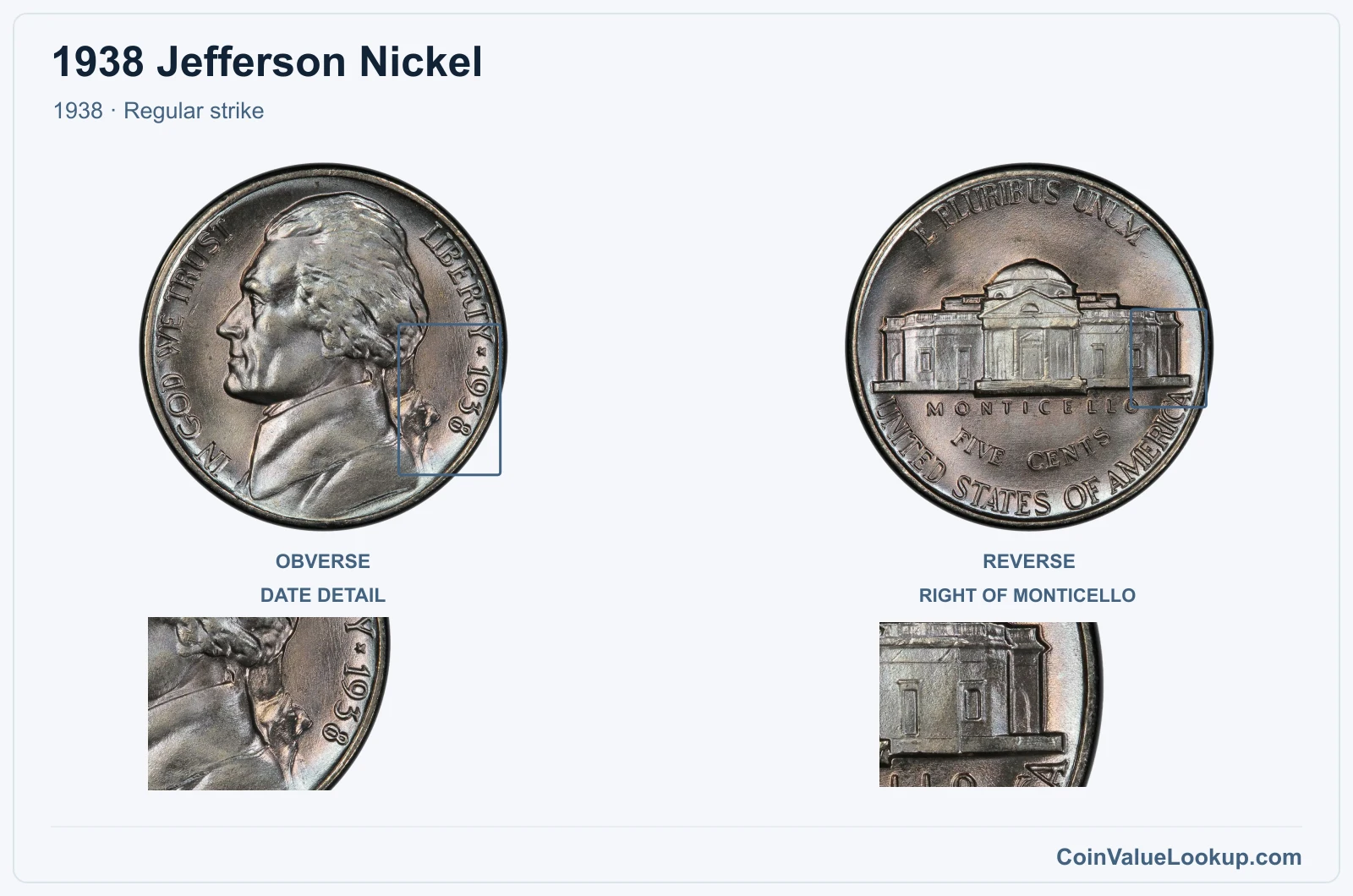
The plain 1938 Philadelphia issue has no mintmark. Guide estimates place a VF20 example at about $0.74, an MS60 at roughly $6.25, and an MS65 at around $19 according to USA Coin Book.
These are retail guide figures, not guaranteed buy prices.
In circulated grades this is an affordable coin. The jump to Mint State rewards patience and a good eye for luster.
Full Steps designated pieces occupy their own price tier above standard MS grades, so keep those comparisons separate.
| Range | Grade | Price | Auction Records | Appraisal |
|---|---|---|---|---|
| PO | PO 1 | — | Coin Identifier | |
| FR | FR 2 | — | Coin Identifier | |
| AG | AG 3 | — | Coin Identifier | |
| G | G 4 | — | Coin Identifier | |
| G 6 | — | Coin Identifier | ||
| VG | VG 8 | — | Coin Identifier | |
| VG 10 | — | Coin Identifier | ||
| F | F 12 | — | Coin Identifier | |
| F 15 | — | Coin Identifier | ||
| VF | VF 20 | — | Coin Identifier | |
| VF 25 | — | Coin Identifier | ||
| VF 30 | — | Coin Identifier | ||
| VF 35 | — | Coin Identifier | ||
| XF | XF 40 | — | Coin Identifier | |
| XF 45 | — | Coin Identifier | ||
| AU | AU 50 | — | Coin Identifier | |
| AU 53 | — | Coin Identifier | ||
| AU 55 | — | Coin Identifier | ||
| AU 58 | — | Coin Identifier | ||
| MS | MS 60 | — | Coin Identifier | |
| MS 61 | — | Coin Identifier | ||
| MS 62 | Coin Identifier | |||
| MS 63 | — | Coin Identifier | ||
| MS 64 | Coin Identifier | |||
| MS 65 | Coin Identifier | |||
| MS 66 | Coin Identifier | |||
| MS 67 | Coin Identifier | |||
| MS 68 | — | — | — | |
| MS 69 | — | — | — | |
| MS 70 | — | — | — |
1938 Jefferson Nickel — PR
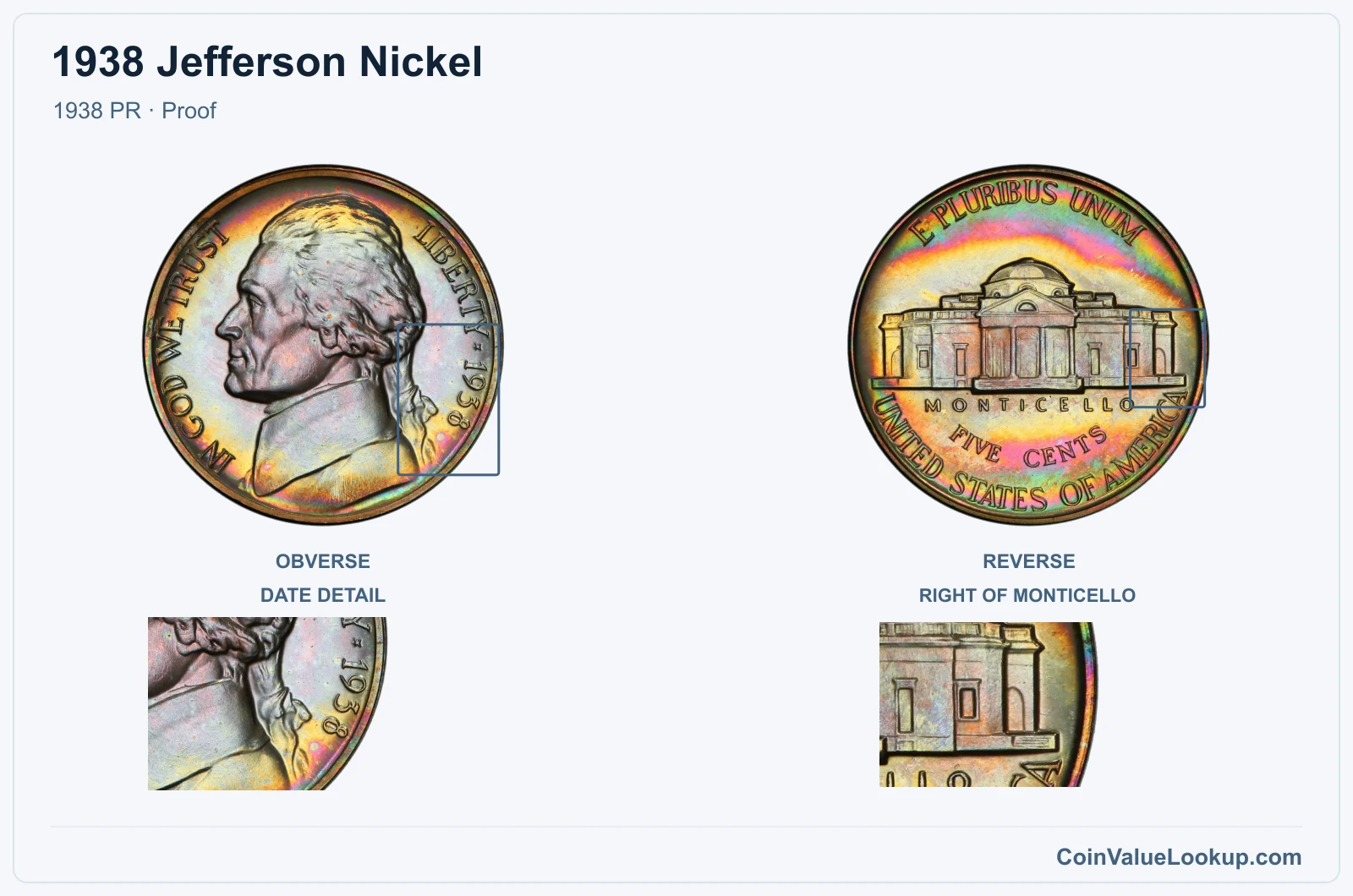
Philadelphia also produced proof Jefferson nickels in 1938, and these are a distinct manufacturing finish, not simply a high-grade business strike. Proof surfaces show mirrored fields and sharp detail that can't be replicated by polishing a regular coin.
A PR65 example carries a guide estimate of about $144 per USA Coin Book. That's a significant step up from even a gem business strike.
Look for deeply reflective fields free of haze or hairlines. Any sign of circulation wear or cleaning sharply reduces a proof's desirability.
Coin Value Lookup is a handy starting point if you want to compare this proof with other Jefferson nickel years or denominations.
| Range | Grade | Price | Auction Records | Appraisal |
|---|---|---|---|---|
| PR | PR 1 | — | Coin Identifier | |
| PR 2 | — | Coin Identifier | ||
| PR 3 | — | Coin Identifier | ||
| PR 4 | — | Coin Identifier | ||
| PR 6 | — | Coin Identifier | ||
| PR 8 | — | Coin Identifier | ||
| PR 10 | — | Coin Identifier | ||
| PR 12 | — | Coin Identifier | ||
| PR 15 | — | Coin Identifier | ||
| PR 20 | — | Coin Identifier | ||
| PR 25 | — | Coin Identifier | ||
| PR 30 | — | Coin Identifier | ||
| PR 35 | — | Coin Identifier | ||
| PR 40 | — | Coin Identifier | ||
| PR 45 | — | Coin Identifier | ||
| PR 50 | — | Coin Identifier | ||
| PR 53 | — | Coin Identifier | ||
| PR 55 | — | Coin Identifier | ||
| PR 58 | — | Coin Identifier | ||
| PR 60 | Coin Identifier | |||
| PR 61 | — | Coin Identifier | ||
| PR 62 | — | Coin Identifier | ||
| PR 63 | Coin Identifier | |||
| PR 64 | Coin Identifier | |||
| PR 65 | Coin Identifier | |||
| PR 66 | Coin Identifier | |||
| PR 67 | Coin Identifier | |||
| PR 68 | Coin Identifier | |||
| PR 69 | — | — | — | |
| PR 70 | — | — | — |
1938 Jefferson Nickel — D
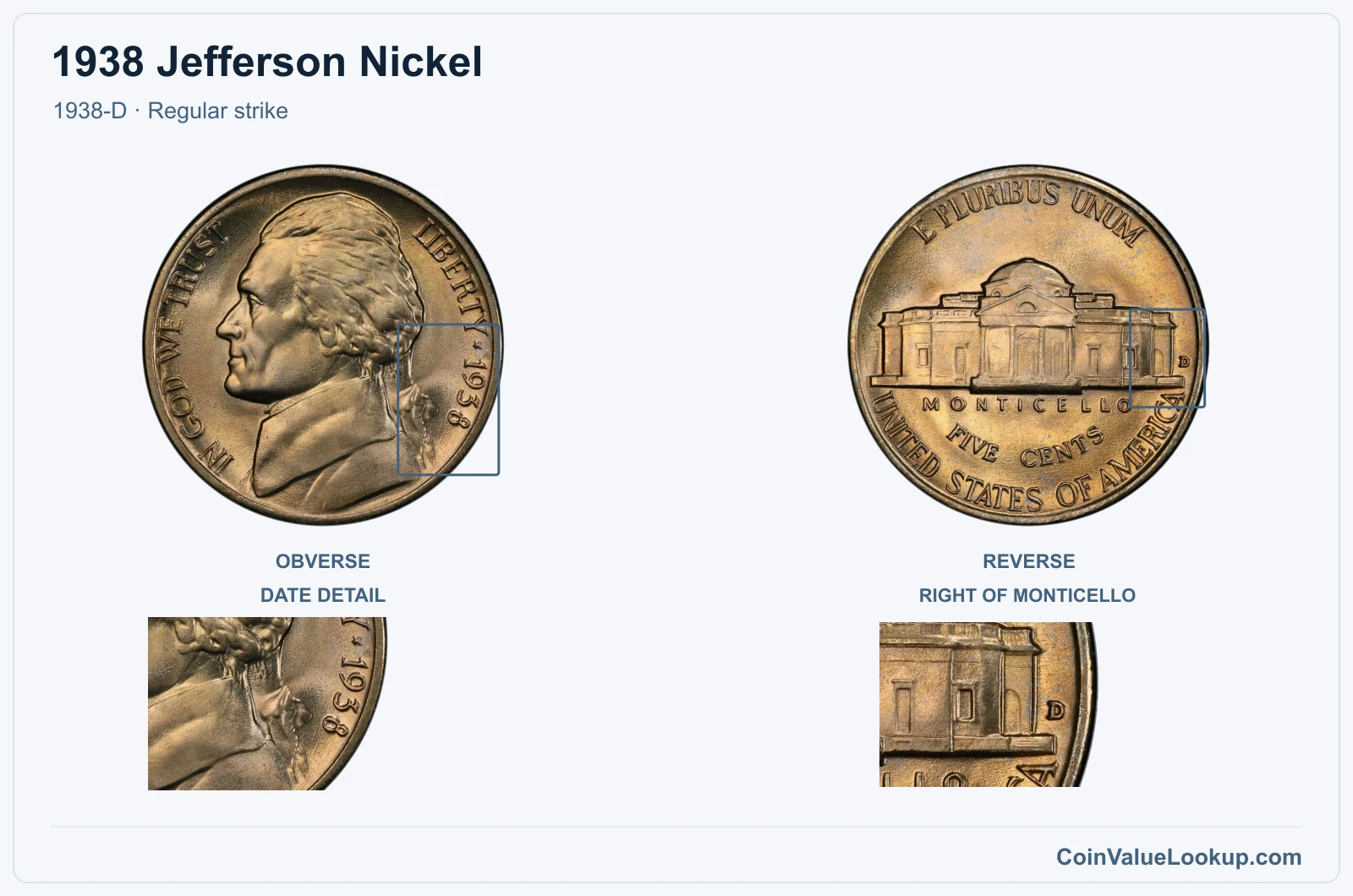
The 1938-D was struck at the Denver Mint and carries a small D to the right of Monticello on the reverse. Guide estimates from USA Coin Book put VF20 at about $2.50, MS60 at roughly $8.64, and MS65 at around $19.
As the first Denver-mint Jefferson nickel, it draws modest first-year interest. Circulated examples are common and affordable.
Mint State coins with clean surfaces and strong luster are where the value starts to climb.
| Range | Grade | Price | Auction Records | Appraisal |
|---|---|---|---|---|
| PO | PO 1 | — | Coin Identifier | |
| FR | FR 2 | — | Coin Identifier | |
| AG | AG 3 | — | Coin Identifier | |
| G | G 4 | — | Coin Identifier | |
| G 6 | — | Coin Identifier | ||
| VG | VG 8 | — | Coin Identifier | |
| VG 10 | — | Coin Identifier | ||
| F | F 12 | — | Coin Identifier | |
| F 15 | — | Coin Identifier | ||
| VF | VF 20 | — | Coin Identifier | |
| VF 25 | — | Coin Identifier | ||
| VF 30 | — | Coin Identifier | ||
| VF 35 | — | Coin Identifier | ||
| XF | XF 40 | — | Coin Identifier | |
| XF 45 | — | Coin Identifier | ||
| AU | AU 50 | — | Coin Identifier | |
| AU 53 | — | Coin Identifier | ||
| AU 55 | — | Coin Identifier | ||
| AU 58 | — | Coin Identifier | ||
| MS | MS 60 | — | Coin Identifier | |
| MS 61 | — | Coin Identifier | ||
| MS 62 | — | Coin Identifier | ||
| MS 63 | — | Coin Identifier | ||
| MS 64 | Coin Identifier | |||
| MS 65 | Coin Identifier | |||
| MS 66 | Coin Identifier | |||
| MS 67 | Coin Identifier | |||
| MS 68 | Coin Identifier | |||
| MS 69 | — | — | — | |
| MS 70 | — | — | — |
1938 Jefferson Nickel — S
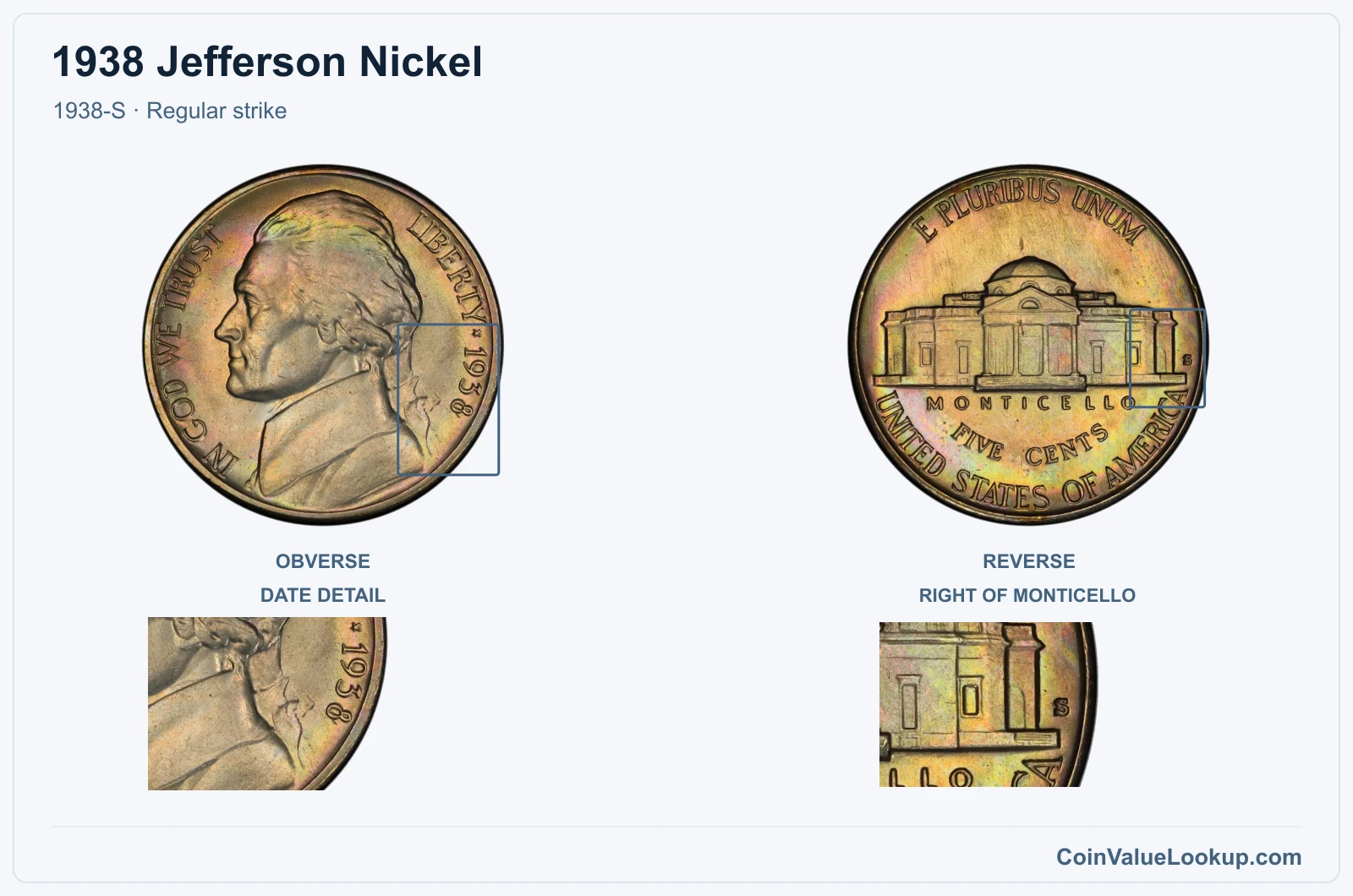
San Francisco's 1938-S shows a small S to the right of Monticello. It carries the highest circulated guide value of the three business-strike mints this year: about $3.62 in VF20, $6.25 in MS60, and $19 at MS65, per USA Coin Book.
That slight premium in lower grades reflects collector demand for the first-year S-mint piece. In gem Mint State the three mints converge at comparable guide levels, so condition and eye appeal become the real differentiators.
| Range | Grade | Price | Auction Records | Appraisal |
|---|---|---|---|---|
| PO | PO 1 | — | Coin Identifier | |
| FR | FR 2 | — | Coin Identifier | |
| AG | AG 3 | — | Coin Identifier | |
| G | G 4 | — | Coin Identifier | |
| G 6 | — | Coin Identifier | ||
| VG | VG 8 | — | Coin Identifier | |
| VG 10 | — | Coin Identifier | ||
| F | F 12 | — | Coin Identifier | |
| F 15 | — | Coin Identifier | ||
| VF | VF 20 | — | Coin Identifier | |
| VF 25 | — | Coin Identifier | ||
| VF 30 | — | Coin Identifier | ||
| VF 35 | — | Coin Identifier | ||
| XF | XF 40 | — | Coin Identifier | |
| XF 45 | — | Coin Identifier | ||
| AU | AU 50 | — | Coin Identifier | |
| AU 53 | — | Coin Identifier | ||
| AU 55 | — | Coin Identifier | ||
| AU 58 | — | Coin Identifier | ||
| MS | MS 60 | — | Coin Identifier | |
| MS 61 | — | Coin Identifier | ||
| MS 62 | — | Coin Identifier | ||
| MS 63 | Coin Identifier | |||
| MS 64 | Coin Identifier | |||
| MS 65 | Coin Identifier | |||
| MS 66 | Coin Identifier | |||
| MS 67 | Coin Identifier | |||
| MS 68 | Coin Identifier | |||
| MS 69 | — | — | — | |
| MS 70 | — | — | — |
1938 Jefferson Nickel — No mintmark Doubled Die Obverse
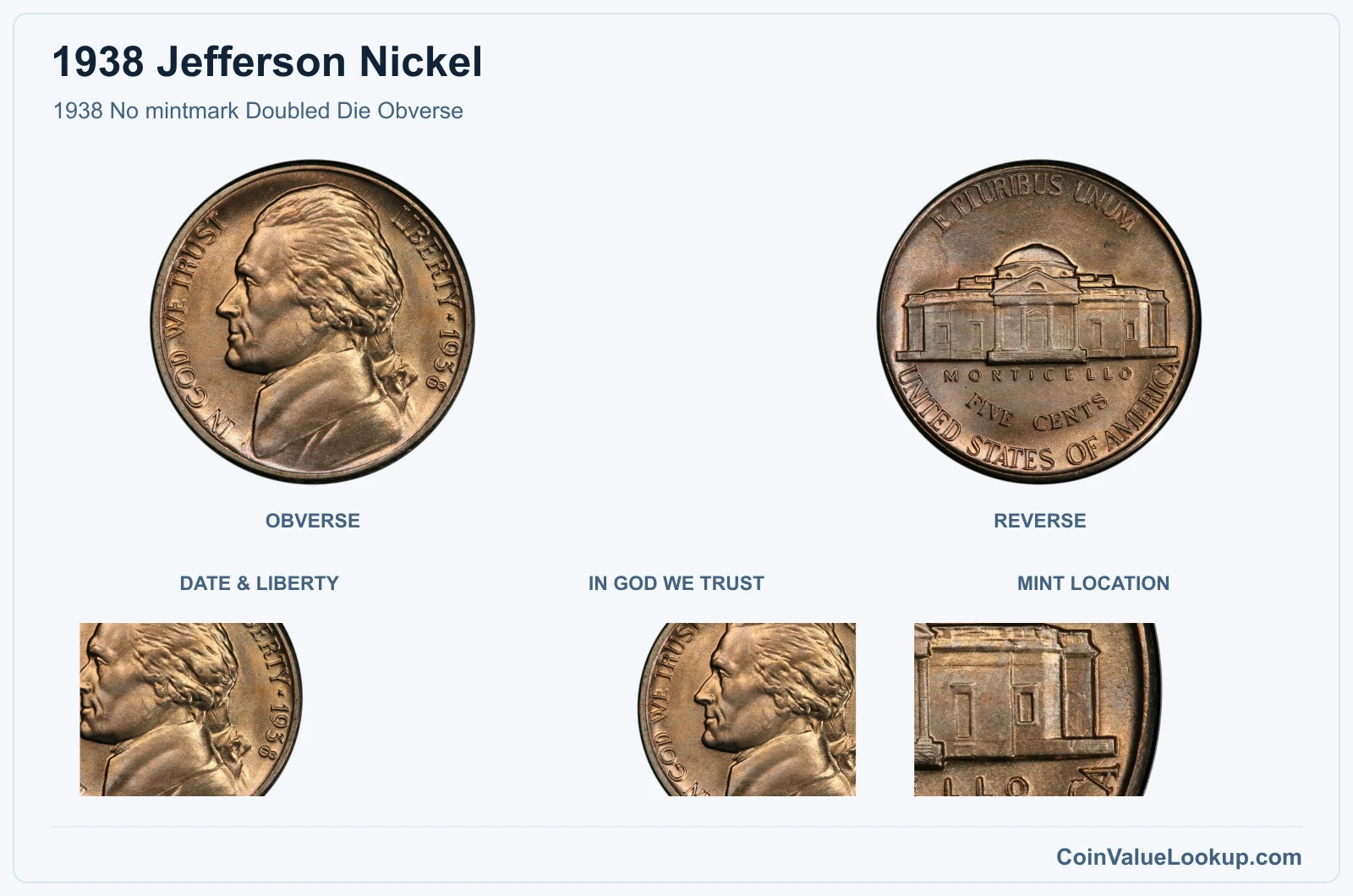
A recognized doubled die obverse exists for the 1938 Philadelphia nickel. The doubling is visible on the numerals of the date (especially the 38), the letters of IN GOD WE TRUST, and the star, showing separated or shelf-like outlines under magnification.
This is a legitimate die variety confirmed by PCGS. Not every hint of doubling qualifies, though.
Machine doubling, which is flat and shelf-like rather than showing fully separated letter forms, is a common lookalike that does not carry a variety premium.
No supported price range is available for this variety. Value depends on authenticated identity, the coin's condition, and the strength of the doubling.
Third-party certification is the practical way to confirm what you have before assigning any premium expectation.
Range Grade
Price Auction Records Appraisal PO PO 1
—
Coin Identifier FR FR 2
—
Coin Identifier AG AG 3
—
Coin Identifier G G 4
—
Coin Identifier
G 6
—
Coin Identifier VG VG 8
—
Coin Identifier
VG 10
—
Coin Identifier F F 12
—
Coin Identifier
F 15
—
Coin Identifier VF VF 20
—
Coin Identifier
VF 25
—
Coin Identifier
VF 30
—
Coin Identifier
VF 35
—
Coin Identifier XF XF 40
—
Coin Identifier
XF 45
—
Coin Identifier AU AU 50
—
Coin Identifier
AU 53
—
Coin Identifier
AU 55
—
Coin Identifier
AU 58
—
Coin Identifier MS MS 60
—
Coin Identifier
MS 61
—
Coin Identifier
MS 62
—
Coin Identifier
MS 63
—
Coin Identifier
MS 64
Coin Identifier
MS 65
—
Coin Identifier
MS 66
—
Coin Identifier
MS 67
—
—
—
MS 68
—
—
—
MS 69
—
—
—
MS 70
—
—
—
1938 Jefferson Nickel Error List
1. 1938 Jefferson Nickel — Doubled die obverse
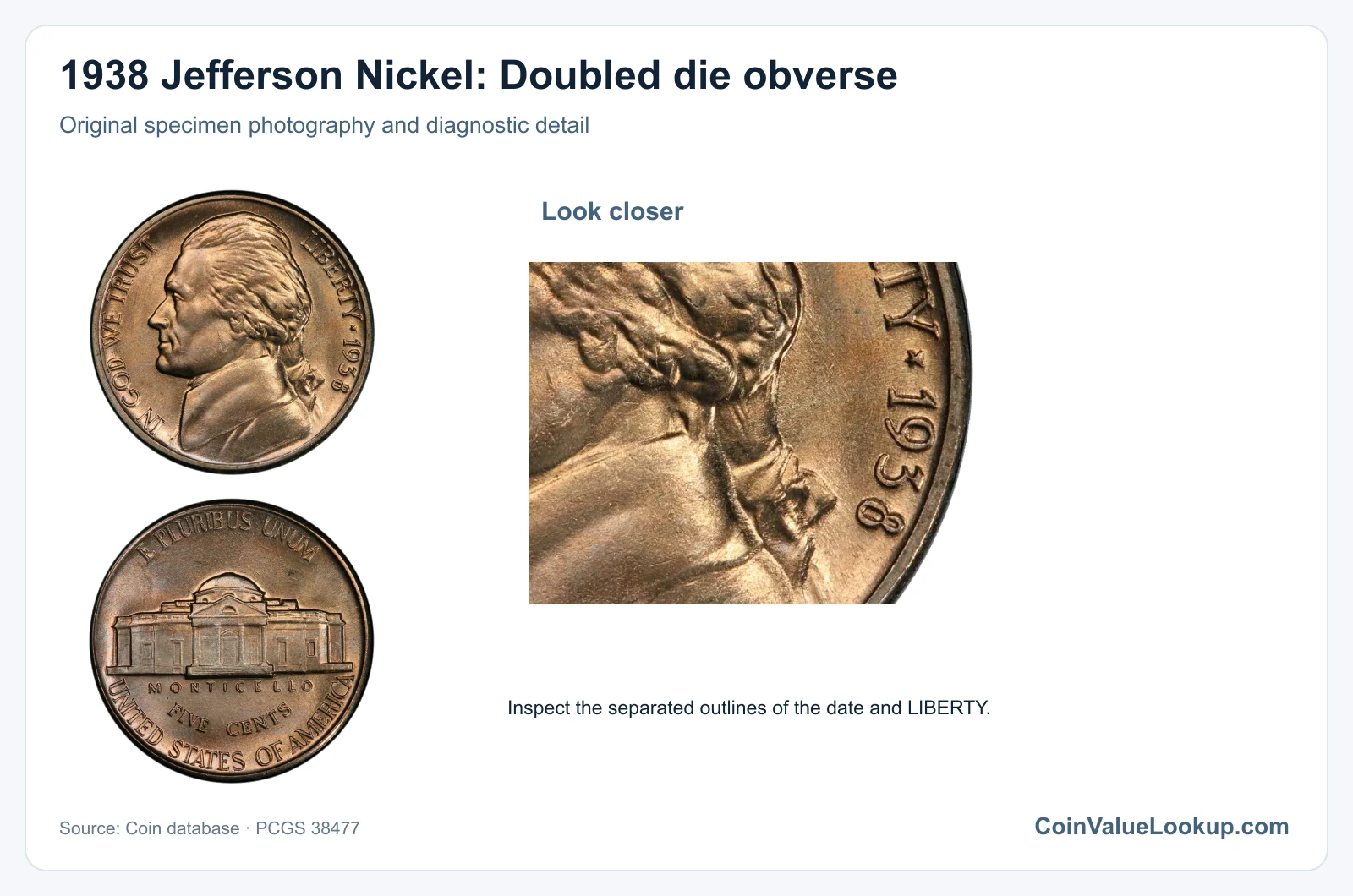
The doubled die obverse on the 1938 Jefferson nickel is best spotted with a 5x to 10x loupe. Focus on the 38 in the date, the motto IN GOD WE TRUST, and the star.
Genuine doubling shows clearly separated outlines, as if two impressions of the design were slightly offset during die production.
The most common lookalike is machine doubling, which produces flat, shelf-like distortion rather than crisp separated lettering. Damaged or worn numerals can also mimic doubling at a glance.
If the extra image looks mushy instead of sharp, it's probably not a doubled die.
No supported numeric price range is available. Each coin's value depends on its authenticated identity, overall condition, and severity of the doubling.
Certification by a major grading service is the reliable path to confirming this variety.
2. 1938 Jefferson Nickel — Struck on a cent blank
A 1938 Jefferson nickel struck on a cent-sized copper-alloy blank is a dramatic wrong-planchet error. The coin weighs roughly 3.0 grams instead of the standard 5.0 grams, and its diameter is noticeably smaller.
The nickel's design appears on copper-colored metal, with outer lettering cropped or stretched because the blank was too small for the dies.
One example has been certified by NGC as MS63 RB. Don't confuse this with a nickel that's been copper-plated, environmentally toned to a brown color, or physically ground down.
Genuine off-metal strikes show correct die detail on the wrong-size, wrong-alloy planchet, and weight is the quickest screening tool.
No supported price range is available. Value depends on the coin's authenticated identity and condition.
Professional certification is essential for a claim this unusual.
3. 1938 Jefferson Nickel — Off-center strike with indent
An off-center strike with an indent combines two mint errors on one coin. The design is displaced dramatically to one side, leaving an unstruck crescent where the planchet wasn't covered by the dies.
On top of that, a smooth impressed area on the reverse records where another blank overlapped this one during striking.
One certified example is a PCGS MS62 that's approximately 90% off-center. That's extreme.
With so much of the design missing, confirming the date and mint can be difficult. Where a partial date or mintmark is visible, it anchors the coin to 1938 rather than a generic Jefferson type.
Watch out for post-mint dents or undated coins simply assumed to be 1938. No supported price range is available for this combined error.
Each piece is individually assessed based on its certified identity, the degree of off-center displacement, and overall preservation.