1938 Walking Liberty Half Dollar Coin Value: How Much Is It Worth?
The 1938 Walking Liberty Half Dollar is a 90% silver coin that appeals to both silver stackers and series collectors. Guide estimates for the year's branches range from about $34.00 in well-worn condition up to $1,016.00 for a gem proof, depending on mint, grade and finish.
These figures are guide anchors from USA Coin Book, not guaranteed selling prices or current silver-melt quotes.
Mint of origin, surface condition and whether the coin is a proof or business strike all shift value substantially. Keep reading to learn how to sort out which version you have and what it might be worth.
Fast Way to Identify Your 1938 Walking Liberty Half Dollar
The quickest way to start figuring out your 1938 Walking Liberty Half Dollar is to snap clear photos of the front and back, then upload them to our identifier. It will give you a preliminary identification of the mint, design type and general branch.
This is not a professional authentication or exact grade assignment, but it points you in the right direction before you dig deeper.
1938 Walking Liberty Half Dollar Value
Upload both sides of your 1938 Walking Liberty Half Dollar.
Front Obverse
Upload photo
Back Reverse
Upload photo
Which 1938 Walking Liberty Half Dollar Versions Are Worth Money?
- The 1938-D business strike carries noticeably higher guide values than the Philadelphia issue, with the Denver coin listed at $79.00 in G4 versus $34.00 for Philadelphia.
- The 1938 proof, graded PR65, carries a guide estimate of $1,016.00, making it the premium branch for this date when condition is strong.
- Weak central strikes are common across Walking Liberty halves; a coin with genuinely full, sharp hand and head detail may stand out to grading services and buyers.
Step 1: Identify Your 1938 Walking Liberty Half Dollar Mint Mark and Version
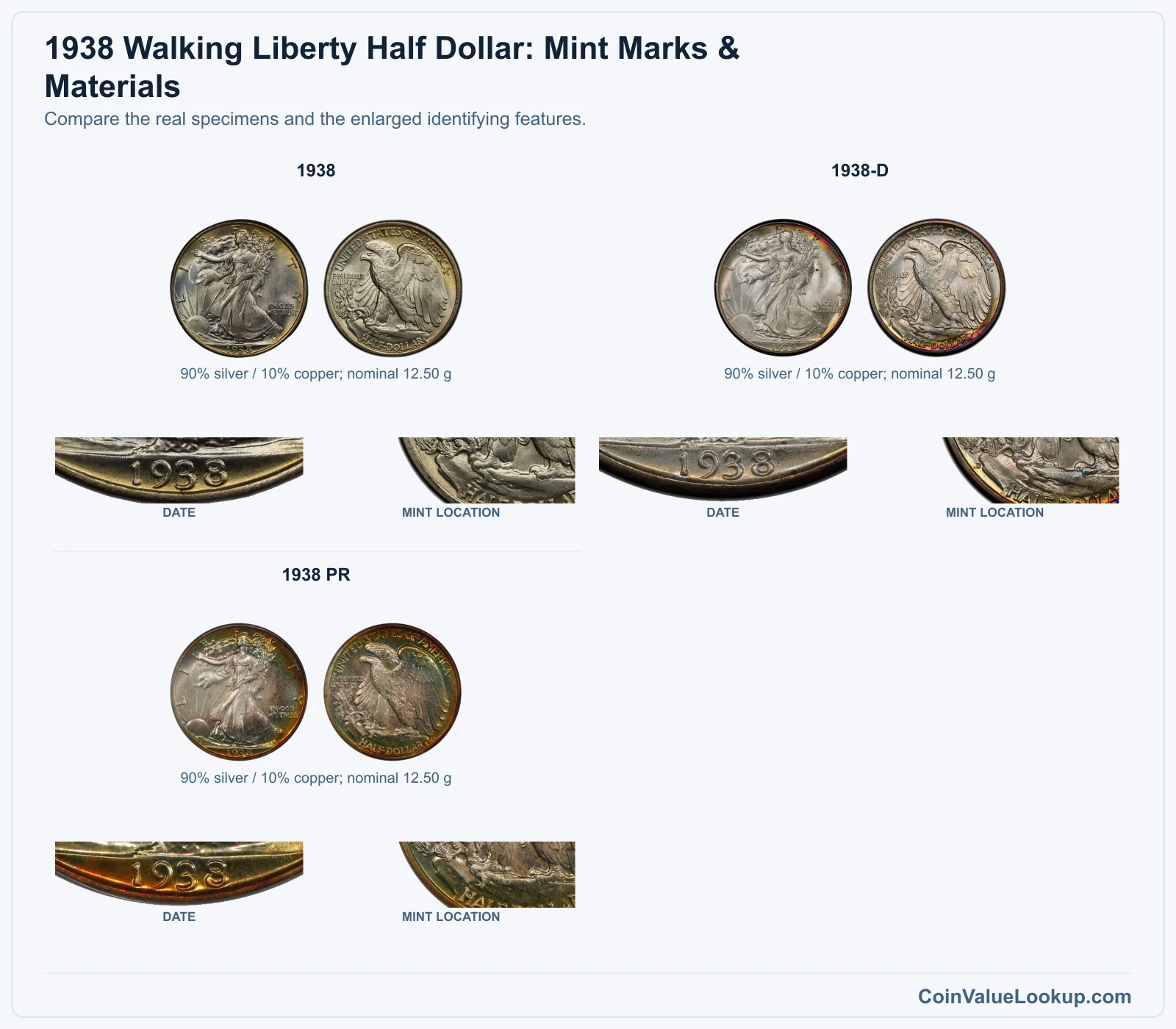
The 1938 Walking Liberty Half Dollar is struck in 90% silver and 10% copper, with a nominal weight of 12.50 grams. Toning or tarnish does not change the underlying alloy.
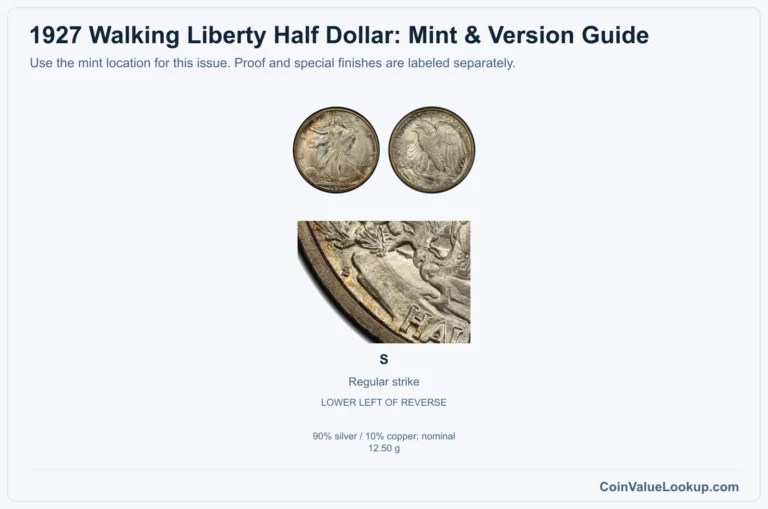
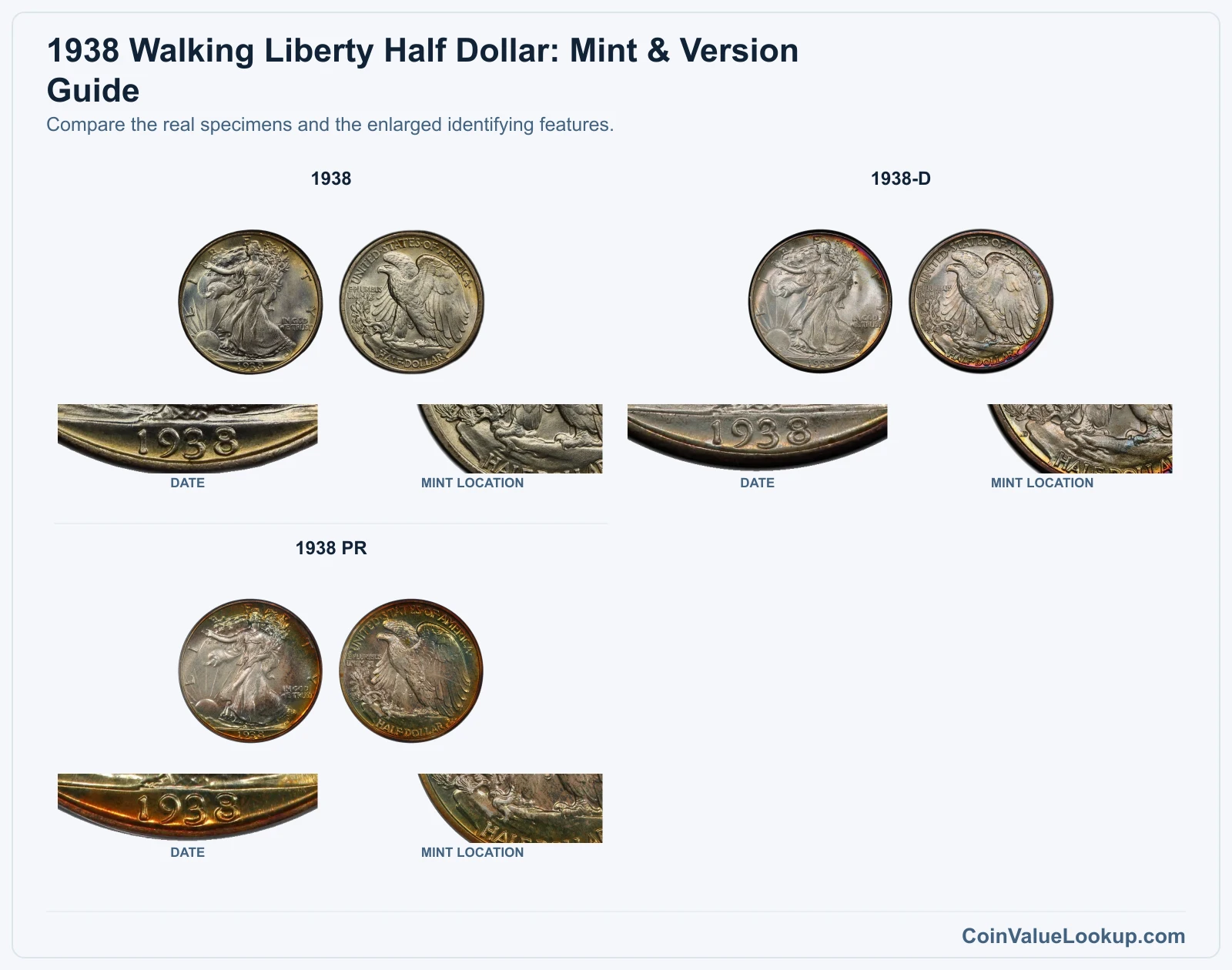
Three branches exist for 1938: the Philadelphia business strike (no mintmark), the Denver business strike (D mintmark) and the Philadelphia proof (no mintmark, mirrored fields). For this date, the mintmark sits on the reverse at the lower left, near the 8 o'clock position.
If there is no mark, you have a Philadelphia coin.
Separating the Philadelphia business strike from the proof takes a closer look. A genuine proof shows deeply mirrored fields and exceptionally sharp device edges.
A polished circulation coin is not a proof, no matter how shiny it looks. Hairlines, haze and contrast between fields and devices all matter when evaluating proof surfaces.
Coin Value Lookup is a handy starting point if you want to look up guides for other dates or denominations in this series. Bookmark it and come back whenever a new coin crosses your path.
Step 2: Check Your 1938 Walking Liberty Half Dollar Grade
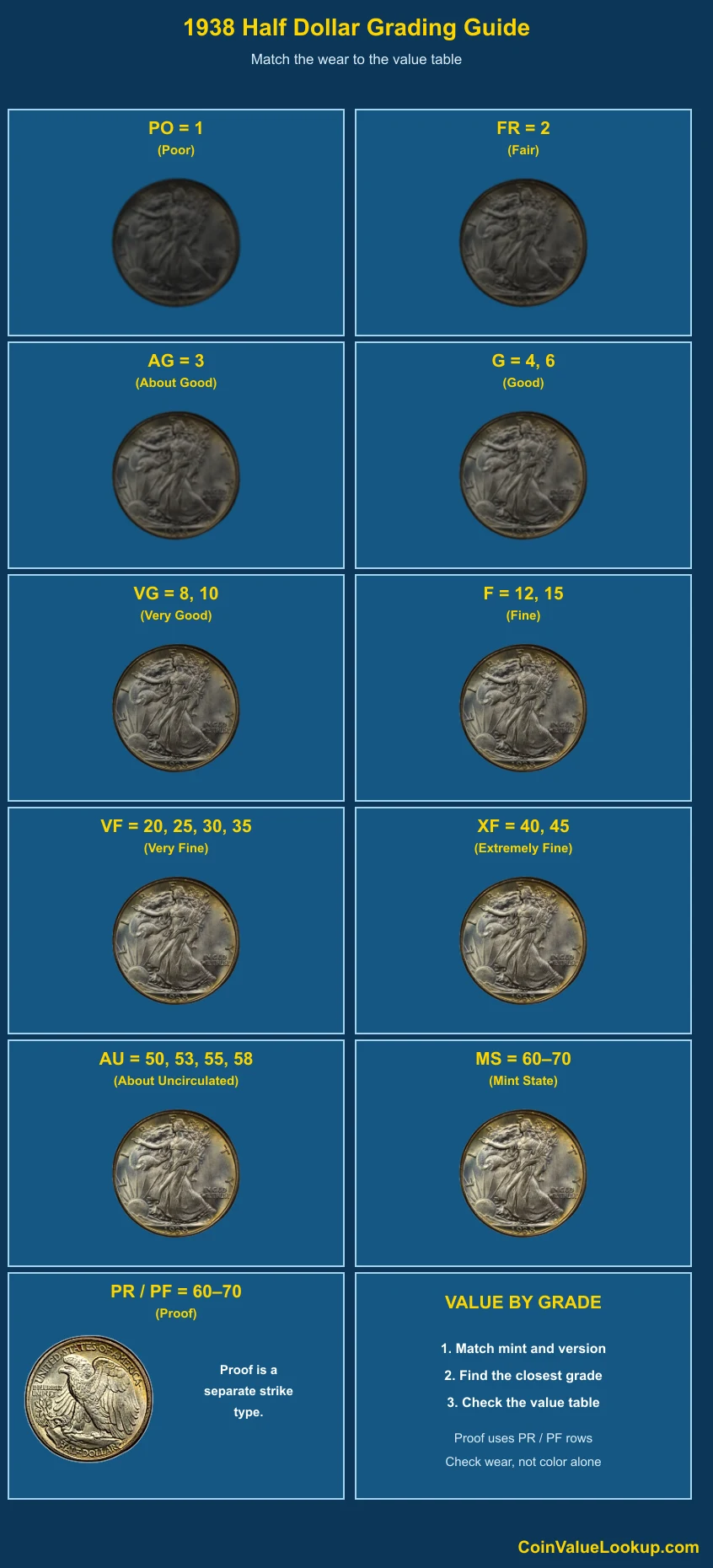
Start by checking Liberty's head, the details of her left hand and the lines across her skirt and knee on the obverse. These are the first areas to lose definition as a coin circulates.
On the reverse, focus on the eagle's breast feathers, legs and the tops of the wing feathers.
Here is the catch with Walkers: many were weakly struck from the factory, especially in the central areas. A coin with a mushy hand and flat head detail is not necessarily worn.
Look at surviving mint luster and check for actual smoothing or contact marks before downgrading. Use the comparison image to see how a sharply struck example differs from a weakly struck but unworn piece.
Cleaned or damaged coins trade well below problem-free examples at every grade level. Original surfaces, even if darkly toned, generally command stronger prices than a coin that has been polished bright.
Step 3: Check 1938 Walking Liberty Half Dollar Value by Mint and Version
1938 Walking Liberty Half Dollar
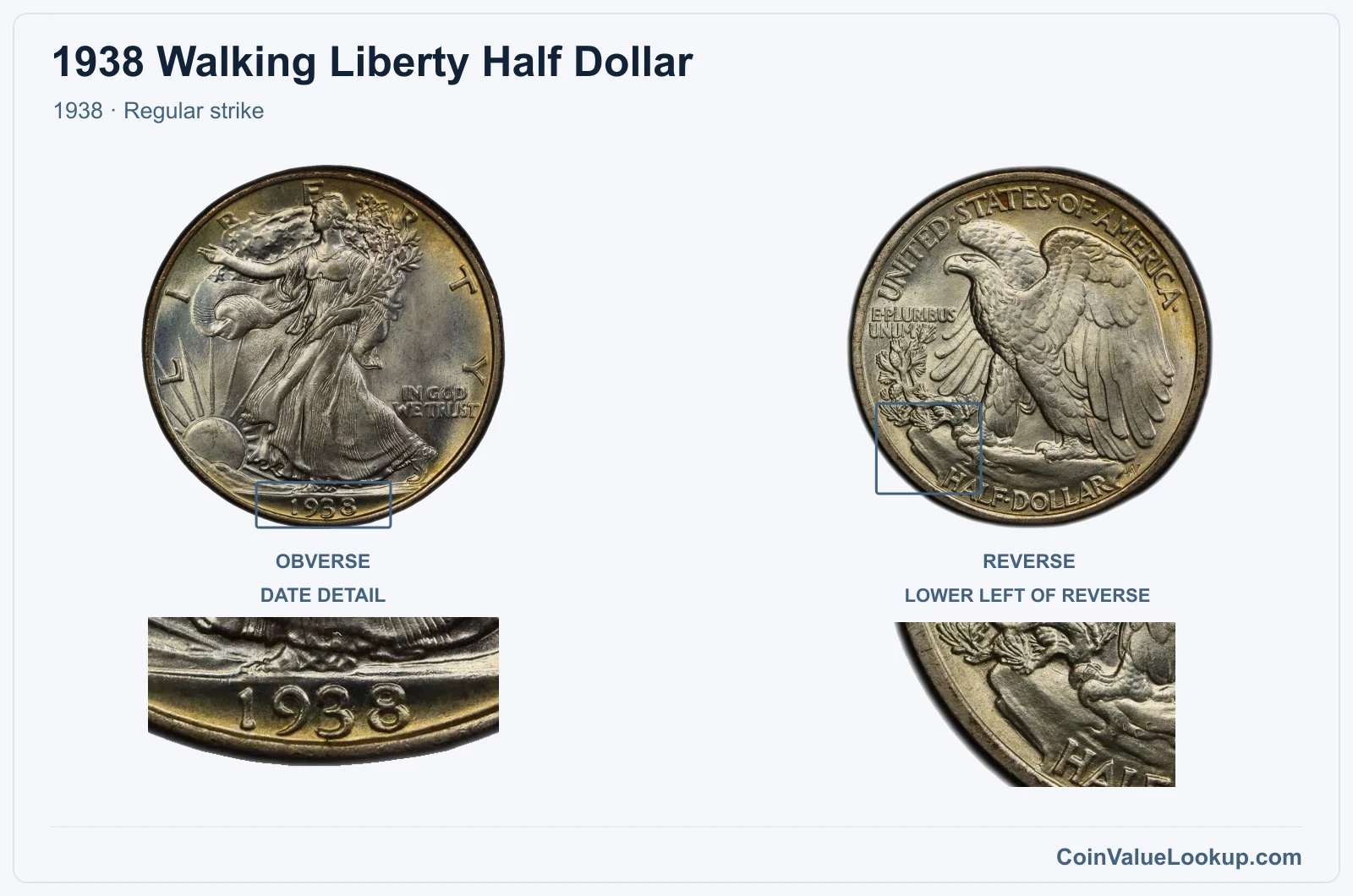
The 1938 Philadelphia business strike has no mintmark. You will find the Walking Liberty design on the obverse and an eagle perched on a rock on the reverse.
In Good-4 condition, the USA Coin Book guide lists this coin at about $34.00. Move up to MS63 and the estimate jumps to $212.00.
Before trusting any value chart, confirm the coin has no mintmark on the reverse lower left and that the surfaces are original. Cleaned or damaged pieces do not qualify for the same prices.
Silver content provides a floor, but a problem-free example in solid grade will always outpace a cleaned one.
Range Grade
Price Auction Records Appraisal PO PO 1
—
Coin Identifier FR FR 2
—
Coin Identifier AG AG 3
—
Coin Identifier G G 4
—
Coin Identifier
G 6
—
Coin Identifier VG VG 8
—
Coin Identifier
VG 10
—
Coin Identifier F F 12
—
Coin Identifier
F 15
—
Coin Identifier VF VF 20
—
Coin Identifier
VF 25
Coin Identifier
VF 30
—
Coin Identifier
VF 35
—
Coin Identifier XF XF 40
—
Coin Identifier
XF 45
—
Coin Identifier AU AU 50
—
Coin Identifier
AU 53
Coin Identifier
AU 55
Coin Identifier
AU 58
Coin Identifier MS MS 60
—
Coin Identifier
MS 61
Coin Identifier
MS 62
Coin Identifier
MS 63
Coin Identifier
MS 64
Coin Identifier
MS 65
Coin Identifier
MS 66
Coin Identifier
MS 67
Coin Identifier
MS 68
Coin Identifier
MS 69
—
—
—
MS 70
—
—
—
1938 Walking Liberty Half Dollar — D
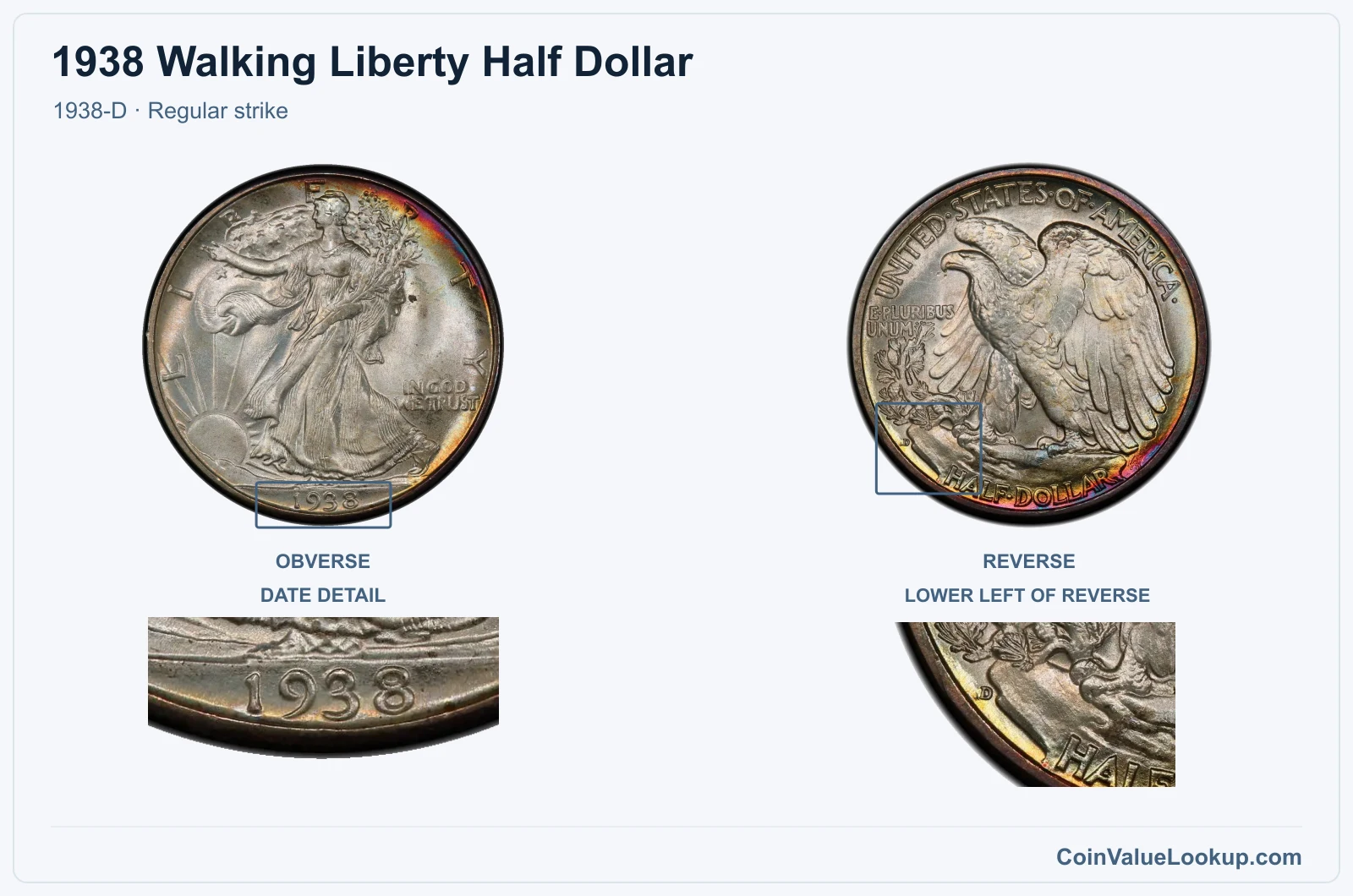
The 1938-D is the Denver mint issue, identified by a small D on the reverse lower left. This branch carries a meaningful premium over its Philadelphia sibling.
USA Coin Book lists G4 at roughly $79.00 and MS63 at about $947.00.
That jump to nearly a thousand dollars in uncirculated condition reflects genuine scarcity in higher grades. Many surviving examples show weak central strikes, so a sharply detailed, lustrous piece stands apart.
As always, confirm the D mintmark under magnification and verify the coin has not been cleaned. Original surfaces are essential for these guide figures to be relevant.
Range Grade
Price Auction Records Appraisal PO PO 1
—
Coin Identifier FR FR 2
—
Coin Identifier AG AG 3
Coin Identifier G G 4
Coin Identifier
G 6
Coin Identifier VG VG 8
Coin Identifier
VG 10
Coin Identifier F F 12
Coin Identifier
F 15
Coin Identifier VF VF 20
Coin Identifier
VF 25
Coin Identifier
VF 30
Coin Identifier
VF 35
Coin Identifier XF XF 40
Coin Identifier
XF 45
Coin Identifier AU AU 50
Coin Identifier
AU 53
Coin Identifier
AU 55
Coin Identifier
AU 58
Coin Identifier MS MS 60
Coin Identifier
MS 61
Coin Identifier
MS 62
Coin Identifier
MS 63
Coin Identifier
MS 64
Coin Identifier
MS 65
Coin Identifier
MS 66
Coin Identifier
MS 67
Coin Identifier
MS 68
—
—
—
MS 69
—
—
—
MS 70
—
—
—
1938 Walking Liberty Half Dollar — PR
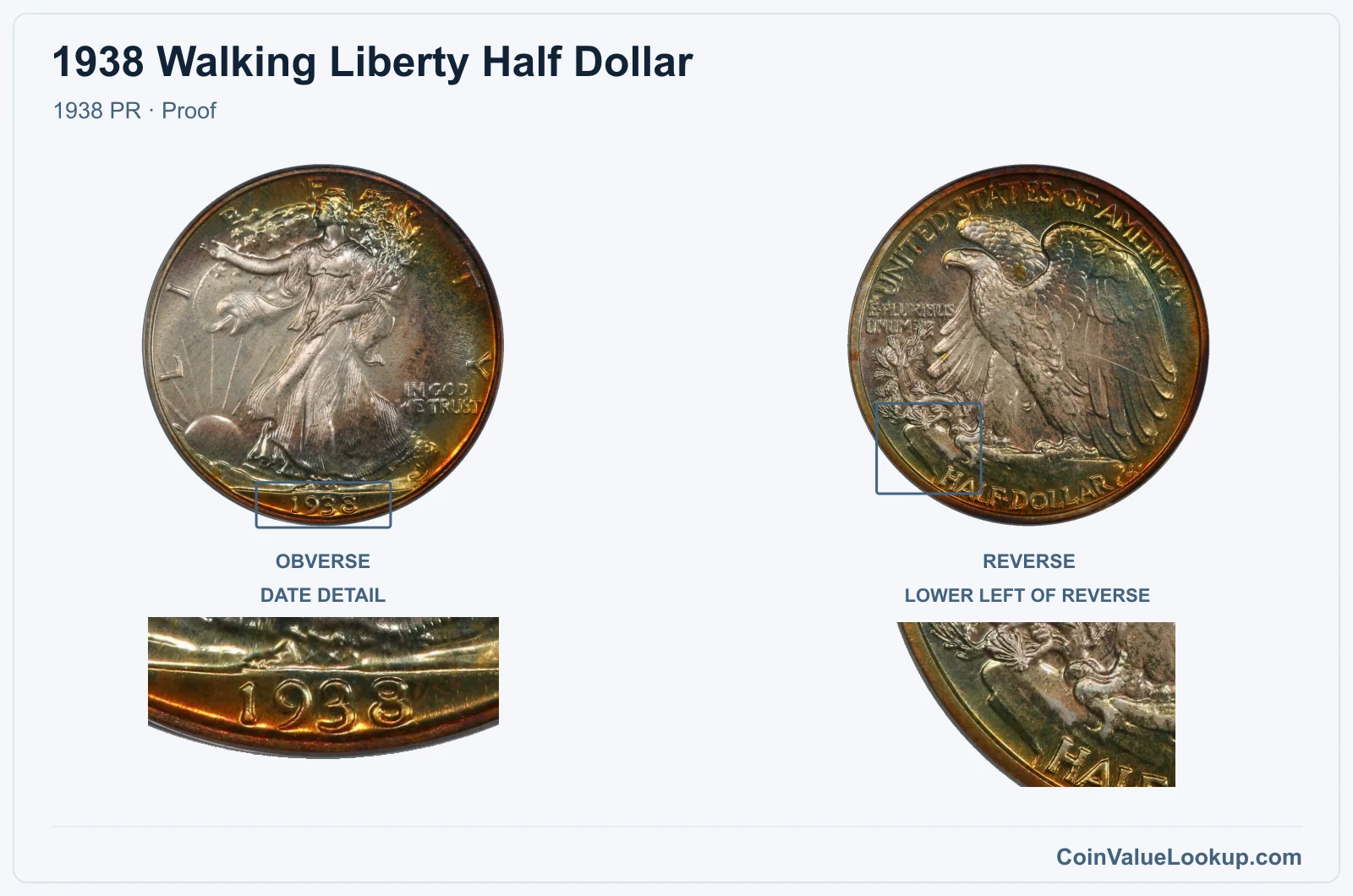
The 1938 proof is a Philadelphia-struck collector issue with mirrored fields and razor-sharp devices. No mintmark appears.
The USA Coin Book guide places a PR65 example at approximately $1,016.00.
Identifying a genuine proof means looking for deeply reflective surfaces in the fields, not just a shiny coin. The devices should show crisp, squared-off edges that business strikes rarely achieve.
Evaluate any hairlines under angled light, because even light wiping drops a proof's grade and value quickly. Cameo contrast between frosted devices and mirror fields can also affect desirability, though not every 1938 proof displays it.
A polished ordinary Philadelphia half is not a proof, full stop.
Range Grade
Price Auction Records Appraisal PR PR 1
—
Coin Identifier
PR 2
—
Coin Identifier
PR 3
—
Coin Identifier
PR 4
—
Coin Identifier
PR 6
—
Coin Identifier
PR 8
—
Coin Identifier
PR 10
—
Coin Identifier
PR 12
—
Coin Identifier
PR 15
—
Coin Identifier
PR 20
—
Coin Identifier
PR 25
—
Coin Identifier
PR 30
—
Coin Identifier
PR 35
—
Coin Identifier
PR 40
—
Coin Identifier
PR 45
—
Coin Identifier
PR 50
—
Coin Identifier
PR 53
—
Coin Identifier
PR 55
Coin Identifier
PR 58
Coin Identifier
PR 60
Coin Identifier
PR 61
—
Coin Identifier
PR 62
Coin Identifier
PR 63
Coin Identifier
PR 64
Coin Identifier
PR 65
Coin Identifier
PR 66
Coin Identifier
PR 67
Coin Identifier
PR 68
Coin Identifier
PR 69
—
—
—
PR 70
—
—
—
1938 Walking Liberty Half Dollar Error List
1. 1938 Walking Liberty Half Dollar — Repunched Mintmark
A repunched mintmark (RPM) error has been reported for the 1938-D Walking Liberty Half Dollar. This occurs when the mintmark punch was applied more than once in slightly different positions on the working die, leaving traces of the earlier strike visible near or under the final D.
To spot this, examine the D mintmark on the reverse lower left under magnification. Look for a secondary outline, a notch or a shadow of a displaced letter.
Compare to a normal 1938-D at the same magnification so you can see the difference clearly.
Do not confuse a repunched mintmark with machine doubling, a die chip sitting on the letter, or simple corrosion around the mark. Each of those has a different visual profile.
No specific price range is available for this variety; value depends on the visibility of the repunching, overall coin condition and collector demand.
2. 1938 Walking Liberty Half Dollar — Clipped Planchet
A clipped planchet error has been reported for the 1938 Walking Liberty Half Dollar. This happens when the blank is punched from the silver strip in a way that overlaps a previously punched hole or the strip's edge, leaving a missing section on the finished coin.
Look for a curved, straight or irregular absence along the rim. The clip area often shows a characteristic weakness on the opposite side of the coin, called the Blakesley effect.
Edge texture at the clip should look like original planchet metal, not a filed or cut surface.
Be cautious about post-mint damage. A coin that was hit, filed or corroded along the edge is not a clip error.
No specific price range is adopted for this variety. Value depends on the size and location of the clip, overall grade and whether the date remains fully visible.
3. 1938 Walking Liberty Half Dollar — Off-Center Strike
An off-center strike error has been reported for the 1938 Walking Liberty Half Dollar. This occurs when the planchet is not properly seated between the dies at the moment of striking, producing a design that is shifted to one side with an unstruck crescent of blank metal on the opposite edge.
The degree of off-center displacement matters enormously. A 5% shift is mild; 10–20% or more becomes visually dramatic and more collectible, especially when the full date remains readable.
Check that the blank crescent has a natural planchet edge, not signs of post-mint flattening or vise damage.
Do not mistake a clipped planchet or a misaligned die for a true off-center strike. No specific price range is available for this error on the 1938 date.
Condition, percentage of displacement and date visibility all influence what a collector would pay.