1919 Walking Liberty Half Dollar Coin Value: How Much Is It Worth?
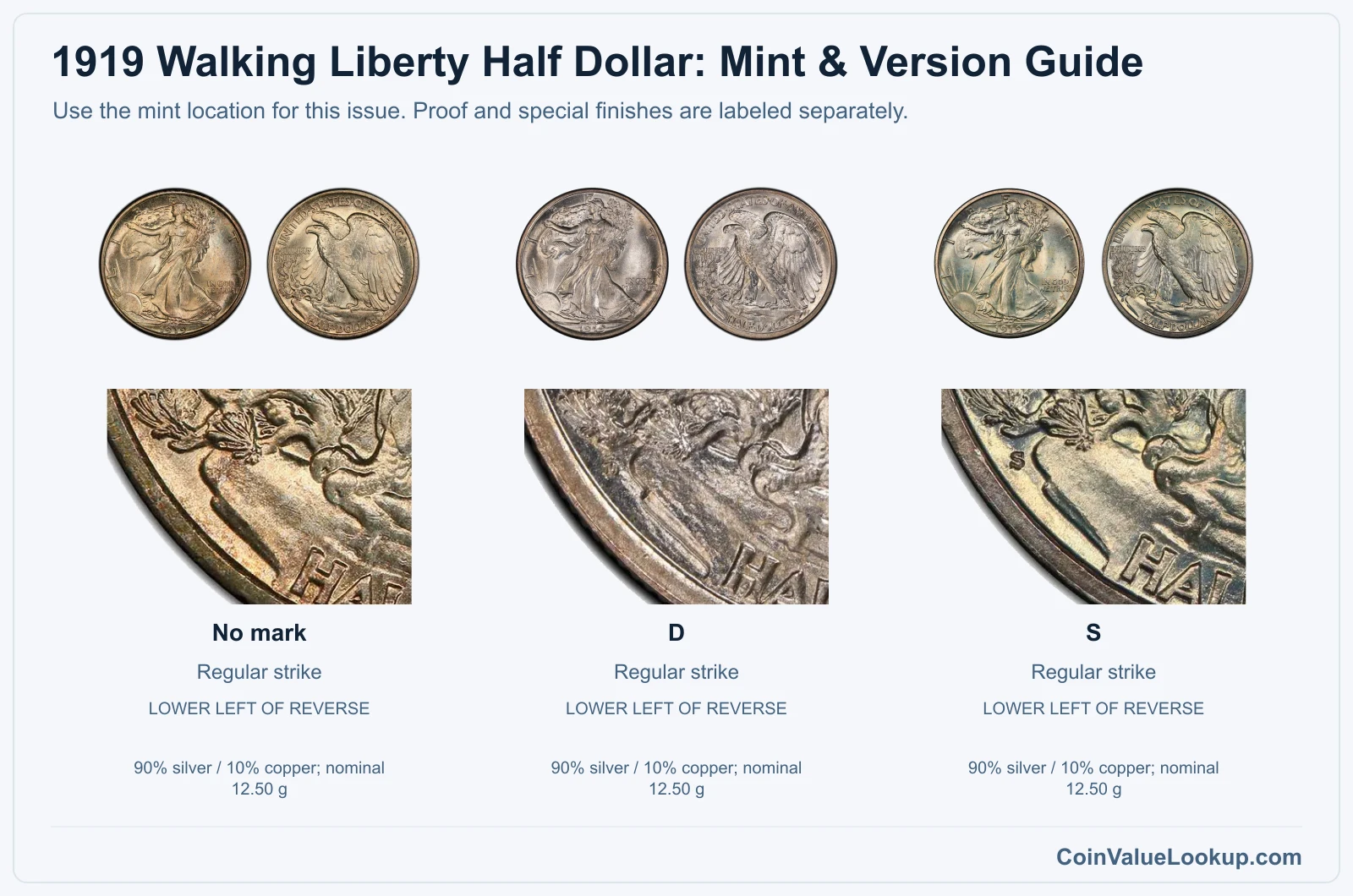
The 1919 Walking Liberty Half Dollar is a 90% silver coin that draws attention from collectors for both its classic design and its scarcity in higher grades. Guide estimates for the three branches of this date range from about $48.00 in well-worn condition up to $11,504.00 for top uncirculated examples, depending on mint and grade.
These figures are guide anchors, not guaranteed selling prices or current silver-melt quotes. Mint, condition, and the specific version you hold all play a role in what your coin may be worth.
Fast Way to Identify Your 1919 Walking Liberty Half Dollar
The quickest way to start figuring out what you have is to snap clear photos of the front and back of your coin. Upload both images to our identifier for a preliminary look at the date, mint, and general condition.
This is not a substitute for professional authentication or exact grading, but it gives you a useful starting point before digging deeper.
1919 Walking Liberty Half Dollar Value
Upload both sides of your 1919 Walking Liberty Half Dollar.
Front Obverse
Upload photo
Back Reverse
Upload photo
Which 1919 Walking Liberty Half Dollar Versions Are Worth Money?
- The 1919-D branch commands the highest guide estimate in uncirculated condition, with an MS63 anchor around $11,504.00, making it the key mint to identify correctly.
- The 1919-S also reaches substantial value in mint state, with an MS63 guide estimate near $10,801.00, well above its modest $48.00 figure in G4.
- All three mints are 90% silver, so even heavily worn examples retain meaningful bullion content alongside their numismatic appeal.
- A repunched mintmark variety has been reported on the 1919-D; check the D closely under magnification for doubled or shifted remnants.
- Mint errors such as off-center strikes and broadstrikes have been reported for this date and can carry additional collector interest beyond standard pricing.
Step 1: Identify Your 1919 Walking Liberty Half Dollar Mint Mark and Version
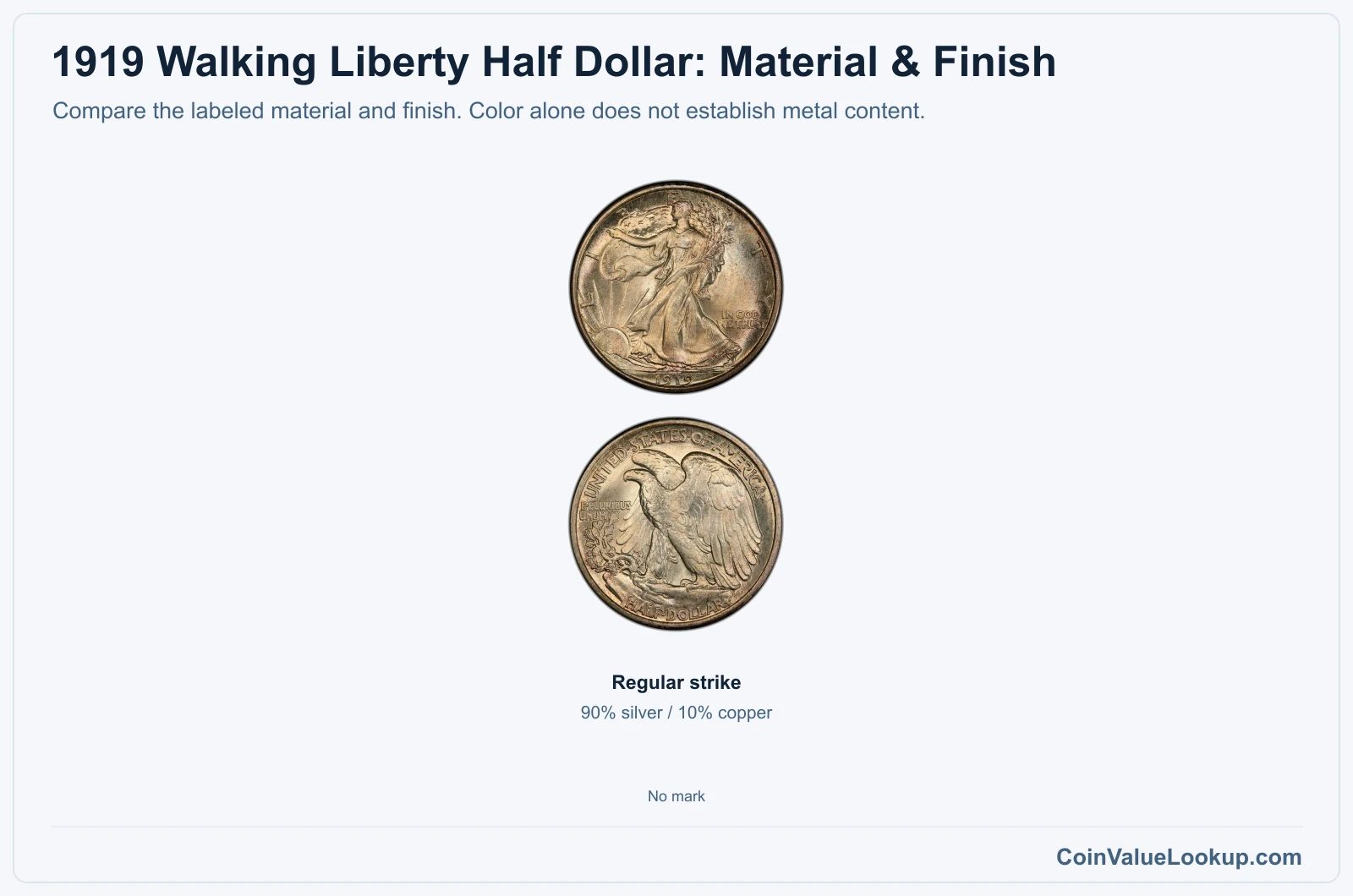
The 1919 Walking Liberty Half Dollar was struck at three mints: Philadelphia (no mintmark), Denver (D), and San Francisco (S). For this date, the mintmark sits on the reverse, at the lower left near the 8 o'clock position.
If you see no mintmark there, you have a Philadelphia coin.
All three versions are 90% silver and 10% copper, weighing about 12.50 grams. Toning or discoloration does not change the underlying alloy, so a dark coin is still the same composition as a bright one.
Be careful with cleaning. A coin that has been scrubbed, dipped aggressively, or damaged is not equivalent to a problem-free example, even if the details look sharp.
Original surfaces matter a great deal to collectors, so resist the urge to polish.
The obverse shows Liberty striding toward the sunrise, draped in the flag, while the reverse features an eagle perched on a rock. Both sides can exhibit weak strikes in the central areas, which is a known trait of the series and not necessarily a sign of wear.
Step 2: Check Your 1919 Walking Liberty Half Dollar Grade
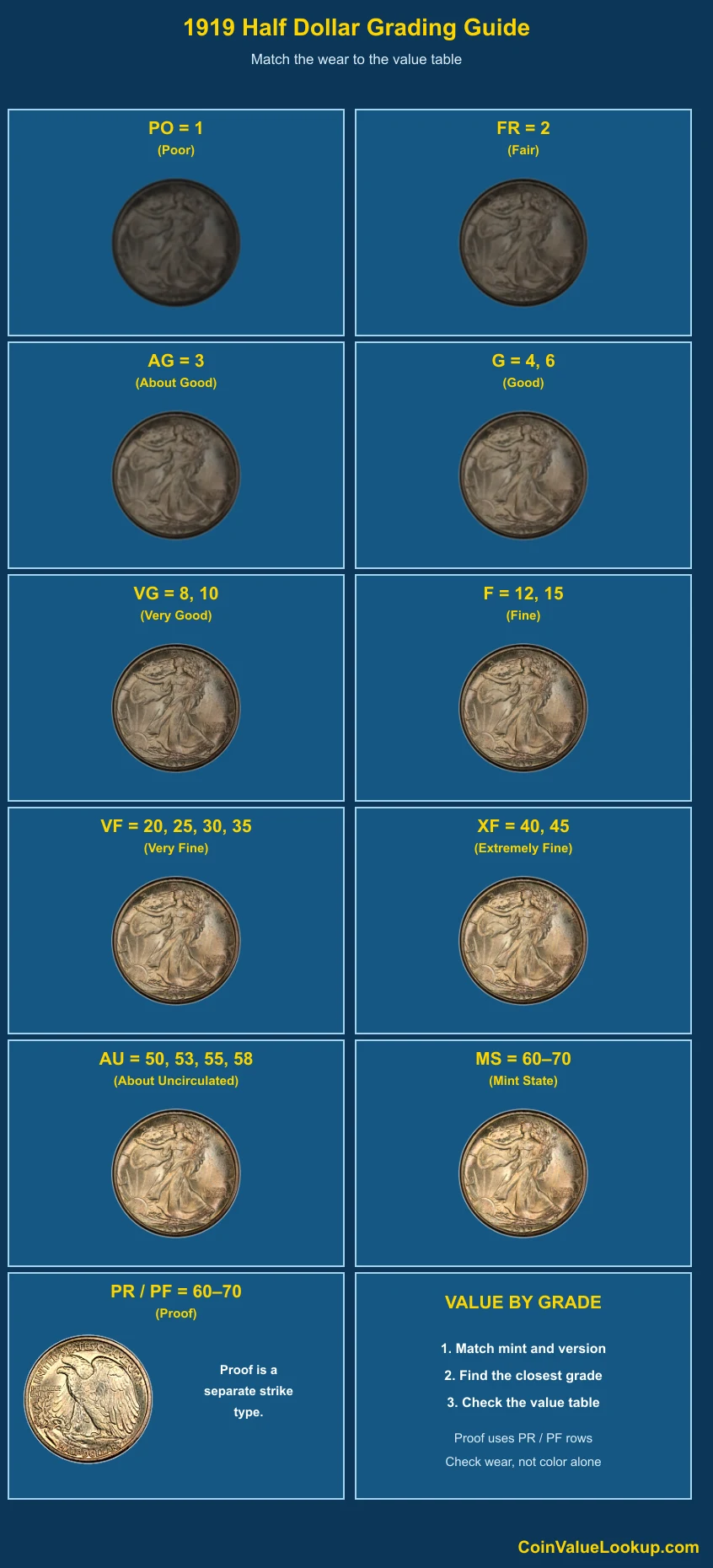
Start with Liberty's head, the breast area, her outstretched left hand, and the skirt lines over her knee. These are the first spots to lose detail as a coin circulates.
On the reverse, check the eagle's breast feathers, leg, and the tops of the wing feathers.
Here is the catch with Walkers: the central design was often weakly struck at the mint, even on brand-new coins. A soft hand or mushy head does not automatically mean the coin saw years in a cash register.
Look at the overall luster. If the fields still show original mint frost and there is no actual smoothing or flattening from contact, you may have an uncirculated piece with a weak strike.
Use the comparison image to match your coin against known grade examples of the same type. Pay attention to whether the high points show real wear or just incomplete metal flow from the strike.
Surviving luster in protected areas is your best friend when making that call.
Step 3: Check 1919 Walking Liberty Half Dollar Value by Mint and Version
1919 Walking Liberty Half Dollar
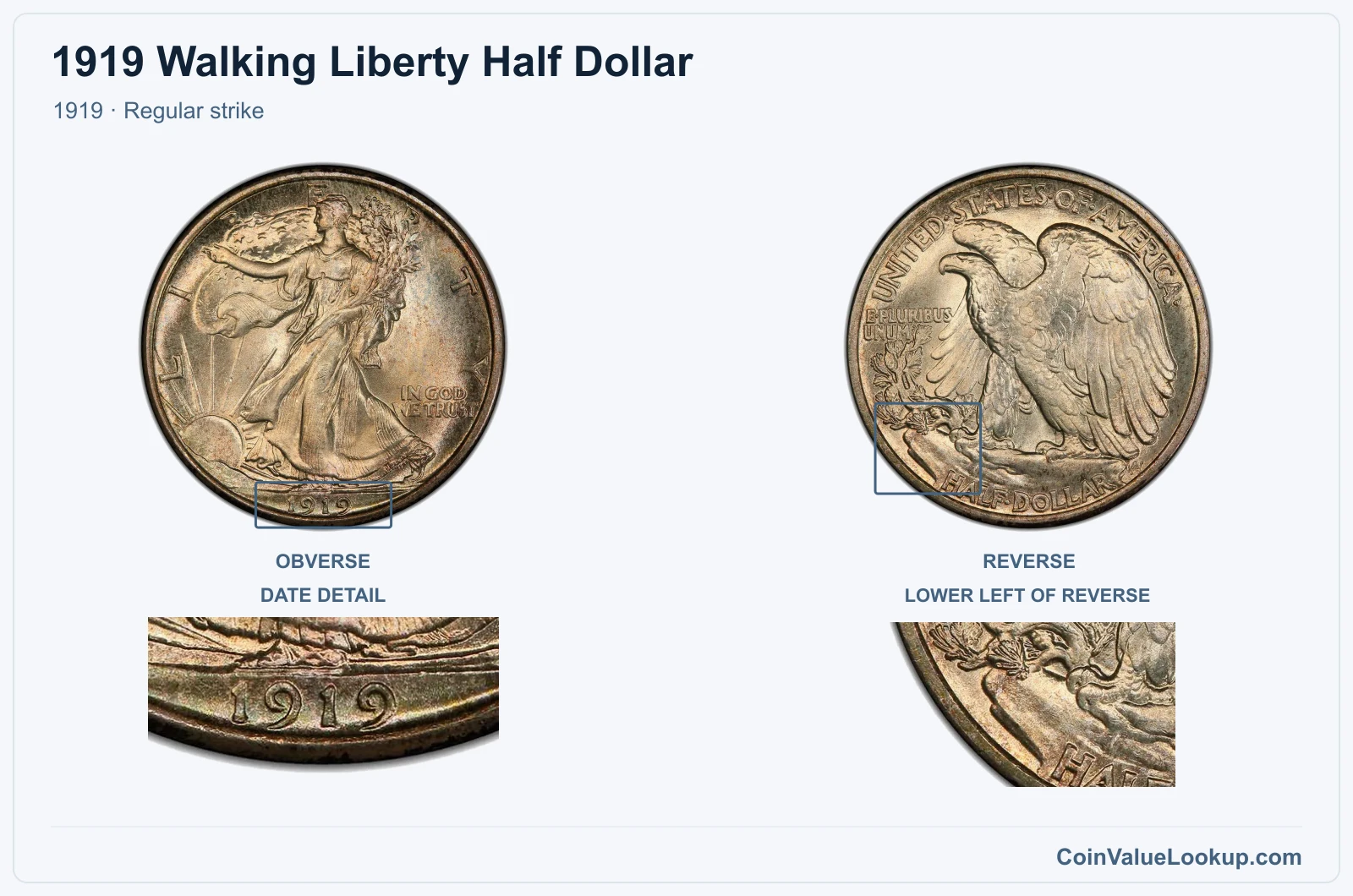
The 1919 Philadelphia half dollar has no mintmark. You will find no letter on the reverse near the lower left; that blank spot confirms Philly production.
Guide estimates place this coin at about $61.00 in G4 (a heavily worn but identifiable grade) and around $4,266.00 in MS63 (a lightly marked uncirculated coin with good luster). These are USA Coin Book guide anchors, not guaranteed sale prices.
Original surfaces are critical. A cleaned or scratched Philadelphia coin will trade well below these figures regardless of how much detail remains.
Look for natural toning and undisturbed luster when evaluating condition.
Range Grade
Price Auction Records Appraisal PO PO 1
—
Coin Identifier FR FR 2
—
Coin Identifier AG AG 3
Coin Identifier G G 4
Coin Identifier
G 6
Coin Identifier VG VG 8
Coin Identifier
VG 10
Coin Identifier F F 12
Coin Identifier
F 15
Coin Identifier VF VF 20
Coin Identifier
VF 25
Coin Identifier
VF 30
Coin Identifier
VF 35
Coin Identifier XF XF 40
Coin Identifier
XF 45
Coin Identifier AU AU 50
Coin Identifier
AU 53
Coin Identifier
AU 55
Coin Identifier
AU 58
Coin Identifier MS MS 60
Coin Identifier
MS 61
Coin Identifier
MS 62
Coin Identifier
MS 63
Coin Identifier
MS 64
Coin Identifier
MS 65
Coin Identifier
MS 66
Coin Identifier
MS 67
Coin Identifier
MS 68
—
—
—
MS 69
—
—
—
MS 70
—
—
—
1919 Walking Liberty Half Dollar — D
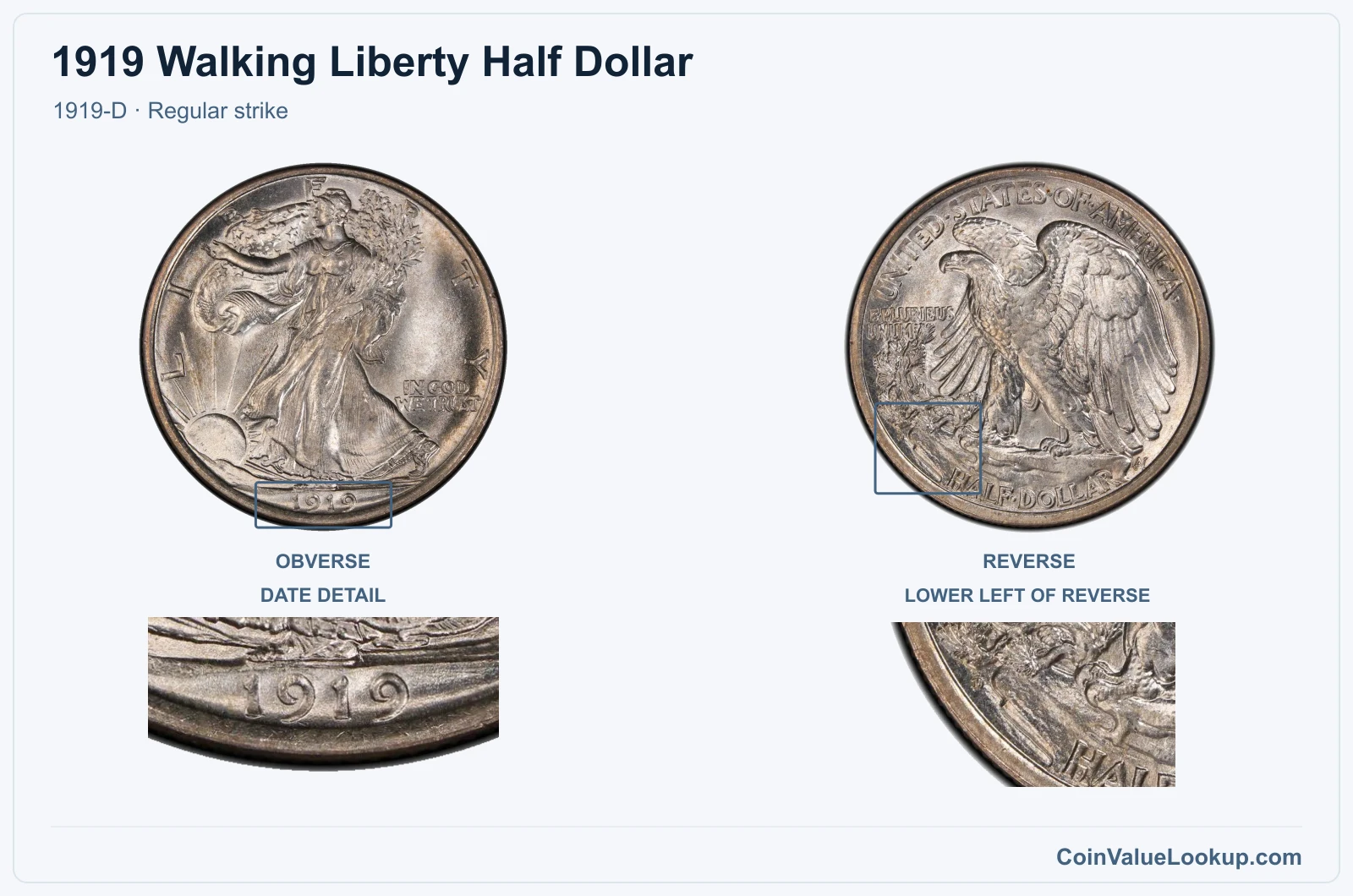
The 1919-D carries a small "D" mintmark on the reverse at the lower left. This is the branch that reaches the highest guide estimates for the year: roughly $61.00 in G4 and a steep $11,504.00 at MS63, according to USA Coin Book.
That enormous jump between worn and uncirculated tells you how few nice examples survived.
Denver Walkers from this era are notorious for soft central strikes, so do not mistake a weak hand or head for heavy wear. Check for actual smoothing on the high points and examine the fields for remaining luster.
A problem-free, well-struck 1919-D in any collectible grade is a coin worth careful evaluation.
Coin Value Lookup is a good place to look up guides for other dates in the Walking Liberty series if you are working through a collection or comparing branch values across years.
Range Grade
Price Auction Records Appraisal PO PO 1
—
Coin Identifier FR FR 2
Coin Identifier AG AG 3
Coin Identifier G G 4
Coin Identifier
G 6
Coin Identifier VG VG 8
Coin Identifier
VG 10
Coin Identifier F F 12
Coin Identifier
F 15
Coin Identifier VF VF 20
Coin Identifier
VF 25
Coin Identifier
VF 30
Coin Identifier
VF 35
Coin Identifier XF XF 40
Coin Identifier
XF 45
Coin Identifier AU AU 50
Coin Identifier
AU 53
Coin Identifier
AU 55
Coin Identifier
AU 58
Coin Identifier MS MS 60
Coin Identifier
MS 61
Coin Identifier
MS 62
Coin Identifier
MS 63
Coin Identifier
MS 64
Coin Identifier
MS 65
Coin Identifier
MS 66
Coin Identifier
MS 67
—
—
—
MS 68
—
—
—
MS 69
—
—
—
MS 70
—
—
—
1919 Walking Liberty Half Dollar — S
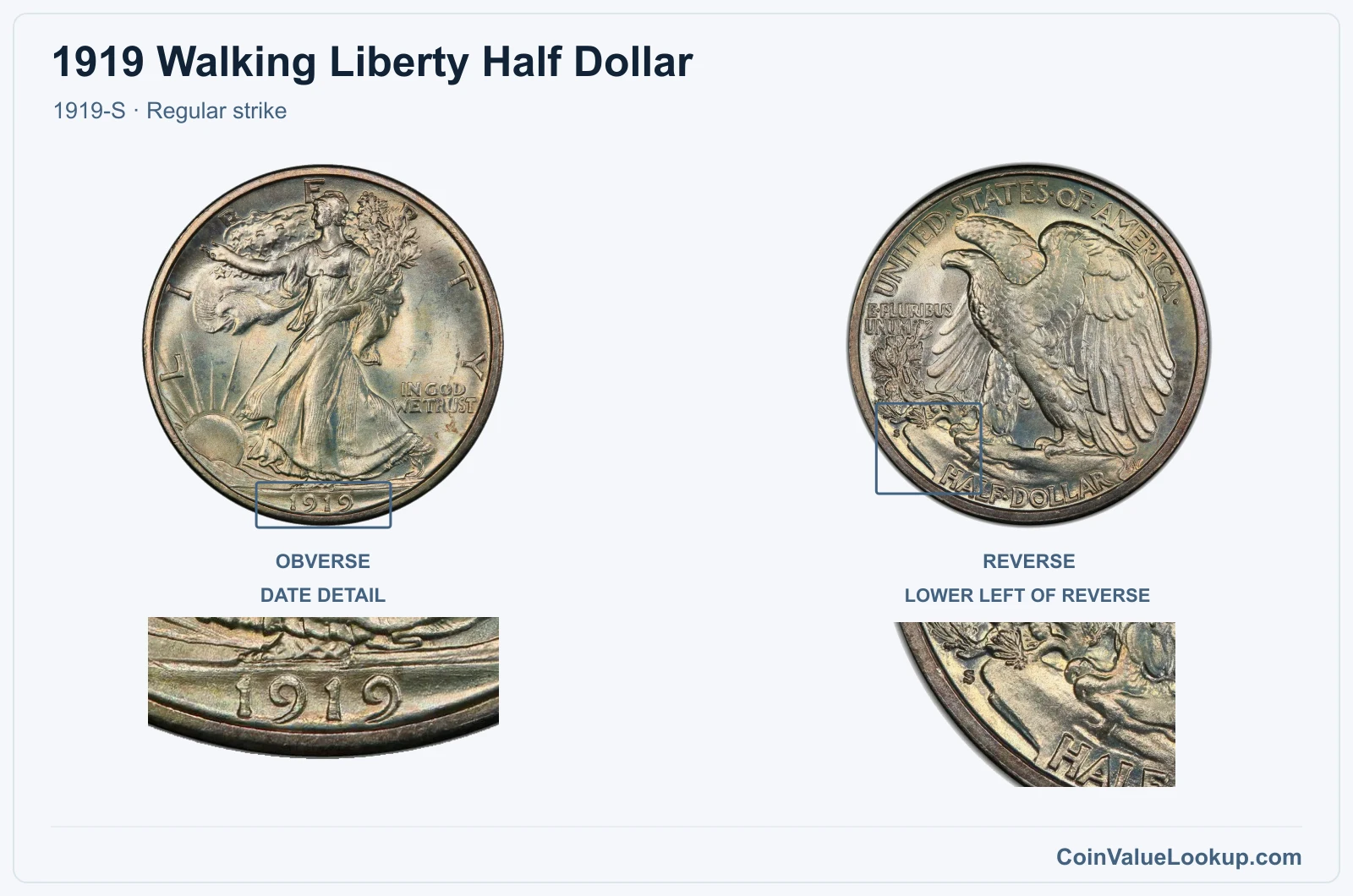
Look for an "S" mintmark on the reverse lower left to confirm a San Francisco coin. Guide estimates from USA Coin Book put the 1919-S at about $48.00 in G4, the lowest entry point of any 1919 branch, rising sharply to around $10,801.00 at MS63.
That spread tells you the mint-state survival rate is tiny.
Like the Denver coins, San Francisco Walkers from 1919 often came with incomplete central details straight from the press. Strong, fully struck examples in uncirculated grades are particularly scarce.
Prioritize original surfaces and honest wear assessment over raw detail sharpness when you evaluate one of these.
Range Grade
Price Auction Records Appraisal PO PO 1
—
Coin Identifier FR FR 2
—
Coin Identifier AG AG 3
—
Coin Identifier G G 4
Coin Identifier
G 6
Coin Identifier VG VG 8
Coin Identifier
VG 10
Coin Identifier F F 12
Coin Identifier
F 15
Coin Identifier VF VF 20
Coin Identifier
VF 25
Coin Identifier
VF 30
Coin Identifier
VF 35
Coin Identifier XF XF 40
Coin Identifier
XF 45
Coin Identifier AU AU 50
Coin Identifier
AU 53
Coin Identifier
AU 55
Coin Identifier
AU 58
Coin Identifier MS MS 60
—
Coin Identifier
MS 61
Coin Identifier
MS 62
Coin Identifier
MS 63
Coin Identifier
MS 64
Coin Identifier
MS 65
Coin Identifier
MS 66
Coin Identifier
MS 67
Coin Identifier
MS 68
—
—
—
MS 69
—
—
—
MS 70
—
—
—
1919 Walking Liberty Half Dollar Error List
1. 1919 Walking Liberty Half Dollar — Repunched Mintmark
A repunched mintmark (RPM) has been reported on the 1919-D Walking Liberty Half Dollar. This occurs when the mintmark punch was applied more than once in slightly different positions, leaving remnants of the earlier impression visible under magnification.
Look closely at the D on the reverse for doubling, a shadow, or a shifted outline that does not match the final position.
Compare your coin's mintmark to a normal 1919-D at the same magnification. Machine doubling, small die chips, or corrosion near the letter can mimic an RPM but lack the distinct secondary punch outline.
No specific price data is available for this variety; value depends on the visibility of the repunching, overall coin condition, and collector demand for the specific RPM.
2. 1919 Walking Liberty Half Dollar — Lamination / Split Planchet
Lamination errors have been reported on the 1919 Walking Liberty Half Dollar. These show up as peeling metal, a raised flap, or a visible separation within the planchet where the alloy did not bond properly during production.
The effect can appear on one face, both faces, or along the edge.
Photograph both the affected surface and the edge together so the separation is clear. Be careful not to confuse a lamination with post-mint damage such as scraping, corrosion pitting, or someone deliberately cutting into the coin.
A genuine lamination will follow the contour of the planchet rather than showing sharp tool marks. No specific price is established; the coin's condition, the size and location of the flaw, and buyer interest all affect what it might bring.
3. 1919 Walking Liberty Half Dollar — Off-Center Strike
Off-center strikes have been reported for the 1919 Walking Liberty Half Dollar. An off-center coin shows a displaced design with a blank crescent where the planchet was not covered by the die.
The more dramatic the shift, the more noticeable the effect.
The date must still be readable for most collectors to consider the coin desirable. A coin that is off-center but missing the date loses much of its appeal.
Do not confuse an off-center strike with a clipped planchet, which removes a curved section of metal before striking, or with post-mint flattening that distorts the rim. No adopted price is available; value depends heavily on the percentage of off-center shift, whether the date is visible, and the coin's overall condition.
4. 1919 Walking Liberty Half Dollar — Wrong Planchet / Off-Metal Strike
Wrong planchet errors have been reported for the 1919 Walking Liberty Half Dollar. This means a half dollar die struck a blank intended for a different denomination or possibly a different composition.
The resulting coin will be noticeably wrong in weight, diameter, or edge characteristics compared to a standard half dollar.
Weigh and measure the coin carefully. Compare it to the normal 12.50-gram, 30.6 mm specification.
If the design is incomplete or the coin looks oddly thin or small, you may have a wrong-planchet strike. However, plating, acid treatments, and deliberate alterations can also change a coin's appearance.
Look for genuine die-strike impressions on both faces rather than tooled or etched surfaces. No specific price data is available; authenticity confirmation and the nature of the blank determine value.
5. 1919 Walking Liberty Half Dollar — Double / Multiple Strike
Double strikes have been reported on the 1919 Walking Liberty Half Dollar. A double strike means the coin received two (or more) separate impressions from the dies, usually with some rotation or displacement between strikes.
You will see overlapping but distinct design elements rather than just thickened lettering.
This is different from a doubled die, where the doubling is in the die itself and appears identically on every coin struck by that die. A double strike is unique to the individual coin.
Post-mint impressions or vise damage can mimic multiple strikes, but these typically lack proper relief and show flat, mushy details. No price data is established for this error on this date; the degree of displacement, the coin's condition, and collector interest all factor into potential value.
6. 1919 Walking Liberty Half Dollar — Broadstrike
Broadstrikes have been reported for the 1919 Walking Liberty Half Dollar. A broadstrike happens when the coin is struck without the normal retaining collar, allowing the metal to spread outward beyond the usual diameter.
The design is centered and complete, but the rim is absent or irregular and the coin appears wider than normal.
Check the edge profile. A broadstruck coin will have a smooth, spread edge rather than the normal reeded edge of a half dollar.
Do not confuse this with an off-center strike, which shifts the design to one side, or with post-mint flattening from a press or hammer. A genuine broadstrike retains full die detail across the faces.
No specific price is available; condition, the degree of spread, and market demand determine what a broadstruck example might be worth.