1929 Walking Liberty Half Dollar Coin Value: How Much Is It Worth?
The 1929 Walking Liberty Half Dollar is a 90% silver coin that draws attention from both silver stackers and series collectors. Guide estimates for the two business-strike branches this year run from about $39.00 in well-worn Good-4 condition up to around $1,409.00 at the Mint State 63 level.
Your coin's actual value depends on which mint produced it, its condition, and whether it carries original, problem-free surfaces. These guide anchors are reference points, not guaranteed selling prices or current silver-melt quotes.
Fast Way to Identify Your 1929 Walking Liberty Half Dollar
Want a quick read on what you have? Upload clear photos of both the front and back of your 1929 half dollar.
That gives us enough to make a preliminary identification of the mint branch and a rough condition estimate. Sharp, well-lit images help the most, so avoid glare and try to capture the full rim on each side.
1929 Walking Liberty Half Dollar Value
Upload both sides of your 1929 Walking Liberty Half Dollar.
Front Obverse
Upload photo
Back Reverse
Upload photo
Which 1929 Walking Liberty Half Dollar Versions Are Worth Money?
- The 1929-S branch in higher grades can reach around $1,409.00 at MS63 per guide estimates, the highest listed anchor for this date.
- The 1929-D in MS63 is guided near $1,363.00, close behind the San Francisco issue.
- Both branches start near $39.00 in Good-4, reflecting strong silver content even in low grades.
- Coins with full, sharp central detail on Liberty's hand and head are scarcer than usual for this date and command stronger interest.
- Problem-free original surfaces without cleaning, scratches or rim damage are essential for full value at any grade level.
- Mint errors such as off-center strikes or doubled dies on 1929 halves have been reported and are worth examining.
Step 1: Identify Your 1929 Walking Liberty Half Dollar Mint Mark and Version
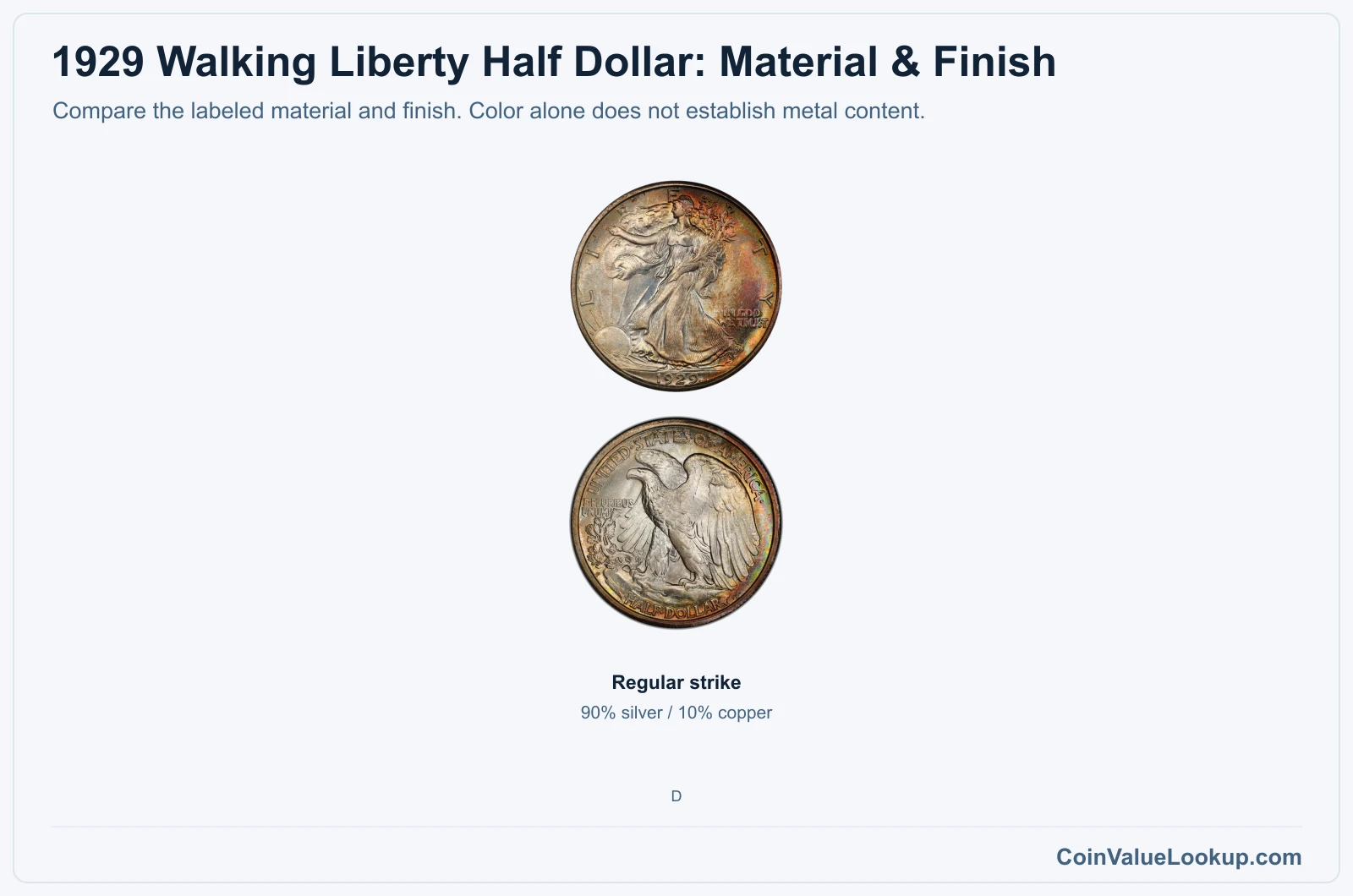
The 1929 Walking Liberty Half Dollar is struck in 90% silver and 10% copper, with a nominal weight of 12.50 grams. Toning or patina does not change the underlying alloy, so a dark coin is still silver.
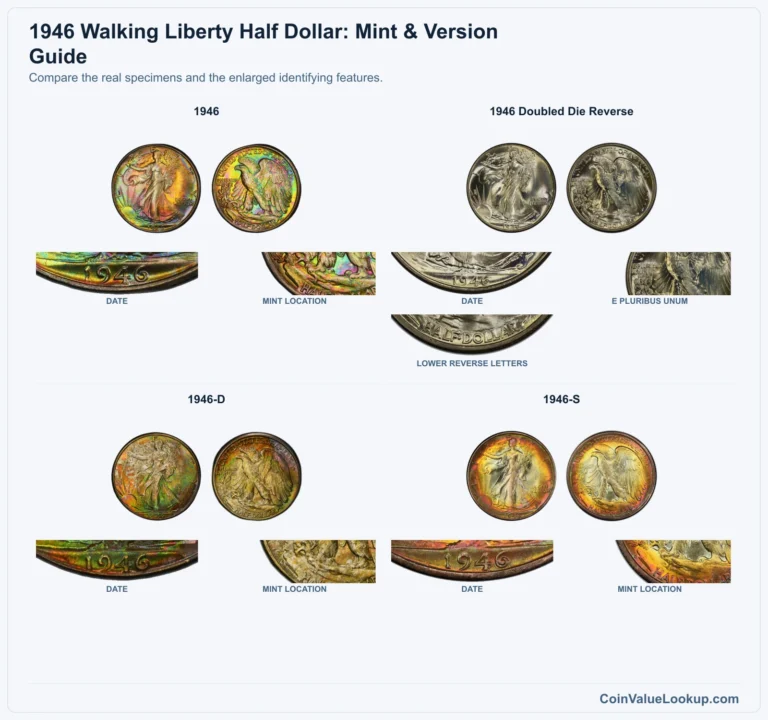
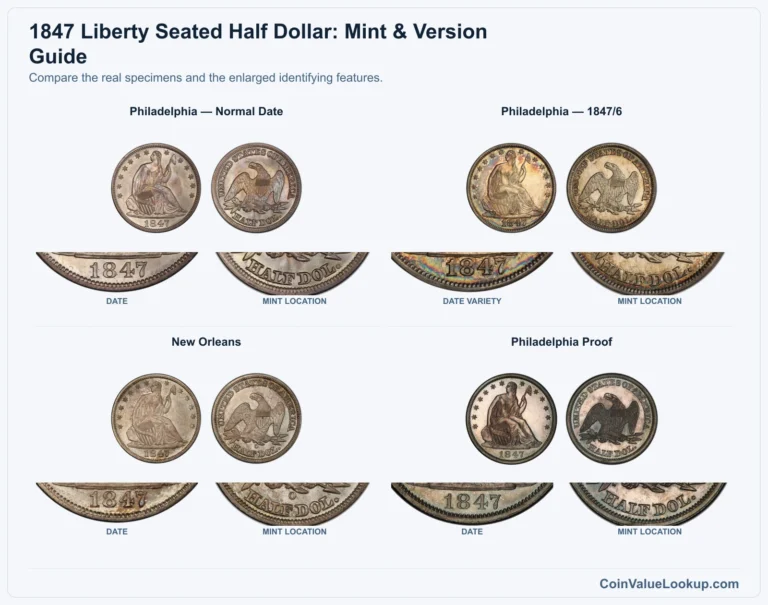
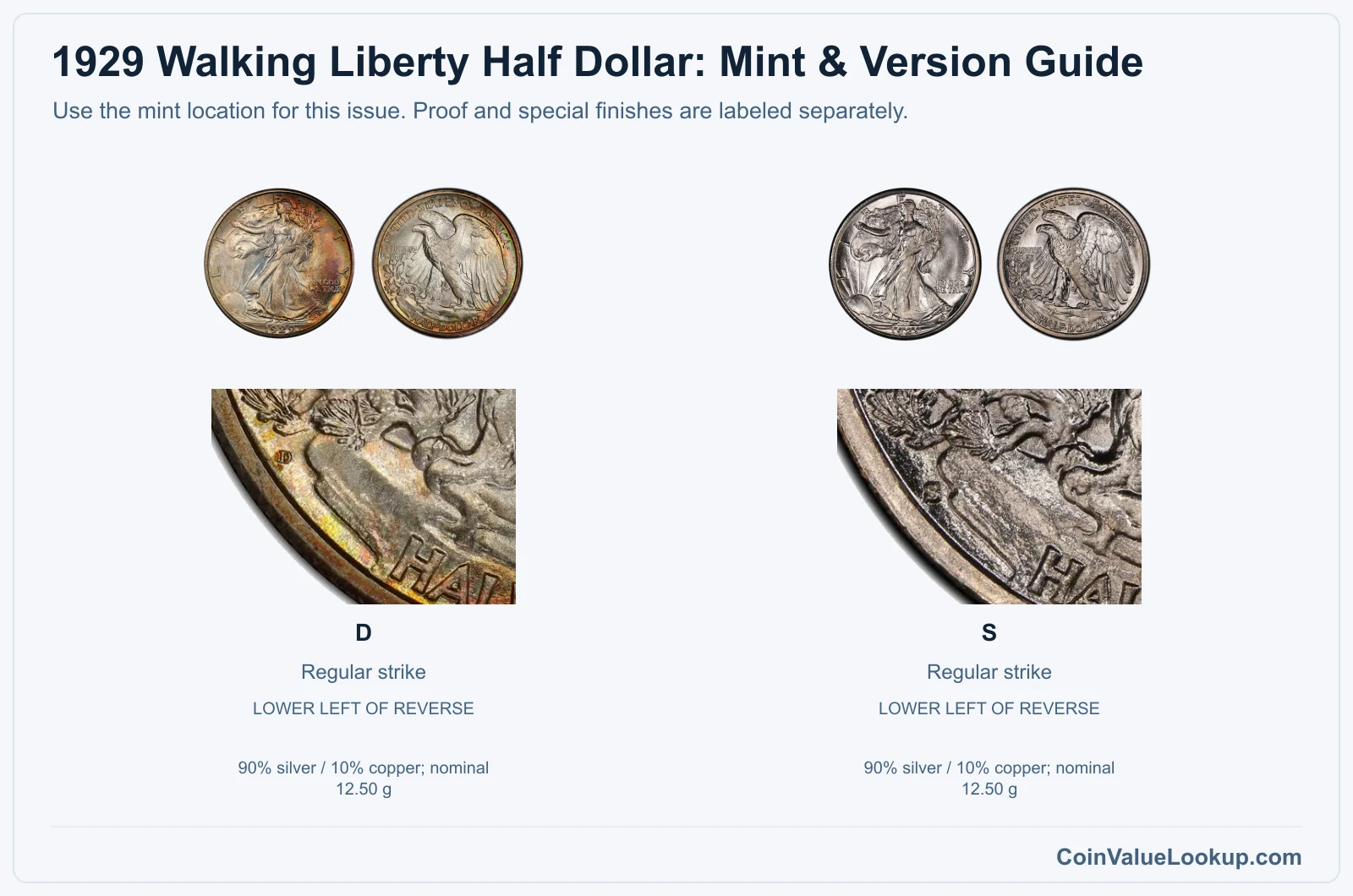
This year was produced at two mints: Denver (D) and San Francisco (S). Philadelphia did not strike a 1929 half dollar, so there is no "no mintmark" branch to worry about.
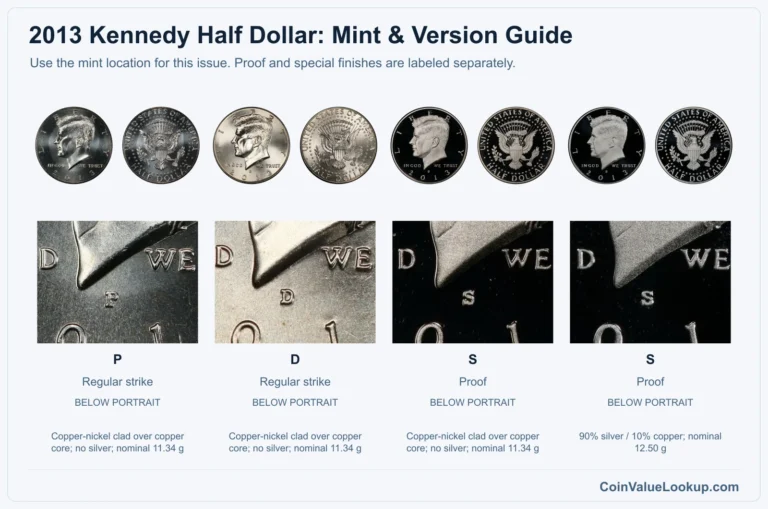
For 1929, the mintmark sits on the reverse, at the lower left near the 8 o'clock position. If you flip the coin over and look just below the branch the eagle stands on, you should spot a small D or S.
Earlier Walking Liberty dates (1916 and part of 1917) placed the mintmark on the obverse, but that does not apply here.
Before checking any value chart, confirm you actually have a business strike and not a cleaned, polished or damaged coin. Cleaned pieces lose their original luster and often show fine hairlines under magnification.
Those are not equivalent to problem-free examples at the same grade.
Step 2: Check Your 1929 Walking Liberty Half Dollar Grade
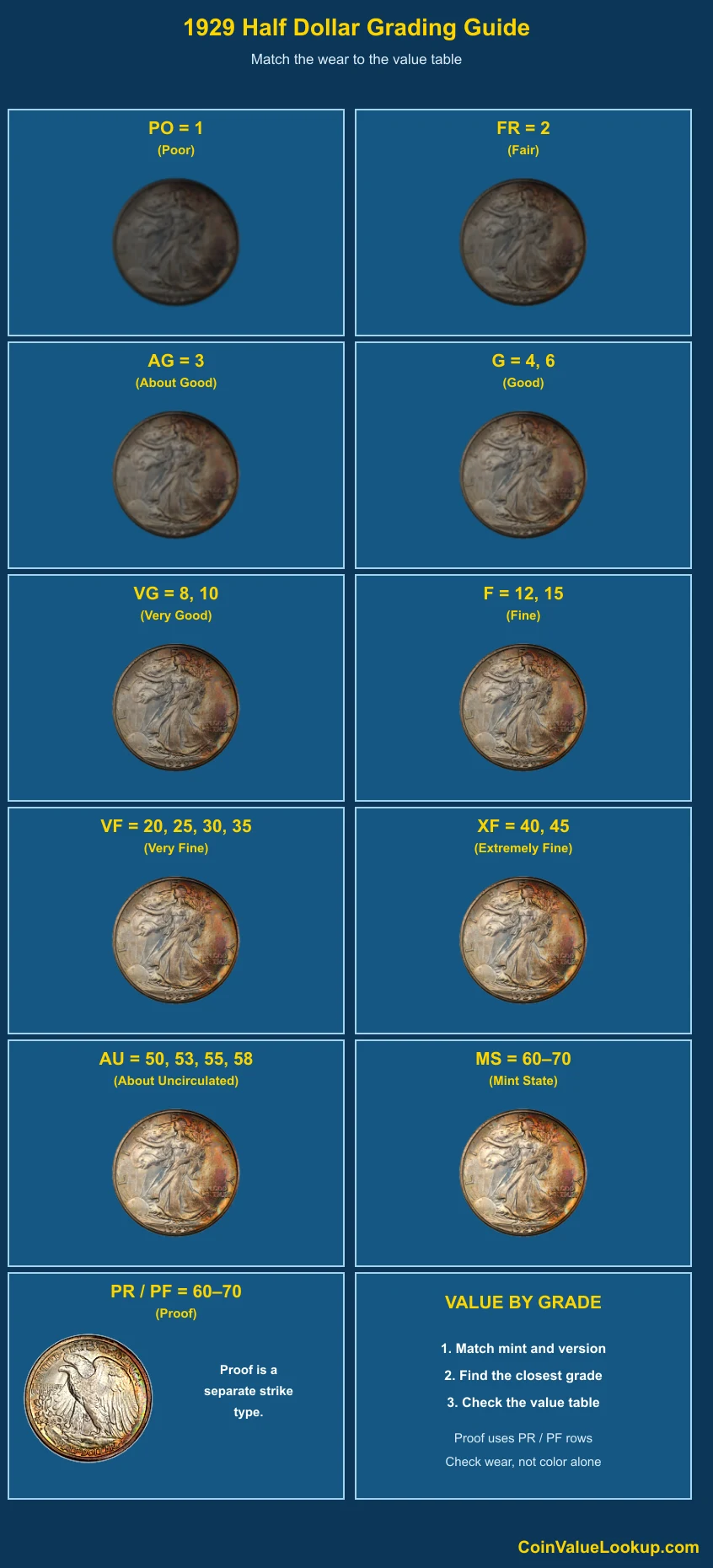
Grading a Walking Liberty half dollar means checking specific high points for actual metal loss versus original softness. Start with Liberty's head, her left hand holding the branches, and the area across her breast and skirt folds.
These wear first. On the reverse, examine the eagle's breast feathers, legs and the tops of the wing feathers.
Here is the catch with Walkers: the Denver and San Francisco mints often delivered coins with weak central strikes, even on brand-new pieces. A soft hand or mushy head detail does not automatically mean the coin circulated.
Look at the fields around the design. If the original mint luster is still rolling across the surface and there is no actual smoothing or friction, you may have an uncirculated coin with a weak strike rather than a worn one.
Use the comparison image to match your coin's wear pattern against known grade examples. Pay attention to the transition from the flat areas into the design relief.
Genuine wear creates a uniform flattening, while a weak strike leaves the surrounding luster intact.
Step 3: Check 1929 Walking Liberty Half Dollar Value by Mint and Version
1929 Walking Liberty Half Dollar — D
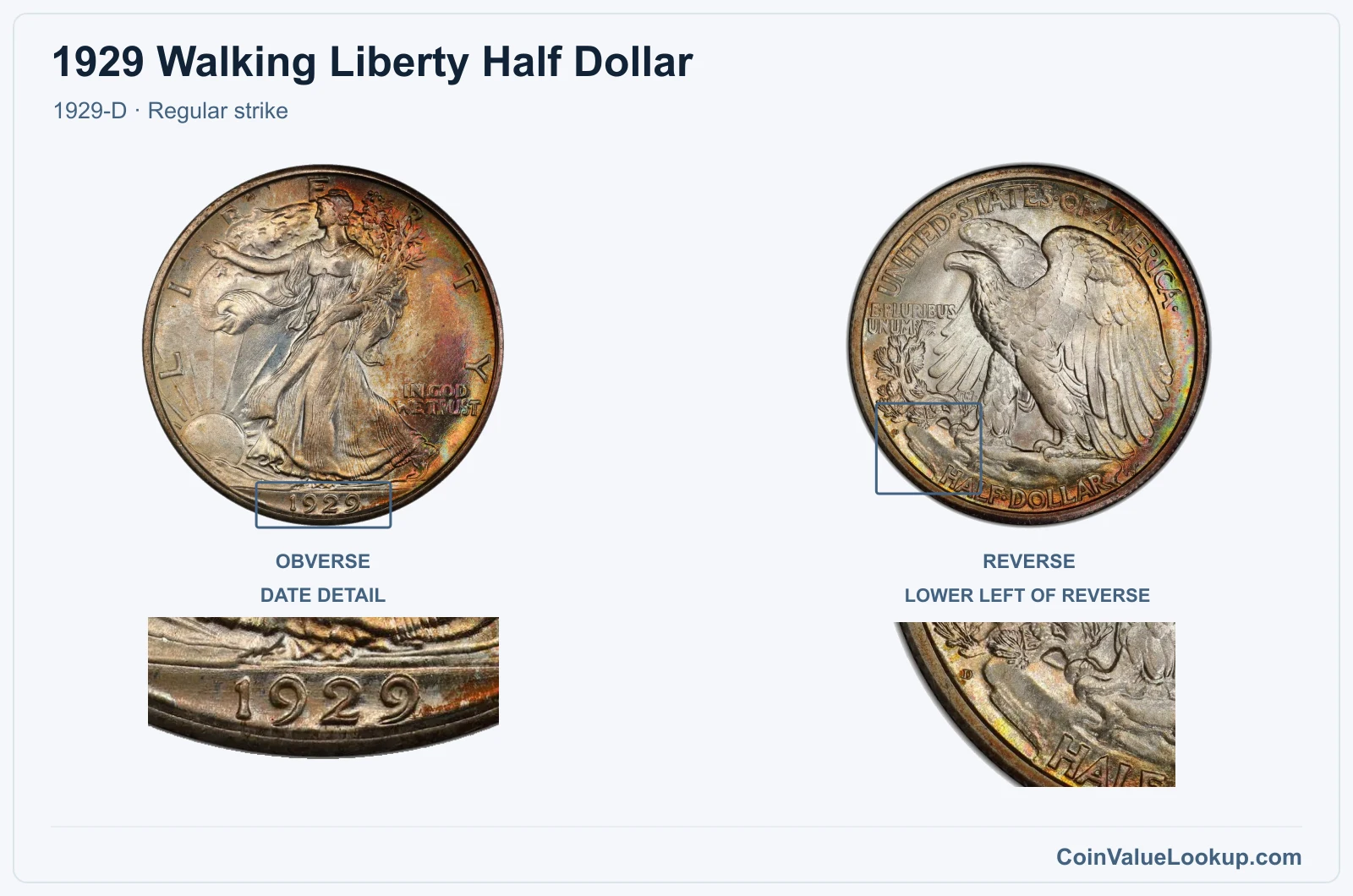
The 1929-D was struck at the Denver Mint. Look for the small "D" on the reverse at the lower left.
Guide estimates place this branch at about $39.00 in Good-4 and around $1,363.00 in MS63, according to USA Coin Book. These are reference anchors, not guaranteed offers.
Silver content alone gives the coin a floor value, but condition and originality drive the collector premium above melt. Cleaned or damaged coins trade well below a problem-free example at the same technical grade.
When evaluating yours, check for hairlines under light, unnatural brightness, or tooling marks around the devices. If the surfaces look original and the detail is strong, especially across Liberty's hand and the eagle's breast, you are in good shape.
Range Grade
Price Auction Records Appraisal PO PO 1
—
Coin Identifier FR FR 2
—
Coin Identifier AG AG 3
—
Coin Identifier G G 4
—
Coin Identifier
G 6
—
Coin Identifier VG VG 8
—
Coin Identifier
VG 10
Coin Identifier F F 12
Coin Identifier
F 15
Coin Identifier VF VF 20
—
Coin Identifier
VF 25
Coin Identifier
VF 30
Coin Identifier
VF 35
Coin Identifier XF XF 40
Coin Identifier
XF 45
Coin Identifier AU AU 50
Coin Identifier
AU 53
Coin Identifier
AU 55
Coin Identifier
AU 58
Coin Identifier MS MS 60
Coin Identifier
MS 61
Coin Identifier
MS 62
Coin Identifier
MS 63
Coin Identifier
MS 64
Coin Identifier
MS 65
Coin Identifier
MS 66
Coin Identifier
MS 67
Coin Identifier
MS 68
—
—
—
MS 69
—
—
—
MS 70
—
—
—
1929 Walking Liberty Half Dollar — S
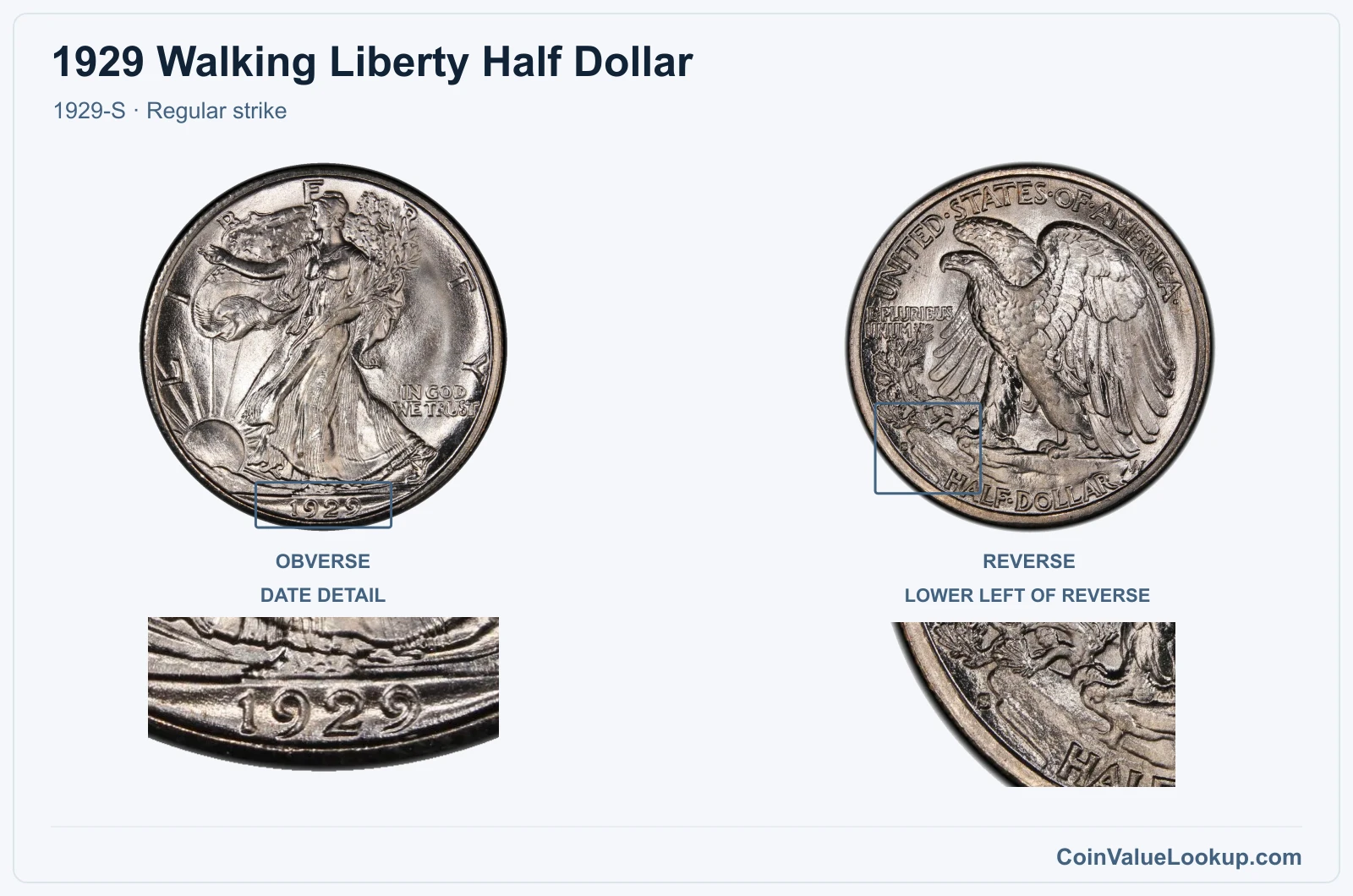
The 1929-S came from the San Francisco Mint, marked by a small "S" on the reverse lower left. USA Coin Book guide estimates put this branch at roughly $39.00 in Good-4 and approximately $1,409.00 at the MS63 level.
Coin Value Lookup is a handy starting point if you want to look up guides for other dates or denominations in the Walking Liberty series, or any other U.S. coin series you are sorting through.
Like the Denver issue, the San Francisco strikes can show weak central detail even on uncirculated coins. Do not downgrade based on a soft hand or head alone.
Instead, check the fields for surviving luster and look for actual contact wear. A problem-free 1929-S with strong detail in higher grades is a genuinely scarce coin and will command a meaningful premium over a typical soft-struck survivor.
Range Grade
Price Auction Records Appraisal PO PO 1
—
Coin Identifier FR FR 2
—
Coin Identifier AG AG 3
—
Coin Identifier G G 4
—
Coin Identifier
G 6
—
Coin Identifier VG VG 8
—
Coin Identifier
VG 10
—
Coin Identifier F F 12
—
Coin Identifier
F 15
Coin Identifier VF VF 20
—
Coin Identifier
VF 25
Coin Identifier
VF 30
Coin Identifier
VF 35
Coin Identifier XF XF 40
Coin Identifier
XF 45
Coin Identifier AU AU 50
Coin Identifier
AU 53
Coin Identifier
AU 55
Coin Identifier
AU 58
Coin Identifier MS MS 60
Coin Identifier
MS 61
Coin Identifier
MS 62
Coin Identifier
MS 63
Coin Identifier
MS 64
Coin Identifier
MS 65
Coin Identifier
MS 66
Coin Identifier
MS 67
Coin Identifier
MS 68
—
—
—
MS 69
—
—
—
MS 70
—
—
—
1929 Walking Liberty Half Dollar Error List
1. 1929 Walking Liberty Half Dollar — Off-Center Strike
An off-center strike happens when the planchet is not seated properly between the dies, producing a displaced design with an unstruck crescent along part of the rim. On a 1929 Walking Liberty Half Dollar, the key diagnostic is that the entire design shifts in one direction, leaving a blank area on the opposite side.
The date should still be visible for the coin to hold strong collector interest.
Do not confuse an off-center strike with a clipped planchet, which removes a curved bite from the edge, or with post-mint damage where someone flattened or bent the coin after it left the press. A genuine off-center error will show a clean, uniform blank area and the struck portion will have normal detail for its grade.
No specific price range is available for this error on the 1929 date. Value depends on the percentage of off-center shift, whether the date is readable, and the coin's overall condition.
2. 1929 Walking Liberty Half Dollar — Wrong Planchet / Off-Metal Strike
A wrong planchet error means the coin was struck on a blank intended for a different denomination or possibly a different metal entirely. On a 1929 half dollar, the clearest diagnostic is a mismatch in weight, diameter or edge profile compared to the standard 12.50-gram, 30.6 mm silver planchet.
The design may appear incomplete or distorted if the blank was smaller or thinner than intended.
Be cautious here. Coins that look odd in color or weight could be victims of plating, acid treatment, environmental corrosion or deliberate alteration rather than genuine mint errors.
Compare your coin's measured weight on a precise scale against the known standard. No adopted price range is available for this error on the 1929 date.
The specific wrong planchet involved, the completeness of the design and the coin's preservation all factor into what a collector would pay.
3. 1929 Walking Liberty Half Dollar — Broadstrike
A broadstrike occurs when a coin is struck without the retaining collar that normally constrains the planchet and forms the reeded edge. The result is a coin that spreads outward slightly, appearing wider than normal, with the design fully present but the rim weak or absent.
The edge will typically be smooth or irregular instead of showing the expected reeding of a standard half dollar.
The whole design should still be centered and complete, which separates a broadstrike from an off-center error. Also watch out for coins that were simply flattened after leaving the mint, perhaps by a train or a vise.
Post-mint flattening usually distorts the design unevenly and may show tool marks. No specific price is available for a broadstrike on the 1929 Walking Liberty Half Dollar.
Condition and the degree of spread determine collector interest.
4. 1929 Walking Liberty Half Dollar — Doubled Die
A doubled die error shows consistent doubling of design elements caused during the die-making process. On a 1929 Walking Liberty Half Dollar, look for separation, notching or shelf-like doubling on lettering, the date, or major design features.
The doubling will appear in the same position on every coin struck from that die, so it is uniform and directional.
The critical distinction is between a true doubled die and machine doubling. Machine doubling is flat, shelf-like and typically affects one side of the raised design.
It is far more common and worth much less. Also rule out optical illusions from reflective surfaces or post-mint impressions from contact with other coins.
No adopted price range is available for a doubled die on this date. The strength of the doubling, which design elements are affected and the coin's overall grade all influence value.
Have any suspect coin examined by a professional grading service for confirmation.