1935 Walking Liberty Half Dollar Coin Value: How Much Is It Worth?
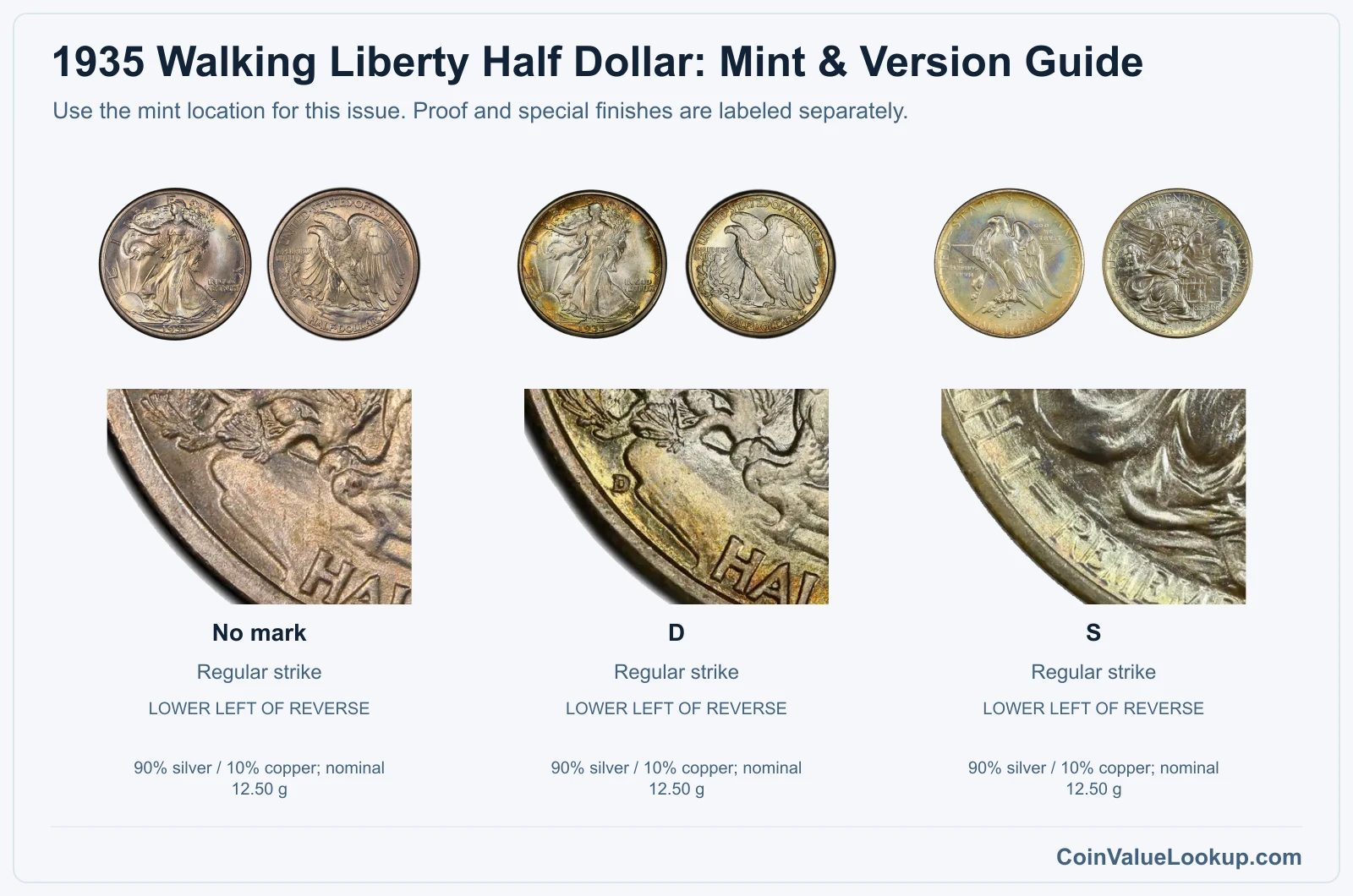
The 1935 Walking Liberty Half Dollar is a 90% silver coin that collectors prize for its bold Art Deco design and honest silver weight. Guide estimates for the three business-strike branches range from about $34.00 in well-worn Good-4 condition up to $684.00 at the Mint State 63 level, depending on which mint produced your coin.
These are reference anchors from a published guide, not guaranteed selling prices or current silver-melt quotes. Mint, condition, and original surfaces all matter.
Fast Way to Identify Your 1935 Walking Liberty Half Dollar
The quickest way to start figuring out what your 1935 Walker is worth is to upload clear photos of both the front and back. Our identifier can give you a preliminary read on which mint branch you have and a rough condition estimate.
Good lighting and a sharp focus on the mintmark area help a lot.
1935 Walking Liberty Half Dollar Value
Upload both sides of your 1935 Walking Liberty Half Dollar.
Front Obverse
Upload photo
Back Reverse
Upload photo
Which 1935 Walking Liberty Half Dollar Versions Are Worth Money?
- The 1935-S (San Francisco) branch carries the highest guide estimate at MS63, reaching $684.00, nearly double the Denver issue at the same grade.
- The 1935-D (Denver) branch jumps sharply from $34.00 in G4 to $394.00 in MS63, making well-preserved examples worth careful grading.
- The 1935 Philadelphia issue is the most affordable in uncirculated condition at $105.00 in MS63, but original problem-free surfaces still matter for full value.
- All three branches share a $34.00 floor in Good-4 condition tied partly to their silver content, so even a heavily worn Walker has baseline worth.
Step 1: Identify Your 1935 Walking Liberty Half Dollar Mint Mark and Version
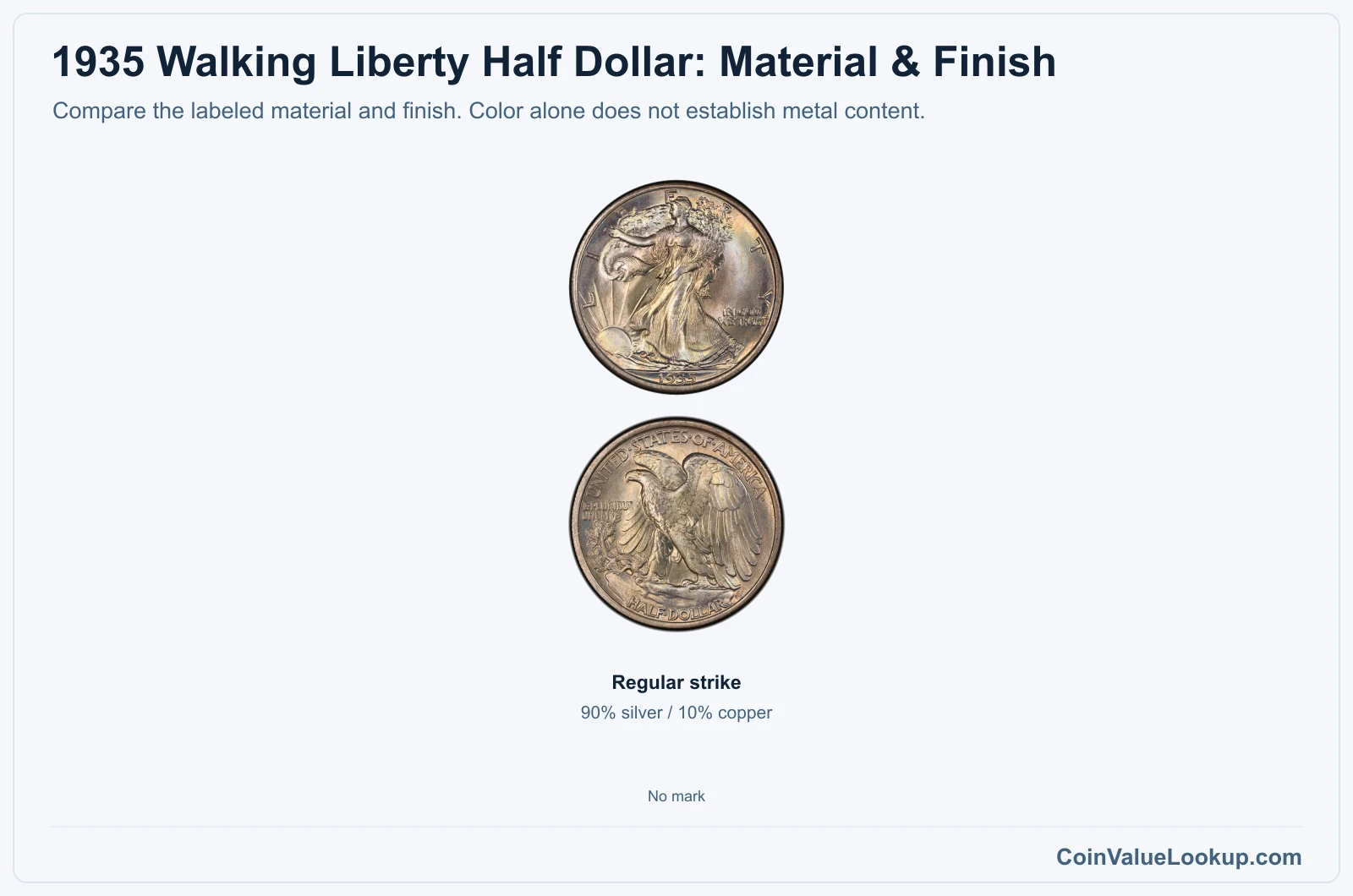
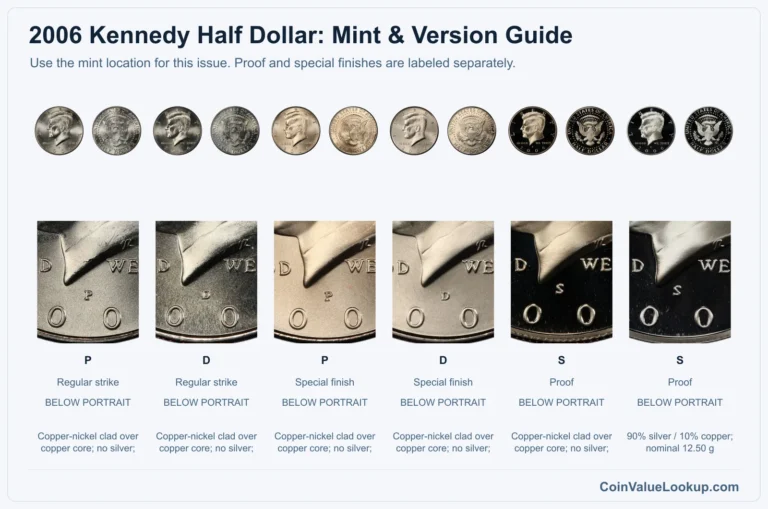
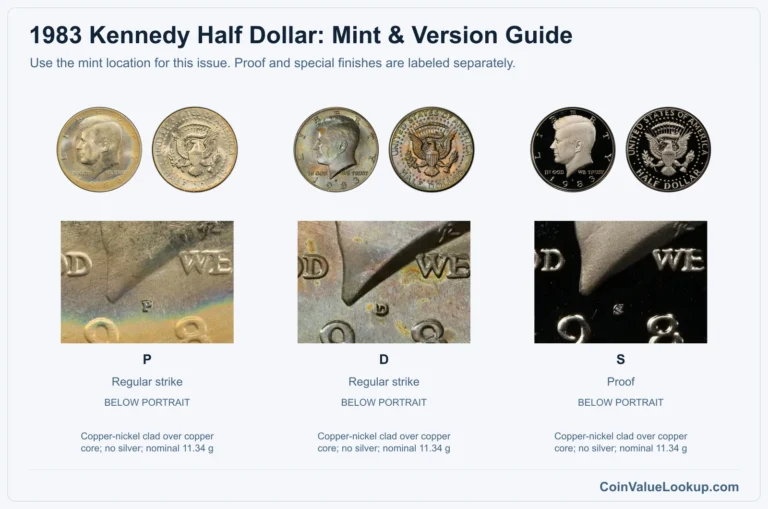
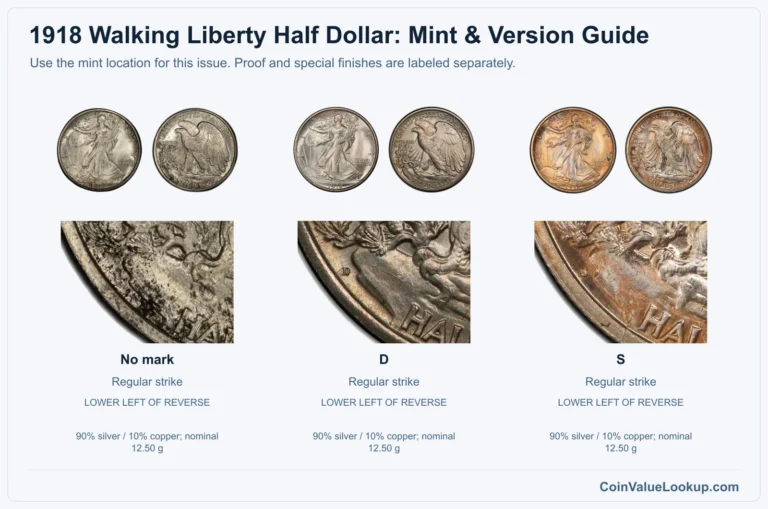
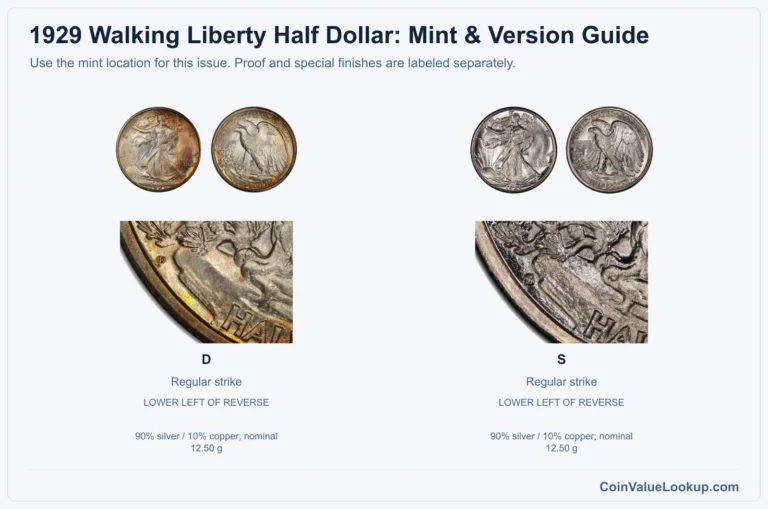
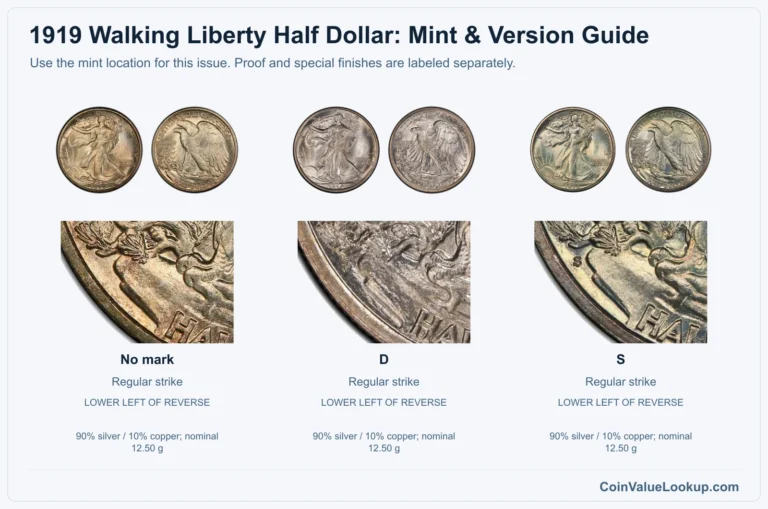
The 1935 Walking Liberty Half Dollar was struck at three mints: Philadelphia (no mintmark), Denver (D), and San Francisco (S). Your first job is finding — or not finding — that tiny letter.
For 1935, the mintmark sits on the reverse, near the lower left, roughly at the 8-o'clock position behind the eagle's tail feathers. If nothing is there, you have a Philadelphia coin.
All three branches share the same composition: 90% silver and 10% copper, weighing about 12.50 grams. Toning or discoloration does not change the underlying alloy.
One pitfall with Walkers: the series is notorious for weak central strikes, especially on Liberty's hand, head, and the eagle's breast feathers. A coin can be technically uncirculated and still show mushy detail in those spots.
Don't confuse a soft strike for wear — look at the surrounding luster and check whether high points show actual smoothing or just incomplete metal flow from the die.
Step 2: Check Your 1935 Walking Liberty Half Dollar Grade
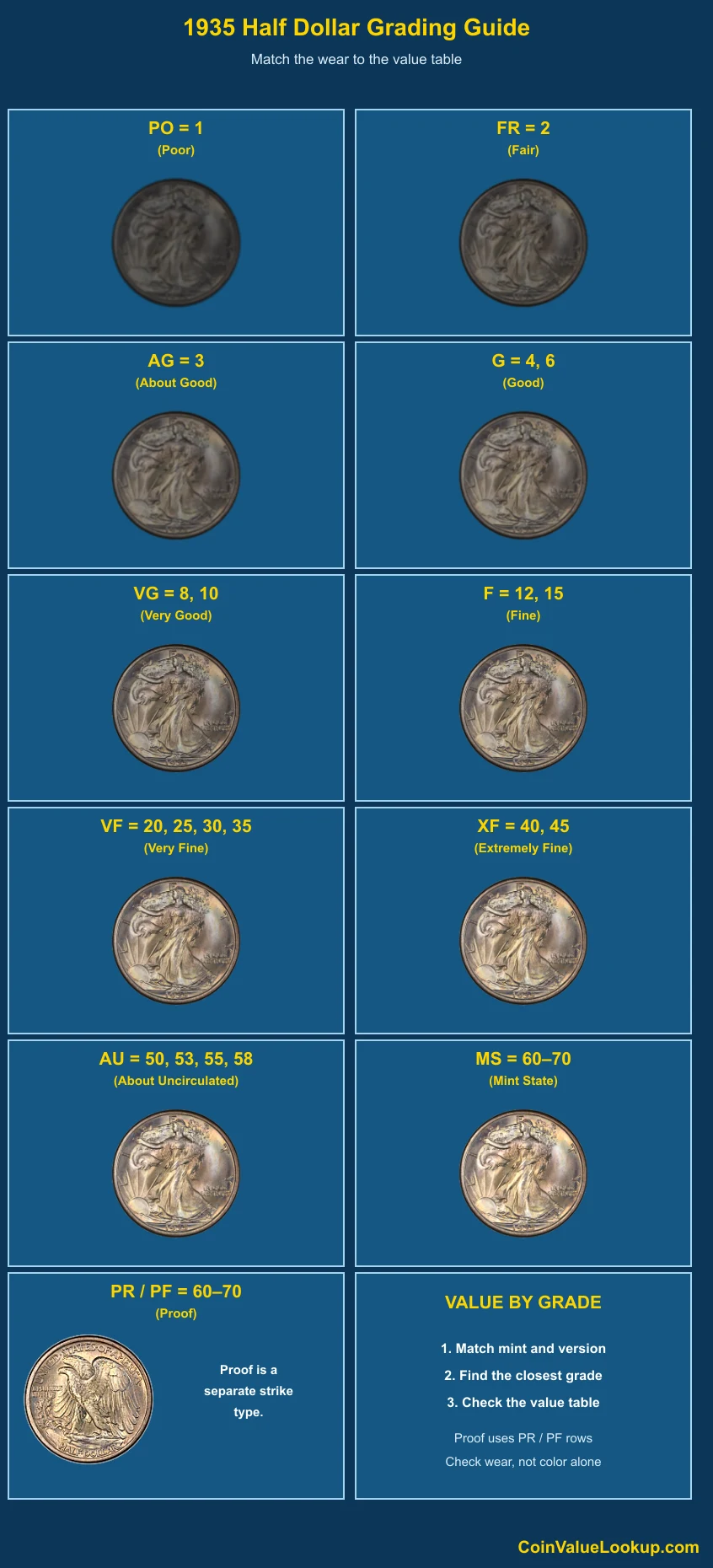
Start with Liberty's head and the area around her left hand on the obverse. These are the first spots to lose detail from circulation.
On the reverse, check the eagle's breast, legs, and the top edges of the wing feathers.
A coin grading around Good-4 will show Liberty as a mostly flat outline, with the motto and date still readable. At Fine or Very Fine, the skirt lines and hand begin to separate.
By About Uncirculated, only the very highest points — breast, knee, hand — show light friction.
Here is where Walkers get tricky. A weakly struck Mint State coin can look worse than a lightly circulated, well-struck one.
The key is luster: if the original cartwheel sheen covers the flat areas without interruption, the coin likely never circulated. Actual wear creates dull, smooth patches that break through the luster.
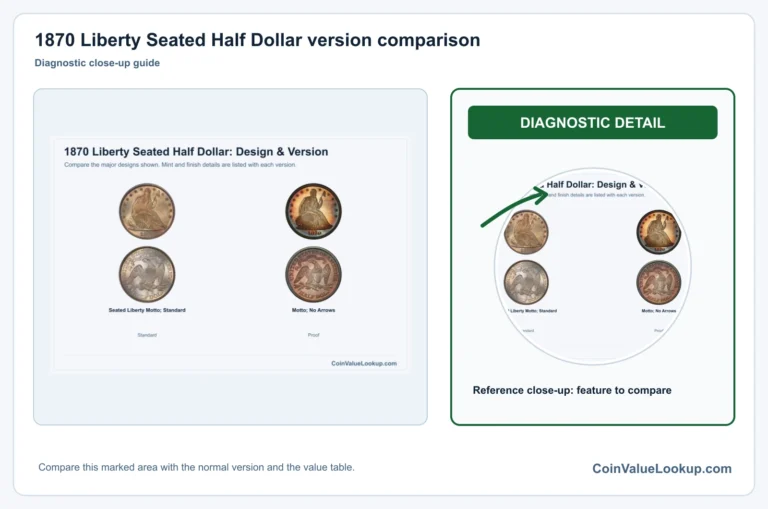
Use the comparison image to see these differences side by side. Cleaned or damaged pieces — even in high technical grade — trade for less than problem-free examples, so look for original surfaces too.
Step 3: Check 1935 Walking Liberty Half Dollar Value by Mint and Version
1935 Walking Liberty Half Dollar
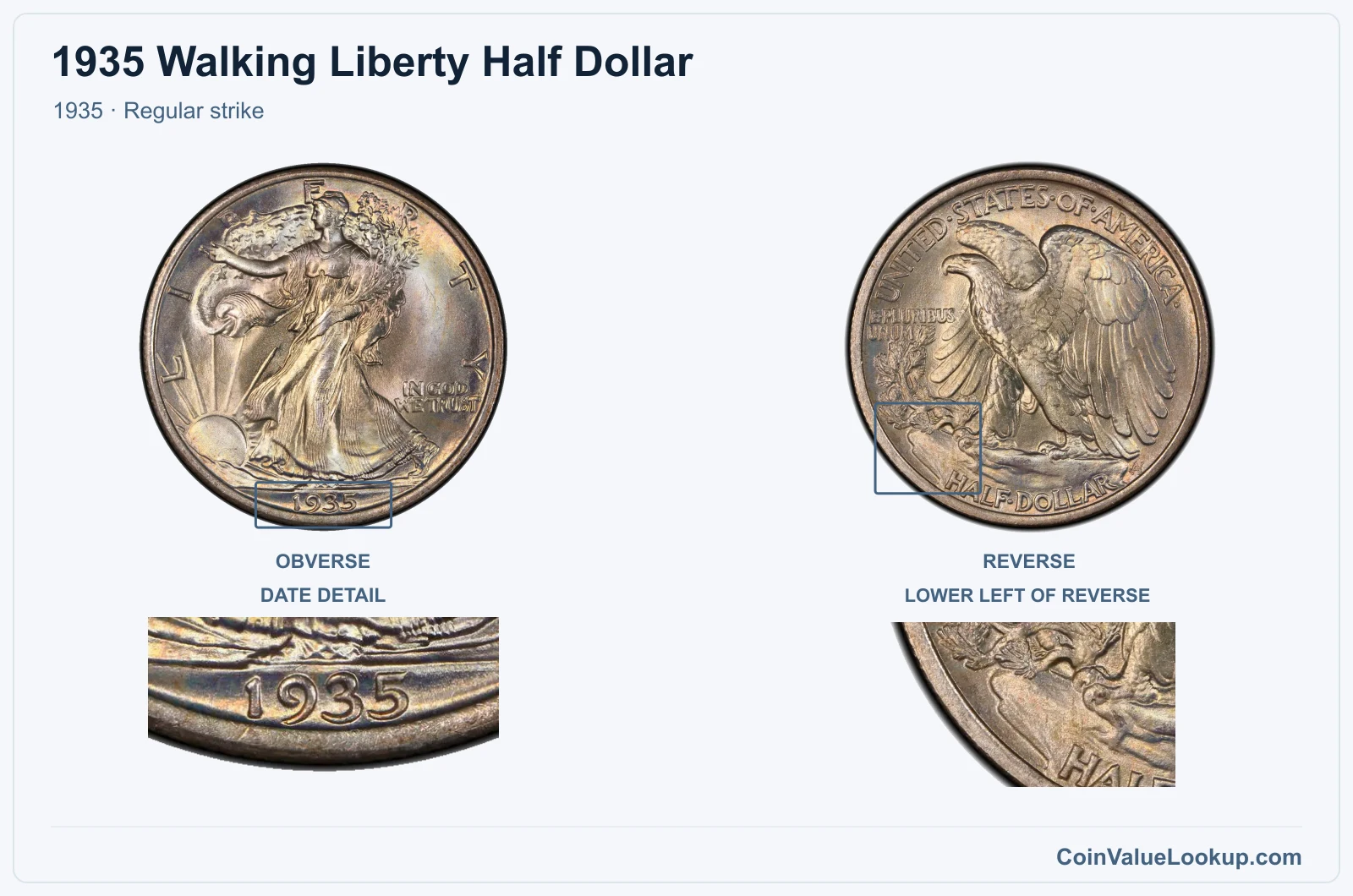
The 1935 Philadelphia half dollar has no mintmark — that blank space on the reverse lower left confirms it. In well-worn Good-4 condition, guide estimates sit at about $34.00.
Jump to MS63 and the figure is roughly $105.00, making Philly the most accessible branch in uncirculated grades.
Before relying on any value chart, confirm you actually have a no-mintmark coin and assess the surfaces honestly. Cleaned silver Walkers are everywhere, and they do not command the same prices as original, naturally toned pieces.
A coin with intact cartwheel luster and no harsh hairlines is what the guide numbers assume.
Coin Value Lookup is a good starting point if you want to look up other dates in the Walking Liberty series or compare values across different denominations.
Range Grade
Price Auction Records Appraisal PO PO 1
—
Coin Identifier FR FR 2
—
Coin Identifier AG AG 3
—
Coin Identifier G G 4
—
Coin Identifier
G 6
—
Coin Identifier VG VG 8
—
Coin Identifier
VG 10
—
Coin Identifier F F 12
—
Coin Identifier
F 15
—
Coin Identifier VF VF 20
Coin Identifier
VF 25
—
Coin Identifier
VF 30
—
Coin Identifier
VF 35
—
Coin Identifier XF XF 40
—
Coin Identifier
XF 45
—
Coin Identifier AU AU 50
—
Coin Identifier
AU 53
Coin Identifier
AU 55
Coin Identifier
AU 58
Coin Identifier MS MS 60
Coin Identifier
MS 61
Coin Identifier
MS 62
Coin Identifier
MS 63
Coin Identifier
MS 64
Coin Identifier
MS 65
Coin Identifier
MS 66
Coin Identifier
MS 67
Coin Identifier
MS 68
Coin Identifier
MS 69
—
—
—
MS 70
—
—
—
1935 Walking Liberty Half Dollar — D
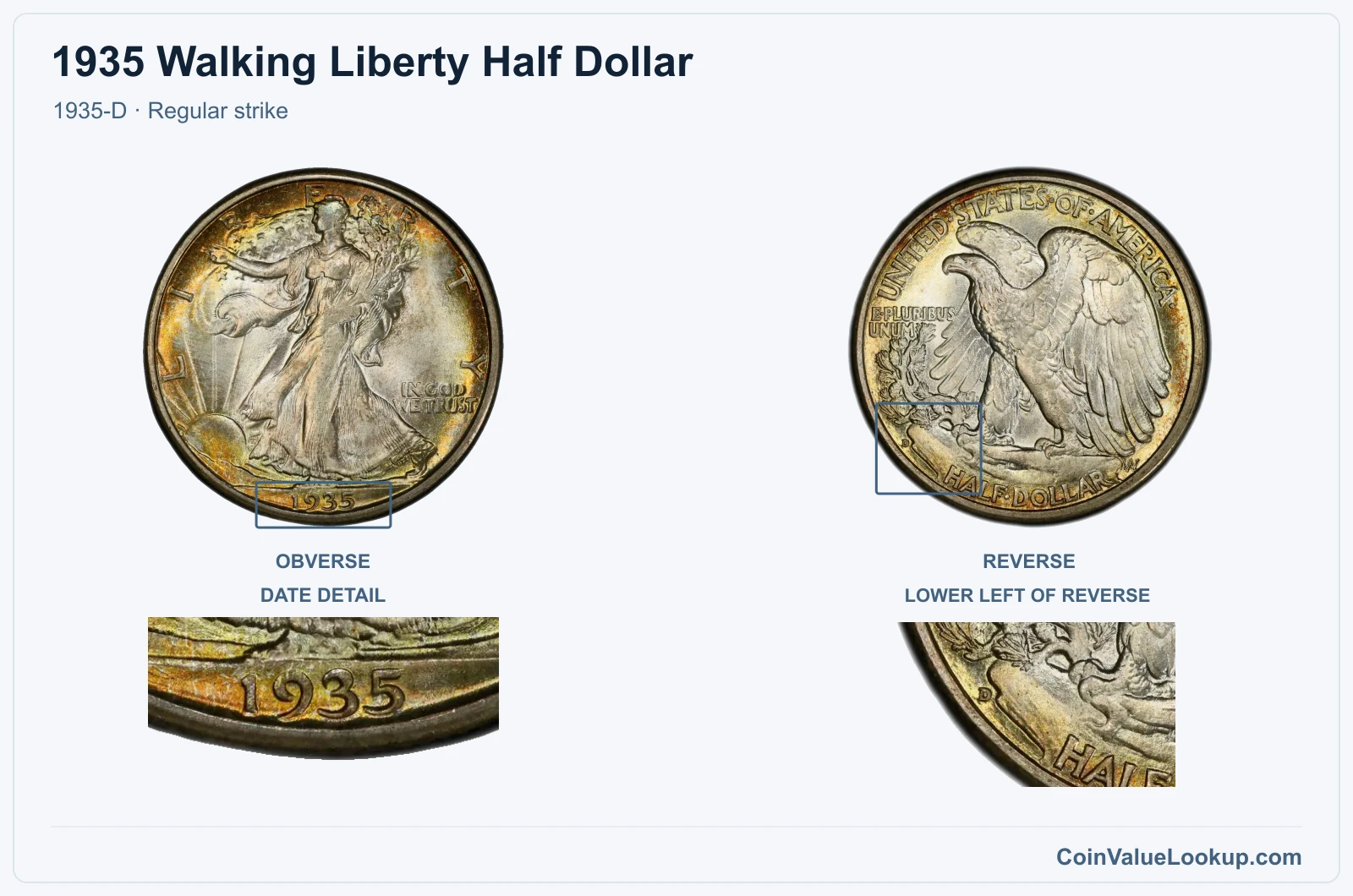
A small "D" on the reverse lower left tells you this is the 1935-D, struck in Denver. The spread between low and high grades is dramatic: about $34.00 at Good-4 versus $394.00 at MS63, according to USA Coin Book guide estimates.
That nearly twelve-fold jump means condition matters enormously. A Denver Walker with strong central detail and clean original luster is a genuinely different proposition from a flat, cleaned example.
Pay special attention to Liberty's hand and head — weak strikes are common on Denver issues, and you need to separate soft striking from actual wear by examining the luster field around those areas.
Range Grade
Price Auction Records Appraisal PO PO 1
—
Coin Identifier FR FR 2
—
Coin Identifier AG AG 3
—
Coin Identifier G G 4
—
Coin Identifier
G 6
—
Coin Identifier VG VG 8
—
Coin Identifier
VG 10
—
Coin Identifier F F 12
Coin Identifier
F 15
—
Coin Identifier VF VF 20
—
Coin Identifier
VF 25
—
Coin Identifier
VF 30
—
Coin Identifier
VF 35
—
Coin Identifier XF XF 40
—
Coin Identifier
XF 45
Coin Identifier AU AU 50
Coin Identifier
AU 53
Coin Identifier
AU 55
Coin Identifier
AU 58
Coin Identifier MS MS 60
Coin Identifier
MS 61
Coin Identifier
MS 62
Coin Identifier
MS 63
Coin Identifier
MS 64
Coin Identifier
MS 65
Coin Identifier
MS 66
Coin Identifier
MS 67
Coin Identifier
MS 68
—
—
—
MS 69
—
—
—
MS 70
—
—
—
1935 Walking Liberty Half Dollar — S
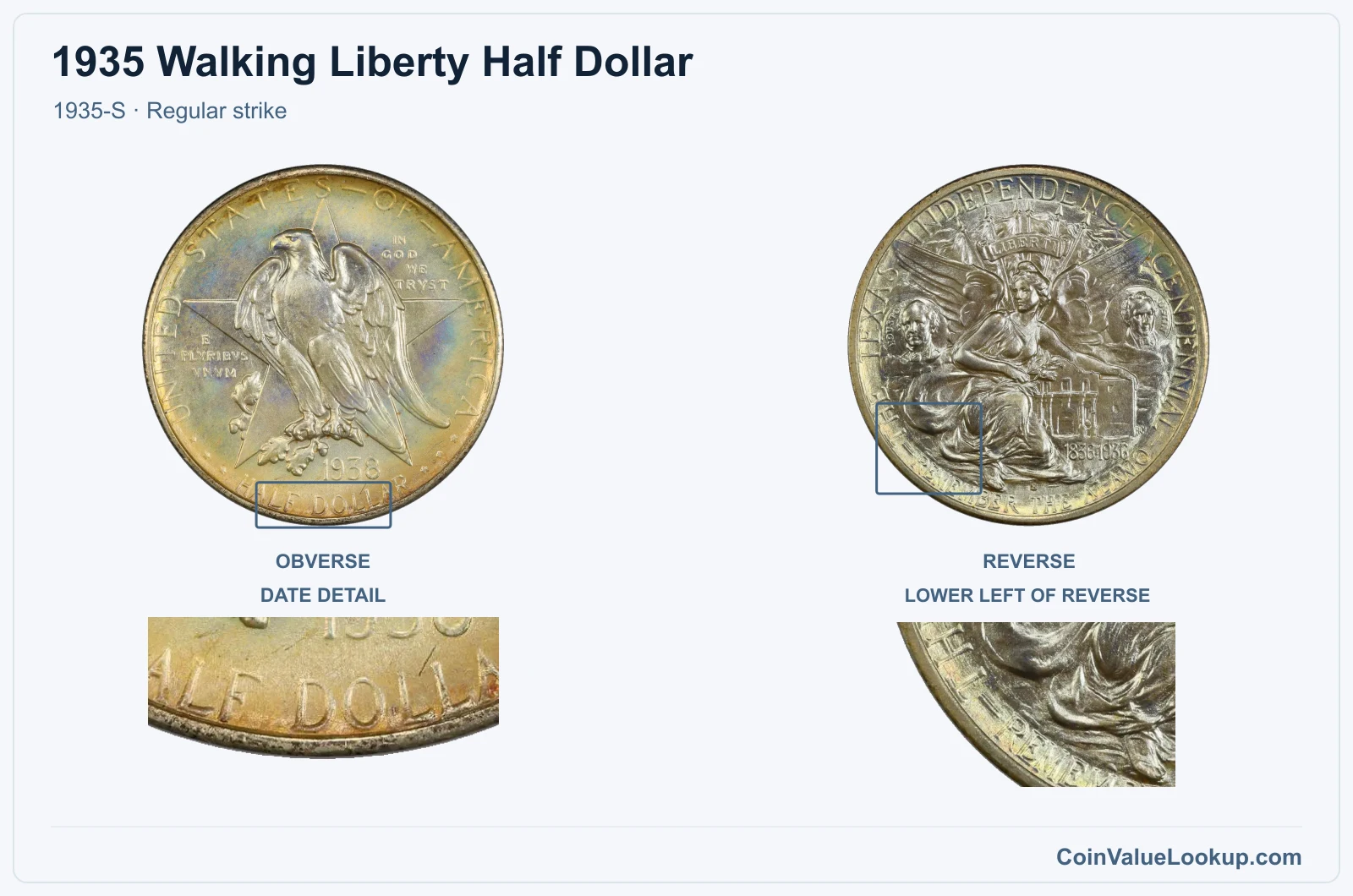
The 1935-S carries a small "S" mintmark on the reverse lower left and is the priciest regular branch this year. Guide estimates place it at about $34.00 in Good-4, then climb steeply to $684.00 at MS63 per USA Coin Book.
Why the premium? San Francisco Walkers from this era often came weakly struck and were heavily circulated in West Coast commerce, so survivors with strong detail and original mint luster are genuinely scarce.
If your 1935-S shows crisp skirt lines, a clear hand, and unbroken cartwheel luster, you may be holding something well above the typical survivor. Cleaned or damaged coins, though, lose most of that premium regardless of apparent detail.
Range Grade
Price Auction Records Appraisal PO PO 1
—
Coin Identifier FR FR 2
—
Coin Identifier AG AG 3
—
Coin Identifier G G 4
—
Coin Identifier
G 6
—
Coin Identifier VG VG 8
Coin Identifier
VG 10
—
Coin Identifier F F 12
—
Coin Identifier
F 15
—
Coin Identifier VF VF 20
—
Coin Identifier
VF 25
Coin Identifier
VF 30
Coin Identifier
VF 35
Coin Identifier XF XF 40
Coin Identifier
XF 45
Coin Identifier AU AU 50
Coin Identifier
AU 53
Coin Identifier
AU 55
Coin Identifier
AU 58
Coin Identifier MS MS 60
Coin Identifier
MS 61
Coin Identifier
MS 62
Coin Identifier
MS 63
Coin Identifier
MS 64
Coin Identifier
MS 65
Coin Identifier
MS 66
Coin Identifier
MS 67
Coin Identifier
MS 68
—
—
—
MS 69
—
—
—
MS 70
—
—
—
1935 Walking Liberty Half Dollar Error List
1. 1935 Walking Liberty Half Dollar — Off-Center Strike
An off-center strike happens when the planchet isn't seated properly between the dies, producing a displaced design and a blank crescent along part of the rim. On a 1935 Walking Liberty Half Dollar, this has been reported as a known error category.
To identify one, look for the design shifted noticeably in one direction with a corresponding unstruck area on the opposite side. The date and major design elements should still be visible for the coin to hold collector interest — a dramatic shift that obliterates the date is less desirable.
Don't confuse this with a clipped planchet, a one-sided die misalignment, or post-mint damage from a vise or hammer. Off-center coins show uniform unstruck metal in the crescent, not jagged edges or tool marks.
No specific price data is available, but value depends on the percentage of offset, the coin's grade, and whether the date remains legible.
2. 1935 Walking Liberty Half Dollar — Rotated Dies
A rotated die error means the obverse and reverse dies were misaligned in their rotation, so when you flip the coin top to bottom, the other side appears tilted rather than perfectly upright. Normal U.S. coin alignment puts both sides oriented 180 degrees apart.
To check your 1935 Walker, hold the obverse upright and rotate the coin on its vertical axis, like turning a page. The eagle on the reverse should appear upright.
If it's tilted — say 15 degrees, 45 degrees, or more — you may have a rotated die error. Larger rotations are scarcer and generally more desirable.
Be careful with photographs: a picture taken at an angle can mimic rotation. Always test with the physical coin in hand.
No specific price data is available for this error, so value depends on the degree of rotation, overall condition, and collector demand.
3. 1935 Walking Liberty Half Dollar — Doubled Die Obverse
A doubled die obverse on the 1935 Walking Liberty Half Dollar means the obverse die received a misaligned secondary impression during its manufacture, leaving consistent doubling visible on letters, digits, or design elements.
To search for it, compare your coin's obverse inscriptions — especially IN GOD WE TRUST, LIBERTY, and the date — against a known normal example under the same lighting. Genuine doubling shows as consistent separation or notching on the affected elements, not a flat shelf across them.
The most common lookalike is machine doubling, which produces flat, shelf-like distortion without the raised, separated profiles of a true doubled die. Reflections and worn die contours can also fool you.
No specific pricing is available, so value will depend on the strength of the doubling, which elements are affected, and the coin's overall condition.
4. 1935 Walking Liberty Half Dollar — Doubled Die Reverse
A doubled die reverse affects the back of the coin, where the eagle, HALF DOLLAR, E PLURIBUS UNUM, or UNITED STATES OF AMERICA may show doubled contours from a die-manufacturing misalignment.
Check the reverse lettering and design edges under magnification and consistent lighting. Compare directly to a normal 1935 Walker.
True doubling will be consistent across the affected area — the same direction, the same separation — rather than random or mushy.
Machine doubling is again the main impostor here. It tends to produce flat, displaced shelves rather than the distinct raised separation of a genuine doubled die.
Random nicks, corrosion, or contact damage can also mimic doubling on a quick glance. No price data is available for this variety, so value depends on doubling strength, affected area, and the coin's preservation.
5. 1935 Walking Liberty Half Dollar — Clipped Planchet
A clipped planchet error occurs when the blank was punched from an improperly fed strip of silver, leaving a missing curved, straight, or irregular section along the rim.
On a 1935 Walker, look for a concave bite out of the edge where the metal simply isn't there — not filed or cut away after striking. A genuine clip often shows a characteristic weakness in the design on the opposite side of the coin, called the Blakesley effect, where metal couldn't flow fully during striking.
Post-mint damage is the main lookalike. Filed notches, deliberate edge cuts, and corrosion all remove metal but leave different surface textures.
A real clip has smooth, rounded edges consistent with the original planchet punch. No specific pricing is available; value depends on clip size, visibility, and the coin's overall grade.