1938 Buffalo Nickel Coin Value: How Much Is It Worth?
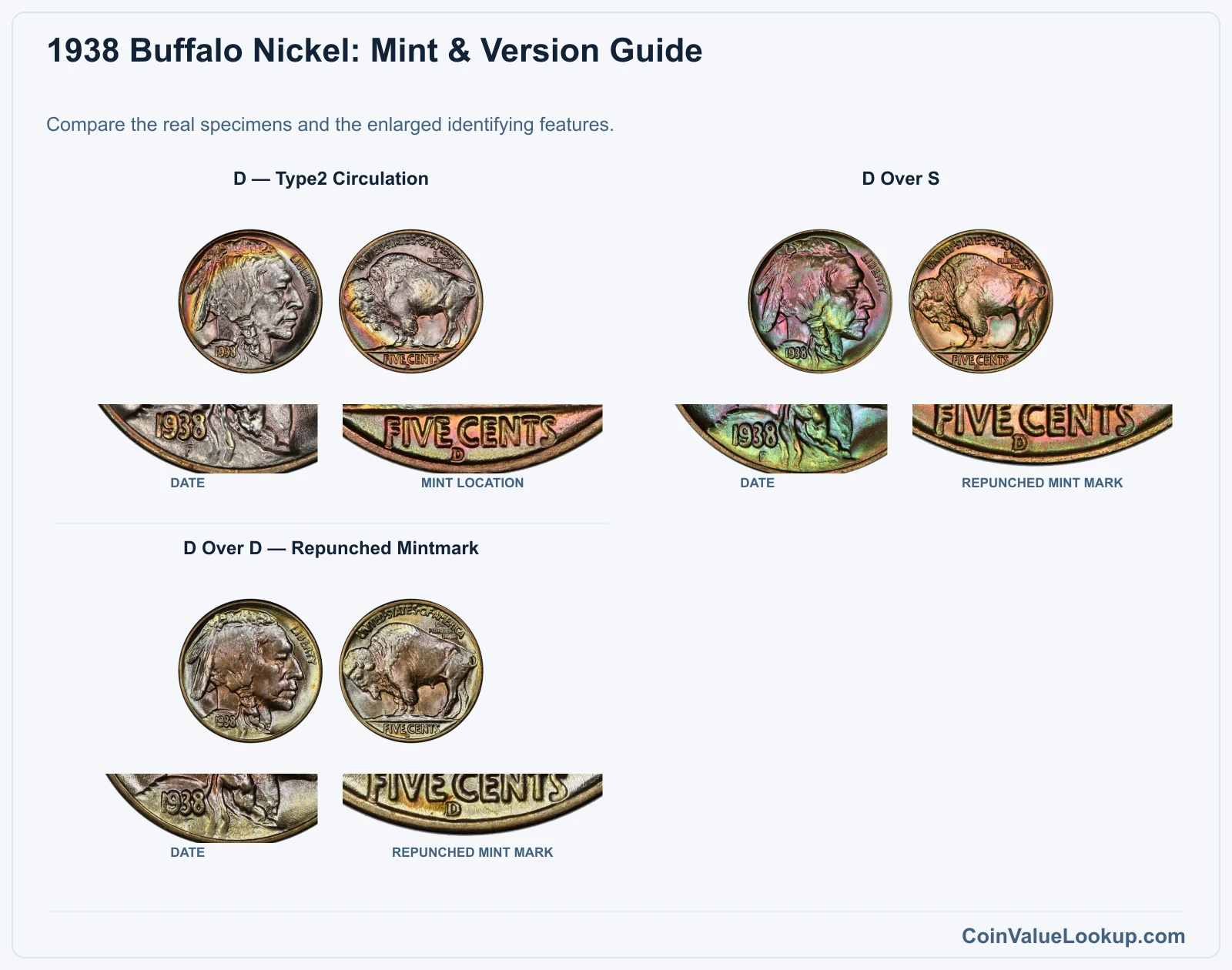
The 1938 Buffalo Nickel is the final year of the series, struck only at the Denver Mint. Guide estimates for ordinary circulation examples range from about $4.26 in G4 to $43 in MS63, depending on condition and variety.
That is not the ceiling, though — the D Over S variety and mint-state pieces with strong original surfaces can push well beyond those figures.
Fast Way to Identify Your 1938 Buffalo Nickel
Want a quick read on what you have? Upload clear photos of both the front and back of your 1938 Buffalo Nickel.
Make sure the date is legible and the mintmark area below FIVE CENTS on the reverse is in focus. That gives us enough for a preliminary identification of your coin's version and approximate condition.
1938 Buffalo Nickel Value
Upload both sides of your 1938 Buffalo Nickel.
Front Obverse
Upload photo
Back Reverse
Upload photo
Which 1938 Buffalo Nickel Versions Are Worth Money?
- The D Over S variety shows remnants of an S mintmark beneath the D, and its guide values run roughly $12 in G4 to $100 in MS63 — noticeably above the standard D issue.
- The D/D repunched mintmark, with the same D letter shifted, carries guide estimates around $7 in VF25 to $81 in MS65.
- Mint-state examples with full original luster and sharp strikes command the strongest prices across all versions.
- Error coins such as the Three-and-a-Half Legs or clipped planchets may carry additional value depending on the severity and condition of the piece.
Step 1: Identify Your 1938 Buffalo Nickel Mint Mark and Version
Every 1938 Buffalo Nickel was struck at Denver and carries a small D mintmark on the reverse, just below the words FIVE CENTS. The denomination sits in a recessed area — that is the Type 2 reverse design used from 1913 onward.
There is no Type 1 (raised mound) version for 1938.
The coin is 75% copper and 25% nickel, weighs about 5 grams, measures 21.2 mm across, and has a plain edge. No silver branch exists for this date.
The big thing to check is that D mintmark. On the D Over S variety, you can see remnants of an underlying S peeking out beneath the final D punch.
This is different from a D/D repunched mintmark, where the same letter was simply struck in a slightly different position. Grab a loupe and look carefully — the distinction matters for value.
If your nickel has no mintmark at all, you are likely looking at a 1938 Jefferson Nickel, which is a completely different coin and series.
Step 2: Check Your 1938 Buffalo Nickel Grade
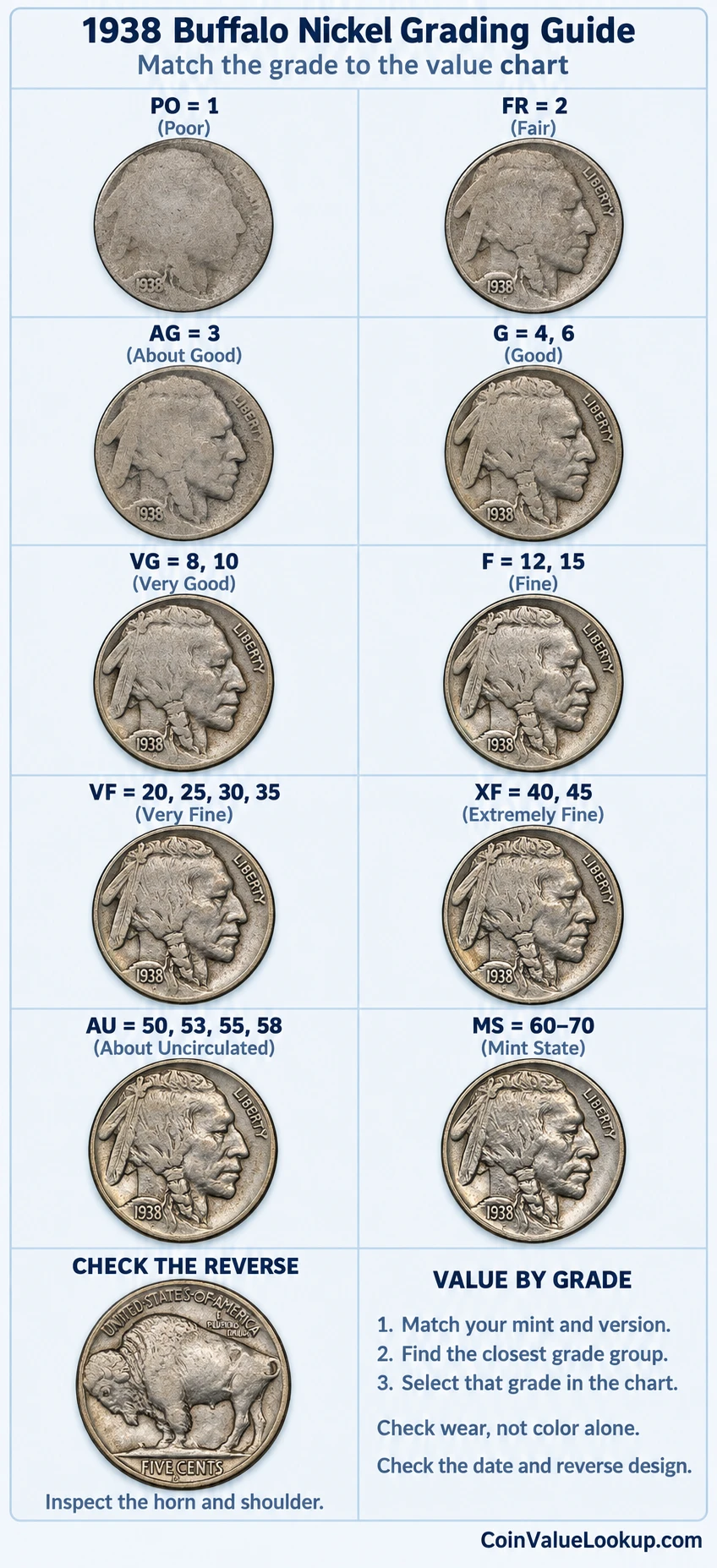
Start with the portrait on the obverse. Look at the hair braid detail, the cheekbone, and the area just above the ribbon tie — these wear first.
On the reverse, the bison's shoulder hump and horn tip are your key checkpoints.
A common trap: mistaking a weak strike for actual wear. Denver issues from this era sometimes left the factory with soft horn detail or mushy braid lines.
If the surrounding fields still show original cartwheel luster, the coin may grade higher than the soft spots suggest.
Compare your coin side by side with the grading comparison image. Check for scratches, rim dings, and contact marks in the fields.
Original surfaces with unbroken mint luster are what separate a $4 coin from a $40-plus coin.
One firm rule: never use acid or any chemical to "restore" a weak or dateless Buffalo Nickel. It destroys the surface and tanks the value to near zero.
Step 3: Check 1938 Buffalo Nickel Value by Mint and Version
1938 Buffalo Nickel — D — Type2 Circulation
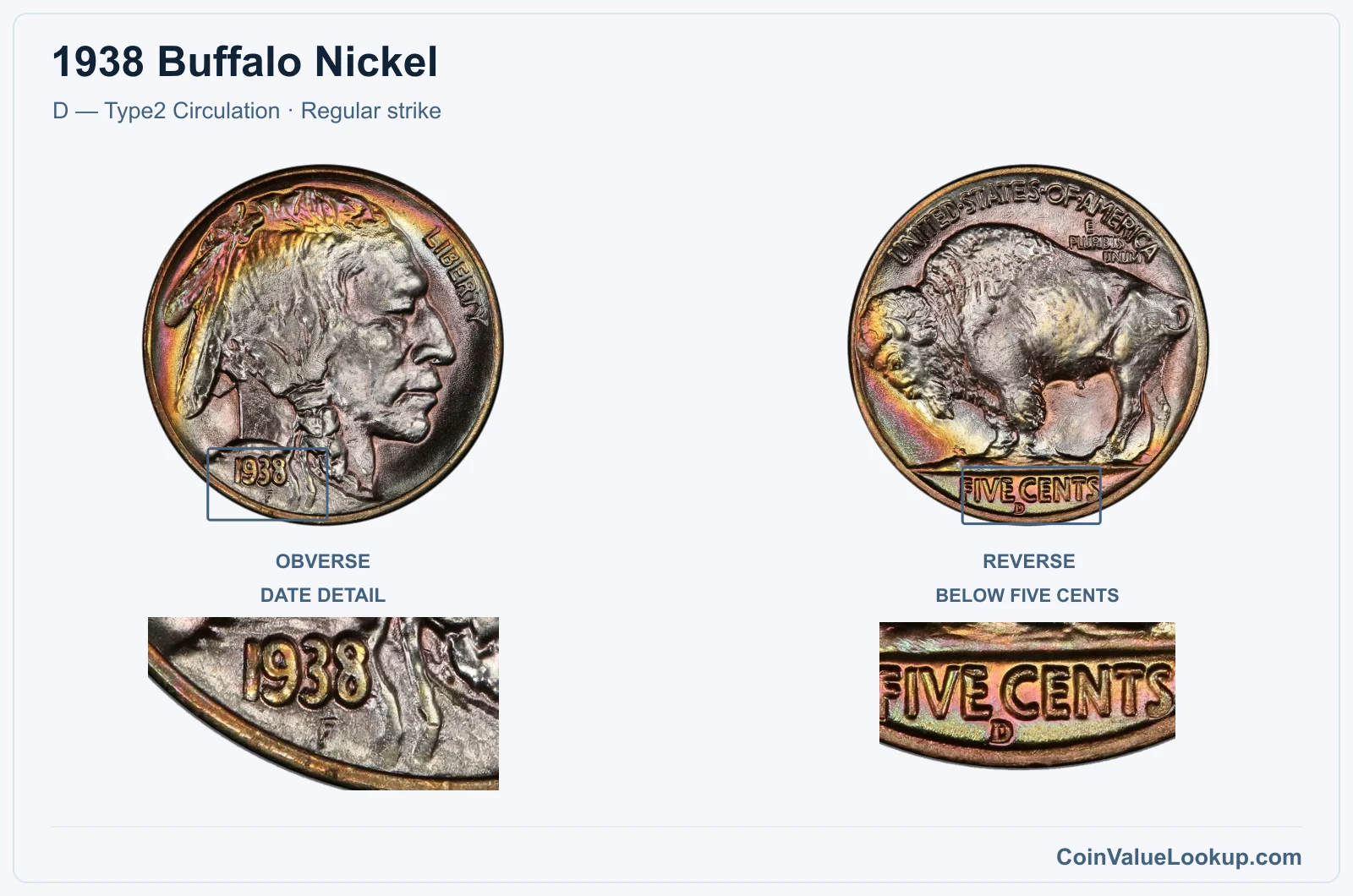
This is the standard 1938-D Buffalo Nickel — the baseline coin most people will find. It uses the Type 2 recessed reverse where FIVE CENTS sits below the ground line.
Guide estimates from USA Coin Book place it around $4.26 in G4 and $43 in MS63.
Because 1938 was the last year of the series, many were saved by collectors straight from the bank. That means nice uncirculated examples turn up more often than you would expect for an 80-plus-year-old nickel.
Still, a sharp MS63 or better piece with clean fields and full luster is a solid keeper.
Coin Value Lookup is a good starting point if you want to compare values across different Buffalo Nickel dates and mints.
Range Grade
Price Auction Records Appraisal PO PO 1
—
Coin Identifier FR FR 2
—
Coin Identifier AG AG 3
—
Coin Identifier G G 4
—
Coin Identifier
G 6
—
Coin Identifier VG VG 8
—
Coin Identifier
VG 10
—
Coin Identifier F F 12
—
Coin Identifier
F 15
—
Coin Identifier VF VF 20
—
Coin Identifier
VF 25
—
Coin Identifier
VF 30
—
Coin Identifier
VF 35
—
Coin Identifier XF XF 40
Coin Identifier
XF 45
—
Coin Identifier AU AU 50
—
Coin Identifier
AU 53
—
Coin Identifier
AU 55
—
Coin Identifier
AU 58
Coin Identifier MS MS 60
—
Coin Identifier
MS 61
—
Coin Identifier
MS 62
Coin Identifier
MS 63
Coin Identifier
MS 64
Coin Identifier
MS 65
Coin Identifier
MS 66
Coin Identifier
MS 67
Coin Identifier
MS 68
Coin Identifier
MS 69
—
—
—
MS 70
—
—
—
1938 Buffalo Nickel — D Over S
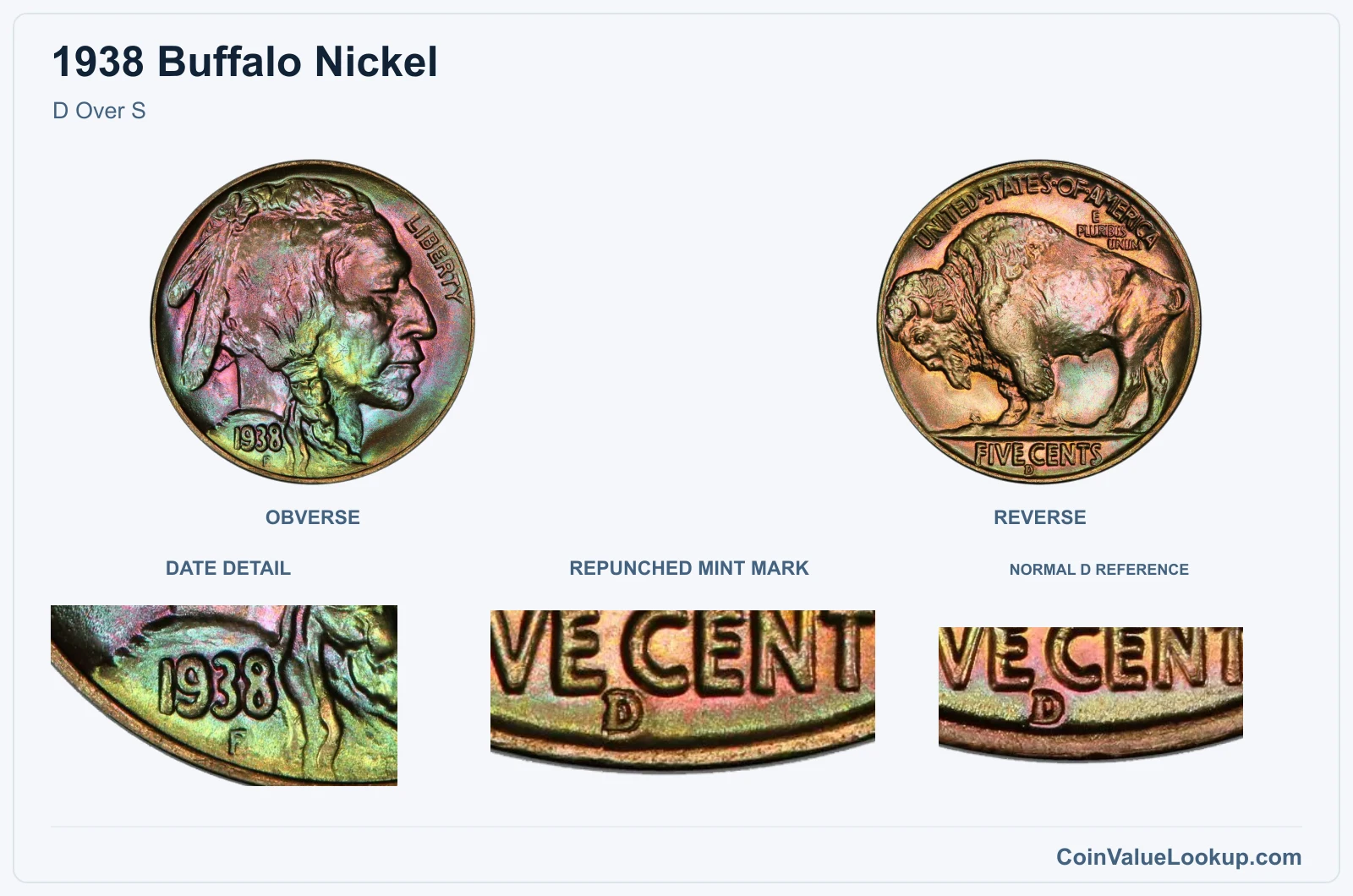
Here is where it gets interesting for variety hunters. The 1938-D Over S nickel was struck with a die that originally carried an S mintmark (intended for San Francisco) before being overpunched with a D for Denver.
Under magnification you can see traces of the curved S still visible beneath the final D.
This is not subtle once you know what to look for, but it does require at least a 5x loupe. The key diagnostic is the leftover serif of the S extending beyond the straight vertical strokes of the D.
Do not confuse this with the D/D repunched mintmark, which only involves the same letter shifted.
Guide estimates from USA Coin Book run about $12 in G4 and $100 in MS63 — a meaningful premium over the standard D issue. Coins with strong remnant S visibility tend to attract more collector interest.
Range Grade
Price Auction Records Appraisal PO PO 1
—
Coin Identifier FR FR 2
—
Coin Identifier AG AG 3
—
Coin Identifier G G 4
—
Coin Identifier
G 6
—
Coin Identifier VG VG 8
—
Coin Identifier
VG 10
—
Coin Identifier F F 12
—
Coin Identifier
F 15
—
Coin Identifier VF VF 20
—
Coin Identifier
VF 25
—
Coin Identifier
VF 30
—
Coin Identifier
VF 35
—
Coin Identifier XF XF 40
—
Coin Identifier
XF 45
—
Coin Identifier AU AU 50
—
Coin Identifier
AU 53
—
Coin Identifier
AU 55
Coin Identifier
AU 58
—
Coin Identifier MS MS 60
—
Coin Identifier
MS 61
—
Coin Identifier
MS 62
—
Coin Identifier
MS 63
Coin Identifier
MS 64
Coin Identifier
MS 65
Coin Identifier
MS 66
Coin Identifier
MS 67
Coin Identifier
MS 68
Coin Identifier
MS 69
—
—
—
MS 70
—
—
—
1938 Buffalo Nickel — D Over D — Repunched Mintmark
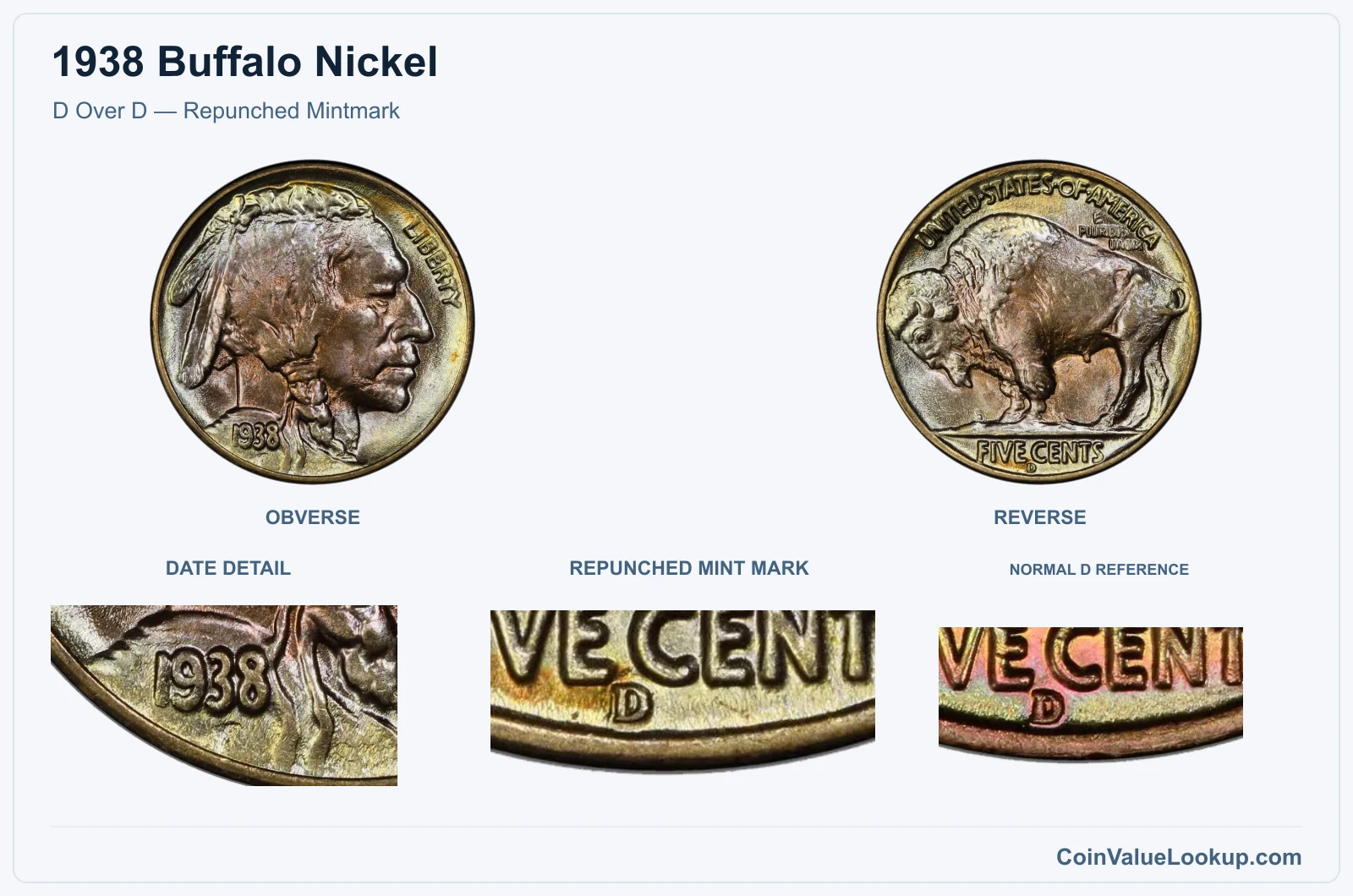
The 1938-D/D is a repunched mintmark variety. The die received two impressions of the same D letter in slightly different positions, leaving a visible doubling or shadow around the mintmark.
Look for a secondary D image offset from the primary one — sometimes showing as a notch or extra serif on one side of the letter. This is distinct from the D Over S, which involves two different letters entirely.
Guide estimates place this variety around $7 in VF25 and $81 in MS65. It is a more affordable entry point than the D/S but still recognized and separately priced by collectors who specialize in mintmark varieties.
A dedicated reverse photo focused tightly on the mintmark is the best way to confirm it.
Range Grade
Price Auction Records Appraisal PO PO 1
—
Coin Identifier FR FR 2
—
Coin Identifier AG AG 3
—
Coin Identifier G G 4
—
Coin Identifier
G 6
—
Coin Identifier VG VG 8
—
Coin Identifier
VG 10
—
Coin Identifier F F 12
—
Coin Identifier
F 15
—
Coin Identifier VF VF 20
—
Coin Identifier
VF 25
—
Coin Identifier
VF 30
—
Coin Identifier
VF 35
—
Coin Identifier XF XF 40
—
Coin Identifier
XF 45
—
Coin Identifier AU AU 50
—
Coin Identifier
AU 53
—
Coin Identifier
AU 55
—
Coin Identifier
AU 58
Coin Identifier MS MS 60
—
Coin Identifier
MS 61
—
Coin Identifier
MS 62
—
Coin Identifier
MS 63
Coin Identifier
MS 64
Coin Identifier
MS 65
Coin Identifier
MS 66
Coin Identifier
MS 67
Coin Identifier
MS 68
Coin Identifier
MS 69
—
—
—
MS 70
—
—
—
1938 Buffalo Nickel Error List
1. 1938 Buffalo Nickel — Three-and-a-Half Legs
The Three-and-a-Half Legs variety on the 1938-D shows a partially abraded front leg on the bison, where die polishing removed some of the leg detail before coins were struck. It is a less dramatic cousin of the famous 1937-D Three-Legged variety.
To check yours, compare the bison's front leg against a normal 1938-D reverse. On an affected coin, part of the leg appears thinned or partially missing while the hoof and body remain intact.
The leg does not vanish entirely — it looks like someone started erasing it and quit halfway.
Watch out for lookalikes. A weakly struck coin can show soft leg detail, and a heavily worn coin will lose leg definition naturally.
Deliberate alteration — someone physically removing metal — is another pitfall. The key is that a genuine die-polish variety will show consistent surface texture across the affected area rather than tool marks or localized damage.
No reliable guide price is available for this variety. Value depends on the visibility of the abraded leg, overall coin condition, and buyer interest.
2. 1938 Buffalo Nickel — Clipped Planchet
A clipped planchet error means the metal blank was incompletely punched from the strip before striking, leaving the coin with a missing section along the edge. On a 1938-D, look for a curved, straight, or ragged bite taken from the rim.
Genuine clips often produce a corresponding area of weakness on the opposite side of the coin, where metal could not flow fully into the die. The edge at the clip itself should show the natural texture of the original blank rather than a sharp, tooled cut.
That distinction matters. A coin that was filed, notched, or corroded after leaving the mint is damaged, not an error.
If the missing area has rough file marks, a perfectly straight machine cut, or pitting from corrosion, it is not a mint-produced clip.
No specific guide price is adopted for this error on the 1938-D. The value depends on the size and type of clip, the overall condition of the coin, and how clearly the clip can be distinguished from post-mint damage.