1939 Jefferson Nickel Coin Value: How Much Is It Worth?
A 1939 Jefferson nickel in ordinary circulated condition might bring roughly $0.30 to $12 depending on mint, with uncirculated examples reaching about $103 at MS65 for certain mints. Those are selected guide points, not guarantees, and they don't cover proof strikes, Full Steps designations, or authenticated error varieties.
Price depends heavily on which mint produced your coin, which reverse hub it carries, and its actual condition.
This year is more complicated than most early Jeffersons because Philadelphia used two different reverse hubs, and a genuine doubled-Monticello variety exists with guide values well into four figures at higher grades. Sorting out what you actually have is the first step.
Fast Way to Identify Your 1939 Jefferson Nickel
Upload clear photos of both sides of your 1939 nickel for a preliminary identification. A front shot captures the date and portrait condition, while the back reveals the mintmark location and Monticello step detail needed to separate the two reverse types.
This is not a substitute for professional authentication or grading, but it gives you a solid starting point for further research.
1939 Jefferson Nickel Value
Upload both sides of your 1939 Jefferson Nickel.
Front Obverse
Upload photo
Back Reverse
Upload photo
Which 1939 Jefferson Nickel Versions Are Worth Money?
- The Doubled Monticello variety (Philadelphia) shows guide estimates of $123 at VF20, $438 at MS60, and $1,879 at MS65, making it the standout collectible from this year.
- Philadelphia proof strikes are a separate collector category with distinct surfaces and pricing; do not confuse a shiny business strike for a proof.
- Denver mint coins carry higher guide values than Philadelphia or San Francisco across circulated grades, so confirming the D mintmark is worth your time.
- Identify which reverse hub your coin uses before looking up values; Reverse of 1938 and Reverse of 1940 are tracked separately by major services.
- Mint State coins with strong, undisturbed luster and verified Full Steps command premiums above ordinary uncirculated pieces.
Step 1: Identify Your 1939 Jefferson Nickel Mint Mark and Version
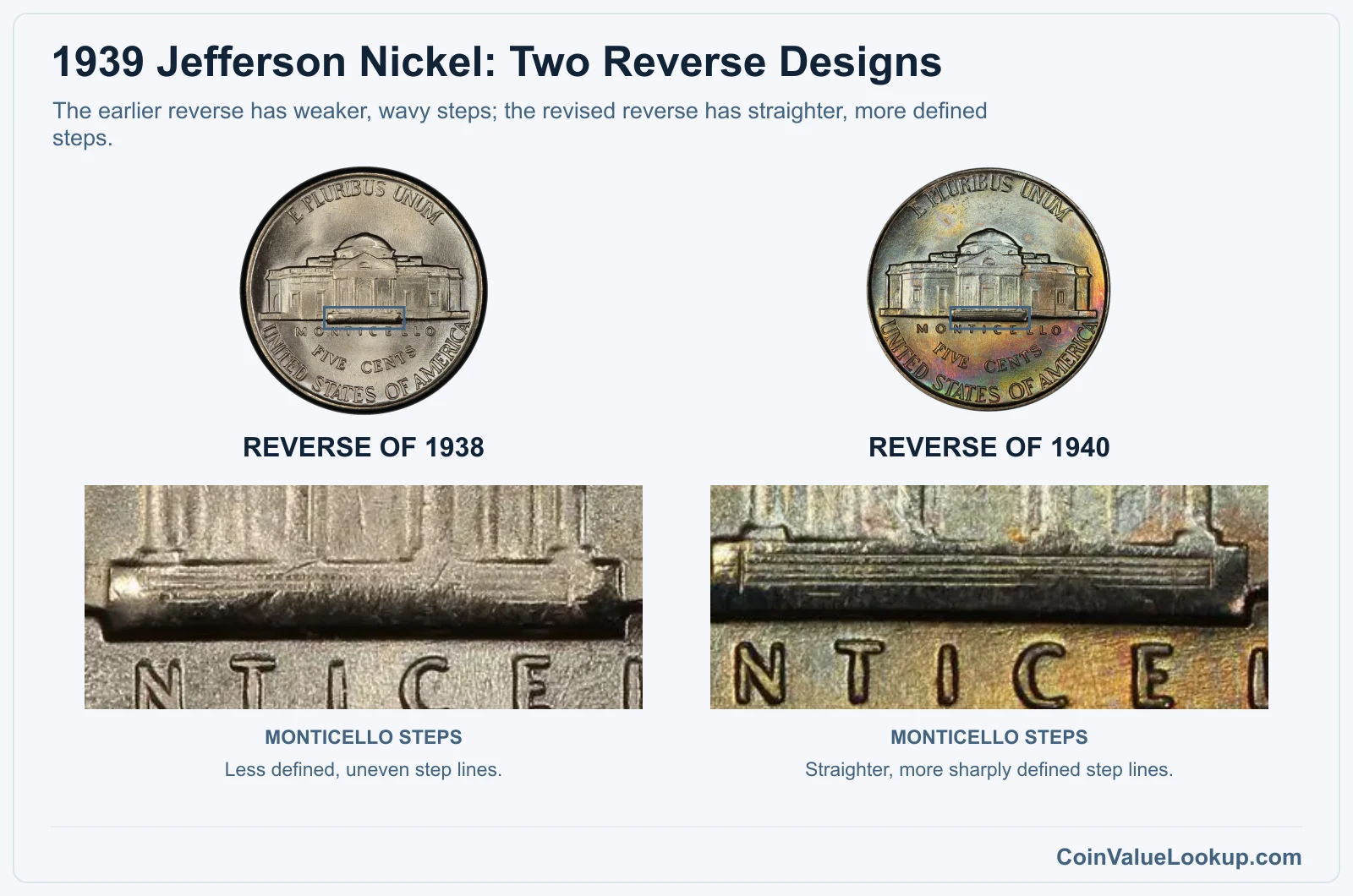
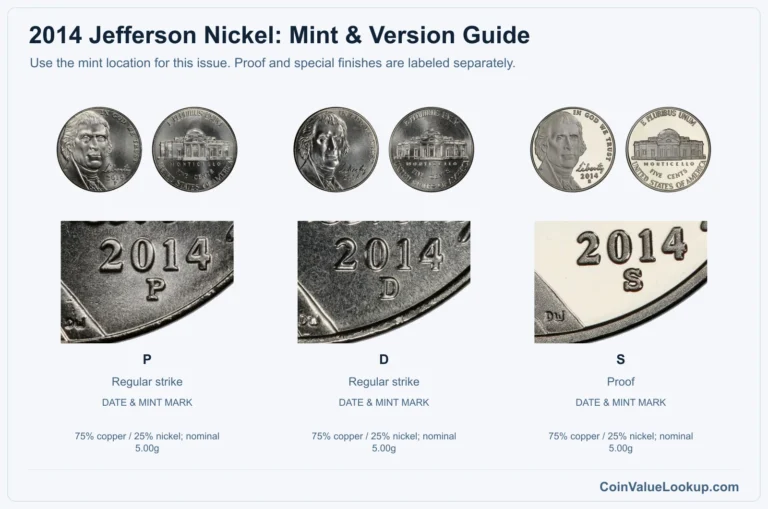
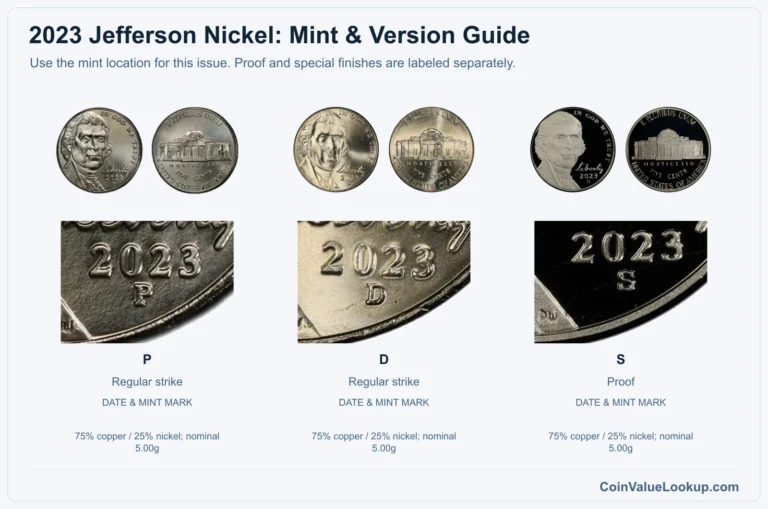
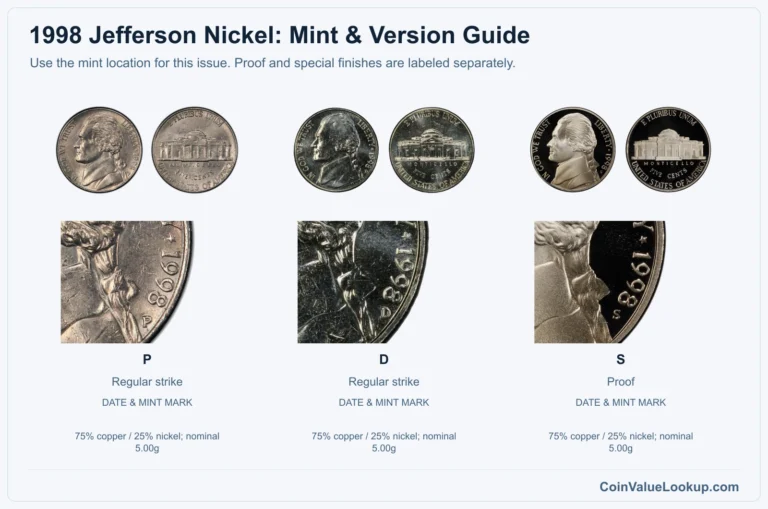
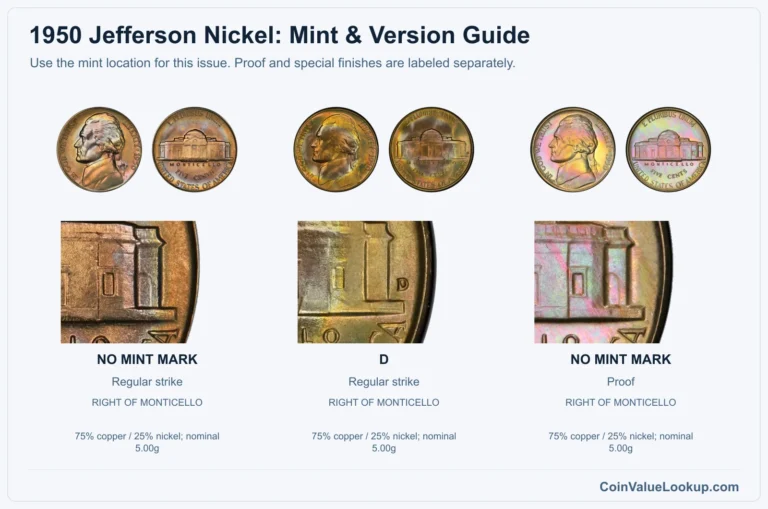
Philadelphia coins carry no mintmark. Denver (D) and San Francisco (S) examples have a small letter to the right of Monticello on the reverse.
All 1939 Jefferson nickels are 75% copper and 25% nickel, weighing nominally 5.00 grams with a 21.2 mm diameter.
The key wrinkle this year is two reverse hubs. The earlier hub (Reverse of 1938) has softer, slightly curved Monticello steps, while the later hub (Reverse of 1940) shows stronger, straighter steps.
You need to compare your coin's steps under good light before picking the right price reference.
Don't confuse color differences from environmental toning with a different alloy. A darker or lighter surface alone tells you nothing about composition.
Also separate honest wear from corrosion, old polishing, or evidence that the coin was once mounted in jewelry.
Step 2: Check Your 1939 Jefferson Nickel Grade
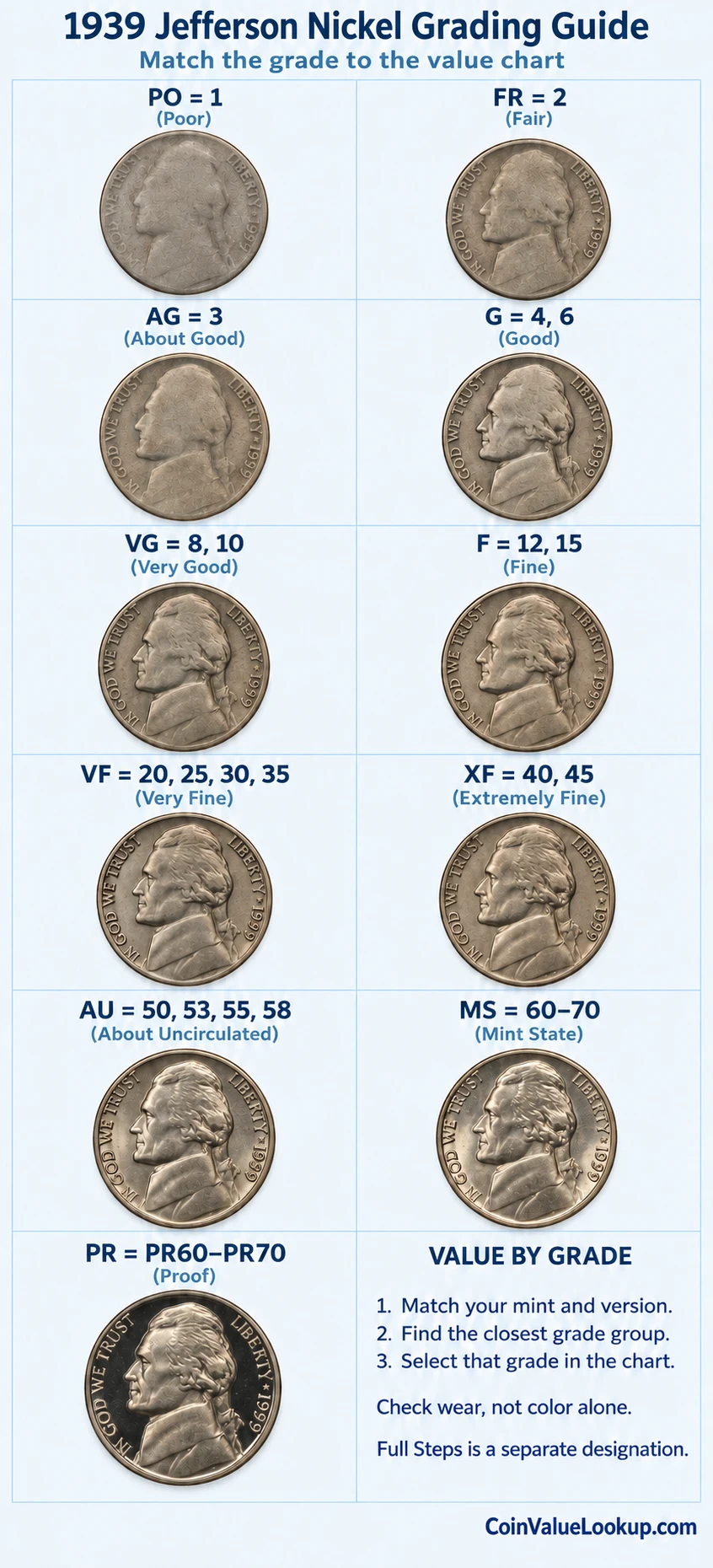
Start with Jefferson's cheekbone and the hair directly above his ear. These are the first high points to lose detail.
Then flip the coin and check the roof and columns of Monticello, where wear shows next.
Luster matters. A coin with full original mint luster across both sides and no wear on the high points qualifies as Mint State.
Once you see any flattening on the cheekbone, you're into circulated territory. Use the comparison image to match your coin against known grade examples.
Full Steps is a separate designation applied only to qualifying Mint State coins. At least five clearly separated steps on Monticello must be visible under PCGS criteria, without interruptions.
A weak strike can produce mushy steps that look like wear but aren't. That distinction matters because Full Steps coins carry their own premium, and you need certification to claim it reliably.
Step 3: Check 1939 Jefferson Nickel Value by Mint and Version
1939 Jefferson Nickel — P Reverse of1938
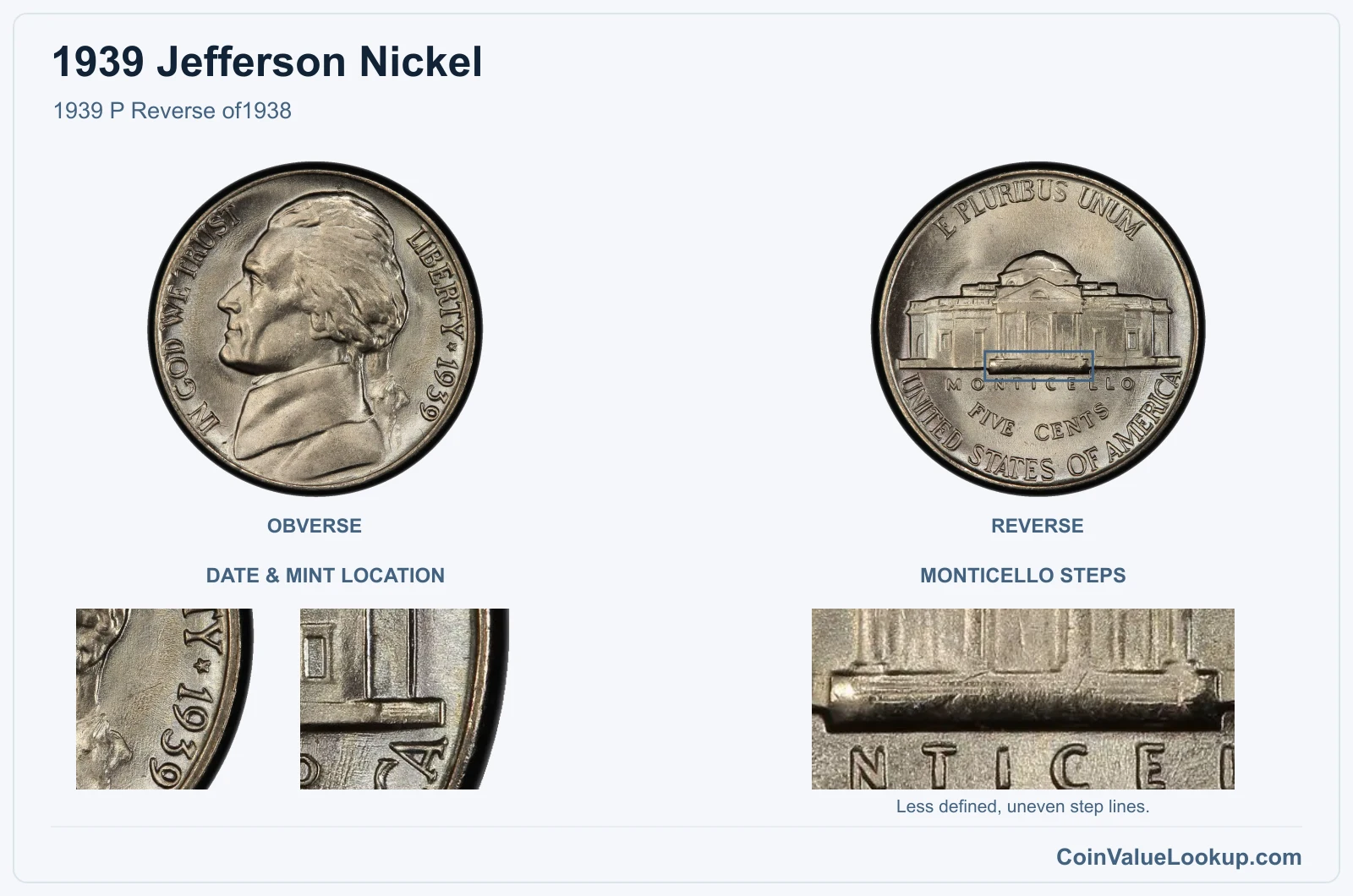
This is a Philadelphia business strike with the earlier Reverse of 1938, identifiable by softer, more curved Monticello steps compared to the later hub. No mintmark appears on the reverse.
Broad guide baselines for the 1939 Philadelphia mint sit around $0.30 at VF20, $2.50 at MS60, and $15 at MS65, but those figures are not specifically attributed to this reverse hub.
Before using any price reference, confirm which reverse your coin actually carries. The step contour difference is subtle but real, so compare under consistent lighting at the same magnification.
| Range | Grade | Price | Auction Records | Appraisal |
|---|---|---|---|---|
| PO | PO 1 | — | Coin Identifier | |
| FR | FR 2 | — | Coin Identifier | |
| AG | AG 3 | — | Coin Identifier | |
| G | G 4 | — | Coin Identifier | |
| G 6 | — | Coin Identifier | ||
| VG | VG 8 | — | Coin Identifier | |
| VG 10 | — | Coin Identifier | ||
| F | F 12 | — | Coin Identifier | |
| F 15 | — | Coin Identifier | ||
| VF | VF 20 | — | Coin Identifier | |
| VF 25 | — | Coin Identifier | ||
| VF 30 | — | Coin Identifier | ||
| VF 35 | — | Coin Identifier | ||
| XF | XF 40 | — | Coin Identifier | |
| XF 45 | — | Coin Identifier | ||
| AU | AU 50 | — | Coin Identifier | |
| AU 53 | Coin Identifier | |||
| AU 55 | — | Coin Identifier | ||
| AU 58 | — | Coin Identifier | ||
| MS | MS 60 | — | Coin Identifier | |
| MS 61 | — | Coin Identifier | ||
| MS 62 | — | Coin Identifier | ||
| MS 63 | — | Coin Identifier | ||
| MS 64 | Coin Identifier | |||
| MS 65 | Coin Identifier | |||
| MS 66 | Coin Identifier | |||
| MS 67 | Coin Identifier | |||
| MS 68 | — | — | — | |
| MS 69 | — | — | — | |
| MS 70 | — | — | — |
1939 Jefferson Nickel — P Reverse of1938 Proof
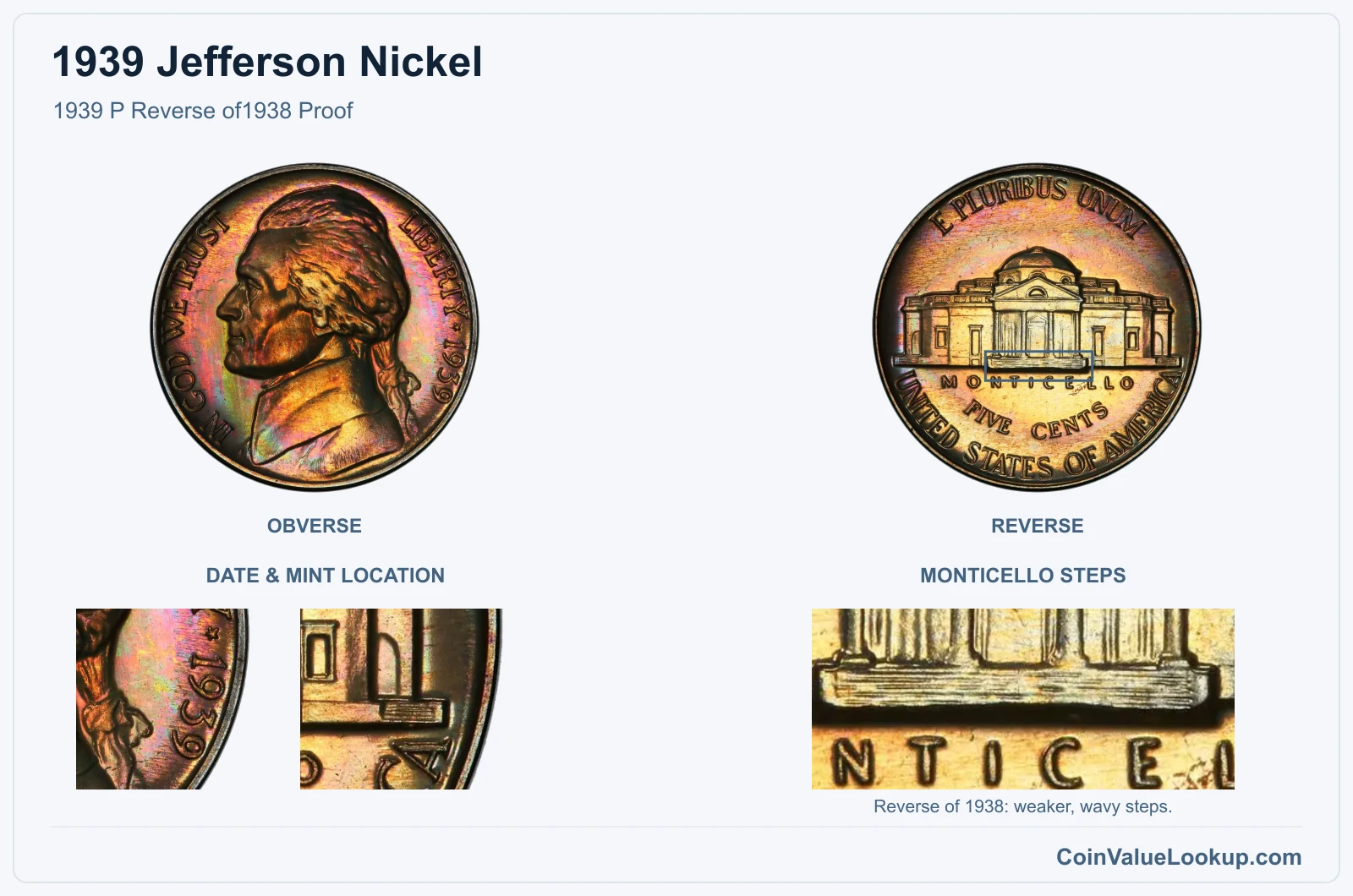
Philadelphia proof nickels from 1939 with the Reverse of 1938 are collector strikes, not simply well-preserved business coins. Genuine proofs show deeply mirrored fields and razor-sharp design edges that no amount of polishing can replicate on a regular strike.
A broad proof guide baseline sits around $163 at PR65, though that figure is not specifically attributed to this reverse hub. You need to confirm the reverse type before matching your coin to the correct price history.
Protected fields free of hairlines or haze are essential to strong proof grades.
| Range | Grade | Price | Auction Records | Appraisal |
|---|---|---|---|---|
| PR | PR 1 | — | Coin Identifier | |
| PR 2 | — | Coin Identifier | ||
| PR 3 | — | Coin Identifier | ||
| PR 4 | — | Coin Identifier | ||
| PR 6 | — | Coin Identifier | ||
| PR 8 | — | Coin Identifier | ||
| PR 10 | — | Coin Identifier | ||
| PR 12 | — | Coin Identifier | ||
| PR 15 | — | Coin Identifier | ||
| PR 20 | — | Coin Identifier | ||
| PR 25 | — | Coin Identifier | ||
| PR 30 | — | Coin Identifier | ||
| PR 35 | — | Coin Identifier | ||
| PR 40 | — | Coin Identifier | ||
| PR 45 | — | Coin Identifier | ||
| PR 50 | — | Coin Identifier | ||
| PR 53 | — | Coin Identifier | ||
| PR 55 | — | Coin Identifier | ||
| PR 58 | — | Coin Identifier | ||
| PR 60 | — | Coin Identifier | ||
| PR 61 | — | Coin Identifier | ||
| PR 62 | Coin Identifier | |||
| PR 63 | Coin Identifier | |||
| PR 64 | Coin Identifier | |||
| PR 65 | Coin Identifier | |||
| PR 66 | Coin Identifier | |||
| PR 67 | Coin Identifier | |||
| PR 68 | Coin Identifier | |||
| PR 69 | — | — | — | |
| PR 70 | — | — | — |
1939 Jefferson Nickel — P Reverse of1940
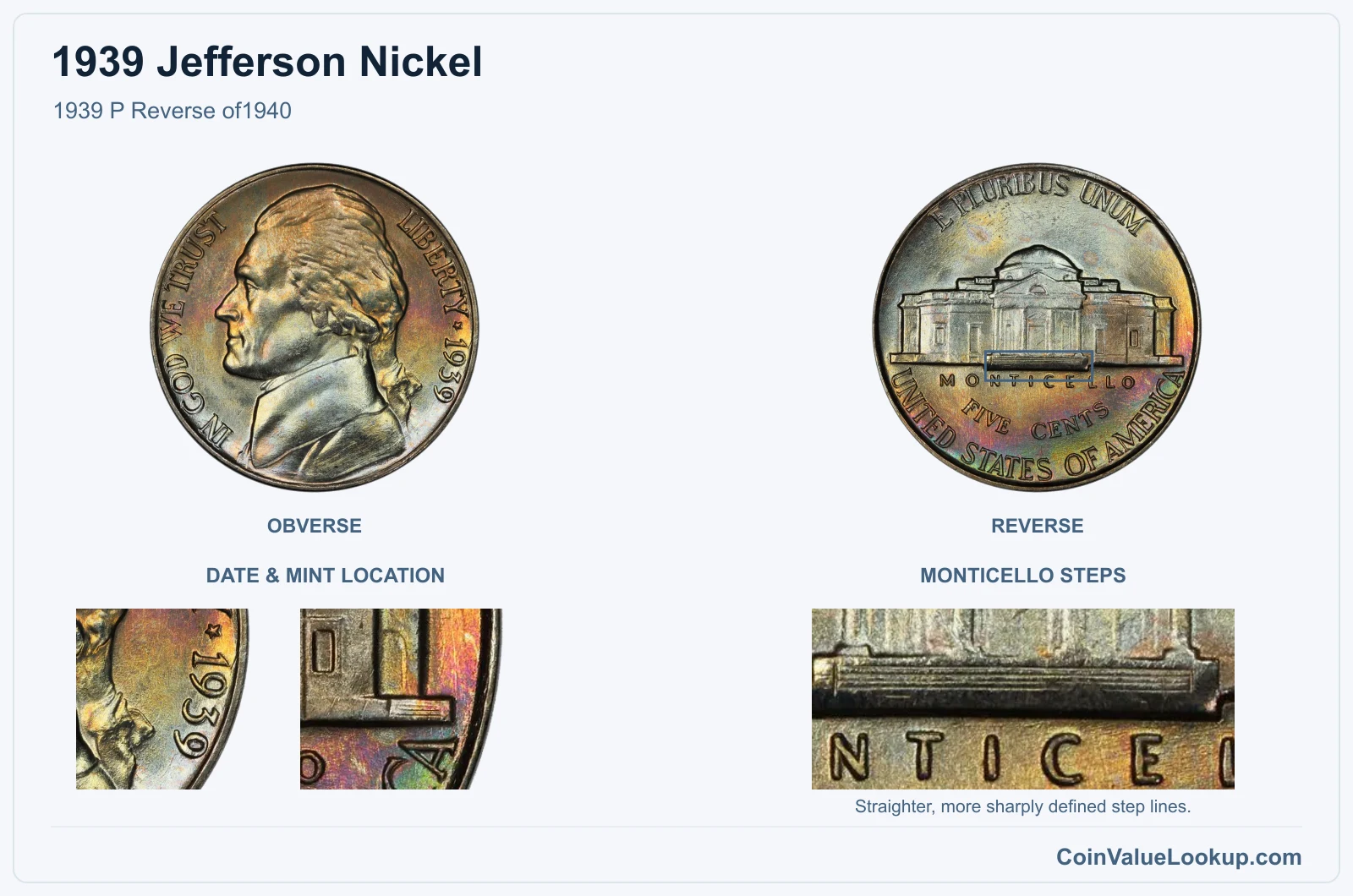
This Philadelphia business strike uses the later Reverse of 1940, with stronger, straighter Monticello steps. Still no mintmark on the reverse.
Broad guide baselines for the 1939 Philadelphia mint are approximately $0.30 at VF20, $2.50 at MS60, and $15 at MS65, but those are not specifically attributed to this reverse type. Identify your reverse before relying on any estimate.
The straighter step lines on this hub are the key diagnostic; compare them side by side with a Reverse of 1938 example at the same angle.
| Range | Grade | Price | Auction Records | Appraisal |
|---|---|---|---|---|
| PO | PO 1 | — | Coin Identifier | |
| FR | FR 2 | — | Coin Identifier | |
| AG | AG 3 | — | Coin Identifier | |
| G | G 4 | — | Coin Identifier | |
| G 6 | — | Coin Identifier | ||
| VG | VG 8 | — | Coin Identifier | |
| VG 10 | — | Coin Identifier | ||
| F | F 12 | — | Coin Identifier | |
| F 15 | — | Coin Identifier | ||
| VF | VF 20 | — | Coin Identifier | |
| VF 25 | — | Coin Identifier | ||
| VF 30 | — | Coin Identifier | ||
| VF 35 | — | Coin Identifier | ||
| XF | XF 40 | — | Coin Identifier | |
| XF 45 | — | Coin Identifier | ||
| AU | AU 50 | — | Coin Identifier | |
| AU 53 | — | Coin Identifier | ||
| AU 55 | Coin Identifier | |||
| AU 58 | Coin Identifier | |||
| MS | MS 60 | — | Coin Identifier | |
| MS 61 | — | Coin Identifier | ||
| MS 62 | Coin Identifier | |||
| MS 63 | Coin Identifier | |||
| MS 64 | Coin Identifier | |||
| MS 65 | Coin Identifier | |||
| MS 66 | Coin Identifier | |||
| MS 67 | Coin Identifier | |||
| MS 68 | Coin Identifier | |||
| MS 69 | — | — | — | |
| MS 70 | — | — | — |
1939 Jefferson Nickel — P Reverse of1940 Proof
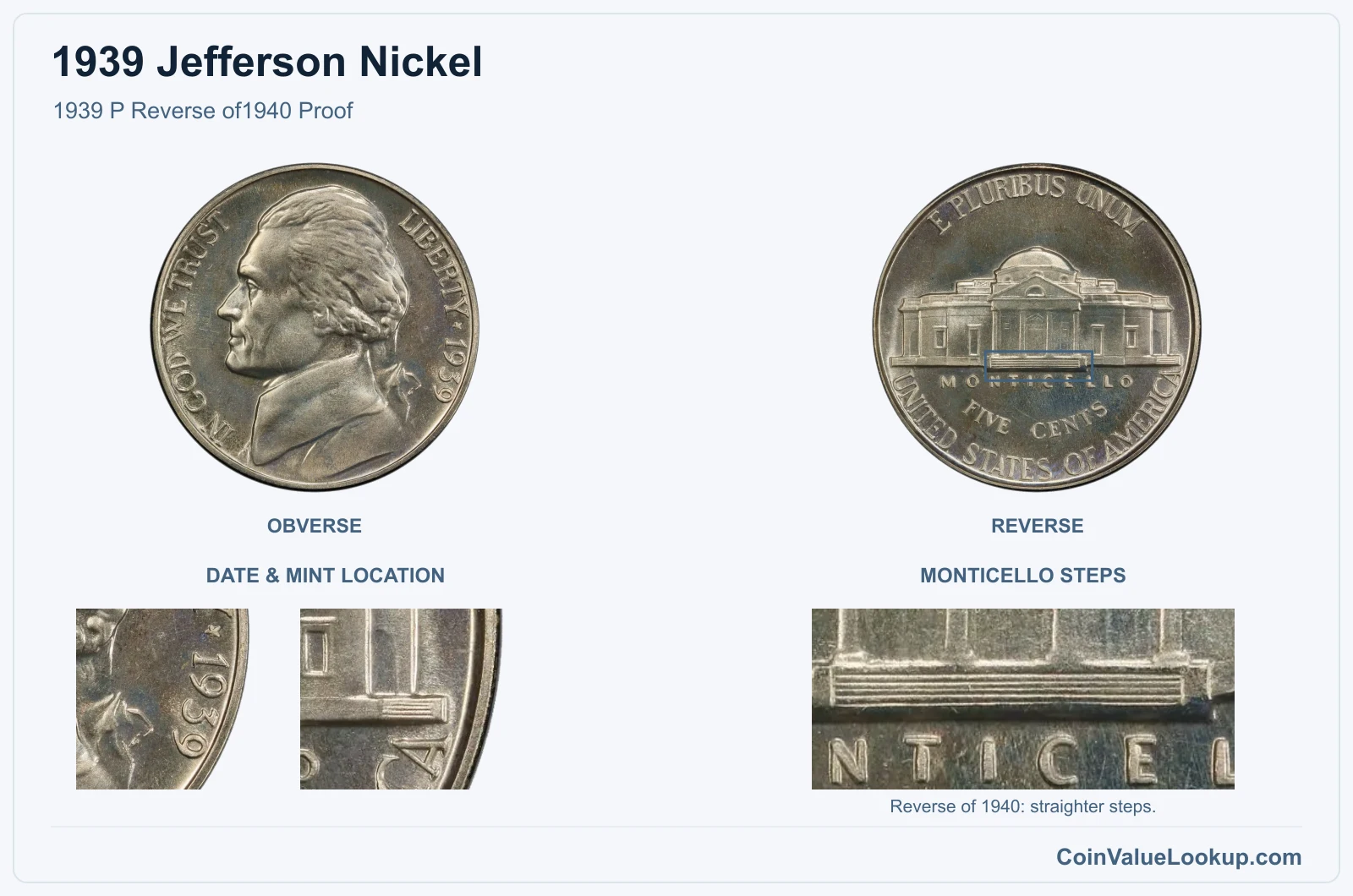
The Reverse of 1940 proof from Philadelphia carries the later hub with straighter Monticello steps. A proof is a manufacturing method: struck on polished planchets with specially prepared dies, producing mirror fields and crisp edges.
Coin Value Lookup is a good place to start comparing different versions of a coin like this before deciding on your next step. The broad proof guide baseline is about $163 at PR65, but that number is not specifically attributed to this reverse hub.
Confirm your reverse type first, then match it to the correct reference.
| Range | Grade | Price | Auction Records | Appraisal |
|---|---|---|---|---|
| PR | PR 1 | — | Coin Identifier | |
| PR 2 | — | Coin Identifier | ||
| PR 3 | — | Coin Identifier | ||
| PR 4 | — | Coin Identifier | ||
| PR 6 | — | Coin Identifier | ||
| PR 8 | — | Coin Identifier | ||
| PR 10 | — | Coin Identifier | ||
| PR 12 | — | Coin Identifier | ||
| PR 15 | — | Coin Identifier | ||
| PR 20 | — | Coin Identifier | ||
| PR 25 | — | Coin Identifier | ||
| PR 30 | — | Coin Identifier | ||
| PR 35 | — | Coin Identifier | ||
| PR 40 | — | Coin Identifier | ||
| PR 45 | — | Coin Identifier | ||
| PR 50 | — | Coin Identifier | ||
| PR 53 | — | Coin Identifier | ||
| PR 55 | — | Coin Identifier | ||
| PR 58 | — | Coin Identifier | ||
| PR 60 | Coin Identifier | |||
| PR 61 | — | Coin Identifier | ||
| PR 62 | — | Coin Identifier | ||
| PR 63 | Coin Identifier | |||
| PR 64 | Coin Identifier | |||
| PR 65 | Coin Identifier | |||
| PR 66 | Coin Identifier | |||
| PR 67 | Coin Identifier | |||
| PR 68 | Coin Identifier | |||
| PR 69 | — | — | — | |
| PR 70 | — | — | — |
1939 Jefferson Nickel — P Doubled Monticello
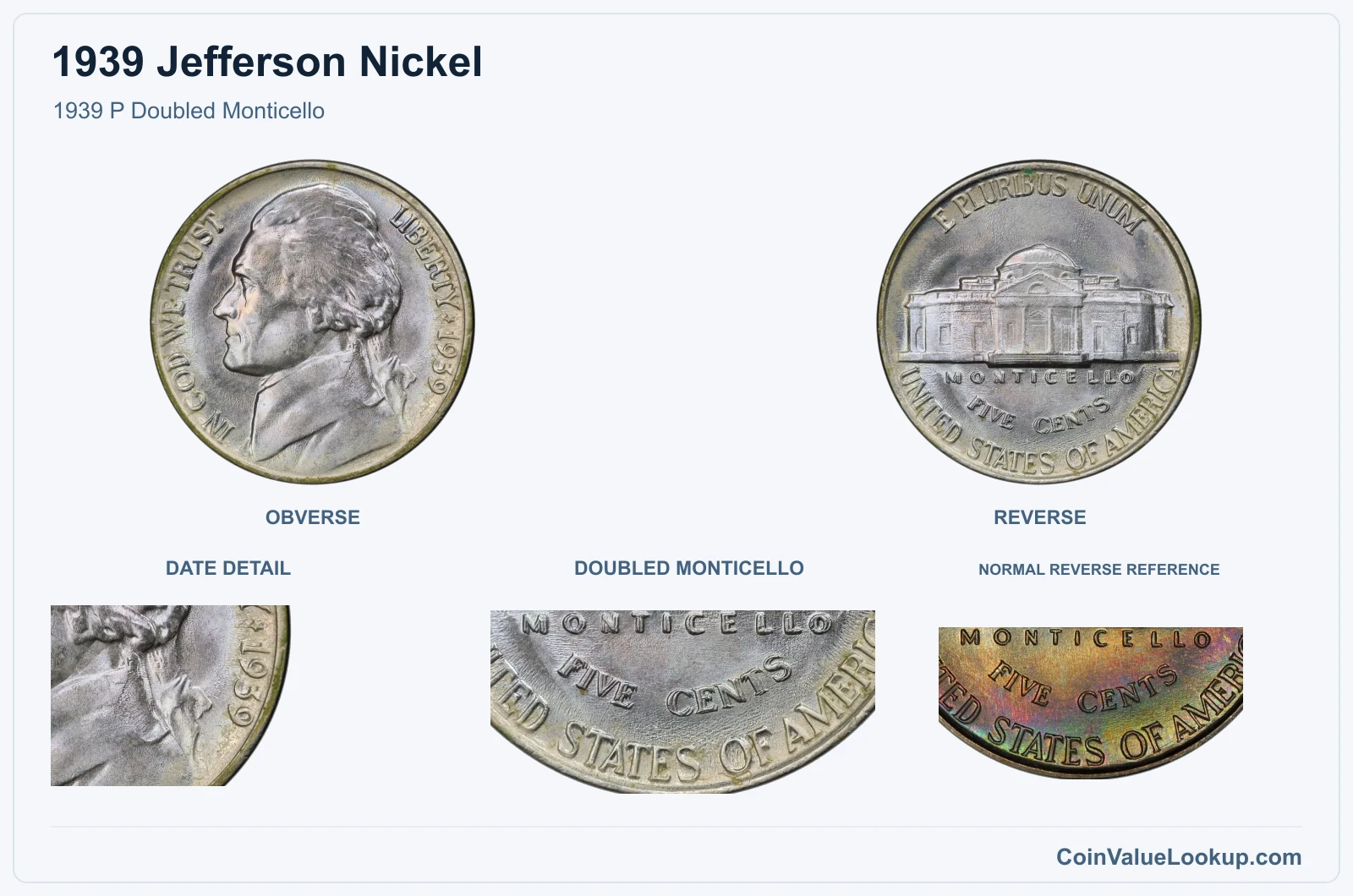
This is the one to look for. The 1939 Doubled Monticello variety is a Philadelphia business strike where the reverse die shows distinct doubled outlines in the word MONTICELLO and the denomination FIVE CENTS.
It's a genuine hub-doubled die, not trivial machine doubling.
Guide estimates run $123 at VF20, $438 at MS60, and $1,879 at MS65. Those are not Full Steps premiums.
Even a well-circulated example carries real collector value if the doubling is confirmed.
To verify, compare your reverse lettering to a normal 1939 nickel at equal magnification. The doubled letters show consistent, separated outlines rather than the flat shelf pattern of machine doubling.
Certification is strongly recommended before assuming you have this variety.
| Range | Grade | Price | Auction Records | Appraisal |
|---|---|---|---|---|
| PO | PO 1 | — | Coin Identifier | |
| FR | FR 2 | — | Coin Identifier | |
| AG | AG 3 | — | Coin Identifier | |
| G | G 4 | — | Coin Identifier | |
| G 6 | — | Coin Identifier | ||
| VG | VG 8 | — | Coin Identifier | |
| VG 10 | — | Coin Identifier | ||
| F | F 12 | Coin Identifier | ||
| F 15 | Coin Identifier | |||
| VF | VF 20 | Coin Identifier | ||
| VF 25 | — | Coin Identifier | ||
| VF 30 | Coin Identifier | |||
| VF 35 | Coin Identifier | |||
| XF | XF 40 | Coin Identifier | ||
| XF 45 | Coin Identifier | |||
| AU | AU 50 | Coin Identifier | ||
| AU 53 | Coin Identifier | |||
| AU 55 | Coin Identifier | |||
| AU 58 | Coin Identifier | |||
| MS | MS 60 | — | Coin Identifier | |
| MS 61 | — | Coin Identifier | ||
| MS 62 | — | Coin Identifier | ||
| MS 63 | Coin Identifier | |||
| MS 64 | Coin Identifier | |||
| MS 65 | Coin Identifier | |||
| MS 66 | Coin Identifier | |||
| MS 67 | Coin Identifier | |||
| MS 68 | — | — | — | |
| MS 69 | — | — | — | |
| MS 70 | — | — | — |
1939 Jefferson Nickel — D Reverse of1938
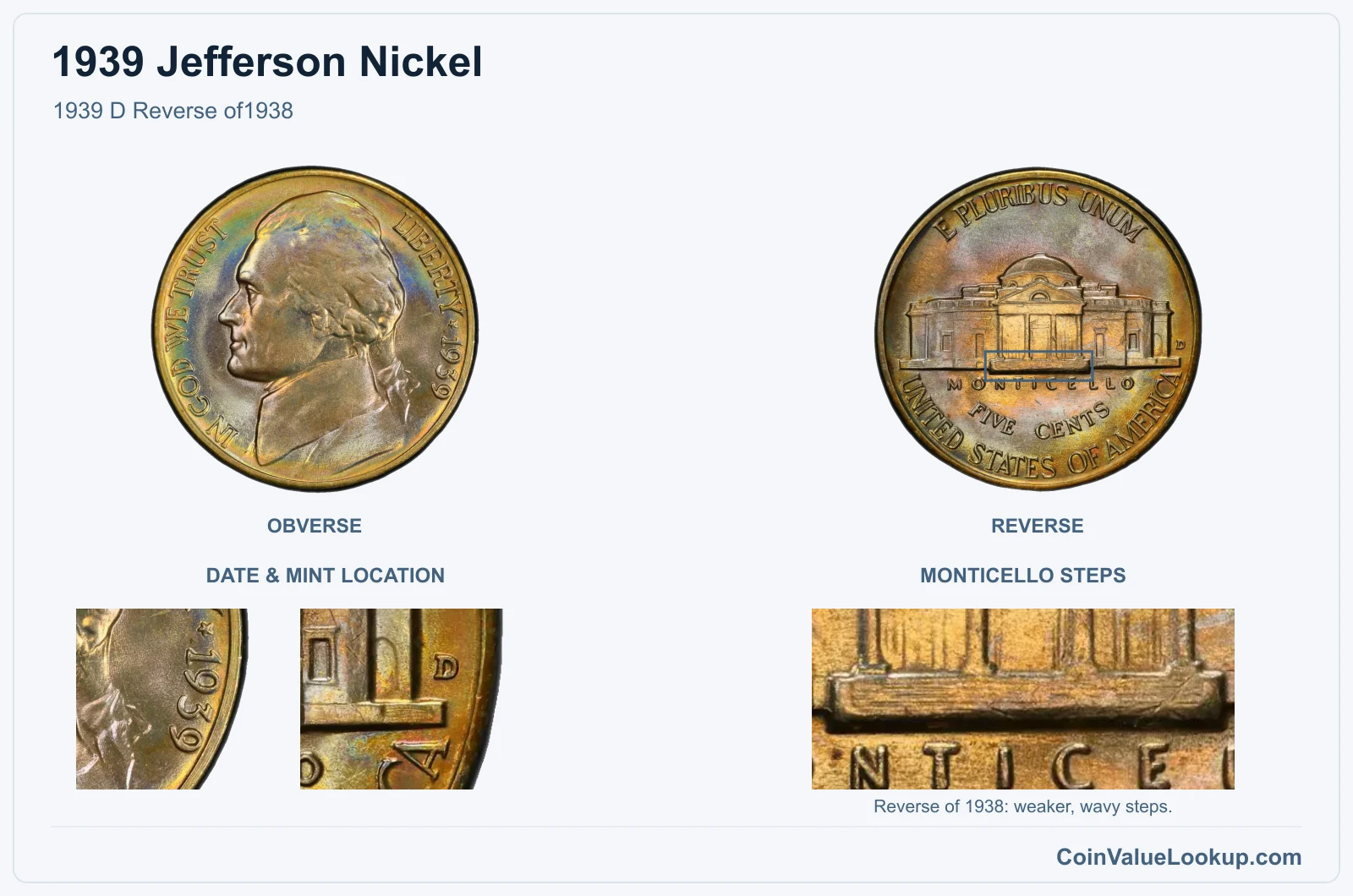
The 1939-D with Reverse of 1938 is a Denver business strike identified by a small D mintmark to the right of Monticello and the older hub's softer, curved steps. Denver coins from this year carry higher guide baselines than their Philadelphia counterparts.
Broad guide figures sit around $12 at VF20, $73 at MS60, and $103 at MS65, though those are not specifically attributed to this reverse hub. Confirm the reverse before pricing.
Even circulated Denver examples command more than most 1939 Philadelphia coins at the same grade.
| Range | Grade | Price | Auction Records | Appraisal |
|---|---|---|---|---|
| PO | PO 1 | — | Coin Identifier | |
| FR | FR 2 | — | Coin Identifier | |
| AG | AG 3 | — | Coin Identifier | |
| G | G 4 | — | Coin Identifier | |
| G 6 | — | Coin Identifier | ||
| VG | VG 8 | — | Coin Identifier | |
| VG 10 | — | Coin Identifier | ||
| F | F 12 | — | Coin Identifier | |
| F 15 | — | Coin Identifier | ||
| VF | VF 20 | — | Coin Identifier | |
| VF 25 | — | Coin Identifier | ||
| VF 30 | — | Coin Identifier | ||
| VF 35 | — | Coin Identifier | ||
| XF | XF 40 | — | Coin Identifier | |
| XF 45 | — | Coin Identifier | ||
| AU | AU 50 | — | Coin Identifier | |
| AU 53 | — | Coin Identifier | ||
| AU 55 | — | Coin Identifier | ||
| AU 58 | Coin Identifier | |||
| MS | MS 60 | — | Coin Identifier | |
| MS 61 | — | Coin Identifier | ||
| MS 62 | — | Coin Identifier | ||
| MS 63 | Coin Identifier | |||
| MS 64 | Coin Identifier | |||
| MS 65 | Coin Identifier | |||
| MS 66 | Coin Identifier | |||
| MS 67 | Coin Identifier | |||
| MS 68 | — | — | — | |
| MS 69 | — | — | — | |
| MS 70 | — | — | — |
1939 Jefferson Nickel — D Reverse of1940
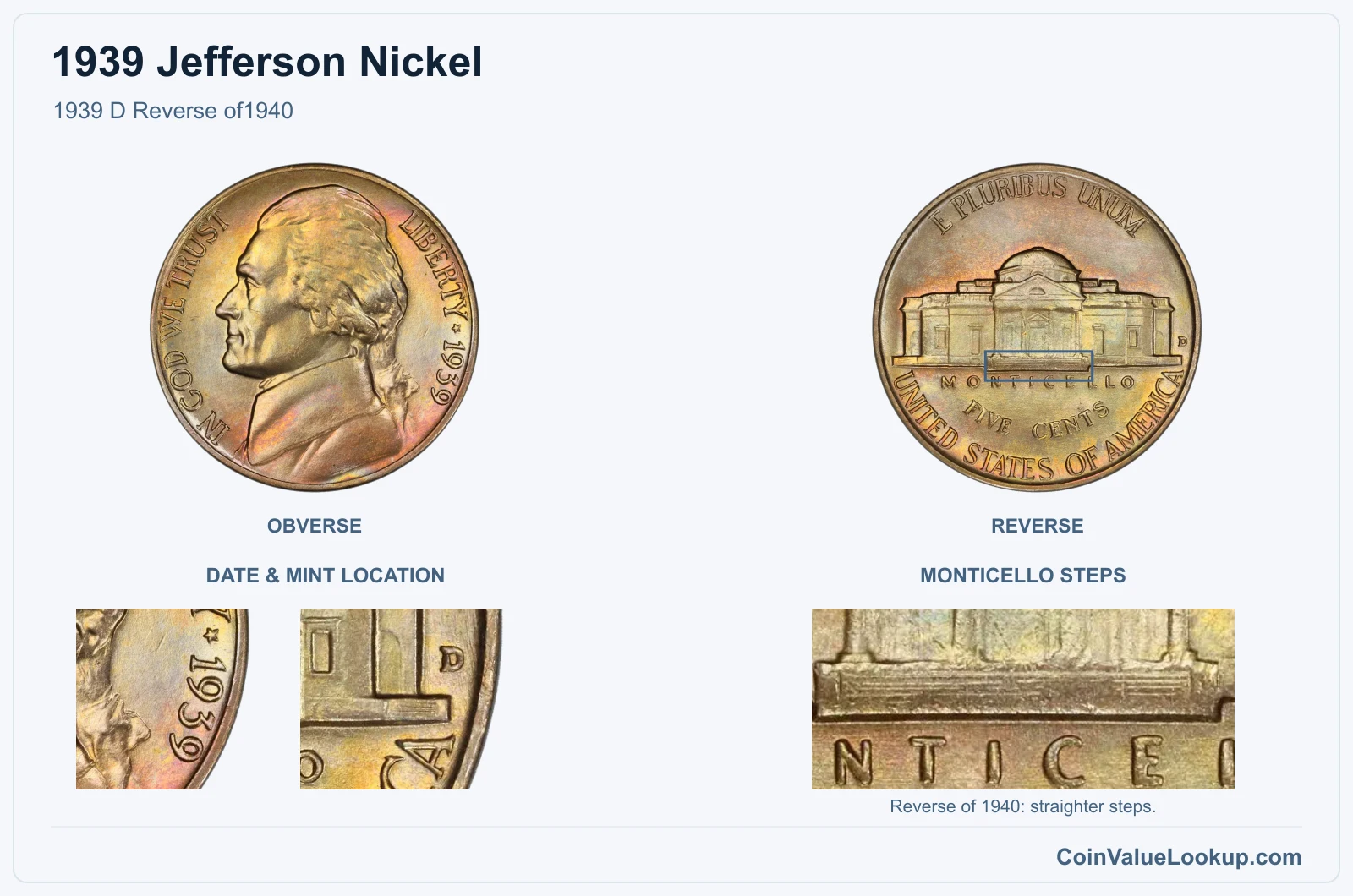
This Denver business strike uses the Reverse of 1940, with its stronger, straighter Monticello steps and a D mintmark to the right of the building. Broad guide baselines for the 1939-D are about $12 at VF20, $73 at MS60, and $103 at MS65, but again, those are not reverse-specific figures.
Denver production for 1939 makes this a coin worth careful examination. Determine the reverse type, then check for Full Steps potential on any Mint State example before selecting comparables.
| Range | Grade | Price | Auction Records | Appraisal |
|---|---|---|---|---|
| PO | PO 1 | — | Coin Identifier | |
| FR | FR 2 | — | Coin Identifier | |
| AG | AG 3 | — | Coin Identifier | |
| G | G 4 | — | Coin Identifier | |
| G 6 | — | Coin Identifier | ||
| VG | VG 8 | — | Coin Identifier | |
| VG 10 | — | Coin Identifier | ||
| F | F 12 | — | Coin Identifier | |
| F 15 | — | Coin Identifier | ||
| VF | VF 20 | — | Coin Identifier | |
| VF 25 | — | Coin Identifier | ||
| VF 30 | — | Coin Identifier | ||
| VF 35 | — | Coin Identifier | ||
| XF | XF 40 | — | Coin Identifier | |
| XF 45 | — | Coin Identifier | ||
| AU | AU 50 | — | Coin Identifier | |
| AU 53 | — | Coin Identifier | ||
| AU 55 | — | Coin Identifier | ||
| AU 58 | — | Coin Identifier | ||
| MS | MS 60 | — | Coin Identifier | |
| MS 61 | — | Coin Identifier | ||
| MS 62 | — | Coin Identifier | ||
| MS 63 | Coin Identifier | |||
| MS 64 | Coin Identifier | |||
| MS 65 | Coin Identifier | |||
| MS 66 | Coin Identifier | |||
| MS 67 | Coin Identifier | |||
| MS 68 | — | Coin Identifier | ||
| MS 69 | — | Coin Identifier | ||
| MS 70 | — | — | — |
1939 Jefferson Nickel — S Reverse of1938
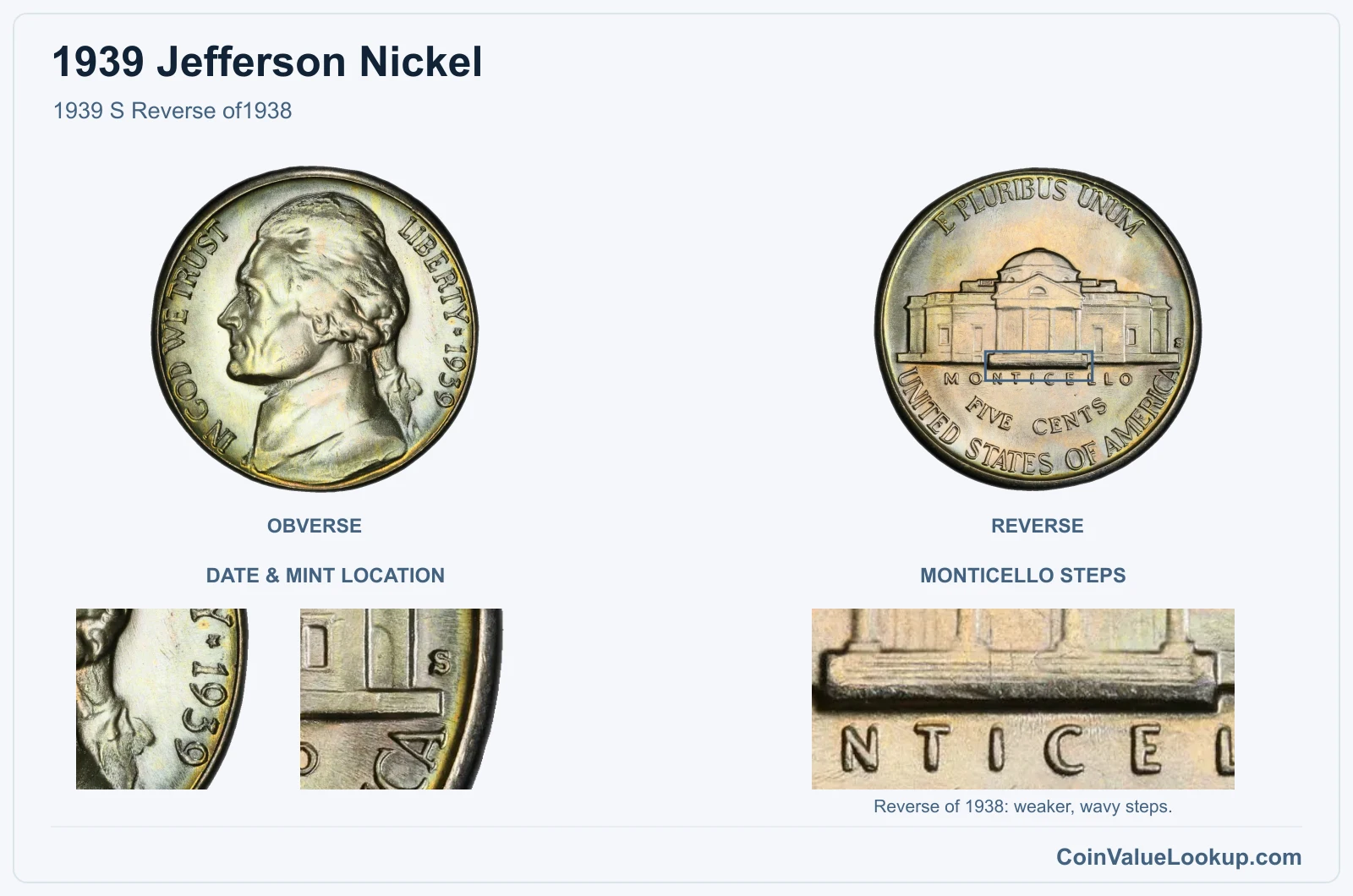
The 1939-S with Reverse of 1938 is a San Francisco business strike bearing a small S mintmark to the right of Monticello. The older reverse hub shows softer, slightly curved step lines.
Broad guide baselines for the 1939-S sit at roughly $3.62 at VF20, $25 at MS60, and $81 at MS65, though these are not specifically attributed to this reverse hub. San Francisco coins from this year fall between Philadelphia and Denver in guide value across circulated grades.
Confirm the reverse before locking in any estimate.
| Range | Grade | Price | Auction Records | Appraisal |
|---|---|---|---|---|
| PO | PO 1 | — | Coin Identifier | |
| FR | FR 2 | — | Coin Identifier | |
| AG | AG 3 | — | Coin Identifier | |
| G | G 4 | — | Coin Identifier | |
| G 6 | — | Coin Identifier | ||
| VG | VG 8 | — | Coin Identifier | |
| VG 10 | — | Coin Identifier | ||
| F | F 12 | — | Coin Identifier | |
| F 15 | — | Coin Identifier | ||
| VF | VF 20 | — | Coin Identifier | |
| VF 25 | — | Coin Identifier | ||
| VF 30 | — | Coin Identifier | ||
| VF 35 | — | Coin Identifier | ||
| XF | XF 40 | — | Coin Identifier | |
| XF 45 | — | Coin Identifier | ||
| AU | AU 50 | — | Coin Identifier | |
| AU 53 | — | Coin Identifier | ||
| AU 55 | — | Coin Identifier | ||
| AU 58 | — | Coin Identifier | ||
| MS | MS 60 | — | Coin Identifier | |
| MS 61 | — | Coin Identifier | ||
| MS 62 | Coin Identifier | |||
| MS 63 | Coin Identifier | |||
| MS 64 | Coin Identifier | |||
| MS 65 | Coin Identifier | |||
| MS 66 | Coin Identifier | |||
| MS 67 | Coin Identifier | |||
| MS 68 | — | — | — | |
| MS 69 | — | — | — | |
| MS 70 | — | — | — |
1939 Jefferson Nickel — S Reverse of1940
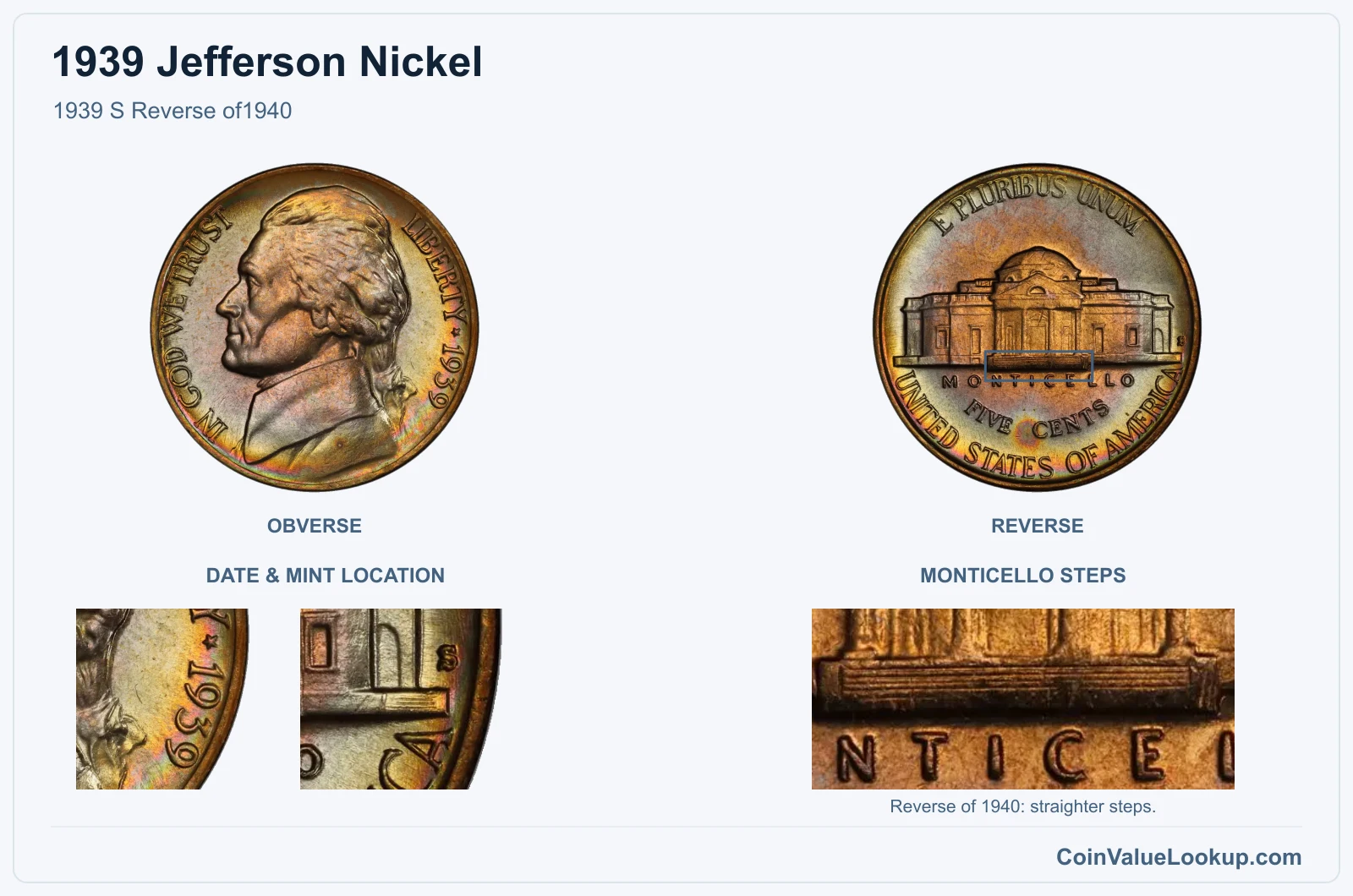
This San Francisco business strike carries the later Reverse of 1940 with straighter Monticello steps and an S mintmark. Broad guide baselines for 1939-S are approximately $3.62 at VF20, $25 at MS60, and $81 at MS65, but those aren't reverse-specific.
As with every 1939 nickel, the reverse identification step comes first. Compare the step contours at good magnification before deciding which price reference applies.
San Francisco coins in solid Mint State condition with clean surfaces are worth a close look.
| Range | Grade | Price | Auction Records | Appraisal |
|---|---|---|---|---|
| PO | PO 1 | — | Coin Identifier | |
| FR | FR 2 | — | Coin Identifier | |
| AG | AG 3 | — | Coin Identifier | |
| G | G 4 | — | Coin Identifier | |
| G 6 | — | Coin Identifier | ||
| VG | VG 8 | — | Coin Identifier | |
| VG 10 | — | Coin Identifier | ||
| F | F 12 | — | Coin Identifier | |
| F 15 | — | Coin Identifier | ||
| VF | VF 20 | — | Coin Identifier | |
| VF 25 | — | Coin Identifier | ||
| VF 30 | — | Coin Identifier | ||
| VF 35 | — | Coin Identifier | ||
| XF | XF 40 | — | Coin Identifier | |
| XF 45 | — | Coin Identifier | ||
| AU | AU 50 | — | Coin Identifier | |
| AU 53 | — | Coin Identifier | ||
| AU 55 | — | Coin Identifier | ||
| AU 58 | — | Coin Identifier | ||
| MS | MS 60 | — | Coin Identifier | |
| MS 61 | — | Coin Identifier | ||
| MS 62 | — | Coin Identifier | ||
| MS 63 | Coin Identifier | |||
| MS 64 | Coin Identifier | |||
| MS 65 | Coin Identifier | |||
| MS 66 | Coin Identifier | |||
| MS 67 | Coin Identifier | |||
| MS 68 | — | — | — | |
| MS 69 | — | — | — | |
| MS 70 | — | — | — |
1939 Jefferson Nickel Error List
1. 1939 Jefferson Nickel — Doubled Monticello
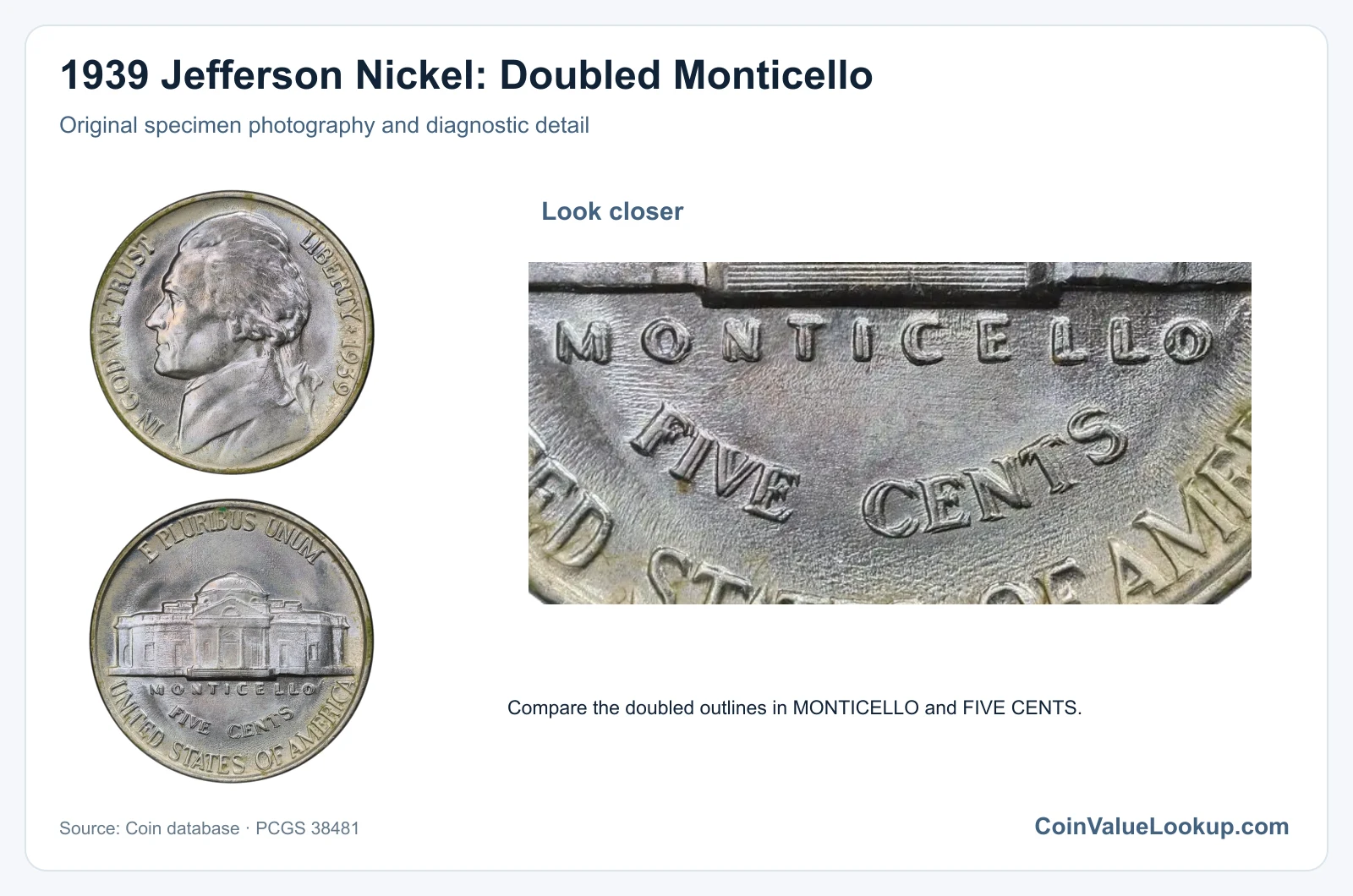
The 1939 Doubled Monticello is a Philadelphia business strike with a hub-doubled reverse die. You can see distinct doubled outlines in the word MONTICELLO and in FIVE CENTS.
Under magnification, these show as consistent, separated letter contours on both sides of the affected text.
Guide estimates place this variety at $123 in VF20, $438 in MS60, and $1,879 in MS65. Those do not include Full Steps premiums.
The common lookalike is machine doubling, which produces a flat, shelf-like distortion rather than the crisp doubled outline of a true hub variety. Glare or reflective surfaces can also trick the eye.
Compare your reverse to a normal 1939 nickel at the same magnification before getting excited. Certification by a major grading service is the reliable way to confirm this variety.
2. 1939 Jefferson Nickel — Struck on a cent planchet
A 1939 Jefferson nickel struck on a cent planchet means a smaller copper-alloy blank intended for a Lincoln cent received the nickel dies instead. The result is a coin with reduced diameter, lower weight, and design that may be cropped or stretched at the outer edges because the planchet was too small.
A Heritage Auctions sale from September 2019 recorded a PCGS AU58 example at $1,560. That's a single recorded result, not a market range.
A normal nickel weighs 5 grams and is copper-nickel colored. This error will look obviously different: copper tone, smaller size, possibly missing rim lettering.
Don't confuse copper plating, environmental toning, a ground-down nickel, or a souvenir-shop alteration with a genuine wrong-planchet strike. Professional authentication is essential.
3. 1939 Jefferson Nickel — Off-center strike
An off-center 1939 nickel was struck with the planchet misaligned relative to the dies, producing a design shifted to one side with an unstruck crescent of blank metal on the opposite edge. The missing border and displaced design are visible to the naked eye.
A Heritage Auctions sale from March 2021 recorded a PCGS MS65 example described as Reverse of 1940 and 10% off-center at $252. That is one sale, not a guaranteed price.
Document the date and any mintmark that remains visible, since the shift may obscure part of the design. Don't confuse this with a misaligned die error, which typically shows a mostly normal opposite face, or a coin that was cut or damaged after leaving the mint.
4. 1939 Jefferson Nickel — Struck on a silver dime planchet
This error involves a 1939 nickel struck on a silver dime planchet. An S-mint example with Reverse of 1940, graded AU55, sold through Heritage Auctions in December 2024 for $1,560.
That is a single recorded sale.
The coin will appear noticeably smaller than a normal nickel with a cropped perimeter where the design runs off the edge, because a dime blank is smaller than a nickel blank. The weight and diameter will be abnormal for a nickel, and the surface will show silver rather than copper-nickel color.
Don't mistake silver plating or unusually pale toning on a normal copper-nickel coin for a genuine wrong-planchet error. Exact planchet authentication by a recognized grading service is required to confirm this one.
5. 1939 Jefferson Nickel — Repunched Mintmark
A repunched mintmark on a 1939 nickel means the small D or S was punched into the working die more than once, leaving remnants of an earlier position visible alongside the final mark. Under magnification, you may see a partial second impression offset from the primary mintmark.
Compare the mintmark area on your coin to a normal example at matching magnification. True repunching shows consistent remnants that can't be explained by a die chip, corrosion around the letter, or the flat shelf of machine doubling.
Condition, the visibility of the repunching, and which specific variety it matches all affect value. No specific price estimate is available here, so professional identification is the right move if you spot something.
6. 1939 Jefferson Nickel — Doubled Die Obverse
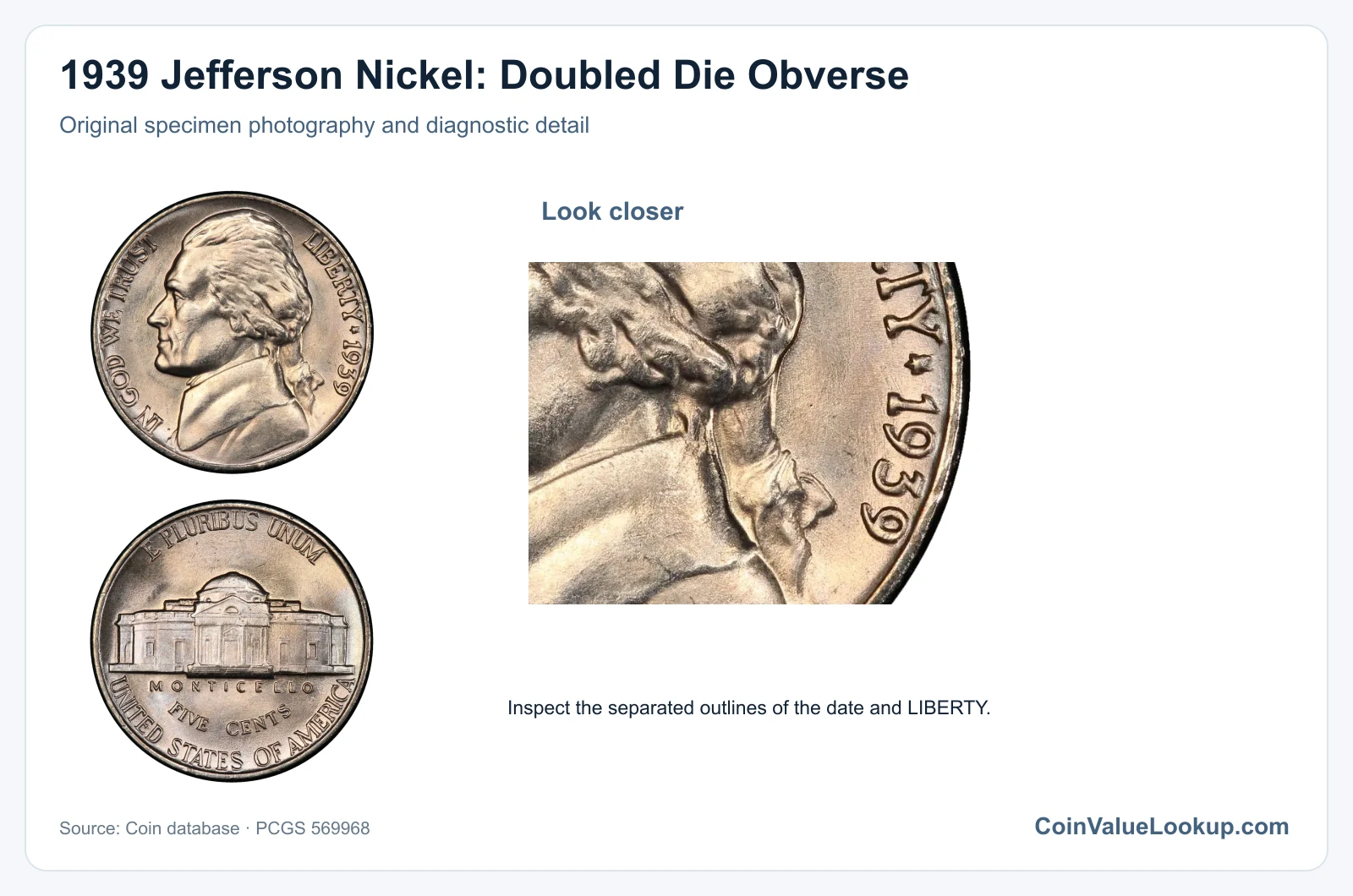
A doubled die obverse on the 1939 Philadelphia nickel with Reverse of 1940 shows consistent separation or notching on obverse design elements such as lettering. This is a hub-doubling phenomenon, not simple die deterioration.
To check, compare the obverse letters and portrait details to a normal 1939 nickel under the same lighting and magnification. Genuine hub doubling produces repeatable, directional separation, while machine doubling creates flat, shelf-like distortion.
Worn die contours and reflections can also mimic the appearance.
Value depends on the coin's condition, the visibility of the doubling, and which specific variety it matches. No numerical price estimate is available here.
If you see consistent doubled features, professional authentication is worth pursuing.
7. 1939 Jefferson Nickel — Broadstrike
A broadstruck 1939 nickel was struck without the normal collar die that confines the blank and forms the rim. The result is a coin with outward metal spread, a larger-than-normal diameter, and a weak or missing rim.
The full design is typically present, just expanded. Look at the edge profile: a broadstruck coin will lack the neat, raised rim of a properly struck piece, and the metal will have flowed outward uniformly.
Don't confuse this with an off-center strike, which shifts the design and leaves a blank crescent. A coin flattened by post-mint damage, like being run over or hammered, can also mimic the spread but usually shows surface distortion inconsistent with a single press event.
Value depends on condition and severity; no specific price estimate is available.
8. 1939 Jefferson Nickel — Struck-Through Error
A struck-through error on a 1939 nickel occurs when foreign material sits between the die and the planchet during striking. This leaves a localized depression, an impression of the obstruction, or an area of incomplete design on one or both sides.
The appearance varies depending on what got trapped. Grease fill-throughs leave smooth, featureless patches.
A retained foreign object might leave a textured impression. Examine the affected area under magnification to distinguish it from ordinary wear, scratches, cleaning marks, or a weak strike from a worn die.
Condition and the nature of the struck-through impression both affect value. No specific price estimate is available here.
If you find a clear impression with sharp boundaries and undisturbed surrounding detail, it is worth having a professional take a closer look.