1902 Liberty Nickel Coin Value: How Much Is It Worth?
A 1902 Liberty Nickel in well-worn G4 condition books at about $2.50 in a USA Coin Book guide estimate, while an MS63 example jumps to around $154. Proofs graded PR63 anchor near $344 in the same snapshot.
Two reverse hub types exist for circulation strikes, and separating them takes a close look at specific design details. Original surfaces and accurate identification matter here.
Fast Way to Identify Your 1902 Liberty Nickel
Snap clear photos of both the front and back of your 1902 Liberty Nickel and upload them for a preliminary identification. Good lighting on the fields and rim helps.
This step can help sort out whether you have a business strike or proof finish, and which reverse hub type you might be holding, before you invest in professional grading.
1902 Liberty Nickel Value
Upload both sides of your 1902 Liberty Nickel.
Front Obverse
Upload photo
Back Reverse
Upload photo
Which 1902 Liberty Nickel Versions Are Worth Money?
- Two circulation reverse hubs exist: Type 1 and Type 2, distinguished by leaf position and AM base spacing on the reverse.
- Proofs struck at Philadelphia are a separate collectible category, with a PR63 guide value near $344.
- High-grade business strikes with original luster can reach the $154 range at MS63 per one guide estimate.
- Confirmed error types such as off-center strikes or laminations may carry premiums depending on severity and eye appeal.
Step 1: Identify Your 1902 Liberty Nickel Mint Mark and Version
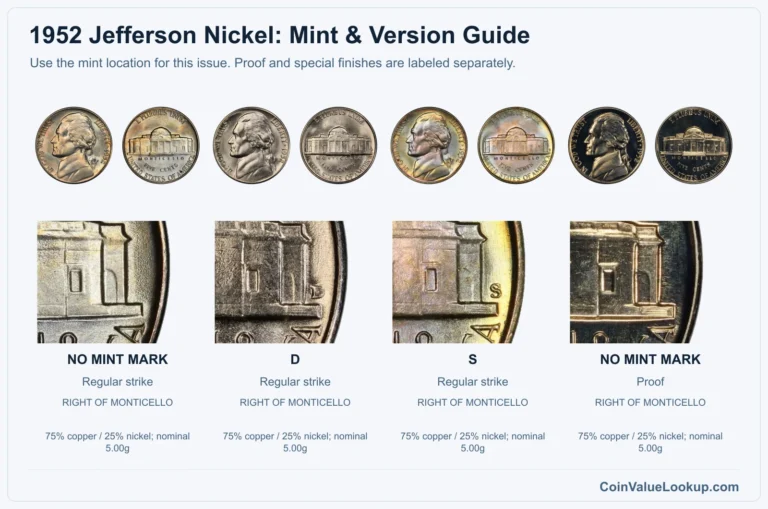
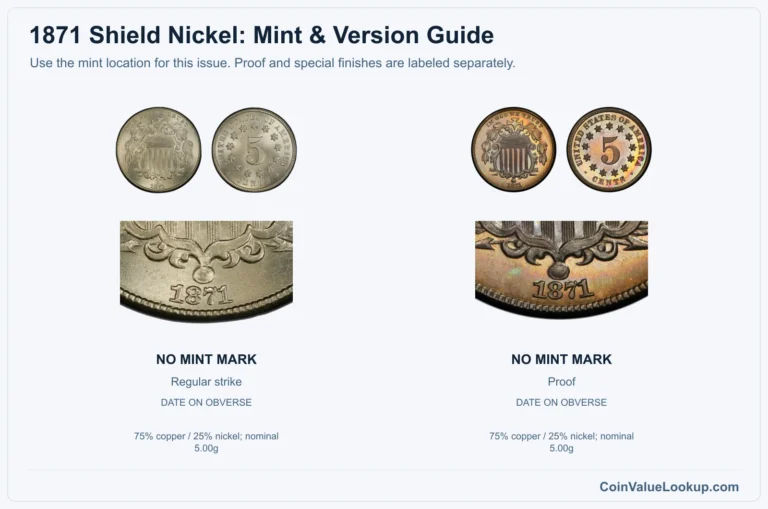
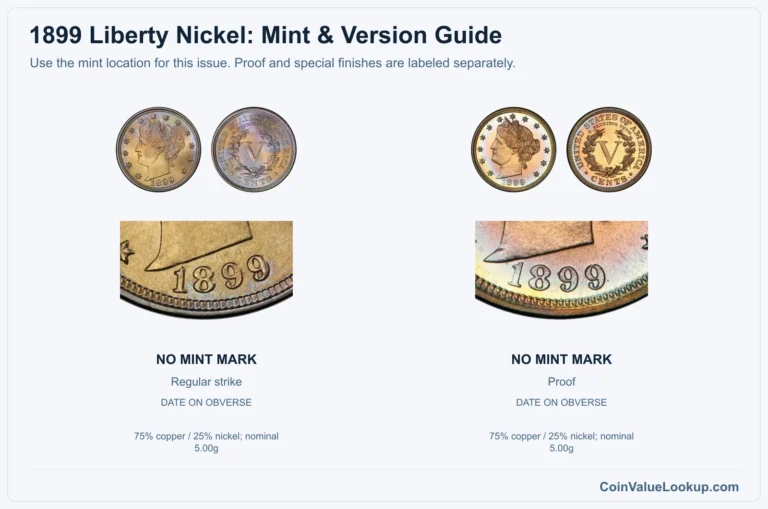
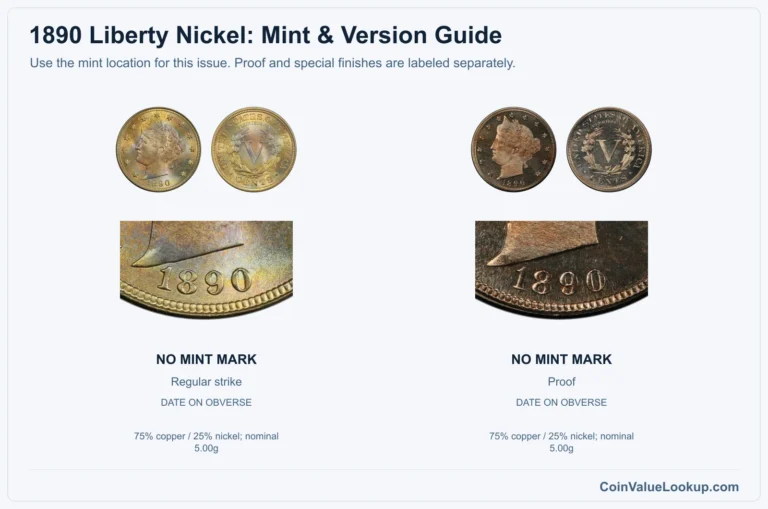
Every 1902 Liberty Nickel was struck at Philadelphia, so there is no mintmark to hunt for. Do not expect a D or S variant for this date.
The coin is 75% copper and 25% nickel, weighs about 5 grams, measures 21.2 mm, and has a plain edge. There is no regular silver version.
All 1902 nickels carry the "CENTS" legend on the reverse. The earlier No CENTS design had already been replaced well before 1902, so if yours says CENTS, that is exactly right.
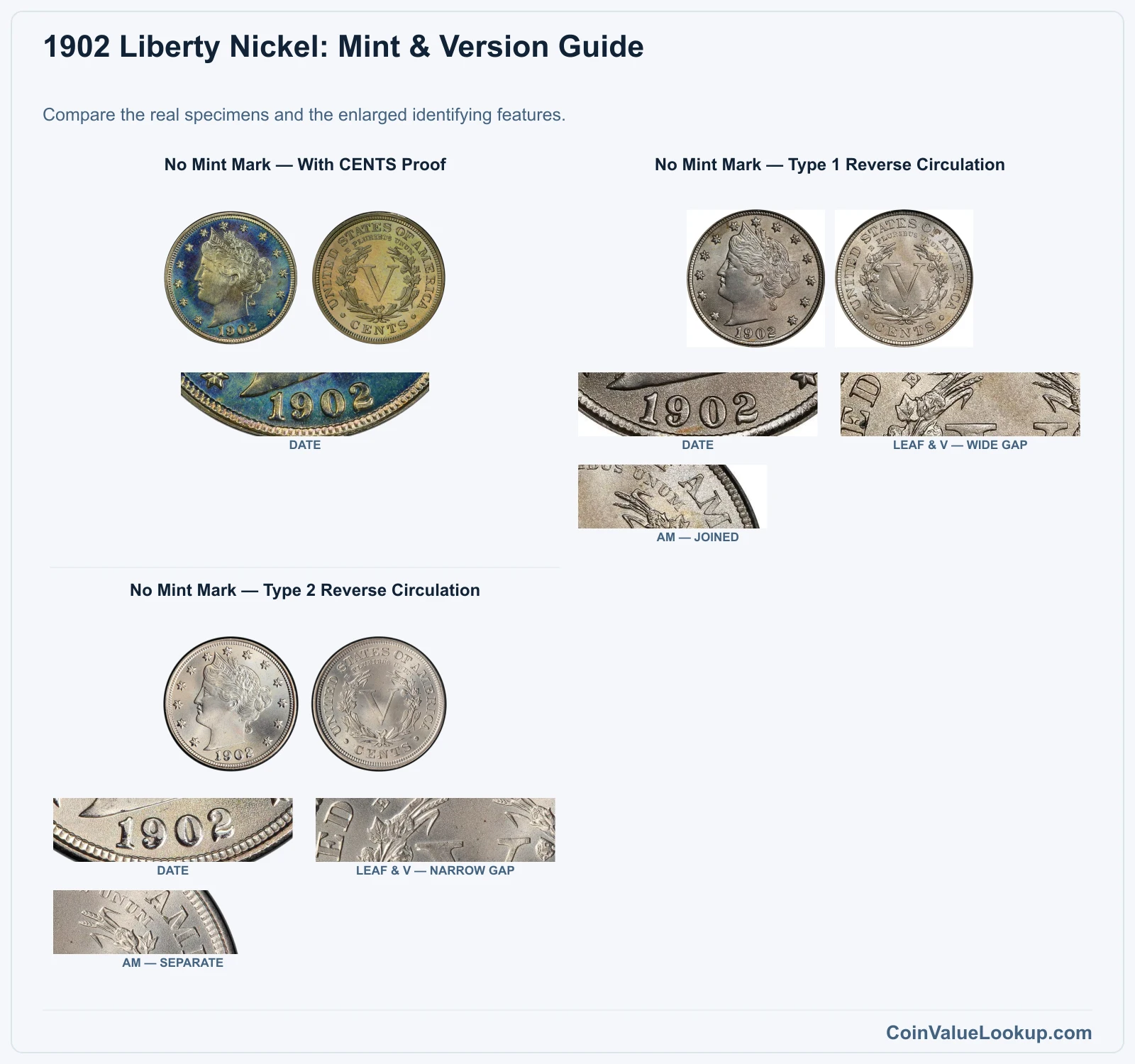
The real sorting challenge is the two circulation reverse hubs, called Type 1 and Type 2. On a Type 1, the leaf above the left arm of the large "V" sits farther from the serif of that arm, and the bases of the letters A and M in AMERICA are connected.
On a Type 2, those details differ. Place your coin next to an attributed example or a clear reference image to compare leaf spacing and AM base connections.
This is subtle work, so patience and magnification help.
Step 2: Check Your 1902 Liberty Nickel Grade
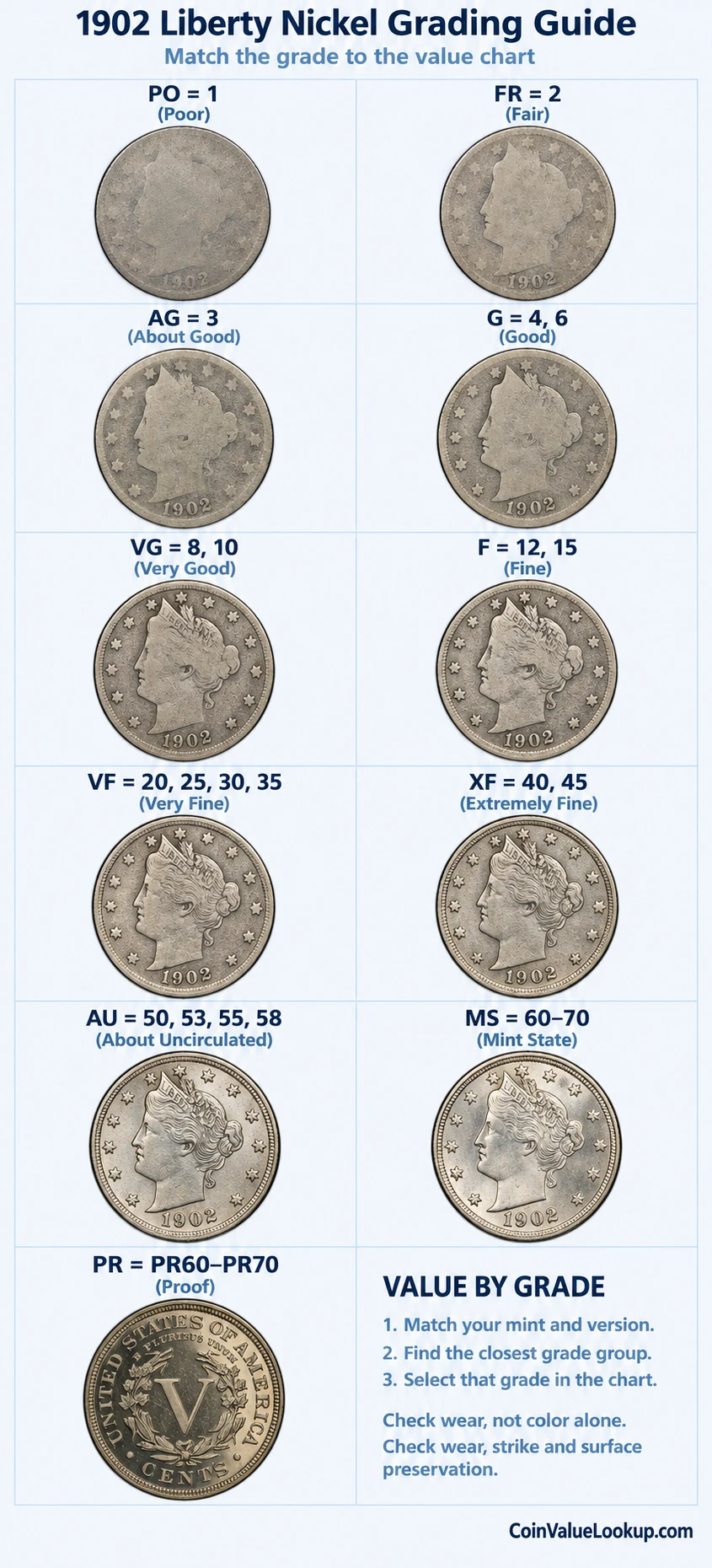
Start with the obverse. The word LIBERTY on the coronet is the first casualty of wear, so count how many letters remain sharp.
High hair curls above the forehead and the cheek below the eye also flatten quickly in circulation.
Flip to the reverse. Inspect the corn ears and wreath detail for smoothing.
Compare what you see against the reference image provided, keeping in mind that weak details can also result from a soft strike at the mint rather than actual wear.
For mint-state coins, focus on original luster, the severity of contact marks, and overall strike sharpness. A coin can look "tired" from a weak strike yet never have left the mint.
Proof is a manufacturing method, not a grade that sits above Mint State. Look for mirrored fields, crisp rims, and minimal hairlines.
Compare with an attributed proof rather than guessing. Coin Value Lookup is a handy starting point if you want to look up additional coin guides while you evaluate your piece.
Step 3: Check 1902 Liberty Nickel Value by Mint and Version
1902 Liberty Nickel — No Mint Mark — With CENTS Proof
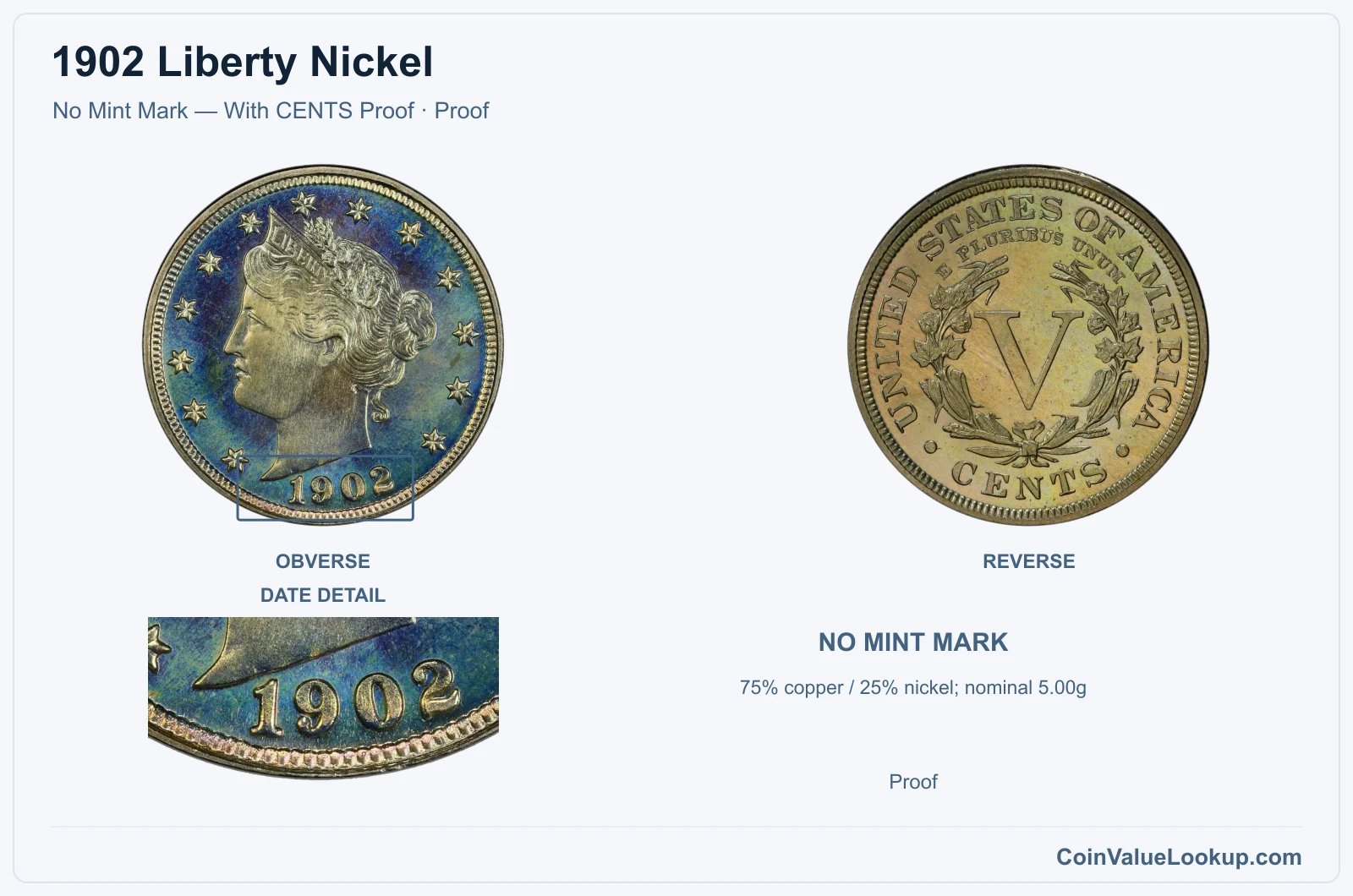
The 1902 proof Liberty Nickel was struck at Philadelphia with no mintmark. It uses the With CENTS reverse design and was made on the same 75% copper / 25% nickel planchets as business strikes, but with specially prepared dies and deliberate multiple strikes that produce mirror-like fields.
A PR63 example sits at roughly $344 in a USA Coin Book guide estimate. When evaluating a proof, examine the fields under magnification for hairlines and the rims for handling marks.
Two different circulation reverse hubs exist alongside the proof version, so if you are comparing coins, note that the proof die may not match either circulation hub exactly. Show both faces and any field or rim detail in your photos for the best preliminary identification.
Range Grade
Price Auction Records Appraisal PR PR 1
—
Coin Identifier
PR 2
—
Coin Identifier
PR 3
—
Coin Identifier
PR 4
—
Coin Identifier
PR 6
—
Coin Identifier
PR 8
—
Coin Identifier
PR 10
—
Coin Identifier
PR 12
—
Coin Identifier
PR 15
—
Coin Identifier
PR 20
—
Coin Identifier
PR 25
—
Coin Identifier
PR 30
—
Coin Identifier
PR 35
—
Coin Identifier
PR 40
—
Coin Identifier
PR 45
—
Coin Identifier
PR 50
—
Coin Identifier
PR 53
—
Coin Identifier
PR 55
—
Coin Identifier
PR 58
Coin Identifier
PR 60
—
Coin Identifier
PR 61
—
Coin Identifier
PR 62
Coin Identifier
PR 63
Coin Identifier
PR 64
Coin Identifier
PR 65
Coin Identifier
PR 66
Coin Identifier
PR 67
Coin Identifier
PR 68
Coin Identifier
PR 69
—
—
—
PR 70
—
—
—
1902 Liberty Nickel — No Mint Mark — Type 1 Reverse Circulation
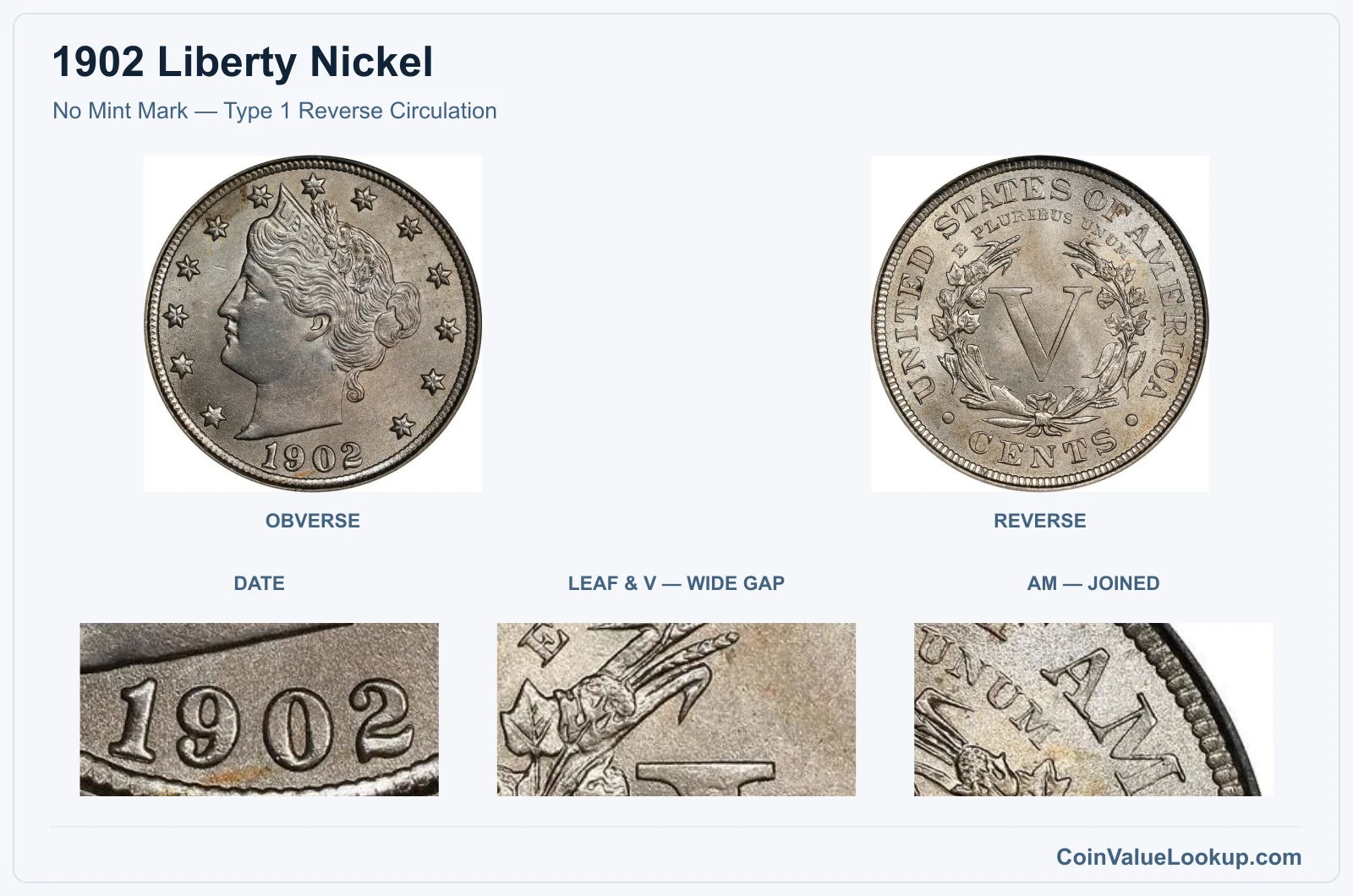
This is the Type 1 reverse circulation strike, made at Philadelphia with no mintmark on a copper-nickel planchet. The key diagnostic: the leaf above the left arm of the large "V" sits noticeably farther from that arm's serif, and the bases of the A and M in AMERICA connect.
General 1902 Liberty Nickel guide values run about $2.50 in G4 to $154 in MS63 from a USA Coin Book snapshot. These anchors are year-level estimates and do not reflect a confirmed premium specific to the Type 1 hub.
Both Type 1 and Type 2 carry the CENTS legend. A side-by-side comparison with an attributed coin or reference photo is the most reliable way to confirm which hub you have.
Range Grade
Price Auction Records Appraisal PO PO 1
—
Coin Identifier FR FR 2
—
Coin Identifier AG AG 3
—
Coin Identifier G G 4
—
Coin Identifier
G 6
—
Coin Identifier VG VG 8
—
Coin Identifier
VG 10
—
Coin Identifier F F 12
—
Coin Identifier
F 15
—
Coin Identifier VF VF 20
—
Coin Identifier
VF 25
—
Coin Identifier
VF 30
—
Coin Identifier
VF 35
—
Coin Identifier XF XF 40
—
Coin Identifier
XF 45
Coin Identifier AU AU 50
—
Coin Identifier
AU 53
—
Coin Identifier
AU 55
Coin Identifier
AU 58
Coin Identifier MS MS 60
Coin Identifier
MS 61
Coin Identifier
MS 62
Coin Identifier
MS 63
Coin Identifier
MS 64
Coin Identifier
MS 65
Coin Identifier
MS 66
Coin Identifier
MS 67
Coin Identifier
MS 68
—
—
—
MS 69
—
—
—
MS 70
—
—
—
1902 Liberty Nickel — No Mint Mark — Type 2 Reverse Circulation
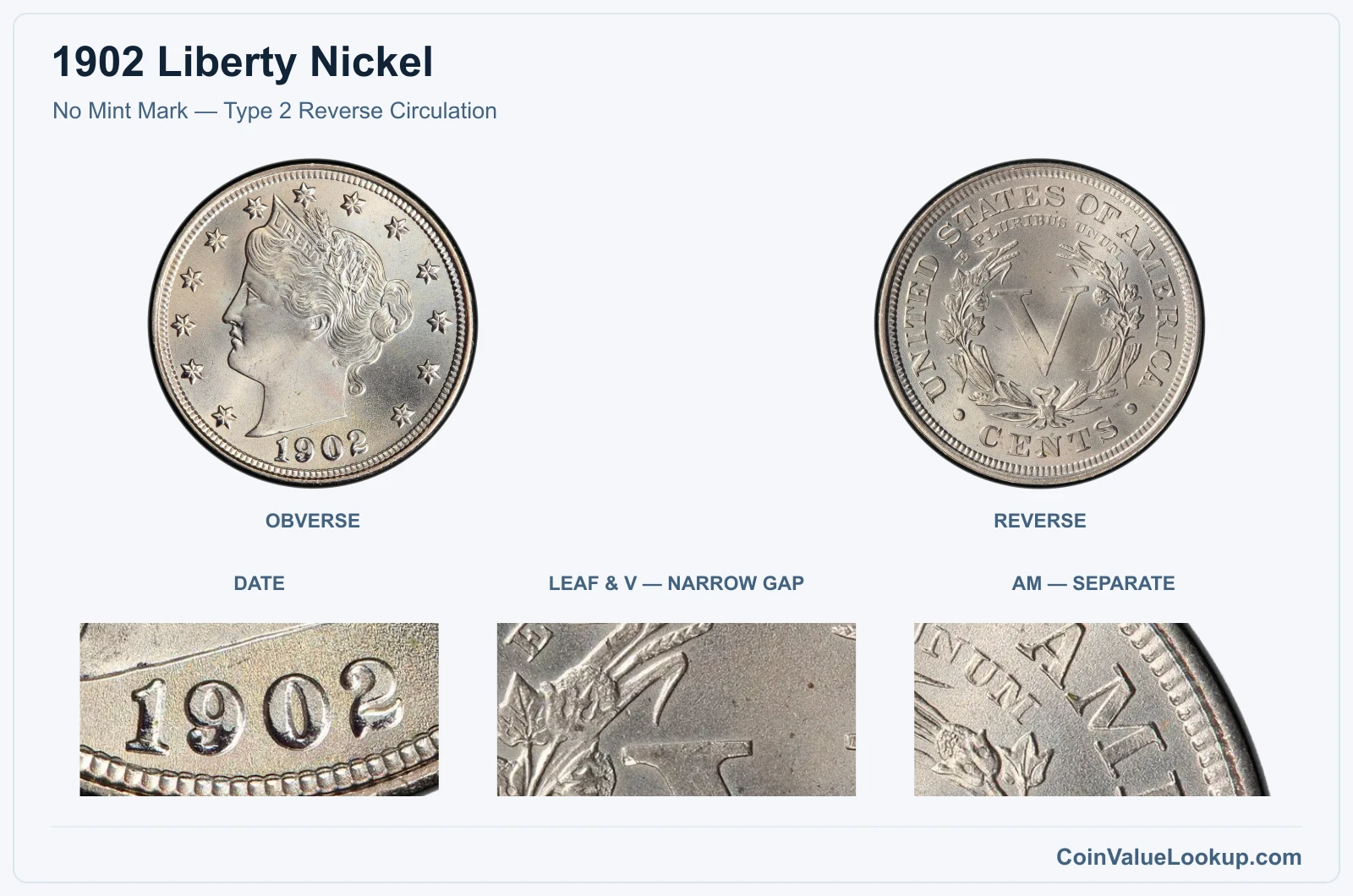
The Type 2 reverse is the other circulation hub used for 1902, also struck at Philadelphia with no mintmark on the same 75% copper / 25% nickel planchet. To tell it apart from Type 1, compare the leaf position above the left arm of the "V" and the spacing between the bases of A and M in AMERICA.
On the Type 2, those features differ from the Type 1 layout.
Year-level guide values of about $2.50 at G4 and $154 at MS63 apply here as well, sourced from a USA Coin Book snapshot. No separate subtype premium is confirmed, so treat these anchors as general 1902 estimates.
Both hubs display CENTS on the reverse, so do not mistake one hub for the other based on that word alone.
Range Grade
Price Auction Records Appraisal PO PO 1
—
Coin Identifier FR FR 2
—
Coin Identifier AG AG 3
—
Coin Identifier G G 4
—
Coin Identifier
G 6
—
Coin Identifier VG VG 8
—
Coin Identifier
VG 10
—
Coin Identifier F F 12
—
Coin Identifier
F 15
—
Coin Identifier VF VF 20
—
Coin Identifier
VF 25
—
Coin Identifier
VF 30
—
Coin Identifier
VF 35
—
Coin Identifier XF XF 40
—
Coin Identifier
XF 45
Coin Identifier AU AU 50
—
Coin Identifier
AU 53
—
Coin Identifier
AU 55
Coin Identifier
AU 58
Coin Identifier MS MS 60
Coin Identifier
MS 61
Coin Identifier
MS 62
Coin Identifier
MS 63
Coin Identifier
MS 64
Coin Identifier
MS 65
Coin Identifier
MS 66
Coin Identifier
MS 67
Coin Identifier
MS 68
—
—
—
MS 69
—
—
—
MS 70
—
—
—
1902 Liberty Nickel Error List
1. 1902 Liberty Nickel — Off-Center Strike
An off-center strike happens when the planchet is not properly seated in the collar before the dies come together. The result is a displaced design with an unstruck crescent along part of the rim.
On a 1902 Liberty Nickel, look for a visible shift where one side of the design fades into blank metal while the opposite side crowds the rim.
The date should remain visible for the error to be most collectible. Watch out for lookalikes: a clipped planchet, one-sided die misalignment, or post-mint flattening from damage can mimic the appearance.
The difference is that a genuine off-center strike shifts the entire design uniformly. No specific price range is available here; value depends on the percentage of off-center shift, whether the date is readable, and overall condition.
2. 1902 Liberty Nickel — Lamination / Split Planchet
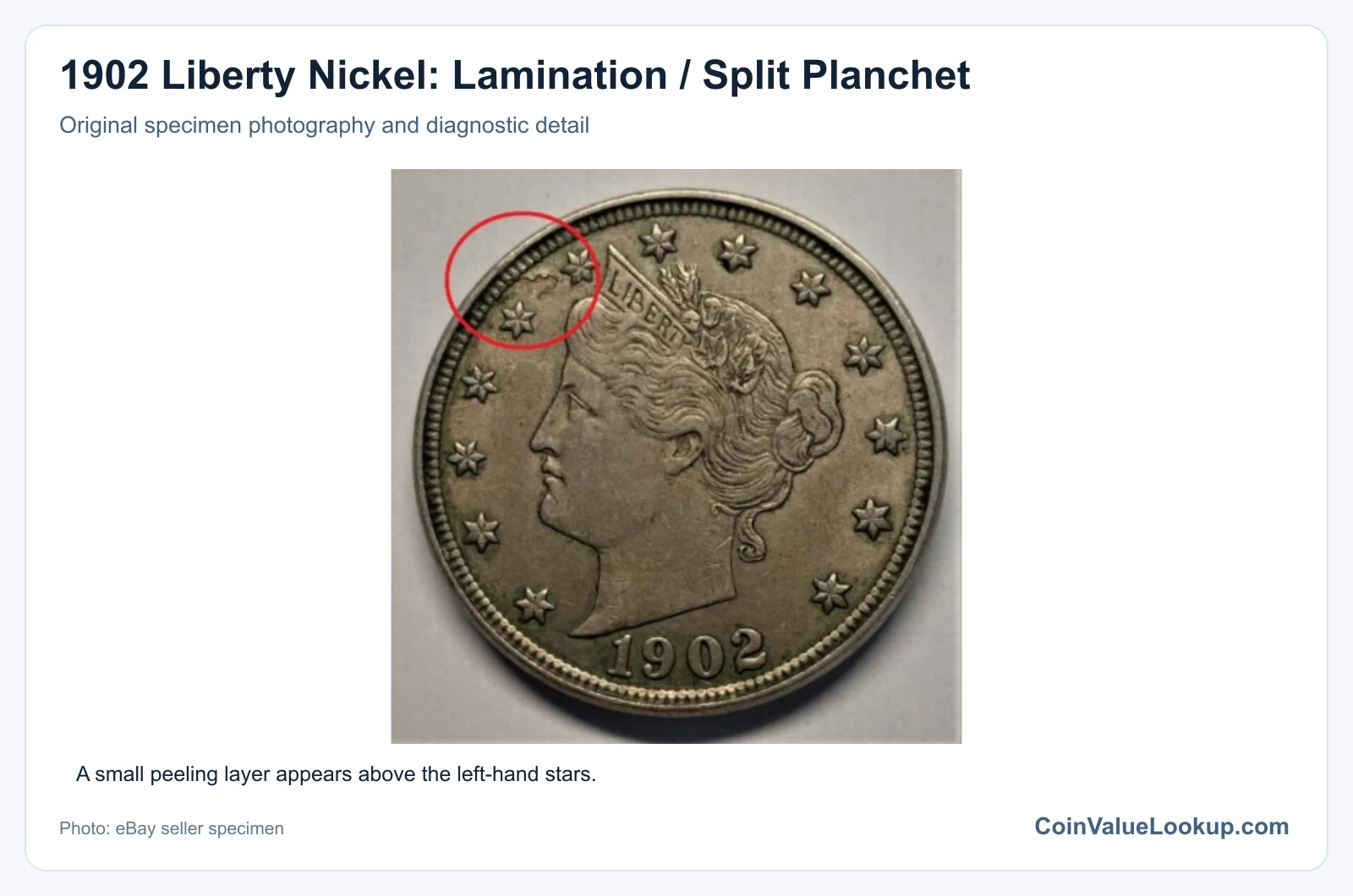
A lamination or split planchet error occurs when layers of the nickel alloy separate, leaving peeling metal, a retained flap, or a visible split within the coin's thickness. On a 1902 Liberty Nickel, check both faces and photograph the edge alongside the affected area for the clearest documentation.
This error has been reported on 1902 circulation nickels. Do not assume a proof coin would show the same category without separate confirmation.
Common lookalikes include surface scraping, corrosion pitting, and coins that have been deliberately cut or peeled. Genuine laminations typically follow the coin's contour and show a natural metallic texture underneath.
No specific price is available for this error; value depends on how dramatic and visible the separation is, plus the coin's overall preservation.