1902 Barber Quarter Coin Value: How Much Is It Worth?
The 1902 Barber Quarter is a 90% silver coin that trades across a wide range depending on mint, finish and condition. Guide estimates for the listed versions span from about $21.00 to $1,354.00 at specific grades, so identifying your exact branch matters before you look up a price.
Fast Way to Identify Your 1902 Barber Quarter
Snap clear photos of both the front and back of your coin and upload them here. A preliminary identification can help you figure out which mint and version you have, so you know where to start your research.
Good lighting and a steady hand go a long way.
1902 Barber Quarter Value
Upload both sides of your 1902 Barber Quarter.
Front Obverse
Upload photo
Back Reverse
Upload photo
Which 1902 Barber Quarter Versions Are Worth Money?
- 1902-O: Guide estimate reaches $1,354.00 at MS63; the New Orleans mint produced coins that are tougher to find in higher uncirculated grades.
- 1902-S: Guide estimate of $1,136.00 at MS63; San Francisco strikes in this condition are scarce enough to carry a strong premium.
- 1902 Proof: Guide estimate of $799.00 at PR63; a collector-finish coin from a limited proof production at Philadelphia.
Step 1: Identify Your 1902 Barber Quarter Mint Mark and Version
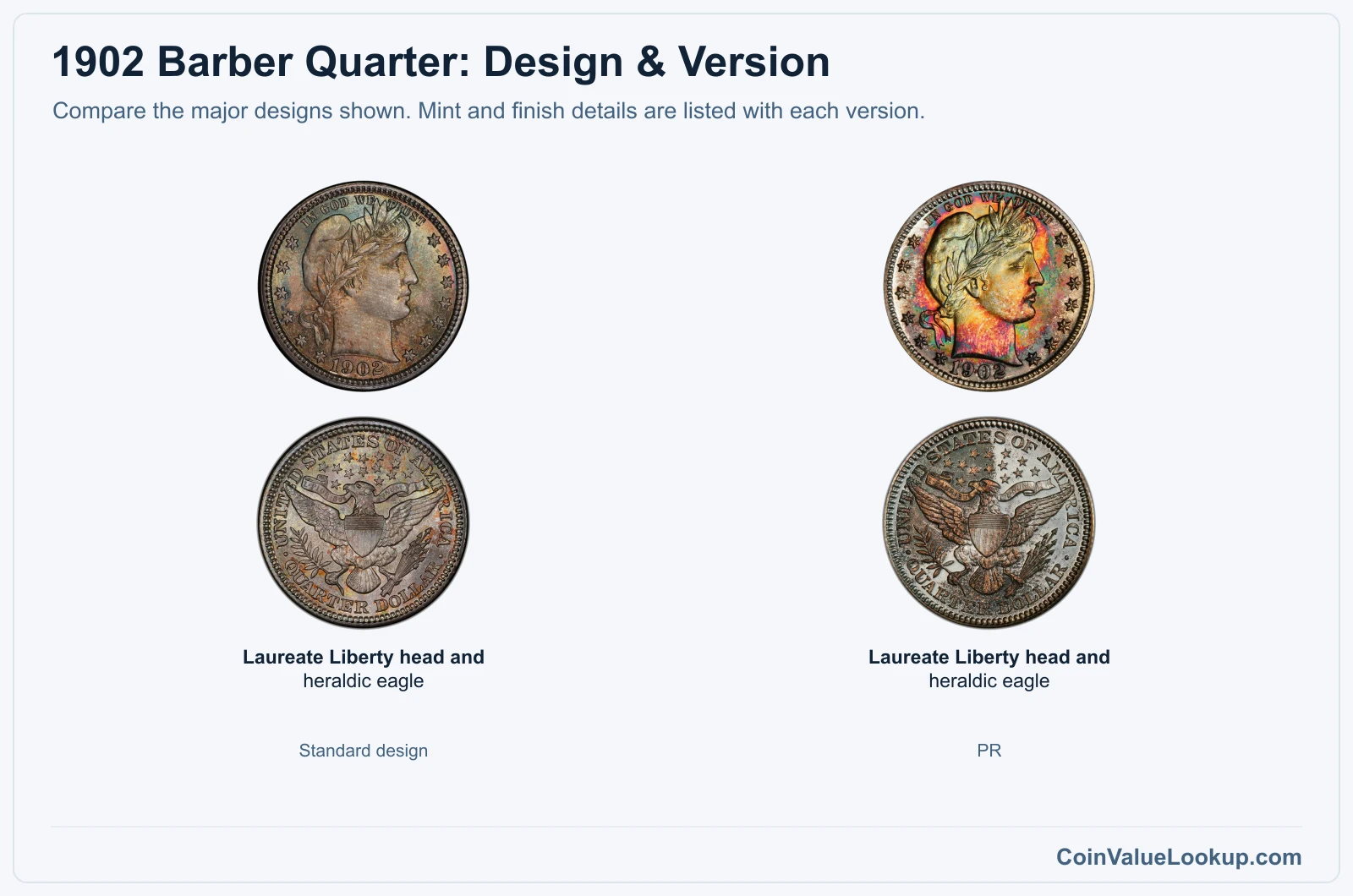
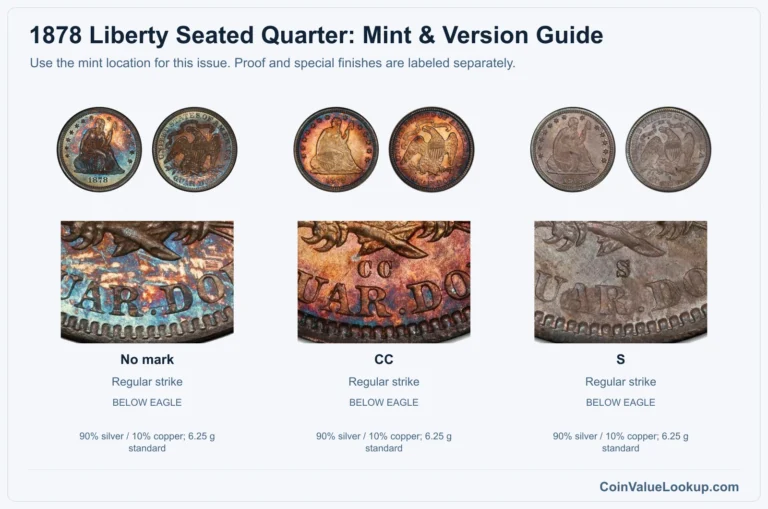
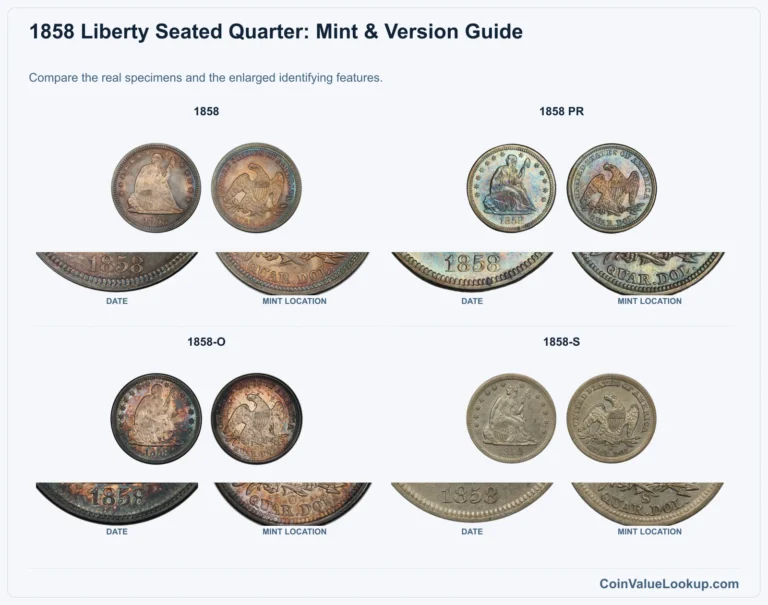
The 1902 Barber Quarter comes in four collectible branches: 1902 (Philadelphia, no mintmark), 1902 Proof (also Philadelphia, no mintmark, proof finish), 1902-O (New Orleans) and 1902-S (San Francisco). To find the mintmark, flip to the reverse and look just below the eagle's tail feathers, above the denomination.
No letter means Philadelphia.
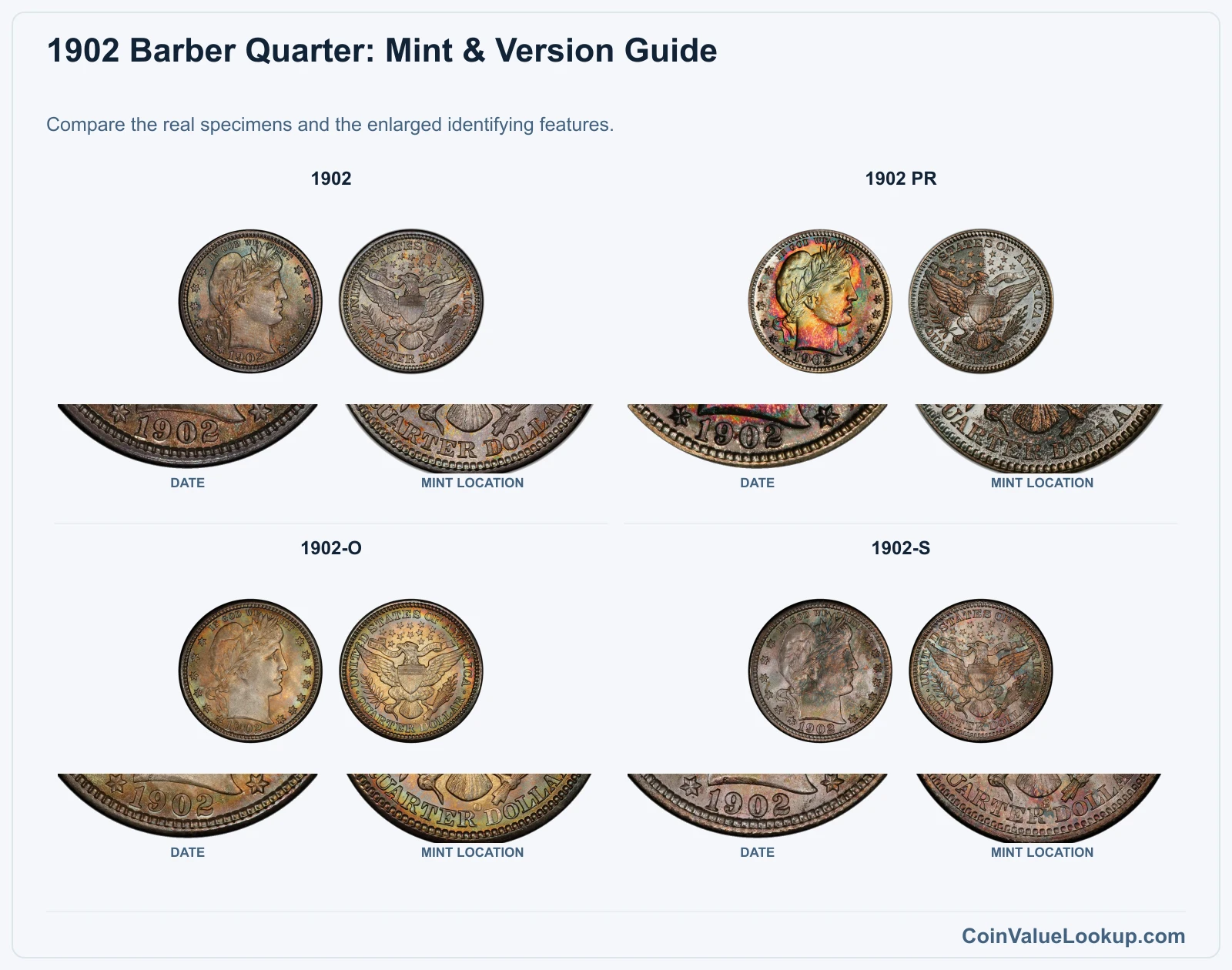
All versions are struck in 90% silver and 10% copper, weighing 6.25 grams. The obverse carries Charles Barber's laureate Liberty head; the reverse shows a heraldic eagle.
Don't confuse a proof with a high-grade business strike. Proofs were manufactured with a distinct process that produces mirror-like fields.
A shiny coin that's been polished is not a proof. If you're unsure, compare the surface texture under magnification rather than guessing from brightness alone.
Step 2: Check Your 1902 Barber Quarter Grade
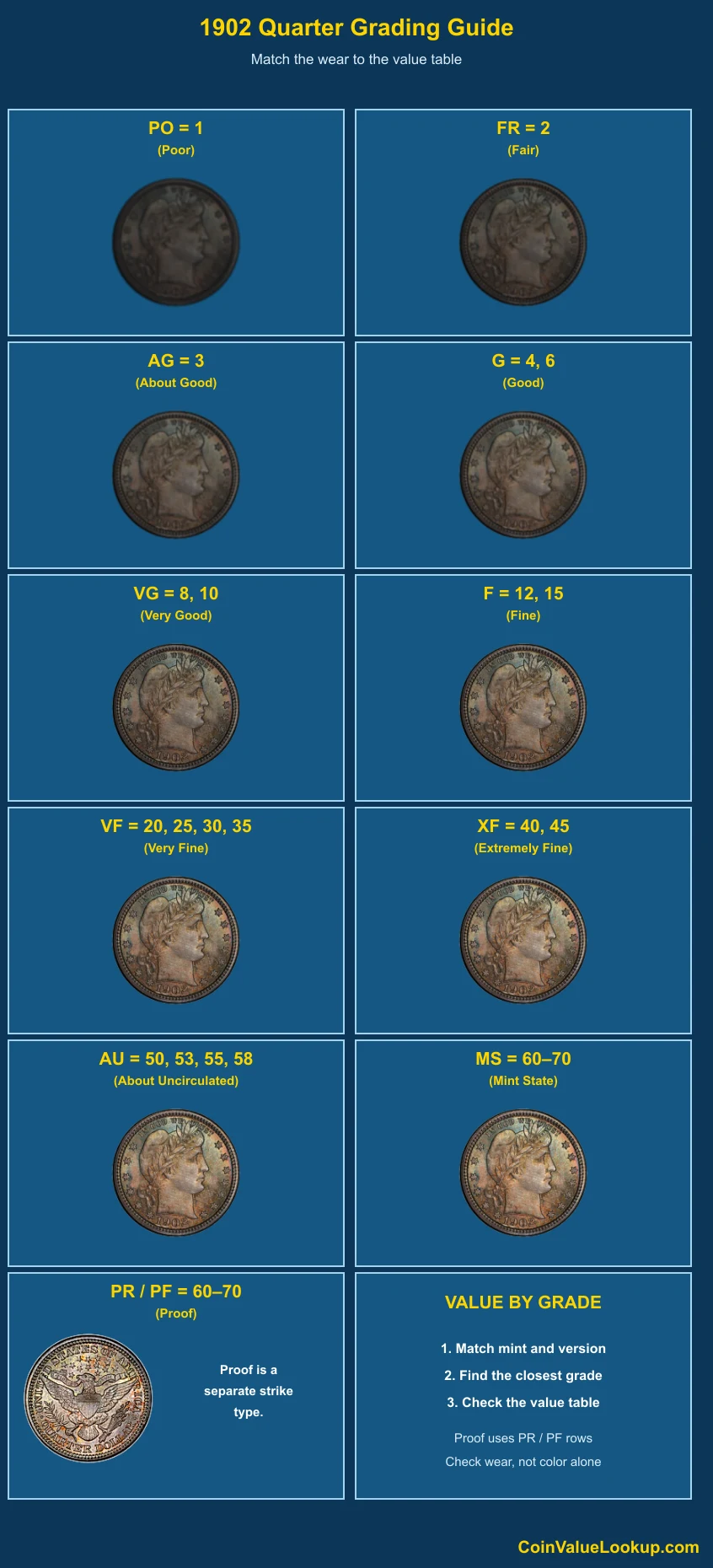
Start with the hair above the forehead and the detail in the wreath on Liberty's head. On well-worn coins, this area flattens first.
The cheek loses contour next. On the reverse, check the eagle's breast feathers, the tops of the wings and the tail.
The word LIBERTY appears on a ribbon in the headband. Letters disappear as the coin wears, but don't rely on LIBERTY alone; evaluate it alongside overall surface wear and remaining luster.
Compare your coin side by side with the reference image for this type. A weak strike at the mint can mimic wear, so look for luster in protected areas.
If the fields still show cartwheel reflections but high points are soft, you may have a strike issue, not a wear issue.
Cleaning or damage always pulls the value down, regardless of how much detail remains. Original toning and unbroken luster matter more than you'd think.
Step 3: Check 1902 Barber Quarter Value by Mint and Version
1902 Barber Quarter
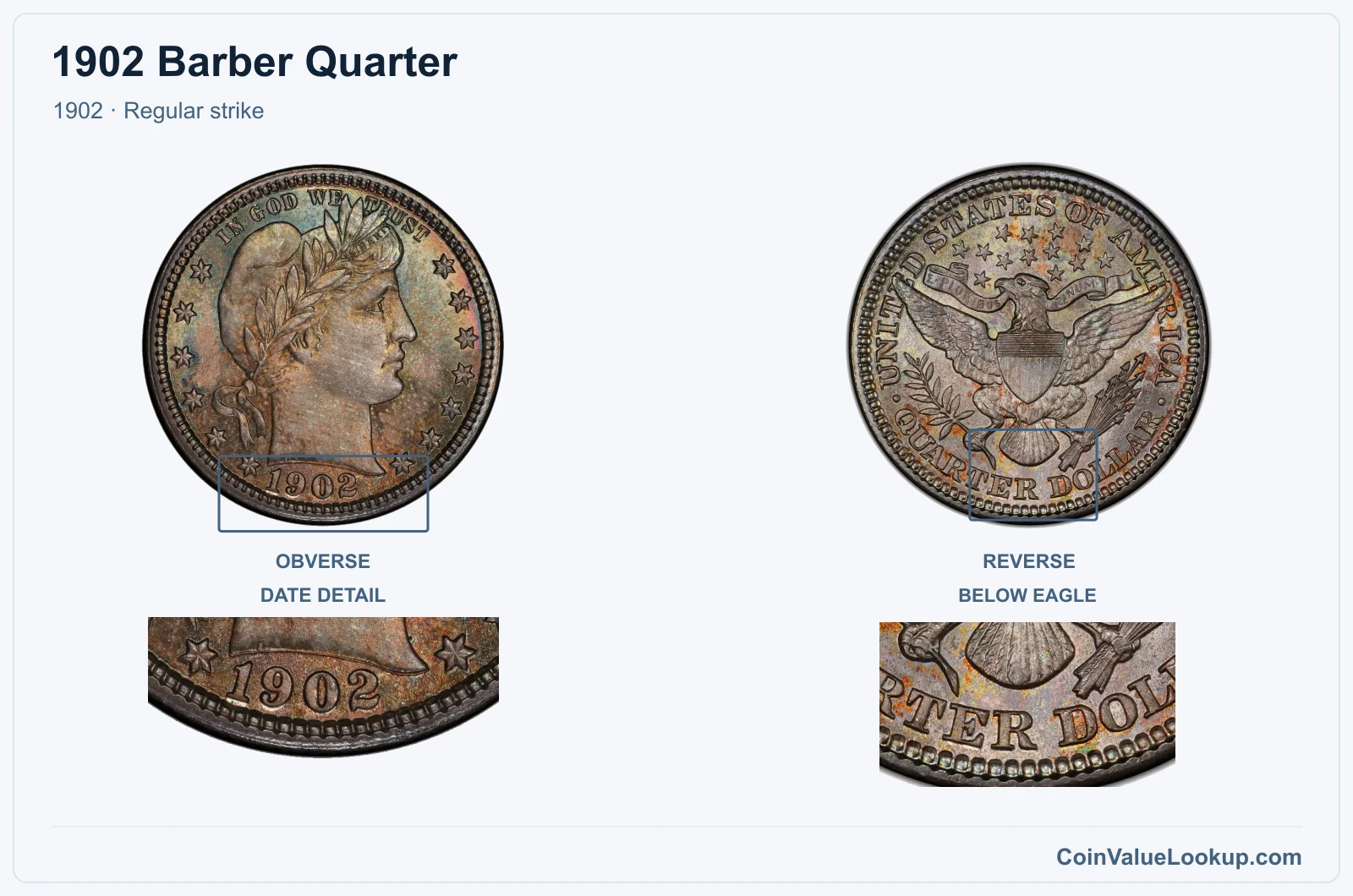
The 1902 Philadelphia quarter has no mintmark. In well-circulated condition at G4, the guide estimate from USA Coin Book is about $21.00.
Jump to MS60 and you're looking at roughly $309.00, with MS63 coins estimated around $477.00.
Confirm the absence of a mintmark on the reverse before assuming Philadelphia. Original surfaces with natural toning and no signs of cleaning are important when comparing to guide values.
Damage or harsh cleaning can push the real-world value well below these figures.
Range Grade
Price Auction Records Appraisal PO PO 1
—
Coin Identifier FR FR 2
—
Coin Identifier AG AG 3
—
Coin Identifier G G 4
—
Coin Identifier
G 6
—
Coin Identifier VG VG 8
—
Coin Identifier
VG 10
—
Coin Identifier F F 12
—
Coin Identifier
F 15
—
Coin Identifier VF VF 20
—
Coin Identifier
VF 25
—
Coin Identifier
VF 30
—
Coin Identifier
VF 35
—
Coin Identifier XF XF 40
Coin Identifier
XF 45
Coin Identifier AU AU 50
—
Coin Identifier
AU 53
Coin Identifier
AU 55
Coin Identifier
AU 58
Coin Identifier MS MS 60
—
Coin Identifier
MS 61
Coin Identifier
MS 62
Coin Identifier
MS 63
Coin Identifier
MS 64
Coin Identifier
MS 65
Coin Identifier
MS 66
Coin Identifier
MS 67
Coin Identifier
MS 68
—
—
—
MS 69
—
—
—
MS 70
—
—
—
1902 Barber Quarter — PR
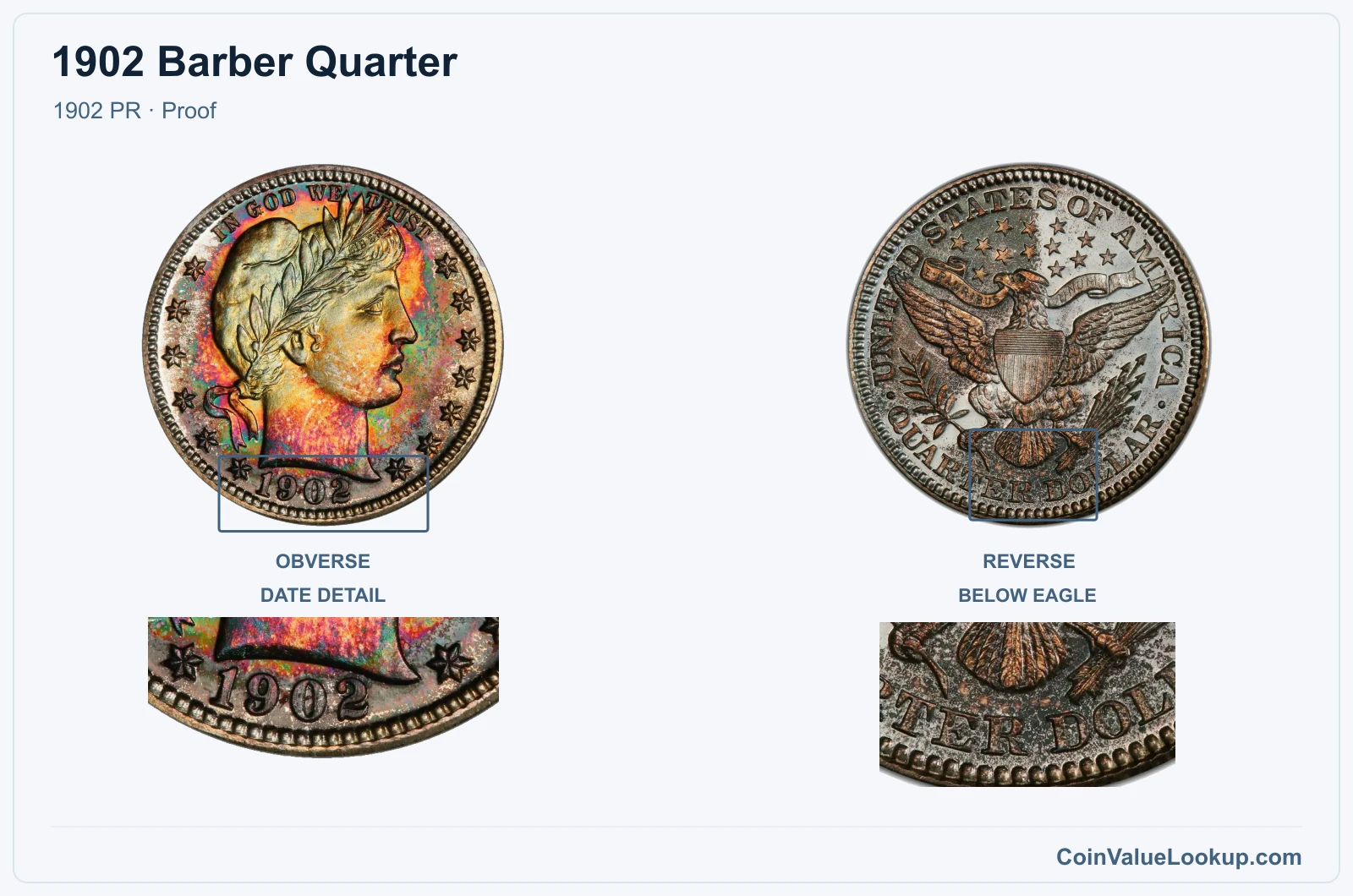
The 1902 Proof was struck at Philadelphia using polished dies and planchets, producing deeply mirrored fields. There is no mintmark.
The USA Coin Book guide estimate for a PR63 example is about $799.00.
Proof finish is a manufacturing method, not a higher grade than Mint State. Look for squared rims, sharp detail and reflective surfaces rather than just brightness.
Surface haze and hairlines from handling are common on proofs of this era and affect collector value. A regular strike that's been polished is not a proof, no matter how shiny it looks under a desk lamp.
Coin Value Lookup is a good starting point if you want to compare this coin against other Barber Quarter years and denominations. You can look up guides by year and mint to get a broader picture of the series.
Range Grade
Price Auction Records Appraisal PR PR 1
—
Coin Identifier
PR 2
—
Coin Identifier
PR 3
—
Coin Identifier
PR 4
—
Coin Identifier
PR 6
—
Coin Identifier
PR 8
—
Coin Identifier
PR 10
—
Coin Identifier
PR 12
—
Coin Identifier
PR 15
—
Coin Identifier
PR 20
—
Coin Identifier
PR 25
—
Coin Identifier
PR 30
—
Coin Identifier
PR 35
—
Coin Identifier
PR 40
—
Coin Identifier
PR 45
—
Coin Identifier
PR 50
—
Coin Identifier
PR 53
Coin Identifier
PR 55
—
Coin Identifier
PR 58
—
Coin Identifier
PR 60
Coin Identifier
PR 61
Coin Identifier
PR 62
Coin Identifier
PR 63
Coin Identifier
PR 64
Coin Identifier
PR 65
Coin Identifier
PR 66
Coin Identifier
PR 67
Coin Identifier
PR 68
Coin Identifier
PR 69
—
—
—
PR 70
—
—
—
1902 Barber Quarter — O
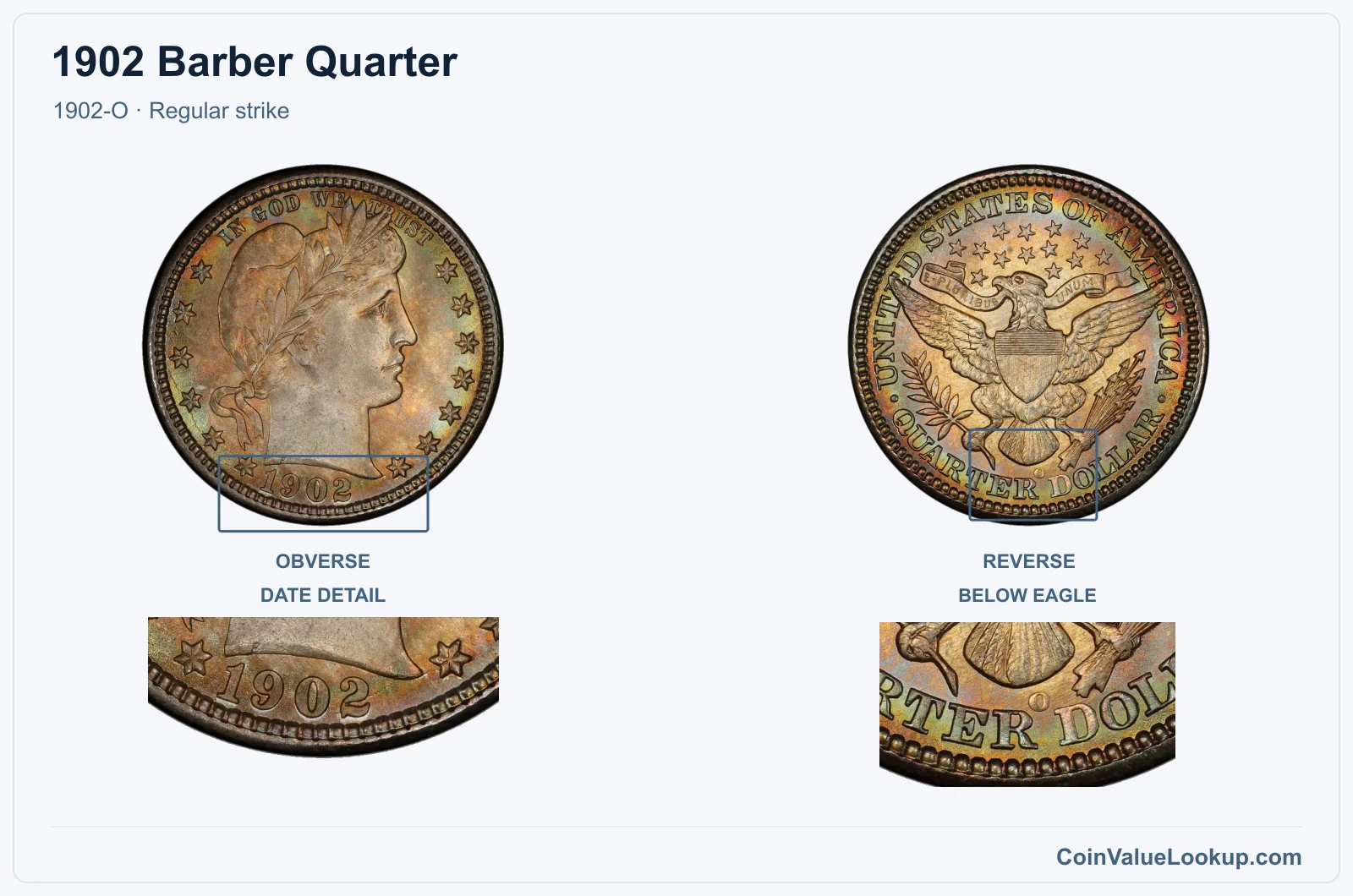
The 1902-O carries an "O" mintmark on the reverse, just below the eagle's tail. New Orleans quarters from this period are popular with series collectors.
The USA Coin Book guide places a G4 at about $24.00, an MS60 at roughly $621.00 and an MS63 at approximately $1,354.00.
That steep jump from circulated to uncirculated tells you something: most of these saw heavy use. Finding one with original surfaces in upper grades is genuinely difficult.
Match the mint, confirm the design details and assess wear carefully before comparing to any guide number. Cleaned or damaged coins do not qualify for these estimates.
Range Grade
Price Auction Records Appraisal PO PO 1
—
Coin Identifier FR FR 2
—
Coin Identifier AG AG 3
—
Coin Identifier G G 4
—
Coin Identifier
G 6
—
Coin Identifier VG VG 8
—
Coin Identifier
VG 10
—
Coin Identifier F F 12
Coin Identifier
F 15
Coin Identifier VF VF 20
Coin Identifier
VF 25
Coin Identifier
VF 30
Coin Identifier
VF 35
Coin Identifier XF XF 40
Coin Identifier
XF 45
Coin Identifier AU AU 50
Coin Identifier
AU 53
Coin Identifier
AU 55
Coin Identifier
AU 58
Coin Identifier MS MS 60
—
Coin Identifier
MS 61
Coin Identifier
MS 62
Coin Identifier
MS 63
Coin Identifier
MS 64
Coin Identifier
MS 65
Coin Identifier
MS 66
Coin Identifier
MS 67
Coin Identifier
MS 68
Coin Identifier
MS 69
—
—
—
MS 70
—
—
—
1902 Barber Quarter — S
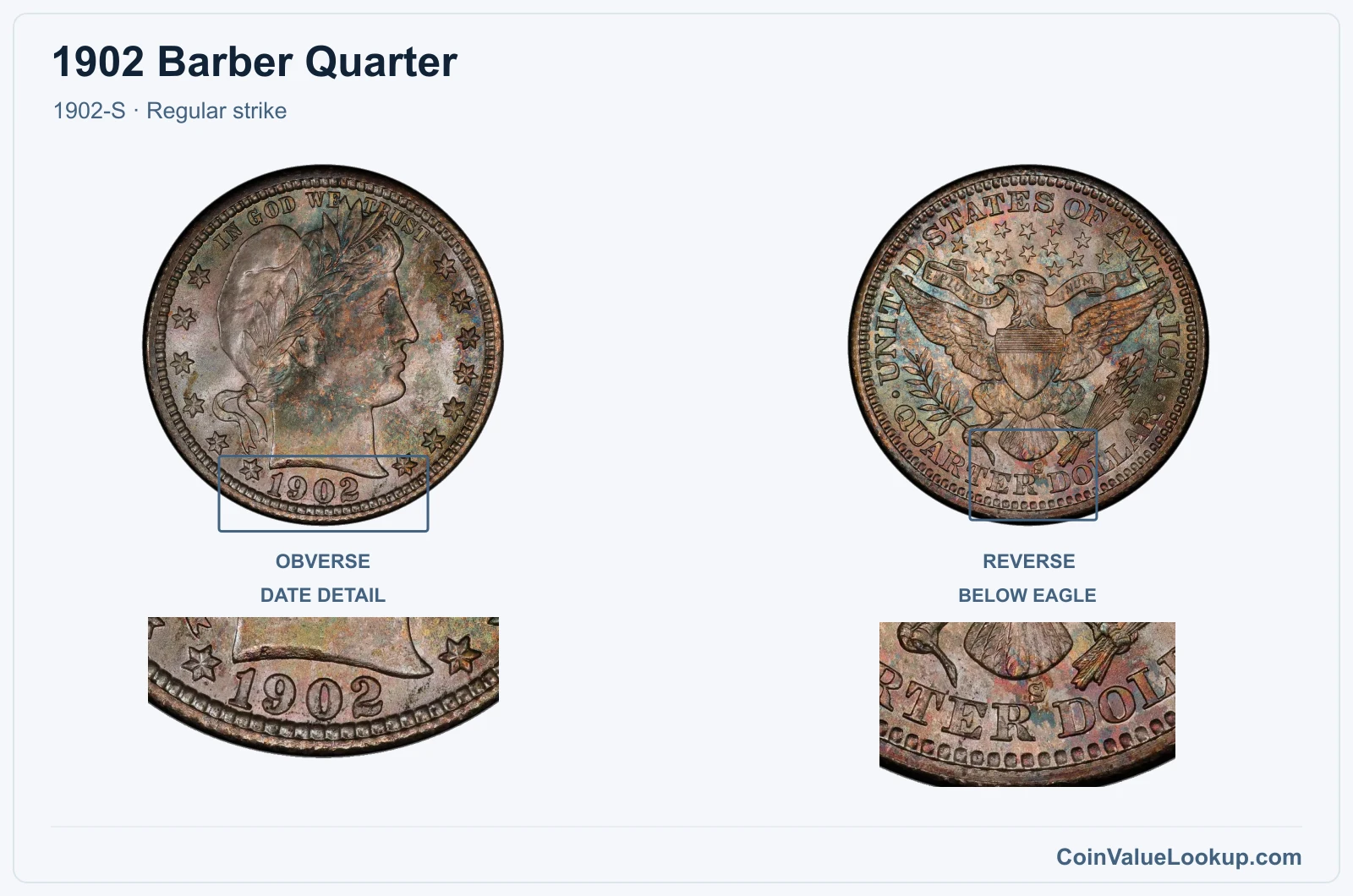
The 1902-S has an "S" mintmark on the reverse beneath the eagle's tail. San Francisco Barber Quarters tend to be scarce in higher grades, and this date is no exception.
USA Coin Book guide estimates come in at about $28.00 for G4, $648.00 for MS60 and $1,136.00 for MS63.
The price difference between G4 and MS63 is enormous because survivorship in uncirculated condition is low. Make sure the mintmark is a clear "S" and not a damaged or filled letter before calling it.
Original surfaces and strike quality matter at every grade level. Cleaning removes the natural patina and almost always reduces value.
Range Grade
Price Auction Records Appraisal PO PO 1
—
Coin Identifier FR FR 2
—
Coin Identifier AG AG 3
—
Coin Identifier G G 4
—
Coin Identifier
G 6
Coin Identifier VG VG 8
—
Coin Identifier
VG 10
—
Coin Identifier F F 12
—
Coin Identifier
F 15
Coin Identifier VF VF 20
—
Coin Identifier
VF 25
Coin Identifier
VF 30
Coin Identifier
VF 35
Coin Identifier XF XF 40
Coin Identifier
XF 45
Coin Identifier AU AU 50
Coin Identifier
AU 53
Coin Identifier
AU 55
Coin Identifier
AU 58
Coin Identifier MS MS 60
—
Coin Identifier
MS 61
Coin Identifier
MS 62
Coin Identifier
MS 63
Coin Identifier
MS 64
Coin Identifier
MS 65
Coin Identifier
MS 66
Coin Identifier
MS 67
Coin Identifier
MS 68
Coin Identifier
MS 69
—
—
—
MS 70
—
—
—
1902 Barber Quarter Error List
1. 1902 Barber Quarter — Repunched Mintmark
A repunched mintmark on a 1902 Barber Quarter shows traces of a second mintmark impression near the primary letter. Since Philadelphia coins have no mintmark, this error applies only to the O or S mint versions.
Under magnification, look for a shadow, secondary serif or offset remnant beside or beneath the main mintmark.
Don't confuse a repunched mintmark with a die chip sitting next to the letter, corrosion filling the area, or machine doubling that produces flat, shelf-like doubling. True repunching shows a distinct second position with the same letter shape.
The value depends on the visibility of the secondary punch, the overall condition of the coin and which specific variety it represents. No standard price applies across all examples.
2. 1902 Barber Quarter — Doubled Die
Doubled die varieties on the 1902 Barber Quarter show consistent separation or notching on design elements where the die received a second, slightly misaligned impression during its creation. This is different from machine doubling, which produces flat, shelf-like distortion without the raised, rounded profile of a true doubled die.
To check, compare lettering, the date or Liberty's portrait details against a normal example at the same magnification. Look for uniform directional doubling that repeats on every struck coin from that die.
Reflections, lighting tricks and post-mint contact marks can mimic doubling to the untrained eye. The value of a doubled die depends on which elements are affected, how visible the doubling is and the coin's overall condition.
3. 1902 Barber Quarter — Off-Center Strike
An off-center strike happens when the planchet isn't seated properly between the dies, shifting the entire design to one side and leaving a blank crescent of unstruck metal on the opposite edge. On a 1902 Barber Quarter, this creates a visually dramatic error.
The key factor for value is whether the date remains fully visible. A 5% off-center coin with the date intact is more collectible than a 50% off-center piece missing the year.
Compare your coin against a properly centered example to gauge the shift.
Don't mistake a clipped planchet or post-mint damage for an off-center strike. Clips show a curved or straight cut without design displacement.
Post-mint flattening from a vice or hammer doesn't produce the characteristic unstruck crescent. Condition and the degree of misalignment both affect what an off-center piece is worth.
4. 1902 Barber Quarter — Die Crack / Die Chip
Die cracks appear as thin, raised lines on the coin's surface where the steel die fractured during use. Die chips show up as small raised blobs where a piece of the die broke away, leaving a void that fills with metal during striking.
Both are mint-made errors on the 1902 Barber Quarter.
A crack that runs from the rim inward is sometimes called a cud when a larger section of the die breaks free, producing a raised lump at the rim. Interior cracks that don't reach the edge are more subtle and easier to miss.
Don't confuse die cracks with scratches, which are incuse rather than raised. Corrosion and foreign material stuck to the surface can also mimic small chips.
Run a fingernail across the feature: raised means die damage, recessed means post-mint. Value depends on the size, location and the coin's overall condition.