1890 Liberty Nickel Coin Value: How Much Is It Worth?
The 1890 Liberty Nickel is a Philadelphia-only issue struck in copper-nickel, and its value depends heavily on condition and whether you have a business strike or a proof. USA Coin Book guide estimates place a circulated example around $12 in G4, rising to about $265 in MS63 for business strikes, while a PR63 proof anchors near $344.
High-grade original surfaces and separately identified proofs can carry premiums beyond those benchmarks.
Fast Way to Identify Your 1890 Liberty Nickel
The quickest way to start figuring out what your 1890 Liberty Nickel is worth is to upload clear photos of both the front and back of your coin. Our identifier can provide a preliminary identification based on those images, helping you narrow down the version and condition before you dig deeper into values.
1890 Liberty Nickel Value
Upload both sides of your 1890 Liberty Nickel.
Front Obverse
Upload photo
Back Reverse
Upload photo
Which 1890 Liberty Nickel Versions Are Worth Money?
- Business strikes in MS63 or higher carry guide values starting around $265 (USA Coin Book) and climb with grade — original surfaces matter most.
- Proof examples in PR63 anchor near $344 per USA Coin Book estimates; higher proof grades or strong eye appeal can push values further.
- Coins with confirmed mint errors such as repunched dates, off-center strikes, or brockages may carry individual premiums depending on visibility and condition.
- A distorted rim alone does not establish an error — verify before assuming added value.
Step 1: Identify Your 1890 Liberty Nickel Mint Mark and Version
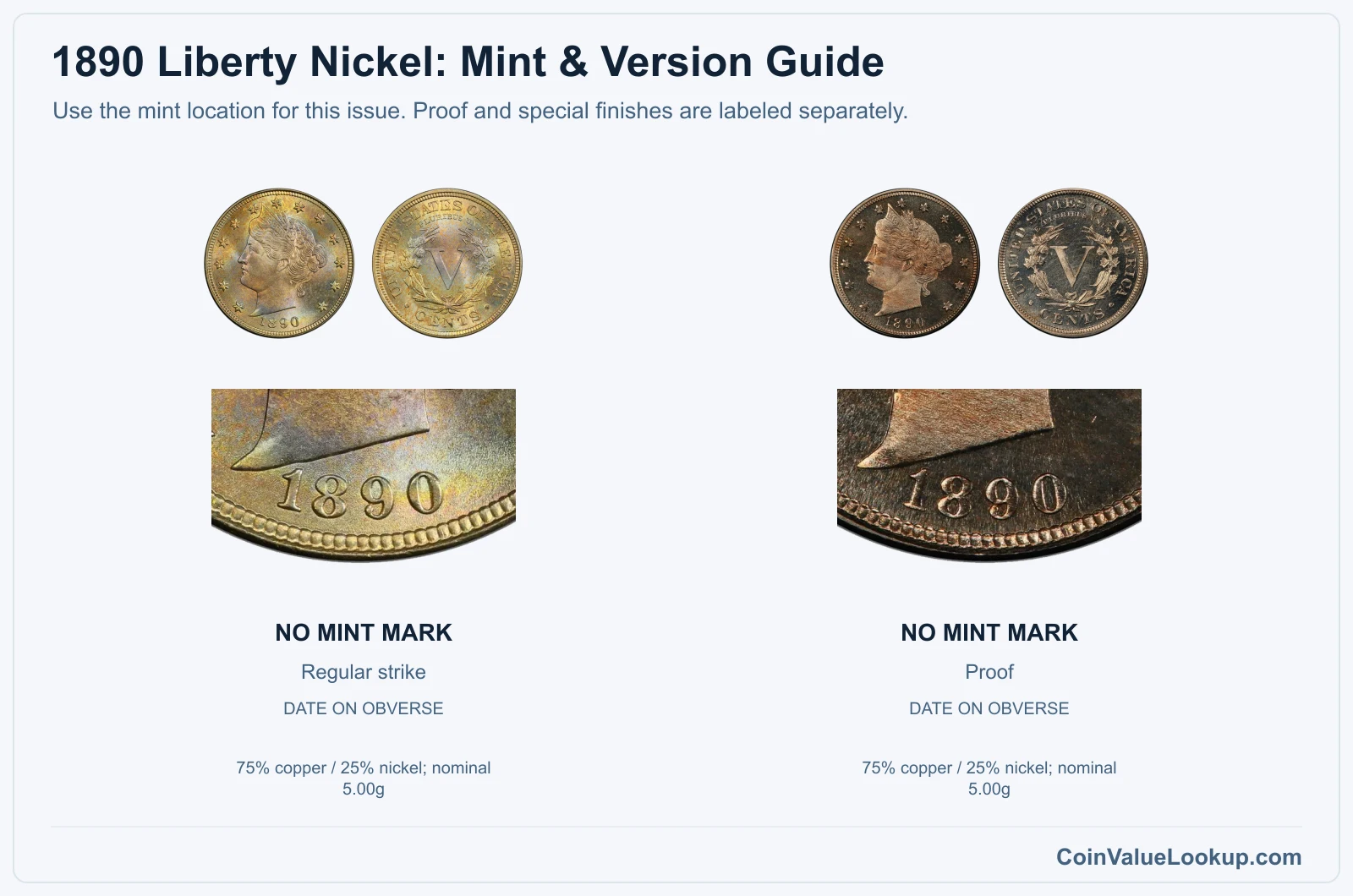
Every regular 1890 Liberty Nickel was struck at Philadelphia. There is no mintmark, so do not look for a D or S on this date.
The coin is 75% copper and 25% nickel, weighs about 5 grams, measures 21.2 mm across, and has a plain edge. No silver branch exists for this year.
All 1890 nickels carry the "With CENTS" reverse design, which shows the Roman numeral V surrounded by a wreath with the words CENTS below. The earlier 1883 "No CENTS" variety does not apply here.
That distinction matters because the two design types are intentional, not errors.
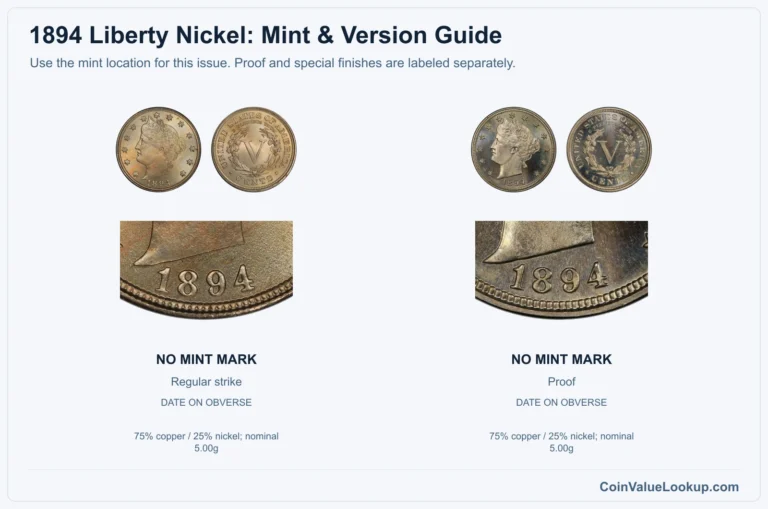
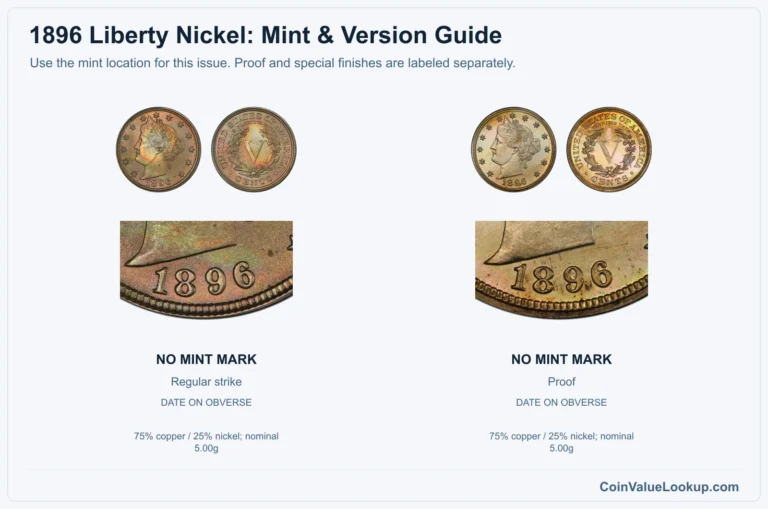
Both business strikes and proofs exist. A proof will show mirror-like fields and sharp rims when original, not just a high level of detail.
A distorted rim by itself does not establish a production error, so look carefully before jumping to conclusions.
Step 2: Check Your 1890 Liberty Nickel Grade
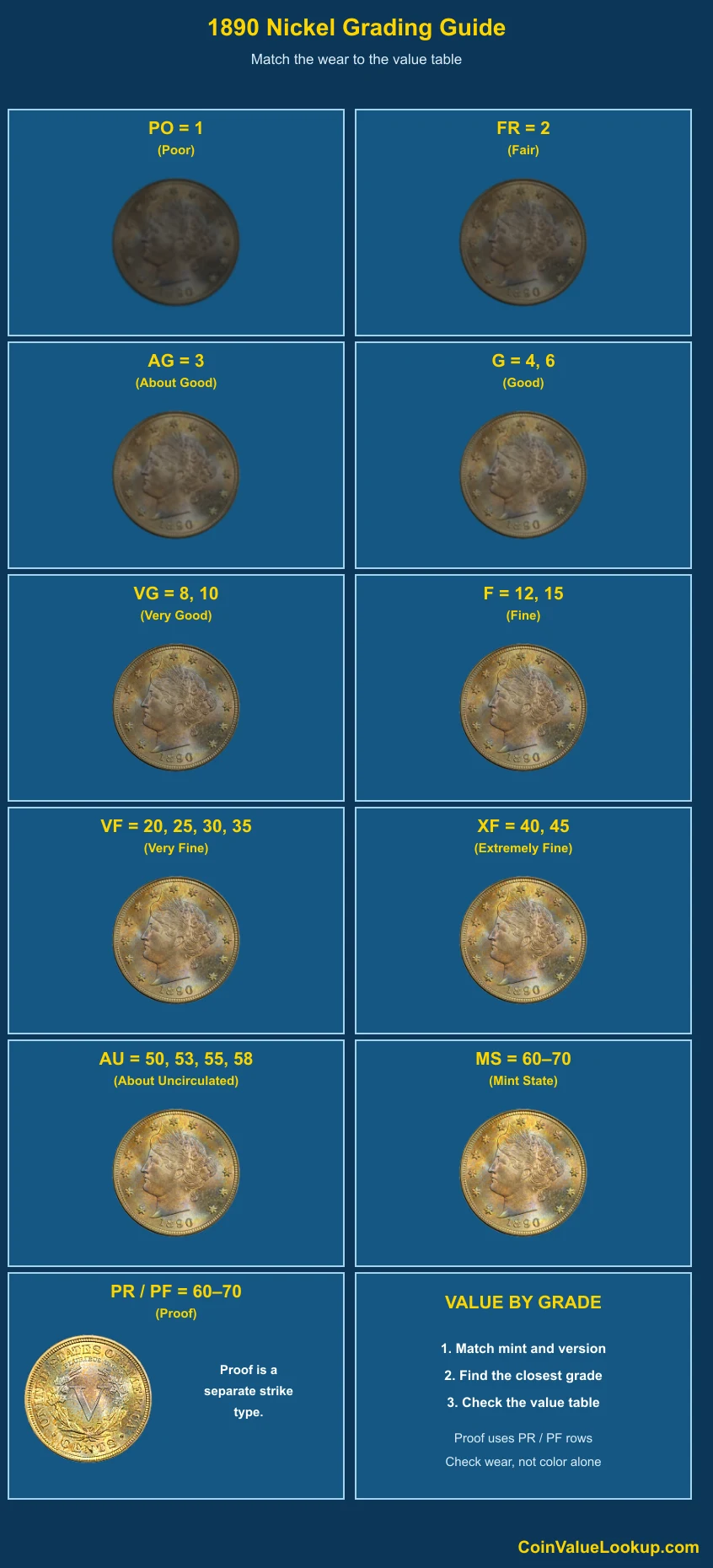
Start by checking the word LIBERTY on the coronet above the forehead. On a well-worn coin those letters fade, starting from the middle outward.
Compare your coin's detail against the reference image to get a rough grade bracket.
The high hair curls behind the ear and the cheek below the eye are early wear points. If the curls are flat but LIBERTY is still readable, you are likely in the Fine to Very Fine range.
Sharpness there alone does not guarantee a higher grade, because strike weakness at the hair and corn ears on the reverse can mimic wear.
For mint-state business strikes, assess overall luster, the severity of contact marks (bag marks from storage), and how completely the design details came up during striking. A coin with full luster but mushy hair detail may simply be weakly struck, not circulated.
Proof is a manufacturing method, not a grade above Mint State. Proof coins should display mirrored fields, squared-off rims, and may show hairlines from cleaning or handling.
Compare your coin's surfaces and edge profile against known proof examples before assuming you have one.
Step 3: Check 1890 Liberty Nickel Value by Mint and Version
1890 Liberty Nickel — No Mint Mark — With CENTS Circulation
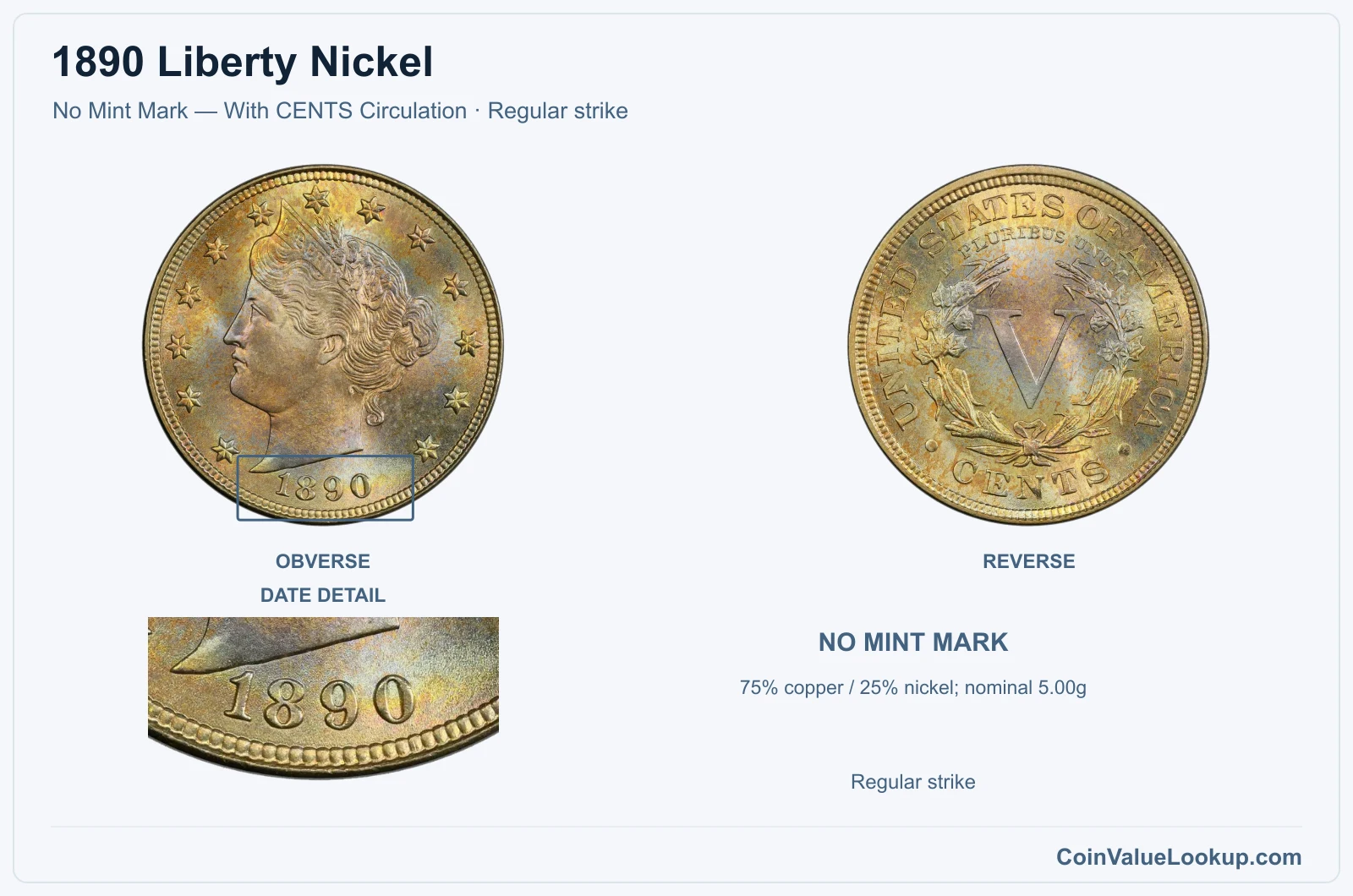
The standard 1890 Liberty Nickel is a business strike from Philadelphia with the "With CENTS" reverse. No mintmark appears on the coin.
USA Coin Book guide estimates place a G4 example at roughly $12 and an MS63 around $265. Those are retail guide snapshots, not guaranteed sale prices.
Condition drives everything here. A coin in the lower circulated grades is common and affordable, while original, lustrous mint-state pieces are where real money shows up.
When evaluating yours, pay attention to the hair detail, cheek smoothness, and whether the fields still carry cartwheel luster. Strike weakness is common on this date, so don't confuse a soft strike for heavy wear.
Coin Value Lookup is a handy starting point if you want to look up guides for other dates and denominations in the Liberty Nickel series or beyond.
Range Grade
Price Auction Records Appraisal PO PO 1
Coin Identifier FR FR 2
—
Coin Identifier AG AG 3
—
Coin Identifier G G 4
—
Coin Identifier
G 6
—
Coin Identifier VG VG 8
—
Coin Identifier
VG 10
—
Coin Identifier F F 12
—
Coin Identifier
F 15
—
Coin Identifier VF VF 20
—
Coin Identifier
VF 25
—
Coin Identifier
VF 30
—
Coin Identifier
VF 35
—
Coin Identifier XF XF 40
—
Coin Identifier
XF 45
Coin Identifier AU AU 50
Coin Identifier
AU 53
Coin Identifier
AU 55
Coin Identifier
AU 58
Coin Identifier MS MS 60
—
Coin Identifier
MS 61
Coin Identifier
MS 62
Coin Identifier
MS 63
Coin Identifier
MS 64
Coin Identifier
MS 65
Coin Identifier
MS 66
Coin Identifier
MS 67
Coin Identifier
MS 68
—
—
—
MS 69
—
—
—
MS 70
—
—
—
1890 Liberty Nickel — No Mint Mark — With CENTS Proof
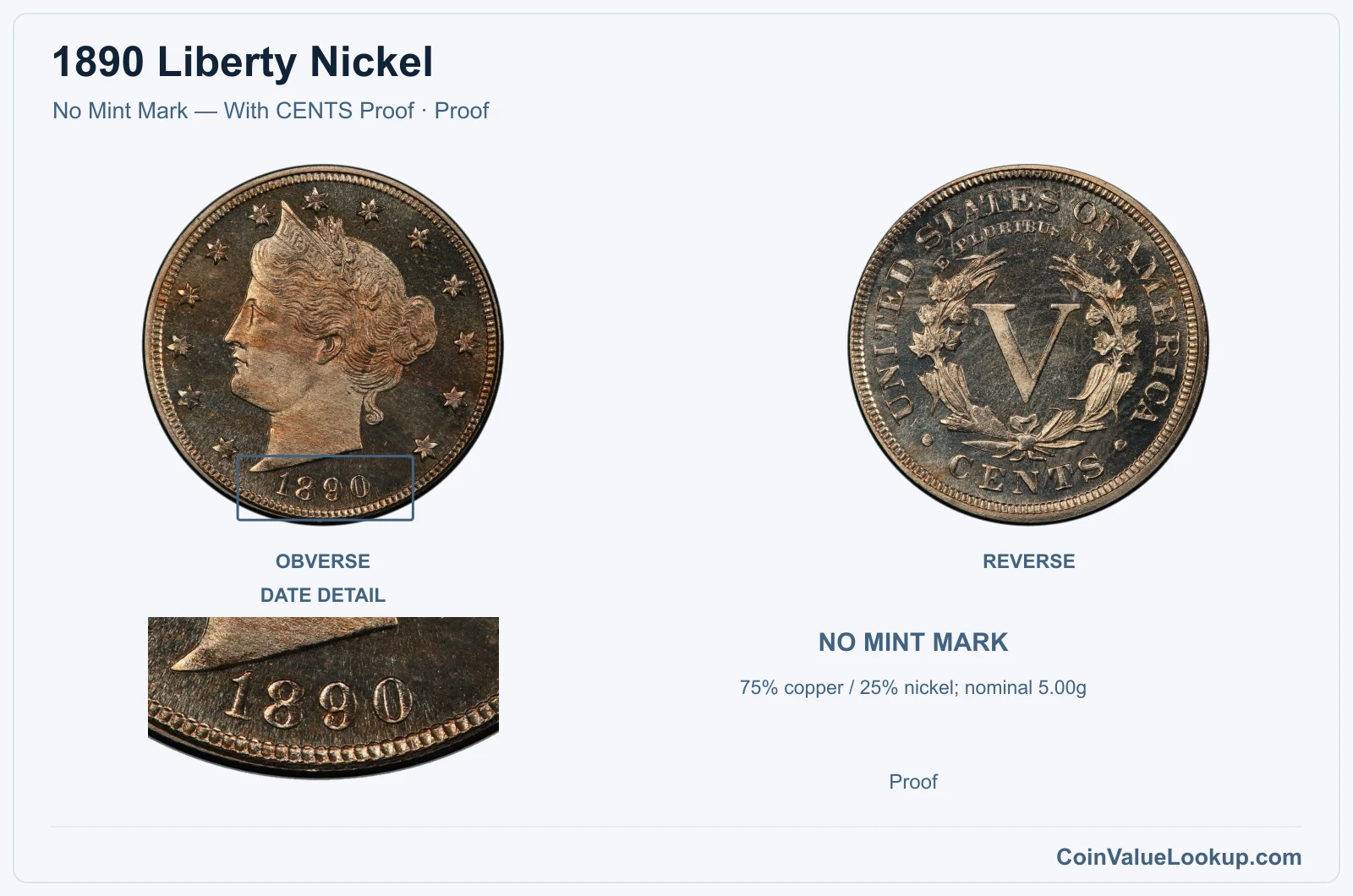
Philadelphia also produced proof 1890 Liberty Nickels for collectors, struck with polished dies on prepared planchets. A PR63 example carries a USA Coin Book guide estimate near $344.
That figure represents one published snapshot, not a binding offer.
Identifying a genuine proof means looking at the fields — they should be deeply mirrored, not just shiny from wear on high points. Rims tend to be square and sharp.
Hairlines from improper cleaning or storage are the most common flaw on surviving proofs and can significantly reduce value. Photograph both faces and the rim detail clearly if you want an informed opinion on your coin.
A distorted rim does not by itself confirm a proof or an error.
Range Grade
Price Auction Records Appraisal PR PR 1
—
Coin Identifier
PR 2
—
Coin Identifier
PR 3
—
Coin Identifier
PR 4
—
Coin Identifier
PR 6
—
Coin Identifier
PR 8
—
Coin Identifier
PR 10
—
Coin Identifier
PR 12
—
Coin Identifier
PR 15
—
Coin Identifier
PR 20
—
Coin Identifier
PR 25
—
Coin Identifier
PR 30
—
Coin Identifier
PR 35
—
Coin Identifier
PR 40
—
Coin Identifier
PR 45
—
Coin Identifier
PR 50
—
Coin Identifier
PR 53
—
Coin Identifier
PR 55
—
Coin Identifier
PR 58
—
Coin Identifier
PR 60
Coin Identifier
PR 61
Coin Identifier
PR 62
Coin Identifier
PR 63
Coin Identifier
PR 64
Coin Identifier
PR 65
Coin Identifier
PR 66
Coin Identifier
PR 67
—
Coin Identifier
PR 68
—
—
—
PR 69
—
—
—
PR 70
—
—
—
1890 Liberty Nickel Error List
1. 1890 Liberty Nickel — Repunched Date
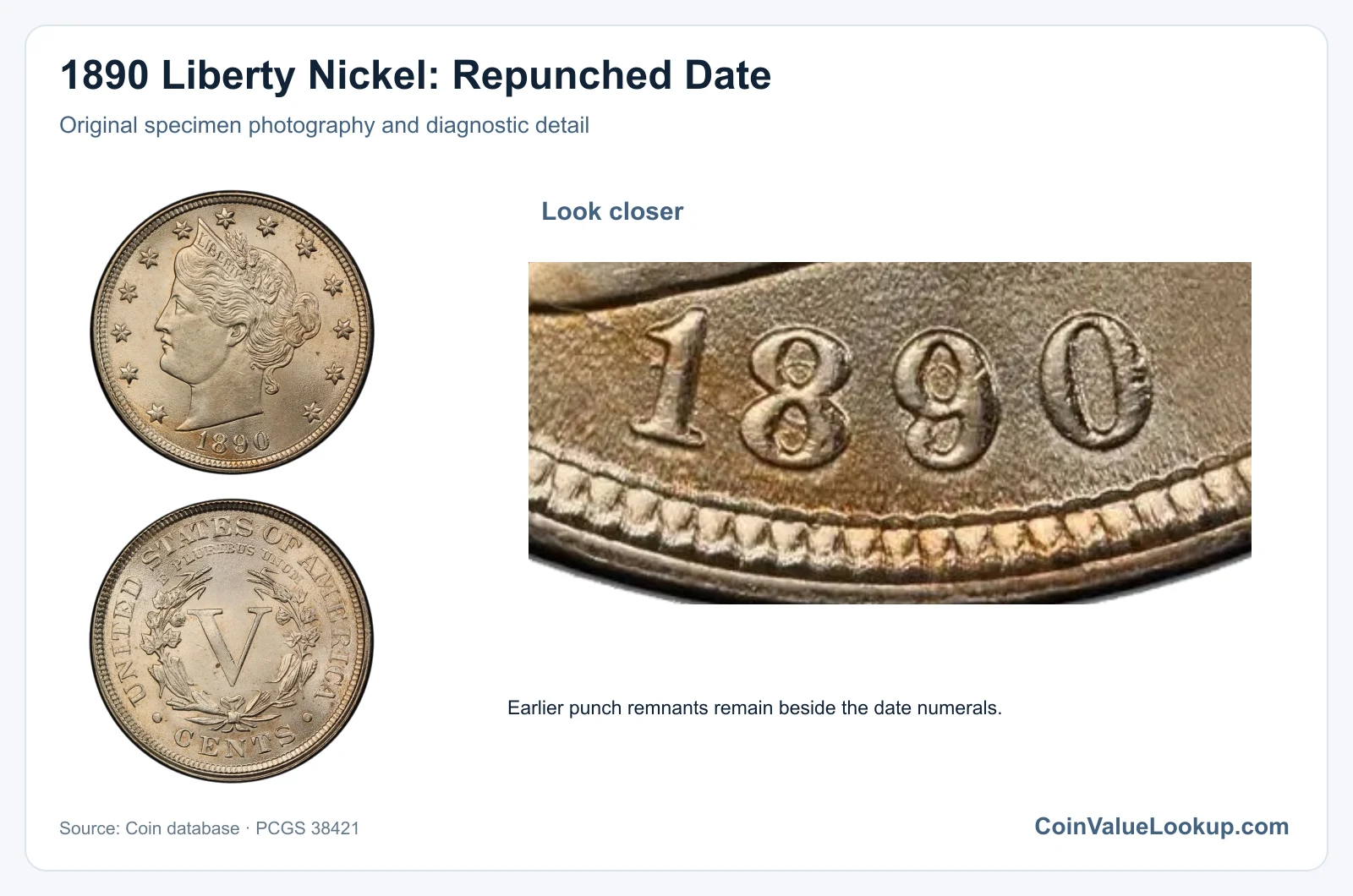
A repunched date on an 1890 Liberty Nickel shows traces of an earlier punch position next to the final numerals. Look closely at the 1, 8, 9, and 0 — you may see a ghost image slightly offset from the accepted position.
This is a die variety created when the date punch was applied more than once during die preparation.
Do not confuse this with machine doubling, which produces a flat, shelf-like secondary image. A repunched date has rounded, raised remnants that match the contour of the original digit.
Damage to the date area from circulation or contact can also mimic a repunch, so compare carefully under magnification. No specific price range is established here; the value of a repunched date depends on how visible the extra impression is, the coin's overall condition, and collector demand for that particular variety.
2. 1890 Liberty Nickel — Broadstrike
A broadstrike happens when the coin is struck without the normal collar die that confines the planchet's edge. The result is a coin that spreads outward, appearing wider than normal, with a distorted or absent rim.
The full design is still present, just pushed toward the edges.
Don't mistake this for an off-center strike, which shifts the design and leaves a blank crescent. Also rule out post-mint damage — a coin smashed flat after leaving the mint can look spread out, but the metal flow pattern and edge profile will differ from a genuine broadstrike.
No numerical price range is adopted for this error on the 1890 nickel. Value depends on the degree of spread, whether the date remains legible, and the coin's preservation.
3. 1890 Liberty Nickel — Clipped Planchet
A clipped planchet error means a portion of the blank was missing before the coin was struck. The clip can be curved (from overlapping punches in the blanking process), straight, or ragged.
You will often see design weakness on the side opposite the clip, because the metal had less material to fill the die in that area.
Compare the edge texture at the clip to the rest of the coin. A genuine clip shows undisturbed metal flow and may reveal a Blakesley effect — a weak area directly across from the missing section.
A filed notch, deliberate cut, or corrosion-eaten edge will look different under magnification and lack that opposing weakness. No specific price is established for clipped 1890 nickels; the premium depends on the size of the clip, condition, and overall eye appeal.
4. 1890 Liberty Nickel — Lamination / Split Planchet
Lamination errors on an 1890 Liberty Nickel appear as peeling metal, a retained flap, or a visible split within the copper-nickel alloy. These occur when impurities or gas pockets in the planchet cause layers to separate during or after striking.
When photographing a suspected lamination, capture the edge and the affected face together so the separation is clear. A small retained flap that lifts away from the surface is a classic presentation.
Larger splits can affect both sides of the coin.
Rule out scraping, corrosion, or deliberate cuts. Post-mint scratches will show a bright, uniform gouge rather than a natural layer pulling away from the surface.
No numerical price range is adopted for lamination errors on this date. Value will hinge on the size and drama of the separation, the coin's grade, and whether the affected area detracts from or adds visual interest.
5. 1890 Liberty Nickel — Brockage
A brockage is a dramatic error where a previously struck coin stays on the die and impresses its design — in mirror-image and incuse — onto the next blank fed into the press. On an 1890 Liberty Nickel, you would see the normal design on one side and a sunken, reversed version of a design on the other.
This is different from a die clash, where faint ghostly impressions of the opposite die appear in the fields but the coin otherwise looks normal. It also differs from two coins pressed together after minting, which won't show the characteristic incuse depth and die-imparted detail of a true brockage.
No adopted price range exists for a brockage on this date. These are genuinely rare and individual; value depends on how complete the brockage impression is, the coin's condition, and third-party verification.
6. 1890 Liberty Nickel — Off-Center Strike
An off-center strike occurs when the planchet is not centered between the dies at the moment of impact. The result is a displaced design with a blank crescent where the die did not reach.
The percentage off-center and whether the date is still visible are the two biggest factors collectors care about.
A coin that retains a full, readable date while showing significant off-center displacement is more desirable than one where the date vanished into the unstruck area. Do not confuse an off-center strike with a clipped planchet, which removes metal from the blank before striking, or with post-mint flattening that distorts the shape.
No specific price is adopted for off-center 1890 nickels. Each example is evaluated individually based on the degree of misalignment, date visibility, and overall preservation.