1871 Shield Nickel Coin Value: How Much Is It Worth?
The 1871 Shield Nickel is a scarcer date in the series, with only 561,000 business strikes reported. A retail guide from USA Coin Book places circulated examples around $100 in G4 condition and Mint State coins near $997 in MS63.
Proof coins are a separate category. Condition drives value on this date, so accurate grading and identification matter before anything else.
Fast Way to Identify Your 1871 Shield Nickel
Want a quick read on your 1871 Shield Nickel? Upload clear photos of the front and back of your coin for a preliminary identification.
This can help you figure out whether you have a circulation strike or proof, spot obvious problems, and point you toward the right value range. It is not a substitute for professional authentication or exact grading.
1871 Shield Nickel Value
Upload both sides of your 1871 Shield Nickel.
Front Obverse
Upload photo
Back Reverse
Upload photo
Which 1871 Shield Nickel Versions Are Worth Money?
- With only 561,000 business strikes, the 1871 is a scarcer circulation date; even well-worn examples carry meaningful value.
- Original Mint State examples and correctly identified proof strikes deserve professional evaluation for accurate pricing.
- Doubled Die Reverse, Repunched Date, Die Crack, and Clashed Dies varieties have been reported for this date and can carry premiums depending on visibility and condition.
Step 1: Identify Your 1871 Shield Nickel Mint Mark and Version
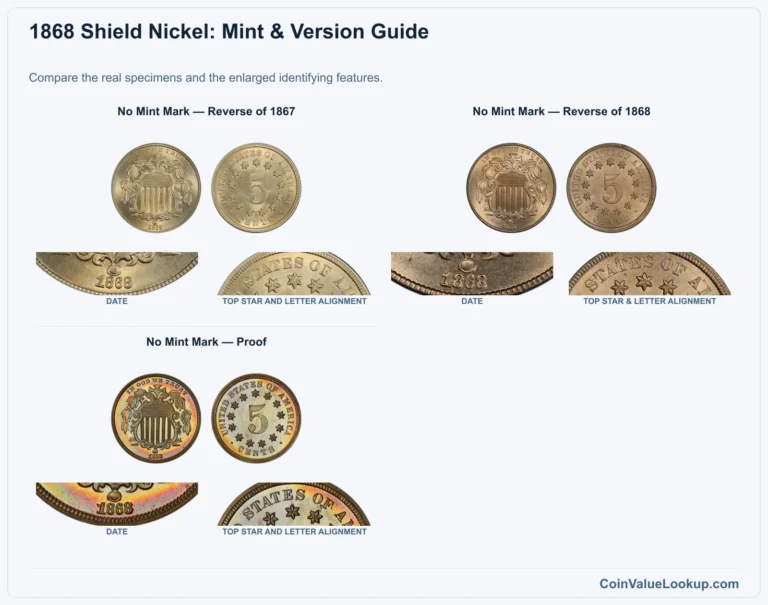
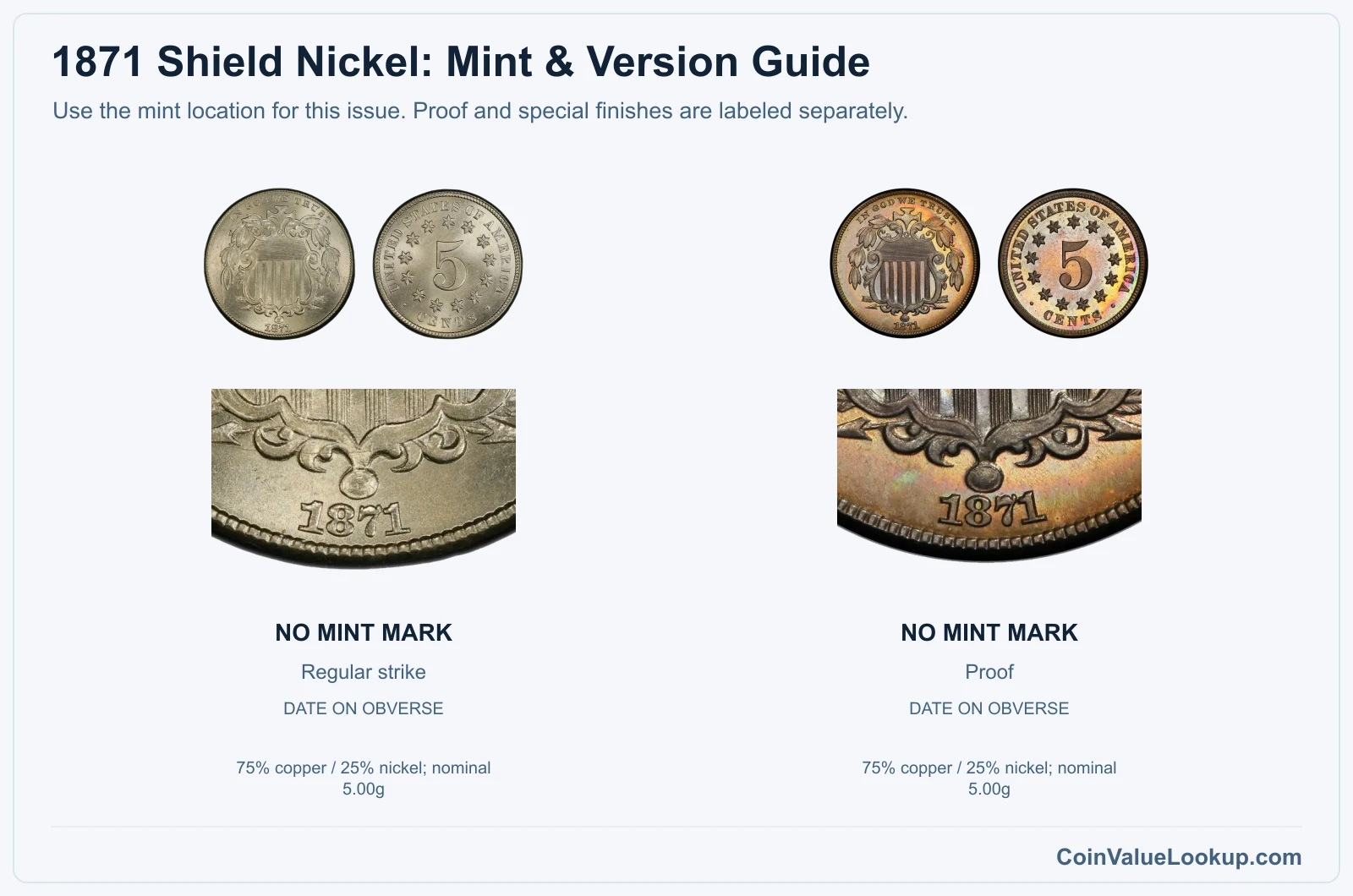
Every 1871 Shield Nickel was struck at the Philadelphia Mint, so there is no mintmark. A missing letter below the wreath is completely normal for this coin, not a sign of a rare variety.
The obverse shows a prominent shield with a cross and horizontal and vertical lines. The reverse displays a large numeral 5 surrounded by stars and rays were already removed from the design by 1867, so your 1871 will have the "No Rays" style.
The coin is copper-nickel, 75% copper and 25% nickel, weighing about 5 grams with a plain edge and a diameter of 20.5 mm. There is no legitimate silver version of this date.
Start by confirming the date reads 1871, then decide whether the coin is a business strike or a proof. Proofs tend to have squared-off rims and mirror-like fields.
Once you know the strike type, move on to grading. And please, never clean the coin, even if it looks ugly.
Cleaning destroys originality and tanks the value.
Step 2: Check Your 1871 Shield Nickel Grade
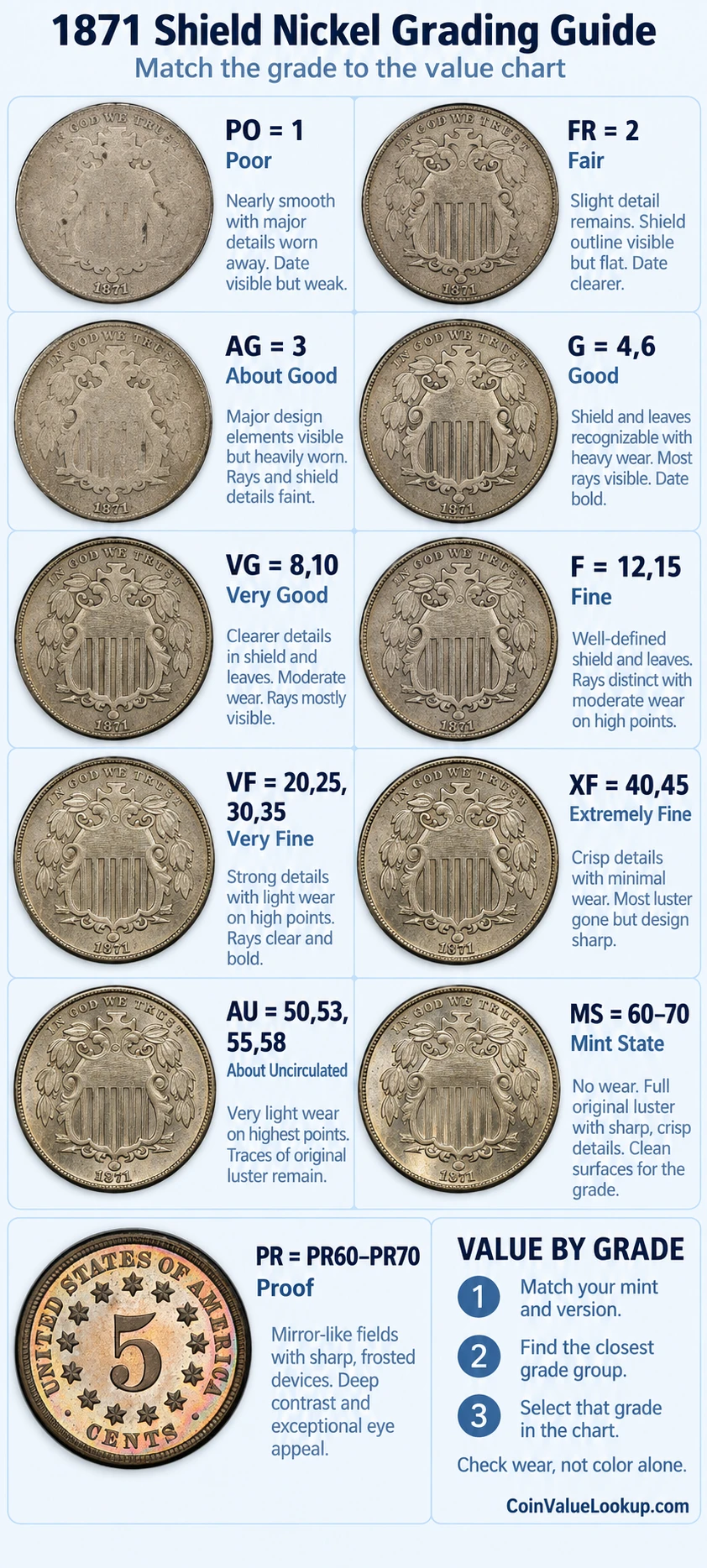
Focus on the shield first. The horizontal and vertical lines inside the shield are the highest points and wear down earliest.
On a well-worn coin, those lines merge or disappear entirely. Check the cross at the top of the shield and the leaves flanking the base as well.
Here is the tricky part: Shield Nickels were sometimes weakly struck at the mint. That means a coin can have mushy shield lines straight from the press, with no circulation wear at all.
Compare both sides for remaining luster, and look at the stars and numeral 5 on the reverse for matching wear patterns. If one side looks sharp and the other does not, suspect a strike issue rather than wear.
Use the comparison image to match your coin against known grade examples. Separate problem-free coins from those with cleaning, corrosion, or damage.
Guide prices assume original, undamaged surfaces. A cleaned or corroded example will sell for less than listed values, sometimes dramatically so.
Step 3: Check 1871 Shield Nickel Value by Mint and Version
1871 Shield Nickel — No Mint Mark — Circulation Strike
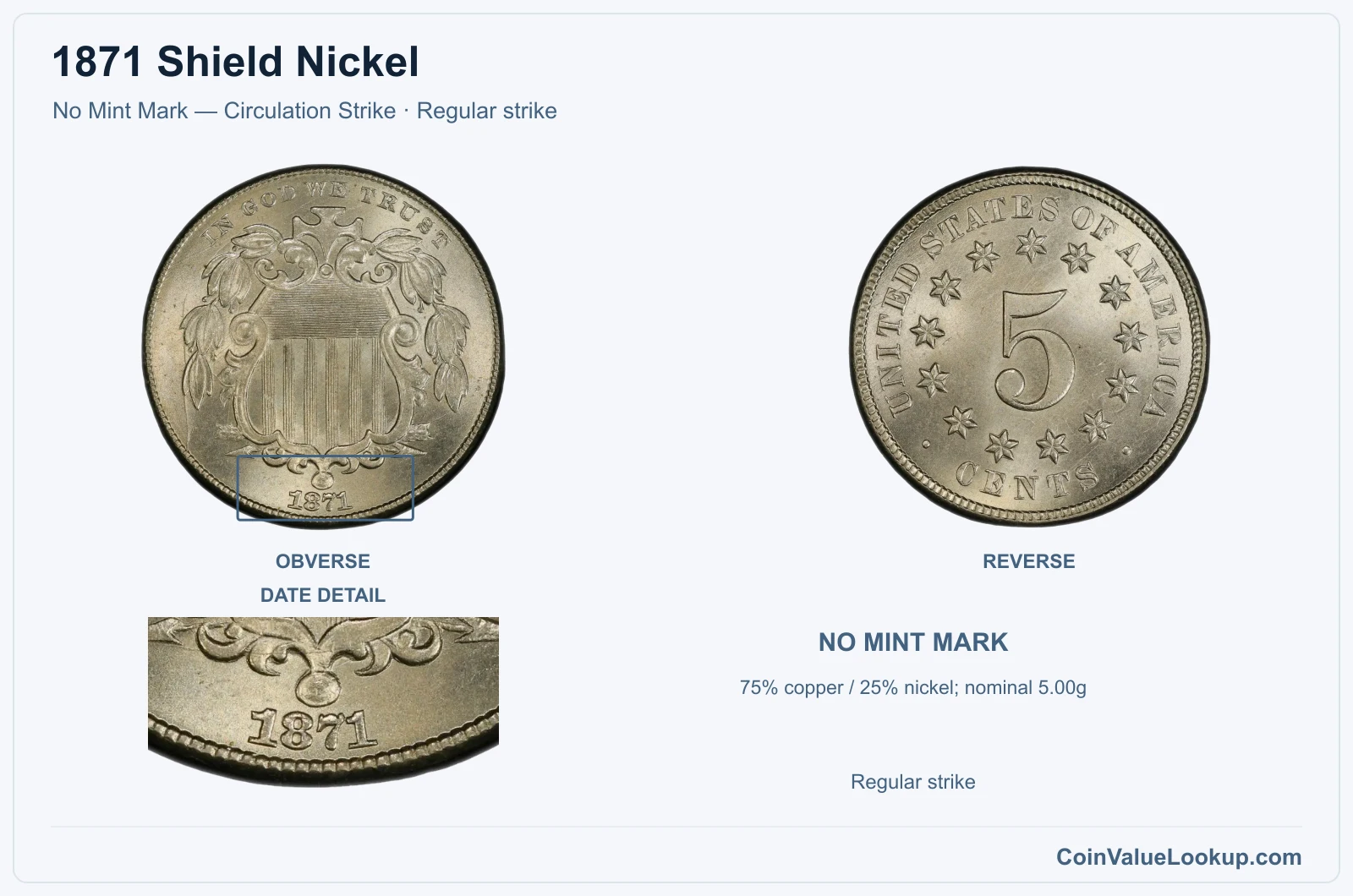
The 1871 circulation strike was produced at Philadelphia with no mintmark. With a reported mintage of 561,000, it is noticeably scarcer than many other Shield Nickel dates.
A USA Coin Book retail guide places the value around $100 in G4 and roughly $997 in MS63.
Grade and originality are everything here. A problem-free example in any collectible grade is worth a careful look.
Weakly struck pieces exist, so do not confuse soft detail for heavy wear. Check for full, undamaged shield lines and original surfaces before comparing your coin to guide estimates.
Coin Value Lookup is a good starting point if you want to look up guides for other dates or denominations in the Shield Nickel series.
Range Grade
Price Auction Records Appraisal PO PO 1
—
Coin Identifier FR FR 2
—
Coin Identifier AG AG 3
—
Coin Identifier G G 4
Coin Identifier
G 6
—
Coin Identifier VG VG 8
Coin Identifier
VG 10
Coin Identifier F F 12
Coin Identifier
F 15
—
Coin Identifier VF VF 20
Coin Identifier
VF 25
Coin Identifier
VF 30
Coin Identifier
VF 35
Coin Identifier XF XF 40
Coin Identifier
XF 45
Coin Identifier AU AU 50
Coin Identifier
AU 53
Coin Identifier
AU 55
Coin Identifier
AU 58
Coin Identifier MS MS 60
Coin Identifier
MS 61
—
Coin Identifier
MS 62
Coin Identifier
MS 63
Coin Identifier
MS 64
Coin Identifier
MS 65
Coin Identifier
MS 66
Coin Identifier
MS 67
—
—
—
MS 68
—
—
—
MS 69
—
—
—
MS 70
—
—
—
1871 Shield Nickel — No Mint Mark — Proof
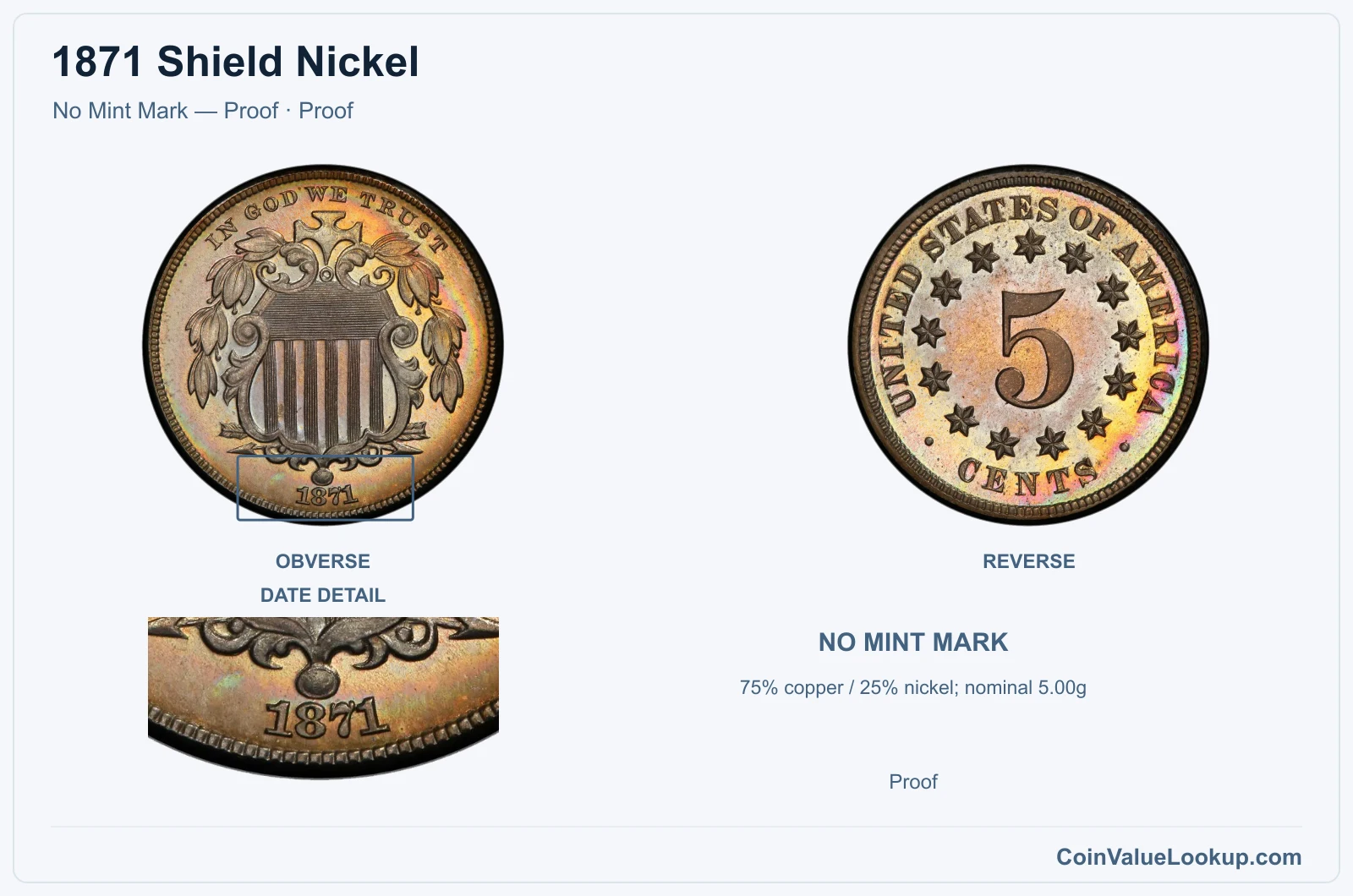
Philadelphia also struck proof Shield Nickels in 1871, intended for collectors rather than commerce. Proofs typically show squared rims, sharp design details, and reflective mirror fields.
A USA Coin Book retail guide lists the PR63 value at about $468.
Compare proof prices with other proof dates, not with the scarce business strike. Proof production numbers were separate, and the markets are distinct.
Confirming a genuine proof versus a well-preserved business strike requires examining the rim profile and field quality closely. If you suspect you have a proof, professional certification is worth pursuing.
Range Grade
Price Auction Records Appraisal PR PR 1
—
Coin Identifier
PR 2
—
Coin Identifier
PR 3
—
Coin Identifier
PR 4
—
Coin Identifier
PR 6
—
Coin Identifier
PR 8
—
Coin Identifier
PR 10
—
Coin Identifier
PR 12
—
Coin Identifier
PR 15
—
Coin Identifier
PR 20
—
Coin Identifier
PR 25
—
Coin Identifier
PR 30
—
Coin Identifier
PR 35
—
Coin Identifier
PR 40
—
Coin Identifier
PR 45
—
Coin Identifier
PR 50
—
Coin Identifier
PR 53
—
Coin Identifier
PR 55
—
Coin Identifier
PR 58
—
Coin Identifier
PR 60
—
Coin Identifier
PR 61
Coin Identifier
PR 62
Coin Identifier
PR 63
Coin Identifier
PR 64
Coin Identifier
PR 65
Coin Identifier
PR 66
Coin Identifier
PR 67
Coin Identifier
PR 68
—
—
—
PR 69
—
—
—
PR 70
—
—
—
1871 Shield Nickel Error List
1. 1871 Shield Nickel — Doubled Die Reverse
A Doubled Die Reverse has been reported for the 1871 Shield Nickel. This variety is created when a working die receives a second, slightly offset impression from the hub, leaving doubled contours on reverse design elements such as lettering, stars, or the numeral 5.
To check your coin, compare the reverse legends and design details against a normal example under magnification. Look for consistent doubling on multiple elements rather than just one letter.
The doubling should be raised and uniform in direction.
Do not confuse this with machine doubling, which produces flat, shelf-like distortions, or with reflections caused by lighting. Random damage or corrosion can also mimic doubling at first glance.
No specific price range is available for this variety; the value depends on the clarity of the doubling, the die involved, and the coin's overall condition.
2. 1871 Shield Nickel — Repunched Date
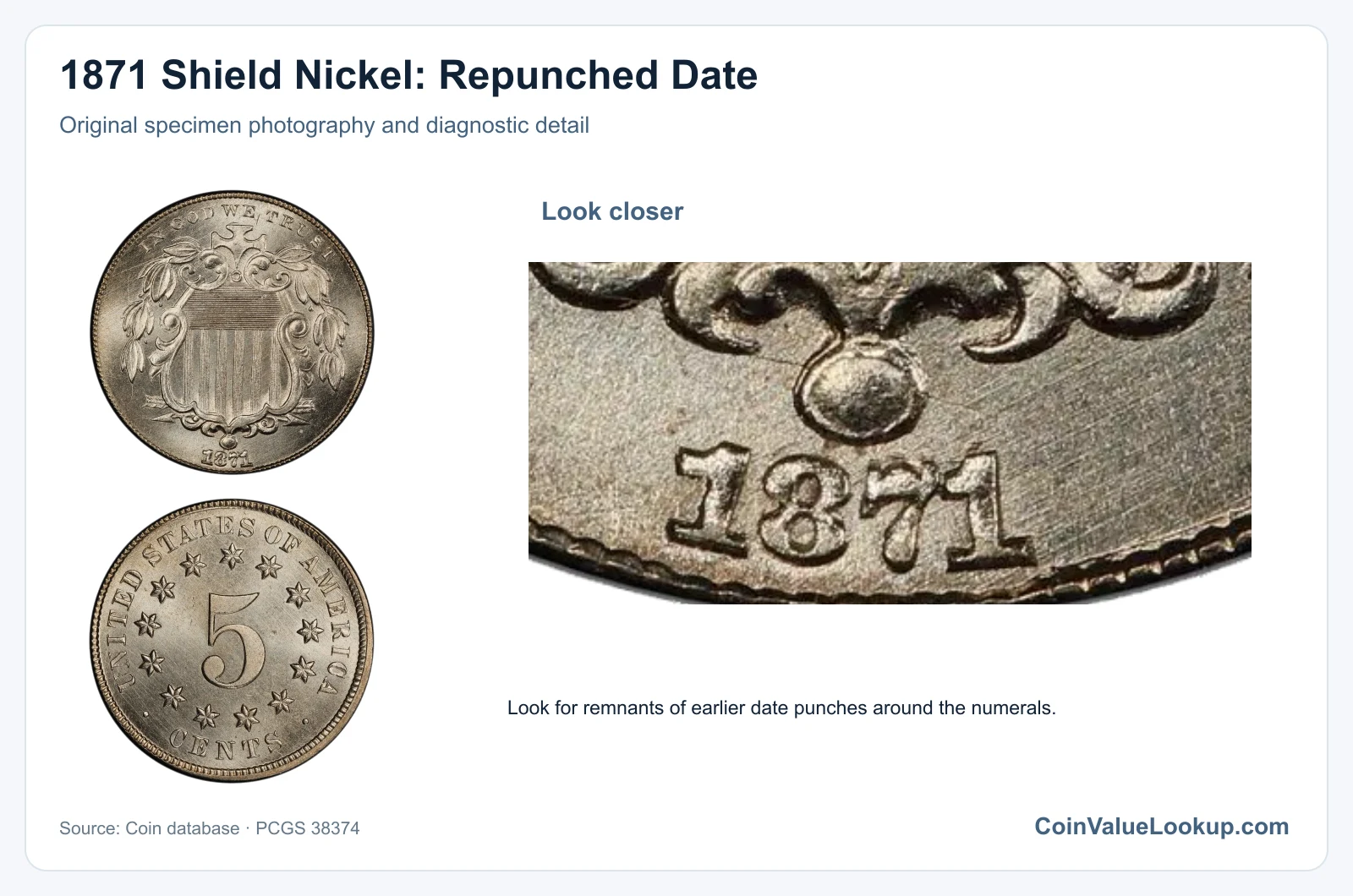
Repunched Date varieties have been reported for the 1871 Shield Nickel. These occur when a date punch was applied more than once in slightly different positions, leaving visible remnants of the earlier impression beside or beneath the final numerals.
Look closely at each digit of the date under magnification. You may see traces of a second "1" or "7" offset from the final position.
The remnants should be raised, just like the final date, and follow a consistent direction.
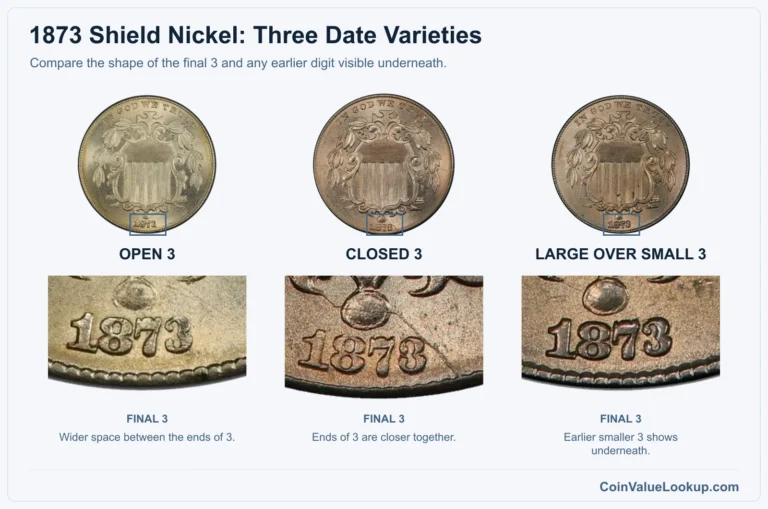
This is different from a Doubled Die, which affects the entire design through a hub impression. It is also distinct from a damaged date, where contact marks or corrosion create irregular shapes around the numerals.
Machine doubling can look similar but tends to be flat and shelf-like. No specific price is available for this variety; value depends on visibility, the specific repunching, and coin condition.
3. 1871 Shield Nickel — Die Crack / Die Chip
Die Crack and Die Chip varieties have been reported for the 1871 Shield Nickel. As a die aged and developed stress fractures, those cracks transferred as raised lines on struck coins.
A die chip, a small piece breaking away from the die face, shows up as a raised blob on the coin's surface.
To spot these, look for thin raised lines that may connect design elements or extend from the rim inward. A chip appears as a small, irregular raised lump, often near letters or design features.
A larger break connecting to the rim is sometimes called a cud.
Do not confuse die cracks with incuse scratches, which are recessed into the surface. Corrosion or foreign material stuck to the coin can also mimic raised features.
No specific price range is available; premiums depend on the size, location, and visual drama of the crack or chip, plus the coin's overall grade.
4. 1871 Shield Nickel — Clashed Dies
Clashed Dies varieties have been reported for the 1871 Shield Nickel. A die clash happens when the obverse and reverse dies strike each other without a planchet between them, transferring a ghostly impression of each die's design onto the opposing die face.
Subsequent coins struck from those clashed dies carry faint traces of the wrong design in the fields.
Look for outlines of the shield or cross appearing in the reverse fields, or reverse elements like stars faintly visible in the obverse fields. The transferred impressions should align with where the opposing design would have contacted the die.
Scratches, random raised lines, or a brockage error struck against another coin can look superficially similar. Clashed die impressions are symmetrical and match known design positions.
No specific price is available for this variety; premiums depend on how visible and dramatic the clash is and on the coin's condition.