1874 Shield Nickel Coin Value: How Much Is It Worth?
An 1874 Shield nickel in well-worn G4 condition carries a retail guide estimate around $43, while a clean MS63 example jumps to roughly $407 according to USA Coin Book. Proof strikes occupy their own price tier.
Both business-strike and proof versions were produced at Philadelphia, and a handful of die varieties — including repunched dates — give collectors something extra to hunt for.
Fast Way to Identify Your 1874 Shield Nickel
Want a quick read on what you have? Upload clear photos of both the front and back of your 1874 Shield nickel, and our identifier can help with a preliminary identification of the version and strike type.
Good lighting at a slight angle brings out the details that matter most for sorting circulation strikes from proofs.
1874 Shield Nickel Value
Upload both sides of your 1874 Shield Nickel.
Front Obverse
Upload photo
Back Reverse
Upload photo
Which 1874 Shield Nickel Versions Are Worth Money?
- Philadelphia circulation strikes in original Mint State condition command significantly higher prices than worn examples — an MS63 is estimated around $407 versus $43 at G4.
- Proof issues from 1874 carry a guide estimate near $468 at PR63 and require careful identification of mirror fields and squared rims.
- Repunched date varieties show remnants of earlier digit positions and can add collector interest when clearly visible.
- Doubled die obverse, struck-through, and misplaced date errors have been reported for this year and are worth checking under magnification.
Step 1: Identify Your 1874 Shield Nickel Mint Mark and Version
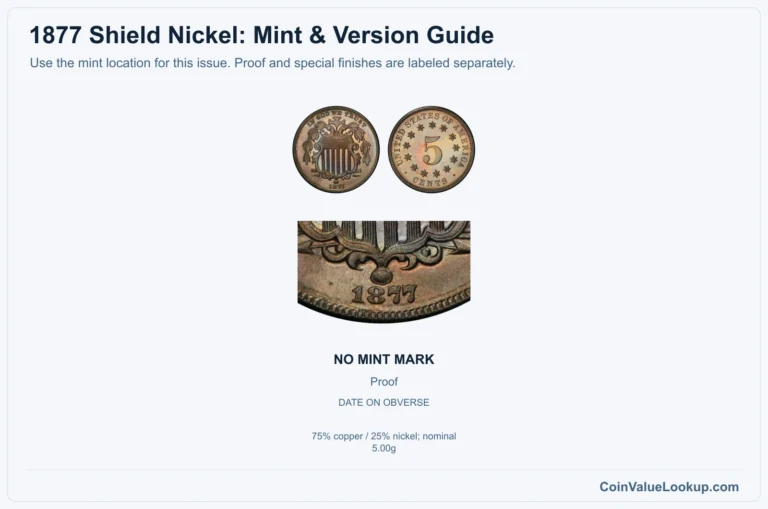
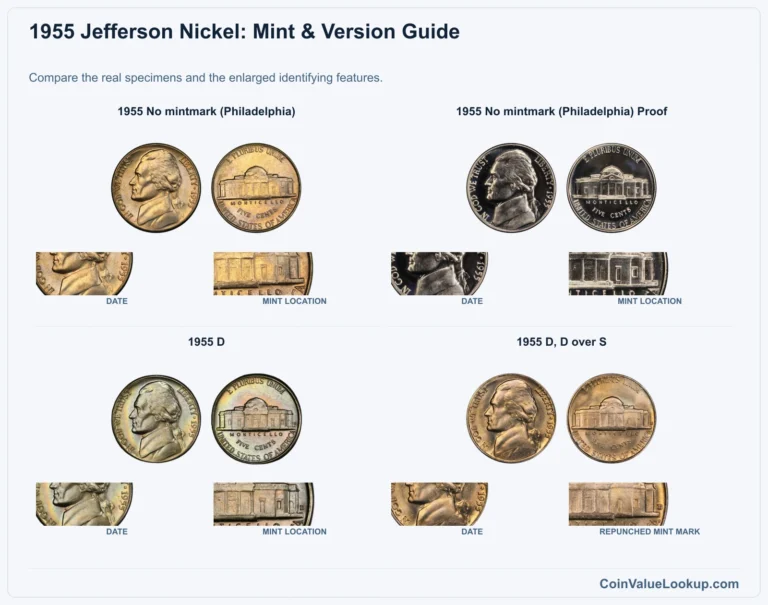
Every 1874 Shield nickel came from Philadelphia, so the absence of a mintmark is completely normal — not a sign of anything special. The obverse shows the Union shield design, while the reverse displays a large numeral 5 surrounded by stars, with no rays between them.
Rays were dropped from the design back in 1867, so all 1874 examples are the "No Rays" type.
The coin is struck in a copper-nickel alloy (75% copper, 25% nickel), weighs about 5 grams, and measures 20.5 mm with a plain edge. There is no legitimate silver version of this date.
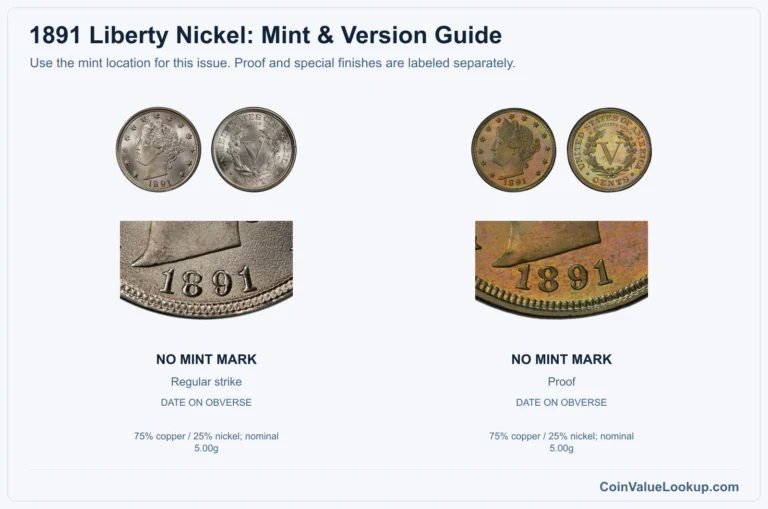
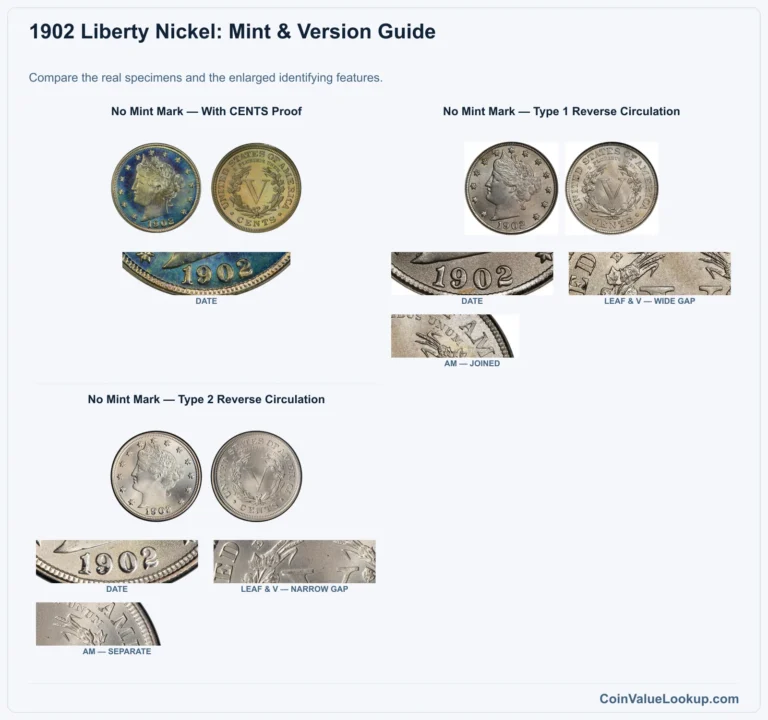
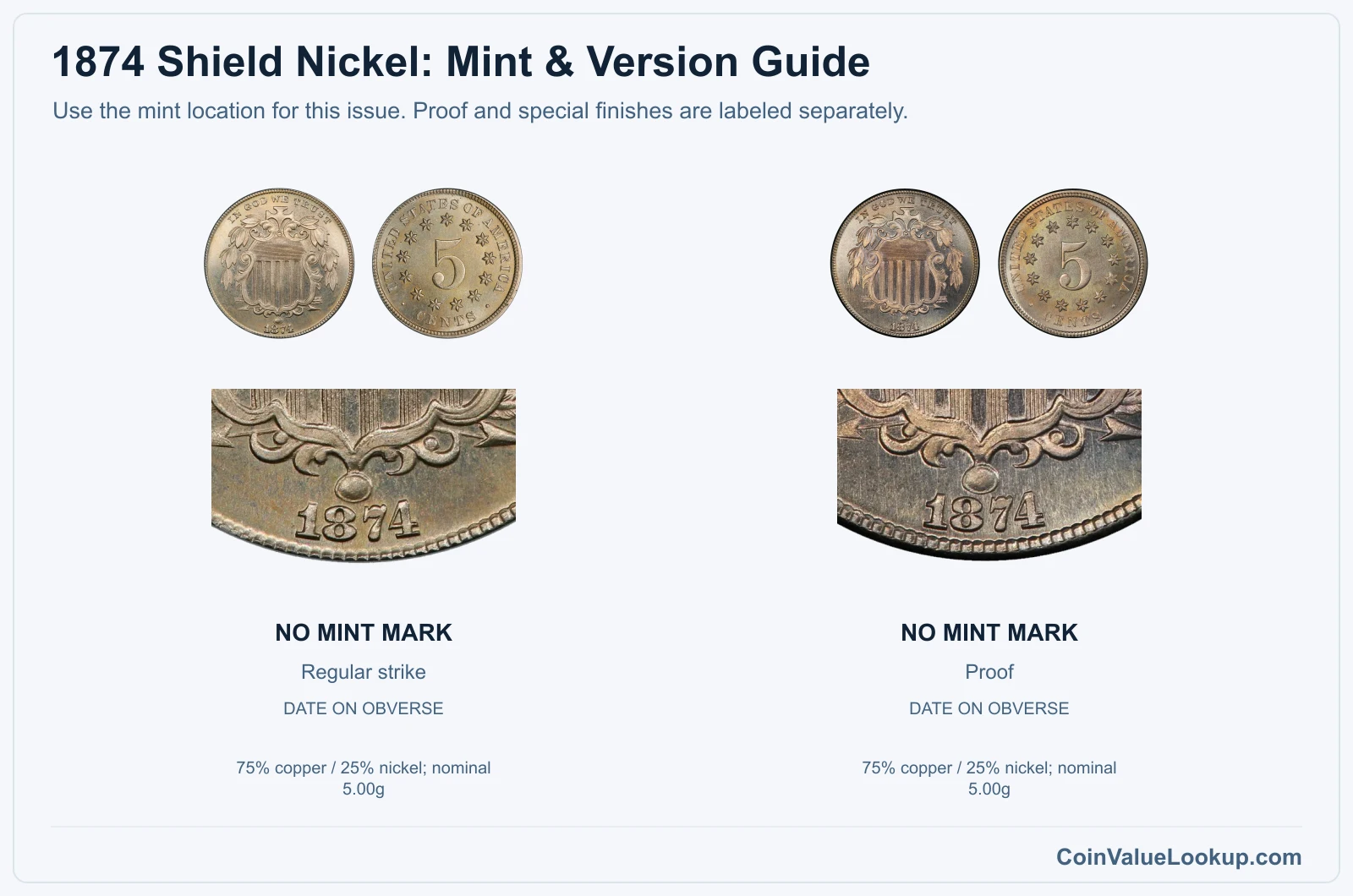
Your two main branches are the standard circulation strike and the proof, and telling them apart matters because proof coins carry different values.
Proofs typically show squared-off rims, mirror-like fields, and sharper overall detail than even a well-struck business coin. If you are unsure, compare your coin's rim profile and field texture to known examples before assuming proof status.
Start by confirming the design and strike type, then move to grading. And please — never clean the coin.
Step 2: Check Your 1874 Shield Nickel Grade
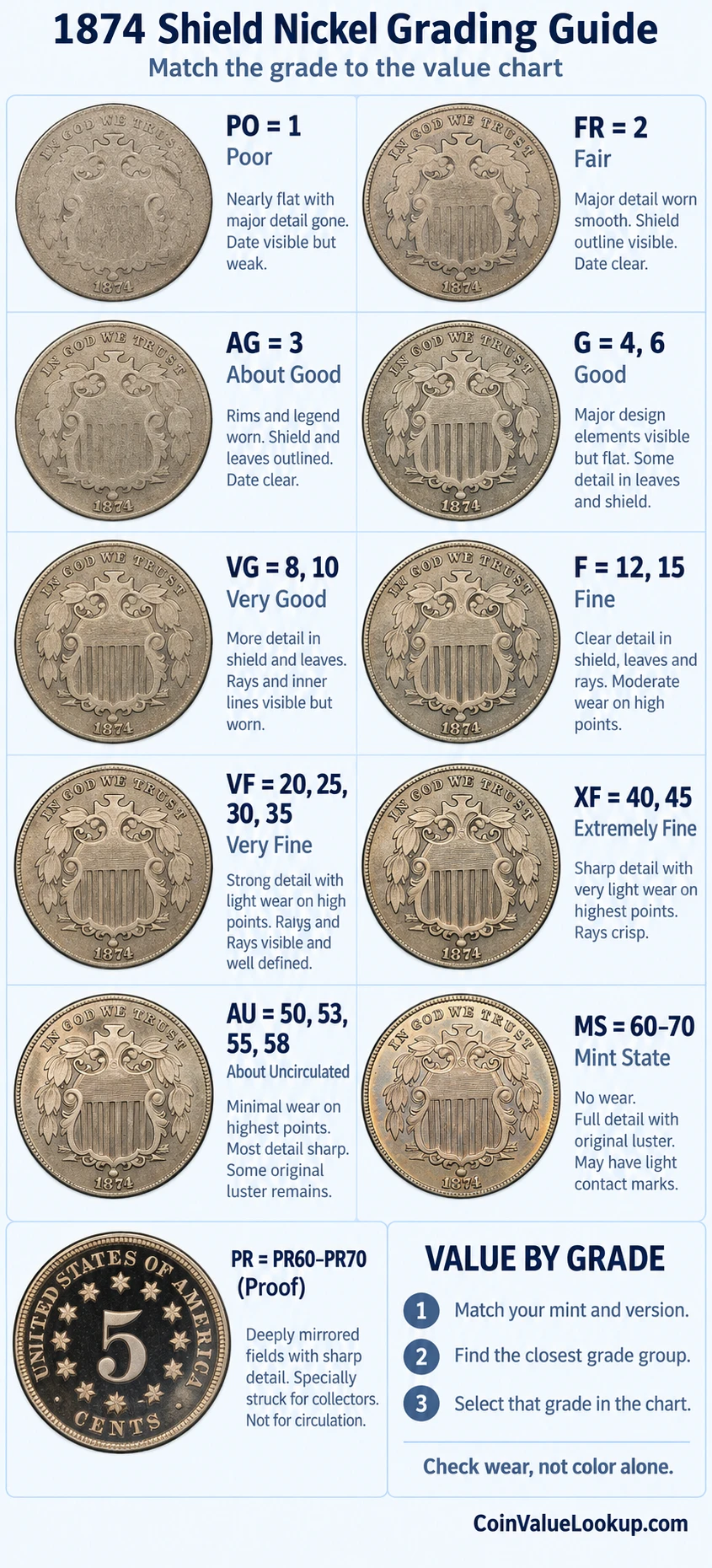
Focus on the shield's horizontal and vertical lines on the obverse and the cross, wreath leaves, and star points on the reverse. These are the first places where friction shows up.
A coin grading around G4 will have most shield detail worn smooth but the overall outline still clear, while an MS63 coin retains full luster and only minor contact marks.
Here is the tricky part with Shield nickels: the original strikes were sometimes weak. Indistinct shield lines do not always mean wear.
Check for remaining cartwheel luster across both faces. If the luster is intact but some lines are soft, you may be looking at a strike issue rather than actual circulation wear.
Use the comparison image to match your coin's detail level against known grade benchmarks. Coins with cleaning, corrosion, or visible damage fall outside standard guide values, so set those aside for individual evaluation.
Step 3: Check 1874 Shield Nickel Value by Mint and Version
1874 Shield Nickel — No Mint Mark — Circulation Strike
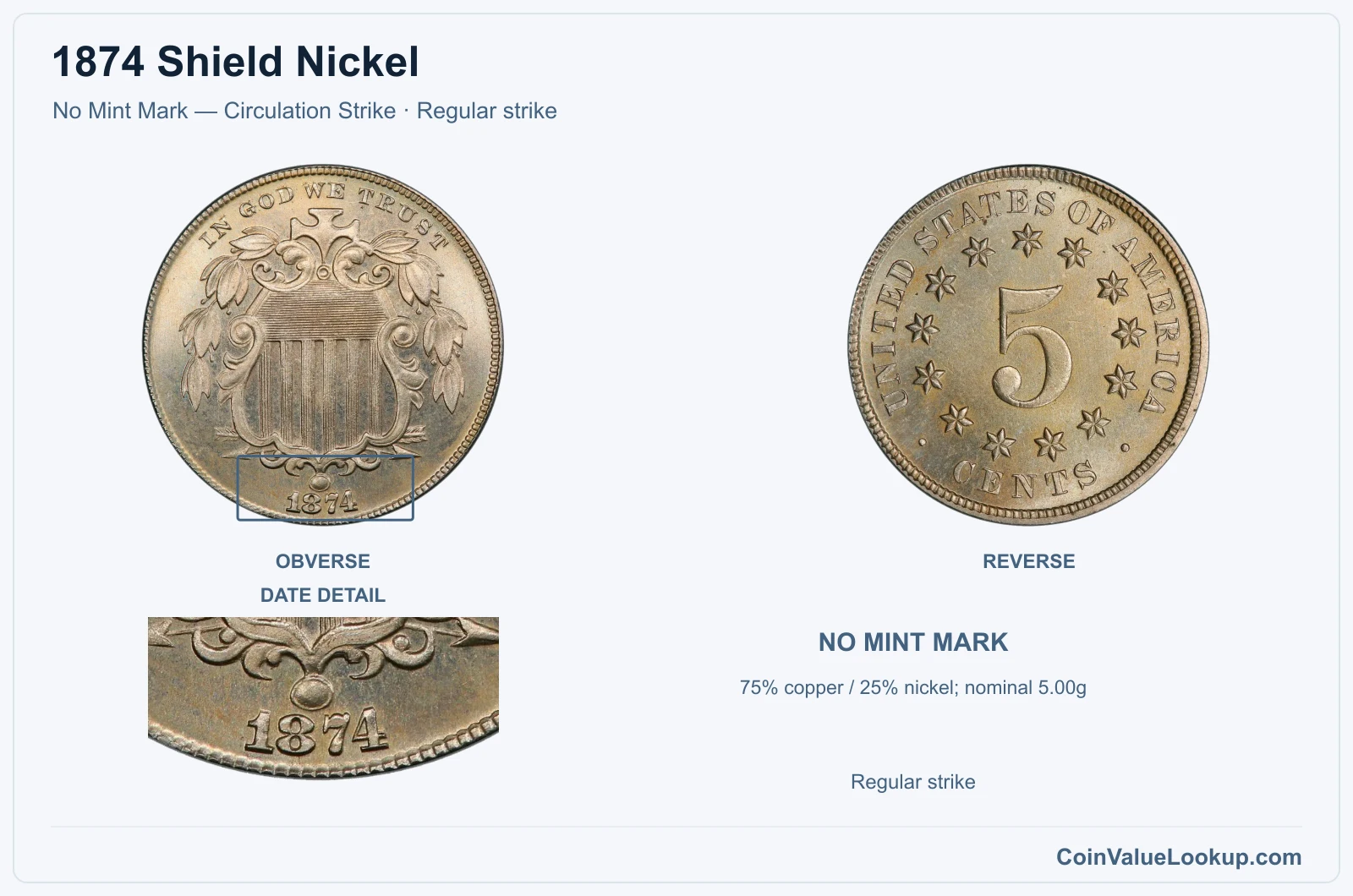
This is the standard 1874 Shield nickel produced for everyday commerce at the Philadelphia Mint. It carries no mintmark — that is expected.
The alloy is 75% copper and 25% nickel, struck in the No Rays reverse design used from mid-1867 onward.
USA Coin Book places a retail guide estimate of about $43 at the G4 grade level and roughly $407 at MS63. The jump between those two points is steep, so condition matters a great deal.
Original, problem-free examples with strong luster are the ones that command real attention.
Coin Value Lookup is a handy starting point if you want to look up guide values for this and other coin series quickly.
Range Grade
Price Auction Records Appraisal PO PO 1
—
Coin Identifier FR FR 2
—
Coin Identifier AG AG 3
—
Coin Identifier G G 4
—
Coin Identifier
G 6
—
Coin Identifier VG VG 8
—
Coin Identifier
VG 10
—
Coin Identifier F F 12
—
Coin Identifier
F 15
—
Coin Identifier VF VF 20
—
Coin Identifier
VF 25
—
Coin Identifier
VF 30
Coin Identifier
VF 35
Coin Identifier XF XF 40
Coin Identifier
XF 45
Coin Identifier AU AU 50
Coin Identifier
AU 53
—
Coin Identifier
AU 55
Coin Identifier
AU 58
Coin Identifier MS MS 60
—
Coin Identifier
MS 61
Coin Identifier
MS 62
Coin Identifier
MS 63
Coin Identifier
MS 64
Coin Identifier
MS 65
Coin Identifier
MS 66
Coin Identifier
MS 67
—
Coin Identifier
MS 68
—
—
—
MS 69
—
—
—
MS 70
—
—
—
1874 Shield Nickel — No Mint Mark — Proof
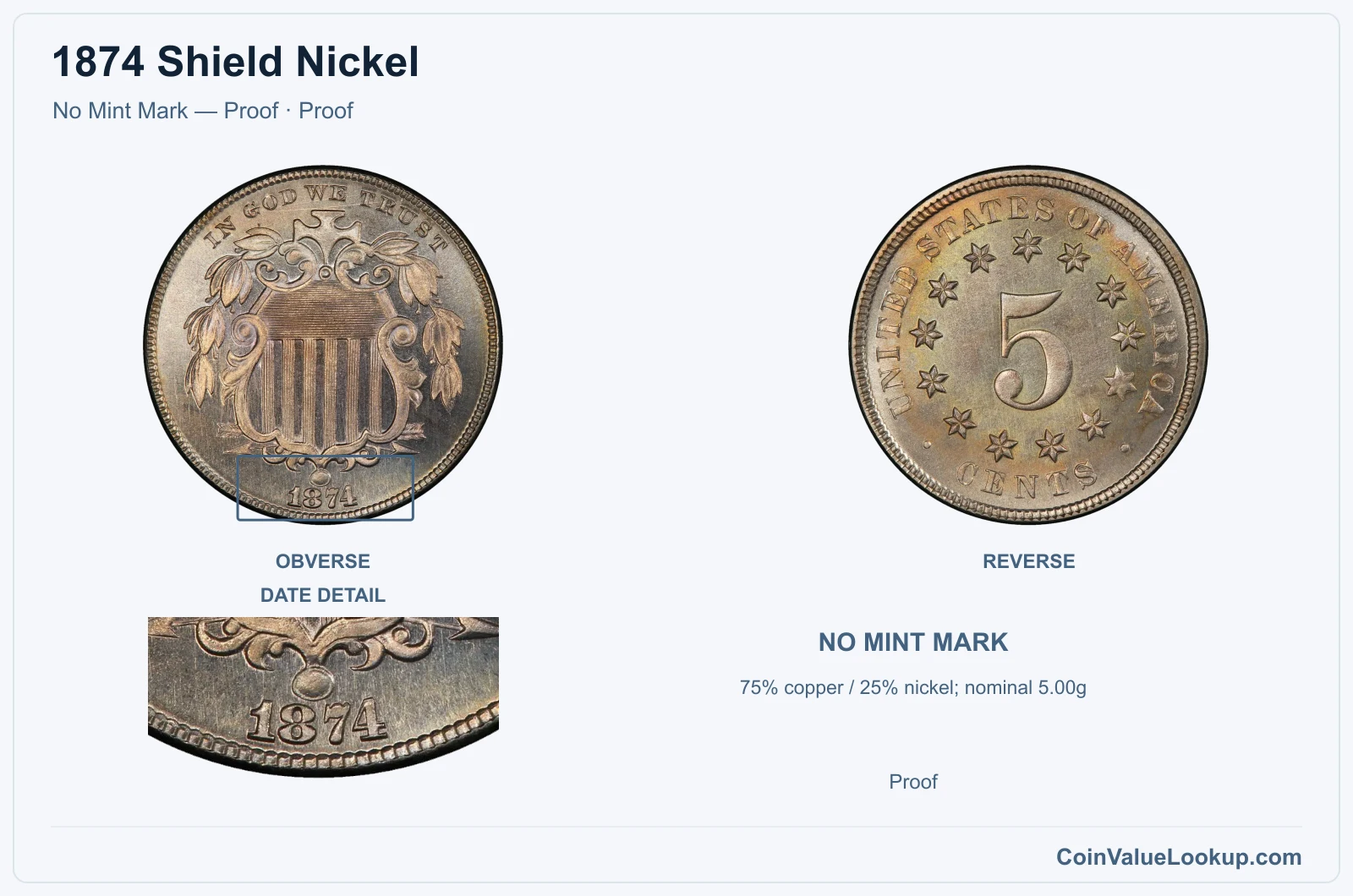
Philadelphia also struck proof Shield nickels in 1874, intended for collectors rather than circulation. These coins were made with specially prepared dies and planchets, producing sharp detail and reflective fields that set them apart from business strikes.
At PR63, the USA Coin Book guide estimate sits around $468. Confirming proof status requires matching your coin's characteristics — squared rims, mirror-like surfaces, and crisp design edges — against known proof examples.
A photograph alone may not be definitive, so handling the coin under good light helps. Cameo or deep-cameo designations require professional evaluation and matching photographs showing frosted devices against mirrored fields.
Range Grade
Price Auction Records Appraisal PR PR 1
—
Coin Identifier
PR 2
—
Coin Identifier
PR 3
—
Coin Identifier
PR 4
—
Coin Identifier
PR 6
—
Coin Identifier
PR 8
—
Coin Identifier
PR 10
—
Coin Identifier
PR 12
—
Coin Identifier
PR 15
—
Coin Identifier
PR 20
—
Coin Identifier
PR 25
—
Coin Identifier
PR 30
—
Coin Identifier
PR 35
—
Coin Identifier
PR 40
—
Coin Identifier
PR 45
—
Coin Identifier
PR 50
—
Coin Identifier
PR 53
—
Coin Identifier
PR 55
—
Coin Identifier
PR 58
—
Coin Identifier
PR 60
—
Coin Identifier
PR 61
—
Coin Identifier
PR 62
Coin Identifier
PR 63
Coin Identifier
PR 64
Coin Identifier
PR 65
Coin Identifier
PR 66
Coin Identifier
PR 67
Coin Identifier
PR 68
—
—
—
PR 69
—
—
—
PR 70
—
—
—
1874 Shield Nickel Error List
1. 1874 Shield Nickel — Doubled Die Obverse
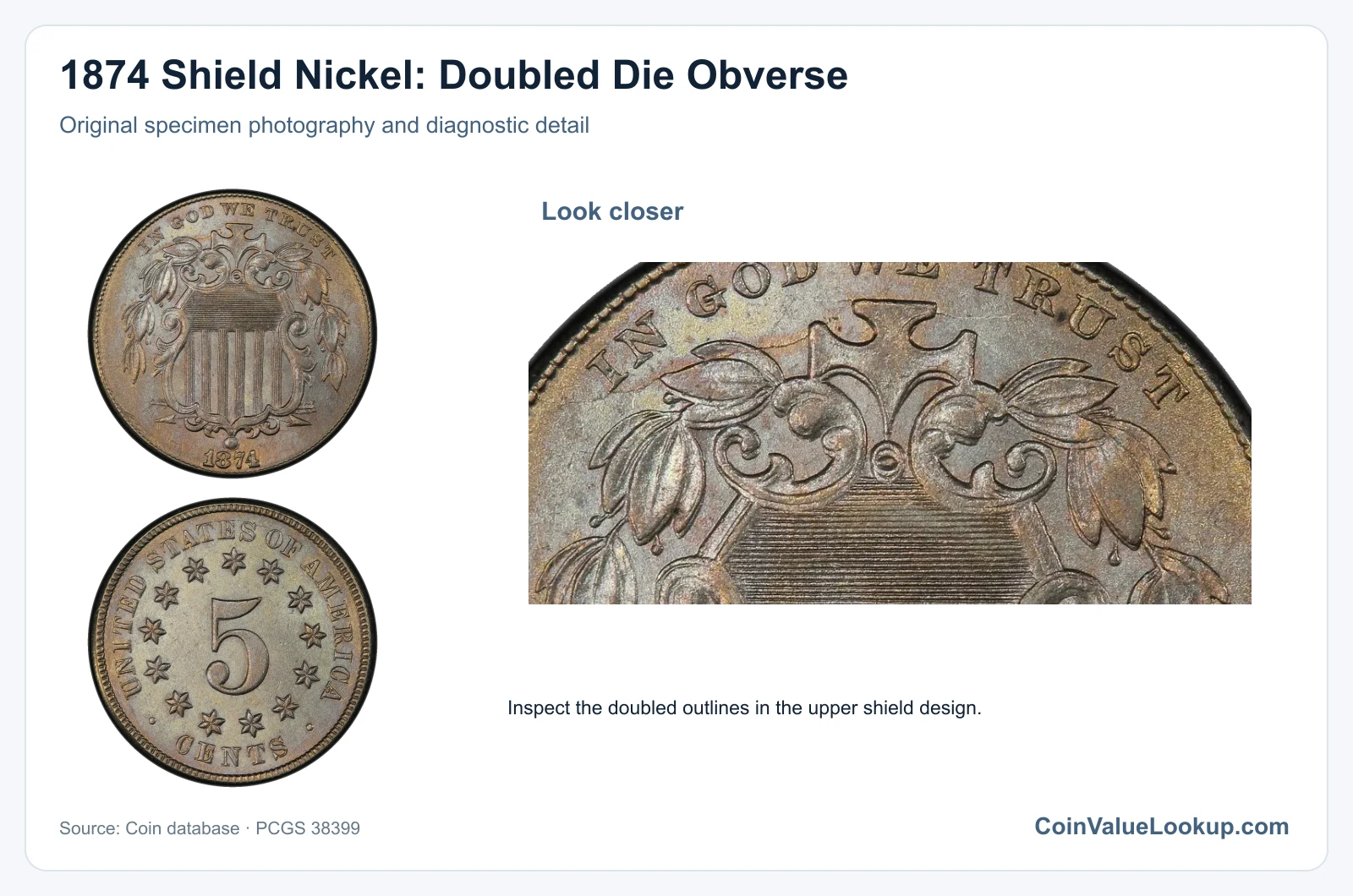
A doubled die obverse on the 1874 Shield nickel shows consistent separation or notching on the obverse lettering or design elements. This is a die-manufacturing variety, meaning every coin struck from that particular die carries the same doubling in the same location.
To check, compare your coin's obverse inscriptions and shield details against a normal 1874 nickel under identical lighting. True hub doubling produces a clean, consistent second image — not a flat, shelf-like smear.
Machine doubling, which happens during the striking process, tends to leave a flatter shelf without the crisp secondary outline.
No specific price data is available for this variety. The value of any doubled die depends on the visibility of the doubling, the coin's overall condition, and collector demand for the particular die pair.
A professional attribution is the surest way to confirm what you are seeing.
2. 1874 Shield Nickel — Repunched Date
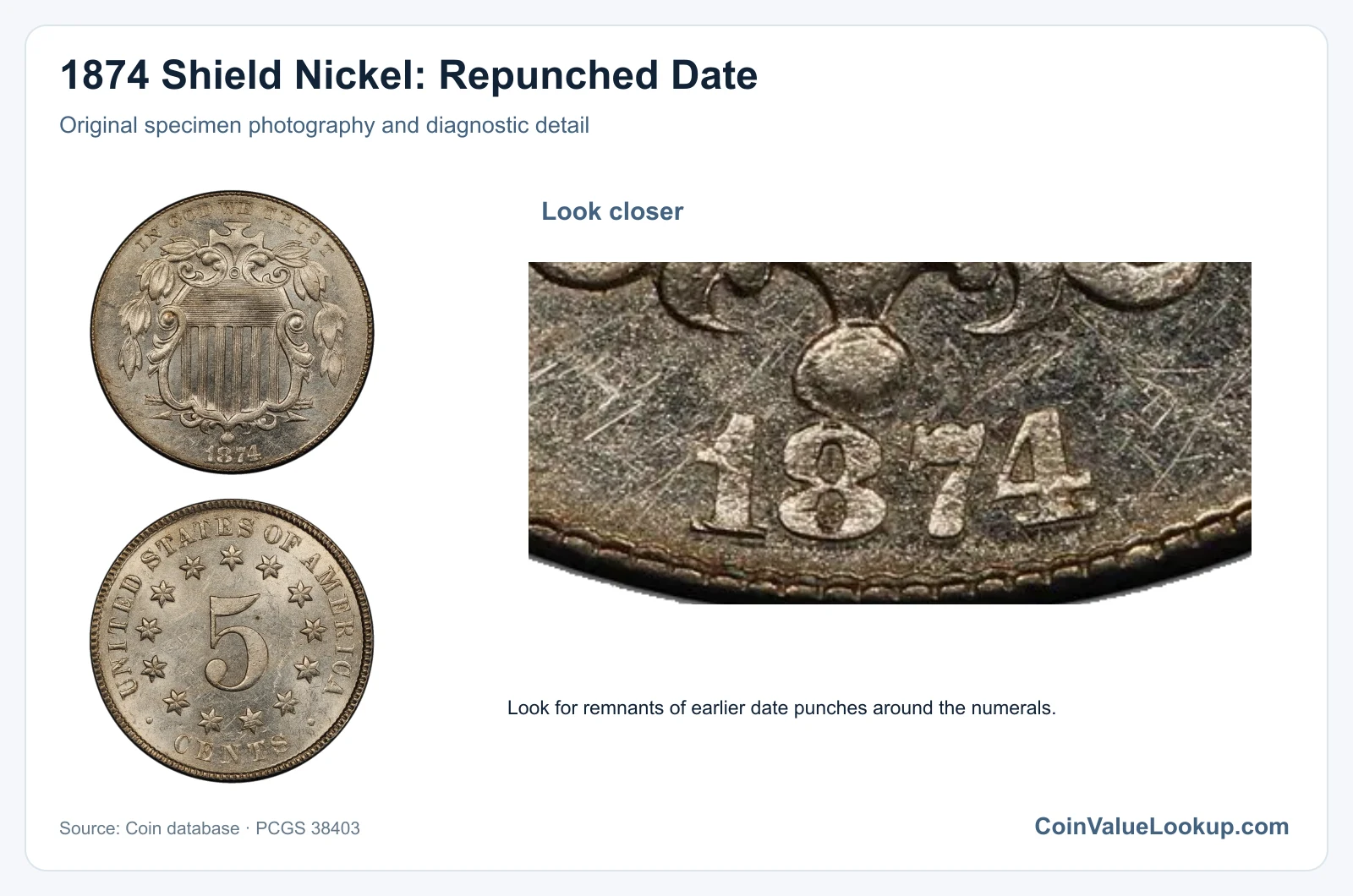
Repunched dates on the 1874 Shield nickel occur because a mint worker punched the date digits into the working die more than once, with the second impression slightly offset from the first. The telltale sign is remnants of an earlier numeral position visible beside or beneath the final date digits — most often noticeable on the 1, 8, or 4.
This is different from a doubled die, which affects the entire obverse design at once. A repunched date is limited to the date area.
Look carefully at the base and tops of each digit under magnification. Damage to the date area or machine doubling can mimic a repunched date, so compare to documented examples when possible.
No adopted price range is available. Value depends on how dramatic the repunching is, the coin's grade, and collector interest in the specific variety.
3. 1874 Shield Nickel — Struck-Through Error
A struck-through error on the 1874 Shield nickel happens when foreign material — grease, a metal fragment, thread, or other debris — sits between the die and the planchet during striking. The result is a localized depression or incomplete area of design where the obstruction blocked the die's impression.
Grease fill-ins tend to create soft, rounded depressions across a broader area, while a retained foreign object leaves a sharper, more defined impression. Both are struck-through errors, but collectors distinguish between the two because retained-object strikes are generally scarcer.
Do not confuse a struck-through with ordinary wear, post-strike scratches, cleaning damage, or a weakly struck area from worn dies. A genuine struck-through will show the surrounding design at full sharpness while the affected zone is distinctly recessed.
No specific pricing data is available; the error's size, location, and the coin's condition all influence what a collector might pay.
4. 1874 Shield Nickel — Misplaced Date
A misplaced date variety on the 1874 Shield nickel shows traces of date digits — typically the top of the numeral 1 or a curved fragment of the 8 — visible in the denticles or border area below the normal date position. This happened when the date punch was first impressed too low on the working die before being corrected to the proper location.
The leftover impression is usually faint and partially hidden among the denticles, so magnification is essential. You are looking for a shape that matches part of a digit rather than just an oddly formed denticle or a rim nick.
Damage from contact or a slightly irregular denticle can fool you if you are not careful.
No price data is adopted for this variety. The clarity of the misplaced fragment and the coin's overall condition will drive its collectible premium.
A specialist attribution helps confirm the find.