1874 Indian Head Penny Coin Value: How Much Is It Worth?
An 1874 Indian Head penny in well-worn Good-4 condition carries a guide value around $30, while a Mint State MS63 example jumps to roughly $344. Proofs from the same year list near $376 at PR63.
These are retail guide estimates, not guaranteed sale prices. Actual value depends on your coin's exact condition, surface quality and whether it qualifies as a proof or standard business strike.
Fast Way to Identify Your 1874 Indian Head Penny
The fastest way to start figuring out what your 1874 Indian Head cent is worth is to upload clear photos of the front and back. Our identifier can give you a preliminary read on which version you have and its approximate condition.
Two well-lit, in-focus images work best — one of each side, straight on.
1874 Indian Head Penny Value
Upload both sides of your 1874 Indian Head Penny.
Front Obverse
Upload photo
Back Reverse
Upload photo
Which 1874 Indian Head Penny Versions Are Worth Money?
- The 1874 business strike in MS63 lists around $344 — original uncirculated surfaces with minimal contact marks drive that premium over circulated examples.
- The 1874 proof at PR63 lists around $376; confirming genuine proof manufacture rather than a polished business strike is essential before applying proof pricing.
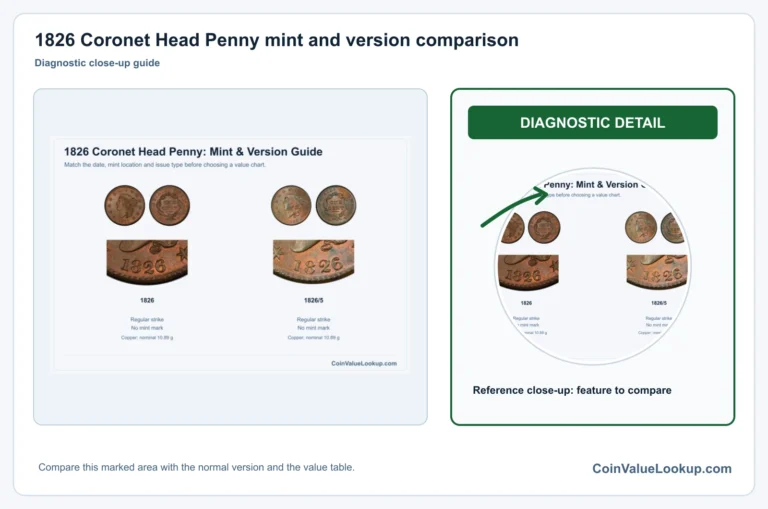
- Several die varieties exist for this date, including doubled die obverse, repunched date and misplaced date examples — each needs individual professional assessment for value.
Step 1: Identify Your 1874 Indian Head Penny Mint Mark and Version
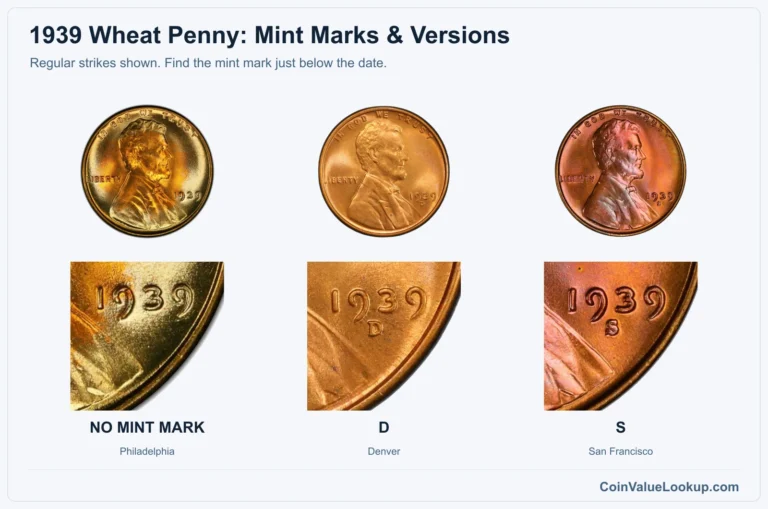
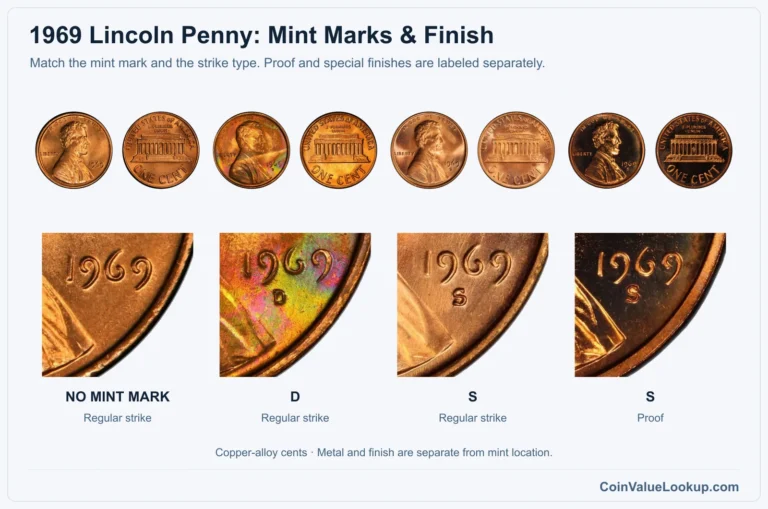
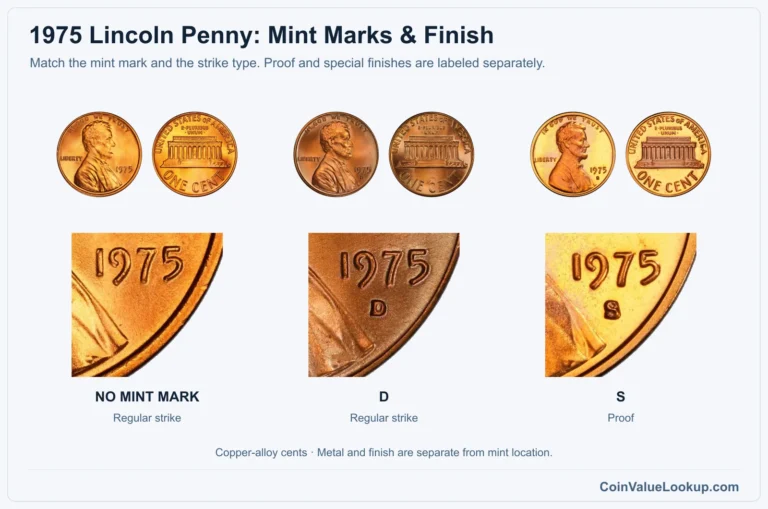
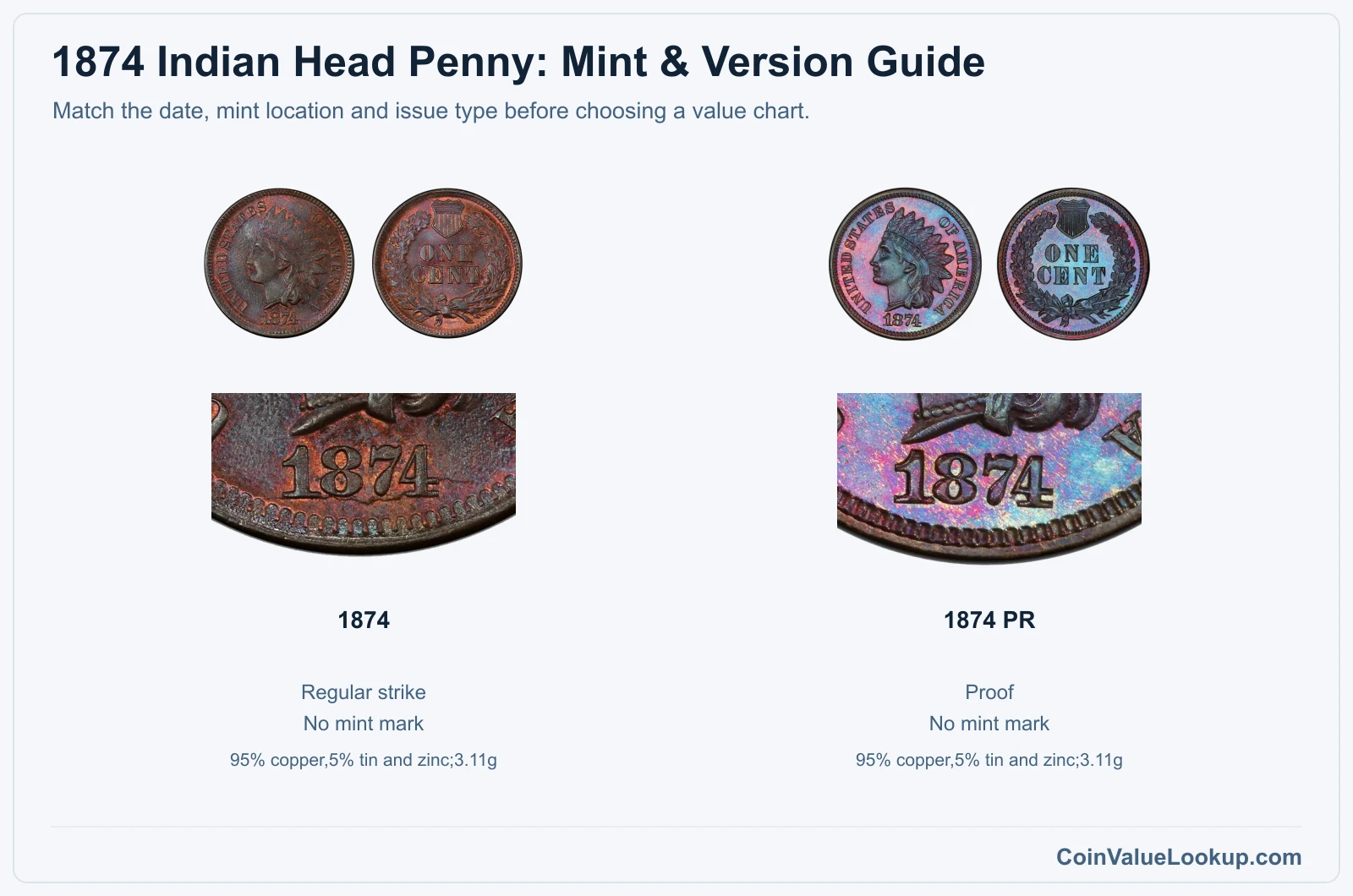
Every regular 1874 Indian Head cent was struck at the Philadelphia Mint. There is no mintmark on this coin, and the small "L" on the ribbon behind the neck is a designer's initial, not a mint identifier.
The obverse shows a Liberty portrait wearing a feathered headdress. The reverse displays an oak wreath surrounding a shield at its top, with "ONE CENT" in the center.
If your coin has a laurel wreath without the shield, you are looking at an 1859 cent instead.
This date was struck in bronze, composed of 95% copper with 5% tin and zinc, weighing about 3.11 grams. Do not confuse it with the heavier copper-nickel Indian cents produced before mid-1864.
The two main branches for 1874 are the standard business strike and the proof. Proof coins were manufactured with specially prepared dies and polished planchets, creating mirrored surfaces.
A business strike that has been polished to look shiny is not a proof — proof status comes from the manufacturing process, not from how reflective the coin appears today.
Step 2: Check Your 1874 Indian Head Penny Grade
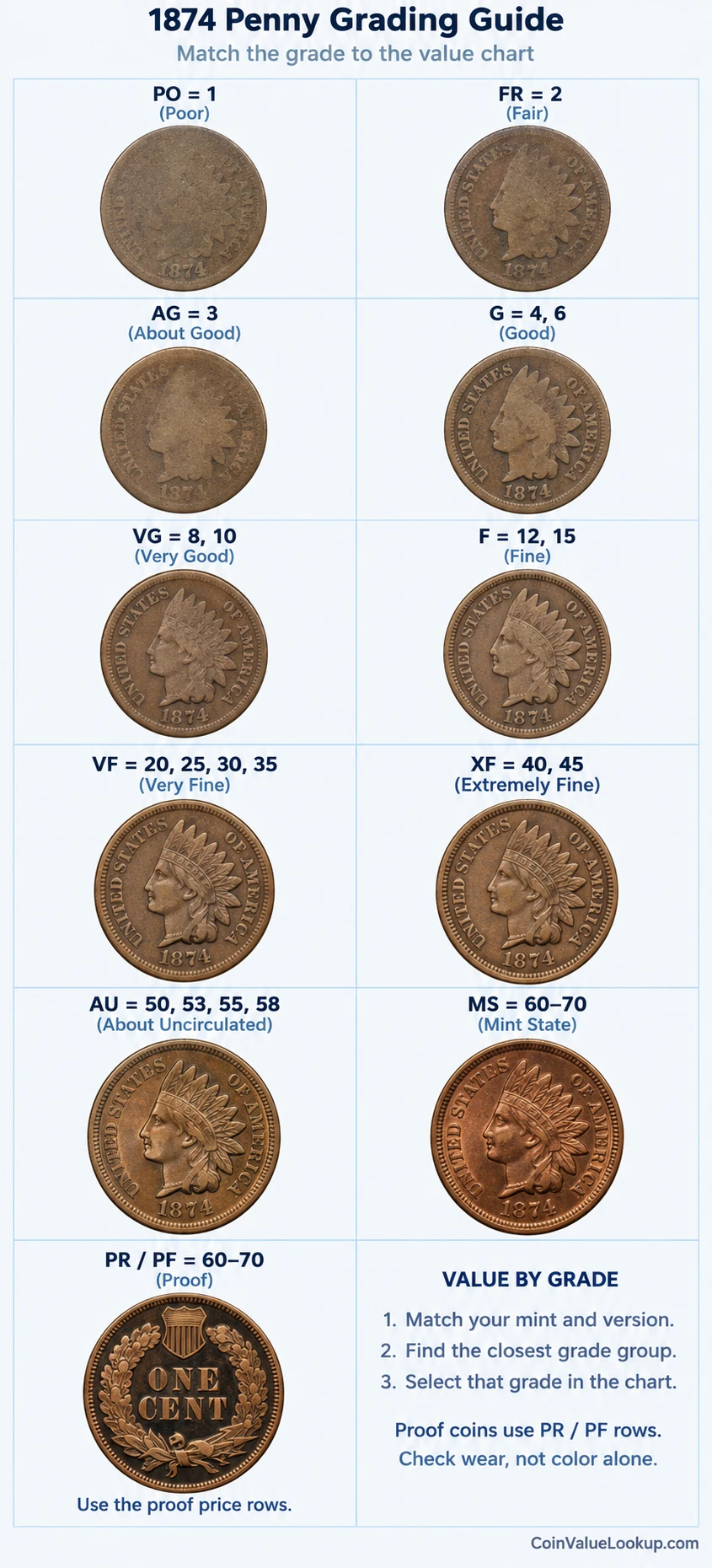
Start with the headband. On a sharp example, all letters of LIBERTY stand clear and fully separated.
In lower grades, the letters progressively merge into the band, with the center letters disappearing first.
Check the feather tips above the headdress and the hair curls below the ear. These are high points that show wear earliest.
A coin in Good-4 will have a smooth portrait outline with little interior detail, while a Fine example retains partial LIBERTY and visible feather structure.
On the reverse, inspect the leaf tips and the shield. Wear flattens leaves on the upper wreath first.
Compare your coin against the grading image — match the overall sharpness, not just one feature.
Be aware that some 1874 cents left the mint with a soft strike, especially in the feathers and hair. Weak detail in those areas alone does not always mean the coin circulated.
Look at the fields and high points together before deciding on a grade.
Color matters too. Bronze cents are described as BN (brown), RB (red-brown) or RD (red) based on how much original copper color remains.
These are color designations, not separate materials. More original red generally means more value at the same grade, but these guide prices do not specify a color tier, so keep that in mind.
Step 3: Check 1874 Indian Head Penny Value by Mint and Version
1874 Indian Head Penny
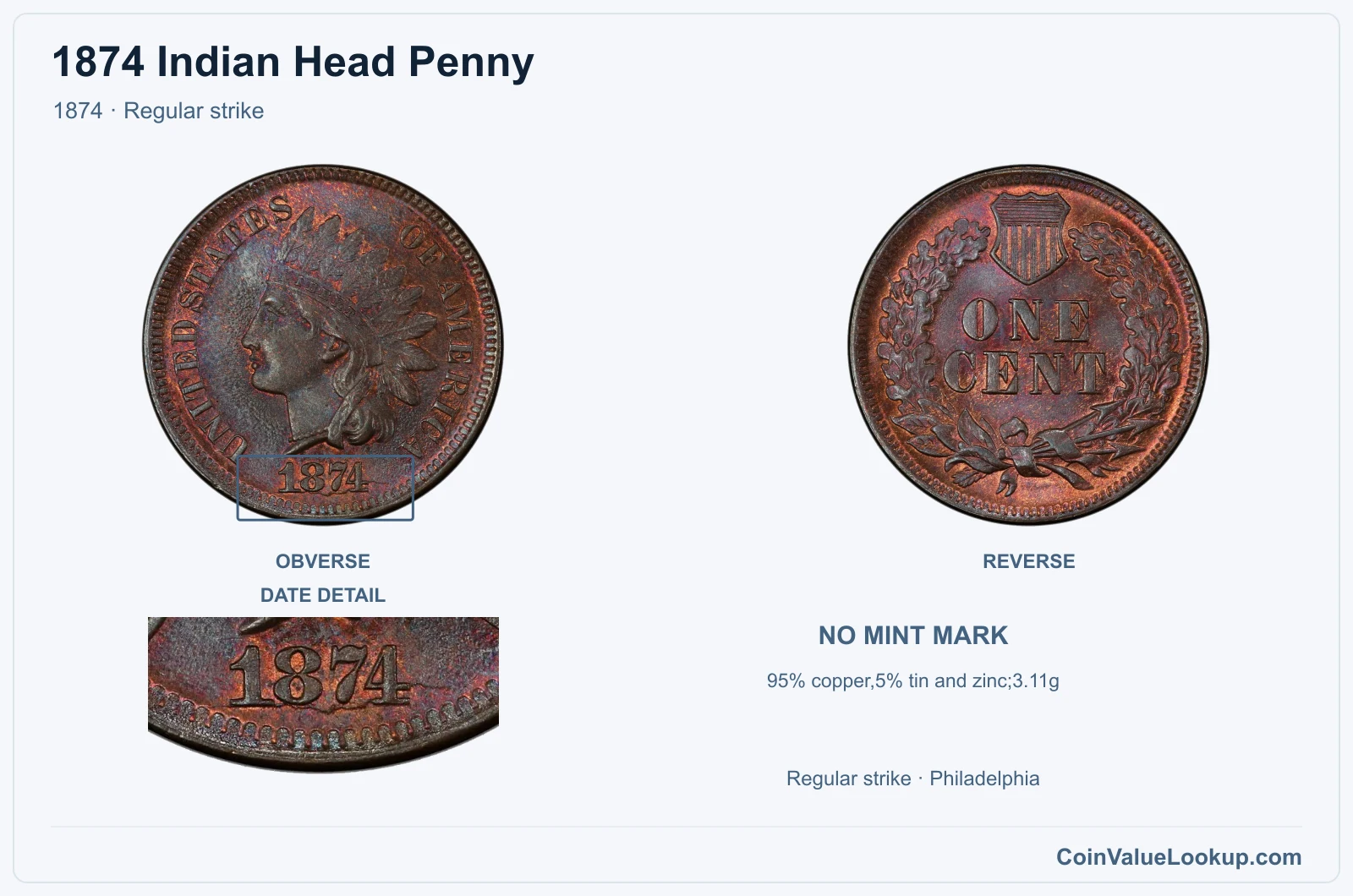
The standard 1874 Indian Head cent is a Philadelphia business strike in bronze, weighing 3.11 grams. Guide values run from about $30 in Good-4 to around $344 in MS63.
That is a big spread, and condition drives the bus here.
Look for honest wear patterns and original surfaces. Cleaned coins or those with corrosion trade for less than these guide figures suggest.
Coins retaining more original copper-red color can bring premiums above brown examples at the same grade, though these listed prices do not specify a color tier.
Coin Value Lookup is a good starting point if you want to compare this date against other years in the Indian Head series or look up values for different denominations.
| Range | Grade | Price | Auction Records | Appraisal |
|---|---|---|---|---|
| PO | PO 1 | — | Coin Identifier | |
| FR | FR 2 | — | Coin Identifier | |
| AG | AG 3 | — | Coin Identifier | |
| G | G 4 | — | Coin Identifier | |
| G 6 | — | Coin Identifier | ||
| VG | VG 8 | — | Coin Identifier | |
| VG 10 | Coin Identifier | |||
| F | F 12 | — | Coin Identifier | |
| F 15 | — | Coin Identifier | ||
| VF | VF 20 | Coin Identifier | ||
| VF 25 | Coin Identifier | |||
| VF 30 | Coin Identifier | |||
| VF 35 | Coin Identifier | |||
| XF | XF 40 | Coin Identifier | ||
| XF 45 | Coin Identifier | |||
| AU | AU 50 | Coin Identifier | ||
| AU 53 | Coin Identifier | |||
| AU 55 | Coin Identifier | |||
| AU 58 | Coin Identifier | |||
| MS | MS 60 | — | Coin Identifier | |
| MS 61 | Coin Identifier | |||
| MS 62 | Coin Identifier | |||
| MS 63 | Coin Identifier | |||
| MS 64 | Coin Identifier | |||
| MS 65 | Coin Identifier | |||
| MS 66 | Coin Identifier | |||
| MS 67 | — | — | — | |
| MS 68 | — | — | — | |
| MS 69 | — | — | — | |
| MS 70 | — | — | — |
1874 Indian Head Penny — PR
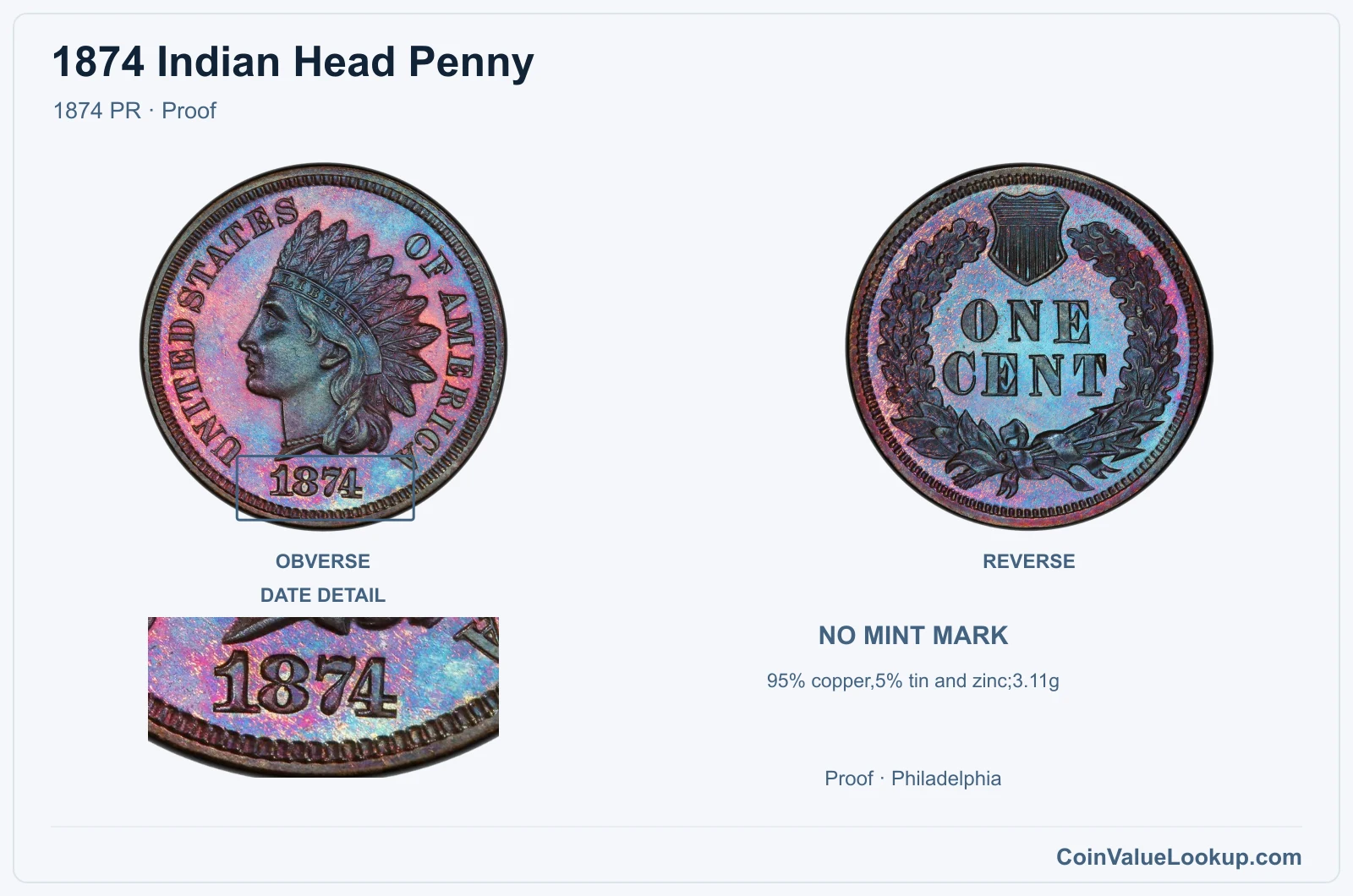
The 1874 proof Indian Head cent was a limited production for collectors, struck on polished planchets with specially prepared dies. At PR63, a guide value of about $376 applies.
That is only modestly above the MS63 business strike price, so correct identification matters a lot — you do not want to pay proof money for a shiny regular coin.
Genuine proofs show squared-off rims, mirrored fields and sharply defined design elements that result from controlled striking pressure. Compare the rim profile and field texture carefully against known examples.
A business strike coin that someone buffed on a cloth wheel will have hairlines, dulled high points and rounded rims — none of which match true proof characteristics.
| Range | Grade | Price | Auction Records | Appraisal |
|---|---|---|---|---|
| PR | PR 1 | — | Coin Identifier | |
| PR 2 | — | Coin Identifier | ||
| PR 3 | — | Coin Identifier | ||
| PR 4 | — | Coin Identifier | ||
| PR 6 | — | Coin Identifier | ||
| PR 8 | — | Coin Identifier | ||
| PR 10 | — | Coin Identifier | ||
| PR 12 | — | Coin Identifier | ||
| PR 15 | — | Coin Identifier | ||
| PR 20 | — | Coin Identifier | ||
| PR 25 | — | Coin Identifier | ||
| PR 30 | — | Coin Identifier | ||
| PR 35 | — | Coin Identifier | ||
| PR 40 | — | Coin Identifier | ||
| PR 45 | — | Coin Identifier | ||
| PR 50 | — | Coin Identifier | ||
| PR 53 | — | Coin Identifier | ||
| PR 55 | — | Coin Identifier | ||
| PR 58 | — | Coin Identifier | ||
| PR 60 | Coin Identifier | |||
| PR 61 | Coin Identifier | |||
| PR 62 | — | Coin Identifier | ||
| PR 63 | Coin Identifier | |||
| PR 64 | Coin Identifier | |||
| PR 65 | Coin Identifier | |||
| PR 66 | Coin Identifier | |||
| PR 67 | — | — | — | |
| PR 68 | — | — | — | |
| PR 69 | — | — | — | |
| PR 70 | — | — | — |
1874 Indian Head Penny Error List
1. 1874 Indian Head Penny — Die Break / Cud
A cud on an 1874 Indian Head cent appears as a raised, flat blob of metal that connects to the rim. It forms when a chunk of the die breaks away entirely, leaving nothing to impress that portion of the design.
The result is a featureless lump where part of the lettering, portrait or wreath should be.
To confirm a genuine cud, check that the raised area reaches the rim and that the surrounding design shows normal strike detail flowing up to its boundary. A rim dent pushes metal inward and sits below the surface, which is the opposite geometry.
Corrosion lumps tend to be rough and uneven rather than smooth and flat. Interior die chips that do not touch the rim are a related but separate category.
Value depends on the size, location and the coin's overall condition, so individual professional assessment is the way to go.
2. 1874 Indian Head Penny — Doubled Die Obverse
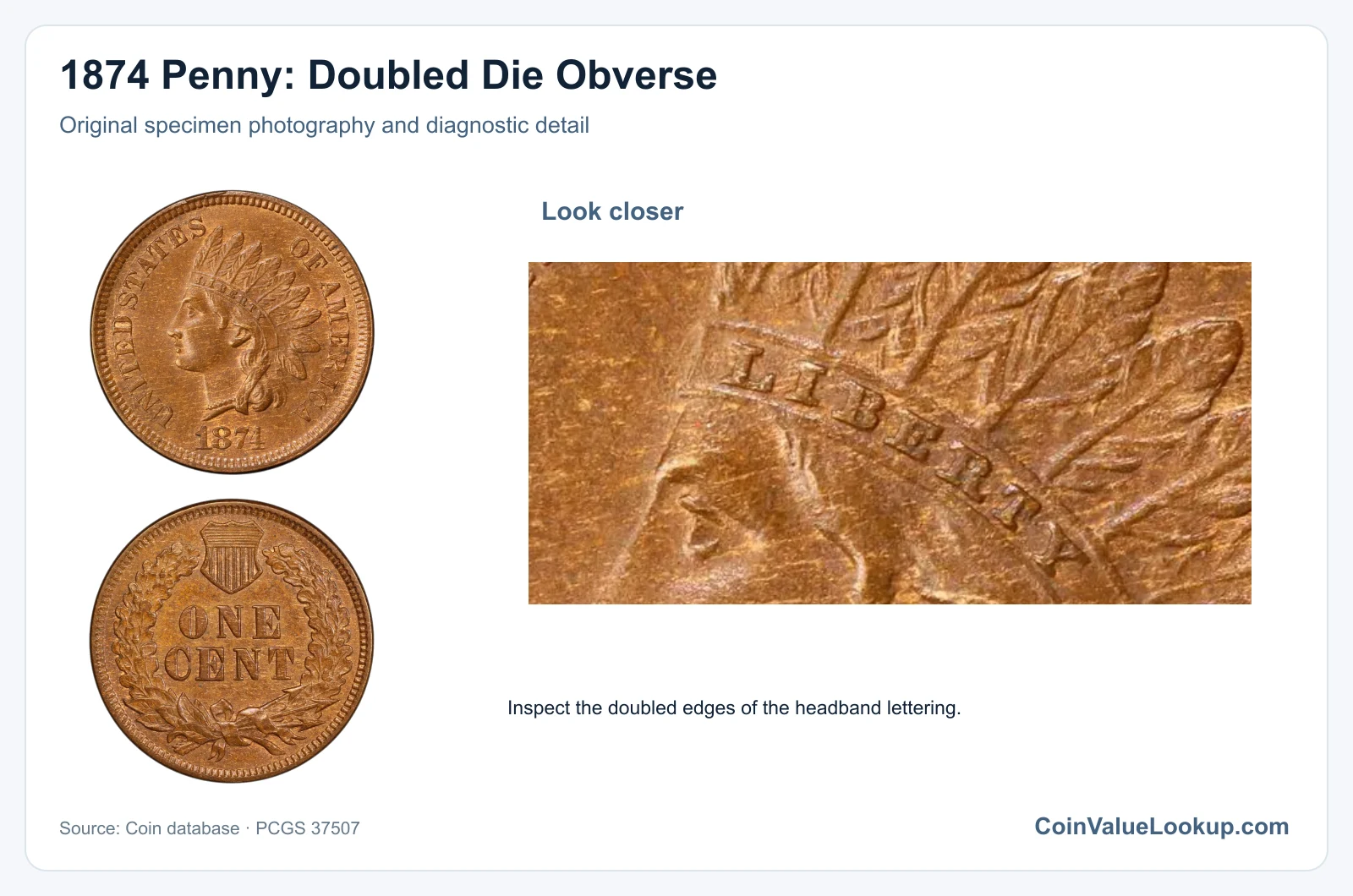
A doubled die obverse on an 1874 Indian Head cent shows consistent doubling across obverse design elements — typically visible as separation or notching in the date digits, LIBERTY lettering or portrait details. The key word is consistent: genuine hub doubling repeats in the same direction across multiple features.
Compare your coin to a normal 1874 under the same lighting and magnification. Look for a second image slightly offset from the primary one, not a flat shelf of displaced metal.
Machine doubling, which is far more common, produces a flat, shelf-like distortion on one side of a letter and lacks the three-dimensional quality of true hub doubling.
Reflections or worn die contours can also mimic doubling at first glance. Professional authentication is the reliable path to confirming this variety and establishing its value.
3. 1874 Indian Head Penny — Misplaced Date
A misplaced date on an 1874 Indian Head cent means partial impressions of one or more date digits appear somewhere they should not — often embedded in the denticles below the date or near the portrait's neck. This happened when the date punch struck the die in a wrong position before being corrected.
Look for faint outlines that match the shape of a numeral from the 1874 date. Compare what you see against photographs of confirmed examples.
The remnant digits will share the same font style as the final date.
Die chips, random scratches and small bumps can look similar at a glance, but they will not form a recognizable numeral shape. If you think you have one, tilt the coin under a strong light at various angles to see whether the shape holds up as a digit.
Value is assessed individually based on the clarity and position of the misplaced element and the coin's overall grade.
4. 1874 Indian Head Penny — Repunched Date
A repunched date on an 1874 Indian Head cent shows traces of an earlier punch position alongside the final date numerals. You might see a ghost image of one or more digits slightly north, south, east or west of where the final number sits.
This is distinct from doubled die varieties, which involve the entire hub impression rather than just the date punch.
Examine each digit carefully under magnification. Remnants of the first punch often appear as partial serifs or curves peeking out from behind the final digit.
Compare against a normal 1874 date to see what should and should not be there.
Damaged dates from post-mint hits can look superficially similar, and machine doubling can flatten letters in ways that mimic repunching. The distinguishing feature is that a genuine repunched date shows a complete but offset secondary digit image.
Individual assessment determines value.
5. 1874 Indian Head Penny — Die Crack
A die crack on an 1874 Indian Head cent appears as a thin, raised line running across the coin's surface. It can cross open fields, cut through lettering or run along the rim.
The line is raised because the crack in the die created a recessed channel that filled with metal during striking.
To verify, run your fingernail across it — a die crack sits above the surface, while a scratch sits below. Scratches are incuse and often show displaced metal along their edges.
Corrosion lines tend to be irregular and rough rather than clean and linear.
Note where the crack begins and ends. Longer cracks or those affecting major design elements tend to draw more collector interest, but the value of any specific die crack depends on its severity and the coin's condition.
No standard price range applies; each piece needs individual evaluation.
6. 1874 Indian Head Penny — Clashed Dies
Clashed dies occur when the obverse and reverse dies strike each other without a planchet between them, transferring faint impressions of each design onto the opposite die. On an 1874 Indian Head cent, you might see ghostly traces of the wreath in the obverse field or hints of the portrait outline on the reverse.
These transferred images will align with where the opposite design would sit during a normal strike. That positional consistency is your best diagnostic clue.
Random scratches or raised lines from damage will not follow that alignment pattern.
A brockage — where a previously struck coin acts as a die — can produce similar-looking transferred images but will appear as a mirror-image impression and typically shows much stronger detail than a die clash. Individual assessment based on clarity, location and overall coin condition determines what a clashed die example is worth.
7. 1874 Indian Head Penny — Die Chip
A die chip on an 1874 Indian Head cent shows up as a small, raised lump of metal, usually filling part of a letter, digit or nearby field area. It forms when a tiny piece of the die surface flakes away, leaving a void that fills with metal during striking.
The lump will blend into the surrounding struck design — the normal detail flows right into the raised area without any sharp boundary that would suggest something was glued on or gouged. That smooth transition is your main diagnostic feature.
Post-mint damage like gouges or adhesive residue will sit on top of the existing design rather than integrating with it, and displaced-metal impacts typically show directional flow. Die chips are relatively common across the Indian Head series, and their value depends on size, location and the coin's overall grade.
Each example requires individual evaluation.