1983 Lincoln Penny Coin Value: How Much Is It Worth?
Most 1983 Lincoln pennies are worth face value — one cent. A typical uncirculated example in MS65 condition carries a guide estimate around $0.36 from USA Coin Book, while a San Francisco proof in PR65 runs about $3.62.
The real excitement comes from specific varieties and errors: the well-known doubled die reverse and the extremely rare bronze transitional planchet are in a different league entirely.
Fast Way to Identify Your 1983 Lincoln Penny
Snap a clear photo of both sides of your 1983 penny and upload them here for a preliminary identification. This can help you figure out the mint, variety and general condition before you dig deeper.
It won't replace professional authentication or exact grading, but it is a solid starting point.
1983 Penny Value
Upload both sides of your 1983 Lincoln Penny.
Front Obverse
Upload photo
Back Reverse
Upload photo
Which 1983 Lincoln Penny Versions Are Worth Money?
- The 1983 doubled die reverse (no mintmark) shows strong doubling on ONE CENT, E PLURIBUS UNUM and UNITED — guide estimate $468 at MS65.
- A bronze transitional planchet error weighing approximately 3.1g instead of 2.50g is extremely rare; one NGC MS61 RB sold for $4,800 at Heritage Auctions in January 2020.
- S-mint proofs in high grade with original surfaces bring a modest premium over face value, with a PR65 guide estimate of $3.62.
Step 1: Identify Your 1983 Lincoln Penny Mint Mark and Version
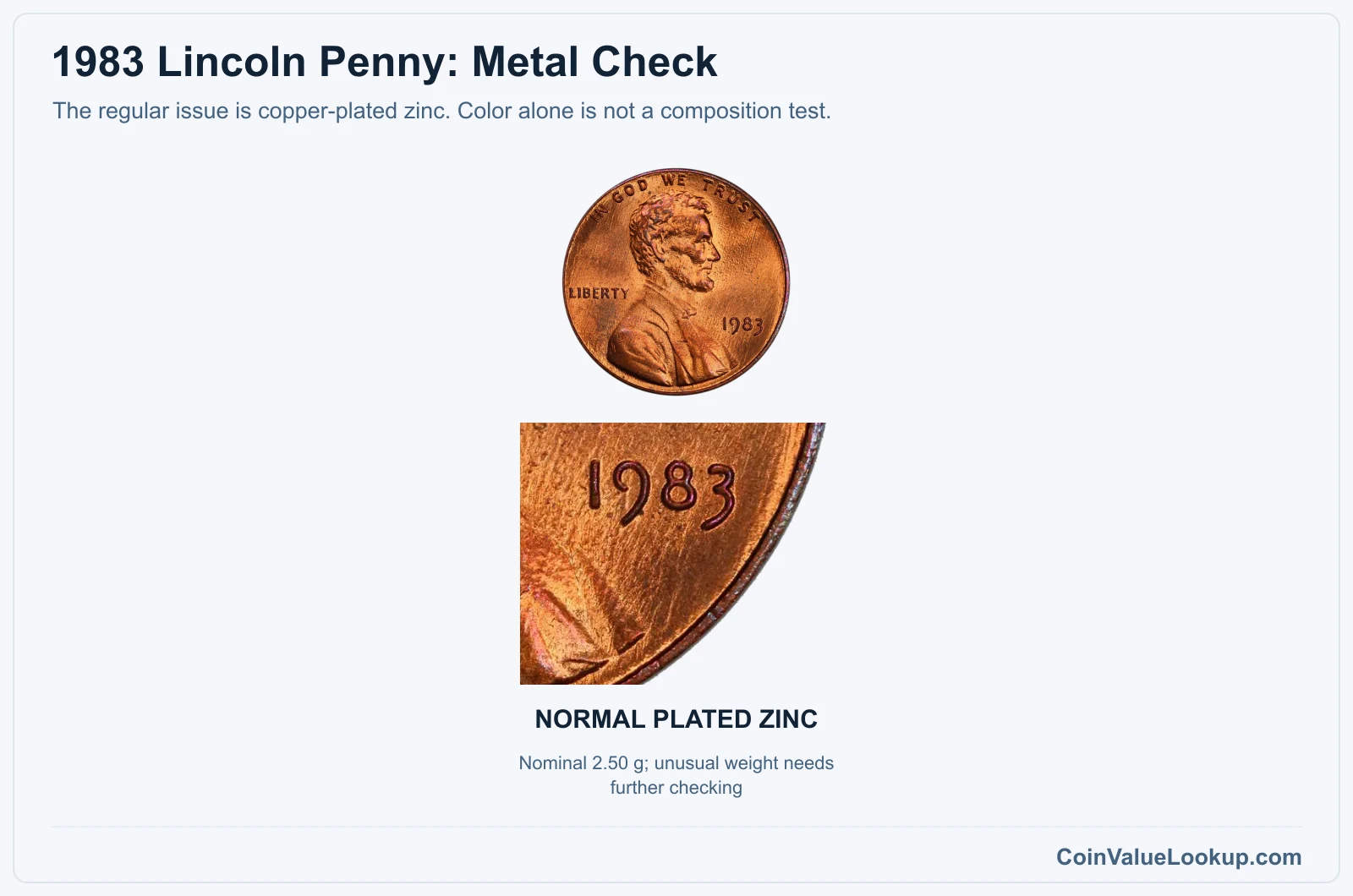
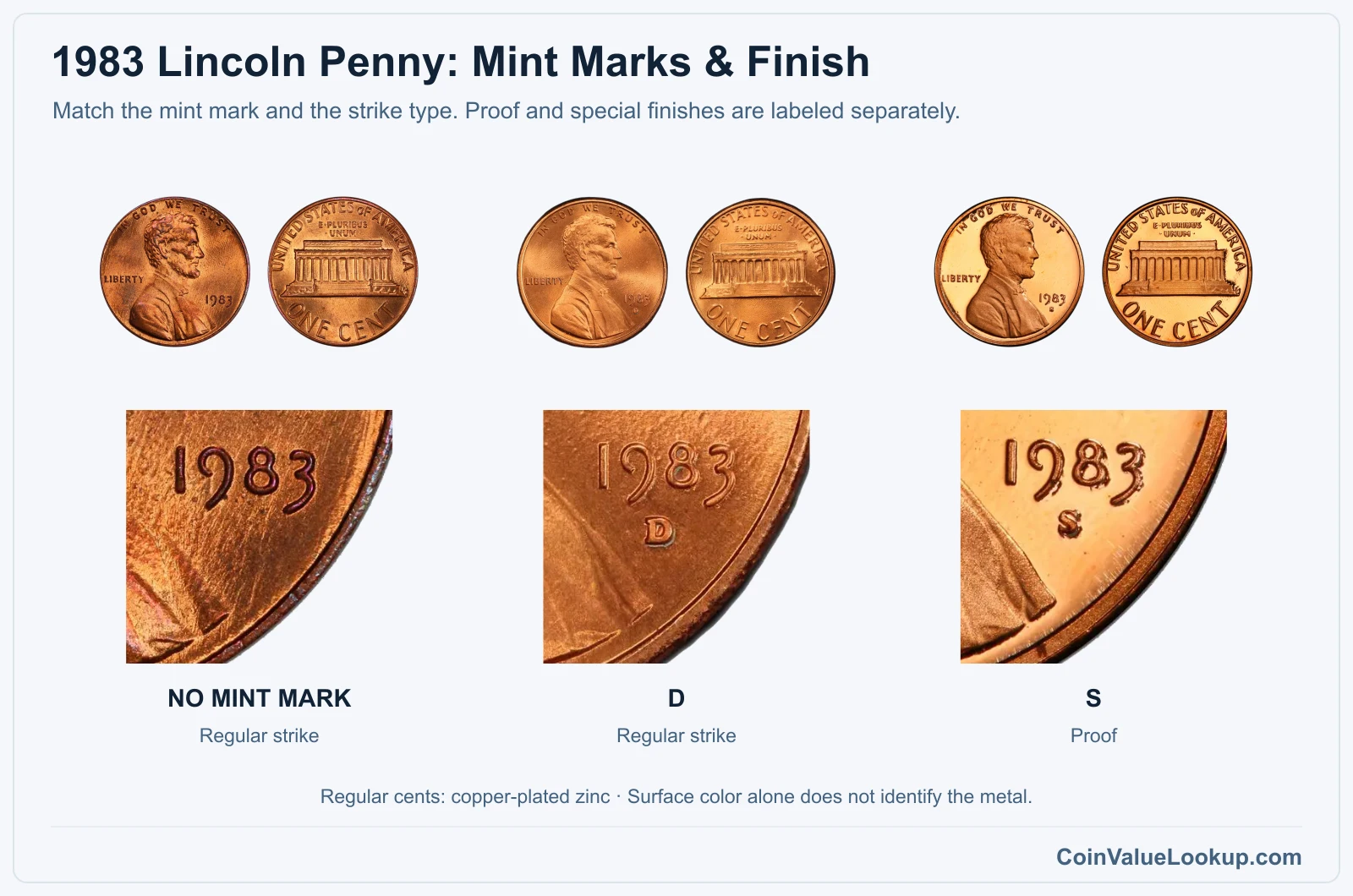
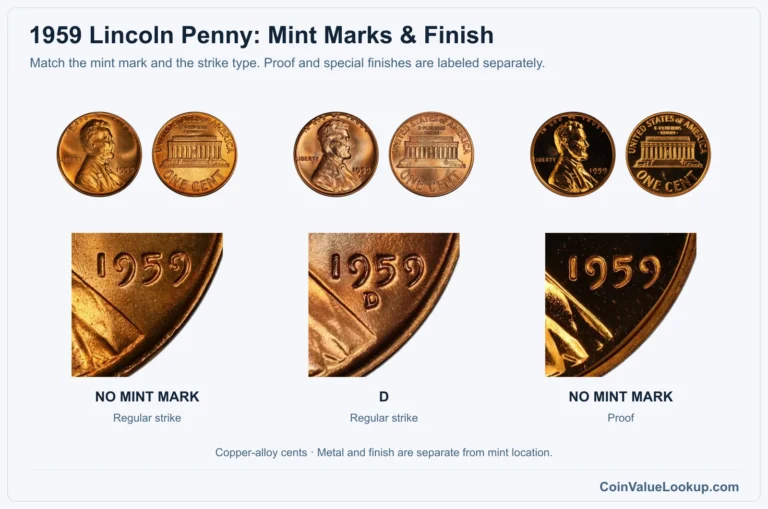
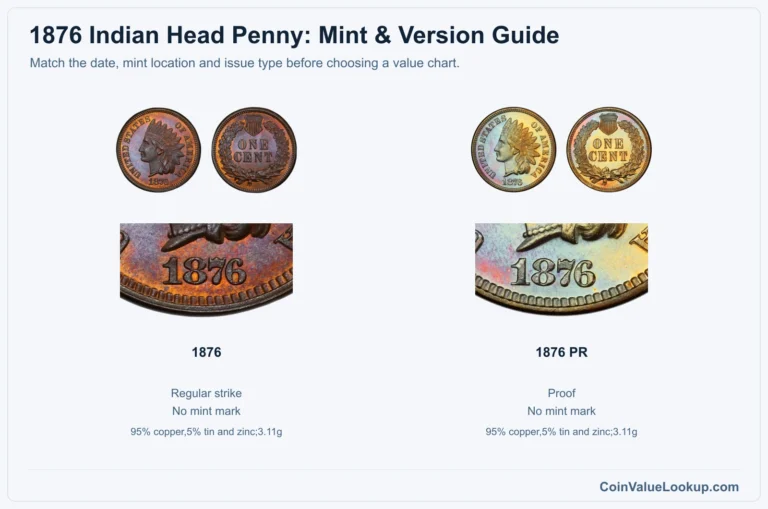
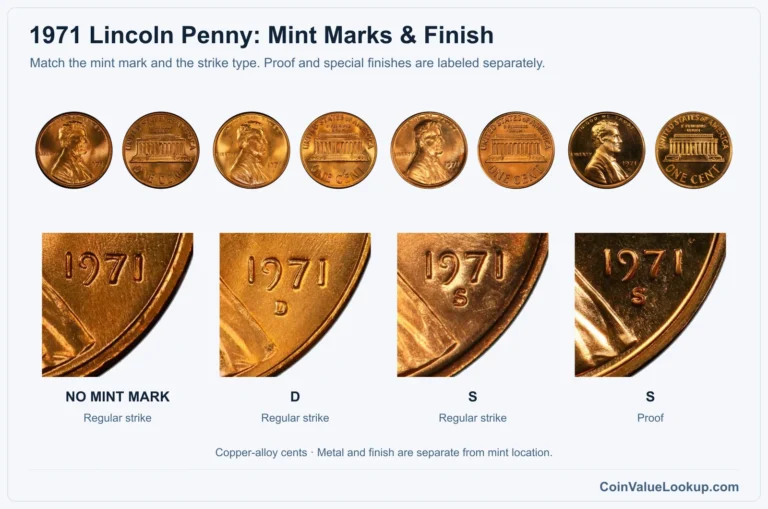
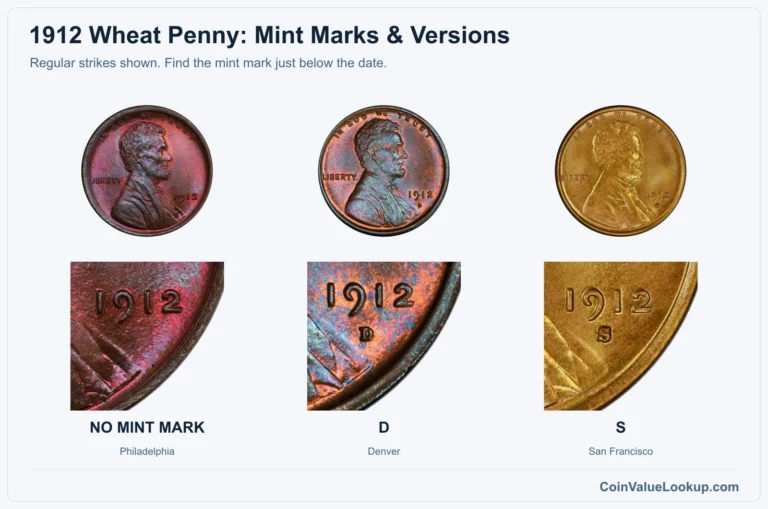
The 1983 Lincoln cent has Abraham Lincoln on the front and the Lincoln Memorial on the back. Look below the date for a mintmark: no letter means Philadelphia, a D means Denver, and an S means it is a proof struck at San Francisco.
All normal 1983 cents are copper-plated zinc, weighing about 2.50 grams. That copper color is just plating over a zinc core.
A shiny penny is not a proof — proofs have specially prepared surfaces and a distinct mirror-like finish, and they come only from San Francisco with the S mintmark.
Before reaching for any value chart, figure out which branch your coin belongs to: normal Philadelphia, normal Denver, S proof, or the doubled die reverse variety. Getting this step wrong means everything after it is wrong too.
Step 2: Check Your 1983 Lincoln Penny Grade
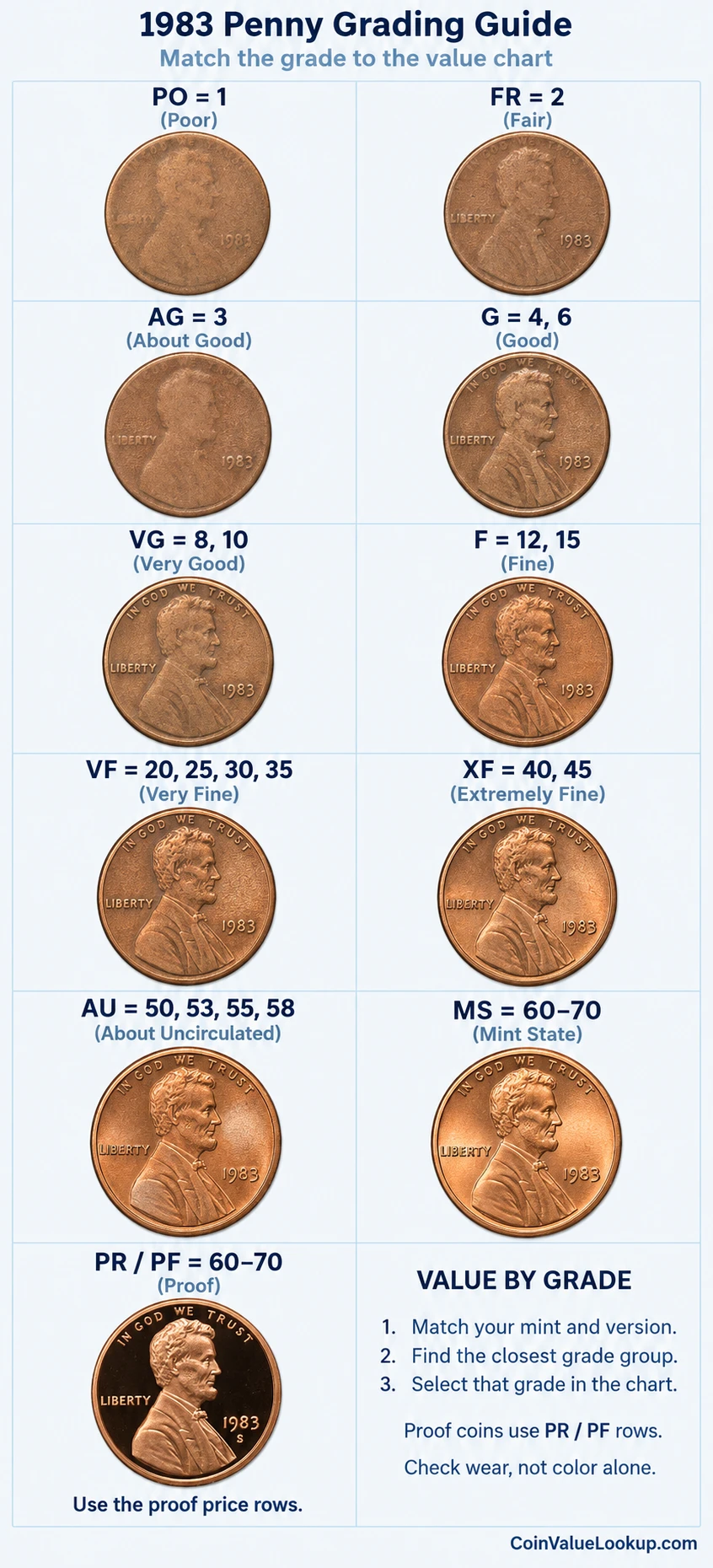
Check Lincoln's cheekbone, jawline and hair detail first. On a well-worn coin, the cheek blends into the jaw and the fine hair strands disappear.
On the reverse, the Memorial columns and horizontal lines flatten with circulation.
Don't confuse a weak strike with heavy wear. A weakly struck coin can still have luster in protected areas, while a worn coin loses luster where contact happened.
Color designations matter for uncirculated cents: BN (brown), RB (red-brown) and RD (red) describe the remaining original copper color on otherwise similar-grade coins. RD commands the strongest premiums.
Cleaning a brown coin will not make it a legitimate red coin — it just makes it a damaged coin.
Use the comparison image to match your penny's wear pattern. Look for spotting, corrosion, or plating bubbles, all of which reduce a coin's appeal regardless of the underlying grade.
Step 3: Check 1983 Lincoln Penny Value by Mint and Version
1983 Lincoln Penny — No Mint Mark — Normal Circulation Strike
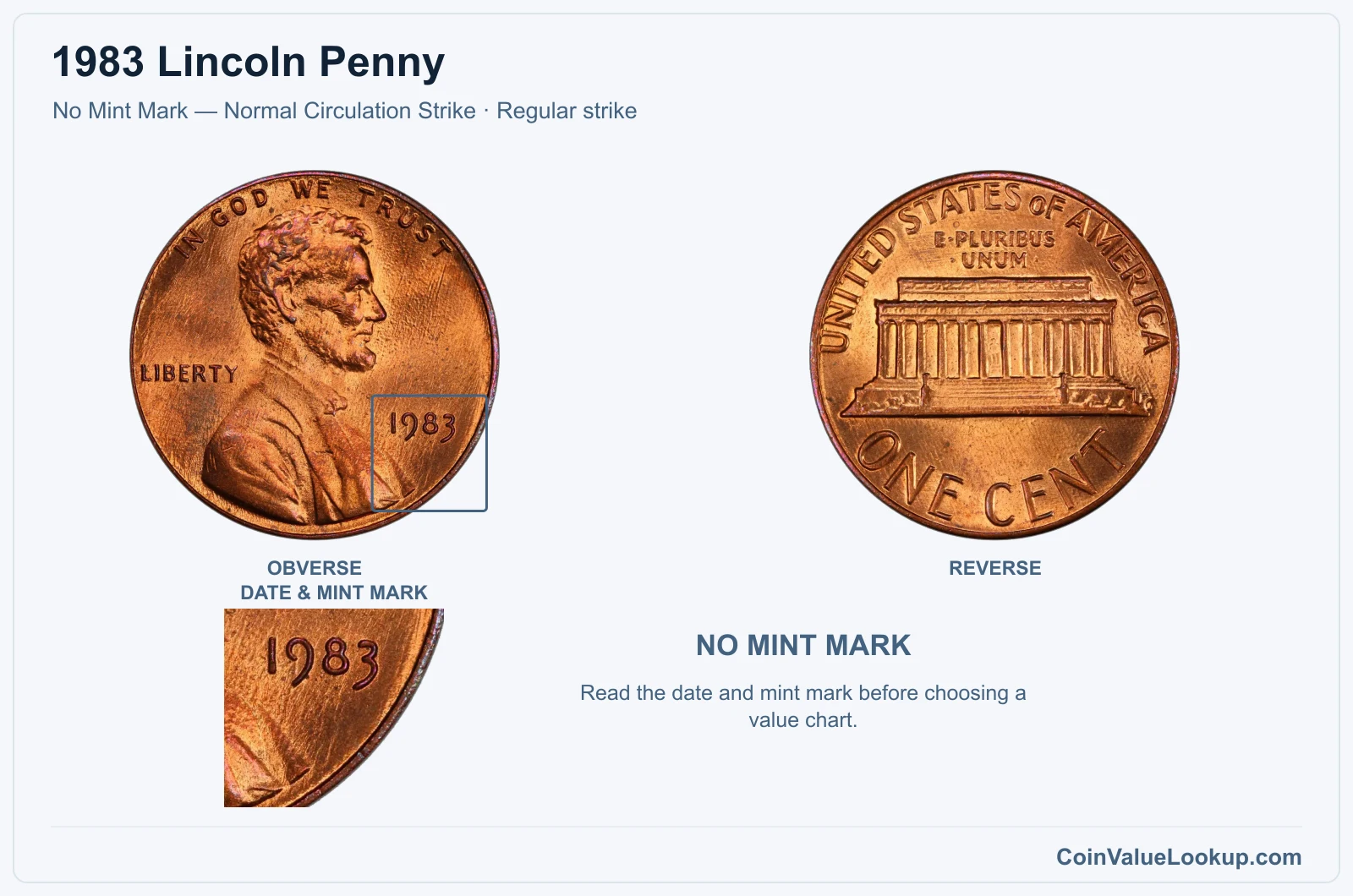
The 1983 Philadelphia penny has no mintmark below the date. It is copper-plated zinc, weighing about 2.50 grams, with a composition of 97.5% zinc and 2.5% copper overall.
In circulated condition, these are worth one cent. Even in nice shape, a USA Coin Book guide estimate for MS65 is just $0.36.
Billions were struck, so finding one in your pocket change proves nothing special. Only coins with full original red luster in certified holders command any meaningful premium above face value.
Range Grade
Price1983 No Mint Mark — Normal Circulation Strike (BN) Price1983 No Mint Mark — Normal Circulation Strike (RB) Price1983 No Mint Mark — Normal Circulation Strike (RD) Auction Records Appraisal PO PO 1
—
Coin Identifier FR FR 2
—
Coin Identifier AG AG 3
—
Coin Identifier G G 4
—
Coin Identifier
G 6
—
Coin Identifier VG VG 8
—
Coin Identifier
VG 10
—
Coin Identifier F F 12
—
Coin Identifier
F 15
—
Coin Identifier VF VF 20
—
Coin Identifier
VF 25
—
Coin Identifier
VF 30
—
Coin Identifier
VF 35
—
Coin Identifier XF XF 40
—
Coin Identifier
XF 45
—
Coin Identifier AU AU 50
—
Coin Identifier
AU 53
—
Coin Identifier
AU 55
—
Coin Identifier
AU 58
—
Coin Identifier MS MS 60
—
Coin Identifier
MS 61
—
Coin Identifier
MS 62
—
Coin Identifier
MS 63
—
Coin Identifier
MS 64
—
Coin Identifier
MS 65
Coin Identifier
MS 66
Coin Identifier
MS 67
—
Coin Identifier
MS 68
—
—
Coin Identifier
MS 69
—
—
—
—
—
MS 70
—
—
—
—
—
1983 Lincoln Penny — D — Normal Circulation Strike
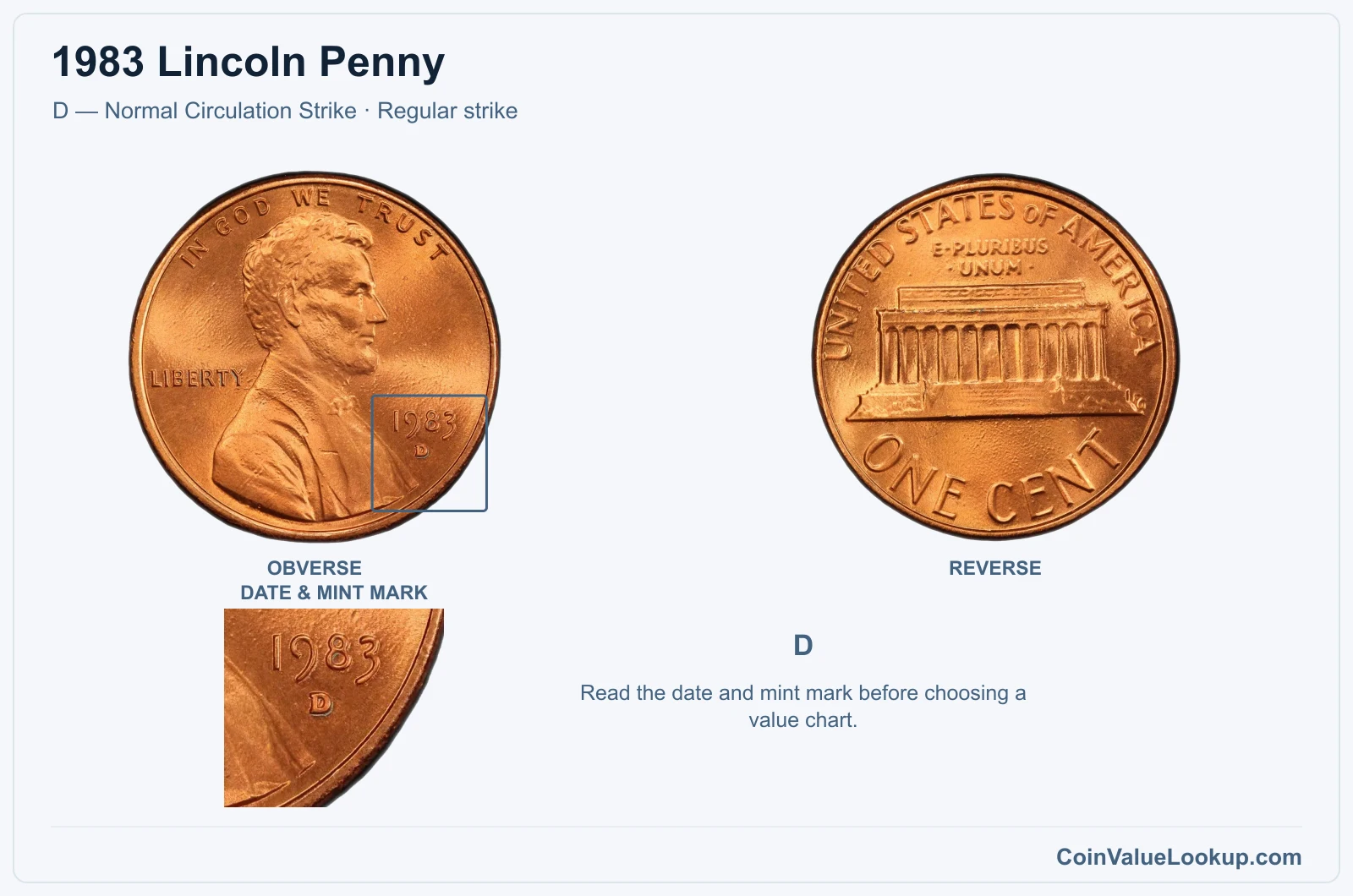
Denver's 1983 cent carries a small D below the date. Same copper-plated zinc composition, same 2.50-gram weight, same Lincoln Memorial reverse.
The story here mirrors Philadelphia: circulated examples are worth a cent, and the MS65 guide estimate from USA Coin Book sits at $0.36. These are extremely common coins.
Unless yours is a pristine uncirculated example with strong red color, it belongs in the spending jar, not the display case.
Range Grade
Price1983 D — Normal Circulation Strike (RB) Price1983 D — Normal Circulation Strike (RD) Auction Records Appraisal PO PO 1
—
Coin Identifier FR FR 2
—
Coin Identifier AG AG 3
—
Coin Identifier G G 4
—
Coin Identifier
G 6
—
Coin Identifier VG VG 8
—
Coin Identifier
VG 10
—
Coin Identifier F F 12
—
Coin Identifier
F 15
—
Coin Identifier VF VF 20
—
Coin Identifier
VF 25
—
Coin Identifier
VF 30
—
Coin Identifier
VF 35
—
Coin Identifier XF XF 40
—
Coin Identifier
XF 45
—
Coin Identifier AU AU 50
—
Coin Identifier
AU 53
—
Coin Identifier
AU 55
—
Coin Identifier
AU 58
—
Coin Identifier MS MS 60
—
Coin Identifier
MS 61
—
Coin Identifier
MS 62
—
Coin Identifier
MS 63
—
Coin Identifier
MS 64
—
Coin Identifier
MS 65
—
Coin Identifier
MS 66
Coin Identifier
MS 67
—
Coin Identifier
MS 68
—
Coin Identifier
MS 69
—
—
—
—
MS 70
—
—
—
—
1983 Lincoln Penny — S — Proof
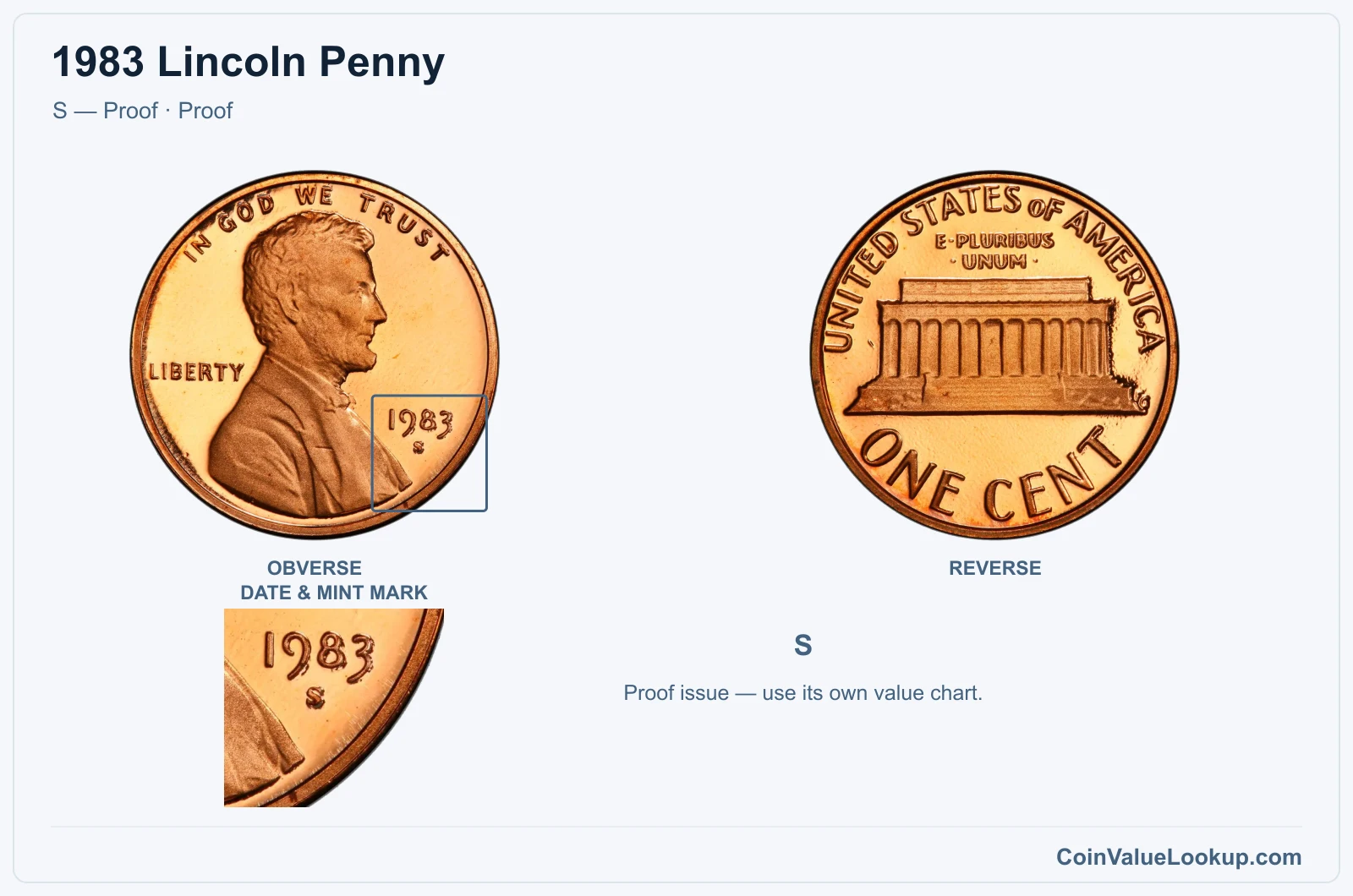
San Francisco produced proof cents in 1983 marked with an S below the date. These were sold in official proof sets, not released into circulation.
They have sharp, squared-off rims and mirror-like fields that distinguish them from any business strike, no matter how shiny.
The USA Coin Book guide estimate for a PR65 is $3.62. Higher grades and cameo or deep cameo designations can filter the value upward.
If your coin lacks the S mintmark or the characteristic proof surfaces, it is not a proof — it is just a clean circulation coin.
Coin Value Lookup is a handy place to look up guides for Lincoln cents and other series when you need a quick reference point.
Range Grade
Price Auction Records Appraisal PR PR 1
—
Coin Identifier
PR 2
—
Coin Identifier
PR 3
—
Coin Identifier
PR 4
—
Coin Identifier
PR 6
—
Coin Identifier
PR 8
—
Coin Identifier
PR 10
—
Coin Identifier
PR 12
—
Coin Identifier
PR 15
—
Coin Identifier
PR 20
—
Coin Identifier
PR 25
—
Coin Identifier
PR 30
—
Coin Identifier
PR 35
—
Coin Identifier
PR 40
—
Coin Identifier
PR 45
—
Coin Identifier
PR 50
—
Coin Identifier
PR 53
—
Coin Identifier
PR 55
—
Coin Identifier
PR 58
—
Coin Identifier
PR 60
—
Coin Identifier
PR 61
—
Coin Identifier
PR 62
—
Coin Identifier
PR 63
—
Coin Identifier
PR 64
—
Coin Identifier
PR 65
—
Coin Identifier
PR 66
Coin Identifier
PR 67
Coin Identifier
PR 68
Coin Identifier
PR 69
Coin Identifier
PR 70
Coin Identifier
1983 Lincoln Penny — No Mint Mark — Doubled Die Reverse
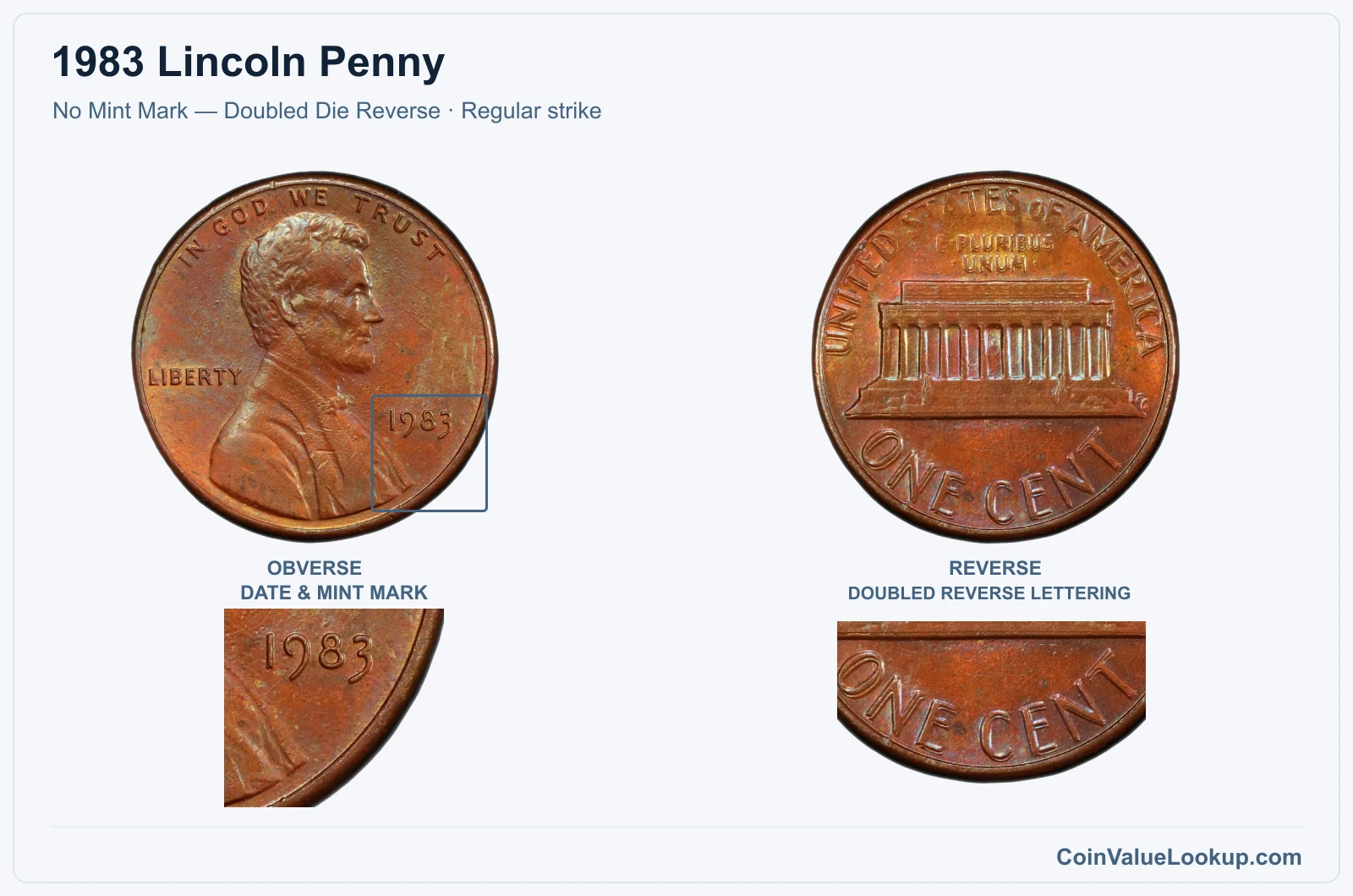
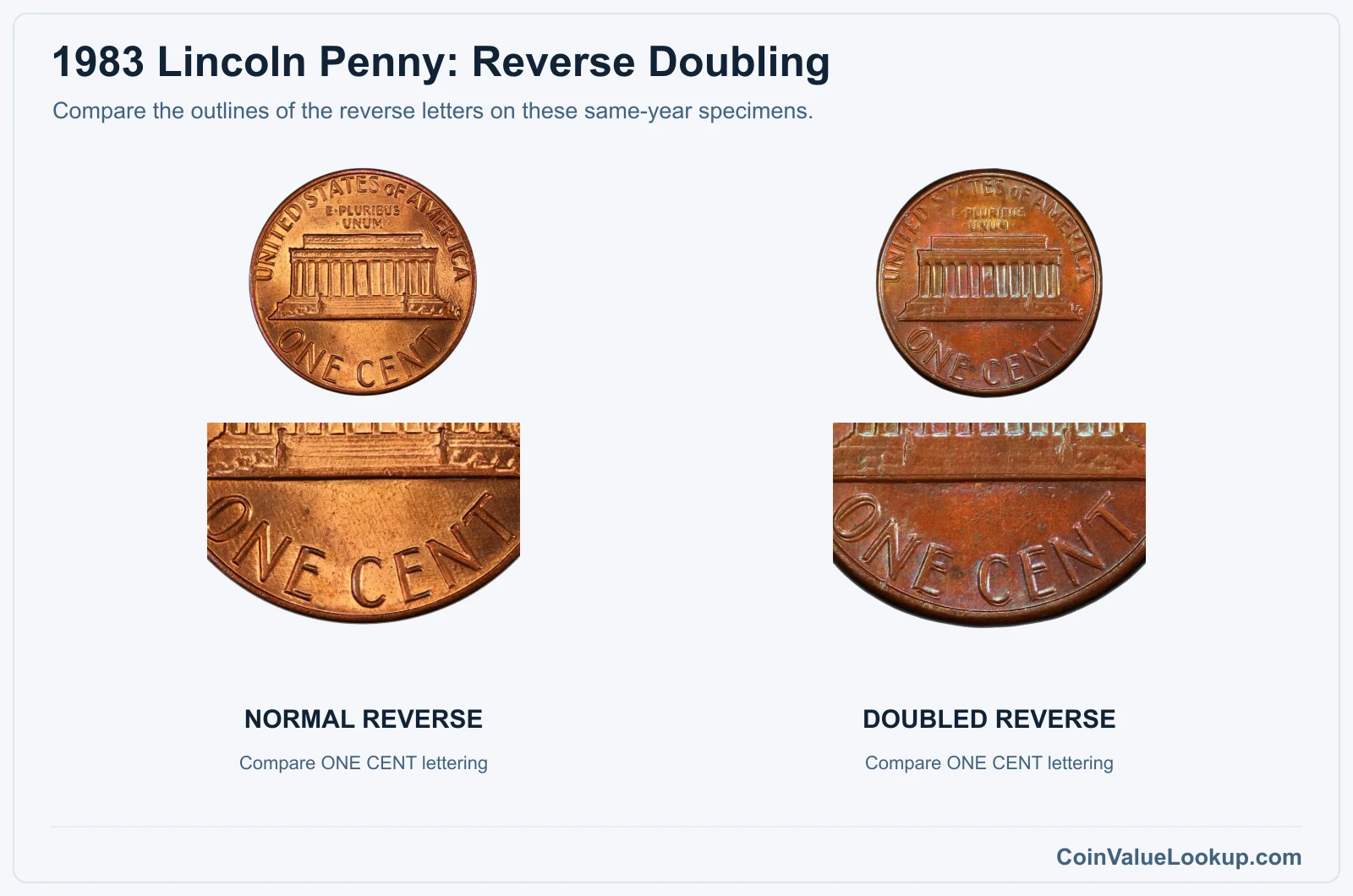
This is the one that gets collectors' attention. The 1983 doubled die reverse is a Philadelphia (no mintmark) business strike with prominent doubling visible on the reverse lettering — particularly ONE CENT, E PLURIBUS UNUM and UNITED STATES OF AMERICA.
The letters show clear raised separation, not flat shelf-like distortion.
The USA Coin Book guide estimate for this variety at MS65 is $468, though the color designation is not specified in that estimate. PCGS catalogs this variety with separate BN, RB and RD color entries, and the difference between brown and full red can be significant.
You need to confirm the exact variety match and the color before assuming a specific value.
Do not confuse machine doubling — which produces flat, shelf-like shadows — with the genuine raised separation of this doubled die. The real DDR shows consistent doubling across multiple reverse elements.
Range Grade
Price1983 No Mint Mark — Doubled Die Reverse (BN) Price1983 No Mint Mark — Doubled Die Reverse (RB) Price1983 No Mint Mark — Doubled Die Reverse (RD) Auction Records Appraisal PO PO 1
—
Coin Identifier FR FR 2
—
Coin Identifier AG AG 3
—
Coin Identifier G G 4
—
Coin Identifier
G 6
—
Coin Identifier VG VG 8
—
Coin Identifier
VG 10
—
Coin Identifier F F 12
—
Coin Identifier
F 15
—
Coin Identifier VF VF 20
—
Coin Identifier
VF 25
—
Coin Identifier
VF 30
—
Coin Identifier
VF 35
—
Coin Identifier XF XF 40
—
Coin Identifier
XF 45
—
Coin Identifier AU AU 50
—
Coin Identifier
AU 53
—
Coin Identifier
AU 55
—
Coin Identifier
AU 58
Coin Identifier MS MS 60
Coin Identifier
MS 61
—
Coin Identifier
MS 62
Coin Identifier
MS 63
Coin Identifier
MS 64
Coin Identifier
MS 65
Coin Identifier
MS 66
Coin Identifier
MS 67
Coin Identifier
MS 68
—
—
Coin Identifier
MS 69
—
—
—
—
—
MS 70
—
—
—
—
—
1983 Lincoln Penny Error List
1. 1983 Lincoln Penny — Doubled Die Reverse
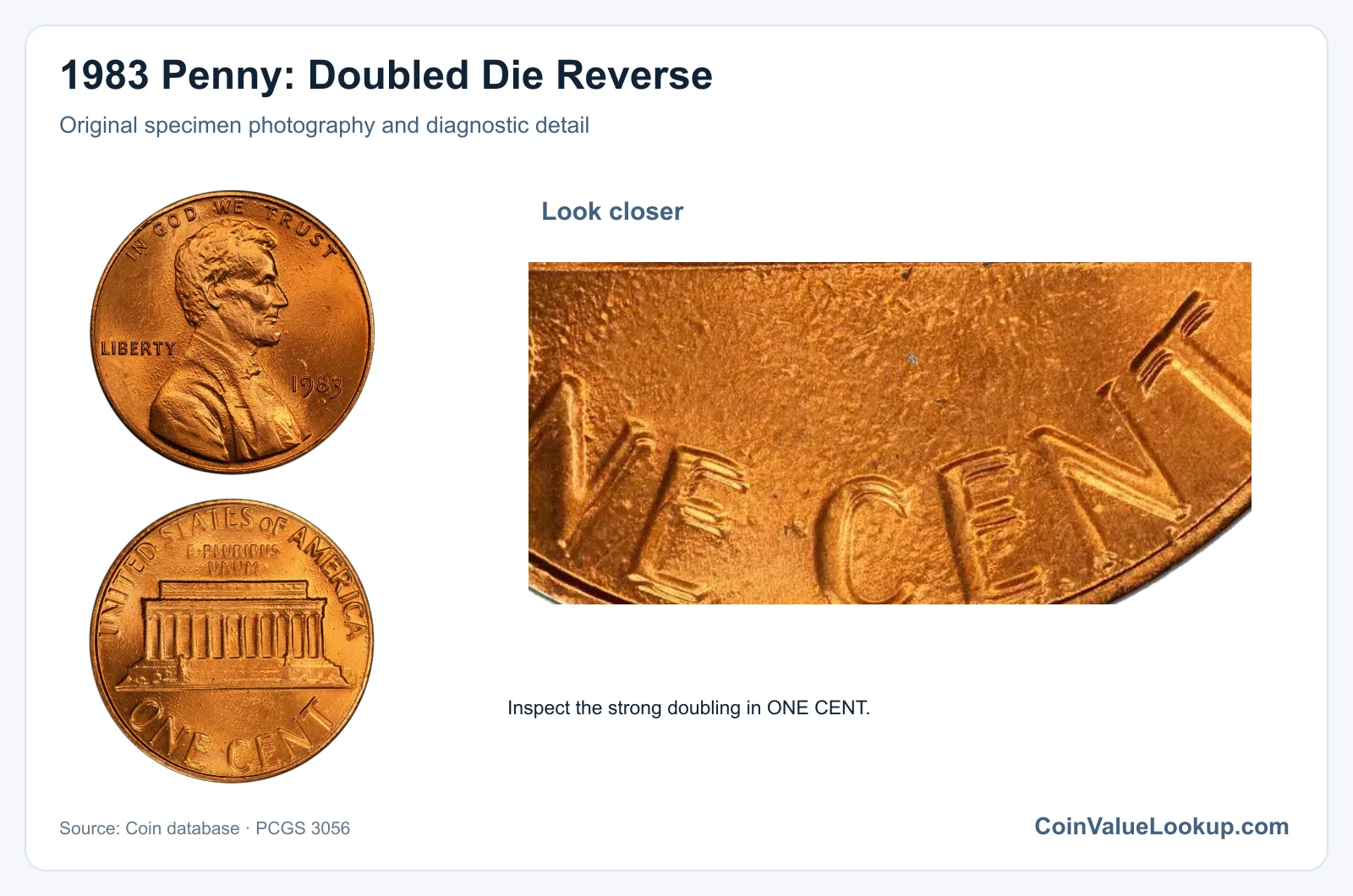
The 1983 doubled die reverse is the marquee variety for this year. Look at the reverse lettering: ONE CENT, E PLURIBUS UNUM and UNITED should show strong, raised separation — almost like each letter has a ghost beside it.
This affects no-mintmark (Philadelphia) business strikes.
The USA Coin Book guide estimate at MS65 is $468, with color unspecified. Real-world value depends on whether the coin grades BN, RB or RD, and the sharpness of the doubling.
The biggest trap is machine doubling, which leaves flat, shelf-like distortion rather than the raised, well-defined separation of a genuine doubled die. Plating distortion can also mimic doubling.
Compare your coin's reverse letters carefully against a known normal example under good light before getting excited.
2. 1983 Lincoln Penny — Bronze Transitional Planchet
In 1983 the Mint switched from solid bronze planchets to copper-plated zinc. A handful of cents were apparently struck on leftover bronze blanks from the previous composition.
These weigh approximately 3.1 grams instead of the normal 2.50 grams — that weight difference is the first screening tool.
One example graded NGC MS61 RB sold for $4,800 at Heritage Auctions in January 2020. That is a single recorded sale, not a broad market range.
A copper-colored 1983 penny is not automatically a bronze error. Normal zinc cents have copper plating that looks identical to the naked eye.
You need a calibrated scale showing a weight near 3.11 grams, and then professional authentication. Altered dates from other years and inaccurate kitchen scales account for most false alarms.
3. 1983 Lincoln Penny — Off-Center Strike
An off-center strike happens when the planchet is not properly seated between the dies. The result is a crescent-shaped blank area on one side, with the design shifted away from center.
The key for value is retaining a readable date.
One 1983 cent struck 35% off center, graded ANACS MS63 Red, sold for $134 at Heritage Auctions in March 2026. The percentage and condition both matter — a 5% misalignment is far less dramatic than 35%.
Do not confuse a slightly uneven rim from a misaligned die with a true off-center strike. A misaligned die shifts the design slightly but the planchet is still fully struck.
A genuine off-center error leaves part of the planchet completely blank.
4. 1983 Lincoln Penny — Struck Through a Capped Die
A capped die error occurs when a previously struck coin sticks to the upper die and then acts as a barrier for subsequent strikes. The result is a coin with one side showing a weak, distorted, spread-out impression while the opposite side retains relatively normal detail.
One 1983 capped die cent has been recorded graded ANACS MS62 Red, though no specific sale price was adopted from available data. Value depends on the severity of the cap impression, the sharpness of the unaffected side and the authenticated identity of the error.
Look-alikes include ordinary heavy wear, grease-filled dies that obscure letters, or coins that have been ground or chemically altered. A genuine capped die strike has a distinctive mushroomed or spread appearance that differs from simple detail loss.
5. 1983 Lincoln Penny — Doubled Die Obverse
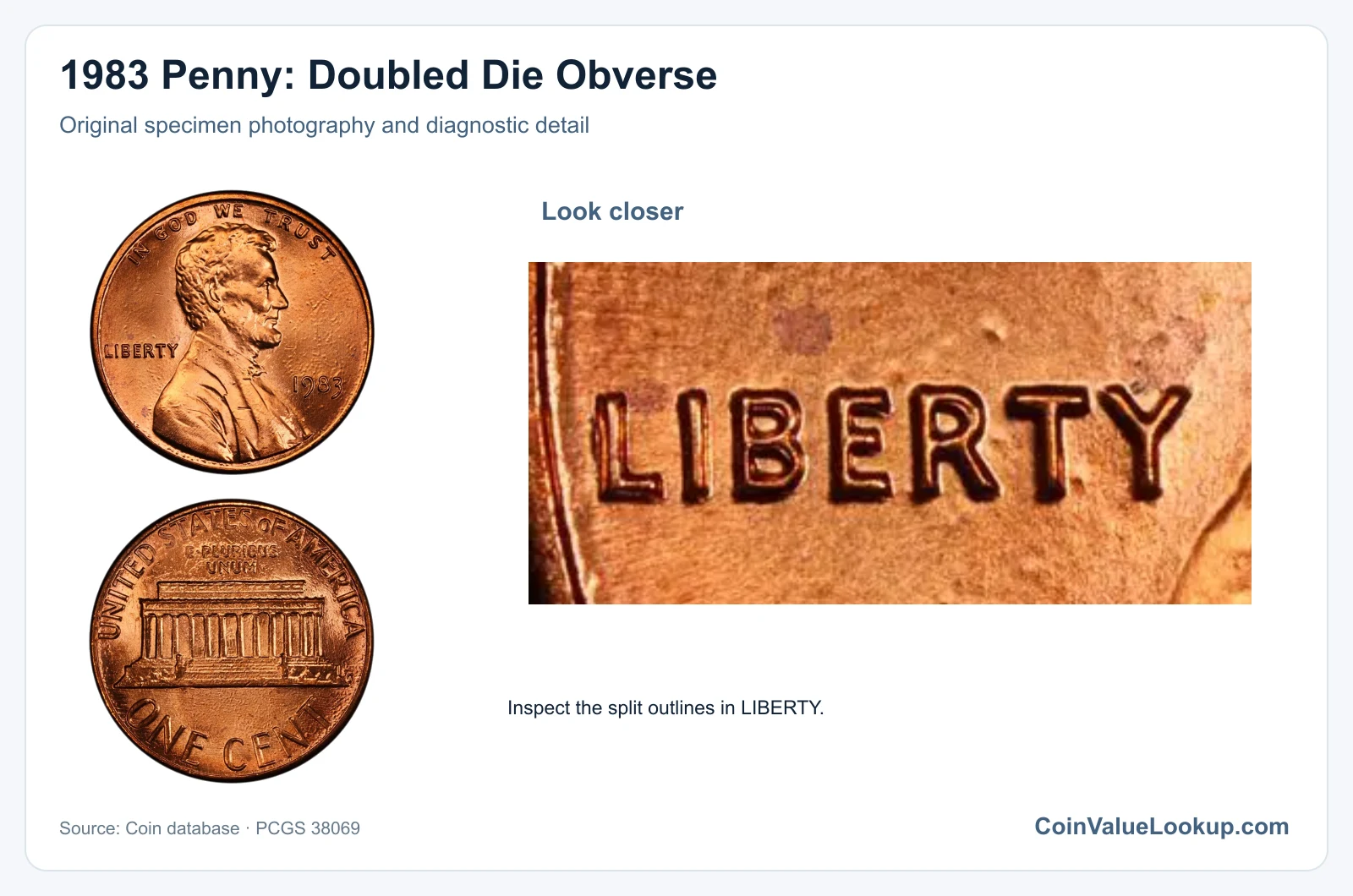
A doubled die obverse on a 1983 cent would show consistent separation or notching on obverse design elements — the date, lettering, or Lincoln's profile. This category has been reported for the 1983 cent in collector references.
The key diagnostic is consistent raised doubling across multiple features on the same side, visible under magnification. Machine doubling produces flat, shelf-like shelves that lack the sharp, raised profile of a genuine doubled die.
Reflections and worn die contours can also trick the eye.
No specific price data was adopted for this category, so value depends on the individual coin's condition, the strength of the doubling, and professional assessment. If you suspect a doubled die obverse, compare your coin's obverse lettering and profile against a confirmed normal example under stable lighting.
6. 1983 Lincoln Penny — Die Break / Cud
A die break or cud appears when a piece of the die cracks or falls away. On the coin, this leaves a raised blob of metal.
A true cud specifically connects to the rim, while interior die breaks sit away from it. Either way, you are looking at a lump where design detail should be.
This error type has been reported for 1983 Lincoln cents. The size and location of the break affect desirability — a large rim cud displacing part of the date or a major design element draws more interest than a tiny edge chip.
No specific price range is available for this variety. Value is determined by the individual coin's condition, the prominence of the break and collector demand.
Do not confuse a rim dent, edge corrosion or a small interior die chip with a significant cud error.
7. 1983 Lincoln Penny — Clipped Planchet
A clipped planchet error means the blank was incomplete before striking — a curved, straight or irregular portion is simply missing. This happens during the blanking process when the strip feeds incorrectly and the punch overlaps a previously cut hole.
Look for a characteristic weakness in the design opposite the clip, sometimes called the Blakesley effect, where metal did not fully flow into the die. The edge at the clip should show the natural metal texture of the original strip, not a sharp cut or file marks.
This error type has been reported for 1983 cents. No adopted price range is available, so each coin must be evaluated individually based on the size of the missing area, overall condition and how much of the date remains visible.
Post-mint damage like filed edges or corrosion can mimic a clip but lacks the telltale opposite-side weakness.