1879 Shield Nickel Coin Value: How Much Is It Worth?
The 1879 Shield Nickel is a coin that commands attention because so few business strikes were made. Guide estimates from USA Coin Book place an ordinary circulation strike around $527 in G4 (a well-worn but identifiable grade) up to roughly $2,768 in MS63 (a lightly marked uncirculated piece).
Proof examples carry a PR63 anchor near $468, while the recognized 1879/8 overdate proof sits closer to $612 in PR63. These are retail guide estimates, not guaranteed sale prices.
Fast Way to Identify Your 1879 Shield Nickel
Want a quick read on what you have? Upload clear photos of the front and back of your 1879 Shield Nickel, and our identifier can offer a preliminary take on the version and condition.
It is not a substitute for professional authentication or certified grading, but it is a solid starting point before you dig deeper.
1879 Shield Nickel Value
Upload both sides of your 1879 Shield Nickel.
Front Obverse
Upload photo
Back Reverse
Upload photo
Which 1879 Shield Nickel Versions Are Worth Money?
- The 1879 business strike is scarce because circulation production had just resumed after two proof-only years, making even worn examples worth checking.
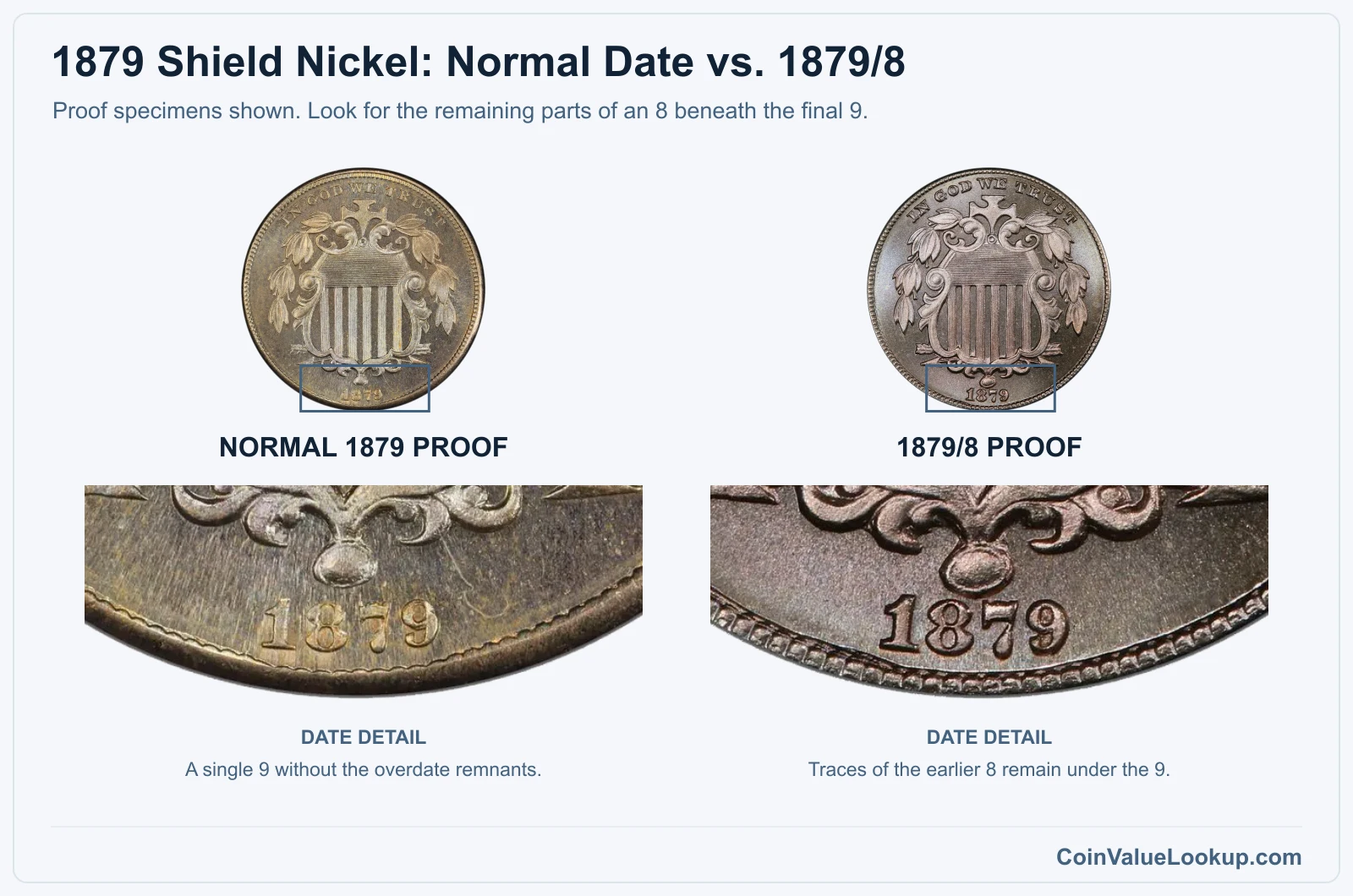
- The 1879/8 overdate proof shows remnants of an 8 beneath the final 9 in the date, and its PR63 guide estimate of $612 exceeds the normal proof's $468 anchor at the same grade.
- Standard 1879 proofs are collectible in their own right; correct identification of proof surfaces versus business-strike luster is essential to proper valuation.
Step 1: Identify Your 1879 Shield Nickel Mint Mark and Version
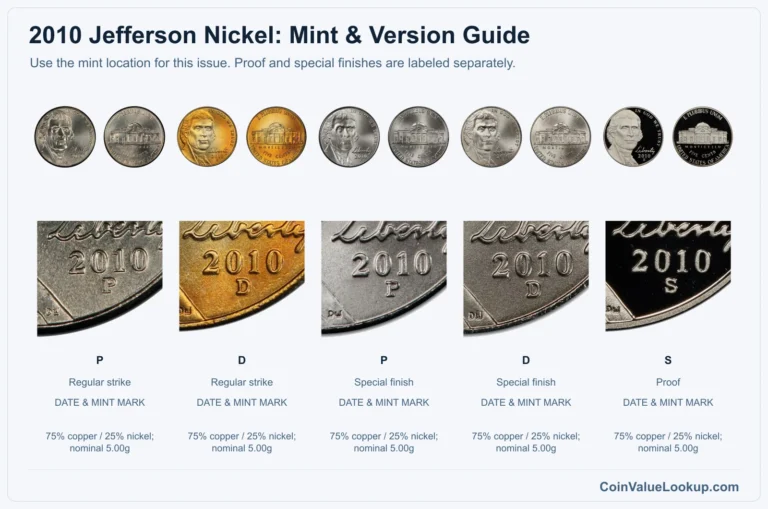
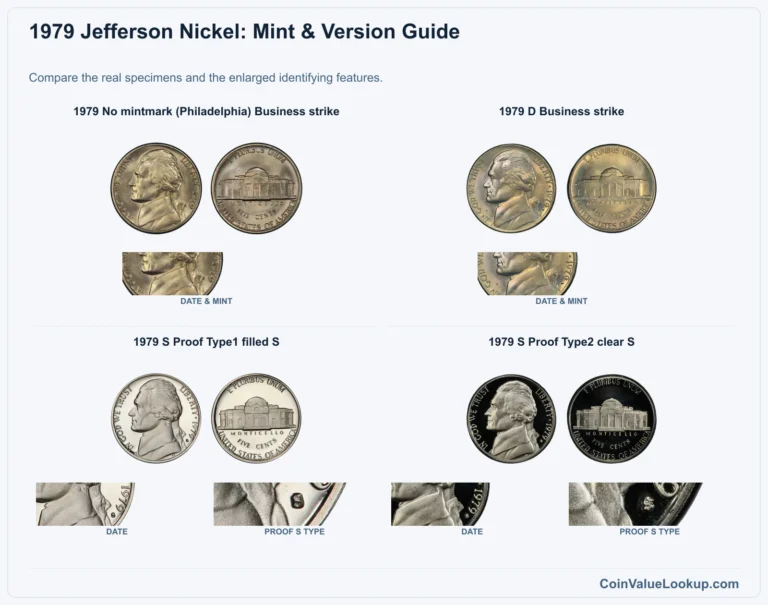
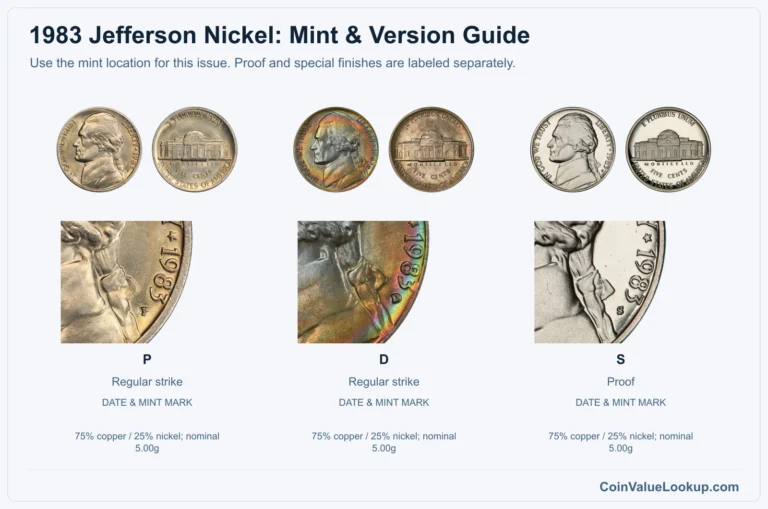
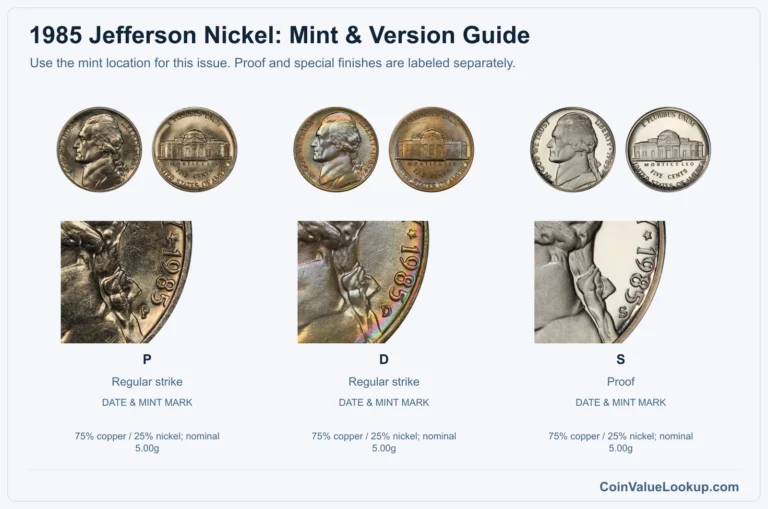
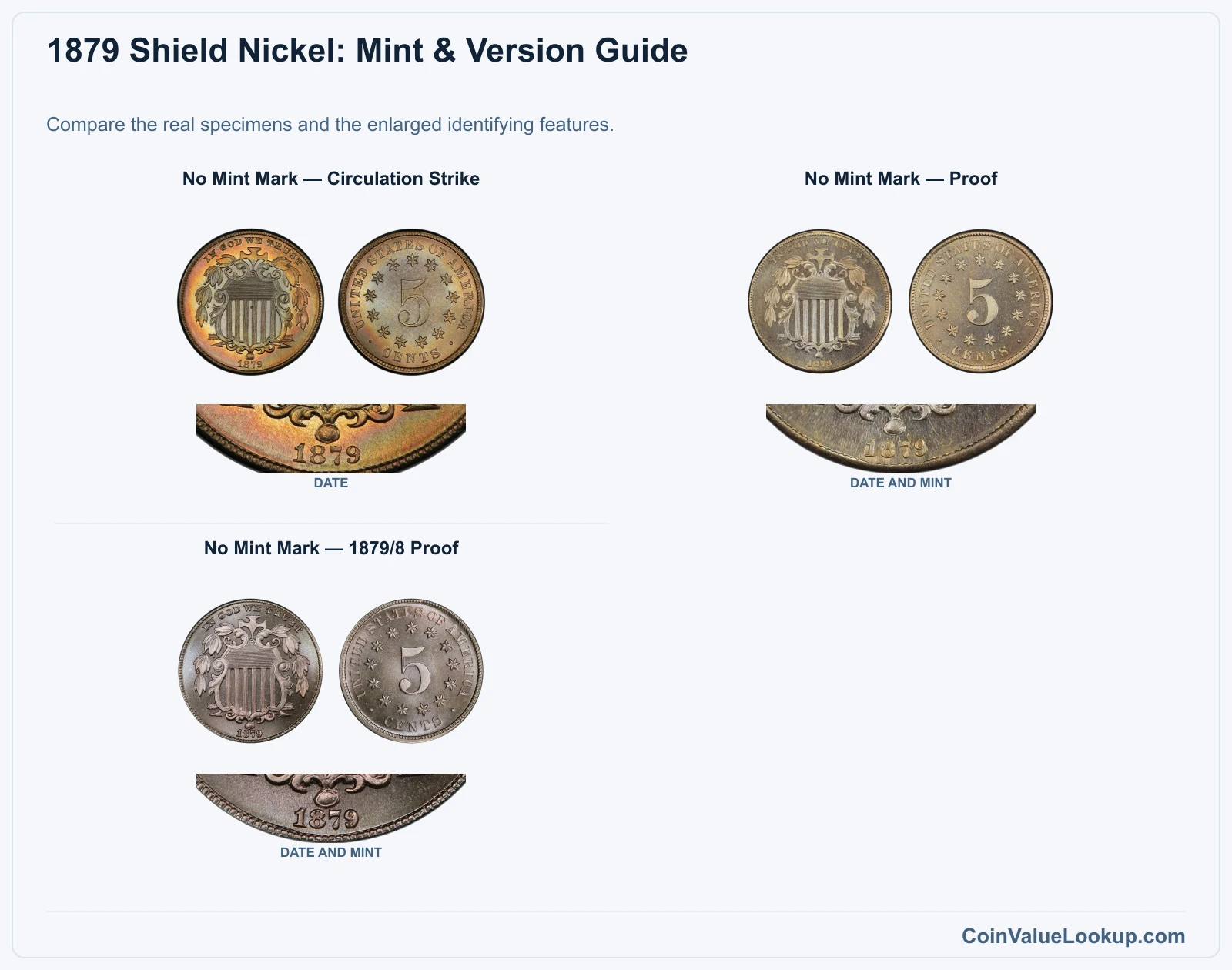
Every 1879 Shield Nickel was struck at the Philadelphia Mint. There is no mintmark, and the absence of a mint letter is completely normal for this issue.
The coin is copper-nickel, 75% copper and 25% nickel, weighing about 5 grams with a 20.5 mm diameter and a plain edge. There is no silver version.
All 1879 nickels use the "No Rays" design, the reverse style adopted after the first year of the series.
Three distinct branches exist for this date. First is the scarce business strike, made in small numbers when circulation production resumed after two proof-only years (1877 and 1878).
Second is the standard proof. Third is the 1879/8 overdate proof, which shows traces of an underlying 8 beneath the final 9 in the date.
Telling these apart matters because they carry different values.
To separate a proof from a business strike, look at the fields (flat areas) on both sides. Proofs typically show mirror-like surfaces and sharper design edges than business strikes, which tend to have a satiny or slightly grainy luster.
This distinction can be tricky on Shield Nickels, so compare both faces carefully before deciding.
Step 2: Check Your 1879 Shield Nickel Grade
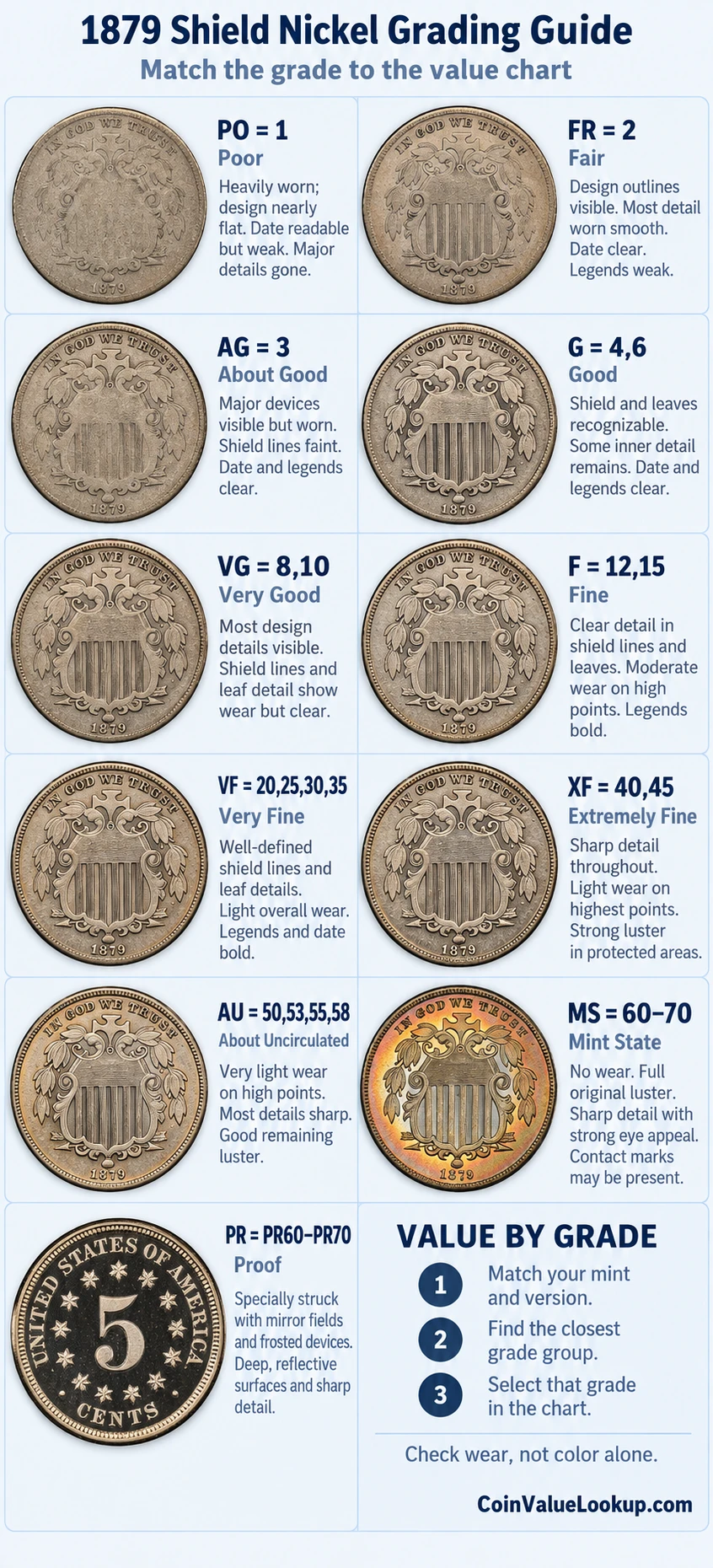
Start by examining the shield on the obverse. The horizontal and vertical lines within the shield are the first details to soften with wear, so a coin missing those fine lines has seen real circulation.
Check the cross at the top of the shield and the surrounding leaves as well.
Weak strikes are common on Shield Nickels, and a poorly struck coin can look worn even when it is not. If the high points are soft but the fields still show original luster, you may have a weakly struck uncirculated piece rather than a circulated one.
For proofs, grading hinges on the preservation of those mirror fields. Light hairlines from old cleaning or improper storage will lower the grade.
Heavy hairlines or obvious cleaning move the coin into a different valuation tier entirely.
Use the comparison image to match your coin's wear pattern against known grade benchmarks. Pay attention to the overall sharpness of the motto and stars on the obverse, and the numeral and wreath details on the reverse.
A side-by-side look beats guessing every time.
Step 3: Check 1879 Shield Nickel Value by Mint and Version
1879 Shield Nickel — No Mint Mark — Circulation Strike
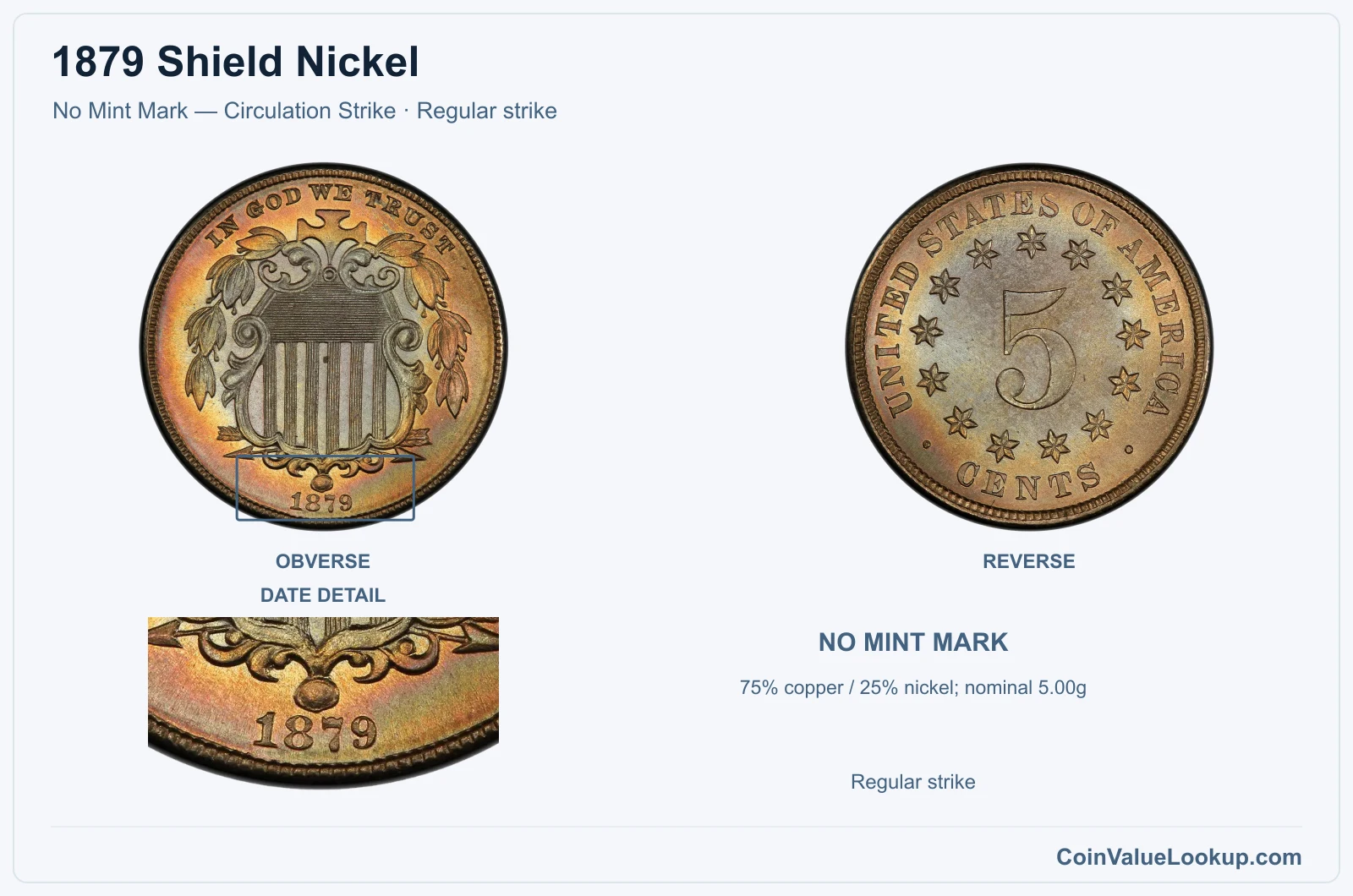
This is the business-strike version, struck for circulation at Philadelphia with no mintmark. Production was tiny because the Mint had made only proofs in 1877 and 1878, then resumed regular coinage in limited quantities for 1879.
That low mintage is the main reason even a well-worn G4 example carries a guide estimate around $527.
At MS63, the USA Coin Book estimate jumps to roughly $2,768. Original, unimpaired luster is the key at that level.
Look for satiny or slightly frosty surfaces across both faces rather than the mirror fields you would see on a proof.
Range Grade
Price Auction Records Appraisal PO PO 1
—
Coin Identifier FR FR 2
—
Coin Identifier AG AG 3
Coin Identifier G G 4
Coin Identifier
G 6
Coin Identifier VG VG 8
Coin Identifier
VG 10
Coin Identifier F F 12
Coin Identifier
F 15
—
Coin Identifier VF VF 20
Coin Identifier
VF 25
Coin Identifier
VF 30
Coin Identifier
VF 35
Coin Identifier XF XF 40
Coin Identifier
XF 45
Coin Identifier AU AU 50
Coin Identifier
AU 53
—
Coin Identifier
AU 55
Coin Identifier
AU 58
Coin Identifier MS MS 60
—
Coin Identifier
MS 61
—
Coin Identifier
MS 62
Coin Identifier
MS 63
Coin Identifier
MS 64
Coin Identifier
MS 65
Coin Identifier
MS 66
Coin Identifier
MS 67
Coin Identifier
MS 68
—
—
—
MS 69
—
—
—
MS 70
—
—
—
1879 Shield Nickel — No Mint Mark — Proof
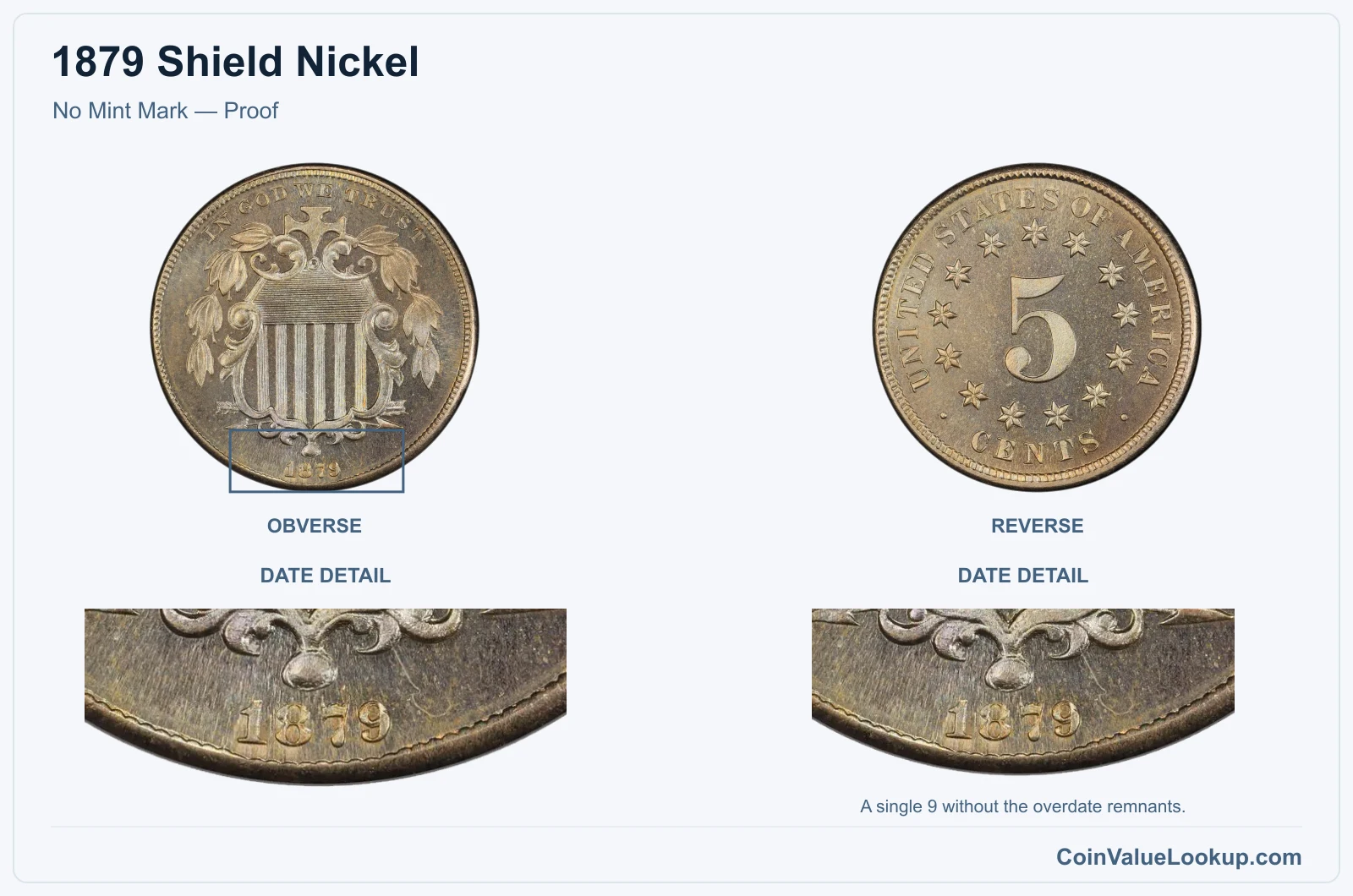
The standard proof was a deliberate collector product from the Philadelphia Mint. Both faces should show mirror-like fields, and the design elements will appear sharp-edged rather than softly rounded.
A PR63 guide estimate sits around $468. When examining a suspected proof, inspect the rims for squared-off edges and look for any die polish lines in the fields.
Cameo contrast, where frosted devices stand against mirrored fields, is a separate designation concern and does not change the base proof identity.
Coin Value Lookup is a handy starting point if you want to compare this proof's value against other Shield Nickel dates or other denominations in your collection.
Range Grade
Price Auction Records Appraisal PR PR 1
—
Coin Identifier
PR 2
—
Coin Identifier
PR 3
—
Coin Identifier
PR 4
—
Coin Identifier
PR 6
—
Coin Identifier
PR 8
—
Coin Identifier
PR 10
—
Coin Identifier
PR 12
—
Coin Identifier
PR 15
—
Coin Identifier
PR 20
—
Coin Identifier
PR 25
—
Coin Identifier
PR 30
—
Coin Identifier
PR 35
—
Coin Identifier
PR 40
—
Coin Identifier
PR 45
Coin Identifier
PR 50
—
Coin Identifier
PR 53
—
Coin Identifier
PR 55
Coin Identifier
PR 58
Coin Identifier
PR 60
—
Coin Identifier
PR 61
Coin Identifier
PR 62
Coin Identifier
PR 63
Coin Identifier
PR 64
Coin Identifier
PR 65
Coin Identifier
PR 66
Coin Identifier
PR 67
Coin Identifier
PR 68
—
—
—
PR 69
—
—
—
PR 70
—
—
—
1879 Shield Nickel — No Mint Mark — 1879/8 Proof
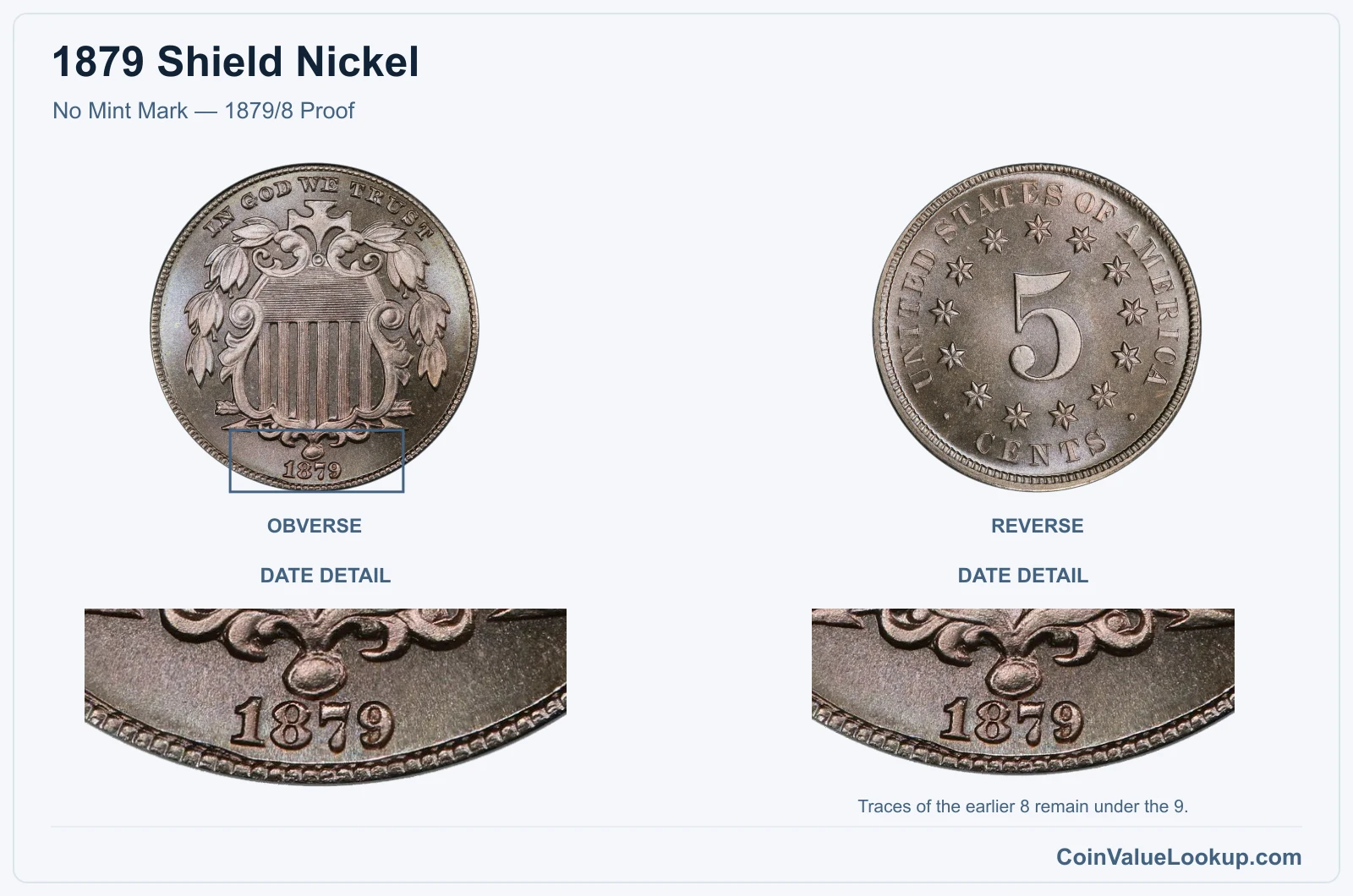
This is the recognized 1879/8 overdate, and it exists only as a proof. The die was originally dated 1878, then re-engraved with a 9 over the 8.
Under magnification, you can see remnants of the underlying 8 peeking out beneath and around the final 9.
Do not confuse ordinary repunched-date marks with the overdate. The 1879/8 shows a distinctly different numeral, an 8, not just a misaligned second impression of the 9.
A loupe at 5x or higher makes the difference clear.
The PR63 guide estimate is approximately $612, a noticeable step above the normal proof's $468 at the same grade. That premium reflects the variety's specialist appeal and its status as a recognized die variety confirmed by major references.
Range Grade
Price Auction Records Appraisal PR PR 1
—
Coin Identifier
PR 2
—
Coin Identifier
PR 3
—
Coin Identifier
PR 4
—
Coin Identifier
PR 35
—
Coin Identifier
PR 40
—
Coin Identifier
PR 45
—
Coin Identifier
PR 50
—
Coin Identifier
PR 53
—
Coin Identifier
PR 55
—
Coin Identifier
PR 58
Coin Identifier
PR 60
—
Coin Identifier
PR 61
—
Coin Identifier
PR 62
Coin Identifier
PR 63
Coin Identifier
PR 64
Coin Identifier
PR 65
Coin Identifier
PR 66
Coin Identifier
PR 67
Coin Identifier
PR 68
Coin Identifier
PR 69
Coin Identifier
PR 70
—
—
—
1879 Shield Nickel Error List
1. 1879 Shield Nickel — Repunched Date
A repunched date on the 1879 Shield Nickel occurs when the date numerals were punched into the die more than once, leaving secondary impressions slightly offset from the final digits. Under magnification, you may spot faint remnants of a shifted numeral sitting just beside or beneath one or more digits of the date.
This is distinct from the 1879/8 overdate proof, which shows a completely different underlying numeral. With a repunched date, the secondary image is still a 9 (or another digit of the same date), just misaligned.
It is also distinct from machine doubling, which produces flat, shelf-like distortion rather than a rounded secondary impression, and from post-strike damage that leaves irregular marks.
Repunched dates on 1879 nickels have been noted on proof specimens. No specific retail price range is adopted for this variety, because value depends on the visibility of the repunching, the coin's overall condition, and collector demand for that particular die state.
Professional evaluation is worthwhile if you spot clear secondary date remnants.