1985 Jefferson Nickel Coin Value: How Much Is It Worth?
Most 1985 Jefferson nickels you pull from a jar are worth face value, plain and simple. Unworn examples graded MS60 to MS65 show guide estimates of roughly $0.61 to $3.62, depending on grade.
S-mint proofs and authenticated mint errors occupy their own separate markets. Guide estimates reflect retail reference points at specific grades, not guaranteed cash offers for any circulated piece you happen to find.
Fast Way to Identify Your 1985 Jefferson Nickel
Snap a clear photo of the front and back of your 1985 nickel, making sure the mintmark area below the date is in focus. Upload both images here for a preliminary identification of the mint, finish, and general condition.
This is not a substitute for professional authentication, but it gives you a solid starting point before deciding your next step.
1985 Jefferson Nickel Value
Upload both sides of your 1985 Jefferson Nickel.
Front Obverse
Upload photo
Back Reverse
Upload photo
Which 1985 Jefferson Nickel Versions Are Worth Money?
- Uncirculated 1985-P and 1985-D nickels in MS65 grade carry a guide estimate around $3.62, with Full Steps designation requiring separate evaluation.
- 1985-S proofs are collector-only strikes; a PR65 example has a guide estimate near $3.62, with cameo contrast graded separately.
- A confirmed 1985-P obverse die cap sold at Heritage Auctions in October 2010 for $1,265 (NGC MS68).
- A 1985-D nickel indented by a dime blank realized $1,092.50 at Heritage Auctions in August 2010 (NGC AU58).
- Authenticated striking errors such as off-center strikes, broadstrikes, and wrong-planchet errors have individual collector markets based on severity and condition.
Step 1: Identify Your 1985 Jefferson Nickel Mint Mark and Version
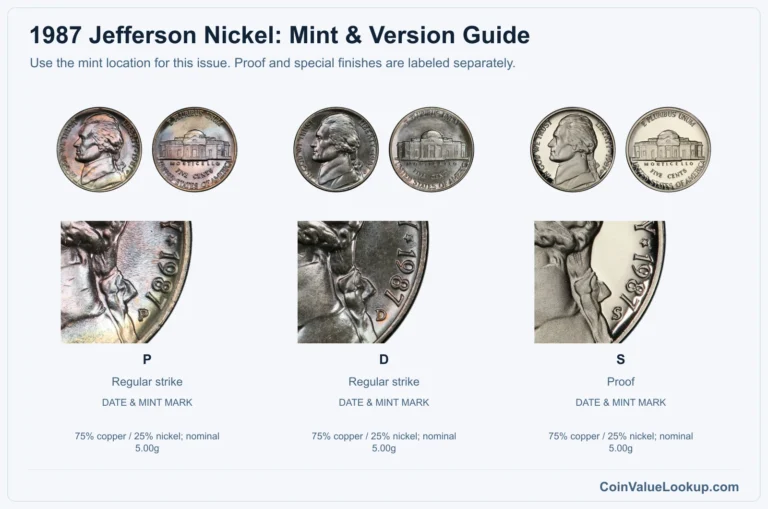
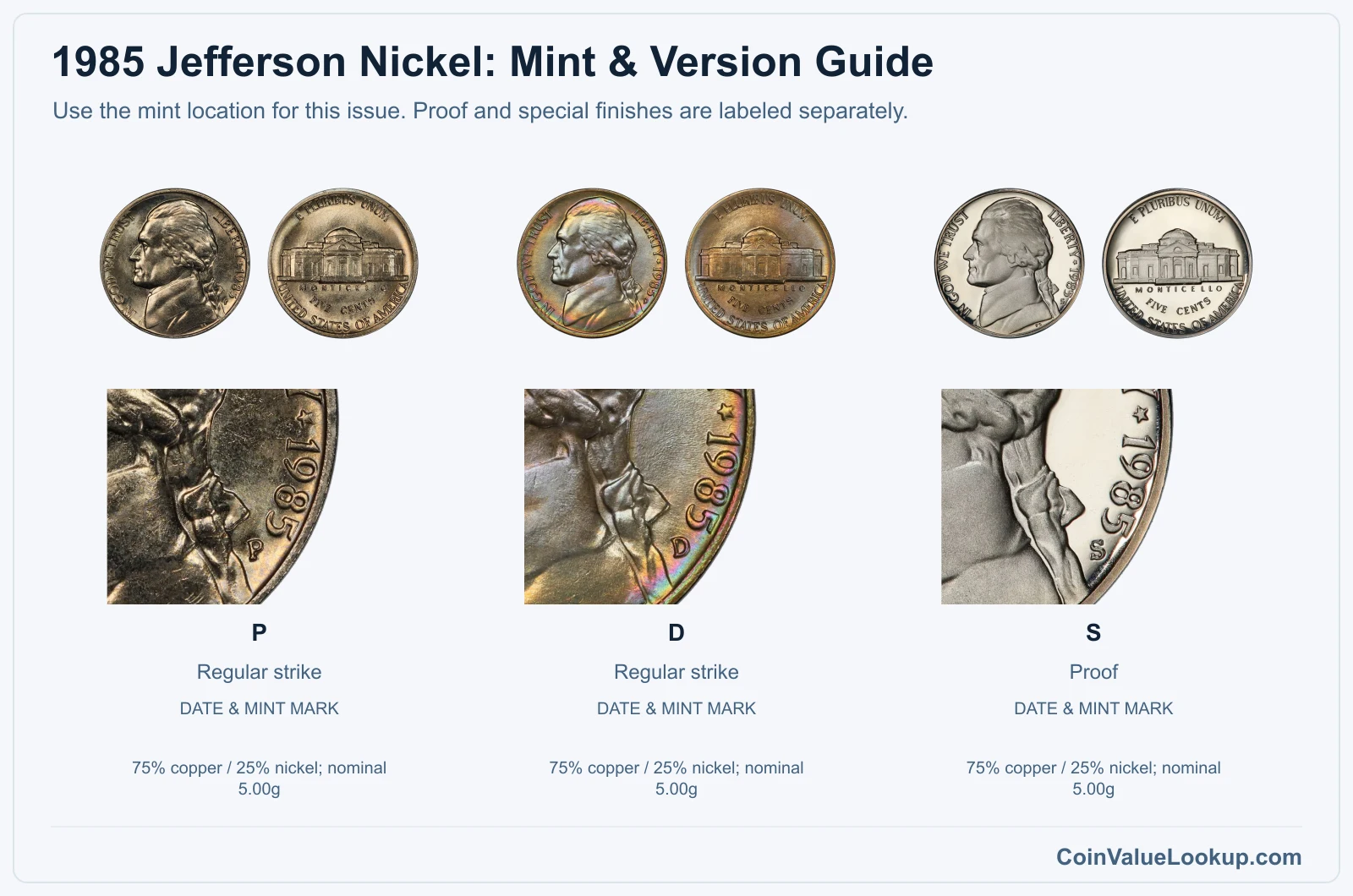
Three versions of the 1985 Jefferson nickel exist: the Philadelphia (P) business strike, the Denver (D) business strike, and the San Francisco (S) proof. The mintmark sits on the obverse, just to the right of and below the date.
Look for a small "P" or "D" on your coin; if you see an "S," you have a proof strike, which was sold in collector sets and has a mirror-like surface.
All three share the same alloy: 75% copper and 25% nickel, weighing about 5 grams with a 21.2 mm diameter and a plain edge. Do not confuse this composition with a clad sandwich structure.
A missing or weak mintmark letter does not mean you have a valuable variety; damage and wear can obscure it.
Before checking any price chart, confirm which mint produced your coin and whether the finish is a normal business strike or a proof. That single step filters out most confusion.
Step 2: Check Your 1985 Jefferson Nickel Grade
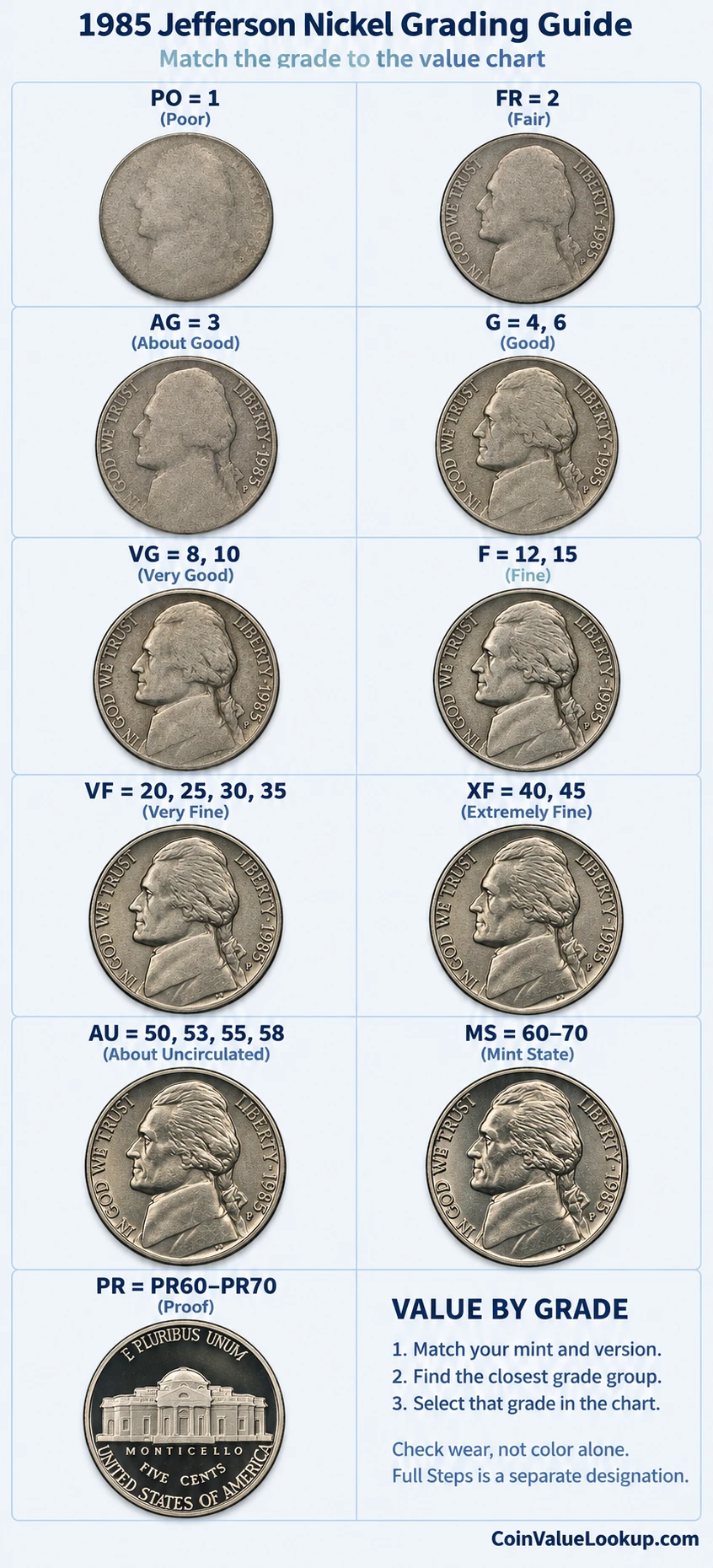
Start with Jefferson's cheekbone and the hair detail above his ear. On a well-circulated coin, these high points flatten first and the original mint luster disappears.
Compare your coin to the reference image to see how much relief remains.
Monticello on the reverse provides a second checkpoint. The roof lines, pillars, and the steps at the base all lose sharpness with wear.
Sharp, uninterrupted steps can indicate strong strike quality rather than low wear, so don't confuse strike strength with grade.
Full Steps is a designation applied to Mint State business strikes where the step lines on Monticello are complete and unbroken. It is not an error.
Proof coins are graded on their own scale and may carry cameo or deep cameo contrast designations, which are separate from the numeric proof grade.
Step 3: Check 1985 Jefferson Nickel Value by Mint and Version
1985 Jefferson Nickel — P Business strike
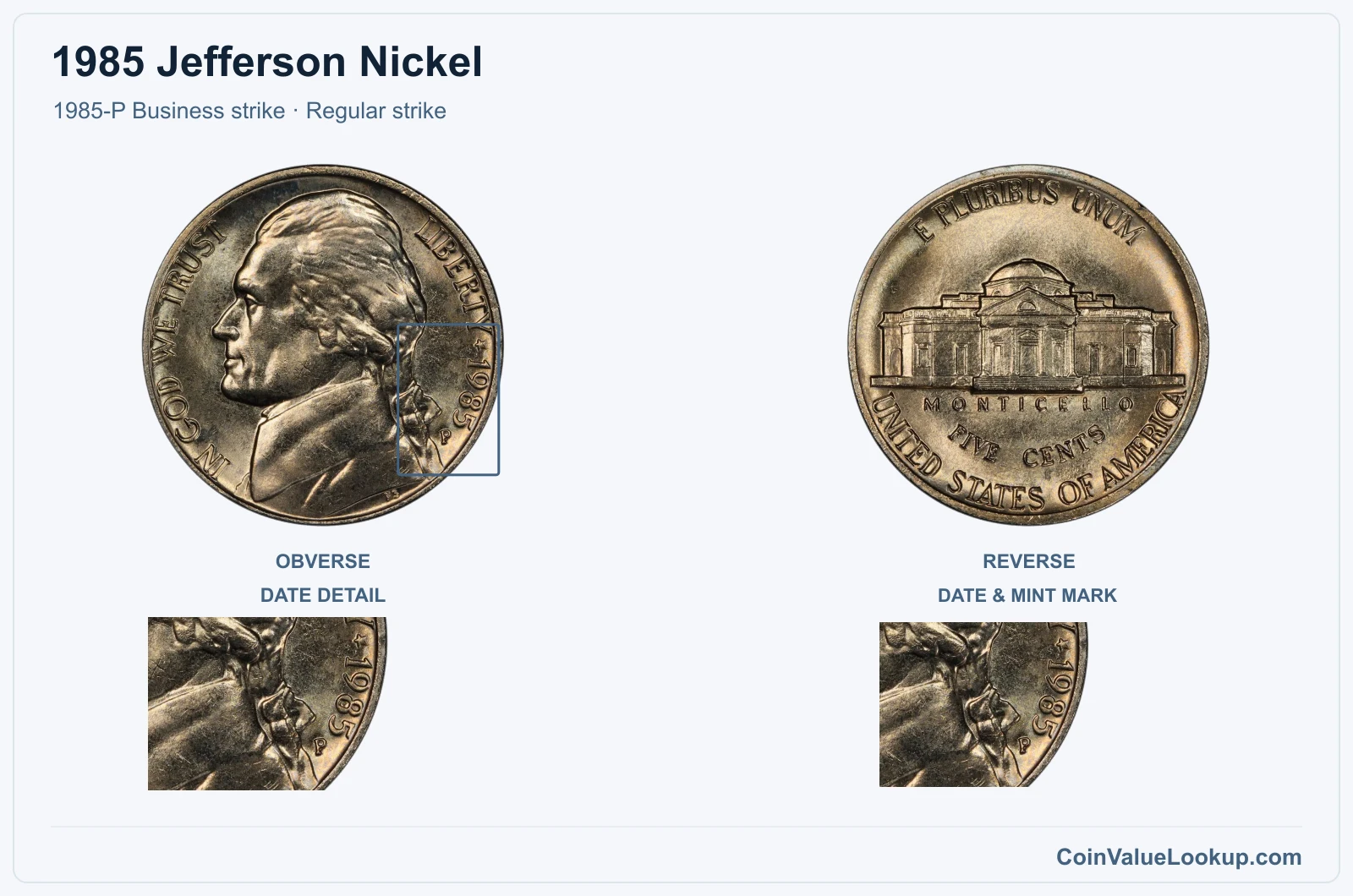
The 1985-P is a standard business strike from the Philadelphia Mint. It carries a small "P" mintmark on the obverse below the date.
The alloy is 75% copper and 25% nickel, 5 grams, with a plain edge. There is no silver collector branch for this year.
Guide estimates from USA Coin Book place the 1985-P at about $0.61 in MS60 and $3.62 in MS65. Circulated examples are generally worth face value.
Coins with the Full Steps designation may command different premiums, but that requires separate certified evaluation.
| Range | Grade | Price | Auction Records | Appraisal |
|---|---|---|---|---|
| PO | PO 1 | — | Coin Identifier | |
| FR | FR 2 | — | Coin Identifier | |
| AG | AG 3 | — | Coin Identifier | |
| G | G 4 | — | Coin Identifier | |
| G 6 | — | Coin Identifier | ||
| VG | VG 8 | — | Coin Identifier | |
| VG 10 | — | Coin Identifier | ||
| F | F 12 | — | Coin Identifier | |
| F 15 | — | Coin Identifier | ||
| VF | VF 20 | — | Coin Identifier | |
| VF 25 | — | Coin Identifier | ||
| VF 30 | — | Coin Identifier | ||
| VF 35 | — | Coin Identifier | ||
| XF | XF 40 | — | Coin Identifier | |
| XF 45 | — | Coin Identifier | ||
| AU | AU 50 | — | Coin Identifier | |
| AU 53 | — | Coin Identifier | ||
| AU 55 | — | Coin Identifier | ||
| AU 58 | — | Coin Identifier | ||
| MS | MS 60 | — | Coin Identifier | |
| MS 61 | — | Coin Identifier | ||
| MS 62 | Coin Identifier | |||
| MS 63 | — | Coin Identifier | ||
| MS 64 | — | Coin Identifier | ||
| MS 65 | Coin Identifier | |||
| MS 66 | Coin Identifier | |||
| MS 67 | — | — | — | |
| MS 68 | — | — | — | |
| MS 69 | — | — | — | |
| MS 70 | — | — | — |
1985 Jefferson Nickel — D Business strike
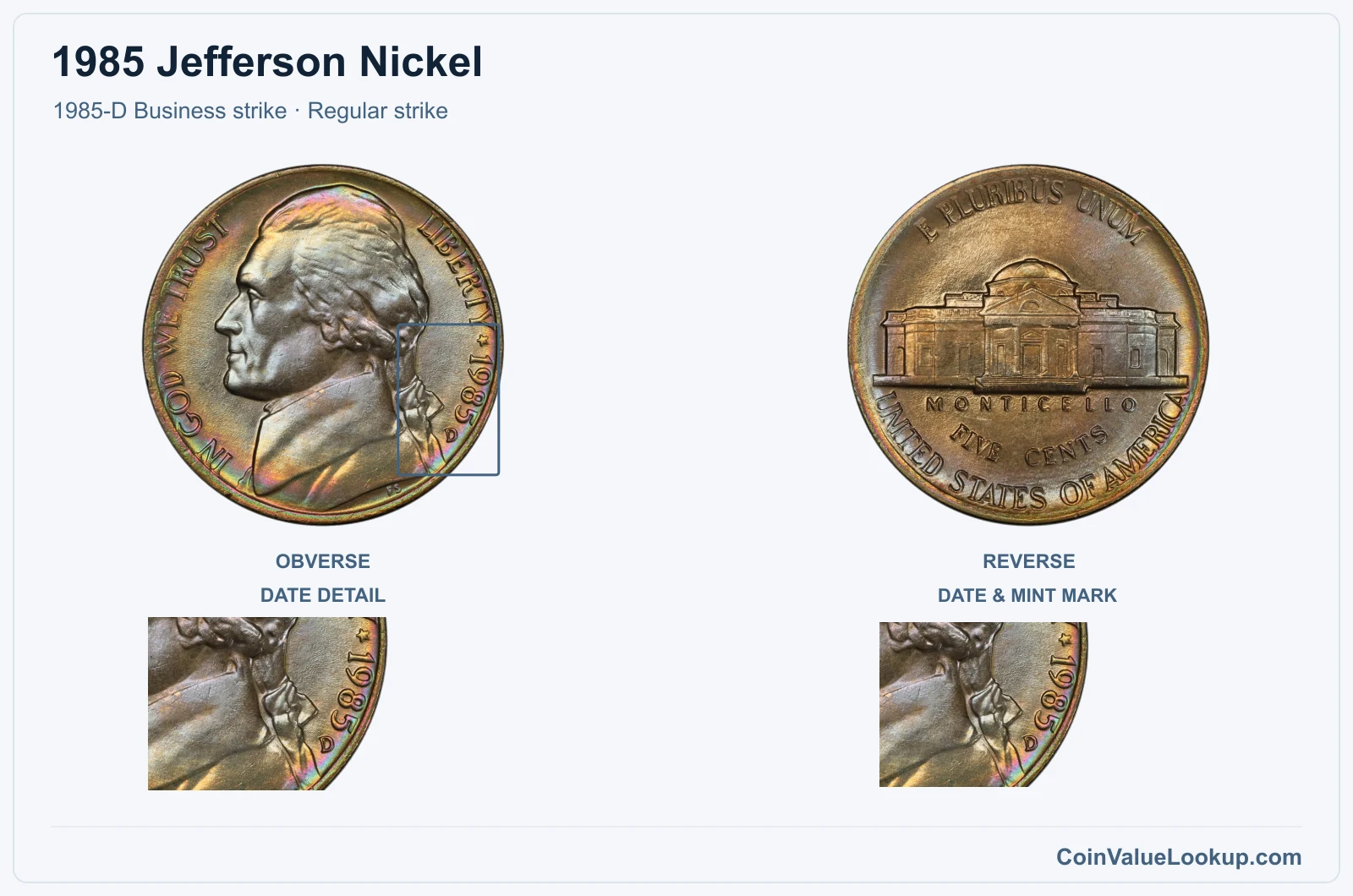
The 1985-D comes from the Denver Mint and shows a "D" mintmark below the date on the obverse. Same alloy, same weight, same design as the P issue.
Guide estimates match the Philadelphia version: roughly $0.61 at MS60 and $3.62 at MS65. Again, circulated coins trade at face value.
If your coin looks uncirculated with sharp Monticello steps, a closer look may be worthwhile. Coin Value Lookup is a handy starting place when you want to compare this nickel against other years and denominations in the Jefferson series.
| Range | Grade | Price | Auction Records | Appraisal |
|---|---|---|---|---|
| PO | PO 1 | — | Coin Identifier | |
| FR | FR 2 | — | Coin Identifier | |
| AG | AG 3 | — | Coin Identifier | |
| G | G 4 | — | Coin Identifier | |
| G 6 | — | Coin Identifier | ||
| VG | VG 8 | — | Coin Identifier | |
| VG 10 | — | Coin Identifier | ||
| F | F 12 | — | Coin Identifier | |
| F 15 | — | Coin Identifier | ||
| VF | VF 20 | — | Coin Identifier | |
| VF 25 | — | Coin Identifier | ||
| VF 30 | — | Coin Identifier | ||
| VF 35 | — | Coin Identifier | ||
| XF | XF 40 | — | Coin Identifier | |
| XF 45 | — | Coin Identifier | ||
| AU | AU 50 | — | Coin Identifier | |
| AU 53 | — | Coin Identifier | ||
| AU 55 | — | Coin Identifier | ||
| AU 58 | — | Coin Identifier | ||
| MS | MS 60 | — | Coin Identifier | |
| MS 61 | — | Coin Identifier | ||
| MS 62 | — | Coin Identifier | ||
| MS 63 | — | Coin Identifier | ||
| MS 64 | Coin Identifier | |||
| MS 65 | Coin Identifier | |||
| MS 66 | — | Coin Identifier | ||
| MS 67 | — | — | — | |
| MS 68 | — | — | — | |
| MS 69 | — | — | — | |
| MS 70 | — | — | — |
1985 Jefferson Nickel — S Proof
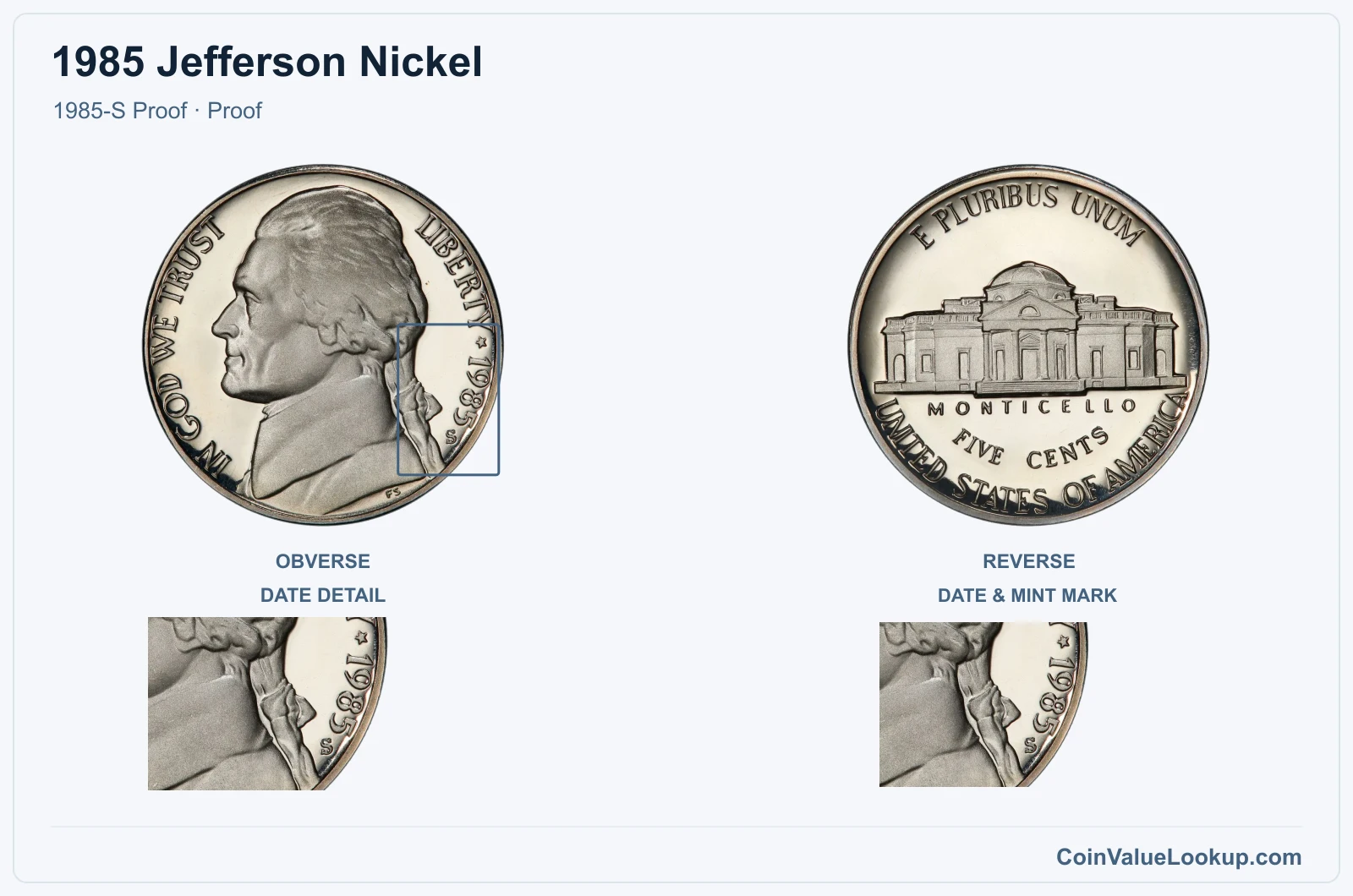
The 1985-S proof was struck at the San Francisco Mint exclusively for collector sets. Look for the "S" mintmark on the obverse and the characteristic mirror fields of a proof finish.
The alloy remains 75% copper and 25% nickel at 5 grams.
A guide estimate for PR65 sits at about $3.62 per USA Coin Book. Cameo and deep cameo contrast levels are graded separately and carry their own market; the PR65 figure here does not automatically reflect those designations.
Proofs are a manufacturing method, not a grade above Mint State, so comparing a proof directly to an MS65 business strike is apples and oranges.
| Range | Grade | Price | Auction Records | Appraisal |
|---|---|---|---|---|
| PR | PR 1 | — | Coin Identifier | |
| PR 2 | — | Coin Identifier | ||
| PR 3 | — | Coin Identifier | ||
| PR 4 | — | Coin Identifier | ||
| PR 6 | — | Coin Identifier | ||
| PR 8 | — | Coin Identifier | ||
| PR 10 | — | Coin Identifier | ||
| PR 12 | — | Coin Identifier | ||
| PR 15 | — | Coin Identifier | ||
| PR 20 | — | Coin Identifier | ||
| PR 25 | — | Coin Identifier | ||
| PR 30 | — | Coin Identifier | ||
| PR 35 | — | Coin Identifier | ||
| PR 40 | — | Coin Identifier | ||
| PR 45 | — | Coin Identifier | ||
| PR 50 | — | Coin Identifier | ||
| PR 53 | — | Coin Identifier | ||
| PR 55 | — | Coin Identifier | ||
| PR 58 | — | Coin Identifier | ||
| PR 60 | — | Coin Identifier | ||
| PR 61 | — | Coin Identifier | ||
| PR 62 | — | Coin Identifier | ||
| PR 63 | — | Coin Identifier | ||
| PR 64 | — | Coin Identifier | ||
| PR 65 | — | Coin Identifier | ||
| PR 66 | — | Coin Identifier | ||
| PR 67 | Coin Identifier | |||
| PR 68 | Coin Identifier | |||
| PR 69 | Coin Identifier | |||
| PR 70 | Coin Identifier |
1985 Jefferson Nickel Error List
1. 1985 Jefferson Nickel — Obverse die cap
An obverse die cap occurs when a struck coin fails to eject and sticks to the upper (obverse) die. Subsequent strikes hammer into its exposed reverse, gradually wrapping the coin around the die like a bottle cap.
From the side, the result looks cup-shaped, with the obverse design spread and distorted.
A confirmed 1985-P die cap graded NGC MS68 sold for $1,265 at Heritage Auctions in October 2010. Do not confuse a die cap with a coin that has been bent or hammered into a cup shape after leaving the mint.
Genuine examples show progressive flattening of the reverse from repeated impressions and characteristic metal flow consistent with press force, not hand tools.
2. 1985 Jefferson Nickel — Indented by dime blank
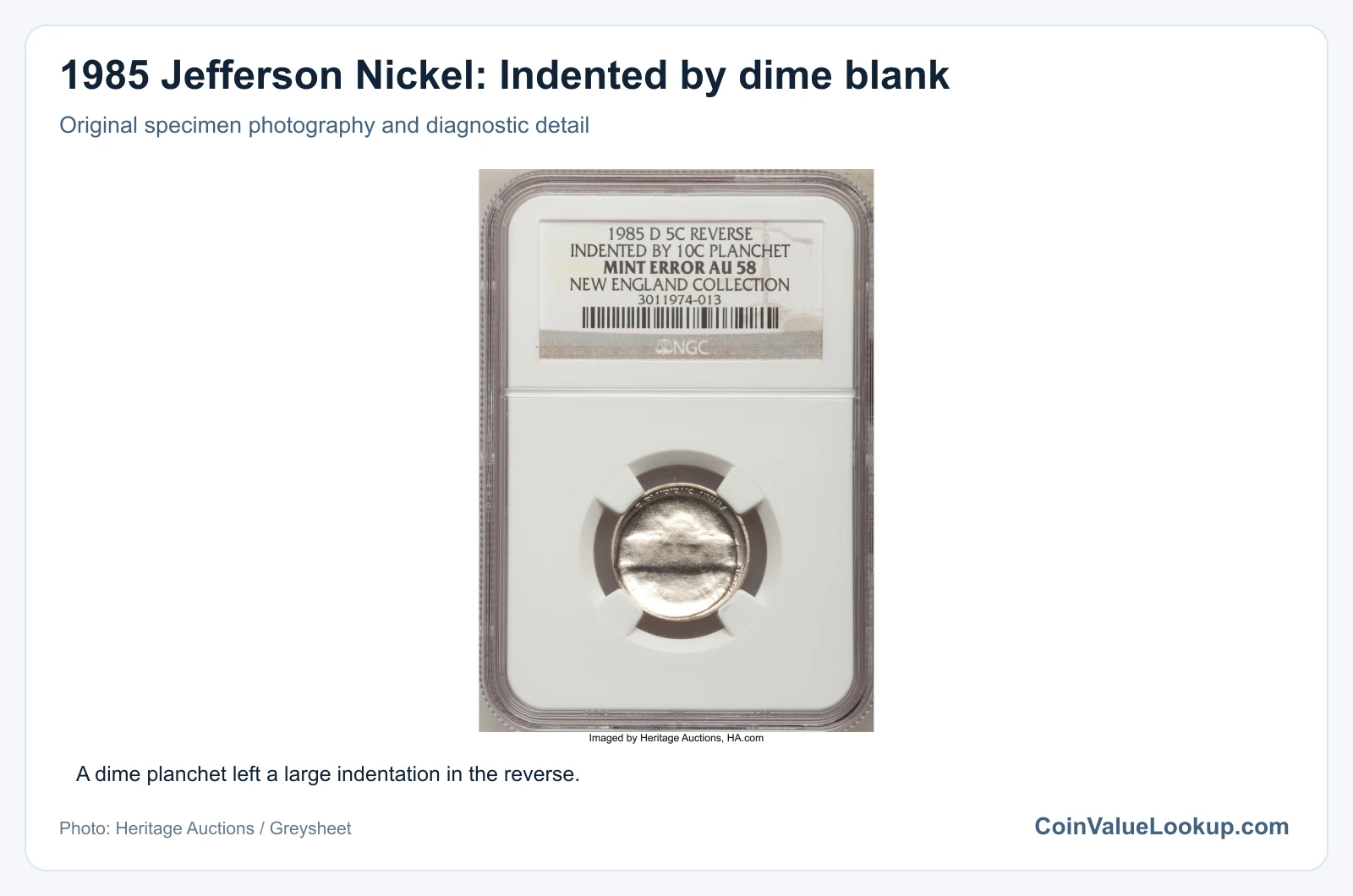
An indented strike happens when a loose blank lands on top of a planchet already in the striking chamber. The stray blank blocks part of the design, leaving a smooth depression on one side while the other side strikes normally.
A 1985-D nickel indented by a dime-sized blank, graded NGC AU58, brought $1,092.50 at Heritage Auctions in August 2010. On that coin, much of Monticello was obscured while the obverse portrait remained largely intact, with some perimeter legends still visible.
A post-mint dent or a coin flattened on one side after striking will lack the clean blank outline and the corresponding normal opposite face that define a genuine indent.
3. 1985 Jefferson Nickel — Improperly annealed blank
An improperly annealed blank results from irregular heat treatment at the mint before the planchet is struck. The surface may appear unusually dark, streaky, or have an abnormal texture that differs from normal luster.
A 1985-P example graded NGC MS63 has been attributed by Heritage Auctions.
This one is tricky to self-diagnose. Dark color alone is not proof of an annealing error.
Coins exposed to fire, buried in soil, painted, or chemically altered can mimic the look. Professional attribution matched to known specimens is essential here.
Value depends on authenticated identity, the coin's condition, and the severity of the annealing defect; no standard price range applies across the board.
4. 1985 Jefferson Nickel — Wrong Planchet / Off-Metal Strike
A wrong-planchet error means the nickel design was struck on a blank intended for a different denomination or even a different country's coin. The result will differ from a normal nickel in weight, diameter, edge characteristics, or all three.
If you suspect you have one, weigh the coin carefully and measure its diameter. A standard 1985 nickel should be about 5 grams and 21.2 mm.
Significant departure from those numbers, combined with a complete or nearly complete nickel design, warrants closer inspection. Plating loss, corrosion, acid thinning, and deliberate alteration can all make a normal coin look like it is on the wrong blank.
Value depends entirely on the specific blank, condition, and the completeness of the struck design.
5. 1985 Jefferson Nickel — Off-Center Strike
An off-center strike occurs when the planchet is not properly seated between the dies, so the design is shifted and part of the blank remains unstruck, creating a crescent of bare metal. The percentage of off-center shift and whether the date is still visible are the two biggest factors collectors care about.
Do not confuse an off-center strike with a clipped planchet or a coin that was flattened unevenly after it left the mint. A genuine off-center coin retains full thickness, and the unstruck crescent is smooth and featureless.
Value varies with the degree of misalignment, the condition of the remaining design, and the presence of a readable date.
6. 1985 Jefferson Nickel — Clipped Planchet
A clipped planchet means the blank was incompletely punched from the metal strip before striking. The missing section can be curved, straight, or ragged.
On the struck coin, you may notice design weakness opposite the clip, caused by incomplete metal flow during the strike.
Compare the edge texture at the clip to the rest of the coin. A genuine clip often shows a smooth, slightly concave break consistent with the blanking press.
Filed notches, deliberate edge cuts, and corrosion damage are common lookalikes. Value depends on the size and shape of the clip, the coin's overall condition, and whether key design elements remain identifiable.
7. 1985 Jefferson Nickel — Clashed Dies
A die clash happens when the obverse and reverse dies strike each other without a planchet between them. The impact transfers ghost-like traces of one die's design onto the opposing die.
Subsequent coins struck by those dies will show faint, misplaced design elements, such as parts of Monticello appearing on Jefferson's side or vice versa.
Look for raised outlines that correspond to features of the opposite design and align with where those elements would appear if the coin were flipped. Random scratches, contact marks, or raised lines from a damaged die are not die clashes.
Value depends on how strong and identifiable the transferred design is, and on the coin's condition.
8. 1985 Jefferson Nickel — Broadstrike
A broadstrike results when the coin is struck without the retaining collar that normally confines the blank and forms the edge. The metal spreads outward, making the coin slightly larger than normal while the design remains roughly centered.
The edge of a broadstrike will look different from a standard plain-edge nickel: it may be thinner and more irregular. Compare it to a coin that was simply flattened after leaving the mint; post-mint damage will usually show uneven distortion and surface marks rather than the uniform radial spread of a broadstrike.
Value depends on how much the design expanded, condition, and whether the full design is still present.
9. 1985 Jefferson Nickel — Double / Multiple Strike
A double or multiple strike error means the coin was hit by the dies more than once, with at least one impression displaced or rotated from the first. You will see two (or more) overlapping but distinct sets of design elements, often shifted at an angle to each other.
This is different from a doubled die, where the doubling is baked into the die itself and appears identically on every coin struck by it. A double strike shows actual separate impressions and usually involves visible disruption of the coin's shape.
Post-mint alterations, such as pressing a design into a coin with a vise, typically lack the sharp definition and rotational consistency of a genuine double strike. Value depends on displacement, condition, and visual drama.
10. 1985 Jefferson Nickel — Struck-Through Error
A struck-through error occurs when foreign material sits between the die and the planchet during striking. Grease-filled die errors are the most common type: accumulated grease in the die cavities prevents parts of the design from being fully impressed, leaving smooth, slightly depressed areas.
Other struck-through errors involve solid objects, such as wire, cloth, or metal fragments, which leave a distinct impression in the coin's surface. The key distinction is that the affected area should show an impression or missing detail consistent with something present during the strike, not afterward.
Normal wear, cleaning scratches, and weak strikes from tired dies can mimic the look. Value varies with the size of the affected area, the type of obstruction, and overall coin condition.