1968 Jefferson Nickel Coin Value: How Much Is It Worth?
A 1968 Jefferson nickel in average circulated condition is worth about face value. The real action starts in uncirculated grades, where guide estimates range from around $0.30 at MS60 up to about $6.25 at MS65 depending on the mint.
Proofs carry their own pricing curve, and certain wrong-planchet errors have sold for thousands at auction.
Fast Way to Identify Your 1968 Jefferson Nickel
The quickest way to get a preliminary identification of your 1968 nickel is to upload clear photos of both the front and back. That lets us check the mintmark, finish and any visible anomalies before you dig deeper.
Snap the images in good light with a steady hand, and make sure the date and mintmark area are in focus.
1968 Jefferson Nickel Value
Upload both sides of your 1968 Jefferson Nickel.
Front Obverse
Upload photo
Back Reverse
Upload photo
Which 1968 Jefferson Nickel Versions Are Worth Money?
- The 1968-S business strike lists around $6.25 at MS65, the highest regular guide figure among the three versions, so check that S mintmark carefully.
- A 1968-S proof struck on a cent planchet in PR66 Red sold for $2,640 at Heritage Auctions in May 2022, a dramatic premium over a normal proof.
- A 1968-S nickel struck over a 1968-S cent reached $3,737.50 at Heritage Auctions in August 2010 as a double-denomination error.
Step 1: Identify Your 1968 Jefferson Nickel Mint Mark and Version
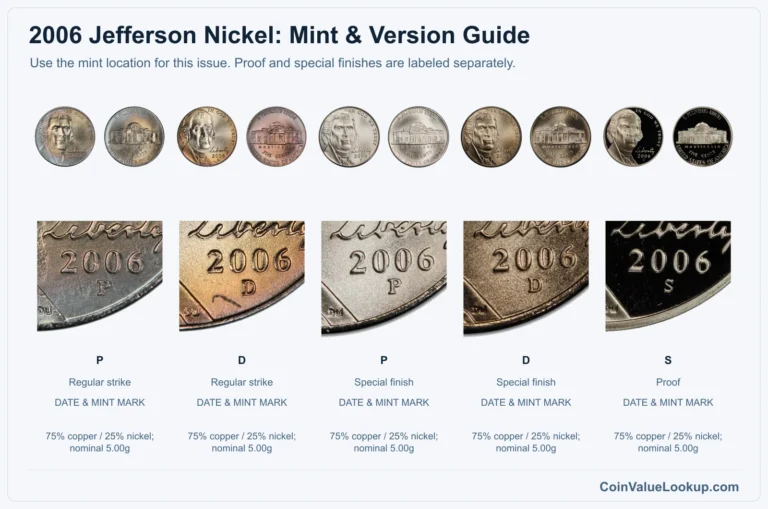
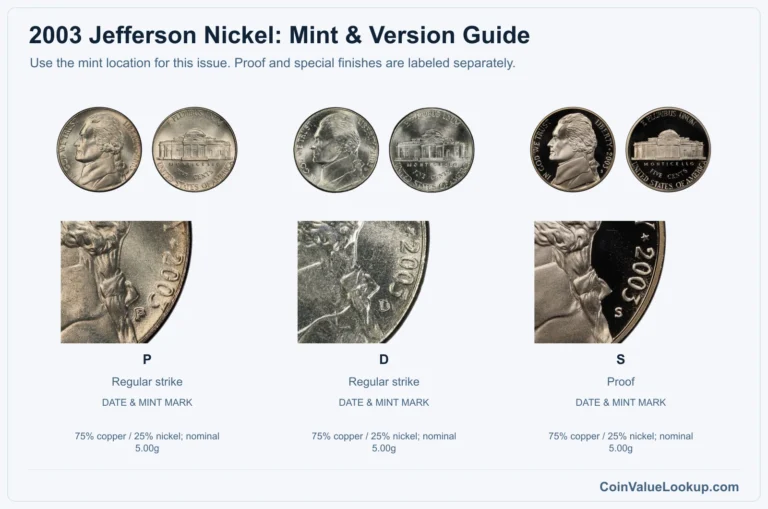
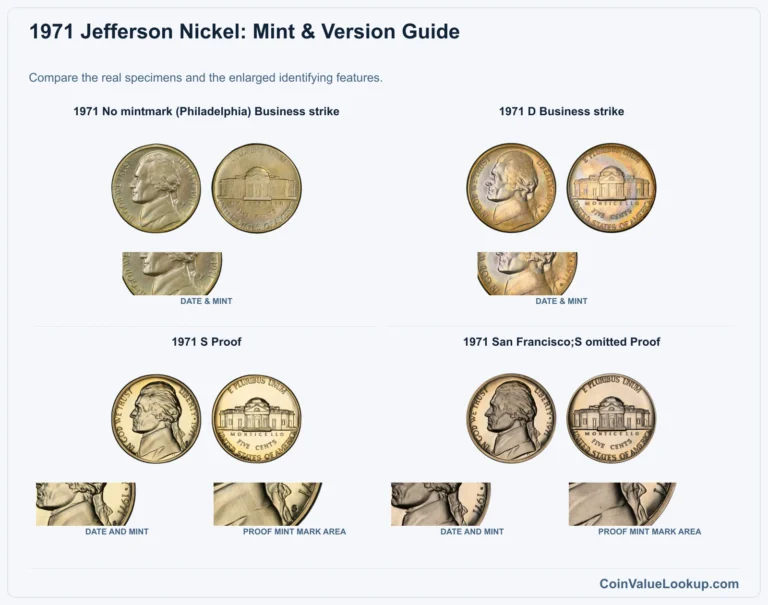
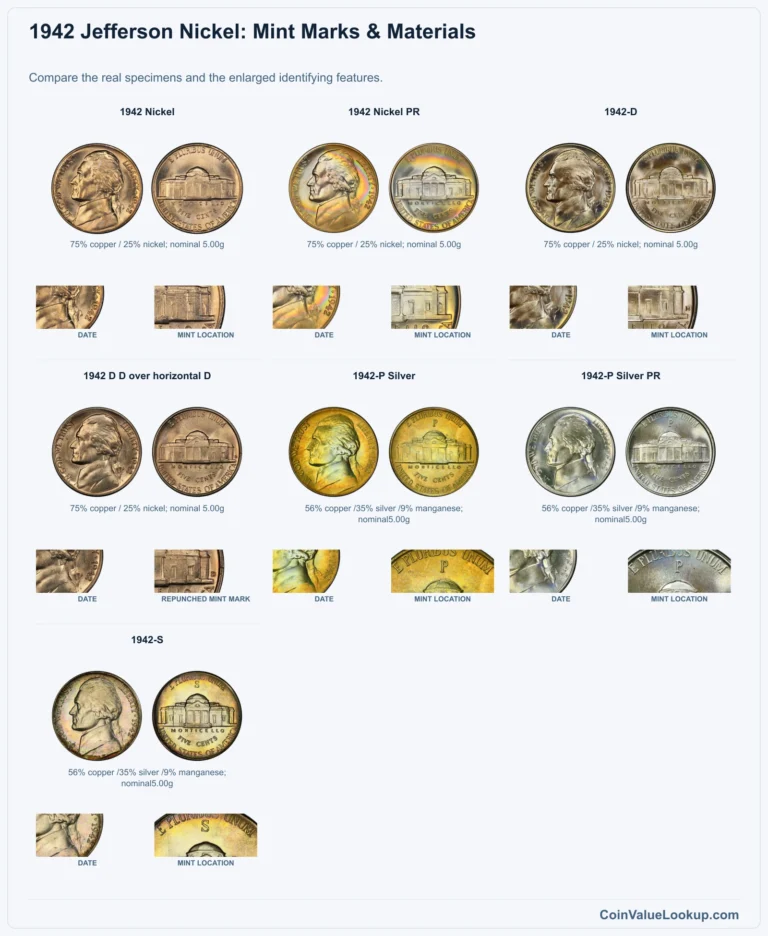
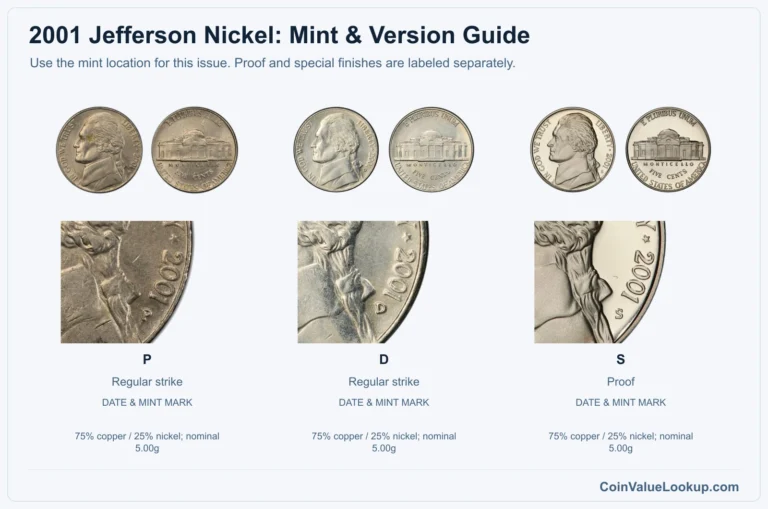
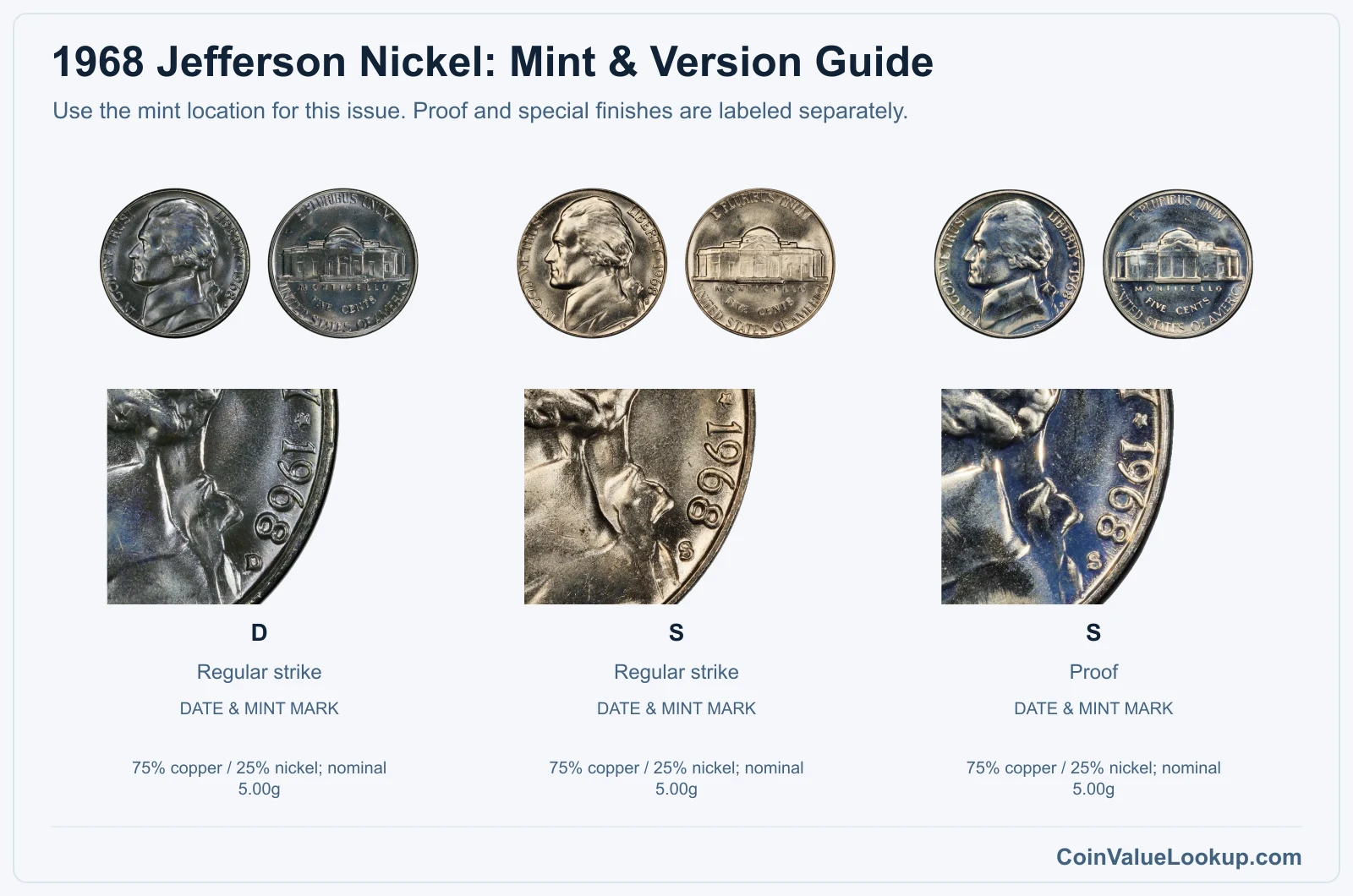
Start by looking below the date on the obverse for a small D or S mintmark. Both Denver and San Francisco produced circulation strikes in 1968, so finding an S does not automatically mean you have a proof.
Proofs were also struck at San Francisco, but they have mirror-like fields and sharp design relief that a business strike lacks.
There is no Philadelphia mint version for 1968. If you see no mintmark at all, you likely have a different year.
The coin should weigh about 5.00 grams and measure 21.2 mm with a plain, smooth edge. The alloy is solid 75% copper and 25% nickel, not a clad sandwich.
Weighing helps screen oddities like wrong-planchet strikes, but weight alone cannot authenticate an error.
Before looking up values, record the date, mintmark, finish type and the condition of both sides. Those four details steer you to the right price column every time.
Step 2: Check Your 1968 Jefferson Nickel Grade
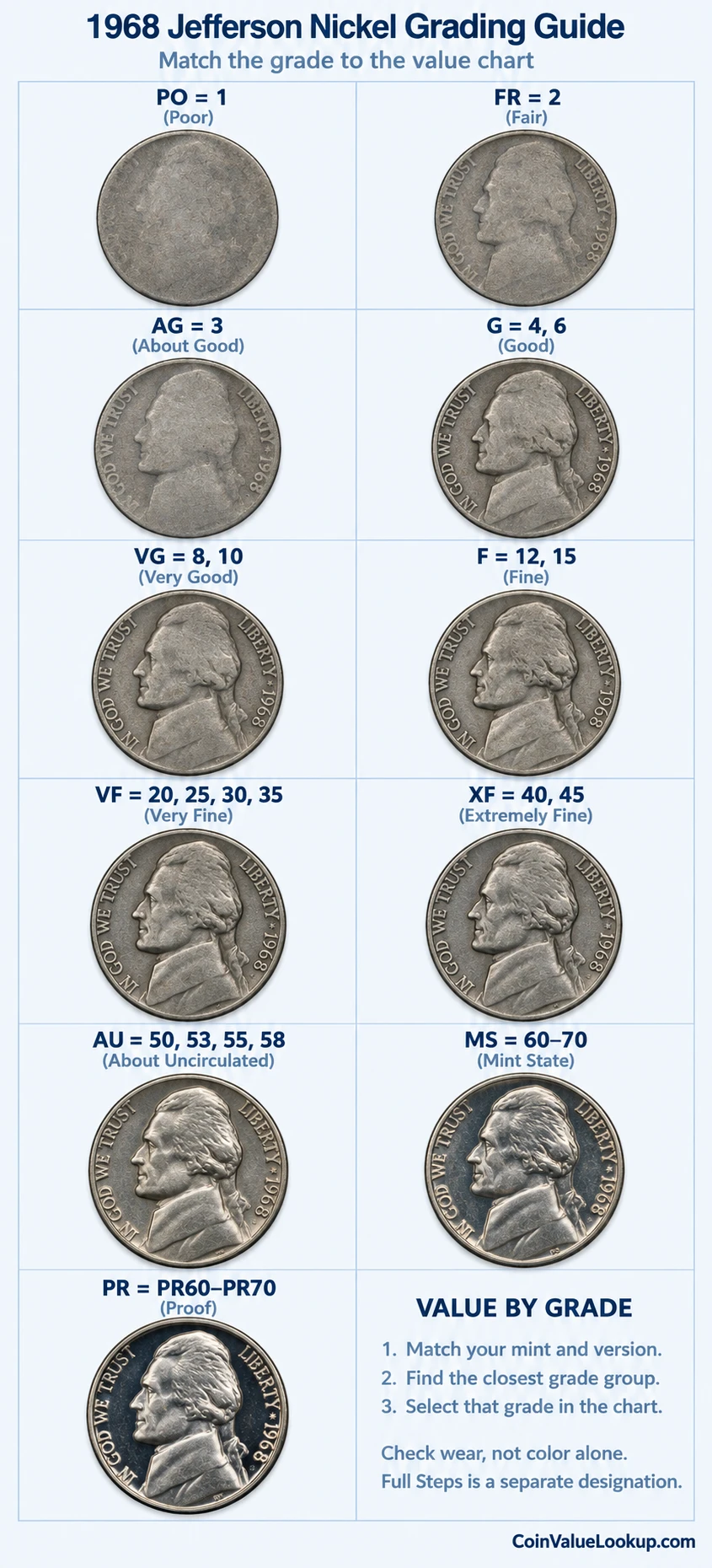
Focus on Jefferson's cheekbone and the hair detail above his ear. In high grades these areas show full luster and sharp contours.
As a coin wears, the cheek flattens first, then the hair strands start merging into a smooth blob.
On the reverse, check the roof and columns of Monticello. Lost column lines and a mushy roofline signal moderate wear.
Don't confuse a weakly struck coin with a worn one. A soft strike can leave mushy details even on a coin that never entered circulation.
Full Steps is a separate strike-quality designation applied only to Mint State coins where the horizontal lines on Monticello's steps remain complete and uninterrupted.
Use the comparison image to match your coin's detail level against known grade benchmarks. That side-by-side approach beats guessing every time.
Step 3: Check 1968 Jefferson Nickel Value by Mint and Version
1968 Jefferson Nickel — D Business strike
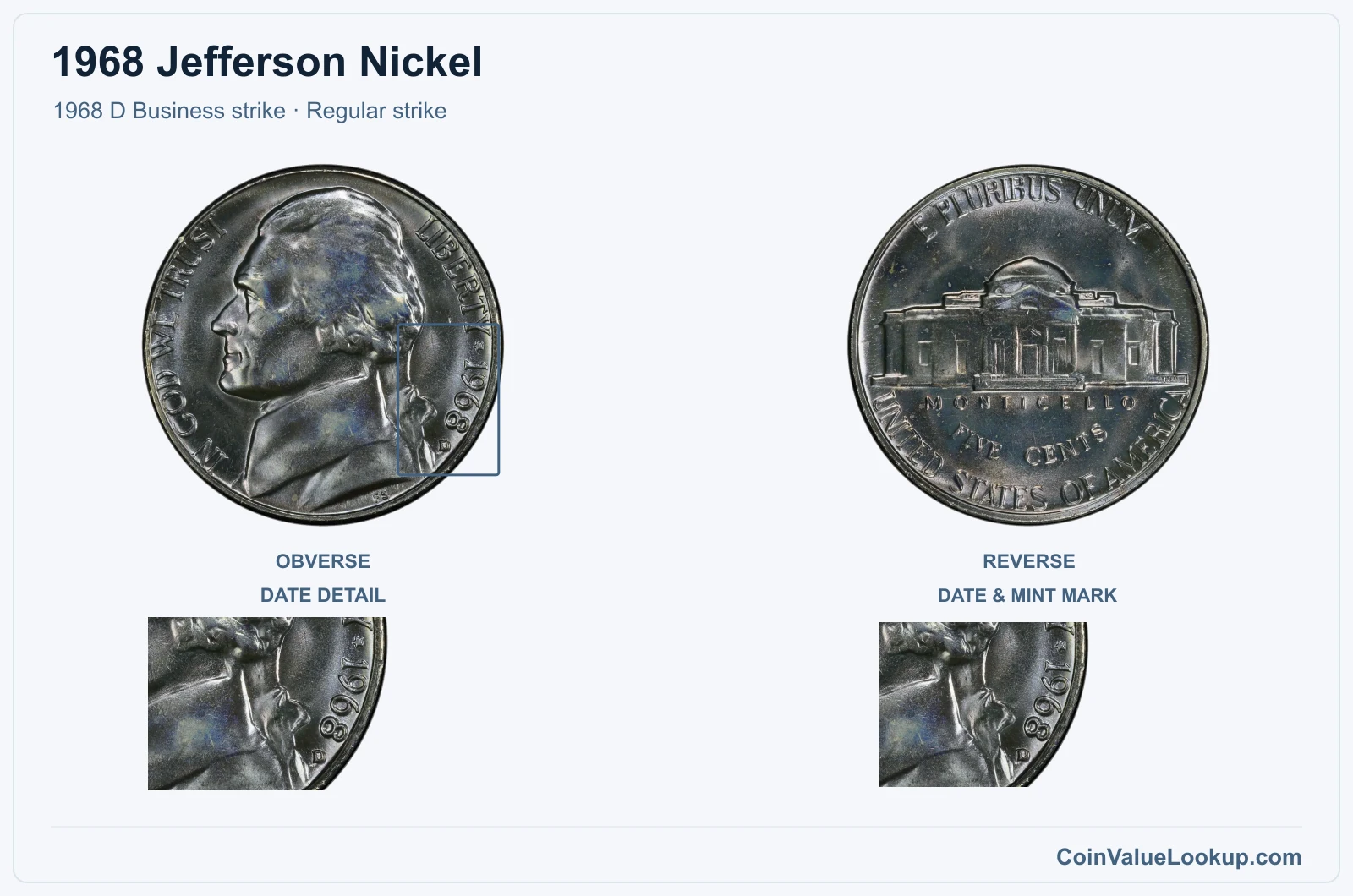
The 1968-D is the Denver mint business strike, identifiable by the small D below the date on the obverse. It's a standard 75% copper, 25% nickel composition at 5.00 grams.
Guide estimates place this version at roughly $0.30 in MS60 and around $4.96 in MS65. In circulated grades, expect face value.
A crisp, lustrous example with sharp cheek detail and clean fields is what pushes this coin toward the upper end of the uncirculated scale.
| Range | Grade | Price | Auction Records | Appraisal |
|---|---|---|---|---|
| PO | PO 1 | — | Coin Identifier | |
| FR | FR 2 | — | Coin Identifier | |
| AG | AG 3 | — | Coin Identifier | |
| G | G 4 | — | Coin Identifier | |
| G 6 | — | Coin Identifier | ||
| VG | VG 8 | — | Coin Identifier | |
| VG 10 | — | Coin Identifier | ||
| F | F 12 | — | Coin Identifier | |
| F 15 | — | Coin Identifier | ||
| VF | VF 20 | — | Coin Identifier | |
| VF 25 | — | Coin Identifier | ||
| VF 30 | — | Coin Identifier | ||
| VF 35 | — | Coin Identifier | ||
| XF | XF 40 | — | Coin Identifier | |
| XF 45 | — | Coin Identifier | ||
| AU | AU 50 | — | Coin Identifier | |
| AU 53 | — | Coin Identifier | ||
| AU 55 | — | Coin Identifier | ||
| AU 58 | — | Coin Identifier | ||
| MS | MS 60 | — | Coin Identifier | |
| MS 61 | — | Coin Identifier | ||
| MS 62 | — | Coin Identifier | ||
| MS 63 | — | Coin Identifier | ||
| MS 64 | Coin Identifier | |||
| MS 65 | Coin Identifier | |||
| MS 66 | Coin Identifier | |||
| MS 67 | Coin Identifier | |||
| MS 68 | — | — | — | |
| MS 69 | — | — | — | |
| MS 70 | — | — | — |
1968 Jefferson Nickel — S Business strike
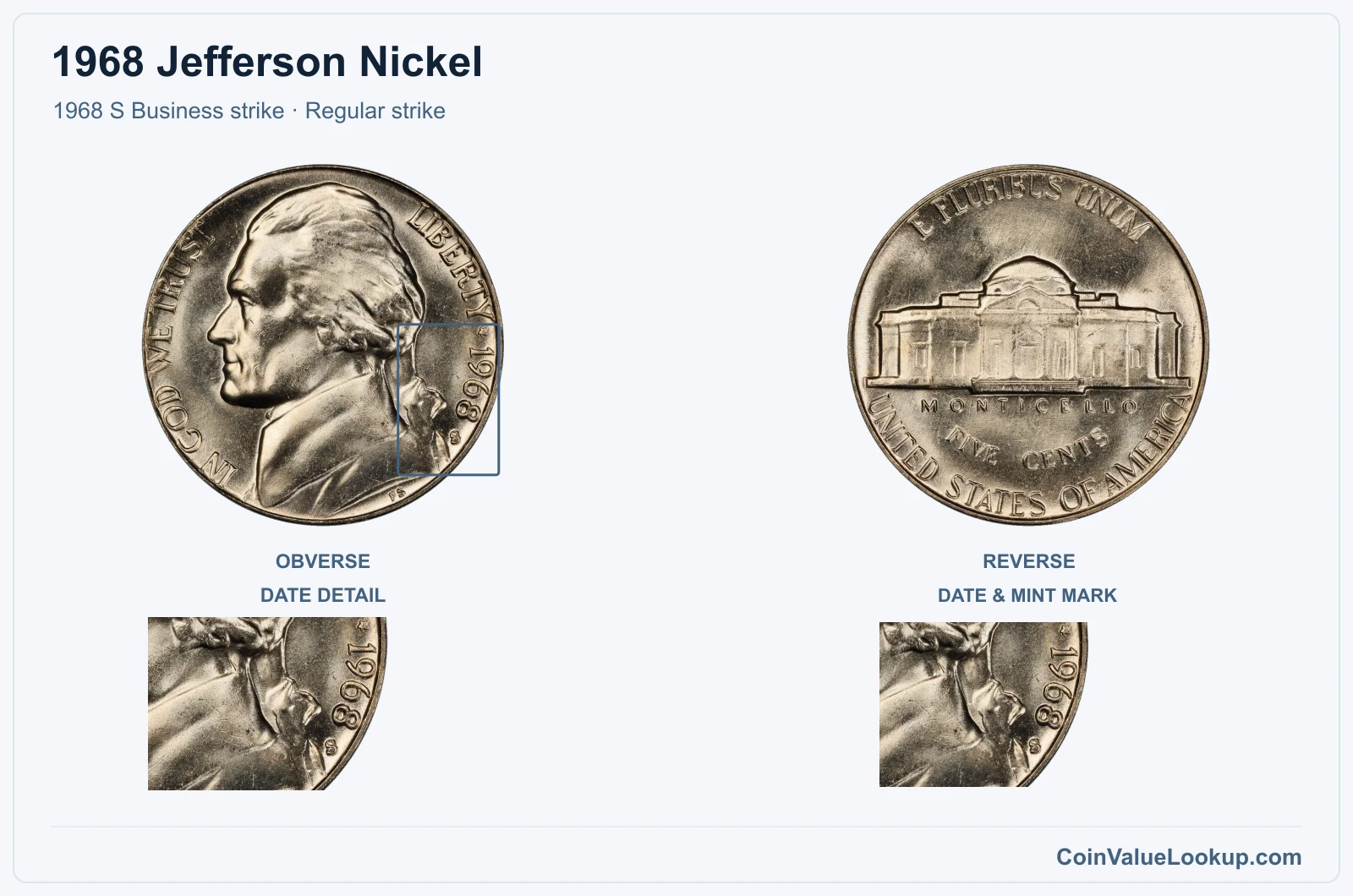
The 1968-S business strike carries a small S mintmark below the date. Do not mistake it for a proof.
Business strikes have normal cartwheel luster, not the mirrored fields of a proof.
Guide estimates run about $0.30 at MS60 and roughly $6.25 at MS65, making the S business strike the higher-valued regular issue for this year at the MS65 level. That small premium over the D mint reflects lower survival rates in top condition.
Look for full luster across both sides and minimal bag marks to identify a strong uncirculated piece.
Coin Value Lookup is a good starting point if you want to compare this version's value against other Jefferson nickel years or denominations.
| Range | Grade | Price | Auction Records | Appraisal |
|---|---|---|---|---|
| PO | PO 1 | — | Coin Identifier | |
| FR | FR 2 | — | Coin Identifier | |
| AG | AG 3 | — | Coin Identifier | |
| G | G 4 | — | Coin Identifier | |
| G 6 | — | Coin Identifier | ||
| VG | VG 8 | — | Coin Identifier | |
| VG 10 | — | Coin Identifier | ||
| F | F 12 | — | Coin Identifier | |
| F 15 | — | Coin Identifier | ||
| VF | VF 20 | — | Coin Identifier | |
| VF 25 | — | Coin Identifier | ||
| VF 30 | — | Coin Identifier | ||
| VF 35 | — | Coin Identifier | ||
| XF | XF 40 | — | Coin Identifier | |
| XF 45 | — | Coin Identifier | ||
| AU | AU 50 | — | Coin Identifier | |
| AU 53 | — | Coin Identifier | ||
| AU 55 | — | Coin Identifier | ||
| AU 58 | — | Coin Identifier | ||
| MS | MS 60 | — | Coin Identifier | |
| MS 61 | — | Coin Identifier | ||
| MS 62 | Coin Identifier | |||
| MS 63 | — | Coin Identifier | ||
| MS 64 | Coin Identifier | |||
| MS 65 | Coin Identifier | |||
| MS 66 | Coin Identifier | |||
| MS 67 | Coin Identifier | |||
| MS 68 | — | Coin Identifier | ||
| MS 69 | — | Coin Identifier | ||
| MS 70 | — | — | — |
1968 Jefferson Nickel — S Proof
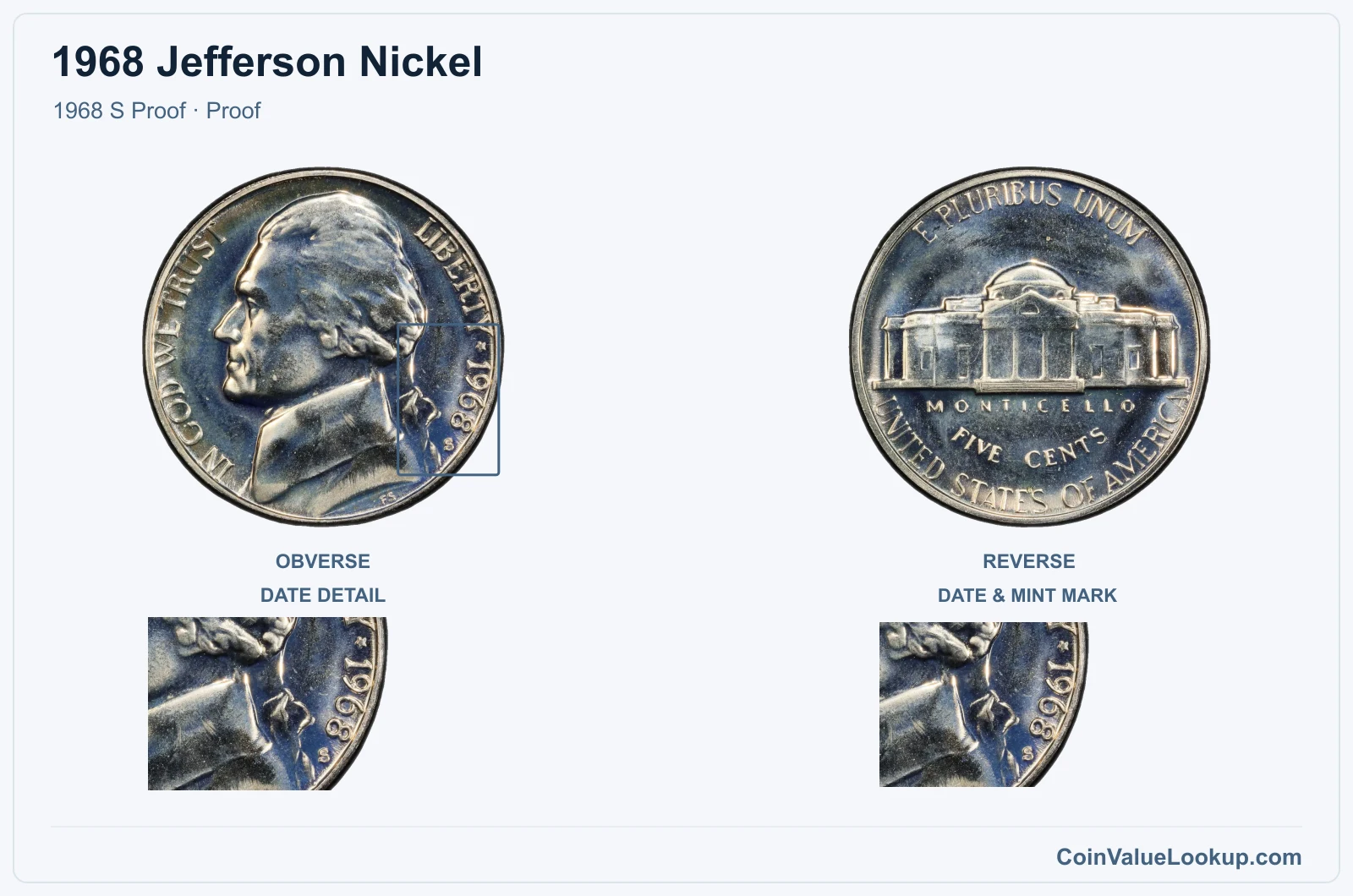
The 1968-S proof was struck at San Francisco with polished dies and specially prepared planchets. It has mirrored fields and frosted raised design elements.
The S mintmark sits below the date, just like the business strike, so finish quality is the real distinguishing feature.
A guide estimate places this coin at about $3.62 in PR65. Some certified examples carry a cameo designation when the contrast between frosted devices and reflective fields is especially strong.
Look for hairlines under magnification, since those fine scratches from handling are the main grade limiter on proofs.
| Range | Grade | Price | Auction Records | Appraisal |
|---|---|---|---|---|
| PR | PR 1 | — | Coin Identifier | |
| PR 2 | — | Coin Identifier | ||
| PR 3 | — | Coin Identifier | ||
| PR 4 | — | Coin Identifier | ||
| PR 6 | — | Coin Identifier | ||
| PR 8 | — | Coin Identifier | ||
| PR 10 | — | Coin Identifier | ||
| PR 12 | — | Coin Identifier | ||
| PR 15 | — | Coin Identifier | ||
| PR 20 | — | Coin Identifier | ||
| PR 25 | — | Coin Identifier | ||
| PR 30 | — | Coin Identifier | ||
| PR 35 | — | Coin Identifier | ||
| PR 40 | — | Coin Identifier | ||
| PR 45 | — | Coin Identifier | ||
| PR 50 | — | Coin Identifier | ||
| PR 53 | — | Coin Identifier | ||
| PR 55 | — | Coin Identifier | ||
| PR 58 | — | Coin Identifier | ||
| PR 60 | — | Coin Identifier | ||
| PR 61 | — | Coin Identifier | ||
| PR 62 | — | Coin Identifier | ||
| PR 63 | — | Coin Identifier | ||
| PR 64 | — | Coin Identifier | ||
| PR 65 | — | Coin Identifier | ||
| PR 66 | Coin Identifier | |||
| PR 67 | Coin Identifier | |||
| PR 68 | Coin Identifier | |||
| PR 69 | Coin Identifier | |||
| PR 70 | — | — | — |
1968 Jefferson Nickel Error List
1. 1968 Jefferson Nickel — Business strike on cent blank
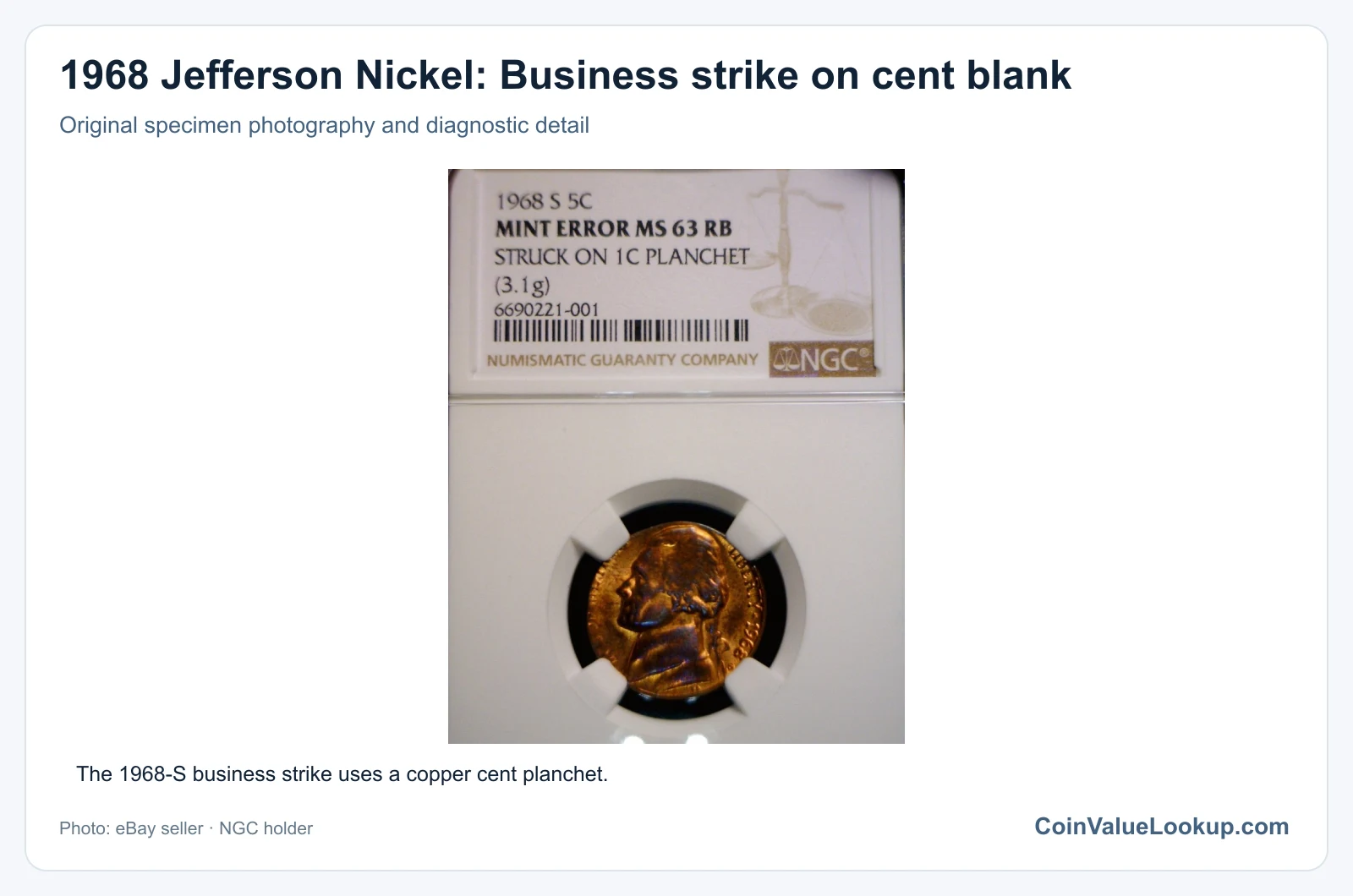
This is a 1968-S nickel struck on a Lincoln cent blank. The copper planchet is smaller and lighter than a normal nickel, so the design appears cropped and the legends stretch toward the rim.
An ordinary nickel weighs about 5 grams; a cent blank comes in noticeably lighter.
One example was authenticated by PCGS as MS64. Check the edge for copper color and weigh the coin carefully.
The entire design should be present but compressed inward.
Condition, the specific mint attribution and error severity all affect what a given piece might bring. Watch out for copper-plated nickels, chemical toning or ground-down coins that can mimic this error.
Third-party certification is the standard way to confirm a wrong-planchet strike.
2. 1968 Jefferson Nickel — Proof on cent blank
A proof version of the same wrong-planchet error also exists: a 1968-S proof nickel struck on a cent planchet. It retains the mirrored proof finish on a smaller copper blank, combining two collectible traits in one coin.
A PCGS PR66 Red example sold for $2,640 at Heritage Auctions in May 2022. That sale reflects the specific grade, red copper color and proof finish of that individual coin.
The diagnostics mirror the business-strike cent-blank error: undersized diameter, stretched legends and lighter weight. Edge color should be copper through and through.
Do not confuse this with a copper-plated regular proof or a business-strike cent-planchet error. Both exist separately and carry different values.
Authentication is essential.
3. 1968 Jefferson Nickel — Nickel struck over a struck cent
This error is a 1968-S nickel die striking over a previously struck 1968-S Lincoln cent. The result is a double-denomination coin showing remnants of both designs.
You can see the ghost of the cent's design underneath the nickel impression.
An NGC MS67 Red example sold for $3,737.50 at Heritage Auctions in August 2010. That price reflects an exceptional grade with full red copper color and two clearly identifiable designs.
To verify, look for traces of Lincoln's portrait, the cent reverse design or duplicated date and mintmark peeking through the nickel design. This is different from a nickel struck on a blank cent planchet, which shows no prior design underneath.
Glued-coin fakes also exist, so inspect the rim junction carefully.
4. 1968 Jefferson Nickel — Curved clipped planchet
A curved clipped planchet results when the blanking press overlaps a previously punched area of the metal strip, leaving a crescent-shaped shortage on the finished coin. One 1968-D nickel with about a 5% clip appeared in a Mint Set and sold as part of a five-coin lot at Heritage Auctions in August 2010 for $126.50.
That price covers the entire lot, not just the nickel.
Look at the rim and edge where the missing area begins. A genuine clip produces a characteristic curved gap with a blakesley effect, or weakness, opposite the clip.
Pliers damage, sawing or post-mint breakage can mimic a clip, but those leave sharp or irregular edges rather than a smooth factory curve. Examine strike flow across the surface for confirmation.
5. 1968 Jefferson Nickel — Repunched Mintmark
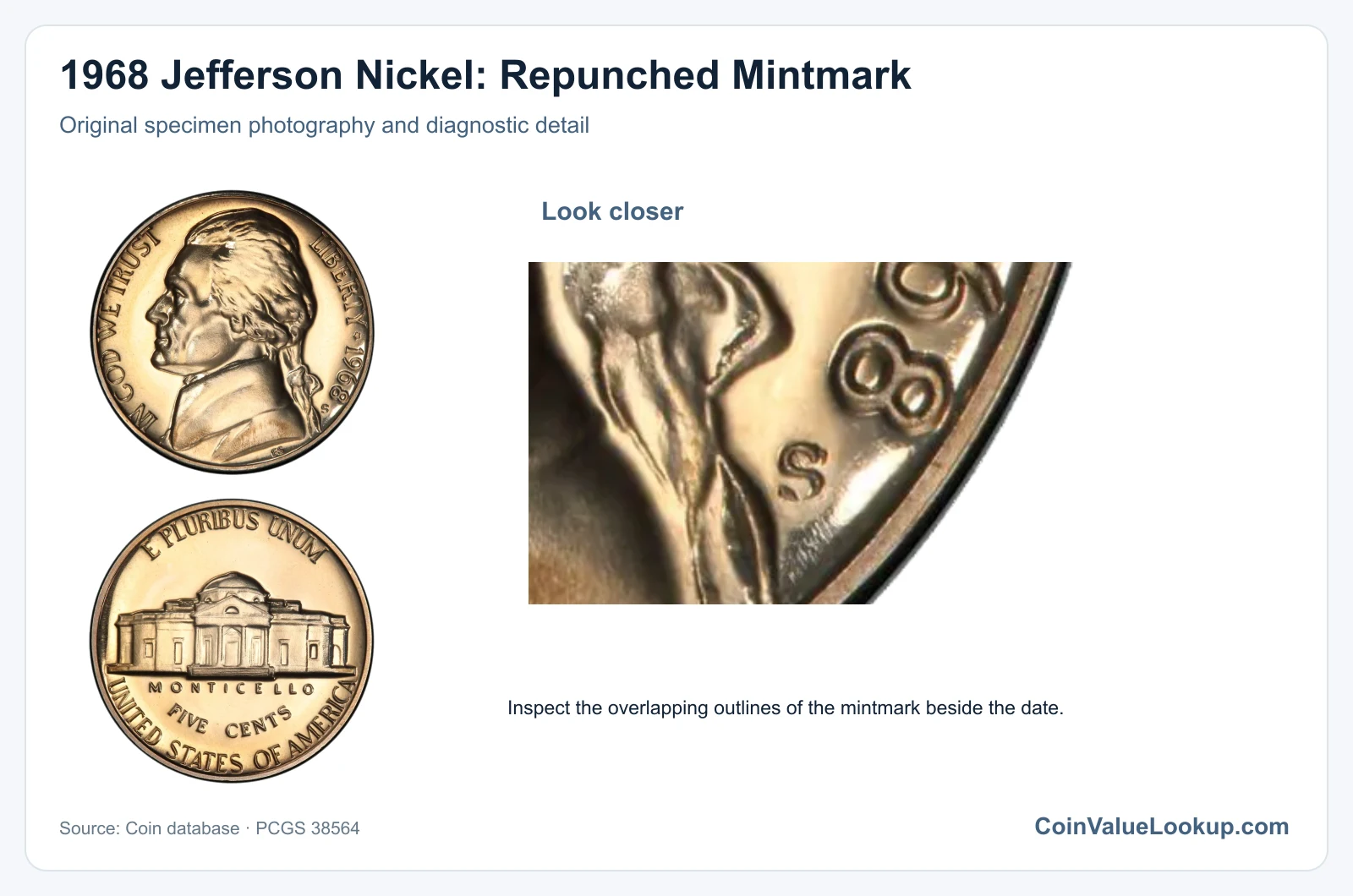
A repunched mintmark variety has been reported for the 1968-S nickel. This occurs when the mintmark punch was applied more than once in slightly different positions, leaving a trace of the earlier impression alongside the final S.
Under magnification, look for a secondary outline, serif remnant or shadow near the primary S below the date. Compare against a normal 1968-S mintmark at the same magnification to see the extra element clearly.
Machine doubling around the mintmark can look similar but typically shows a flat, shelf-like displacement rather than a distinct second punch. Die chips and corrosion can also create odd shapes near the letter.
The specific variety, its visibility and the coin's overall condition all factor into value. No specific price range is established here.
6. 1968 Jefferson Nickel — Doubled Die Obverse
A doubled die obverse variety has been reported for the 1968-S nickel. Doubled dies show consistent separation or notching in the obverse lettering or design elements because of a misaligned hub impression during die production.
Compare the obverse inscriptions on your coin with a known normal 1968-S under matching lighting and magnification. True doubling appears as a repeating offset in the same direction across multiple letters or features.
Machine doubling is the common lookalike. It produces flat, shelf-like distortion rather than distinct rounded separation.
Reflections and worn die contours can also trick the eye. The value of a doubled die depends on the severity of the doubling, the coin's grade and market demand for the specific variety.
No established price range is available for this entry.
7. 1968 Jefferson Nickel — Doubled Die Reverse
A doubled die reverse variety has been reported for the 1968-D nickel. Like obverse doubled dies, this error originates during die manufacture when a hub impression shifts between strikes, creating consistent doubling on reverse design elements.
Examine the reverse legends and Monticello's architectural details against a normal 1968-D at the same magnification. Genuine doubling will show repeatable separation in the same direction across multiple areas.
Machine doubling, light reflections and random post-mint damage are the usual false alarms. Machine doubling tends to look like a flat smear rather than a cleanly separated second image.
Condition, the strength of visible doubling and the specific die variety all influence what a collector might pay. No numerical price range is adopted for this variety.