1920 Buffalo Nickel Coin Value: How Much Is It Worth?
The 1920 Buffalo Nickel is a coin that still turns up in old collections and junk boxes regularly. USA Coin Book guide estimates place ordinary circulation examples from about $2.50 in G4 to over $2,000 in MS63, depending on mint.
Branch-mint pieces from Denver and San Francisco carry meaningful premiums over their Philadelphia counterparts, and several recognized mint errors add further collecting interest to this date.
Fast Way to Identify Your 1920 Buffalo Nickel
Upload clear photos of both sides of your 1920 Buffalo Nickel and our identifier will offer a preliminary identification of your coin's mint and version. Make sure the date is readable, the area below FIVE CENTS on the reverse is visible, and the lighting is even.
This is not authentication or exact grading, but it gives you a useful starting point.
1920 Buffalo Nickel Value
Upload both sides of your 1920 Buffalo Nickel.
Front Obverse
Upload photo
Back Reverse
Upload photo
Which 1920 Buffalo Nickel Versions Are Worth Money?
- The 1920-S (San Francisco) in higher grades commands the strongest guide estimates among the three mints, reaching $2,033 at MS63 per USA Coin Book.
- The 1920-D (Denver) also carries a significant premium, with guide values climbing to $1,747 at MS63 compared to $178 for Philadelphia at the same grade.
- Recognized mint errors such as off-center strikes, repunched mintmarks, cuds, and the Two Feathers variety on the 1920-S add collecting interest beyond standard date-and-mint value.
- Even low-grade branch-mint examples start well above face value, with Good-4 pieces listed at $12 to $15 versus $2.50 for Philadelphia.
Step 1: Identify Your 1920 Buffalo Nickel Mint Mark and Version
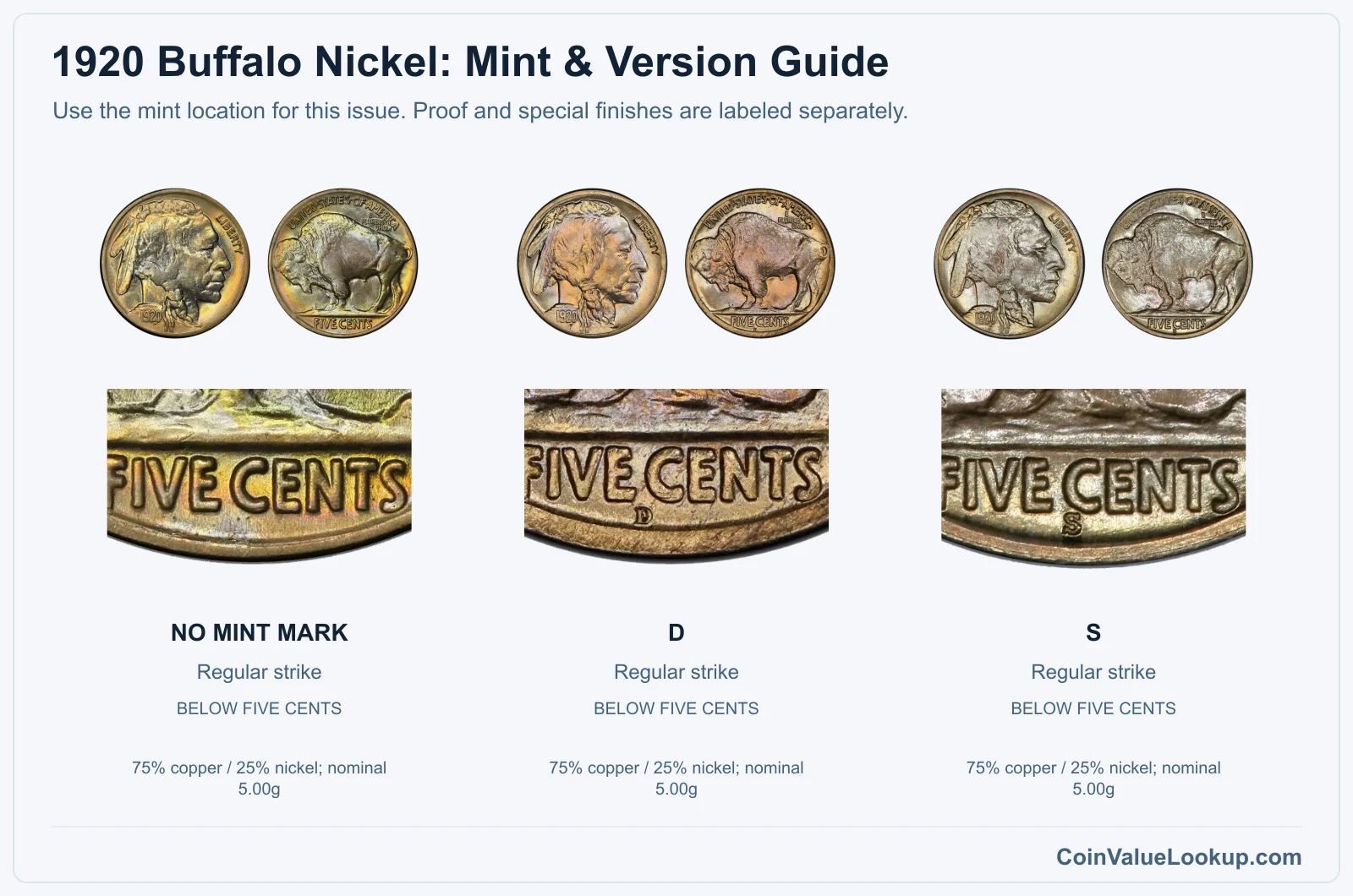
All 1920 Buffalo Nickels use the Type 2 reverse design, where FIVE CENTS sits in a recessed area below the bison. There was no Type 1 version this year; that raised-mound reverse was exclusive to early 1913 production.
Three mints struck this date. Philadelphia coins carry no mintmark at all.
Denver coins show a small D below FIVE CENTS on the reverse, and San Francisco coins show an S in the same spot. You will need decent magnification because the mintmark sits in that recessed field and can fill with grime.
The coin is 75% copper and 25% nickel, weighs 5 grams, measures 21.2 mm in diameter, and has a plain edge. There is no silver version.
If your piece looks silver-colored, it is the normal copper-nickel alloy. No regular proof was issued for 1920.
Step 2: Check Your 1920 Buffalo Nickel Grade
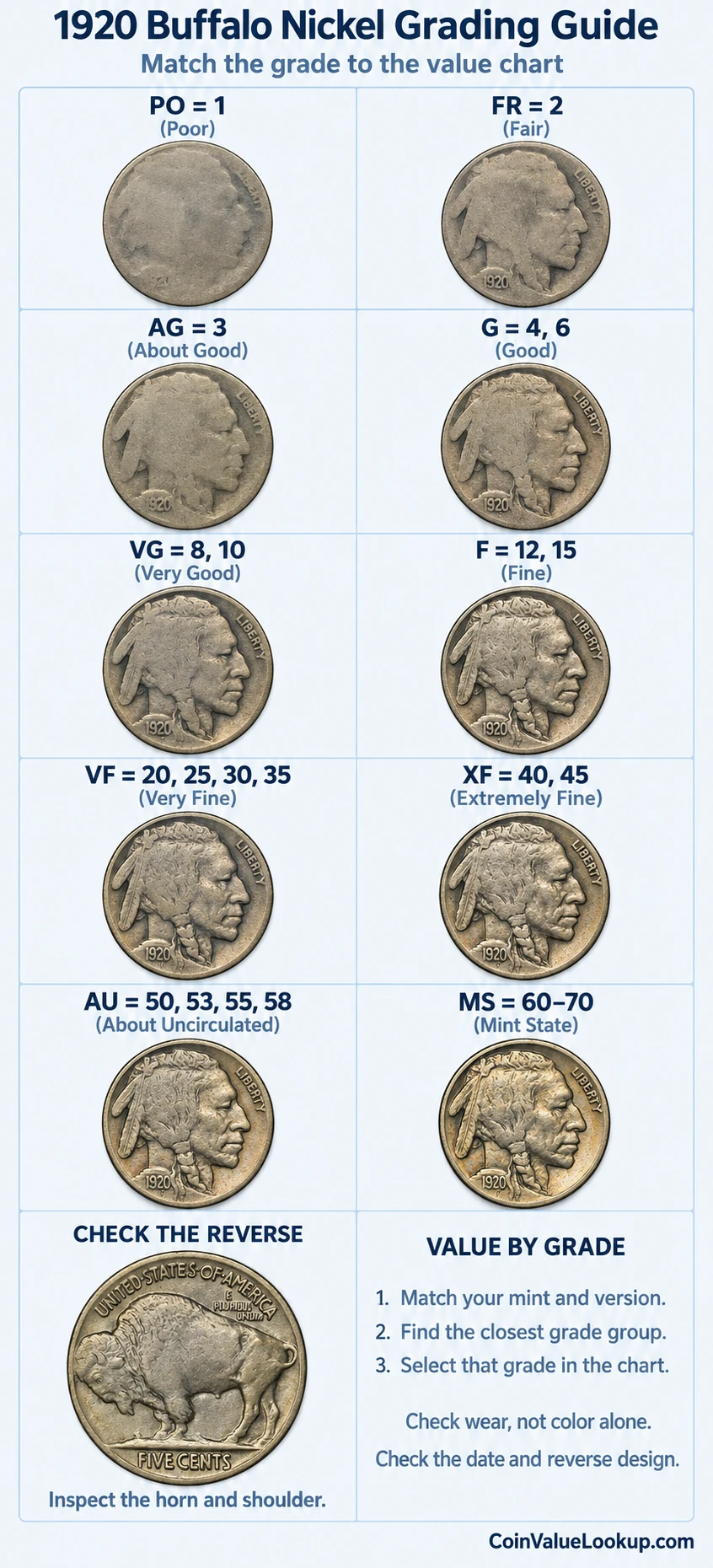
Start with the obverse. The high points that wear first are the braid above the Native American's ear, the cheek, and the hair near the forehead.
On the reverse, check the bison's shoulder, hip, and horn tip.
Here is the tricky part with 1920 nickels: weak strikes are common, especially from branch mints. A coin can leave the press with a mushy horn or flat shoulder detail and never see a day of circulation.
Compare your coin to the grading reference image to separate genuine wear from strike softness.
Original luster matters a lot for mint-state determinations. Look for unbroken cartwheel reflections under a single light source tilted at an angle.
Scratches, cleaning, and environmental damage all reduce a coin's grade and appeal.
Never use acid or chemicals to restore a faded date. It destroys surfaces and any numismatic premium the coin might carry.
Step 3: Check 1920 Buffalo Nickel Value by Mint and Version
1920 Buffalo Nickel — No Mint Mark — Type2 Circulation
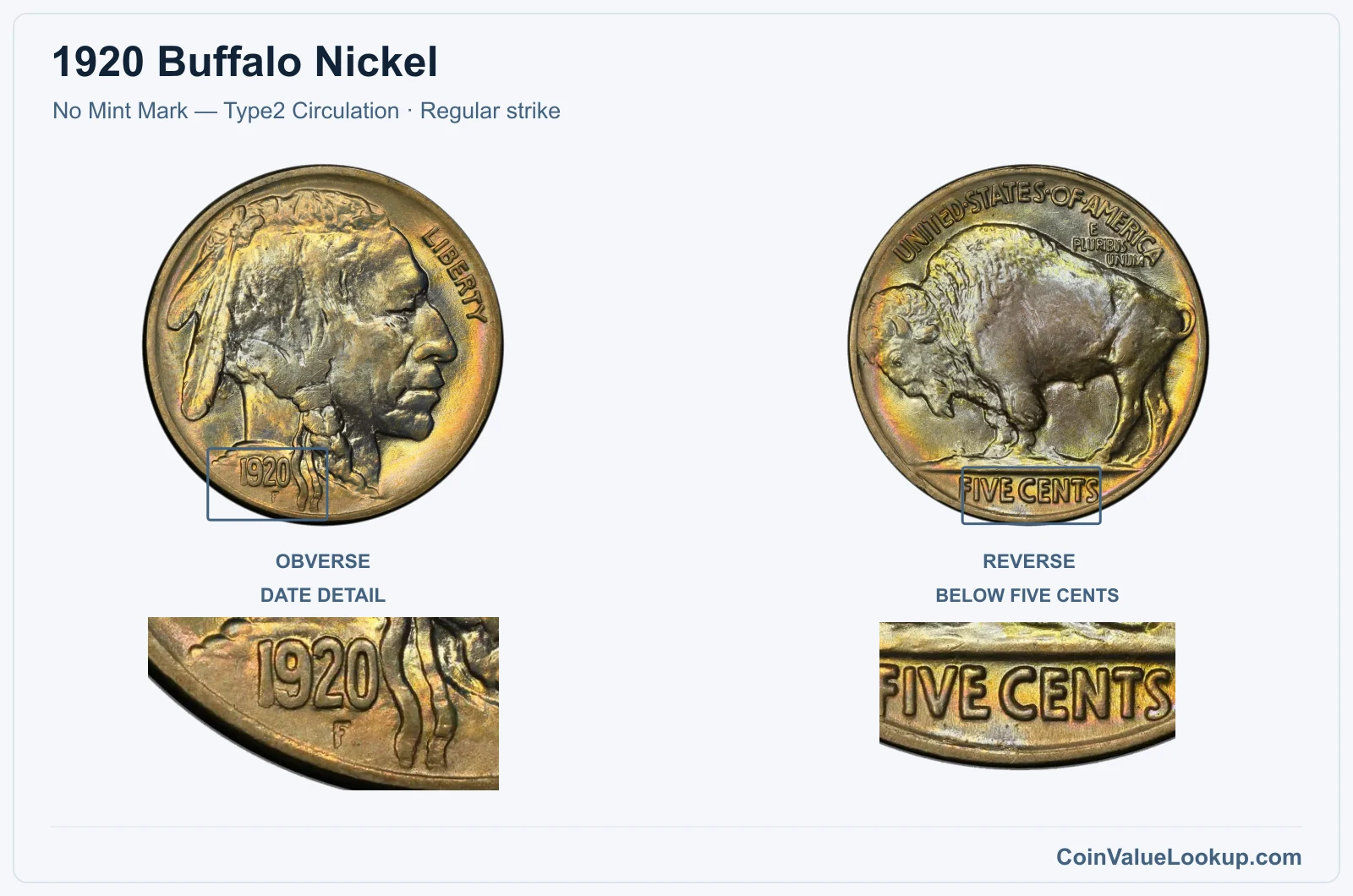
The 1920 Philadelphia Buffalo Nickel has no mintmark. Look at the reverse below FIVE CENTS; the field should be empty.
This is the most available mint for the date.
USA Coin Book guide estimates run from about $2.50 in G4 up to $178 in MS63. The jump from circulated grades to mint state is steep because many surviving examples saw heavy use.
Finding one with full, original luster and a sharp strike takes patience.
Coin Value Lookup is a good place to start when you want to look up guides for other dates and mints in the Buffalo Nickel series.
Range Grade
Price Auction Records Appraisal PO PO 1
—
Coin Identifier FR FR 2
—
Coin Identifier AG AG 3
—
Coin Identifier G G 4
—
Coin Identifier
G 6
—
Coin Identifier VG VG 8
—
Coin Identifier
VG 10
—
Coin Identifier F F 12
Coin Identifier
F 15
Coin Identifier VF VF 20
—
Coin Identifier
VF 25
Coin Identifier
VF 30
—
Coin Identifier
VF 35
—
Coin Identifier XF XF 40
—
Coin Identifier
XF 45
Coin Identifier AU AU 50
—
Coin Identifier
AU 53
—
Coin Identifier
AU 55
Coin Identifier
AU 58
Coin Identifier MS MS 60
Coin Identifier
MS 61
Coin Identifier
MS 62
Coin Identifier
MS 63
Coin Identifier
MS 64
Coin Identifier
MS 65
Coin Identifier
MS 66
Coin Identifier
MS 67
Coin Identifier
MS 68
—
—
—
MS 69
—
—
—
MS 70
—
—
—
1920 Buffalo Nickel — D — Type2 Circulation
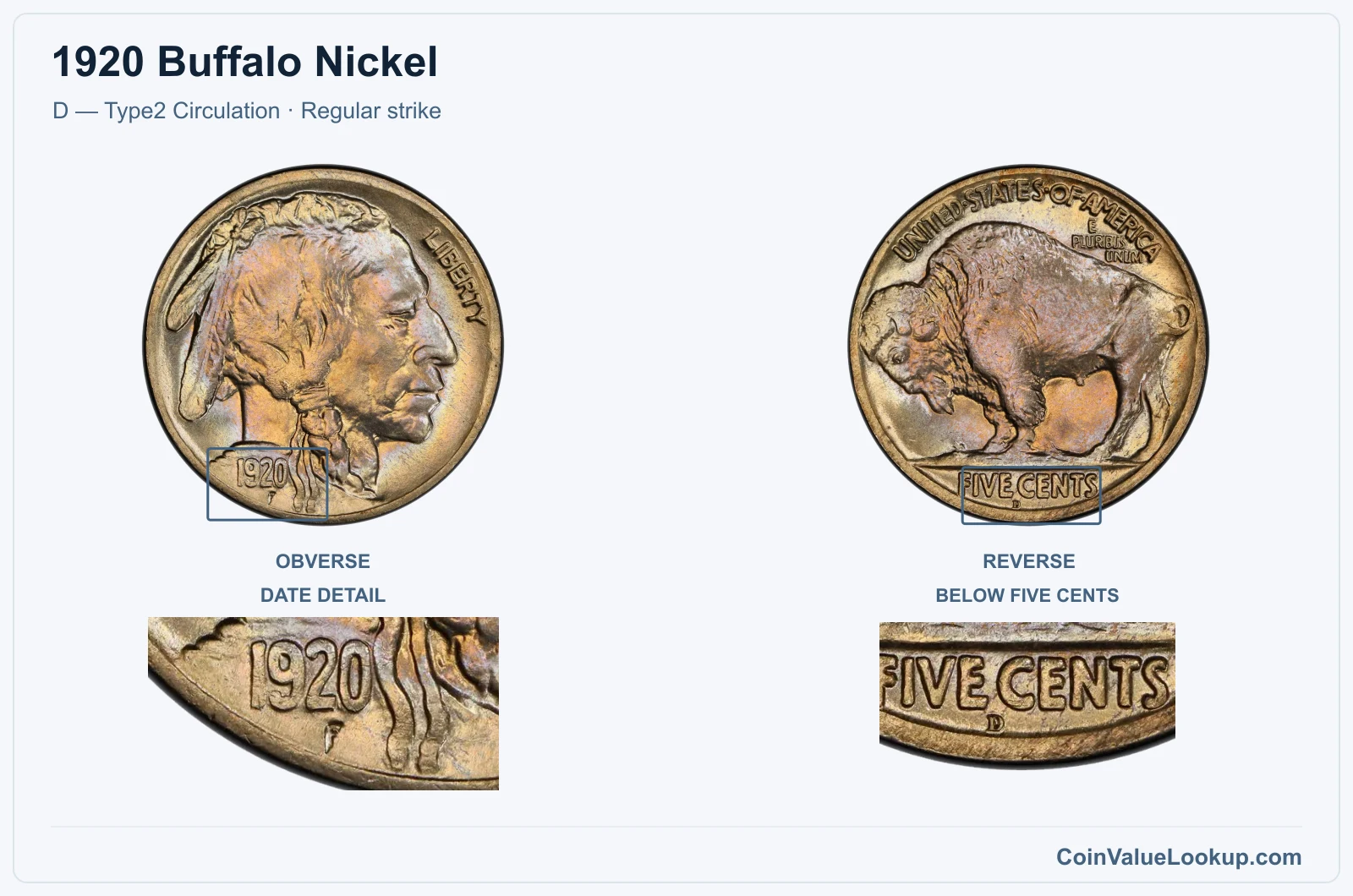
The 1920-D carries a small D mintmark on the reverse, positioned below FIVE CENTS. It is a considerably scarcer coin than its Philadelphia sibling, and the market reflects that.
USA Coin Book guide estimates range from about $15 in G4 to $1,747 in MS63. That is a dramatic spread, and it tells you that well-preserved examples are genuinely hard to find.
Strike quality on Denver issues this year can be uneven, so do not assume a soft horn automatically means heavy wear. Compare multiple features before drawing conclusions about grade.
Range Grade
Price Auction Records Appraisal PO PO 1
—
Coin Identifier FR FR 2
—
Coin Identifier AG AG 3
—
Coin Identifier G G 4
—
Coin Identifier
G 6
Coin Identifier VG VG 8
—
Coin Identifier
VG 10
Coin Identifier F F 12
—
Coin Identifier
F 15
Coin Identifier VF VF 20
Coin Identifier
VF 25
Coin Identifier
VF 30
Coin Identifier
VF 35
Coin Identifier XF XF 40
Coin Identifier
XF 45
Coin Identifier AU AU 50
Coin Identifier
AU 53
Coin Identifier
AU 55
Coin Identifier
AU 58
Coin Identifier MS MS 60
—
Coin Identifier
MS 61
Coin Identifier
MS 62
Coin Identifier
MS 63
Coin Identifier
MS 64
Coin Identifier
MS 65
Coin Identifier
MS 66
Coin Identifier
MS 67
Coin Identifier
MS 68
—
—
—
MS 69
—
—
—
MS 70
—
—
—
1920 Buffalo Nickel — S — Type2 Circulation
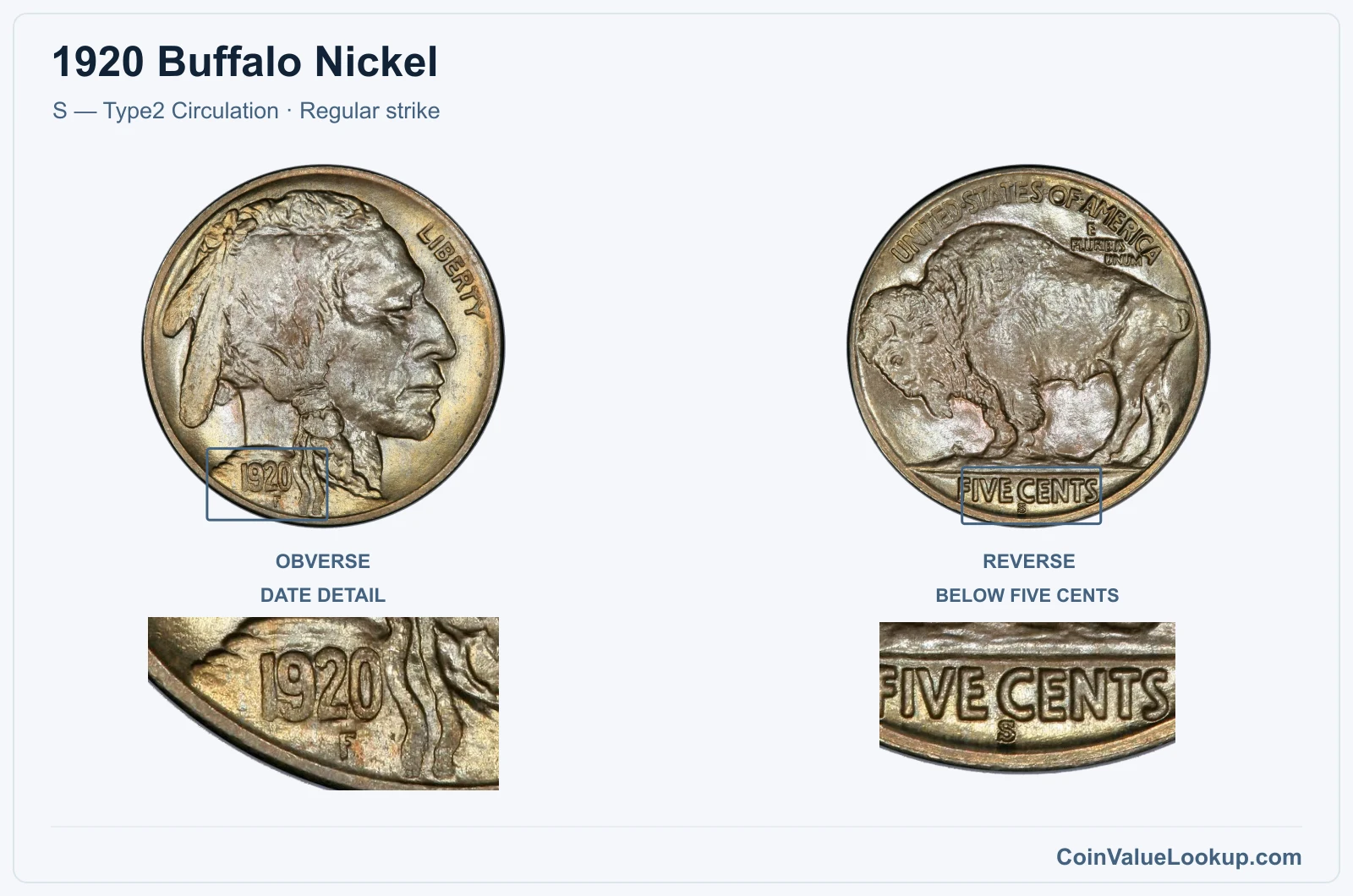
The 1920-S shows an S mintmark on the reverse below FIVE CENTS. San Francisco struck fewer high-grade survivors than either Philadelphia or Denver for this date, and that scarcity drives strong premiums.
USA Coin Book guide estimates place this coin at about $12 in G4 and up to $2,033 in MS63, the highest listed value among the three 1920 mints at that grade. Strike softness is a known characteristic, so careful comparison between wear and original striking weakness is essential.
A genuinely sharp, lustrous MS example is a serious coin.
Range Grade
Price Auction Records Appraisal PO PO 1
—
Coin Identifier FR FR 2
—
Coin Identifier AG AG 3
—
Coin Identifier G G 4
—
Coin Identifier
G 6
—
Coin Identifier VG VG 8
Coin Identifier
VG 10
Coin Identifier F F 12
Coin Identifier
F 15
Coin Identifier VF VF 20
Coin Identifier
VF 25
Coin Identifier
VF 30
Coin Identifier
VF 35
Coin Identifier XF XF 40
Coin Identifier
XF 45
Coin Identifier AU AU 50
Coin Identifier
AU 53
Coin Identifier
AU 55
Coin Identifier
AU 58
Coin Identifier MS MS 60
Coin Identifier
MS 61
Coin Identifier
MS 62
Coin Identifier
MS 63
Coin Identifier
MS 64
Coin Identifier
MS 65
Coin Identifier
MS 66
Coin Identifier
MS 67
—
—
—
MS 68
—
—
—
MS 69
—
—
—
MS 70
—
—
—
1920 Buffalo Nickel Error List
1. 1920 Buffalo Nickel — Wrong Planchet / Off-Metal Strike
A wrong-planchet 1920 Buffalo Nickel was struck on a blank intended for a different denomination. The reported scope covers a Philadelphia cent-planchet strike.
To check, compare your coin's weight, diameter, and edge against normal specifications of 5 grams and 21.2 mm. A coin struck on a cent blank will typically be lighter, smaller, or show incomplete design at the periphery because the planchet does not fill the die cavity.
Do not confuse this error with plating loss, corrosion, acid treatment, or deliberate alteration, all of which can change a coin's color and apparent size. Value depends on the specific off-metal denomination, how complete the design is, and the coin's overall condition.
2. 1920 Buffalo Nickel — Broadstrike
A broadstrike happens when the collar die fails to contain the blank during striking. The result is a coin with metal spreading outward beyond normal diameter, but the design is still roughly centered.
Reported examples exist from the Philadelphia and San Francisco mints for 1920. Look for a coin that is wider than 21.2 mm with design elements fading or distorted near the rim rather than sharply contained by it.
The edge profile will differ from a normal piece.
Do not confuse a broadstrike with an off-center strike, which shifts the entire design, or with a coin that was flattened after leaving the mint by a train wheel or vise. Value depends on the degree of spread, eye appeal, and overall condition.
3. 1920 Buffalo Nickel — Lamination / Split Planchet
Lamination errors on 1920 Buffalo Nickels result from impurities or trapped gas within the copper-nickel alloy. The reported scope covers a Philadelphia split-planchet pair.
Look for a flap of metal peeling away from the coin's surface, or a coin that has separated into two thinner halves. Photograph the edge and the affected face together so the separation is clear.
This error can be confused with post-mint scraping, corrosion pitting, or a coin that was deliberately cut or filed. Genuine laminations follow the internal structure of the planchet rather than showing tool marks.
Value depends on the size and visibility of the separation, whether both halves survive, and overall condition.
4. 1920 Buffalo Nickel — Off-Center Strike
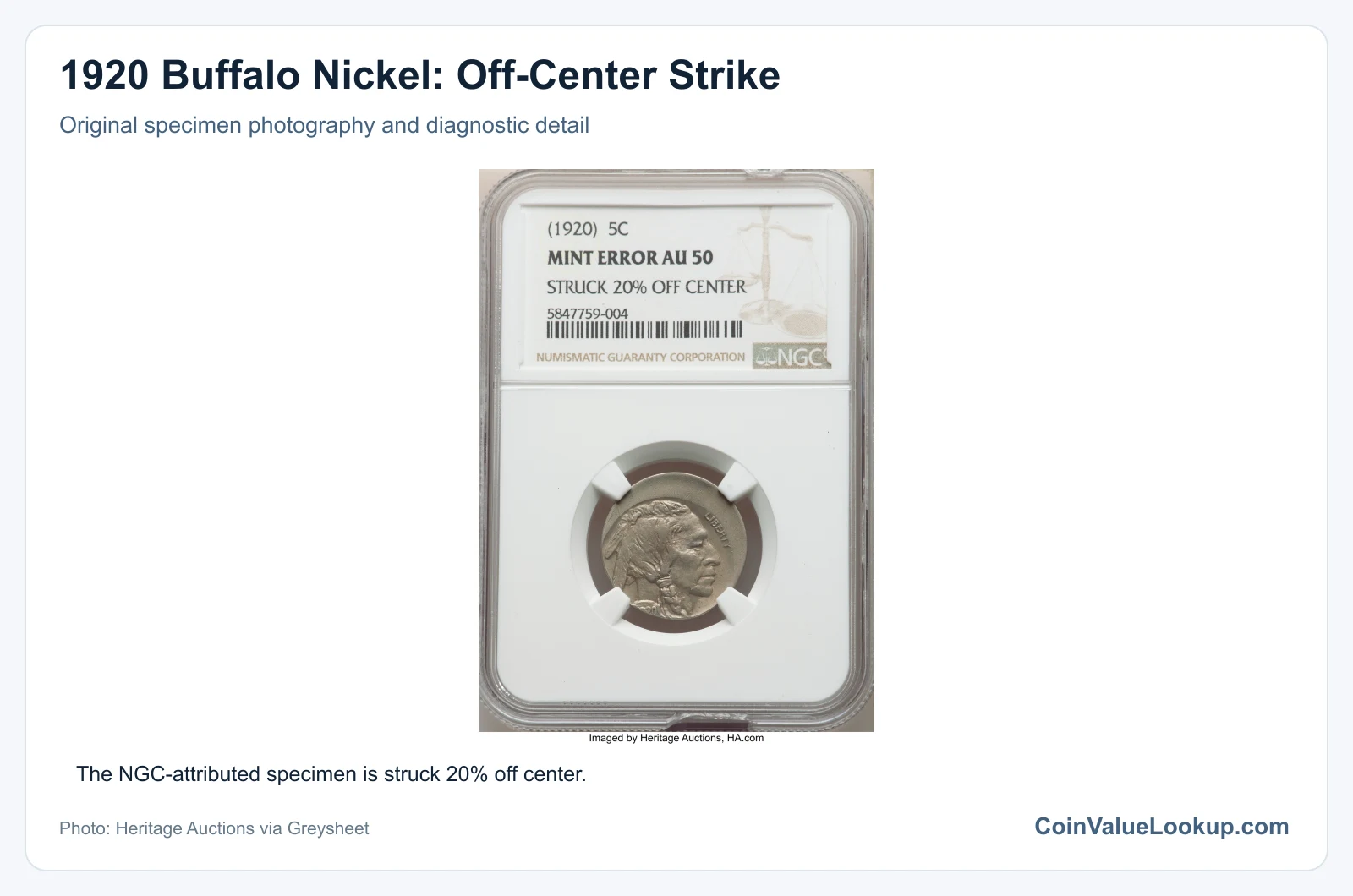
An off-center strike occurs when the planchet is not seated properly between the dies. The design shifts to one side, leaving an unstruck crescent of blank metal on the opposite edge.
Off-center 1920 Buffalo Nickels have been reported from Philadelphia, Denver, and San Francisco. The most desirable examples retain a readable date, since that confirms the year.
Without a visible date, the coin loses much of its specific attribution.
Do not mistake a clipped planchet, one-sided die misalignment, or post-mint damage for a genuine off-center error. The unstruck area should be smooth, original planchet surface.
Value depends on the percentage off center, date visibility, and condition.
5. 1920 Buffalo Nickel — Struck-Through Error
A struck-through error happens when foreign material sits between the die and the planchet during striking. The result is a localized depression, a missing design element, or an impression of the intervening object on the coin's surface.
The reported example involves a Philadelphia 1920 nickel with a filled reverse denomination area. Grease fills are one common variety; a retained foreign object is another, and they look quite different.
Ordinary weak detail from die wear, light strikes, or cleaning can mimic a struck-through appearance. A genuine struck-through area will show a distinct depression or texture change compared to surrounding surfaces.
Value varies with the size, location, and visual clarity of the error.
6. 1920 Buffalo Nickel — Die Break / Cud
A cud forms when a chunk of the die breaks away at the rim. The missing die section leaves a raised, featureless blob of metal on the finished coin, connected to the rim.
Interior die breaks also exist but do not technically qualify as cuds.
Reported examples for 1920 come from both Philadelphia and Denver. Look for a raised lump that merges into the rim and obliterates part of the design beneath it.
Multiple die stages can exist as the break progresses.
Do not confuse a cud with a rim dent, corrosion buildup, or a small interior die chip. A genuine cud has a smooth, raised surface and always touches the rim.
Value depends on the cud's size, location, and the coin's overall condition.
7. 1920 Buffalo Nickel — Rotated Dies
A rotated-die error means the reverse die was not properly aligned relative to the obverse die. Normal US coins have a 180-degree medal turn: hold the obverse upright, flip the coin top to bottom, and the reverse should also appear upright.
The reported example is a 1920-D. To test yours, hold the obverse so the Native American faces right, then rotate the coin on its vertical axis.
If the bison on the reverse is tilted, you may have a rotation error.
Be careful with photographs. A rotated image file is not a rotated die.
Confirm the rotation physically. Value depends on the degree of rotation and the coin's condition; minor rotations are less desirable than dramatic ones.
8. 1920 Buffalo Nickel — Repunched Mintmark
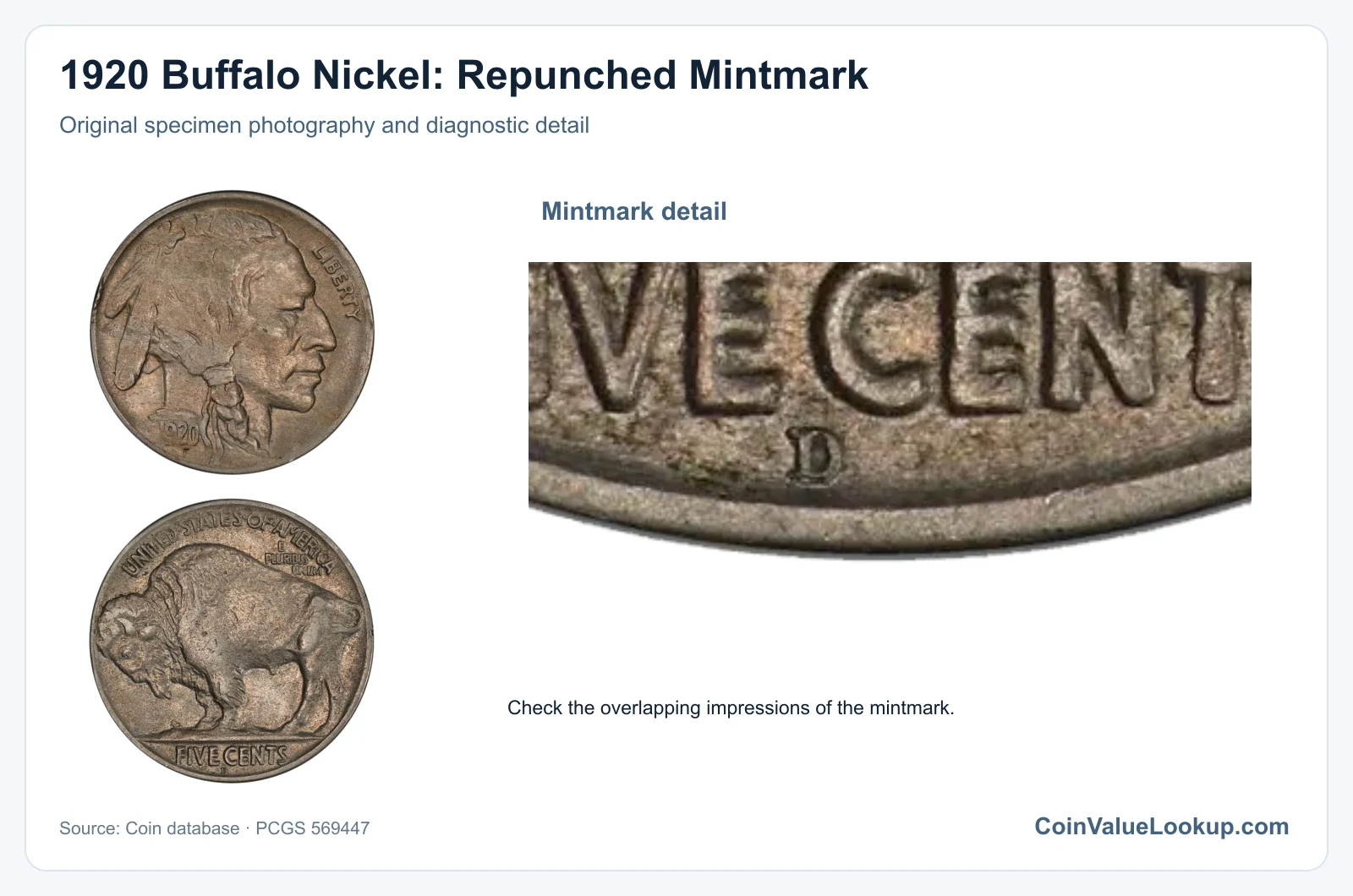
A repunched mintmark occurs when the mintmark punch was applied more than once in slightly different positions, leaving traces of the earlier impression. The reported variety is a 1920-D with a repunched D.
Examine the D below FIVE CENTS under magnification. Look for remnants of a second D offset from the primary mark, often visible as a shadow or partial letter to one side.
Compare your coin's mintmark to a normal 1920-D at the same magnification so you have a baseline.
Machine doubling, small die chips, and corrosion around the mintmark can all mimic a repunched appearance. Value depends on the clarity of the repunching, the coin's grade, and overall eye appeal.
9. 1920 Buffalo Nickel — Two Feathers / Abraded Third Feather
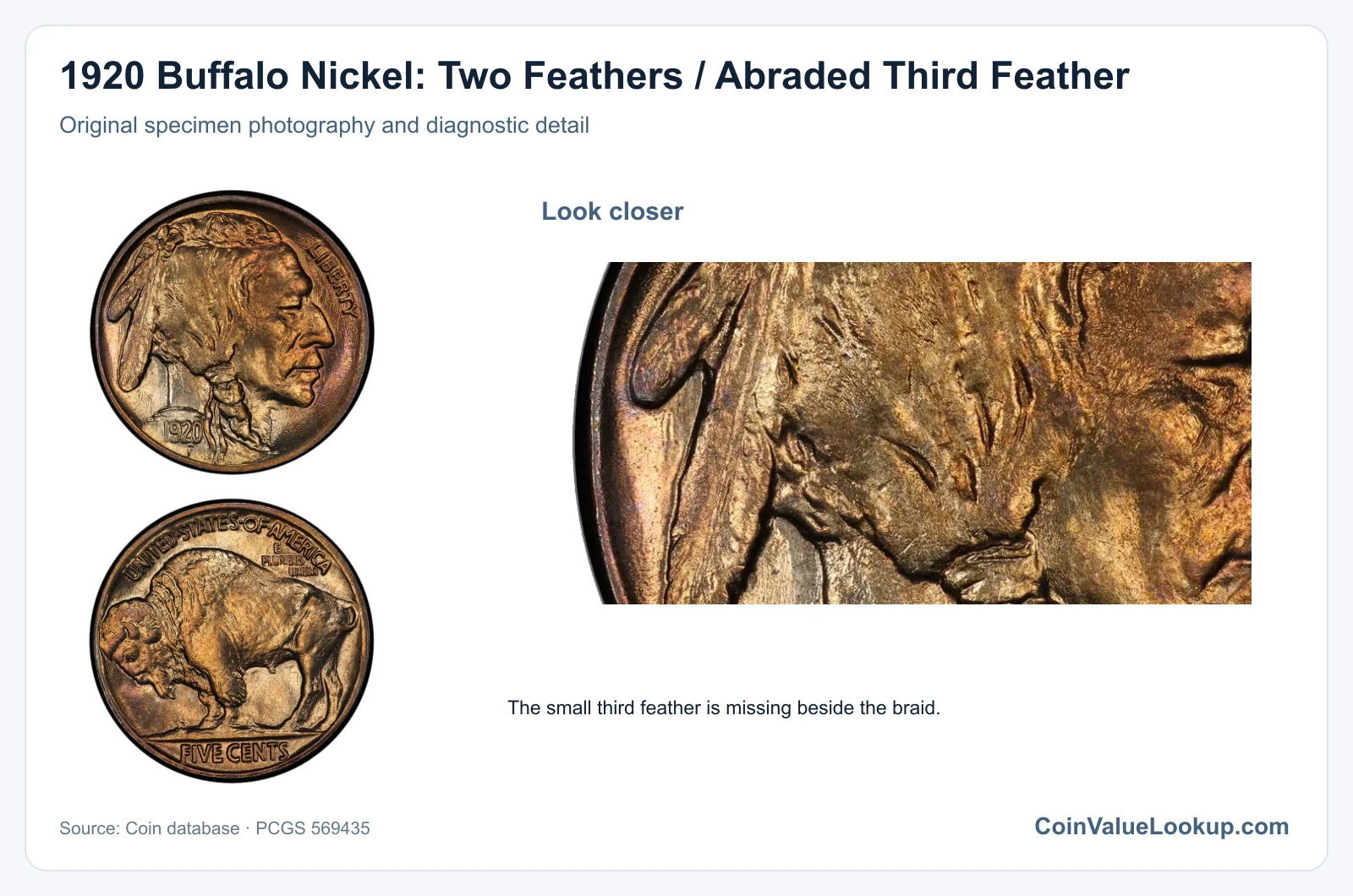
The normal Buffalo Nickel obverse shows three feathers trailing from the braid behind the Native American's head. The Two Feathers variety on the 1920-S shows an abraded or missing third feather, the small one closest to the neck.
Compare that area carefully against a normal three-feather example. The missing feather should be absent or show only a faint remnant, not simply weakened by overall wear across the entire coin.
Generalized strike weakness, grease-filled dies, heavy circulation, and deliberate scraping can all reduce feather detail. The key distinction is that a genuine Two Feathers coin shows an isolated absence of the third feather while other nearby details remain comparatively sharp.
Value depends on condition and how clearly the variety is expressed.