1985 Roosevelt Dime Coin Value: How Much Is It Worth?
Most 1985 Roosevelt dimes you pull from a jar are worth face value — ten cents. In higher uncirculated grades, USA Coin Book lists both the Philadelphia and Denver issues at about $2.79 in MS 65, while a standard San Francisco proof starts around $3.62 in PR 65.
The real action comes from error coins and well-preserved specimens with crisp torch detail, so it pays to look closely before spending one at the gas station.
Fast Way to Identify Your 1985 Roosevelt Dime
Snap a clear photo of the front and back of your 1985 dime and upload both images here. Our identifier can give you a preliminary read on the mint mark, general condition, and whether anything unusual jumps out.
It is not a substitute for professional authentication, but it is a solid first step toward figuring out what you have.
1985 Roosevelt Dime Value
Upload both sides of your 1985 Roosevelt Dime.
Front Obverse
Upload photo
Back Reverse
Upload photo
Which 1985 Roosevelt Dime Versions Are Worth Money?
- Business strikes from Philadelphia or Denver with full original luster and separated torch bands can reach guide values well above face in MS 65 condition.
- San Francisco proofs with strong contrast between frosted devices and mirrored fields are the collectible proof option for 1985.
- Off-center strikes with visible date and a blank crescent are a documented error category for 1985 dimes.
- Two-planchet bonded pairs, where two blanks were fused during striking, are a rare and dramatic mint error recorded for the 1985-P.
Step 1: Identify Your 1985 Roosevelt Dime Mint Mark and Version
Start by confirming the date reads 1985 and the obverse shows Roosevelt's portrait facing left. Flip it over — you should see a torch flanked by olive and oak branches.
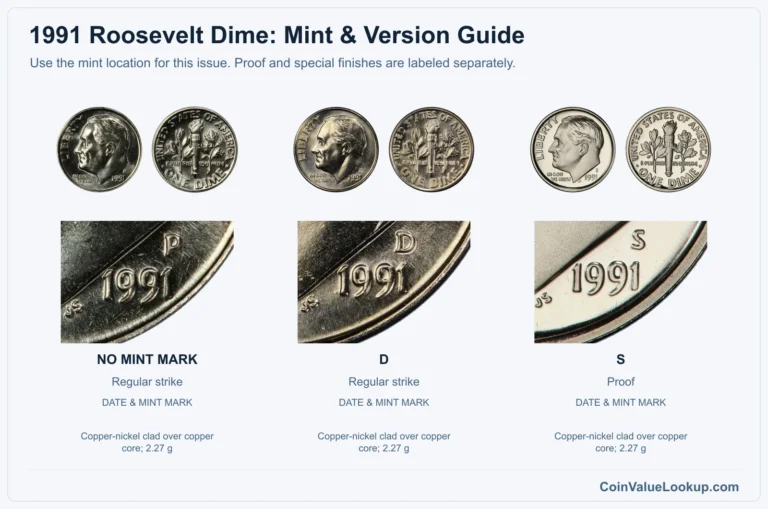
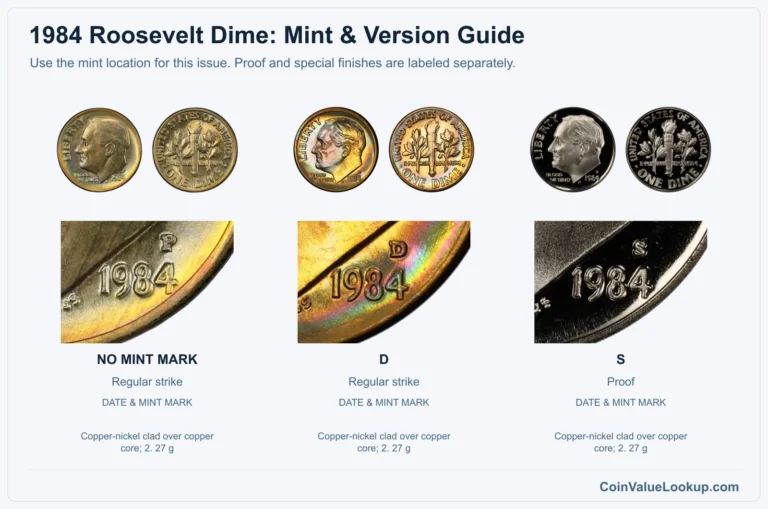
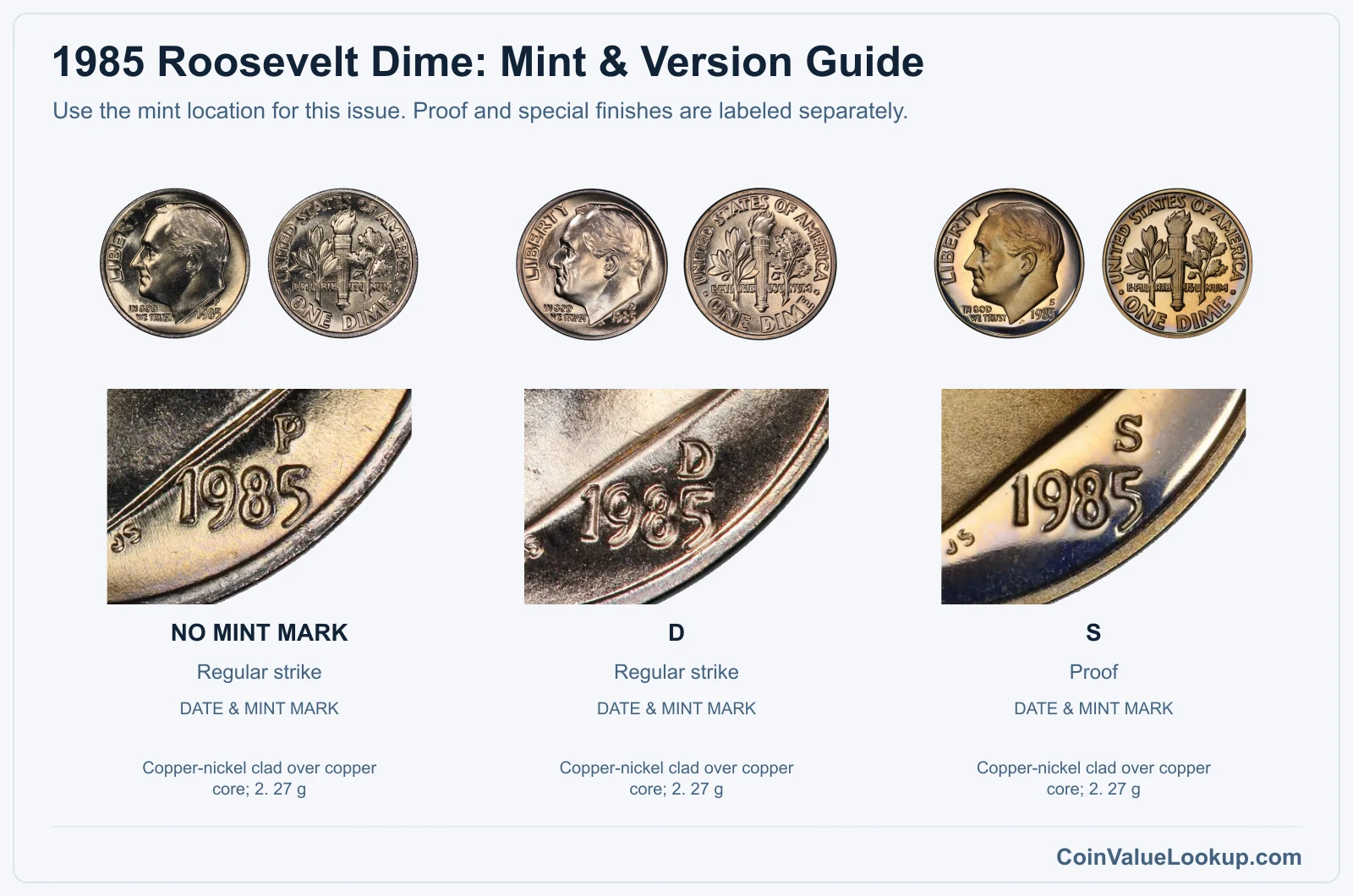
Now look just above the date on the obverse for the mint mark. A "P" means Philadelphia, a "D" means Denver, and an "S" indicates a San Francisco proof.
There is no supported silver version or missing-mint-mark variety for 1985.
The coin is copper-nickel clad, weighs about 2.27 grams, and measures roughly 17.9 mm across. If the edge looks like a sandwich of silver-colored layers over a copper core, that is normal.
A coin that feels noticeably lighter or heavier, or shows an unusual color on one face, may be an error worth investigating further.
Step 2: Check Your 1985 Roosevelt Dime Grade
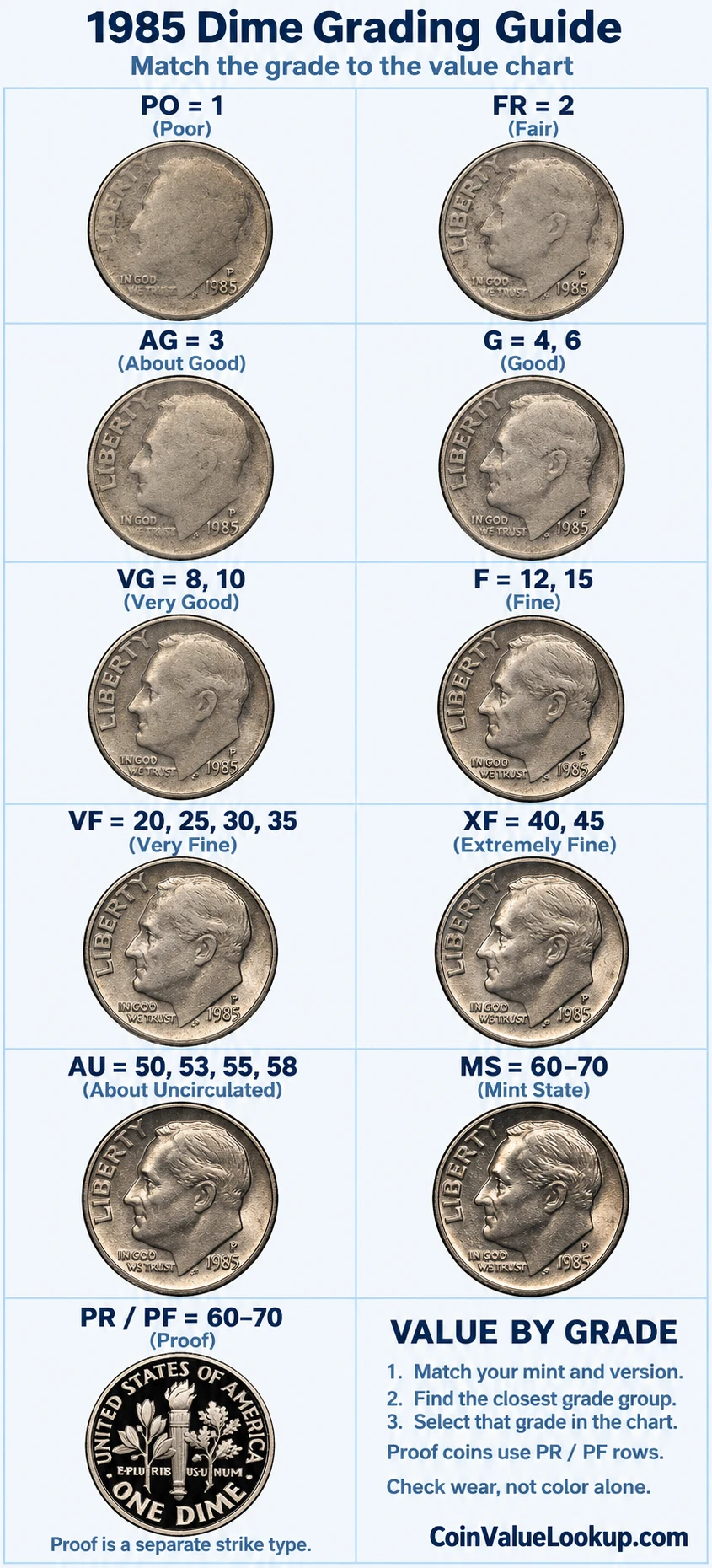
Focus on four areas when judging wear. Roosevelt's cheekbone and jawline are the first places to lose detail, followed by the hair above his ear.
On the reverse, examine the horizontal bands on the torch and the leaf veins.
A coin with no wear and full original luster falls into the Mint State range. The comparison image nearby shows you what different grades look like side by side — match yours to the closest example.
Scratches, cleaning marks, and fingerprint damage all drag the grade down, even if the coin was never spent. Proof coins are evaluated similarly but on a proof scale (PR rather than MS), and their mirror-like fields and frosted devices are features of the manufacturing process, not indicators of a higher grade.
Full Bands — where both horizontal torch bands are completely separated — is a strike designation that collectors pay attention to. It is not an error, just a sign of a strong strike.
Step 3: Check 1985 Roosevelt Dime Value by Mint and Version
1985 Roosevelt Dime — P Business Strike
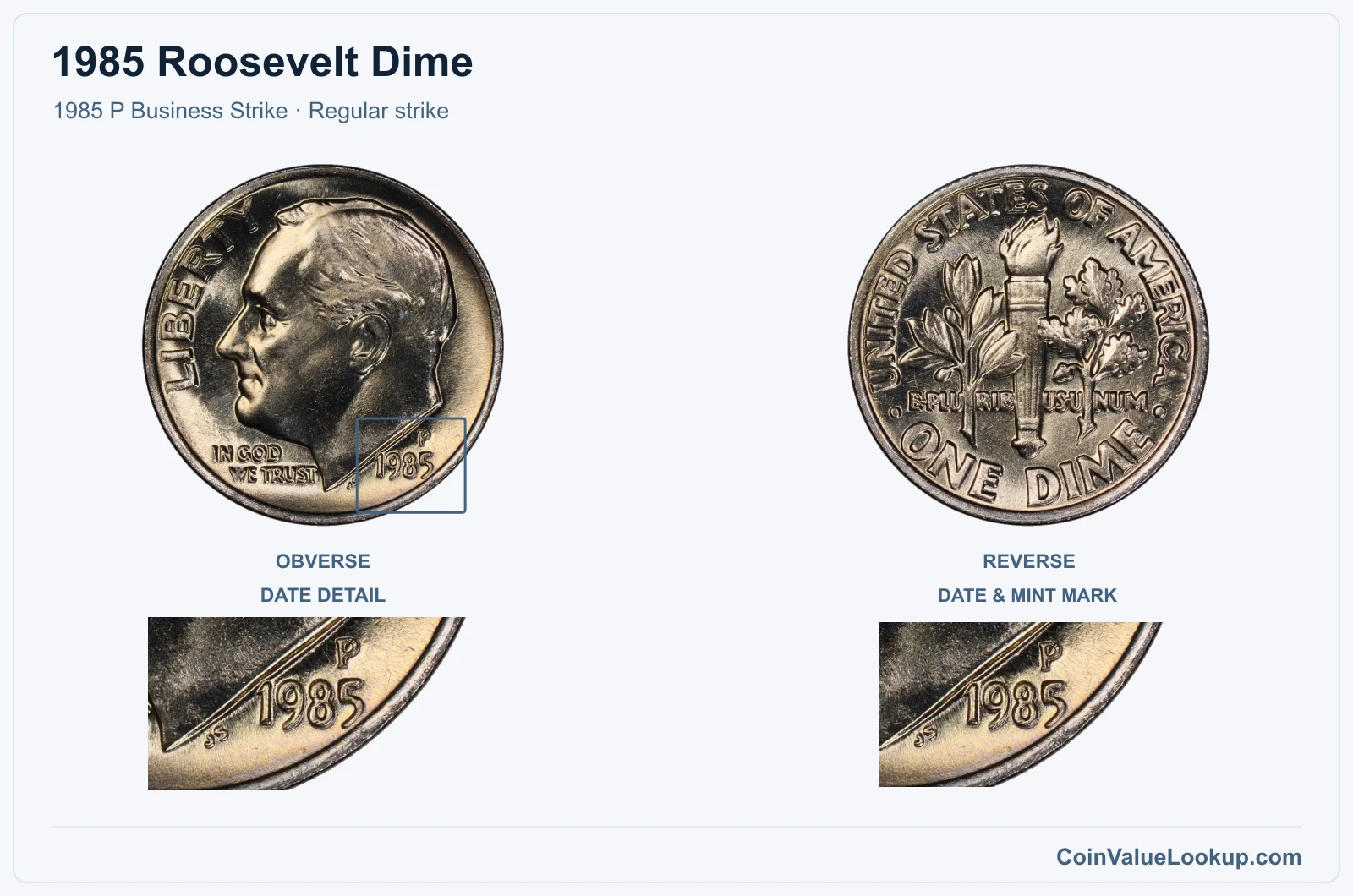
The 1985-P was struck at Philadelphia and carries a small "P" mint mark near the date. It is copper-nickel clad over a copper core, weighing about 2.27 grams.
Circulated examples are worth face value. In MS 65, USA Coin Book places the guide estimate at $2.79.
Coins with fully separated horizontal torch bands — the Full Bands designation — tend to attract more collector interest, so check the reverse closely under magnification before tossing it back in the change pile.
Range Grade
Price Auction Records Appraisal PO PO 1
—
Coin Identifier FR FR 2
—
Coin Identifier AG AG 3
—
Coin Identifier G G 4
—
Coin Identifier
G 6
—
Coin Identifier VG VG 8
—
Coin Identifier
VG 10
—
Coin Identifier F F 12
—
Coin Identifier
F 15
—
Coin Identifier VF VF 20
—
Coin Identifier
VF 25
—
Coin Identifier
VF 30
—
Coin Identifier
VF 35
—
Coin Identifier XF XF 40
—
Coin Identifier
XF 45
—
Coin Identifier AU AU 50
—
Coin Identifier
AU 53
—
Coin Identifier
AU 55
—
Coin Identifier
AU 58
—
Coin Identifier MS MS 60
—
Coin Identifier
MS 61
—
Coin Identifier
MS 62
—
Coin Identifier
MS 63
—
Coin Identifier
MS 64
—
Coin Identifier
MS 65
—
Coin Identifier
MS 66
Coin Identifier
MS 67
Coin Identifier
MS 68
—
—
—
MS 69
—
—
—
MS 70
—
—
—
1985 Roosevelt Dime — D Business Strike
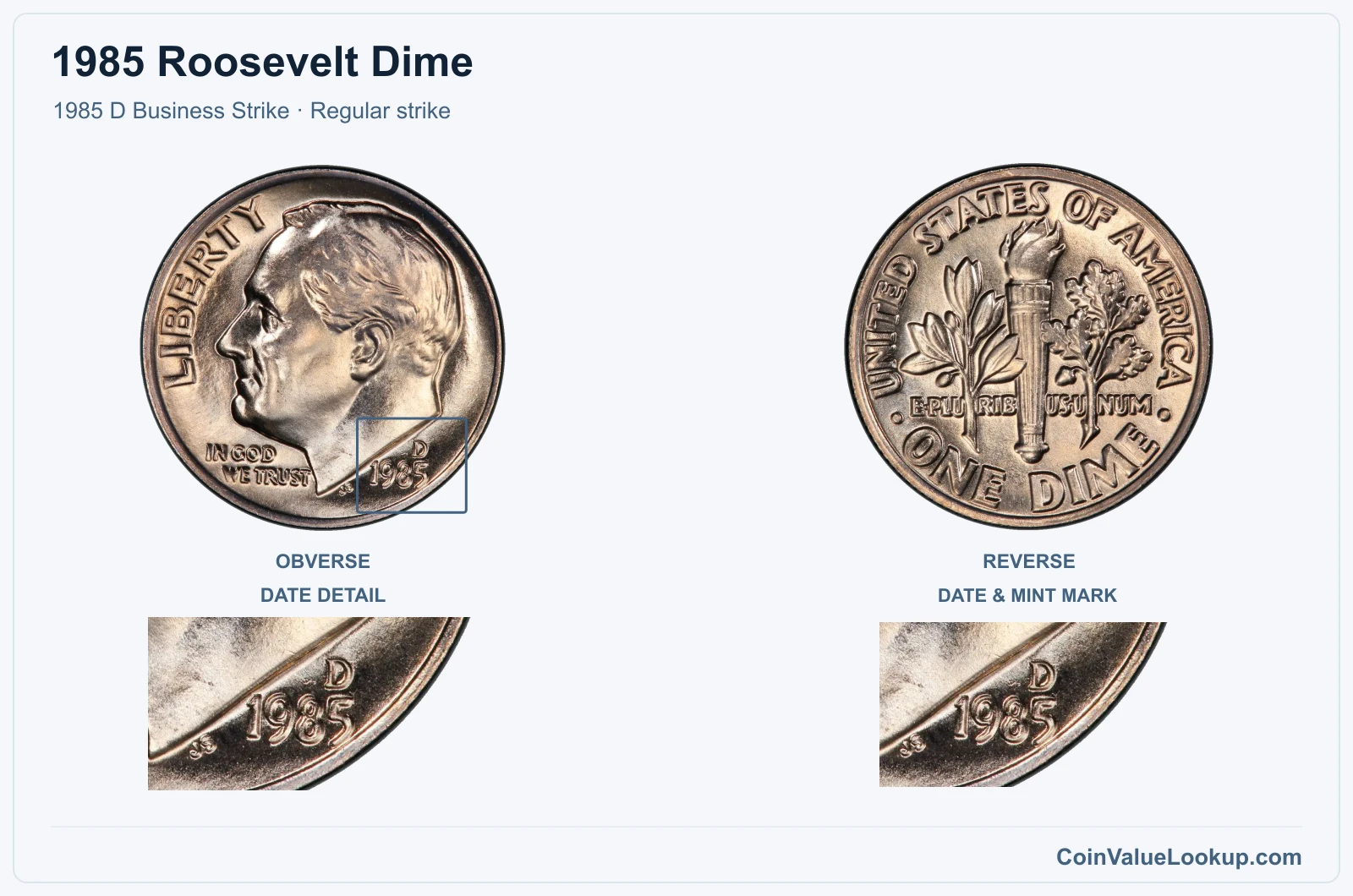
Denver's 1985-D dime is identical in composition and design to the Philadelphia issue but carries a "D" mint mark. In everyday circulated condition it is a ten-cent coin.
The USA Coin Book guide lists MS 65 at $2.79, the same as the Philadelphia strike. As with the P, look for strong torch bands and clean, original surfaces.
Those details separate a common coin from one a collector might want.
Coin Value Lookup is a handy place to check guide values for other dates and denominations while you are sorting through a roll.
Range Grade
Price Auction Records Appraisal PO PO 1
—
Coin Identifier FR FR 2
—
Coin Identifier AG AG 3
—
Coin Identifier G G 4
—
Coin Identifier
G 6
—
Coin Identifier VG VG 8
—
Coin Identifier
VG 10
—
Coin Identifier F F 12
—
Coin Identifier
F 15
—
Coin Identifier VF VF 20
—
Coin Identifier
VF 25
—
Coin Identifier
VF 30
—
Coin Identifier
VF 35
—
Coin Identifier XF XF 40
—
Coin Identifier
XF 45
—
Coin Identifier AU AU 50
—
Coin Identifier
AU 53
—
Coin Identifier
AU 55
—
Coin Identifier
AU 58
—
Coin Identifier MS MS 60
—
Coin Identifier
MS 61
—
Coin Identifier
MS 62
—
Coin Identifier
MS 63
—
Coin Identifier
MS 64
—
Coin Identifier
MS 65
—
Coin Identifier
MS 66
Coin Identifier
MS 67
Coin Identifier
MS 68
Coin Identifier
MS 69
—
—
—
MS 70
—
—
—
1985 Roosevelt Dime — S Proof
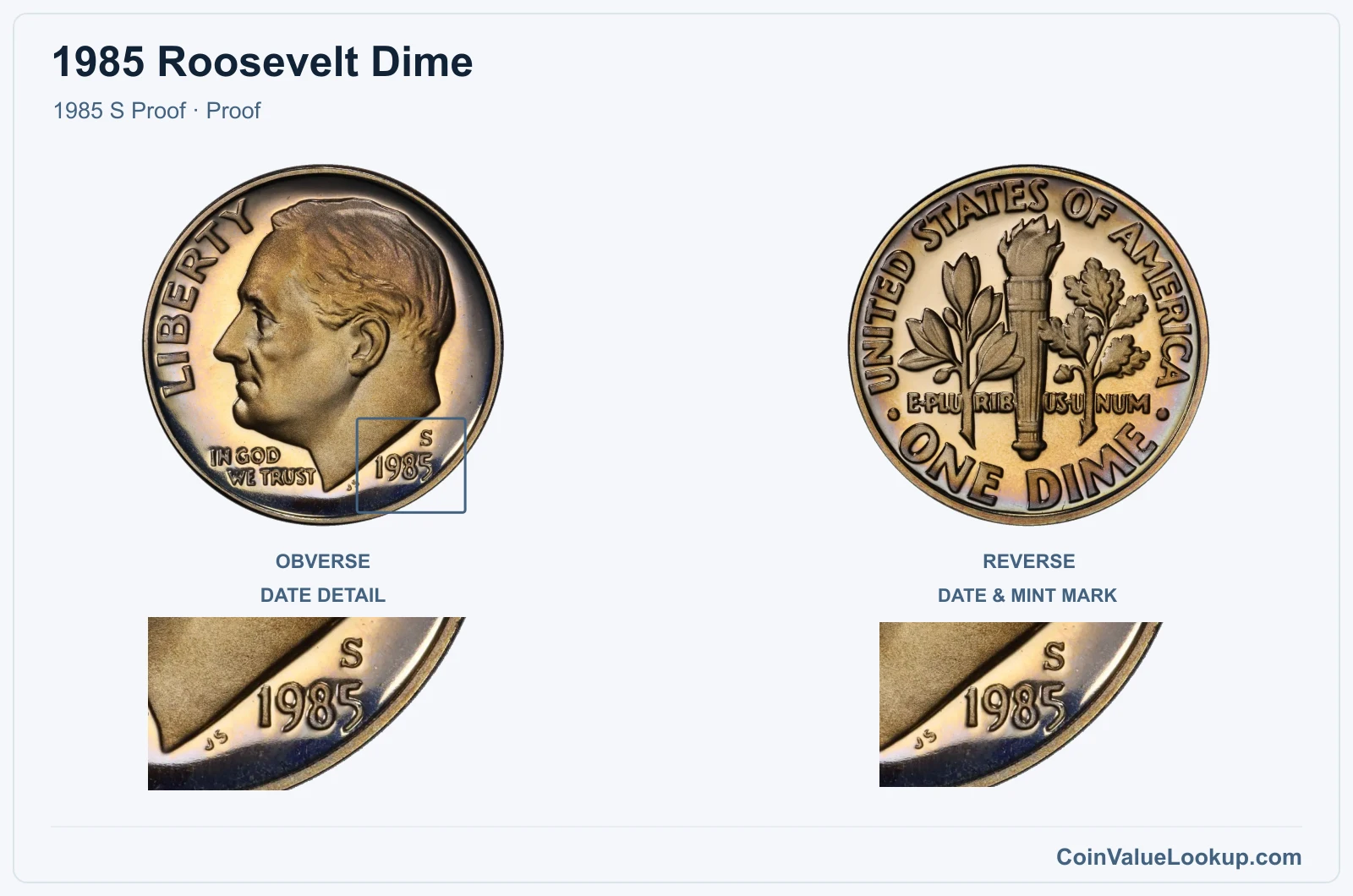
San Francisco produced proof dimes for collectors in 1985, struck on the same copper-nickel clad composition as the business issues. The "S" mint mark sits near the date.
These were sold in official proof sets, so most survived in excellent condition. USA Coin Book lists the PR 65 guide estimate at $3.62.
Cameo or deep cameo contrast — where the raised design elements appear frosty against mirror-bright fields — is a manufacturing characteristic, not a separate variety, but it does influence collector appeal within the same proof designation.
Range Grade
Price Auction Records Appraisal PR PR 1
—
Coin Identifier
PR 2
—
Coin Identifier
PR 3
—
Coin Identifier
PR 4
—
Coin Identifier
PR 6
—
Coin Identifier
PR 8
—
Coin Identifier
PR 10
—
Coin Identifier
PR 12
—
Coin Identifier
PR 15
—
Coin Identifier
PR 20
—
Coin Identifier
PR 25
—
Coin Identifier
PR 30
—
Coin Identifier
PR 35
—
Coin Identifier
PR 40
—
Coin Identifier
PR 45
—
Coin Identifier
PR 50
—
Coin Identifier
PR 53
—
Coin Identifier
PR 55
—
Coin Identifier
PR 58
—
Coin Identifier
PR 60
—
Coin Identifier
PR 61
—
Coin Identifier
PR 62
—
Coin Identifier
PR 63
—
Coin Identifier
PR 64
—
Coin Identifier
PR 65
—
Coin Identifier
PR 66
—
Coin Identifier
PR 67
—
Coin Identifier
PR 68
Coin Identifier
PR 69
Coin Identifier
PR 70
Coin Identifier
1985 Roosevelt Dime Error List
1. 1985 Roosevelt Dime — Off-Center Strike
An off-center strike happens when the planchet is not seated properly in the collar before the dies come together. A documented 1985-D example shows about 65% off center toward the 10 o'clock position, leaving a blank crescent on one side while the dated portion of the design remains visible.
That last detail matters — an off-center dime without a readable date is far less desirable.
Do not confuse this with a misaligned die, which shifts the entire design slightly but keeps normal coin dimensions. A true off-center strike has a distinctly incomplete shape.
Pricing depends on the severity, whether the date is legible, and the coin's overall condition; professional authentication helps establish each piece individually.
2. 1985 Roosevelt Dime — Two-Planchet Bonded Pair
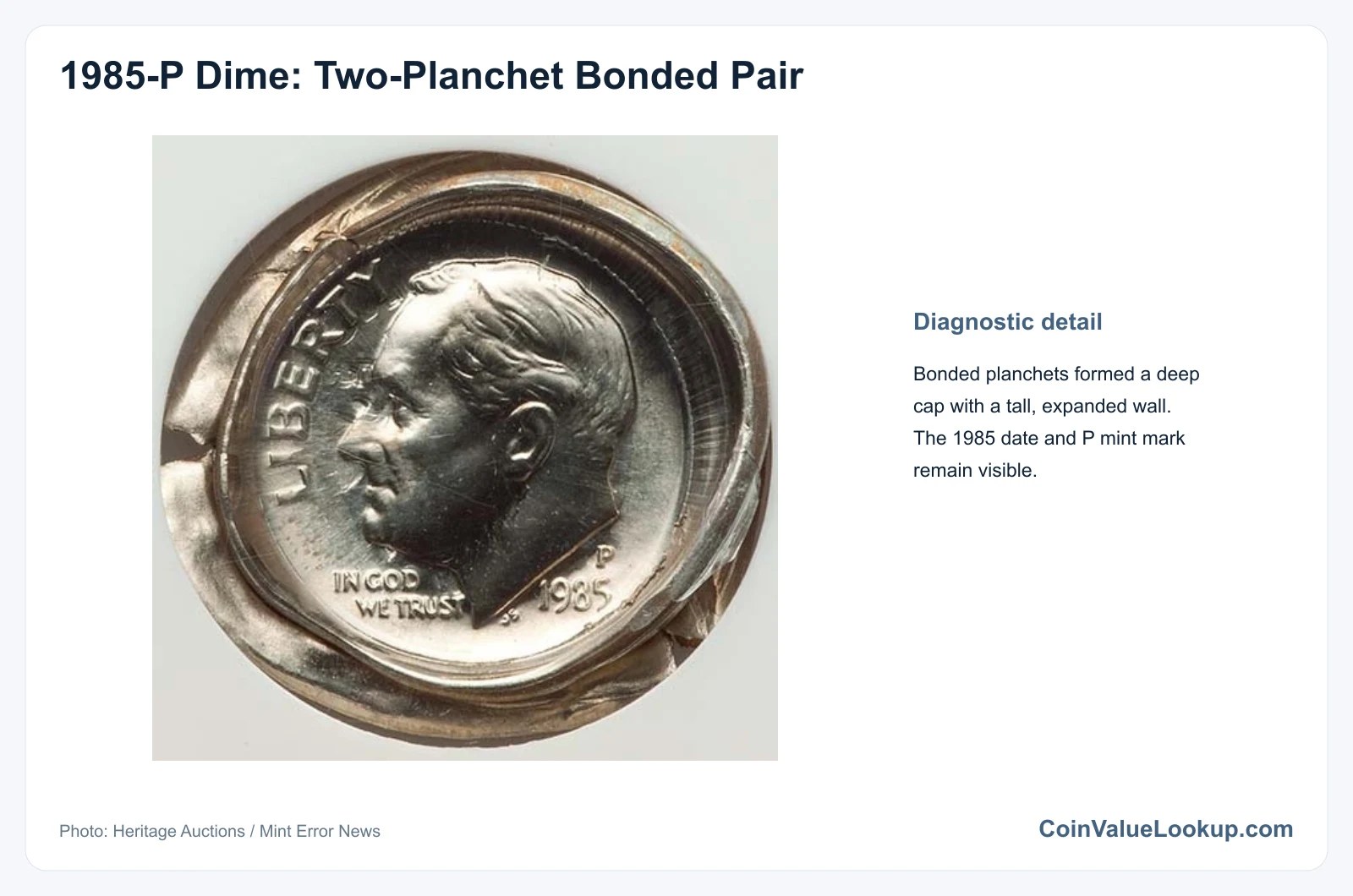
A two-planchet bonded pair is one of the more dramatic mint errors you can encounter. A documented 1985-P example appeared at Heritage Auctions as a bonded pair with a capped-die obverse shape, graded NGC MS 67.
Two blanks were fed into the press simultaneously and fused together by the force of the strike, creating a cupped or cap-like profile visible from the side.
Keep this as a single unit — separating the pieces destroys the error and the value. The key diagnostic is the joined construction visible in the edge view.
Post-mint fakes exist: two coins glued, welded, or pressed together after leaving the mint lack the genuine metal flow and cupping. Condition, authentication, and error severity all factor into individual assessment.
3. 1985 Roosevelt Dime — Clipped Planchet
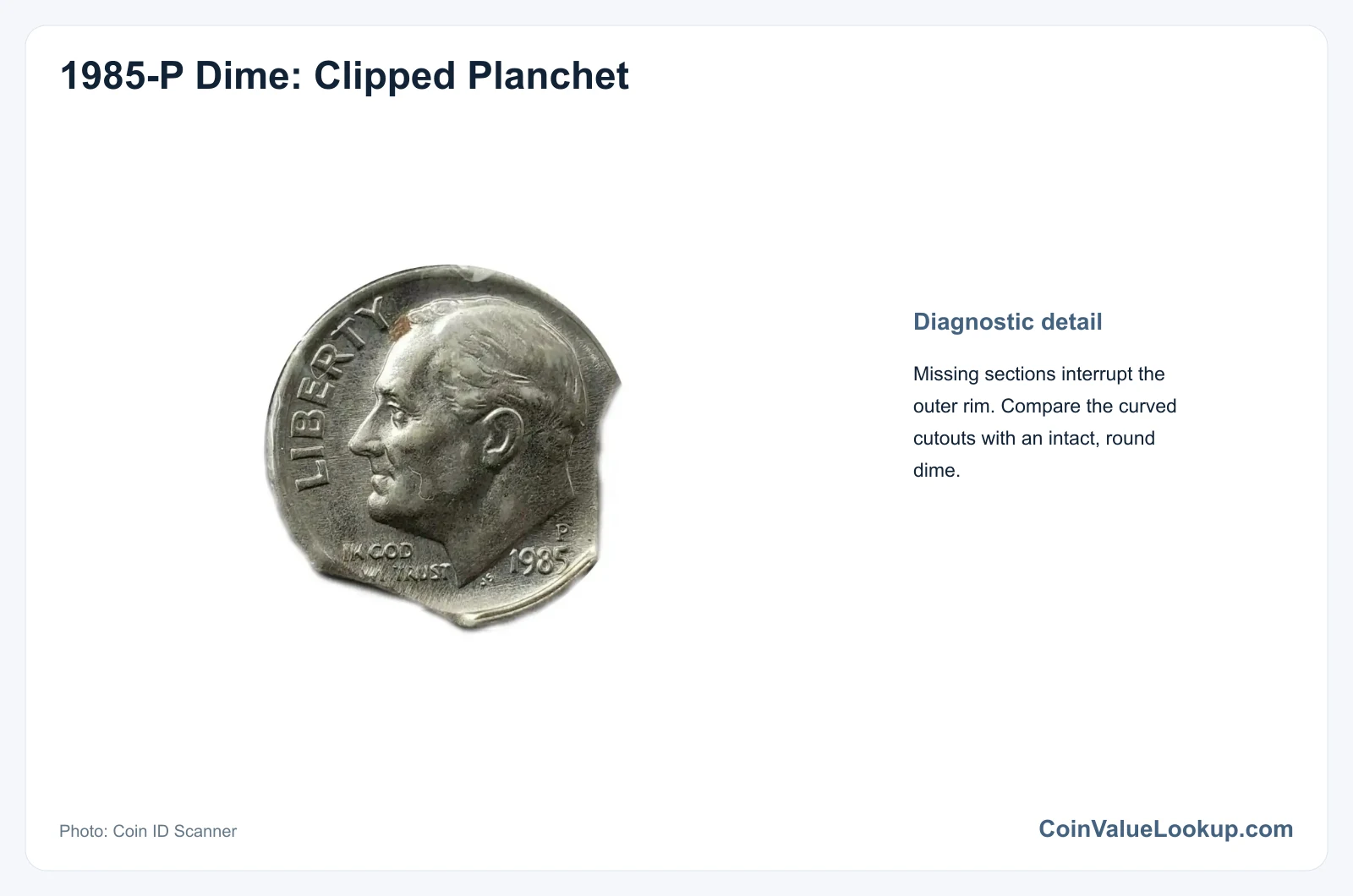
A clipped planchet occurs when the blank is punched improperly from the metal strip, leaving a missing curved, straight, or irregular section along the edge. On a 1985 dime, look for a bite-shaped absence with natural metal-flow characteristics near the clip and corresponding weakness on the opposite side of the coin.
A genuine clip will show undisturbed edge texture where the metal simply was not there. Compare that to a coin with a filed notch, deliberate edge cut, or corrosion damage — those show tool marks or pitting rather than smooth flow.
Value depends on the clip's size, visibility, and the coin's overall condition. Each piece warrants individual assessment.
4. 1985 Roosevelt Dime — Doubled Die Obverse
A doubled die obverse on a 1985 dime shows consistent doubling in the obverse lettering or design elements caused during die creation. Under magnification, look for a clear separation or notching on letters like LIBERTY or IN GOD WE TRUST rather than a flat, shelf-like distortion.
The flat shelf is the hallmark of machine doubling, which is far more common and adds little to no premium. Reflections from lighting angles can also mimic doubling to the untrained eye.
Compare your coin directly against a known normal example under the same light. Pricing varies based on the strength and location of the doubling and the coin's condition, so professional evaluation is the safest route.
5. 1985 Roosevelt Dime — Doubled Die Reverse
A doubled die reverse affects the back of the coin — look at ONE DIME, E PLURIBUS UNUM, and the torch design for consistent doubled contours. Genuine hub doubling creates a second, slightly offset impression that appears uniform across the affected area.
Machine doubling, by contrast, tends to flatten the edges of letters rather than creating a distinct secondary image. Random nicks and damage after minting can also look suspicious at first glance.
Compare the reverse legends of your coin to a normal 1985 dime side by side. Value depends on the visibility and strength of the doubling plus the coin's overall grade, and each example should be evaluated on its own merits.
6. 1985 Roosevelt Dime — Broadstrike
A broadstrike happens when the retaining collar fails and the planchet spreads outward under striking pressure. The result is a coin that is wider than normal with a complete or nearly complete design but no raised rim and a smooth, spread edge.
Compare this to an off-center strike, which shifts the design to one side and leaves a blank crescent. A broadstrike keeps the design roughly centered — it just stretches.
Also rule out coins that were flattened after leaving the mint by checking for proper design relief. The edge profile is your best diagnostic.
Value depends on how pronounced the spread is and the coin's condition; individual professional assessment is recommended.
7. 1985 Roosevelt Dime — Missing Clad Layer
A missing clad layer error means one of the outer copper-nickel layers was absent from the blank before it was struck. The exposed side often appears copper-colored, and the coin will weigh noticeably less than the standard 2.27 grams.
Weigh the coin and compare the color of each face. A genuine missing-clad piece has a uniform copper appearance on the affected side with slightly softer design detail.
Toning, corrosion, environmental damage, and deliberate plating removal can all mimic the look, but those show uneven color or surface pitting. Edge inspection helps too — a normal dime shows a visible clad sandwich, while a missing-clad coin will look different.
Condition and which side is affected influence value.
8. 1985 Roosevelt Dime — Die Crack / Die Chip
Die cracks appear as thin raised lines on the coin's surface, caused by fractures in the steel die during production. Die chips look like small raised blobs, often in enclosed areas of letters.
On 1985 dimes, these are documented varieties worth examining.
A crack that extends from the design to the rim is simply a die crack; one that removes a chunk of the rim is called a cud. Look for raised, not incuse, irregularities — scratches and damage dig into the surface, while die cracks sit above it.
Foreign material stuck to the surface can also fool you. Value depends on the size, location, and the coin's overall condition.
9. 1985 Roosevelt Dime — Double / Multiple Strike
A double or multiple strike error shows two or more separate impressions of the design on the same coin, often displaced or rotated relative to each other. On a 1985 dime, look for clearly distinct, overlapping design images rather than just thickened or blurry lettering.
This is different from a doubled die, where the doubling was built into the die itself and every coin from that die shows the same effect. A double strike affects only the individual coin.
Post-mint damage — like a coin jammed against another object — can leave impressions too, but those lack the proper relief and detail of a genuine second strike. Severity, displacement, and condition all drive individual value.