1960 Roosevelt Dime Coin Value: How Much Is It Worth?
A 1960 Roosevelt Dime is a 90% silver coin, and even worn examples carry a baseline value tied to their metal content. According to USA Coin Book guide estimates, a circulated 1960 dime grades out around $5.81 at G4, while uncirculated examples can reach roughly $12.26 at MS65.
Proof strikes and certain error varieties command separate premiums worth investigating.
Fast Way to Identify Your 1960 Roosevelt Dime
Want a quick read on your 1960 dime? Upload clear photos of the front and back, and our identifier can offer a preliminary identification of your coin's mint, finish, and basic version.
It is not a substitute for professional authentication or exact grading, but it is a solid starting point for figuring out what you are holding.
1960 Roosevelt Dime Value
Upload both sides of your 1960 Roosevelt Dime.
Front Obverse
Upload photo
Back Reverse
Upload photo
Which 1960 Roosevelt Dime Versions Are Worth Money?
- Philadelphia business strikes in MS65 or higher with Full Bands designation — guide value around $12.26 at MS65, with original untouched surfaces being key.
- Philadelphia proofs with clean mirror fields — guide value near $9.87 at PR65; cameo contrast coins are a separate tier worth checking.
- Proof Doubled Die Obverse — more than one die pair exists, so confirmed die attribution is required before any premium applies.
- 1960-D Curved Clipped Planchet — a known mint error with documented certified examples; value depends on authentication and severity.
- 1960-D Obverse Lamination — a planchet flaw with documented certified examples; value depends on condition and size of the defect.
- 1960-D/D Repunched Mintmark — remnants of a second punch position can carry a premium with proper attribution.
Step 1: Identify Your 1960 Roosevelt Dime Mint Mark and Version
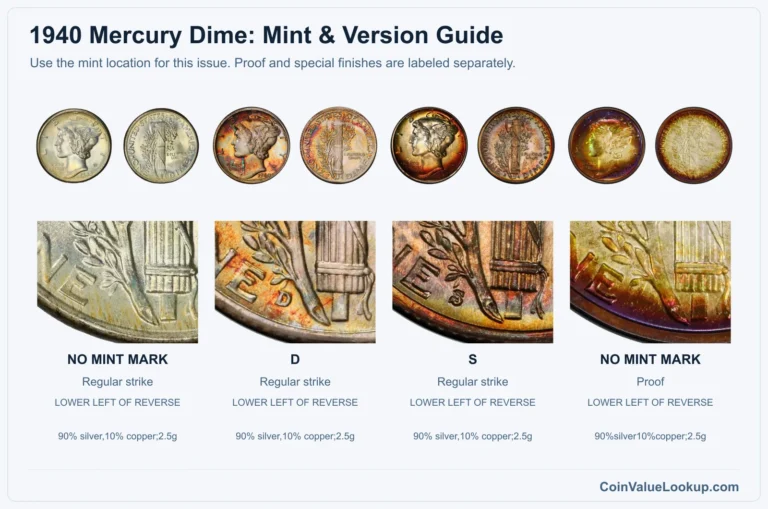
Every 1960 Roosevelt Dime is struck in 90% silver and 10% copper, weighing about 2.50 grams with a diameter near 17.9 mm. The obverse shows Roosevelt's portrait facing left with the date at the lower left.
The reverse displays an upright torch flanked by olive and oak branches.
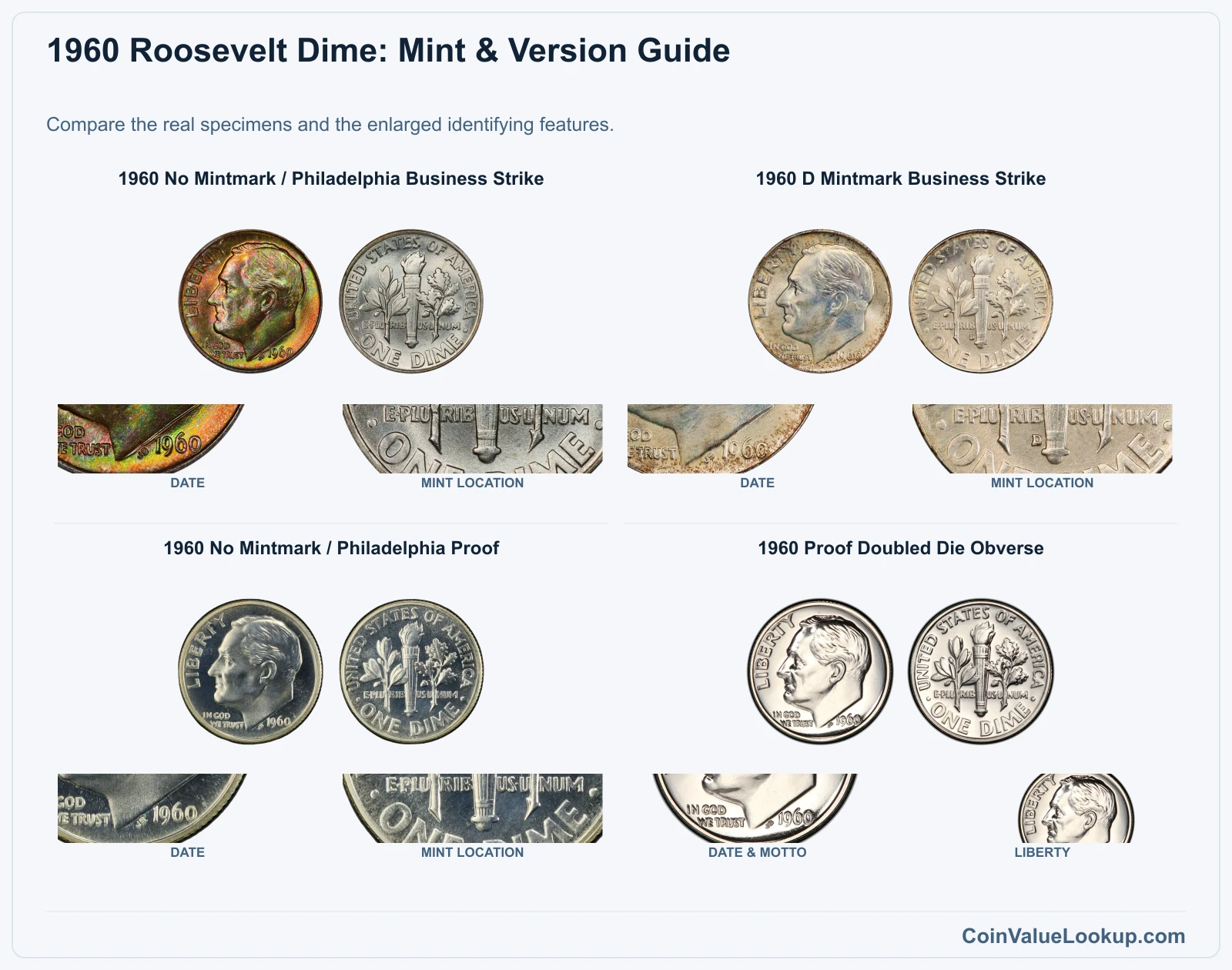
Mintmarks sit beside the base of the torch on the reverse. No mintmark means Philadelphia.
A small "D" means Denver. Both mints produced business strikes, but only Philadelphia made proofs in 1960.
Separating normal business strikes from proofs matters a lot. Proofs have mirror-like fields and sharp detail from specially prepared dies, and they should never be lumped with regular coins for pricing.
Within the proof category, a Doubled Die Obverse variety exists and needs its own confirmed die attribution before you assign any premium.
If your coin has original surfaces, check for the Full Bands designation, which refers to clear separation of both horizontal band pairs on the torch. Coins with and without Full Bands are different animals for valuation, so compare only within matching mint, grade, and designation.
Step 2: Check Your 1960 Roosevelt Dime Grade
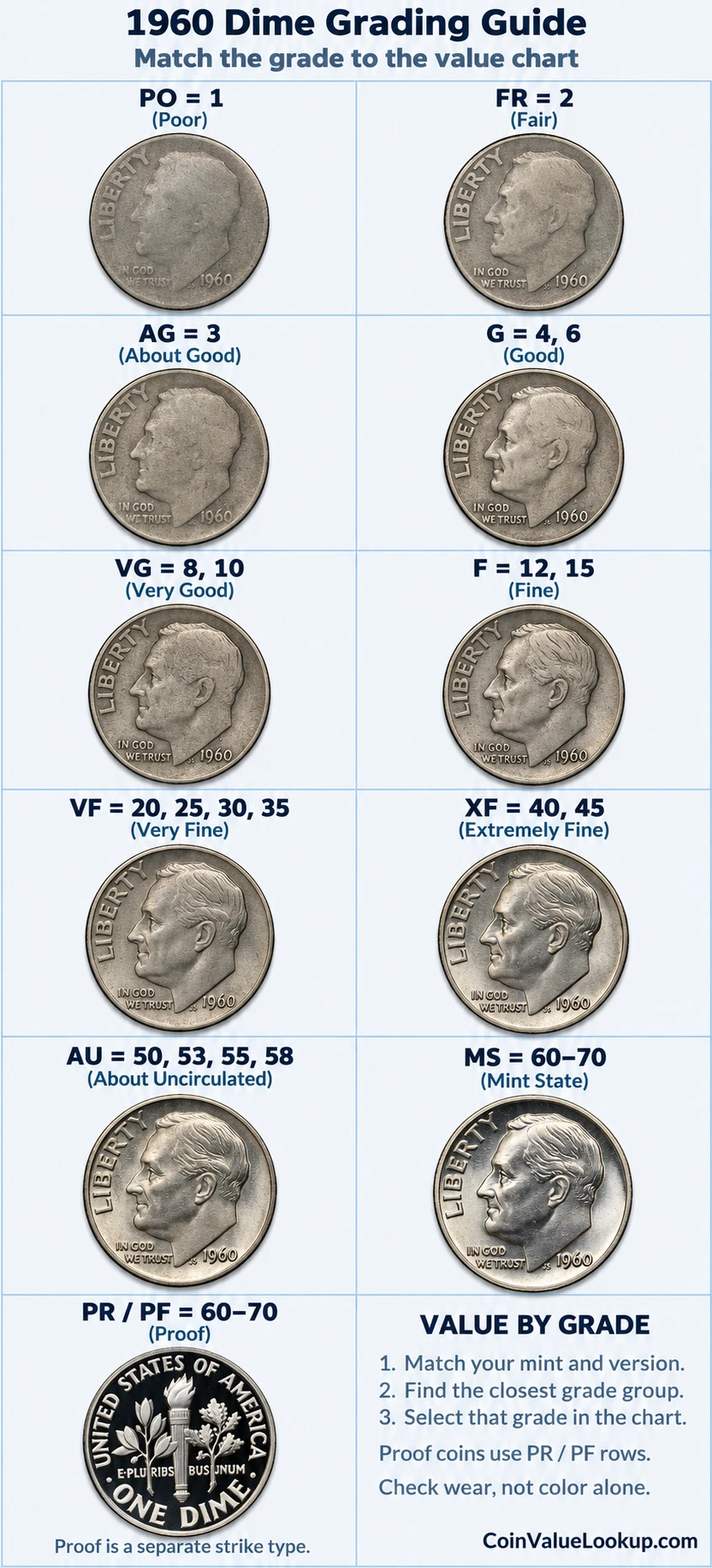
Start with the high points. Roosevelt's cheek and jawline wear first, followed by the hair detail just above and behind the ear.
On the reverse, the torch lines and leaf details soften early in circulation.
Tilt your coin under a single light source. Unbroken cartwheel luster across the fields points to a coin that never saw a cash register.
A weak strike can mimic wear, though, so look for flatness only on the highest relief, not across broad flat areas.
Cleaning is the silent killer of value. Hairlines from polishing or wiping catch light differently than natural wear.
Compare your coin's surfaces to the grading image provided; if yours shows tiny parallel scratches visible at an angle, it has likely been cleaned, and that matters to buyers.
For proofs, look at the fields under magnification. Undisturbed mirror surfaces with no haze or handling marks indicate a well-preserved coin.
A cameo contrast, where frosted devices stand out against mirror fields, is a separate designation and requires its own comparison.
Step 3: Check 1960 Roosevelt Dime Value by Mint and Version
1960 Roosevelt Dime — No Mintmark / Philadelphia Business Strike
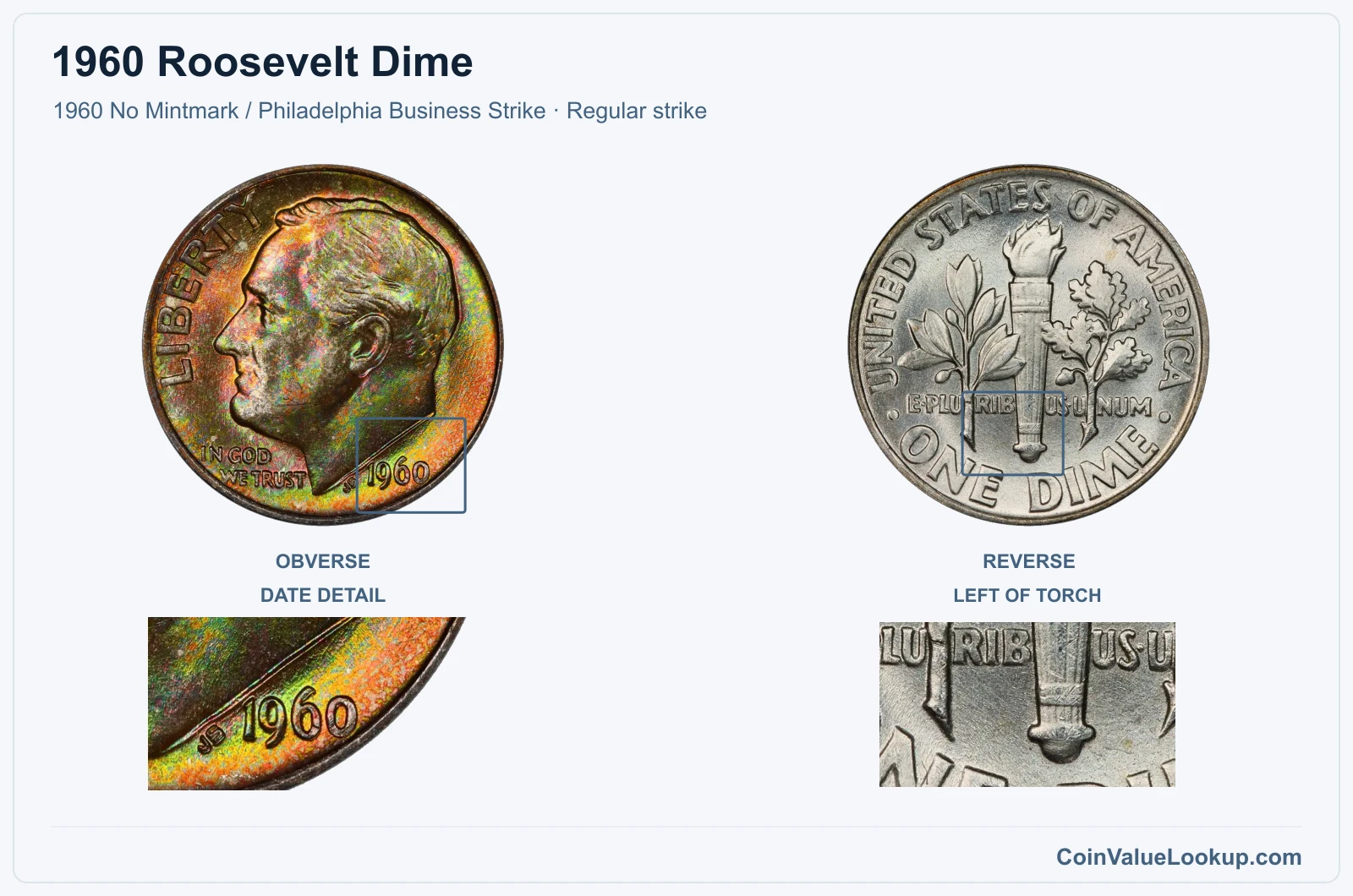
The 1960 Philadelphia business strike carries no mintmark. Look at the reverse beside the torch base — if the space is blank, you have a Philly coin.
USA Coin Book lists a guide value of about $5.81 at G4 and $12.26 at MS65. Silver content alone gives even beat-up examples a floor price, but gem specimens with Full Bands separation command more attention from collectors.
Full Bands means both horizontal pairs on the torch are clearly split, which is a strike quality designation, not a grade. Only compare Full Bands coins to other Full Bands coins when estimating value.
Range Grade
Price Auction Records Appraisal PO PO 1
—
Coin Identifier FR FR 2
—
Coin Identifier AG AG 3
—
Coin Identifier G G 4
—
Coin Identifier
G 6
—
Coin Identifier VG VG 8
—
Coin Identifier
VG 10
—
Coin Identifier F F 12
—
Coin Identifier
F 15
—
Coin Identifier VF VF 20
—
Coin Identifier
VF 25
—
Coin Identifier
VF 30
—
Coin Identifier
VF 35
—
Coin Identifier XF XF 40
—
Coin Identifier
XF 45
—
Coin Identifier AU AU 50
—
Coin Identifier
AU 53
—
Coin Identifier
AU 55
—
Coin Identifier
AU 58
—
Coin Identifier MS MS 60
—
Coin Identifier
MS 61
—
Coin Identifier
MS 62
—
Coin Identifier
MS 63
Coin Identifier
MS 64
Coin Identifier
MS 65
Coin Identifier
MS 66
Coin Identifier
MS 67
Coin Identifier
MS 68
—
—
—
MS 69
—
—
—
MS 70
—
—
—
1960 Roosevelt Dime — D Mintmark Business Strike
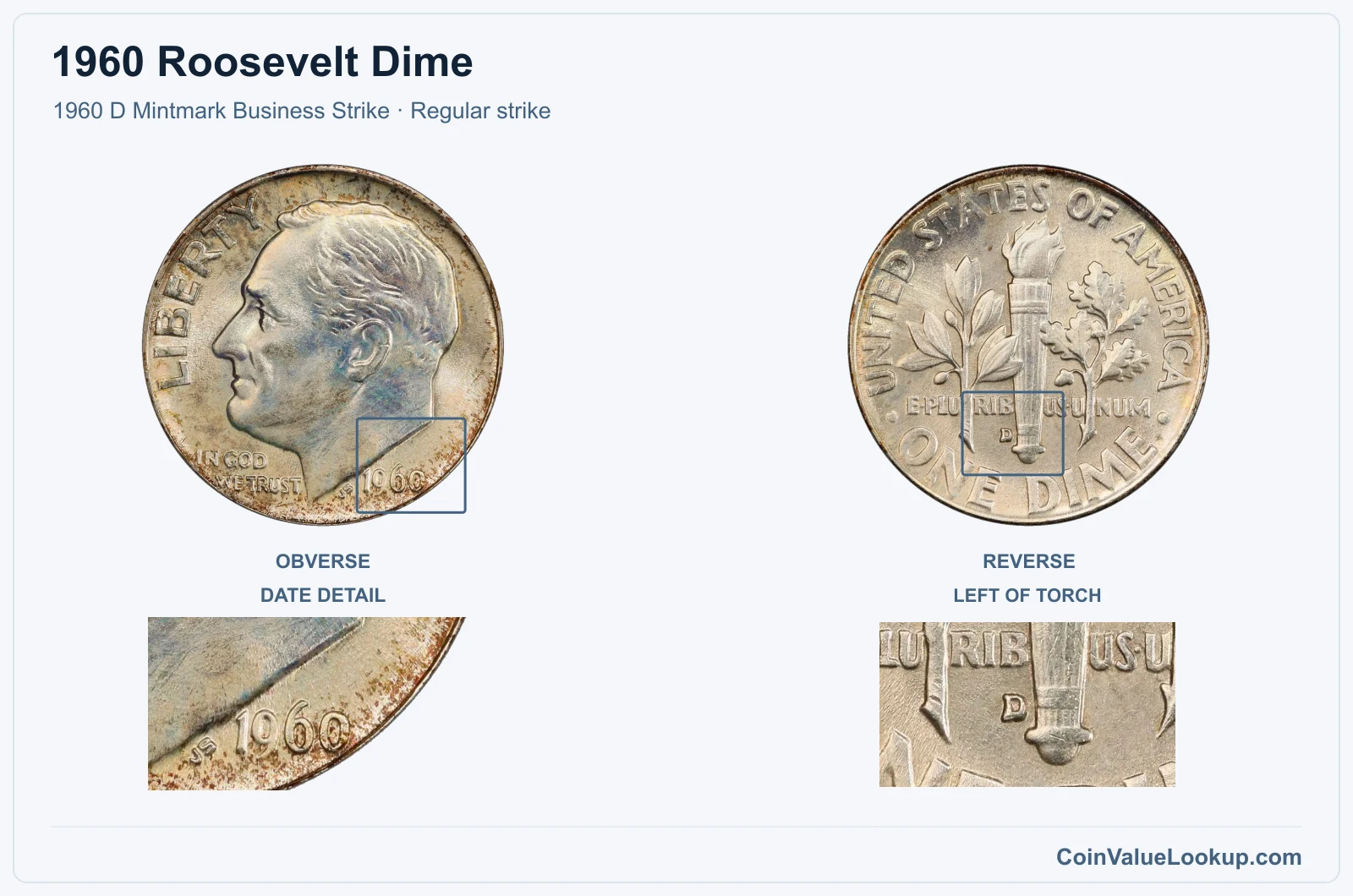
The Denver issue shows a small "D" mintmark beside the torch base on the reverse. These are common in circulated grades and easy to find in pocket change from the era.
Guide estimates from USA Coin Book place the 1960-D at about $5.81 in G4 and around $10.91 at MS65. That MS65 figure is a touch lower than the Philadelphia version, though both sit comfortably above melt.
As with the Philly coin, Full Bands designation matters. A well-struck Denver dime with fully separated torch bands in original condition is a different proposition than one without.
Coin Value Lookup is a handy place to look up guides for other Roosevelt Dime dates and mints if you are working through a collection.
Range Grade
Price Auction Records Appraisal PO PO 1
—
Coin Identifier FR FR 2
—
Coin Identifier AG AG 3
—
Coin Identifier G G 4
—
Coin Identifier
G 6
—
Coin Identifier VG VG 8
—
Coin Identifier
VG 10
—
Coin Identifier F F 12
—
Coin Identifier
F 15
—
Coin Identifier VF VF 20
—
Coin Identifier
VF 25
—
Coin Identifier
VF 30
—
Coin Identifier
VF 35
—
Coin Identifier XF XF 40
—
Coin Identifier
XF 45
—
Coin Identifier AU AU 50
—
Coin Identifier
AU 53
—
Coin Identifier
AU 55
—
Coin Identifier
AU 58
—
Coin Identifier MS MS 60
—
Coin Identifier
MS 61
—
Coin Identifier
MS 62
—
Coin Identifier
MS 63
—
Coin Identifier
MS 64
—
Coin Identifier
MS 65
Coin Identifier
MS 66
Coin Identifier
MS 67
Coin Identifier
MS 68
—
—
—
MS 69
—
—
—
MS 70
—
—
—
1960 Roosevelt Dime — No Mintmark / Philadelphia Proof
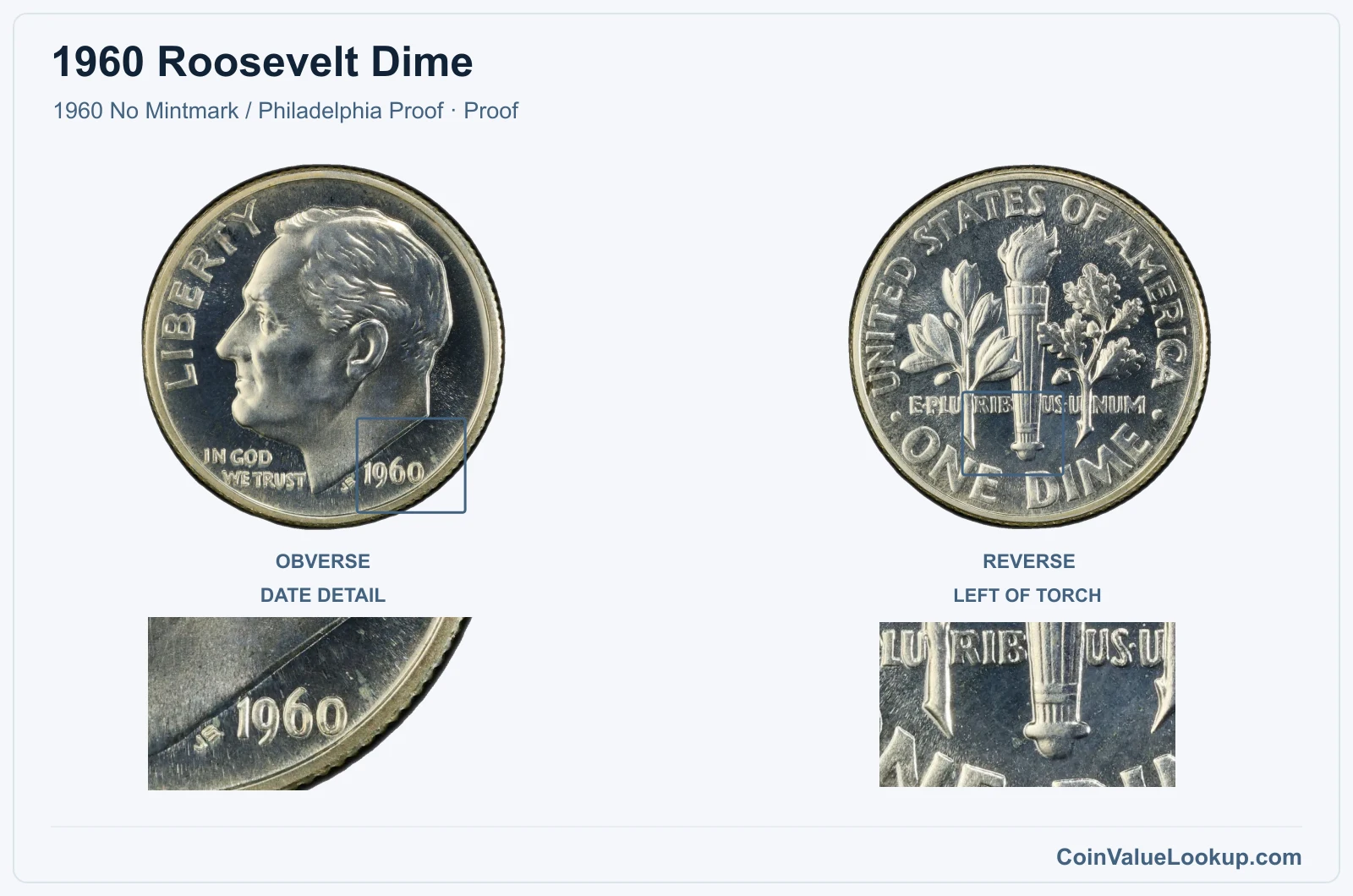
Philadelphia produced proof dimes in 1960 using specially prepared dies and polished planchets. These coins have sharp, squared-off rims and deeply mirrored fields that business strikes simply cannot replicate.
USA Coin Book lists the ordinary 1960 proof at about $9.87 in PR65. Coins with cameo contrast, where frosted design elements stand against mirror fields, are a separate designation and typically bring more, but do not assume every proof has cameo characteristics.
Keep proof pricing entirely separate from business-strike pricing. A proof is a method of manufacture, not a grade above Mint State.
Range Grade
Price Auction Records Appraisal PR PR 1
—
Coin Identifier
PR 2
—
Coin Identifier
PR 3
—
Coin Identifier
PR 4
—
Coin Identifier
PR 6
—
Coin Identifier
PR 8
—
Coin Identifier
PR 10
—
Coin Identifier
PR 12
—
Coin Identifier
PR 15
—
Coin Identifier
PR 20
—
Coin Identifier
PR 25
—
Coin Identifier
PR 30
—
Coin Identifier
PR 35
—
Coin Identifier
PR 40
—
Coin Identifier
PR 45
—
Coin Identifier
PR 50
—
Coin Identifier
PR 53
—
Coin Identifier
PR 55
—
Coin Identifier
PR 58
—
Coin Identifier
PR 60
Coin Identifier
PR 61
—
Coin Identifier
PR 62
—
Coin Identifier
PR 63
—
Coin Identifier
PR 64
Coin Identifier
PR 65
Coin Identifier
PR 66
Coin Identifier
PR 67
Coin Identifier
PR 68
Coin Identifier
PR 69
Coin Identifier
PR 70
Coin Identifier
1960 Roosevelt Dime — Proof Doubled Die Obverse
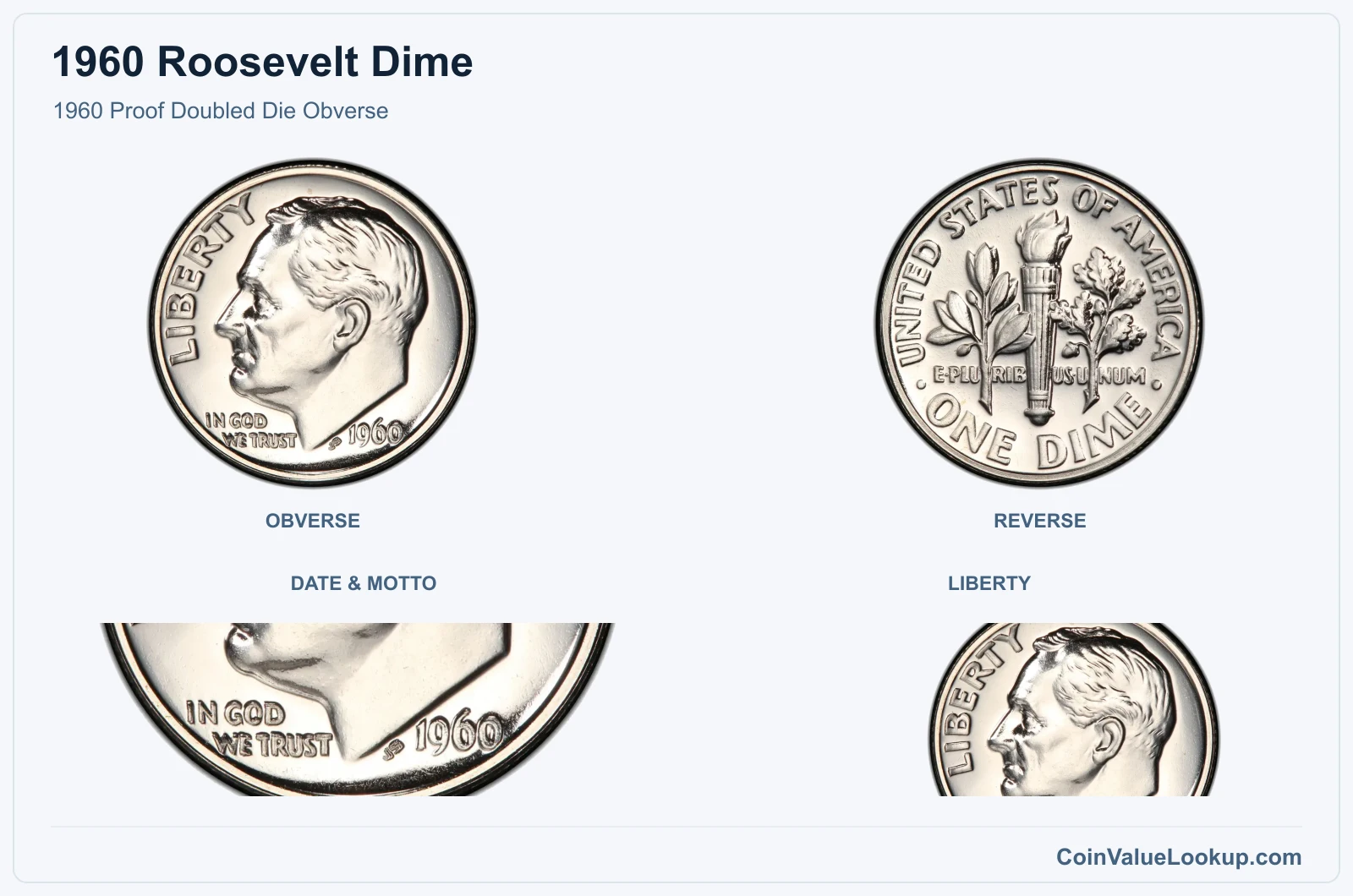
A Proof Doubled Die Obverse exists for the 1960 dime, and it is a legitimate die variety, not a handling artifact. The doubling appears on the date digits, the motto, and the designer's initials.
More than one doubled proof die has been documented for this year, so each requires its own confirmed die attribution.
No single guide price covers all proof DDO examples because the specific die, the severity of doubling, and the coin's overall condition all affect what a buyer will pay. Individual assessment by a recognized grading service is the practical path.
Do not assume every faint double outline on a 1960 proof is this variety — flat mechanical doubling and post-mint abrasion can mimic the effect. Compare against a certified reference specimen before drawing conclusions.
Ordinary-issue reference: Ordinary-issue reference only: The table below shows prices for the 1960 Roosevelt Dime (proof). It does not represent the value of the specific 1960 Proof Doubled Die Obverse variety or its variety premium. Year, mint, metal and strike type are matched; the specific variety is not priced by this table.
Range Grade
Price Auction Records Appraisal PR PR 1
—
Coin Identifier
PR 2
—
Coin Identifier
PR 3
—
Coin Identifier
PR 4
—
Coin Identifier
PR 6
—
Coin Identifier
PR 8
—
Coin Identifier
PR 10
—
Coin Identifier
PR 12
—
Coin Identifier
PR 15
—
Coin Identifier
PR 20
—
Coin Identifier
PR 25
—
Coin Identifier
PR 30
—
Coin Identifier
PR 35
—
Coin Identifier
PR 40
—
Coin Identifier
PR 45
—
Coin Identifier
PR 50
—
Coin Identifier
PR 53
—
Coin Identifier
PR 55
—
Coin Identifier
PR 58
—
Coin Identifier
PR 60
Coin Identifier
PR 61
—
Coin Identifier
PR 62
—
Coin Identifier
PR 63
—
Coin Identifier
PR 64
Coin Identifier
PR 65
Coin Identifier
PR 66
Coin Identifier
PR 67
Coin Identifier
PR 68
Coin Identifier
PR 69
Coin Identifier
PR 70
Coin Identifier
1960 Roosevelt Dime Error List
1. 1960 Roosevelt Dime — Proof Doubled Die Obverse
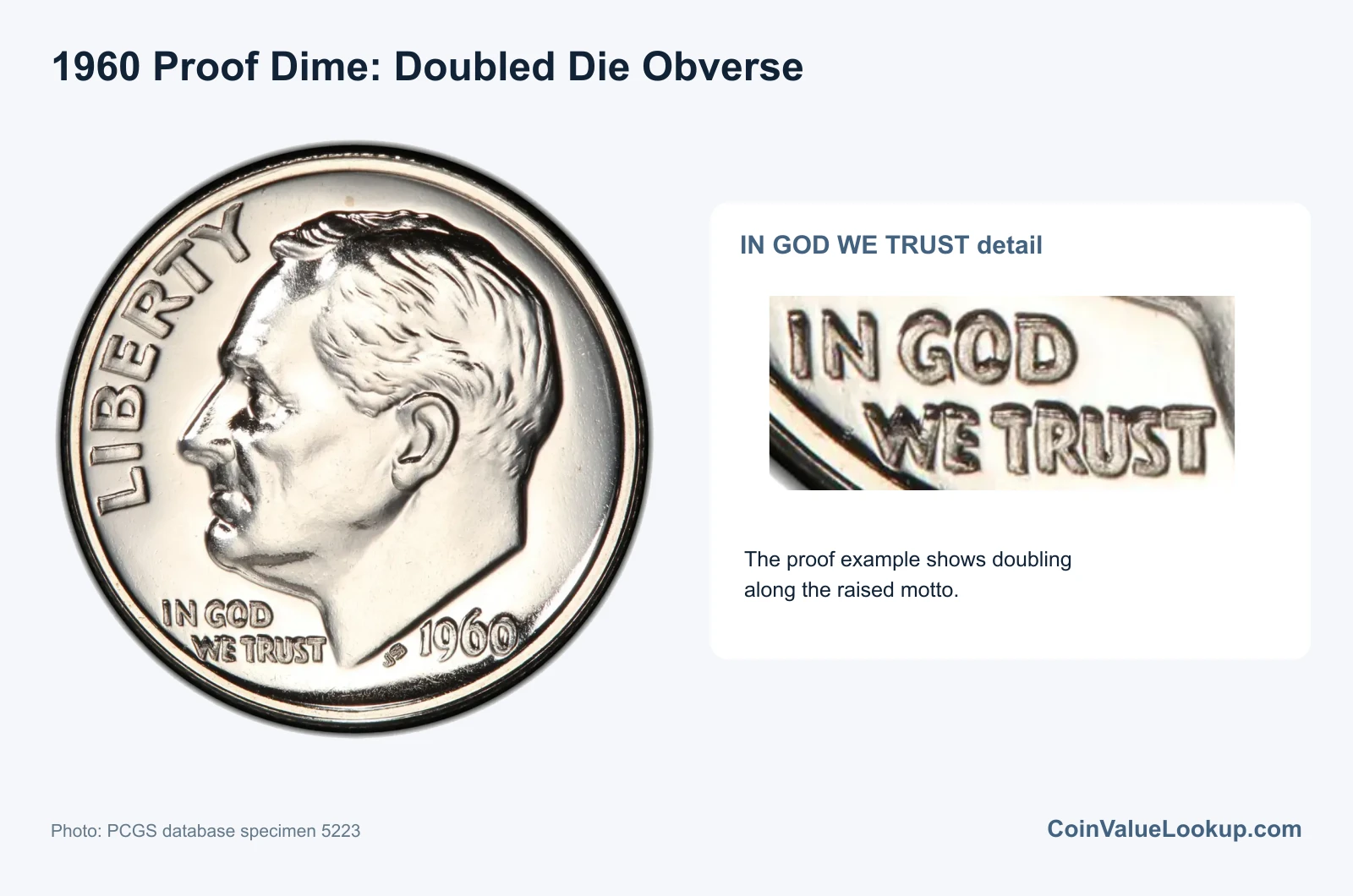
The Proof Doubled Die Obverse is a die variety found on 1960 Philadelphia proof dimes. Look for raised doubling on the "60" in the date, the motto lettering, and the JS designer initials.
The doubling is a product of the die itself, not something done to the coin after striking.
More than one proof doubled die exists for this year. That means you cannot assign a blanket price to every coin that shows some doubling.
Each die pair produces its own diagnostic fingerprint, and value depends on the specific attribution, doubling severity, and the coin's condition.
Watch out for flat mechanical doubling, which looks like shelf-like flattening rather than a crisp secondary image. Post-mint abrasion and corrosion can also produce misleading outlines.
Comparing your coin against a certified specimen at matching magnification is the most reliable way to confirm the variety.
2. 1960 Roosevelt Dime — Obverse Lamination
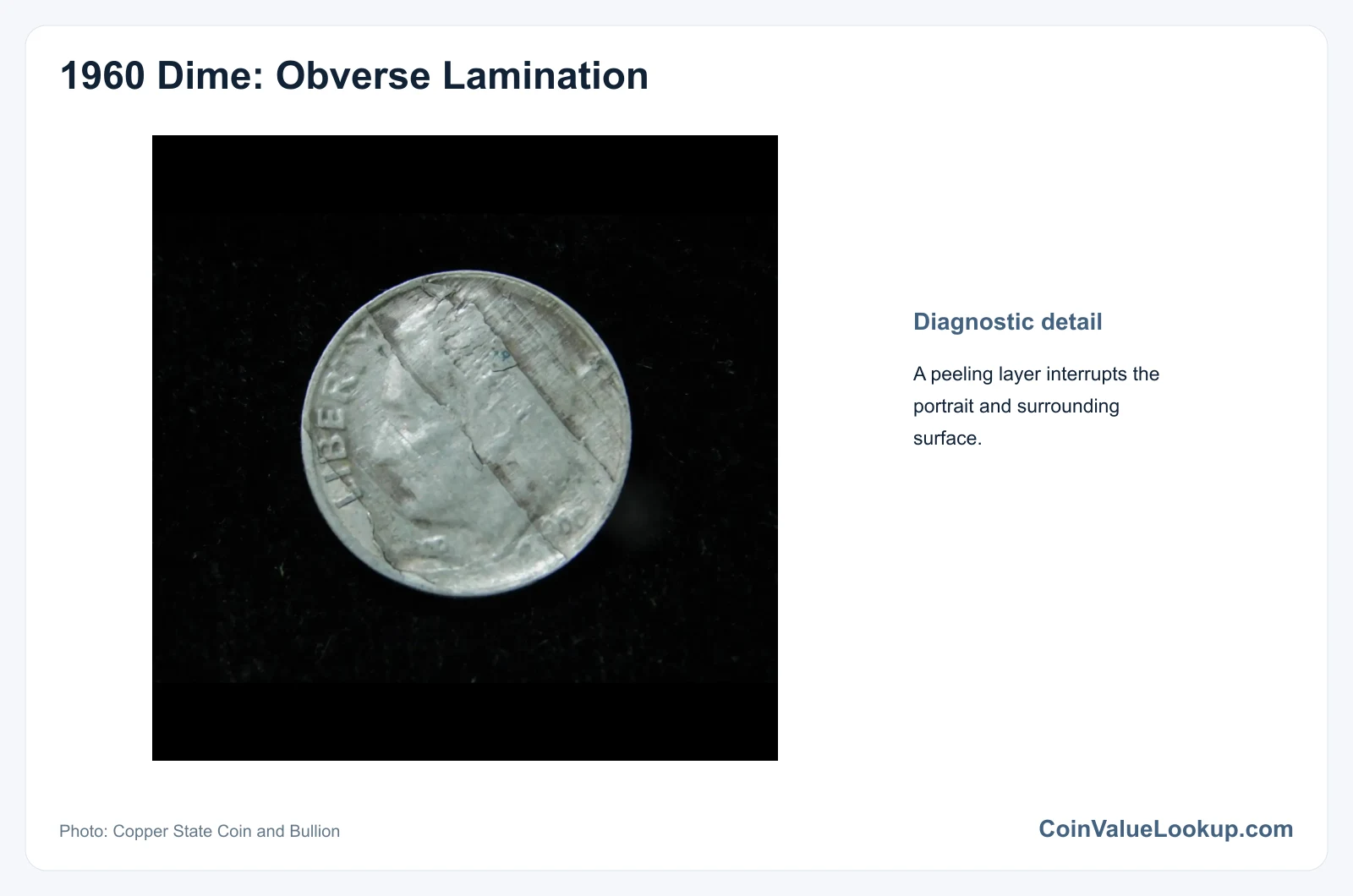
An obverse lamination error has been documented on the 1960-D business strike, with at least one example certified by NGC at MS65. This defect occurs when a layer of planchet metal separates, creating a peeling or missing strip on the coin's surface.
The fracture edges should look natural and irregular, following the alloy's internal structure.
The key diagnostic is distinguishing a genuine lamination from post-mint damage. Scrapes, gouges, and deliberate peeling after the coin left the mint will show tool marks or unnatural edges.
A real lamination has contoured, rounded fracture borders that flow with the metal.
No specific price range is adopted for this error. Value depends on the size and location of the lamination, overall coin grade, and authentication by a grading service.
If you suspect a lamination, comparison with a certified example is the safest approach.
3. 1960 Roosevelt Dime — Curved Clipped Planchet
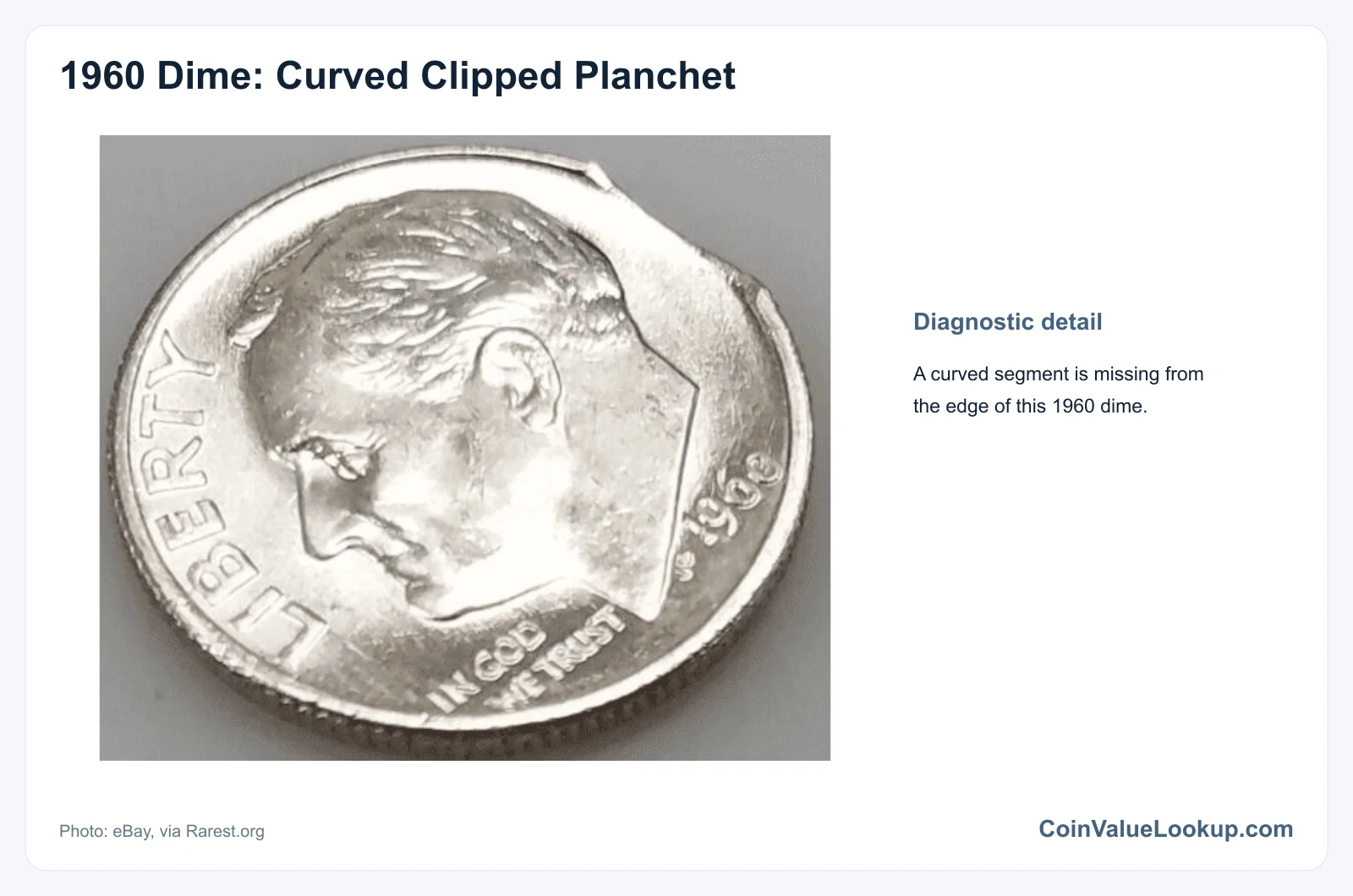
A curved clipped planchet error has been documented on the 1960-D dime. One certified example, graded NGC MS63 Full Bands, shows about a 10% curved clip near the 3 o'clock position and weighs 2.2 grams versus the normal 2.50 grams.
To identify this error, look for a curved missing section along the rim with a characteristic weakness in the design near both endpoints of the clip. The rim at those transitions should show a blending effect, not a sharp cut.
Weight can be a supporting clue but is not definitive on its own.
Do not confuse a clip with post-mint damage such as filing or bending. A genuine clip will have a smooth, curved edge following the shape of an adjacent planchet hole in the original strip.
Value requires individual assessment based on clip size, overall grade, and professional authentication.
4. 1960 Roosevelt Dime — Repunched Mintmark
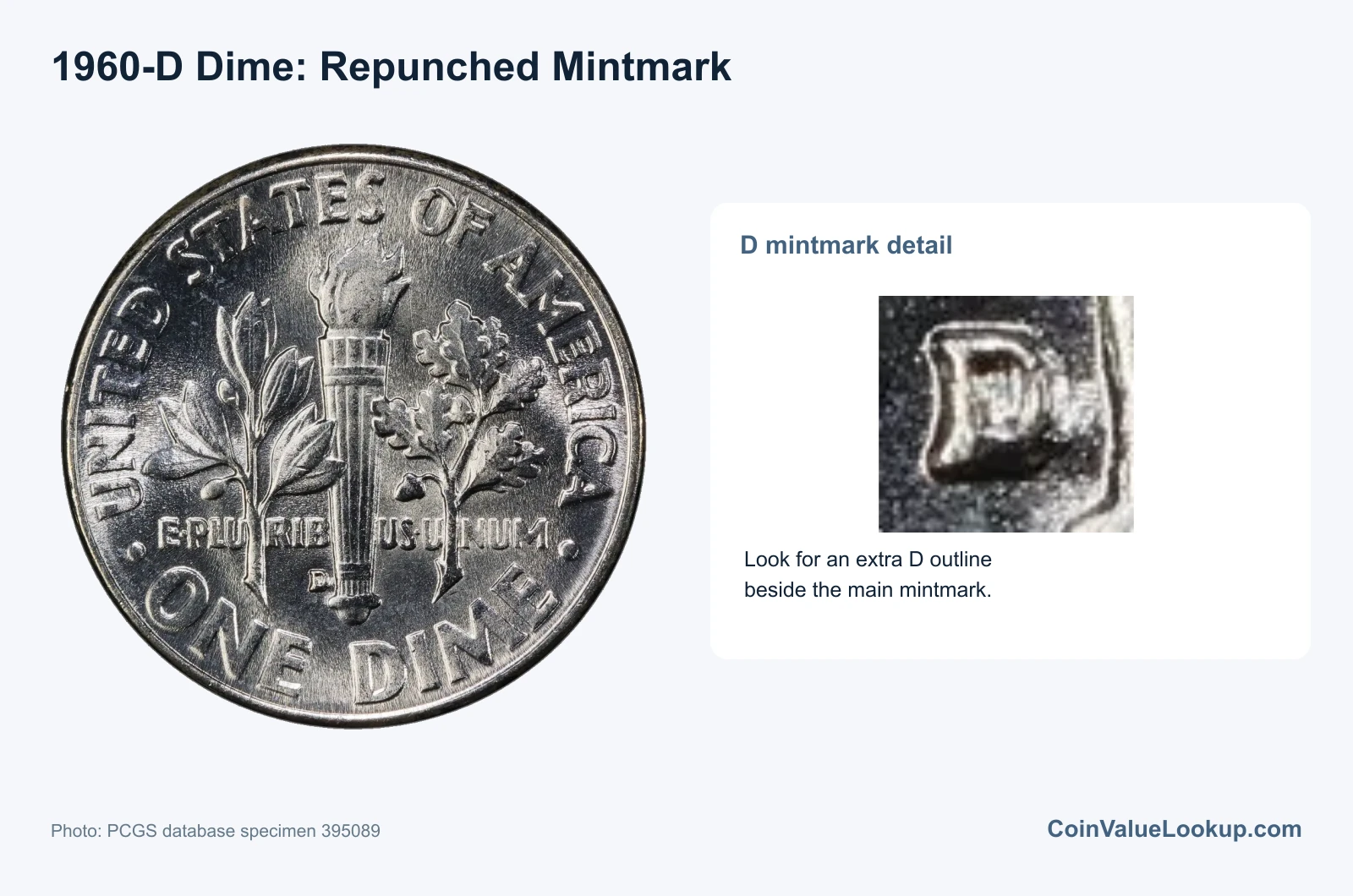
A Repunched Mintmark has been reported for the 1960-D dime, listed as 1960-D/D. The diagnostic involves remnants of an earlier mintmark punch visible beneath or beside the final D on the reverse, near the torch base.
To check, examine the mintmark area under at least 5x magnification. You are looking for traces of a second D in a slightly different position.
The remnant may appear as a partial serif or shadow that does not match the primary punch alignment.
Do not confuse this with machine doubling, which produces flat shelf-like distortion rather than a distinct secondary impression. Die chips or corrosion around the mintmark can also create misleading shapes.
No specific price range is adopted for this variety. Condition, the clarity of the repunching, and confirmed attribution all factor into what a collector will pay.
5. 1960 Roosevelt Dime — Off-Center Strike
Off-center strikes have been reported for 1960 Roosevelt Dimes. An off-center coin shows a displaced design with an unstruck crescent of blank planchet along one edge, caused by misalignment between the planchet and the dies during striking.
The most collectible off-center errors retain a fully visible date. Without the date, authentication and attribution become difficult, and collector interest drops sharply.
Check that the design shift is consistent on both sides and that the unstruck area has a smooth, original planchet surface.
Do not mistake a clipped planchet, a one-sided die misalignment, or post-mint flattening for an off-center strike. A clip removes metal from the edge but the design is centered.
Die misalignment shifts only one side. No specific price range is adopted here.
The percentage off-center, date visibility, and overall condition determine value on a coin-by-coin basis.