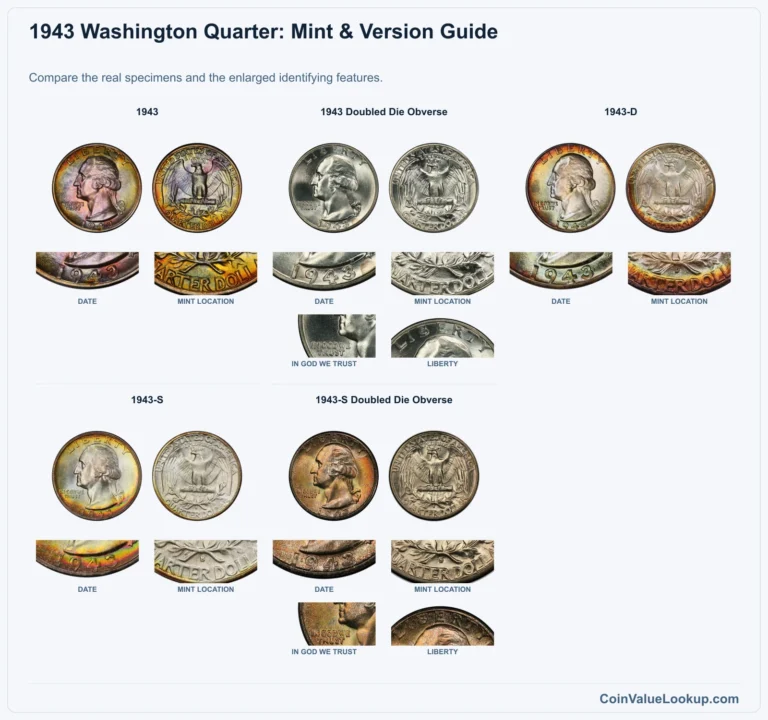
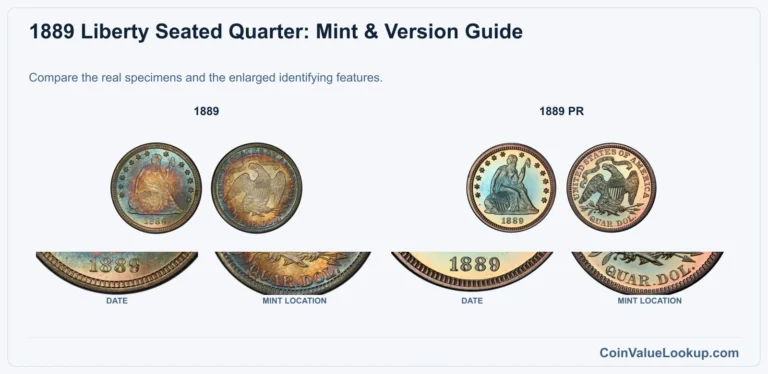
1960 Washington Quarter Coin Value: How Much Is It Worth?
A 1960 Washington Quarter is a 90% silver coin that holds real value even in well-worn condition. Circulated examples start around $16.43, driven largely by their silver content.
Mint State pieces from Philadelphia or Denver can reach roughly $28 to $31 at the MS65 level, depending on mint. Proofs, the Type B reverse variety, and authenticated error strikes occupy their own price territory and deserve separate evaluation.
Fast Way to Identify Your 1960 Washington Quarter
The quickest way to get a preliminary identification of your 1960 quarter is to upload clear photos of both the front and back. Good lighting and a steady shot help reveal mintmarks, surface condition, and any unusual features.
From there you can narrow down which version you have and whether it warrants closer inspection or professional grading.
1960 Washington Quarter Value
Upload both sides of your 1960 Washington Quarter.
Front Obverse
Upload photo
Back Reverse
Upload photo
Which 1960 Washington Quarter Versions Are Worth Money?
- Philadelphia business strikes in MS65 list around $28 in one guide, while Denver MS65 pieces reach about $31, making the Denver mint slightly more valued at that grade level.
- Philadelphia proofs graded PR65 list near $23 and are a distinct finish from business strikes, requiring separate evaluation.
- The 1960 Type B Reverse is a Philadelphia circulation strike using a proof-style reverse hub, identified by the separated E and S in STATES, and carries no standard guide price, so individual assessment matters.
- A 1960 quarter struck on a silver dime planchet sold for $960 at PCGS MS65 through Heritage Auctions in July 2021.
- A doubled-die reverse proof at PR66 sold for $65 through Heritage in January 2013, a modest but real premium over a normal proof.
Step 1: Identify Your 1960 Washington Quarter Mint Mark and Version
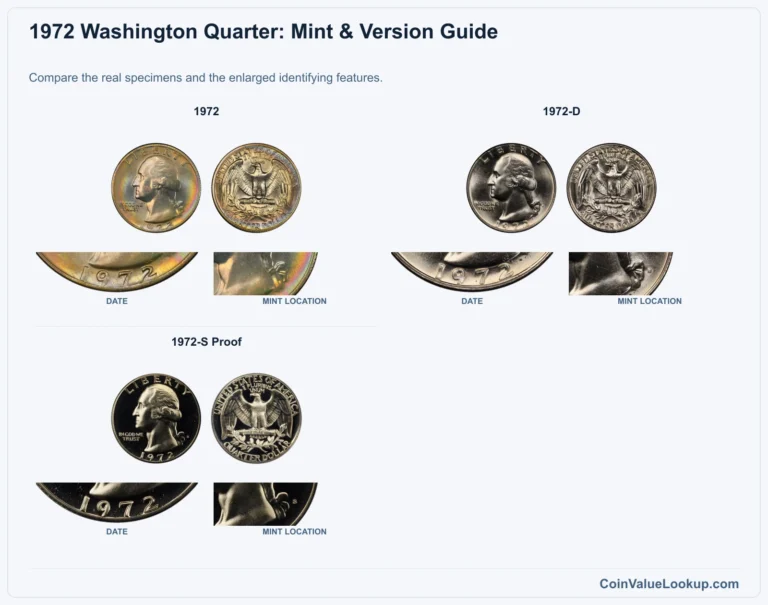
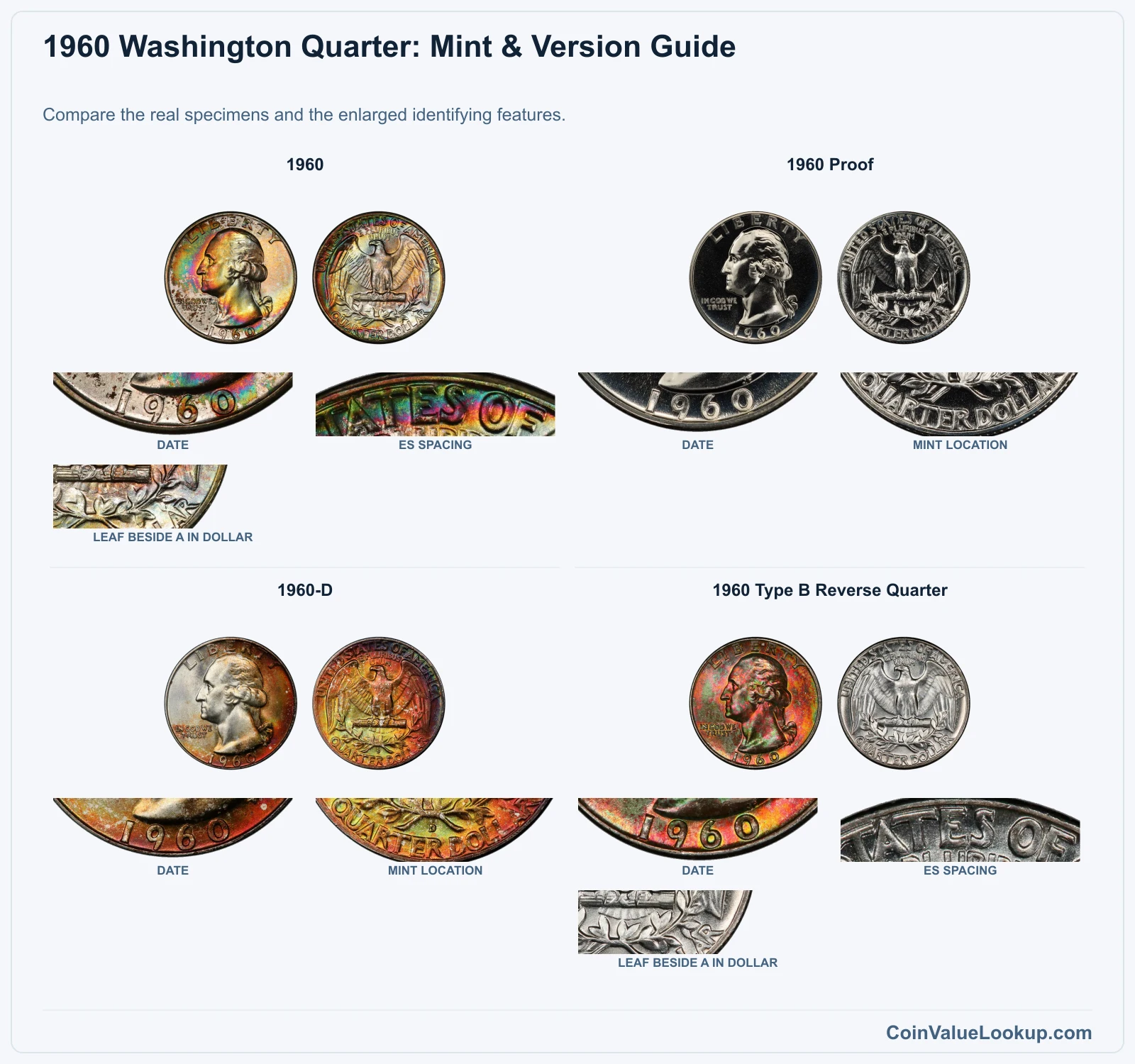
Start with the reverse. Look below the eagle's tail feathers, just beneath the wreath, for a small "D" mintmark.
If no letter appears there, your coin was struck in Philadelphia. Both mints used the same alloy: 90% silver and 10% copper, with a standard weight of about 6.25 grams and a diameter near 24.3 mm.
Next, determine the finish. A proof 1960 quarter has deeply mirrored fields and crisp, squared-off design edges.
A business strike shows a satiny or cartwheel luster instead. This distinction matters because proof and circulation strikes use different value scales.
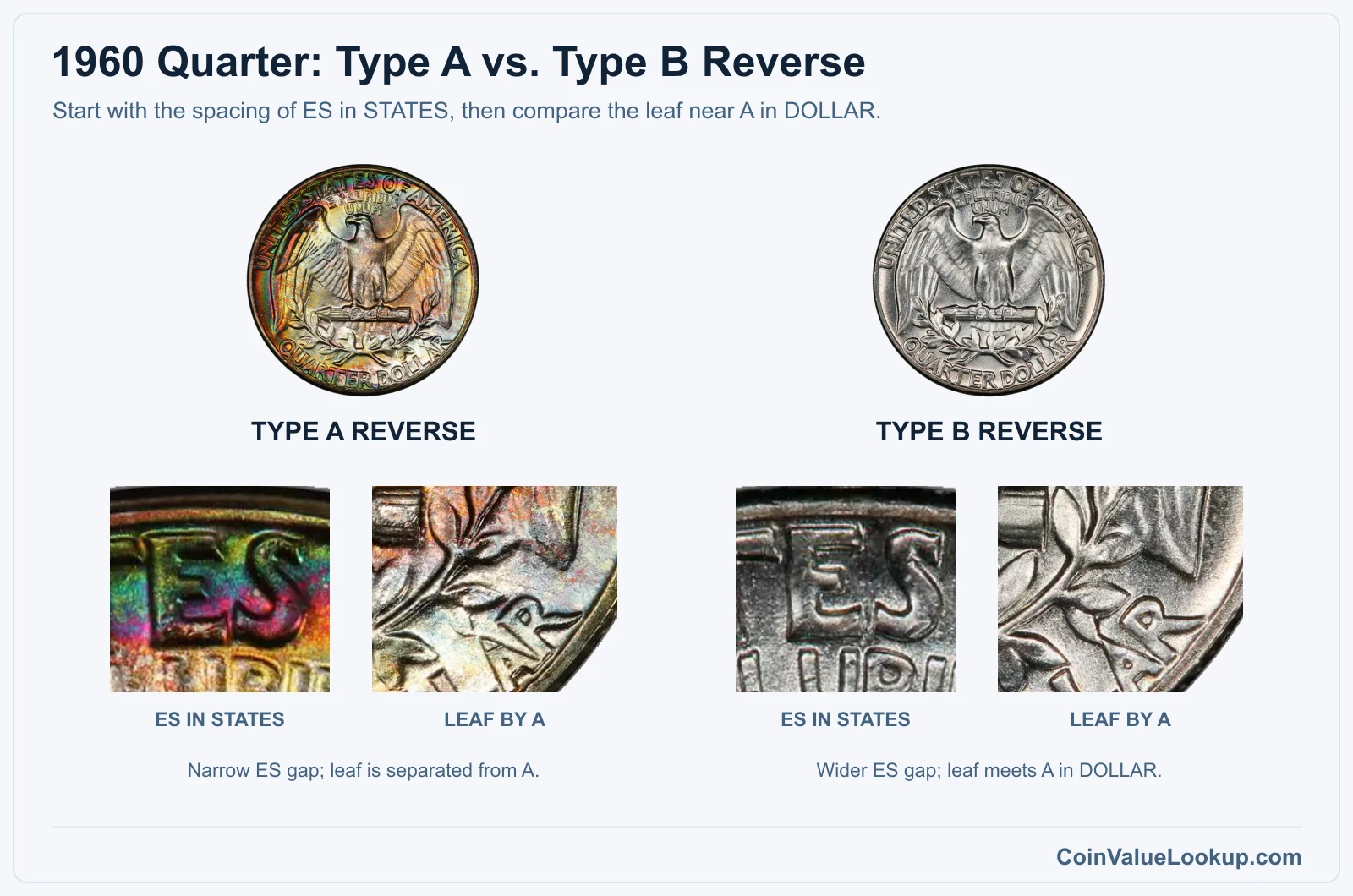
Finally, check whether your Philadelphia business strike carries the scarcer Type B reverse. Zoom in on the word STATES and examine the gap between the E and S.
On the ordinary circulation reverse, those two letters nearly touch. On the Type B, the E and S are clearly separated.
A proof with separated ES is just a normal proof, not the Type B variety.
Step 2: Check Your 1960 Washington Quarter Grade
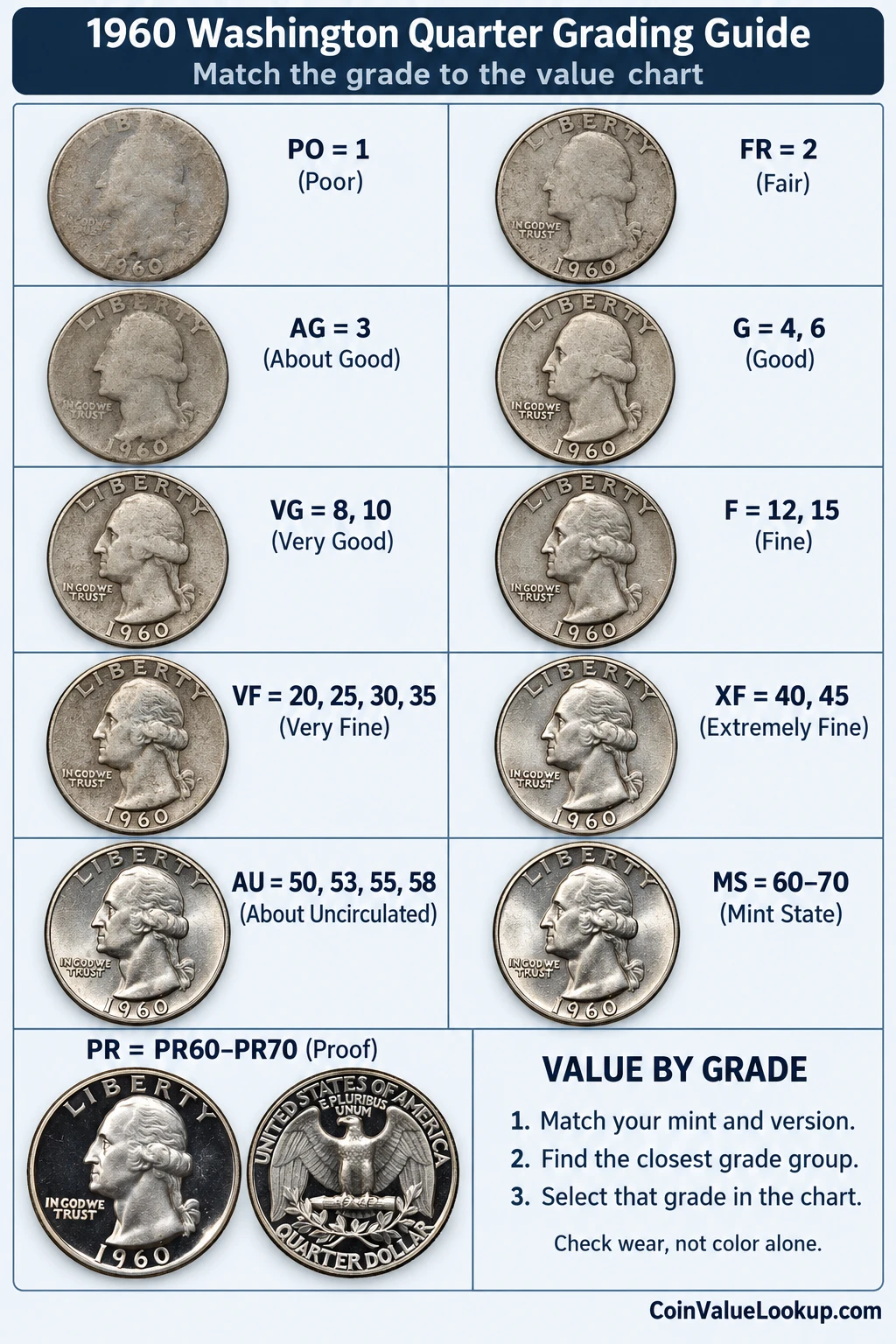
Focus on George Washington's cheek first. That broad, flat area picks up friction before anything else.
Then examine the hair detail directly above the ear, where fine strands disappear early in circulation.
On the reverse, check the eagle's breast feathers and the tops of the wings. Worn coins lose feather definition there quickly.
Compare your coin's remaining luster with the reference image to see how much original surface survives.
A coin with full, unbroken cartwheel luster and no contact marks is a candidate for Mint State grades. One that shows slight friction on the cheek but retains most luster falls into the About Uncirculated range.
Heavy wear across the high points, with little or no luster, places a coin around Good to Fine.
Also look for cleaning hairlines under a light held at an angle. Hairlines from polishing are thin, parallel scratches that reduce a coin's grade and appeal.
Proof coins should be checked for haze, fingerprints, and rim nicks that affect the contrast designation.
Step 3: Check 1960 Washington Quarter Value by Mint and Version
1960 Washington Quarter
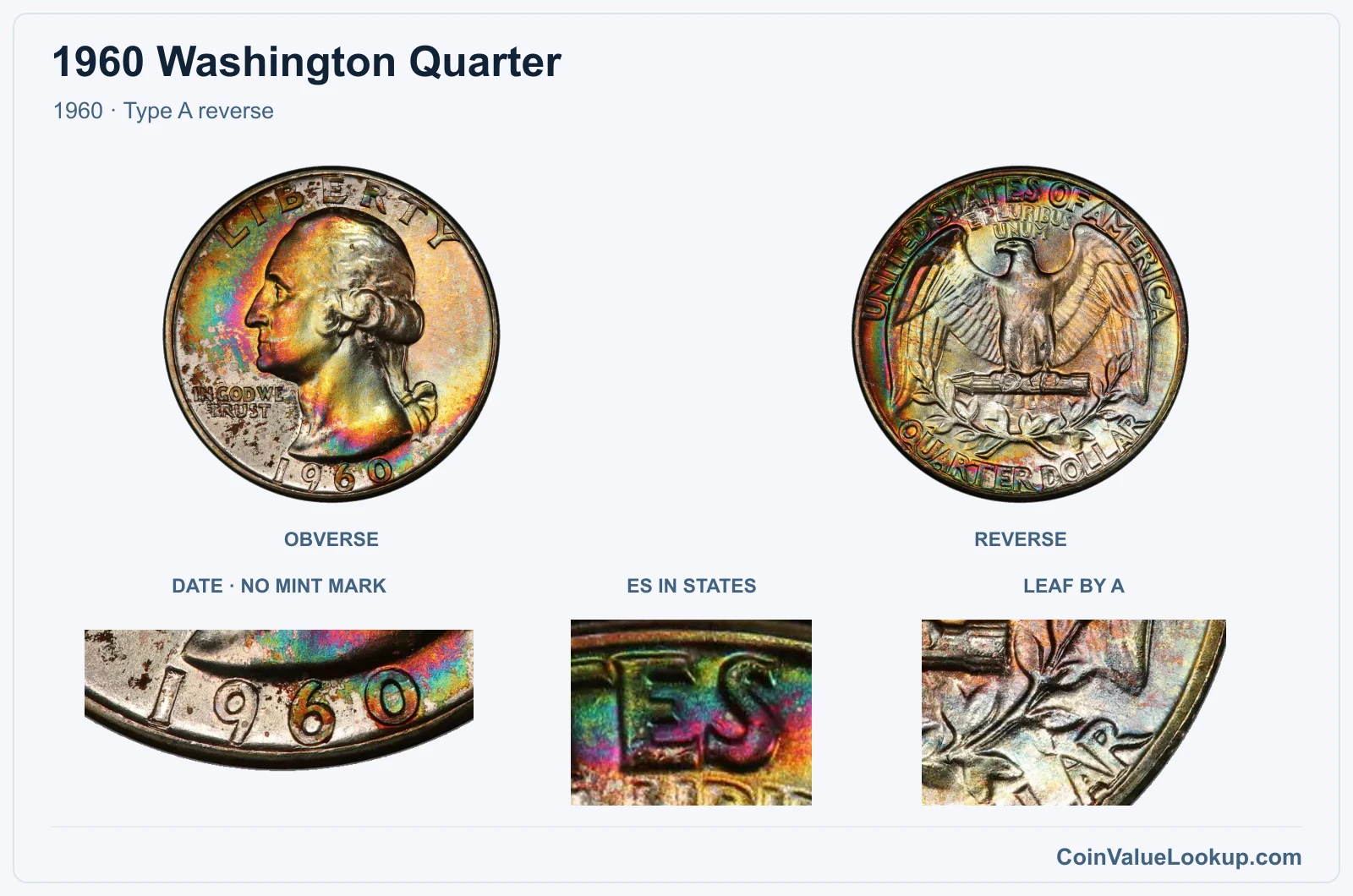
This is the standard 1960 Philadelphia quarter with no mintmark. It uses the ordinary Type A circulation reverse where the E and S in STATES nearly touch.
In well-circulated condition around Good-4, a guide estimate places it near $16.43, mostly reflecting silver content. At MS60 the estimate rises to about $20, and an MS65 example lists around $28.
Philadelphia Gem-quality survivors are moderately available compared to other dates in the silver Washington series. Look for original, undisturbed mint luster and minimal bag marks when evaluating higher-grade pieces.
Do not apply proof pricing to a business strike, even if the surfaces look unusually reflective.
| Range | Grade | Price | Auction Records | Appraisal |
|---|---|---|---|---|
| PO | PO 1 | — | Coin Identifier | |
| FR | FR 2 | — | Coin Identifier | |
| AG | AG 3 | — | Coin Identifier | |
| G | G 4 | — | Coin Identifier | |
| G 6 | — | Coin Identifier | ||
| VG | VG 8 | — | Coin Identifier | |
| VG 10 | — | Coin Identifier | ||
| F | F 12 | — | Coin Identifier | |
| F 15 | — | Coin Identifier | ||
| VF | VF 20 | — | Coin Identifier | |
| VF 25 | — | Coin Identifier | ||
| VF 30 | — | Coin Identifier | ||
| VF 35 | — | Coin Identifier | ||
| XF | XF 40 | — | Coin Identifier | |
| XF 45 | — | Coin Identifier | ||
| AU | AU 50 | — | Coin Identifier | |
| AU 53 | — | Coin Identifier | ||
| AU 55 | — | Coin Identifier | ||
| AU 58 | — | Coin Identifier | ||
| MS | MS 60 | — | Coin Identifier | |
| MS 61 | — | Coin Identifier | ||
| MS 62 | — | Coin Identifier | ||
| MS 63 | Coin Identifier | |||
| MS 64 | Coin Identifier | |||
| MS 65 | Coin Identifier | |||
| MS 66 | Coin Identifier | |||
| MS 67 | Coin Identifier | |||
| MS 68 | — | — | — | |
| MS 69 | — | — | — | |
| MS 70 | — | — | — |
1960 Washington Quarter — Proof
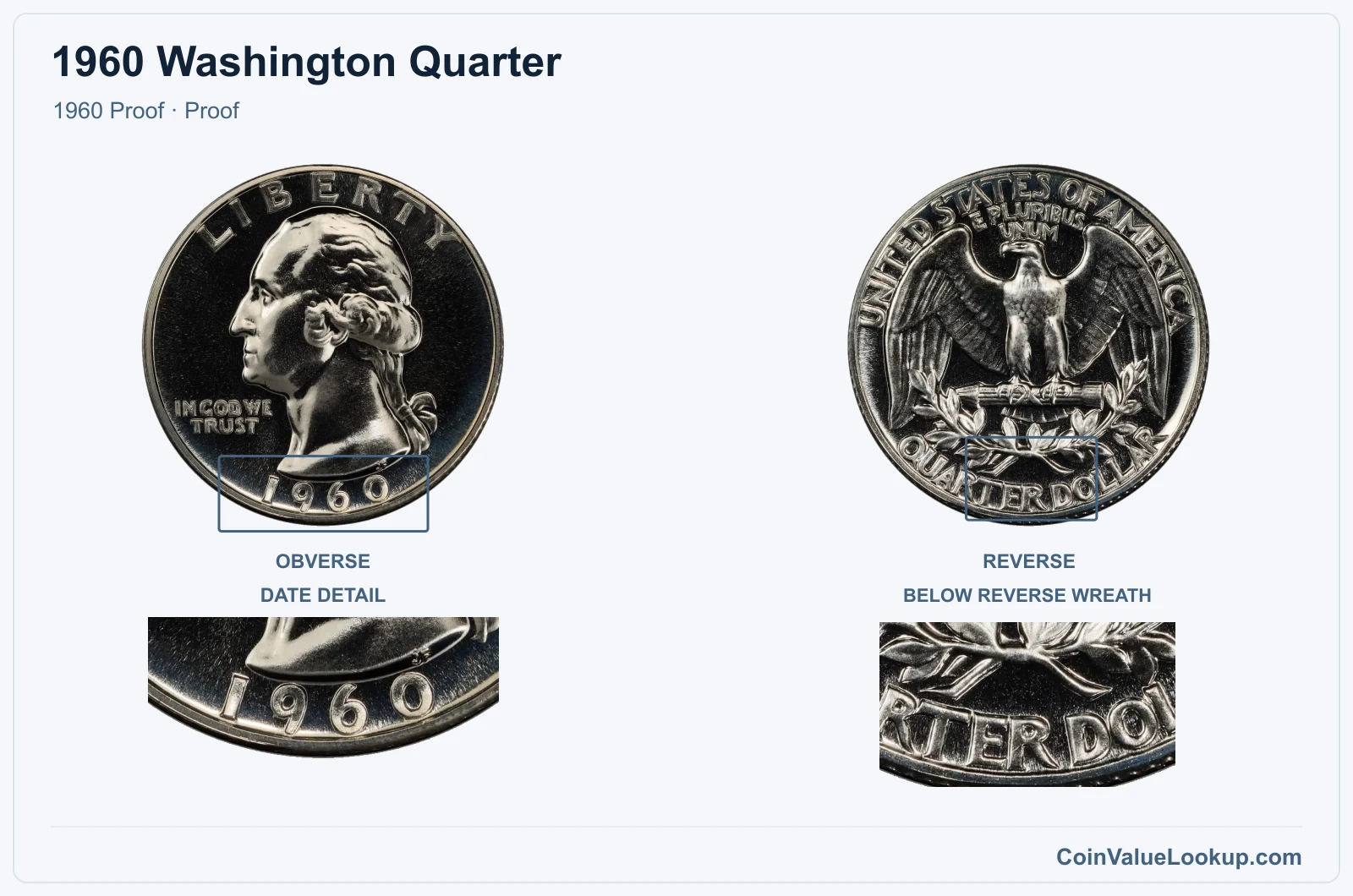
The 1960 Proof was struck at Philadelphia on the same 90% silver planchets but with polished dies and specially prepared blanks, producing mirror-like fields and sharp design edges. A PR65 example lists around $23 according to USA Coin Book guide estimates.
Proof is a method of manufacture, not a grade above Mint State. A scratched or hazed proof can grade lower than a pristine business strike.
Cameo and Deep Cameo designations describe the contrast between frosted devices and mirrored fields and are tracked separately from the numerical proof grade.
Coin Value Lookup is a useful starting point if you want to compare this proof against other dates and denominations in the Washington series.
| Range | Grade | Price | Auction Records | Appraisal |
|---|---|---|---|---|
| PR | PR 1 | — | Coin Identifier | |
| PR 2 | — | Coin Identifier | ||
| PR 3 | — | Coin Identifier | ||
| PR 4 | — | Coin Identifier | ||
| PR 6 | — | Coin Identifier | ||
| PR 8 | — | Coin Identifier | ||
| PR 10 | — | Coin Identifier | ||
| PR 12 | — | Coin Identifier | ||
| PR 15 | — | Coin Identifier | ||
| PR 20 | — | Coin Identifier | ||
| PR 25 | — | Coin Identifier | ||
| PR 30 | — | Coin Identifier | ||
| PR 35 | — | Coin Identifier | ||
| PR 40 | — | Coin Identifier | ||
| PR 45 | — | Coin Identifier | ||
| PR 50 | — | Coin Identifier | ||
| PR 53 | — | Coin Identifier | ||
| PR 55 | — | Coin Identifier | ||
| PR 58 | — | Coin Identifier | ||
| PR 60 | — | Coin Identifier | ||
| PR 61 | — | Coin Identifier | ||
| PR 62 | — | Coin Identifier | ||
| PR 63 | — | Coin Identifier | ||
| PR 64 | Coin Identifier | |||
| PR 65 | Coin Identifier | |||
| PR 66 | Coin Identifier | |||
| PR 67 | Coin Identifier | |||
| PR 68 | Coin Identifier | |||
| PR 69 | Coin Identifier | |||
| PR 70 | — | Coin Identifier |
1960 Washington Quarter — D
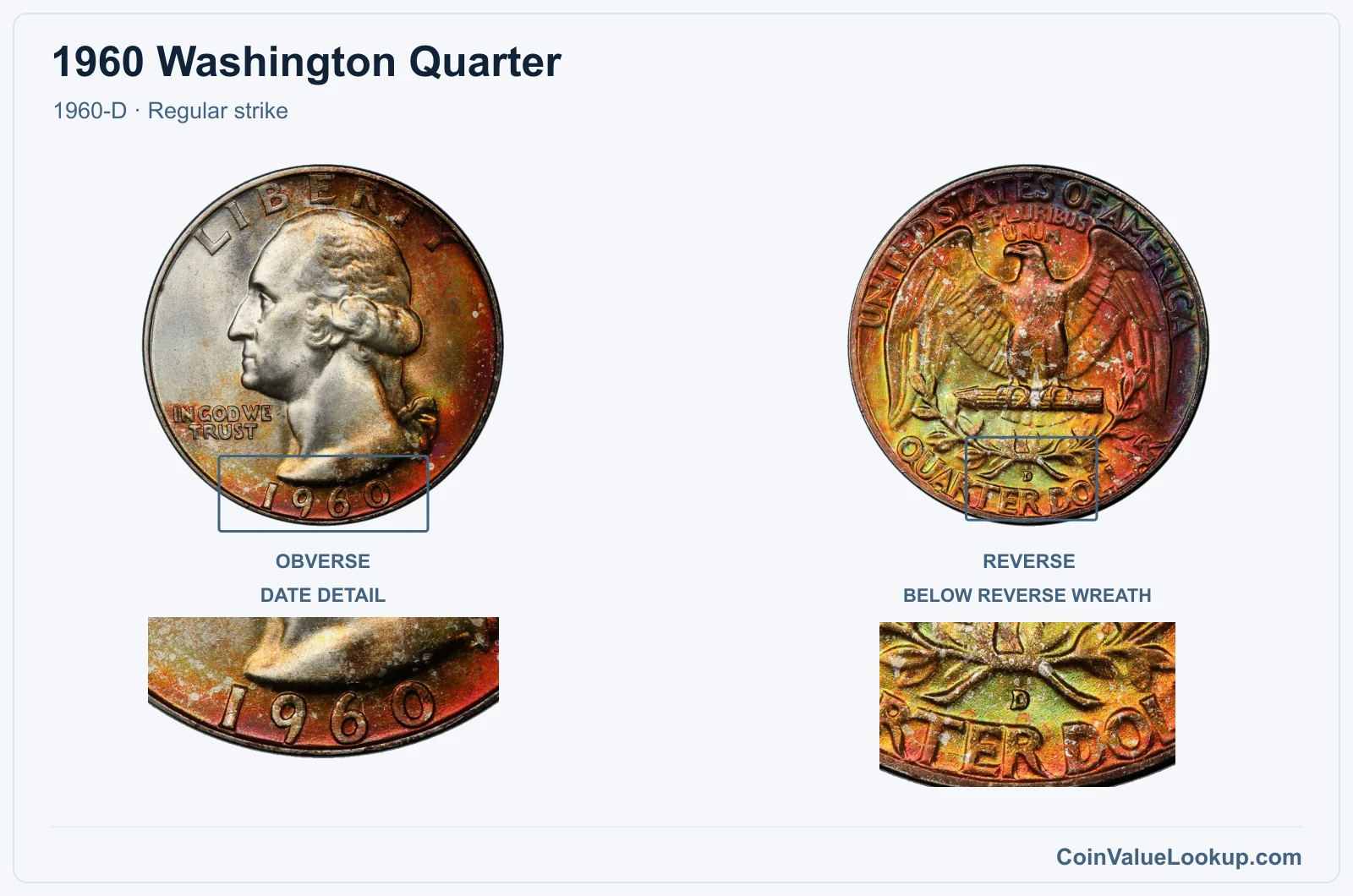
The 1960-D quarter carries a small "D" mintmark below the wreath on the reverse. Same silver composition and design as the Philadelphia issue, but struck at the Denver facility.
Guide estimates from USA Coin Book place it at about $16.43 in Good-4, $20 at MS60, and roughly $31 at MS65.
That MS65 figure edges slightly above the Philadelphia business strike at the same grade. As always, these are retail guide estimates in USD, not guaranteed purchase offers, and values shift with silver prices and collector demand.
Check for original luster and clean surfaces when hunting for higher-grade examples.
| Range | Grade | Price | Auction Records | Appraisal |
|---|---|---|---|---|
| PO | PO 1 | — | Coin Identifier | |
| FR | FR 2 | — | Coin Identifier | |
| AG | AG 3 | — | Coin Identifier | |
| G | G 4 | — | Coin Identifier | |
| G 6 | — | Coin Identifier | ||
| VG | VG 8 | — | Coin Identifier | |
| VG 10 | — | Coin Identifier | ||
| F | F 12 | — | Coin Identifier | |
| F 15 | — | Coin Identifier | ||
| VF | VF 20 | — | Coin Identifier | |
| VF 25 | — | Coin Identifier | ||
| VF 30 | — | Coin Identifier | ||
| VF 35 | — | Coin Identifier | ||
| XF | XF 40 | — | Coin Identifier | |
| XF 45 | — | Coin Identifier | ||
| AU | AU 50 | — | Coin Identifier | |
| AU 53 | — | Coin Identifier | ||
| AU 55 | — | Coin Identifier | ||
| AU 58 | — | Coin Identifier | ||
| MS | MS 60 | — | Coin Identifier | |
| MS 61 | — | Coin Identifier | ||
| MS 62 | — | Coin Identifier | ||
| MS 63 | — | Coin Identifier | ||
| MS 64 | Coin Identifier | |||
| MS 65 | Coin Identifier | |||
| MS 66 | Coin Identifier | |||
| MS 67 | Coin Identifier | |||
| MS 68 | — | — | — | |
| MS 69 | — | — | — | |
| MS 70 | — | — | — |
1960 Washington Quarter — Type B Reverse Quarter
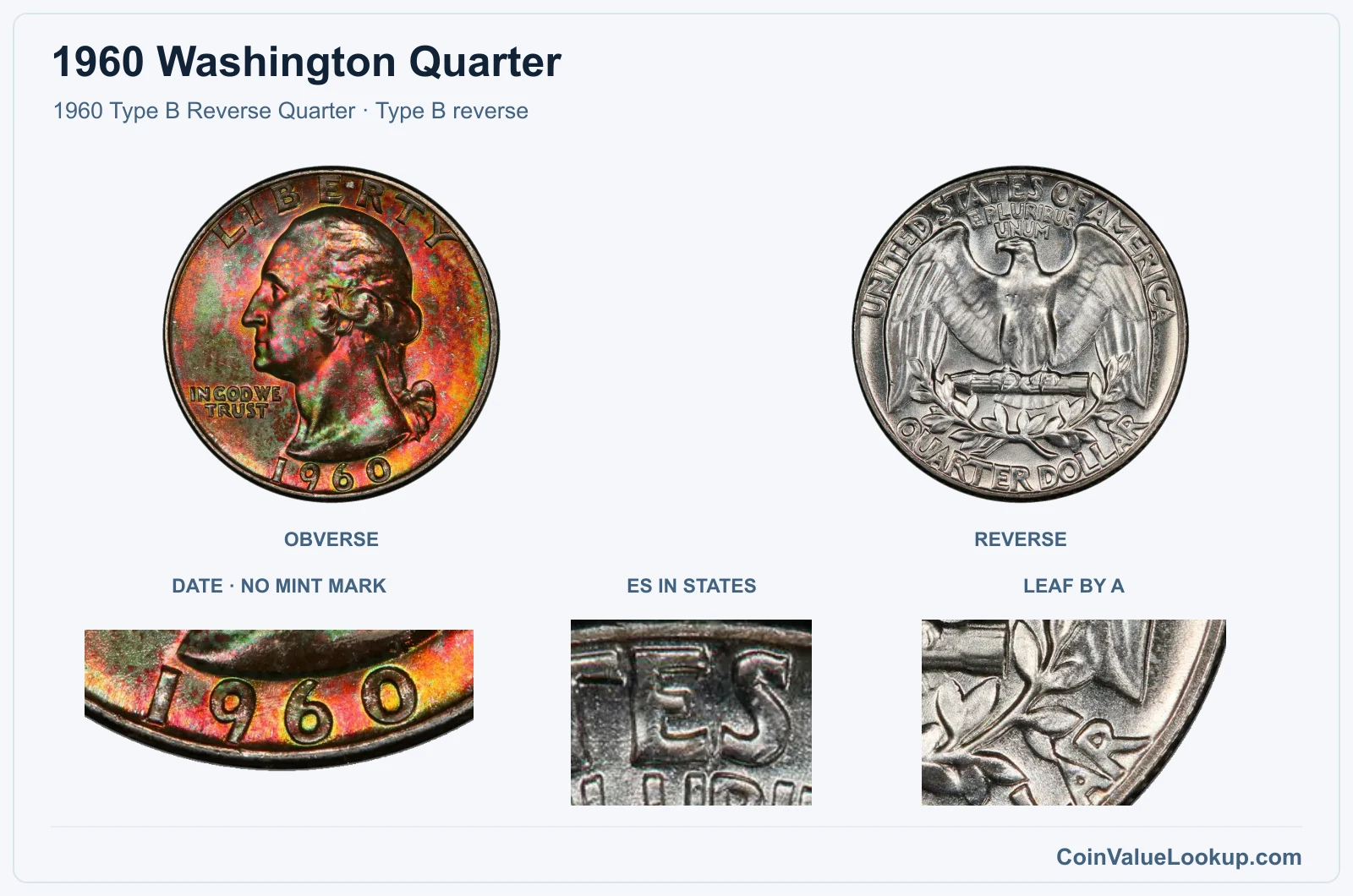
The 1960 Type B Reverse is a Philadelphia business strike that was made using a proof-style reverse die hub. The key diagnostic is the spacing between E and S in STATES on the reverse.
On a normal 1960 circulation quarter, those letters nearly touch. On the Type B, a clear gap separates them.
This variety exists because Philadelphia circulation quarters dated 1956 through 1964 occasionally received proof-hub reverses. A regular proof showing the same letter spacing is simply a normal proof and does not qualify as the Type B variety.
Confirm your coin has business-strike surfaces, meaning satiny luster rather than mirrored fields.
No standard guide price is adopted for this variety. Value depends on authenticated identity, condition, and market interest at the time of sale, so professional attribution from a grading service is the practical next step if you believe you have one.
Range Grade
Price Auction Records Appraisal PO PO 1
—
Coin Identifier FR FR 2
—
Coin Identifier AG AG 3
—
Coin Identifier G G 4
—
Coin Identifier
G 6
—
Coin Identifier VG VG 8
—
Coin Identifier
VG 10
—
Coin Identifier F F 12
—
Coin Identifier
F 15
—
Coin Identifier VF VF 20
—
Coin Identifier
VF 25
—
Coin Identifier
VF 30
—
Coin Identifier
VF 35
—
Coin Identifier XF XF 40
—
Coin Identifier
XF 45
—
Coin Identifier AU AU 50
—
Coin Identifier
AU 53
—
Coin Identifier
AU 55
—
Coin Identifier
AU 58
—
Coin Identifier MS MS 60
—
Coin Identifier
MS 61
—
Coin Identifier
MS 62
—
Coin Identifier
MS 63
—
Coin Identifier
MS 64
Coin Identifier
MS 65
Coin Identifier
MS 66
Coin Identifier
MS 67
—
Coin Identifier
MS 68
—
—
—
MS 69
—
—
—
MS 70
—
—
—
1960 Washington Quarter Error List
1. 1960 Washington Quarter — Struck on a Silver Dime Planchet
A 1960 Philadelphia quarter struck on a silver dime planchet is a dramatic wrong-planchet error. The dime blank is smaller and lighter than a quarter blank, so the resulting coin shows full central design details but loses outer legends and rim portions where the smaller planchet ran out of metal.
To check, compare your coin's weight and diameter against the standard quarter specs of approximately 6.25 grams and 24.3 mm. A silver dime planchet is noticeably smaller and lighter.
Silver color alone does not confirm the error because both denominations used 90% silver in 1960.
Watch out for coins that have been cut, ground, or filed down after leaving the mint. A genuine off-denomination strike shows intact design flow from the striking process and undisturbed edges.
A PCGS MS65 example sold for $960 through Heritage Auctions in July 2021, illustrating the premium these authenticated pieces command.
2. 1960 Washington Quarter — Type B Reverse Variety
The Type B Reverse is classified here as a variety error because a proof-style die hub was used to strike circulation coins at Philadelphia. The diagnostic is straightforward: enlarge the letters E and S in STATES on the reverse.
If those two letters are clearly separated rather than nearly touching, you may have the Type B hub.
This is not the same as mechanical or strike doubling. Machine doubling produces flat, shelf-like distortions, while the Type B distinction comes from the hub design itself and is consistent across the entire reverse.
Also, a normal proof quarter from 1960 will show the same separated ES, so you must confirm business-strike surfaces before calling it a Type B.
No standard numeric value is adopted for this variety. Individual assessment based on authenticated identity and condition is the appropriate approach.
Professional attribution from a recognized grading service is strongly recommended.
3. 1960 Washington Quarter — Struck on a Cent Planchet
A 1960 Philadelphia quarter struck on a cent planchet is a spectacular wrong-metal error. The copper blank produces a coin with a distinctive red-brown color, carrying quarter design details on a planchet far too small and too light for the denomination.
Central elements like the date and Washington's portrait may survive, while peripheral legends are typically lost.
The normal copper cent planchet weighs around 3.1 grams, less than half the quarter's 6.25-gram standard. Weight and size are the first checks.
Be cautious of silver quarters that have been copper-plated or chemically altered to fake the appearance. Only a certified attribution should be trusted for a claim this unusual.
A PCGS MS64 RB specimen is documented in the Heritage archive, though no specific sale price is adopted here. If you suspect you have one, professional grading and encapsulation are essential before assigning any value.
4. 1960 Washington Quarter — Doubled-Die Reverse Proof
A doubled-die reverse proof from 1960 Philadelphia shows repeated raised contours on the reverse legends and design elements. Under magnification you can see a secondary image slightly offset from the primary design, a result of the die being impressed more than once during its manufacture.
Do not confuse this with machine doubling, which is far more common and far less valuable. Machine doubling produces flat, shelf-like distortions that lack the raised, rounded profile of a true doubled die.
The doubled-die effect is consistent on every coin struck from that die, while random strike anomalies vary piece to piece.
A PCGS PR66 example sold for $65 through Heritage Auctions on January 8, 2013. That is a modest premium over a standard proof but confirms collector recognition of this variety.
Verify that your coin is indeed a proof, with mirrored fields, before pursuing a doubled-die reverse attribution.