1972 Washington Quarter Coin Value: How Much Is It Worth?
Most 1972 Washington quarters you find in pocket change are worth face value — 25 cents, nothing more. These are copper-nickel clad coins, not silver.
In higher uncirculated grades, a guide estimate for an MS65 example reaches about $7.29 according to USA Coin Book. Genuine errors like the D-mint nickel-planchet strike or the triple-clip broadstrike are a different story entirely, but those require independent authentication.
Fast Way to Identify Your 1972 Washington Quarter
Snap clear photos of both the front and back of your 1972 quarter and upload them here for a preliminary identification. This can help you figure out which mint version you have and whether any visible features are worth investigating further.
Good lighting and a steady hand make all the difference.
1972 Washington Quarter Value
Upload both sides of your 1972 Washington Quarter.
Front Obverse
Upload photo
Back Reverse
Upload photo
Which 1972 Washington Quarter Versions Are Worth Money?
- The 1972-D struck on a nickel planchet sold for $172.50 in PCGS AU58 at Heritage Auctions in May 2005 — a confirmed wrong-planchet error.
- A 1972-D broadstruck with a 22% triple clip brought $336 in PCGS MS63 at Heritage Auctions in March 2025.
- A 1972-S proof double strike with obverse rotation is listed in Heritage's August 2024 archive as an NGC PR65 Cameo — value depends on individual assessment.
- High-grade MS65 Philadelphia or Denver business strikes carry a USA Coin Book guide estimate of about $7.29.
- The 1972-S proof in PR65 has a guide estimate around $6.25 per USA Coin Book.
Step 1: Identify Your 1972 Washington Quarter Mint Mark and Version
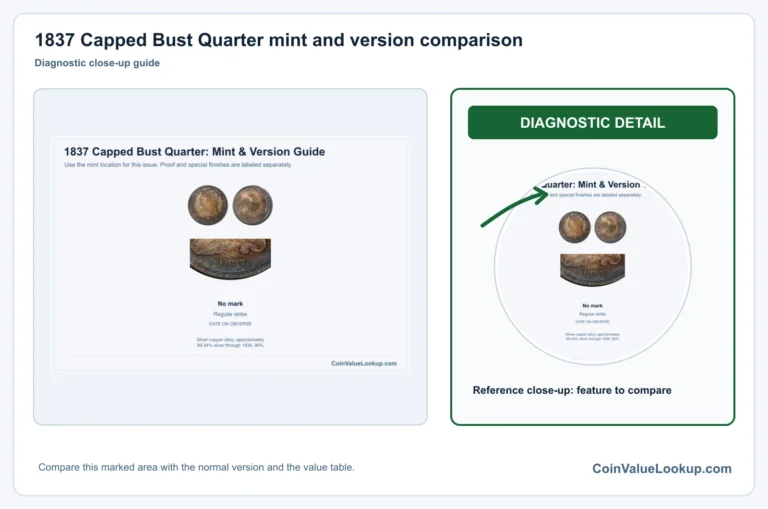
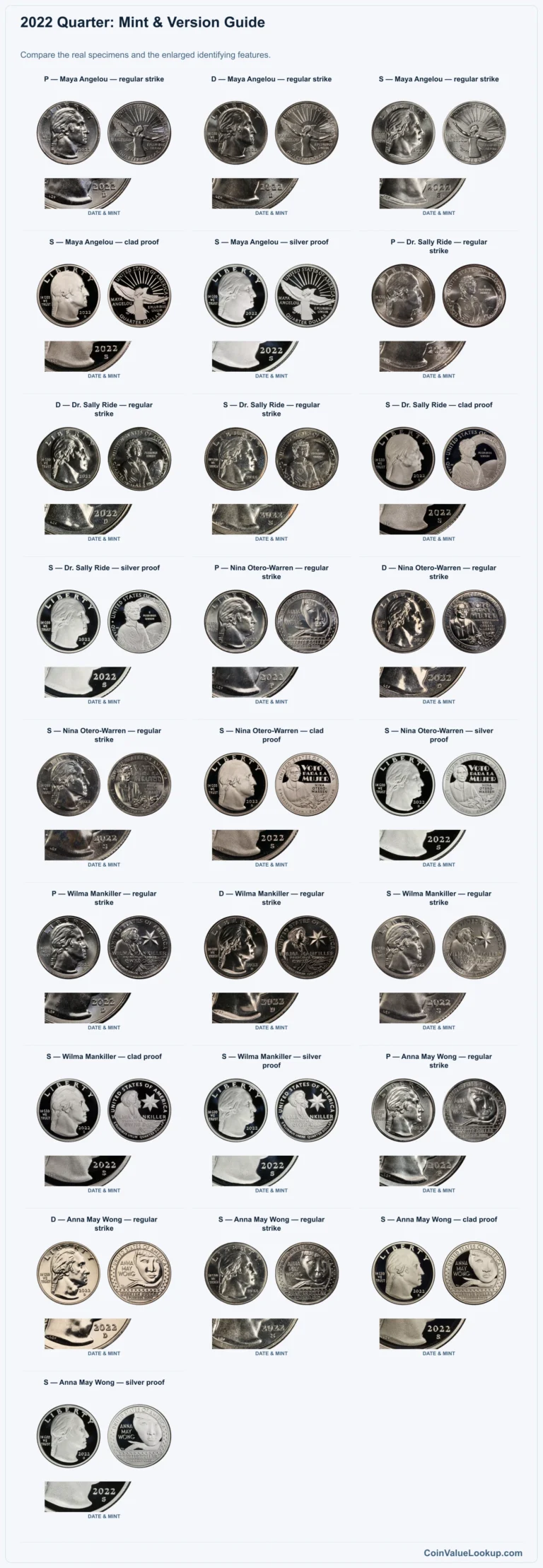
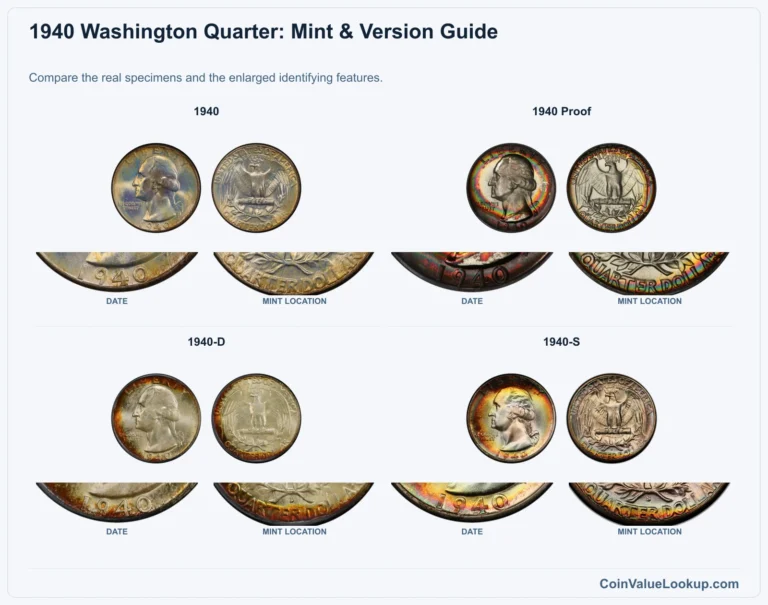
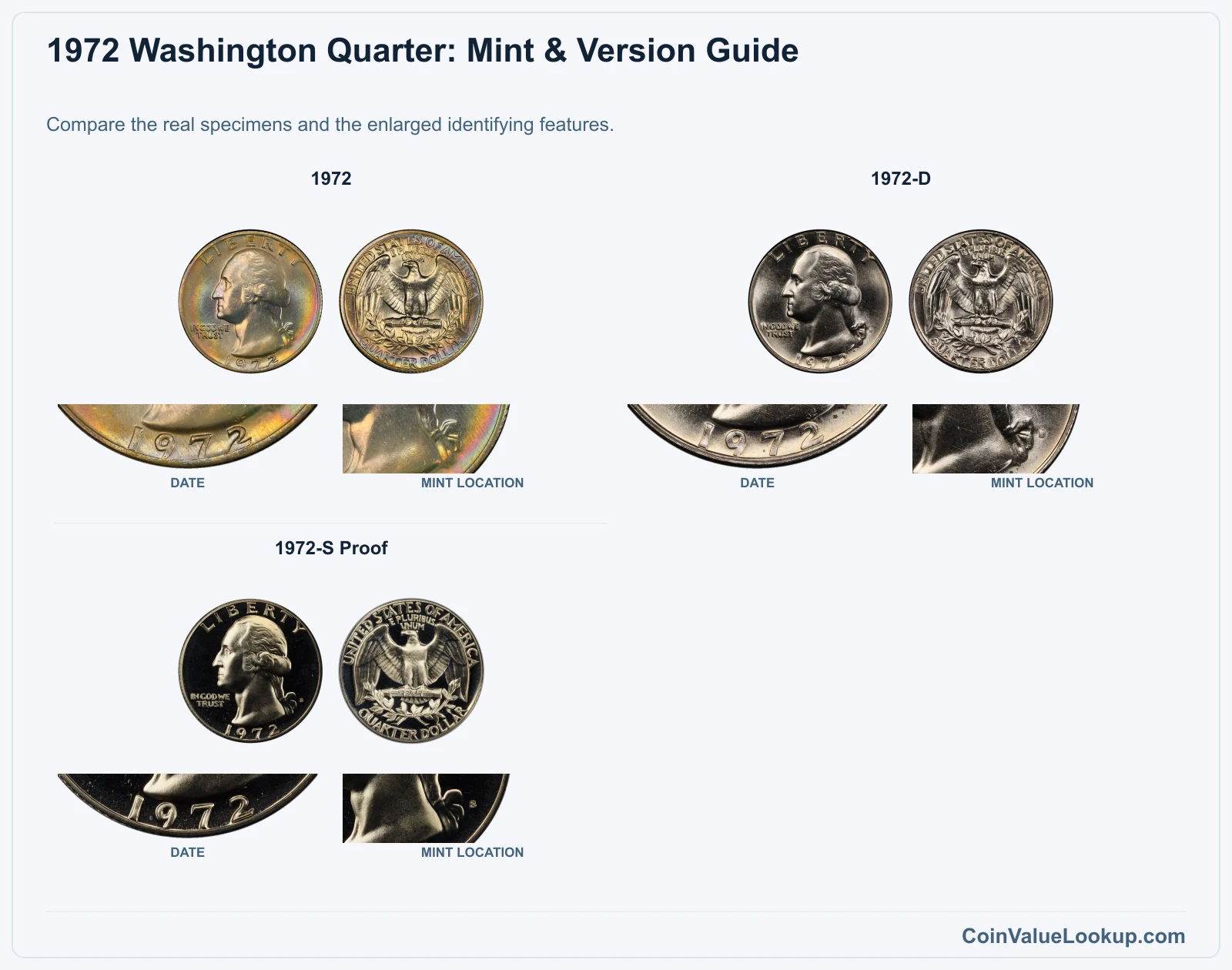
Three versions exist for 1972: the Philadelphia issue (no mintmark), the Denver issue (D mintmark), and the San Francisco proof (S mintmark). The mintmark sits on the obverse, near the date at about the 4 o'clock position.
If you see no letter, that is the Philadelphia coin — not a missing-mintmark error.
All standard 1972 quarters are copper-nickel clad over a copper core, weighing about 5.67 grams with a diameter of roughly 24.3 mm. None of them contain silver.
A normal clad edge shows a visible copper stripe between the outer layers; color alone cannot authenticate an unusual alloy.
Original high grade, an attributed finish or reverse variety, or a genuine error determines whether your coin carries a collector premium. Damage, polishing, and ordinary missing mintmarks do not add value.
Step 2: Check Your 1972 Washington Quarter Grade
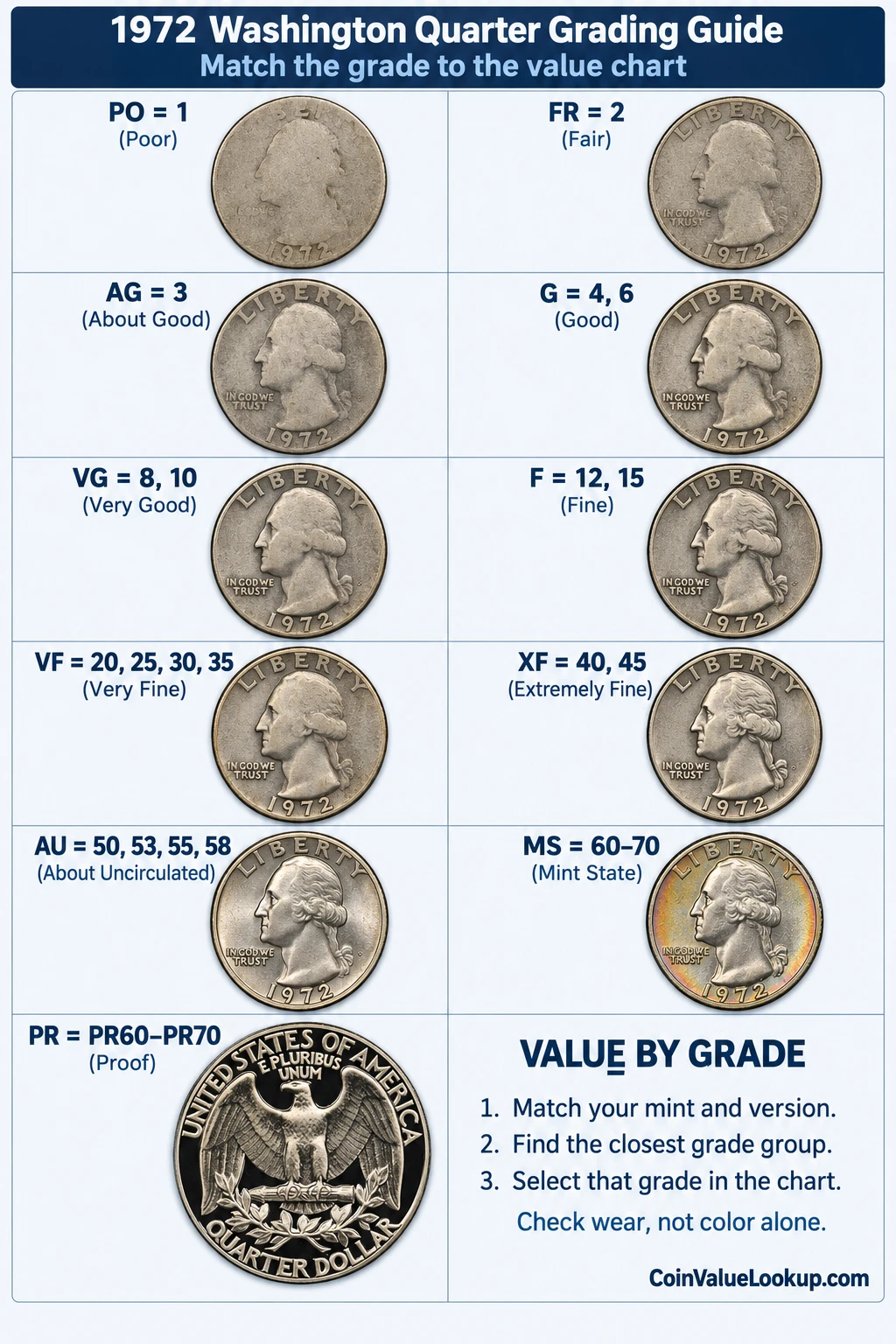
Start by checking the hair detail above Washington's ear and along the cheek and jawline. These are the first areas to lose definition from wear.
On the reverse, the eagle's breast feathers flatten early.
Compare your coin's luster with the reference comparison image. Unbroken cartwheel luster across both sides suggests a coin that never circulated.
Breaks in that luster, even without obvious wear, indicate friction.
Surface hairlines, contact marks, and rim dings all reduce the grade. A proof coin should be evaluated for contrast and surface quality separately — and no amount of polishing a circulation strike will turn it into a proof.
Step 3: Check 1972 Washington Quarter Value by Mint and Version
1972 Washington Quarter
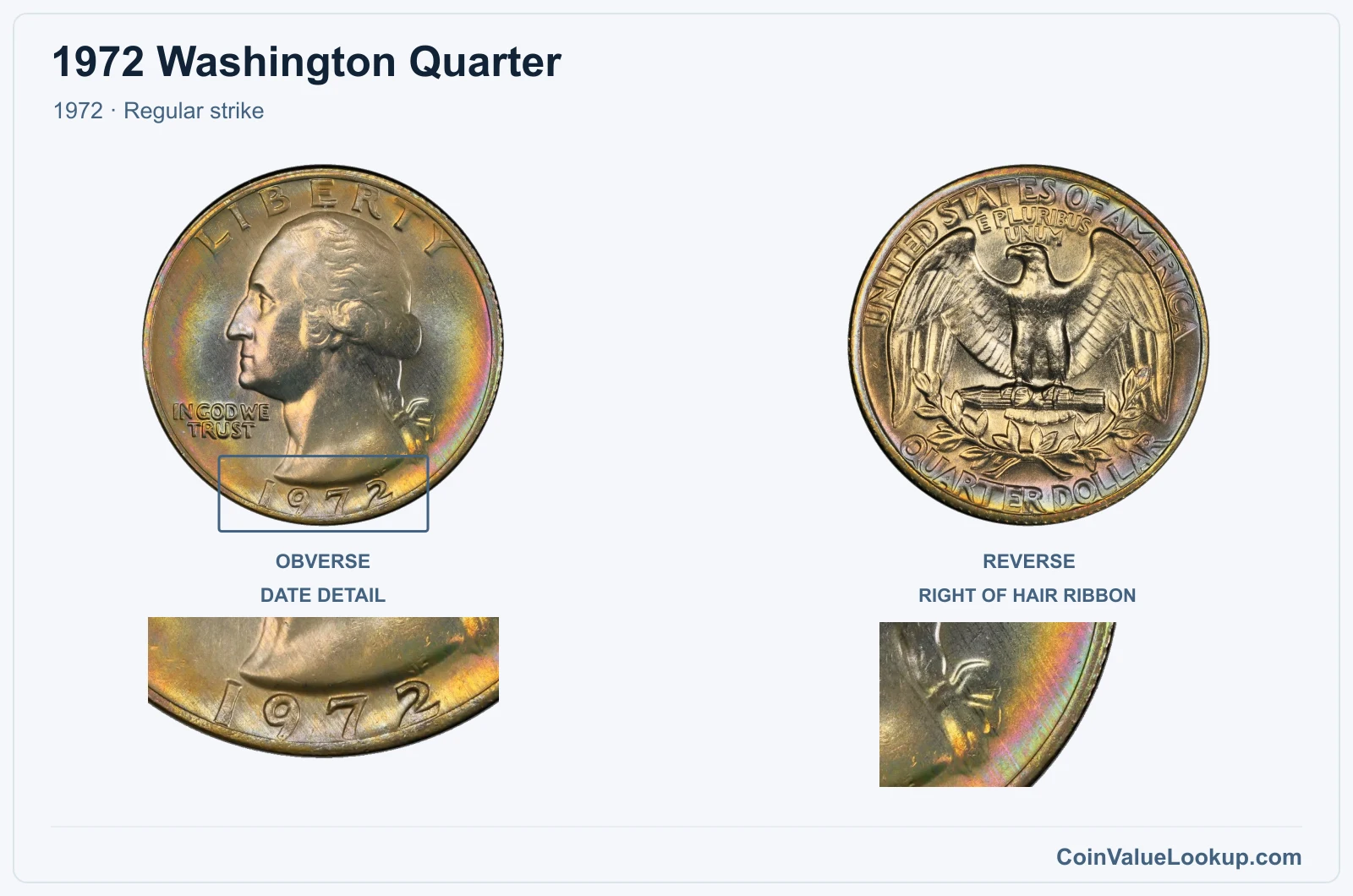
The 1972 Philadelphia quarter has no mintmark on the obverse. It is a copper-nickel clad business strike, the most commonly encountered version of this date.
In circulated condition, it trades at face value.
At the MS65 level, USA Coin Book lists a guide estimate of about $7.29. That is a retail guide figure, not a guaranteed sale price.
Look for full luster, minimal bag marks, and sharp hair detail above the ear to identify a coin that might reach that grade.
| Range | Grade | Price | Auction Records | Appraisal |
|---|---|---|---|---|
| PO | PO 1 | — | Coin Identifier | |
| FR | FR 2 | — | Coin Identifier | |
| AG | AG 3 | — | Coin Identifier | |
| G | G 4 | — | Coin Identifier | |
| G 6 | — | Coin Identifier | ||
| VG | VG 8 | — | Coin Identifier | |
| VG 10 | — | Coin Identifier | ||
| F | F 12 | — | Coin Identifier | |
| F 15 | — | Coin Identifier | ||
| VF | VF 20 | — | Coin Identifier | |
| VF 25 | — | Coin Identifier | ||
| VF 30 | — | Coin Identifier | ||
| VF 35 | — | Coin Identifier | ||
| XF | XF 40 | — | Coin Identifier | |
| XF 45 | — | Coin Identifier | ||
| AU | AU 50 | — | Coin Identifier | |
| AU 53 | — | Coin Identifier | ||
| AU 55 | — | Coin Identifier | ||
| AU 58 | — | Coin Identifier | ||
| MS | MS 60 | — | Coin Identifier | |
| MS 61 | — | Coin Identifier | ||
| MS 62 | — | Coin Identifier | ||
| MS 63 | — | Coin Identifier | ||
| MS 64 | Coin Identifier | |||
| MS 65 | Coin Identifier | |||
| MS 66 | Coin Identifier | |||
| MS 67 | Coin Identifier | |||
| MS 68 | — | — | — | |
| MS 69 | — | — | — | |
| MS 70 | — | — | — |
1972 Washington Quarter — D
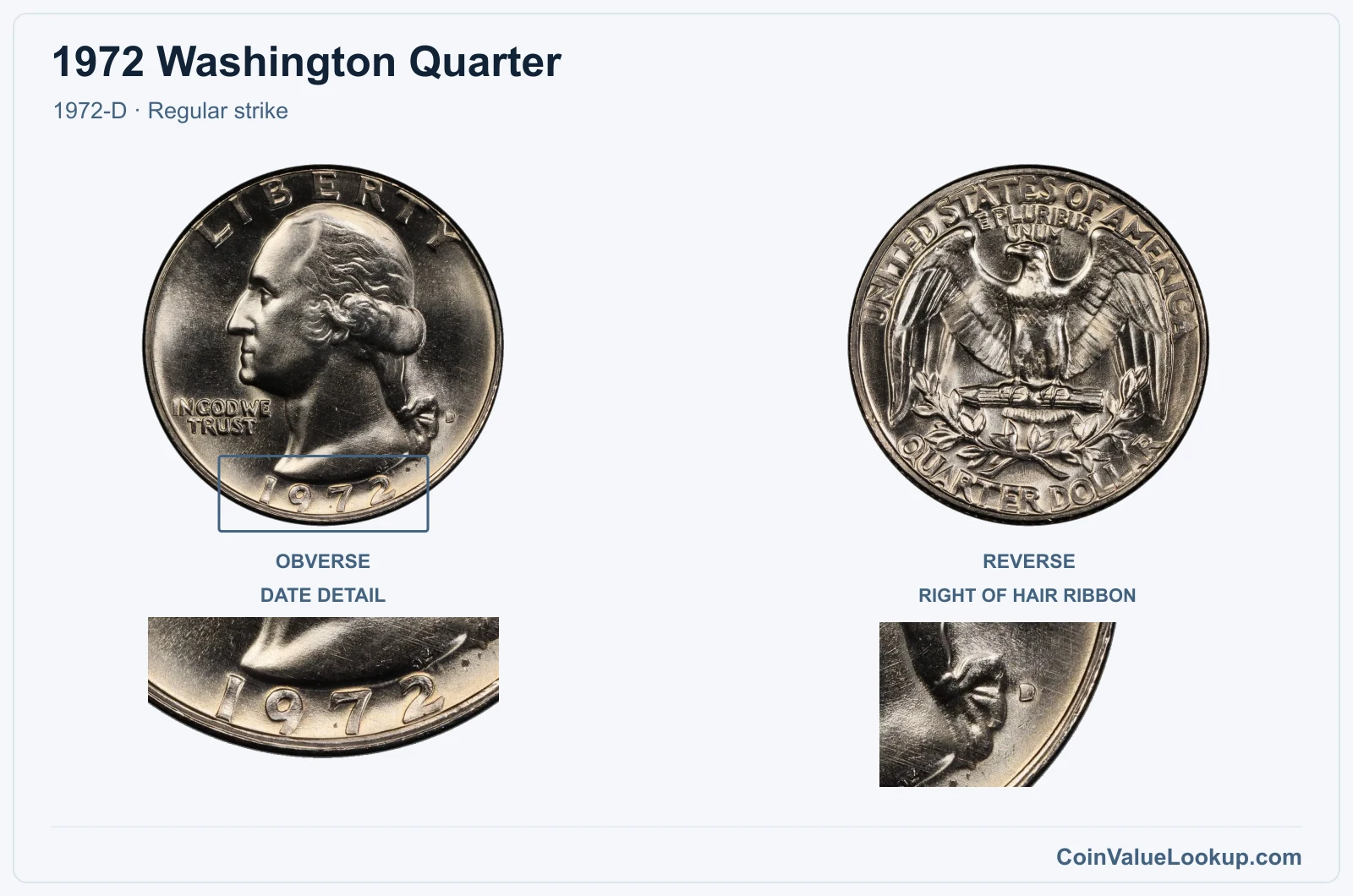
The 1972-D quarter carries a small D mintmark on the obverse near the date. Like the Philadelphia issue, it is a copper-nickel clad business strike worth face value in circulated grades.
USA Coin Book estimates about $7.29 at the MS65 level. Denver-mint coins from this year are also the host for two independently authenticated errors: the nickel-planchet strike and the triple-clip broadstrike.
Those are specific attributed specimens, not something every 1972-D might show.
Coin Value Lookup is a good starting point if you want to compare your quarter against other years and denominations in the Washington series.
| Range | Grade | Price | Auction Records | Appraisal |
|---|---|---|---|---|
| PO | PO 1 | — | Coin Identifier | |
| FR | FR 2 | — | Coin Identifier | |
| AG | AG 3 | — | Coin Identifier | |
| G | G 4 | — | Coin Identifier | |
| G 6 | — | Coin Identifier | ||
| VG | VG 8 | — | Coin Identifier | |
| VG 10 | — | Coin Identifier | ||
| F | F 12 | — | Coin Identifier | |
| F 15 | — | Coin Identifier | ||
| VF | VF 20 | — | Coin Identifier | |
| VF 25 | — | Coin Identifier | ||
| VF 30 | — | Coin Identifier | ||
| VF 35 | — | Coin Identifier | ||
| XF | XF 40 | — | Coin Identifier | |
| XF 45 | — | Coin Identifier | ||
| AU | AU 50 | — | Coin Identifier | |
| AU 53 | — | Coin Identifier | ||
| AU 55 | — | Coin Identifier | ||
| AU 58 | — | Coin Identifier | ||
| MS | MS 60 | — | Coin Identifier | |
| MS 61 | — | Coin Identifier | ||
| MS 62 | Coin Identifier | |||
| MS 63 | — | Coin Identifier | ||
| MS 64 | — | Coin Identifier | ||
| MS 65 | Coin Identifier | |||
| MS 66 | Coin Identifier | |||
| MS 67 | Coin Identifier | |||
| MS 68 | Coin Identifier | |||
| MS 69 | — | — | — | |
| MS 70 | — | — | — |
1972 Washington Quarter — S Proof
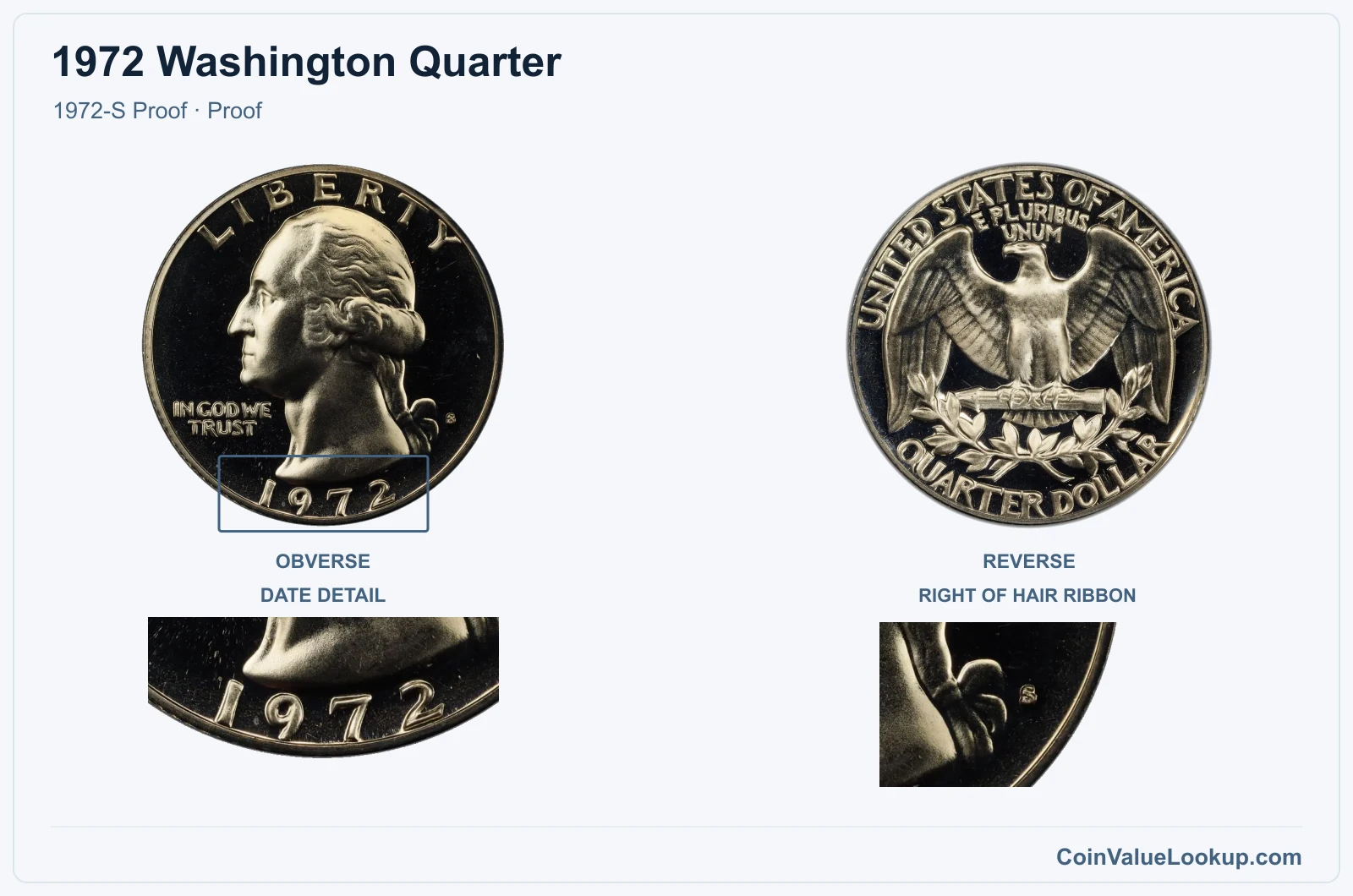
The 1972-S proof quarter was struck at San Francisco with an S mintmark on the obverse. Proofs were sold in sets to collectors and feature sharp, squared rims and mirror-like fields.
At PR65, USA Coin Book places the guide estimate at about $6.25. A proof that has been mishandled — fingerprints, haze, scratches — will grade lower.
Evaluate contrast and surface quality rather than simply checking for wear, since proofs rarely circulate.
| Range | Grade | Price | Auction Records | Appraisal |
|---|---|---|---|---|
| PR | PR 1 | — | Coin Identifier | |
| PR 2 | — | Coin Identifier | ||
| PR 3 | — | Coin Identifier | ||
| PR 4 | — | Coin Identifier | ||
| PR 6 | — | Coin Identifier | ||
| PR 8 | — | Coin Identifier | ||
| PR 10 | — | Coin Identifier | ||
| PR 12 | — | Coin Identifier | ||
| PR 15 | — | Coin Identifier | ||
| PR 20 | — | Coin Identifier | ||
| PR 25 | — | Coin Identifier | ||
| PR 30 | — | Coin Identifier | ||
| PR 35 | — | Coin Identifier | ||
| PR 40 | — | Coin Identifier | ||
| PR 45 | — | Coin Identifier | ||
| PR 50 | — | Coin Identifier | ||
| PR 53 | — | Coin Identifier | ||
| PR 55 | — | Coin Identifier | ||
| PR 58 | — | Coin Identifier | ||
| PR 60 | — | Coin Identifier | ||
| PR 61 | — | Coin Identifier | ||
| PR 62 | — | Coin Identifier | ||
| PR 63 | — | Coin Identifier | ||
| PR 64 | — | Coin Identifier | ||
| PR 65 | Coin Identifier | |||
| PR 66 | — | Coin Identifier | ||
| PR 67 | Coin Identifier | |||
| PR 68 | Coin Identifier | |||
| PR 69 | Coin Identifier | |||
| PR 70 | — | — | — |
1972 Washington Quarter Error List
1. 1972 Washington Quarter — Struck on a Nickel Planchet
This 1972-D quarter was struck on a five-cent nickel planchet instead of the correct quarter blank. Because the nickel planchet is smaller, the peripheral legends are only partially present and stretch as they approach the rim.
The date, D mintmark, and partial denomination remain visible.
A PCGS AU58 example sold for $172.50 at Heritage Auctions in May 2005. That is a single authenticated specimen, not a broad market range.
Do not rely on color or odd shape alone to identify this error. Post-mint filing, cutting, corrosion, hammering, or plating can all mimic an undersized strike.
Genuine wrong-planchet coins show proper strike surfaces across the design that was reached by the dies. Professional attribution is essential.
2. 1972 Washington Quarter — Triple Clip with Broadstrike
This 1972-D quarter was broadstruck with a 22% triple clip — three missing segments from the blank visible in the final coin, combined with an expanded diameter because the collar failed to contain the strike. The clipping occurred before the coin was struck; the missing crescents and metal flow pattern differ from post-strike cutting.
A PCGS MS63 specimen sold for $336 at Heritage Auctions in March 2025. That price reflects the combined severity of the triple clip and the broadstrike together on one coin.
Post-mint filing, random damage, or corrosion can create missing-edge illusions. Genuine clips show undisturbed strike surfaces and characteristic metal flow toward the clipped areas.
The 22% figure belongs to this attributed specimen specifically, not a universal rule for clipped quarters.
3. 1972 Washington Quarter — Proof Double Strike with Obverse Rotation
This 1972-S proof quarter received a second proof-quality impression with an obverse rotation. You can see the rotated duplicate around Washington's neck and date area while the cameo proof surfaces remain intact.
A true double strike produces two raised impressions with a repeatable rotation angle.
An NGC PR65 Cameo example is listed in Heritage Auctions' August 2024 proof-error archive. No specific sale price is adopted here; value depends on the individual coin's condition, the degree of rotation, and the severity of the second impression.
Do not confuse this with flat shelf doubling or machine doubling, which are die or mechanical effects that leave flat, shelf-like distortions rather than fully raised second impressions. Post-mint damage, corrosion, or hammering can also create misleading doubled appearances.
Authentication by a third-party grading service is the safest route.
4. 1972 Washington Quarter — Doubled Die Obverse
A doubled die obverse has been reported for the 1972 quarter. On an affected coin, look for consistent separation or notching on the obverse lettering or design elements compared to a normal example under identical lighting and magnification.
True die doubling shows raised, separated outlines that repeat across multiple design features in the same direction. Machine doubling, by contrast, produces flat shelf-like distortion and does not carry the same collector interest.
No specific price is adopted for this variety. Value depends on the visibility and strength of the doubling, the coin's overall condition, and which specific die pair produced it.
If you suspect you have one, compare it carefully with a known normal coin and consider professional attribution.
5. 1972 Washington Quarter — Off-Center Strike
Off-center strikes have been reported for the 1972 quarter. These occur when the blank is not properly seated between the dies, resulting in a displaced design and an unstruck crescent along part of the rim.
The most collectible off-center coins retain a full, readable date. Without the date, identification becomes difficult and collector demand drops.
The percentage of off-center displacement and the coin's condition both affect value.
No specific price is adopted here. Do not confuse an off-center strike with a clipped planchet, which removes a crescent from the blank before striking, or with post-mint flattening that can shift the appearance of the design.
Genuine off-center coins show the design cleanly displaced with an unstruck area, not simply a weak or damaged region.
6. 1972 Washington Quarter — Repunched Mintmark
A repunched mintmark has been reported for the 1972-D quarter. Before mintmarks were placed by the die hub, individual letter punches were applied by hand, and occasionally the D was punched more than once in slightly different positions.
Under magnification, look for remnants of a second D partially visible near the primary mintmark. Compare your coin at the same magnification with a normal 1972-D to see whether the extra impression is genuine or just an artifact of wear.
No specific price is adopted. Value varies with the visibility of the repunching and the coin's grade.
Machine doubling, die chips, or corrosion around the mintmark area can mimic an RPM, so careful comparison is important.
7. 1972 Washington Quarter — Doubled Die Reverse
Doubled die reverse errors have been reported for the 1972 quarter. These involve a misaligned secondary impression on the reverse die itself, producing raised doubling on the struck coins.
Compare the reverse legends and design contours — particularly around the lettering and the eagle — with a normal 1972 quarter under identical magnification. True die doubling will show consistent separation on multiple elements in the same direction.
No specific price is adopted. The value depends on the strength and visibility of the doubling and the coin's condition.
Machine doubling and random surface damage can look similar at first glance but produce flat, shelf-like distortions rather than the raised secondary image of a genuine doubled die.
8. 1972 Washington Quarter — Missing Clad Layer
Missing clad layer errors have been reported for the 1972 quarter. On a genuine example, one or both outer clad layers were absent from the planchet before striking, exposing the copper core on the affected face.
Compare the suspect face and edge with a normal clad coin. A missing clad layer coin will typically weigh less than the standard 5.67 grams, and the exposed side may appear copper-colored.
The edge cross-section should also look different from a normal three-layer sandwich.
No specific price is adopted. Value depends on condition, whether one or both layers are missing, and professional confirmation.
Toning, environmental damage, plating removal, or post-mint surface stripping can all mimic this error, so weight and edge examination are more reliable indicators than color alone.
9. 1972 Washington Quarter — Struck-Through Error
A struck-through error has been reported for the 1972 quarter, described as a massive struck-through reeding impression. This type of error occurs when foreign material — in this case apparently a fragment carrying a reeding pattern — sits between the die and the planchet during striking, leaving a localized depression or obstruction imprint on the finished coin.
Look for an area where the design is incomplete or impressed with an unusual texture that does not match normal wear. Grease fills, retained foreign objects, and reeding transfers each produce distinct patterns.
No specific price is adopted. Value depends on the size, location, and visual drama of the obstruction impression, plus the coin's overall condition.
Ordinary wear, scratches, or cleaning can weaken design details in ways that superficially resemble a struck-through area, so compare carefully with a normal coin.