1960 Franklin Half Dollar Coin Value: How Much Is It Worth?
The 1960 Franklin Half Dollar is a 90% silver coin that remains popular with collectors for both its metal content and its classic mid-century design. Guide estimates for this year range from about $32.00 in well-worn grades up to $203.00 for top uncirculated examples, depending on which mint struck the coin and its condition.
These are guide anchors from USA Coin Book, not guaranteed selling prices or current silver-melt quotes. Mint, grade, strike quality and the presence of certain varieties all play a role in what your particular coin might bring.
Fast Way to Identify Your 1960 Franklin Half Dollar
Want a quick read on your coin? Upload clear photos of both the front and back, and our identifier can offer a preliminary take on which version you have.
This is not a professional authentication or exact grade assignment, but it can point you in the right direction before you dig deeper into specifics.
1960 Franklin Half Dollar Value
Upload both sides of your 1960 Franklin Half Dollar.
Front Obverse
Upload photo
Back Reverse
Upload photo
Which 1960 Franklin Half Dollar Versions Are Worth Money?
- The 1960-D in MS65 condition carries the highest guide estimate among listed branches at $203.00, making top-grade Denver coins the ones to watch.
- Philadelphia business strikes in MS65 are estimated at $118.00, still a meaningful premium over lower grades.
- The 1960 proof at PR65 is estimated at $48.00 and is worth confirming if your coin has mirrored fields.
- Full Bell Lines designation can add a premium to any business strike if the lower bell detail is fully intact.
- A reported Proof Doubled Die Obverse exists for this year and could carry additional collector interest beyond standard proof values.
Step 1: Identify Your 1960 Franklin Half Dollar Mint Mark and Version
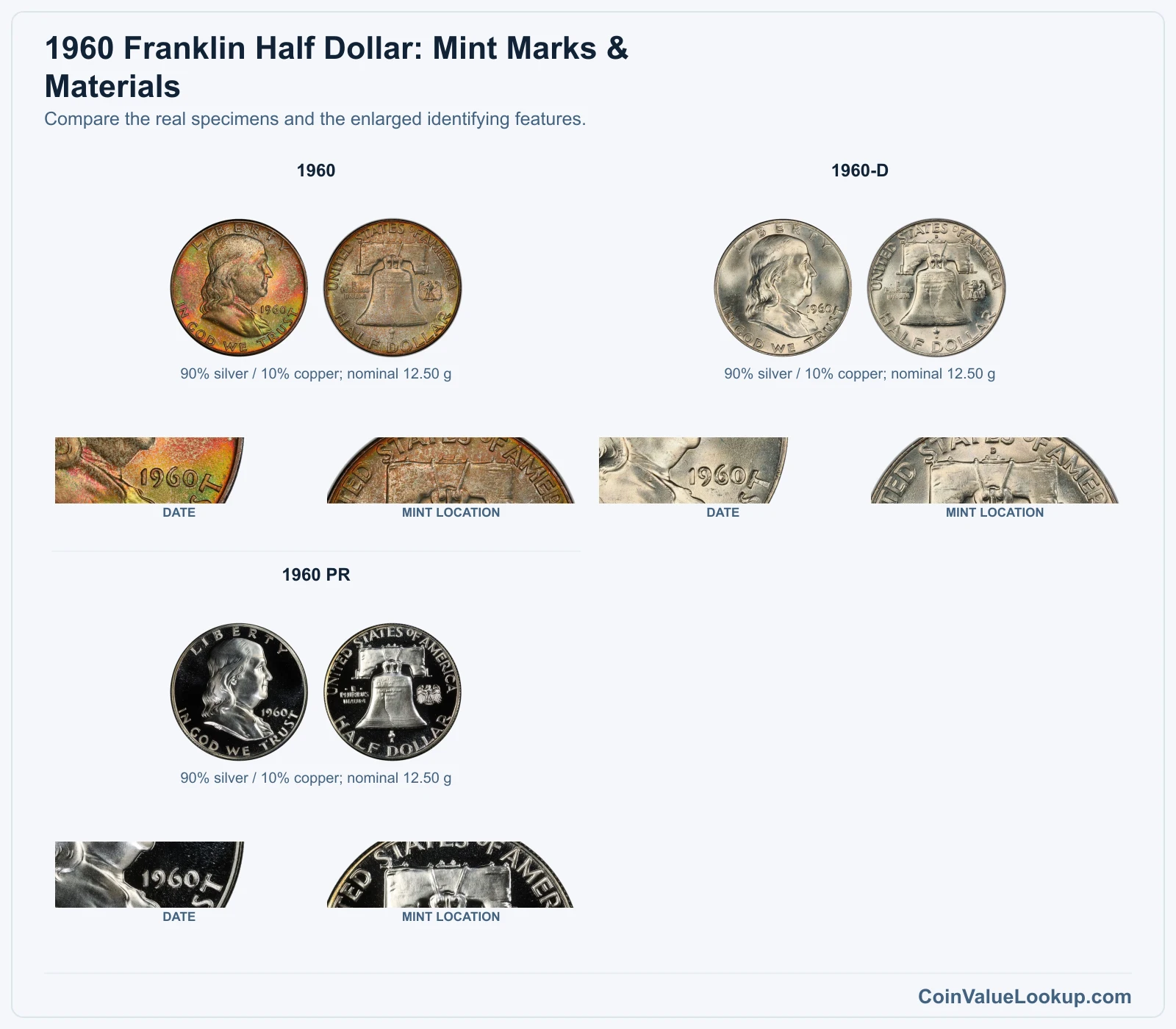
Every 1960 Franklin Half Dollar is struck in 90% silver and 10% copper, with a nominal weight of 12.50 grams. Toning or discoloration does not change the underlying alloy.
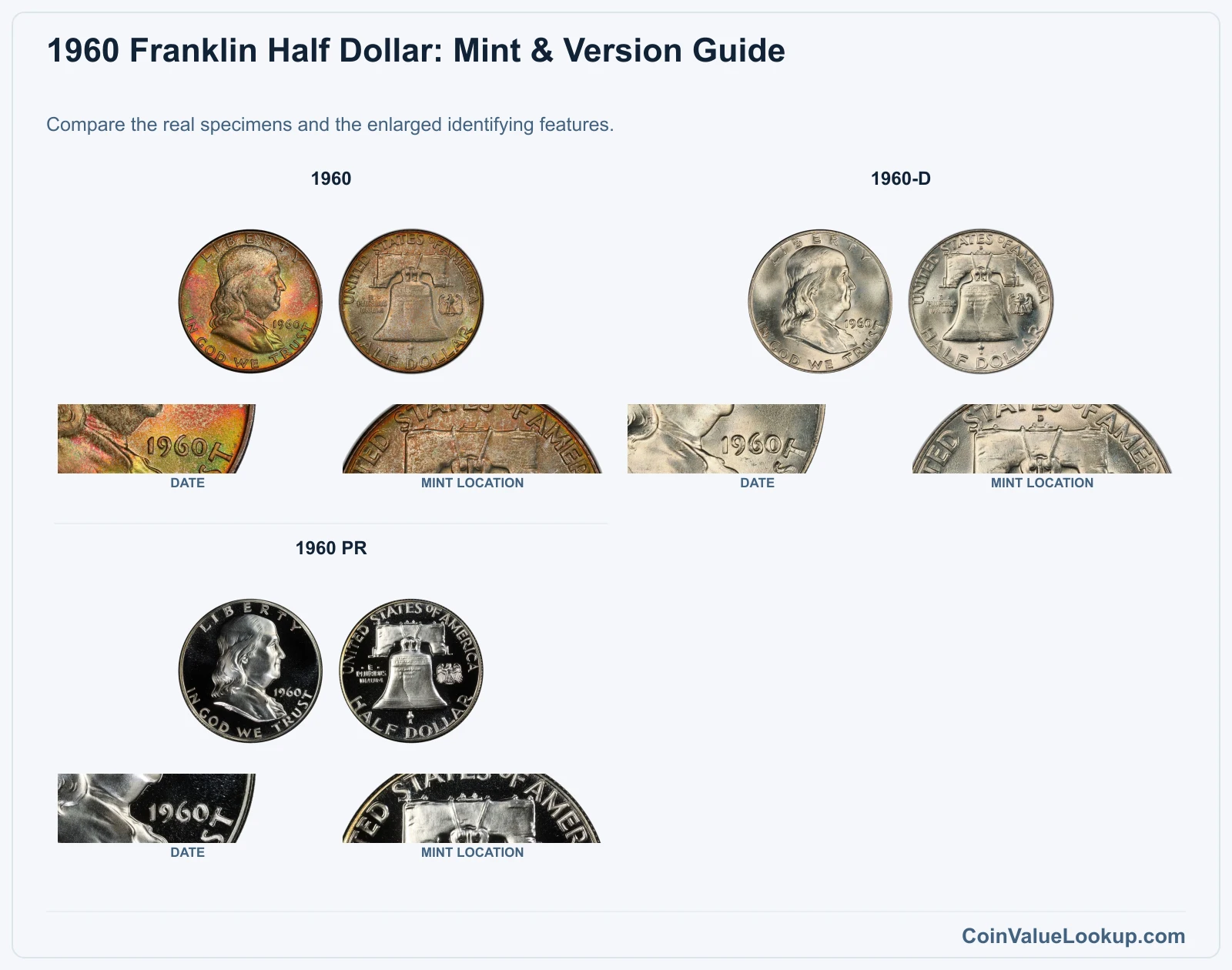
The mintmark sits on the reverse, just above the Liberty Bell and below E PLURIBUS UNUM. No mintmark means Philadelphia.
A small "D" means Denver. San Francisco did not produce this date.
Three branches exist for 1960: the Philadelphia business strike, the Denver business strike, and the Philadelphia proof. Business strikes were made for circulation; proofs were manufactured for collectors with mirrored fields and sharp devices.
A polished circulation coin is not a proof, no matter how shiny it looks.
Full Bell Lines is sometimes referenced as a premium designation. It refers to complete, unbroken horizontal lines on the lower portion of the Liberty Bell, indicating a strong strike.
It is not a separate mint, metal, or design variety.
Step 2: Check Your 1960 Franklin Half Dollar Grade
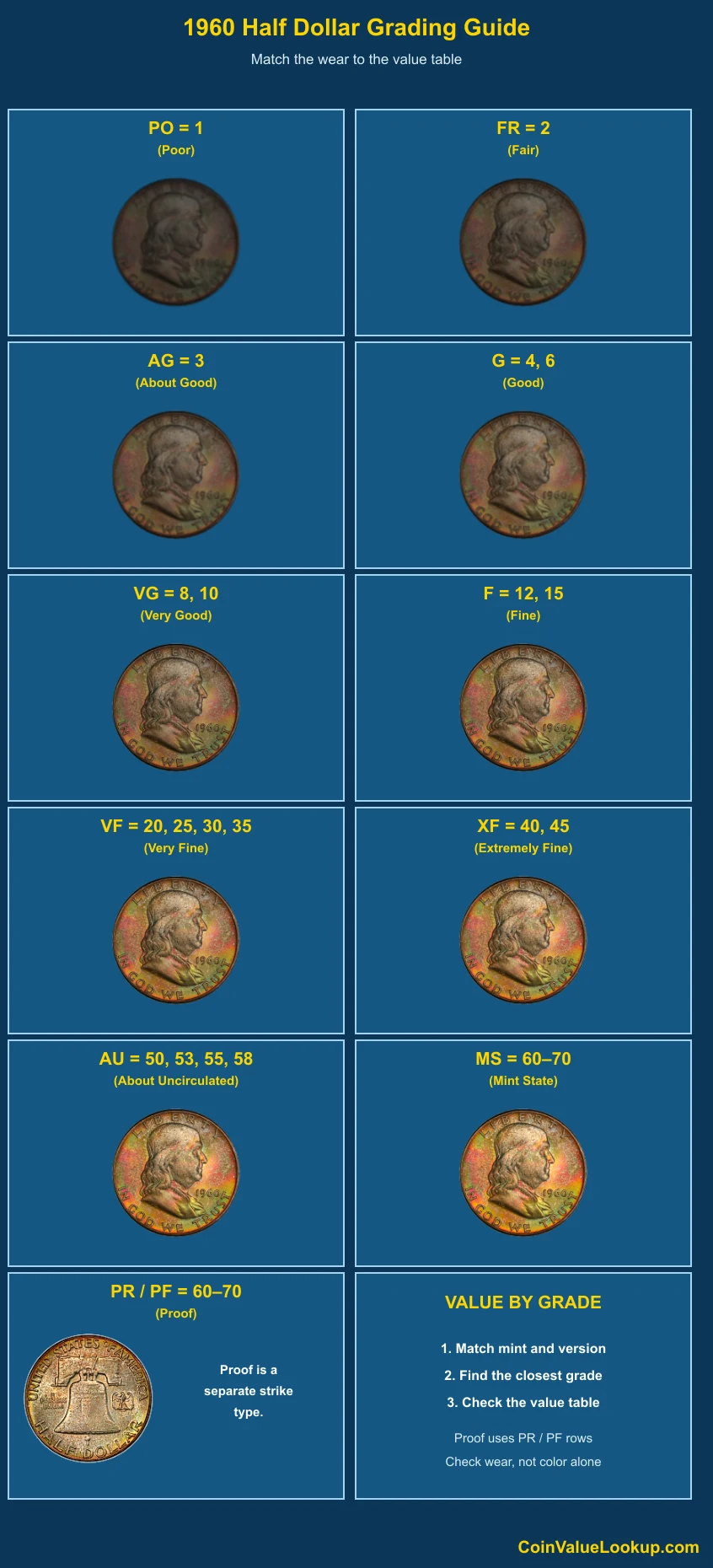
Start with Franklin's cheek and the hair behind his ear. In lower grades, those areas flatten first and merge into broad, smooth patches.
A coin grading around Good-4 will show a recognizable outline but very little interior detail.
Move to the shoulder area. Even light wear shows up there quickly because it is one of the highest relief points on the obverse.
On the reverse, check the Liberty Bell lettering and the lower bell lines. Rim sharpness matters too.
Contact marks from banging around in bags are different from actual circulation smoothing; marks leave individual dings while wear creates uniform flatness.
Use the comparison image to match your coin against known grade examples of the same type. Proof coins are graded on a separate scale that emphasizes hairlines, haze and surface quality rather than wear.
Step 3: Check 1960 Franklin Half Dollar Value by Mint and Version
1960 Franklin Half Dollar
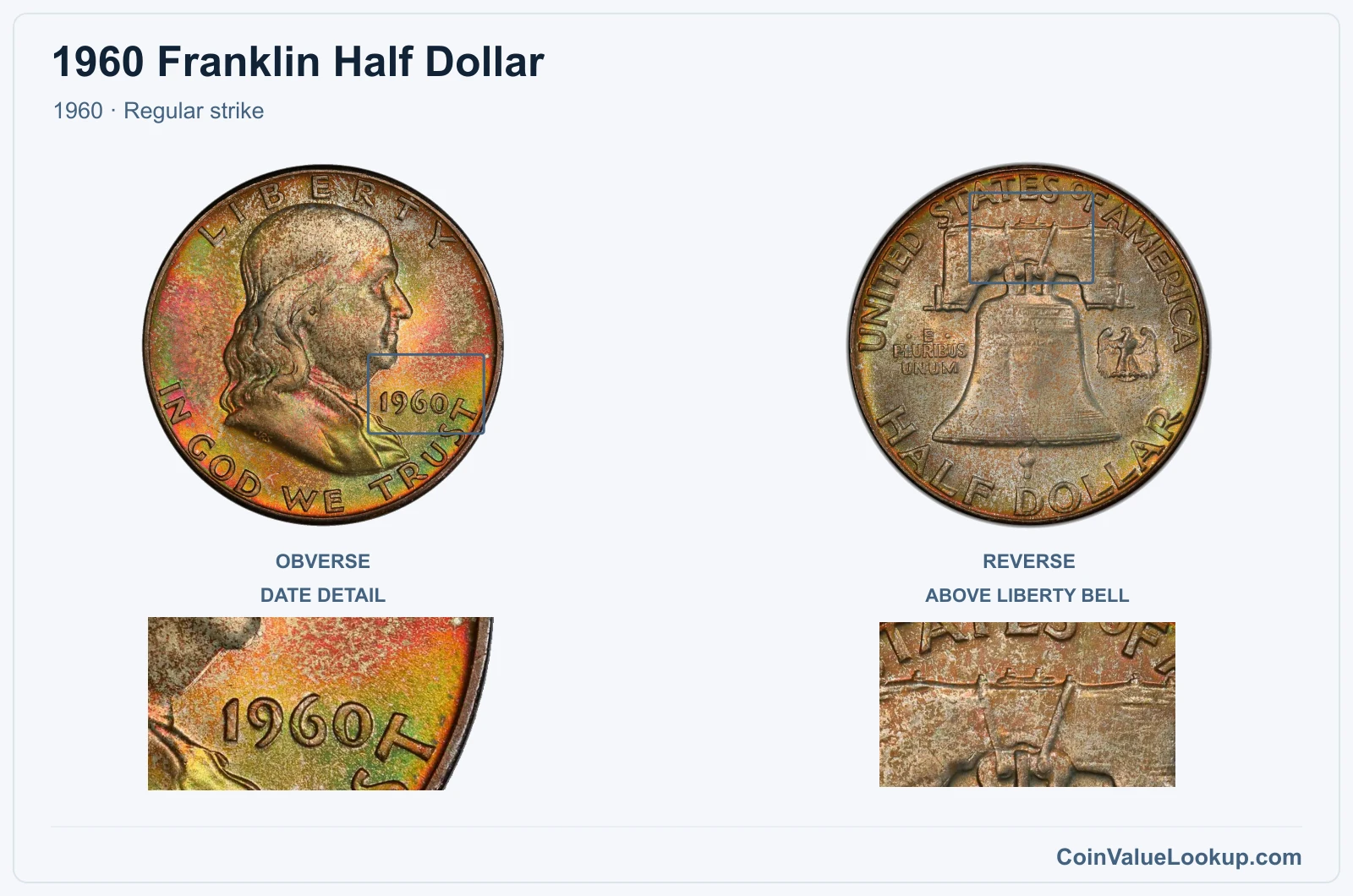
The 1960 Philadelphia business strike carries no mintmark. Look at the reverse above the Liberty Bell: if the space below E PLURIBUS UNUM is blank, you have the Philly coin.
USA Coin Book estimates place this version at roughly $32.00 in G4 and $118.00 in MS65. Those are guide figures, not guaranteed offers.
Silver content supports a baseline, but cleaned or damaged coins trade well below problem-free examples at the same technical grade.
If your coin shows complete, unbroken horizontal lines across the lower bell, it may qualify for the Full Bell Lines designation, which can push the premium higher than the standard MS65 estimate.
Range Grade
Price Auction Records Appraisal PO PO 1
—
Coin Identifier FR FR 2
—
Coin Identifier AG AG 3
—
Coin Identifier G G 4
—
Coin Identifier
G 6
—
Coin Identifier VG VG 8
—
Coin Identifier
VG 10
—
Coin Identifier F F 12
—
Coin Identifier
F 15
—
Coin Identifier VF VF 20
—
Coin Identifier
VF 25
—
Coin Identifier
VF 30
—
Coin Identifier
VF 35
—
Coin Identifier XF XF 40
—
Coin Identifier
XF 45
—
Coin Identifier AU AU 50
—
Coin Identifier
AU 53
—
Coin Identifier
AU 55
—
Coin Identifier
AU 58
—
Coin Identifier MS MS 60
—
Coin Identifier
MS 61
—
Coin Identifier
MS 62
Coin Identifier
MS 63
Coin Identifier
MS 64
Coin Identifier
MS 65
Coin Identifier
MS 66
Coin Identifier
MS 67
Coin Identifier
MS 68
—
—
—
MS 69
—
—
—
MS 70
—
—
—
1960 Franklin Half Dollar — D
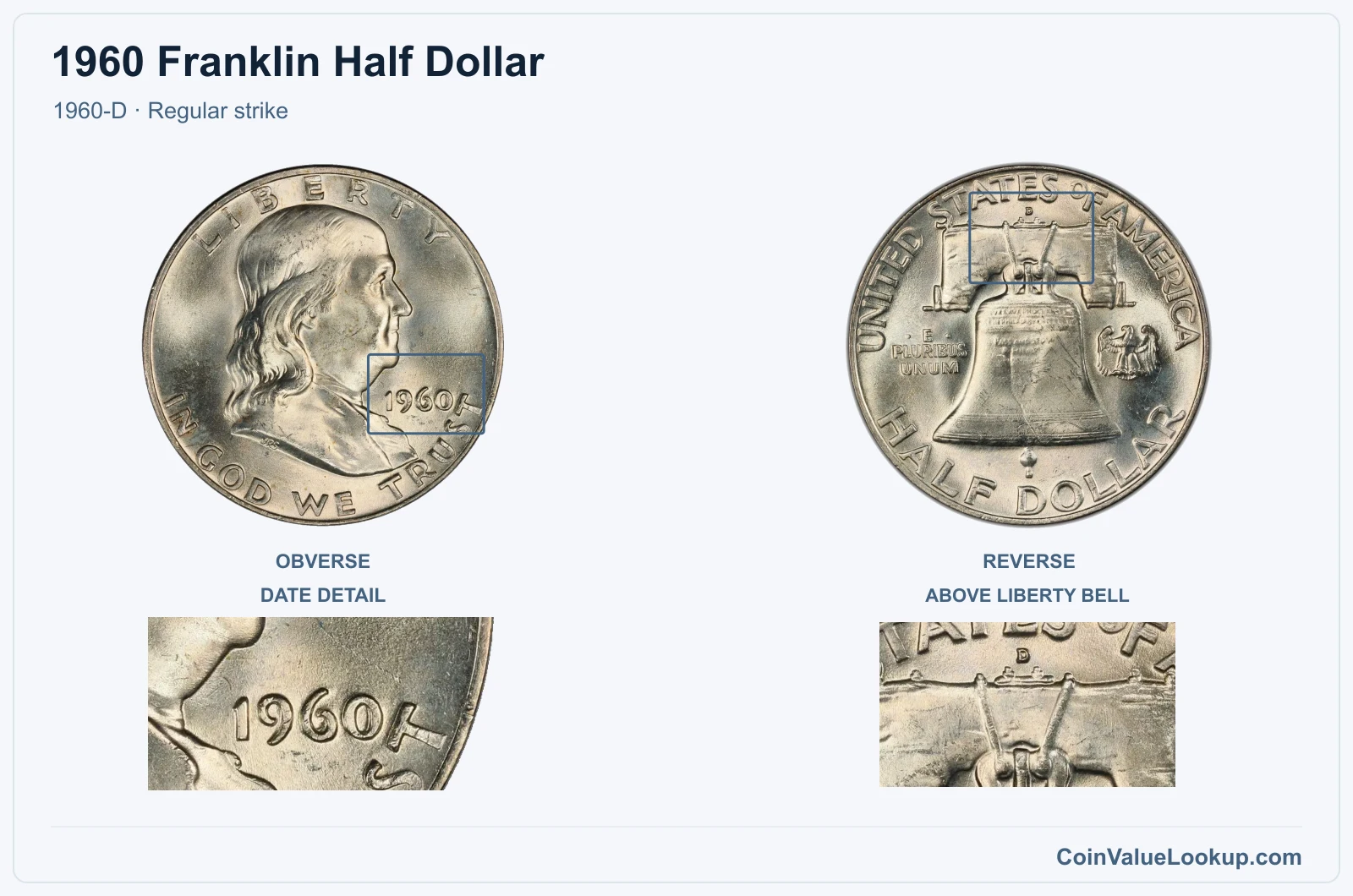
The Denver issue has a small "D" mintmark on the reverse, above the Liberty Bell. It is the branch with the highest guide estimate this year: about $32.00 in G4 and $203.00 in MS65, per USA Coin Book.
That MS65 figure is nearly double the Philadelphia business strike at the same grade, so condition really matters here. A bag-marked coin grading MS63 is a different animal from a clean MS65.
Coin Value Lookup is a handy starting point if you want to look up other Franklin dates or denominations alongside this one. A couple of minutes there can save you a lot of scrolling.
As with the Philadelphia coin, Full Bell Lines can add value if those lower bell lines are fully intact. Confirm the mintmark first, then assess the strike.
Range Grade
Price Auction Records Appraisal PO PO 1
—
Coin Identifier FR FR 2
—
Coin Identifier AG AG 3
—
Coin Identifier G G 4
—
Coin Identifier
G 6
—
Coin Identifier VG VG 8
—
Coin Identifier
VG 10
—
Coin Identifier F F 12
—
Coin Identifier
F 15
—
Coin Identifier VF VF 20
—
Coin Identifier
VF 25
—
Coin Identifier
VF 30
Coin Identifier
VF 35
—
Coin Identifier XF XF 40
—
Coin Identifier
XF 45
—
Coin Identifier AU AU 50
—
Coin Identifier
AU 53
—
Coin Identifier
AU 55
—
Coin Identifier
AU 58
Coin Identifier MS MS 60
—
Coin Identifier
MS 61
—
Coin Identifier
MS 62
Coin Identifier
MS 63
Coin Identifier
MS 64
Coin Identifier
MS 65
Coin Identifier
MS 66
Coin Identifier
MS 67
—
—
—
MS 68
—
—
—
MS 69
—
—
—
MS 70
—
—
—
1960 Franklin Half Dollar — PR
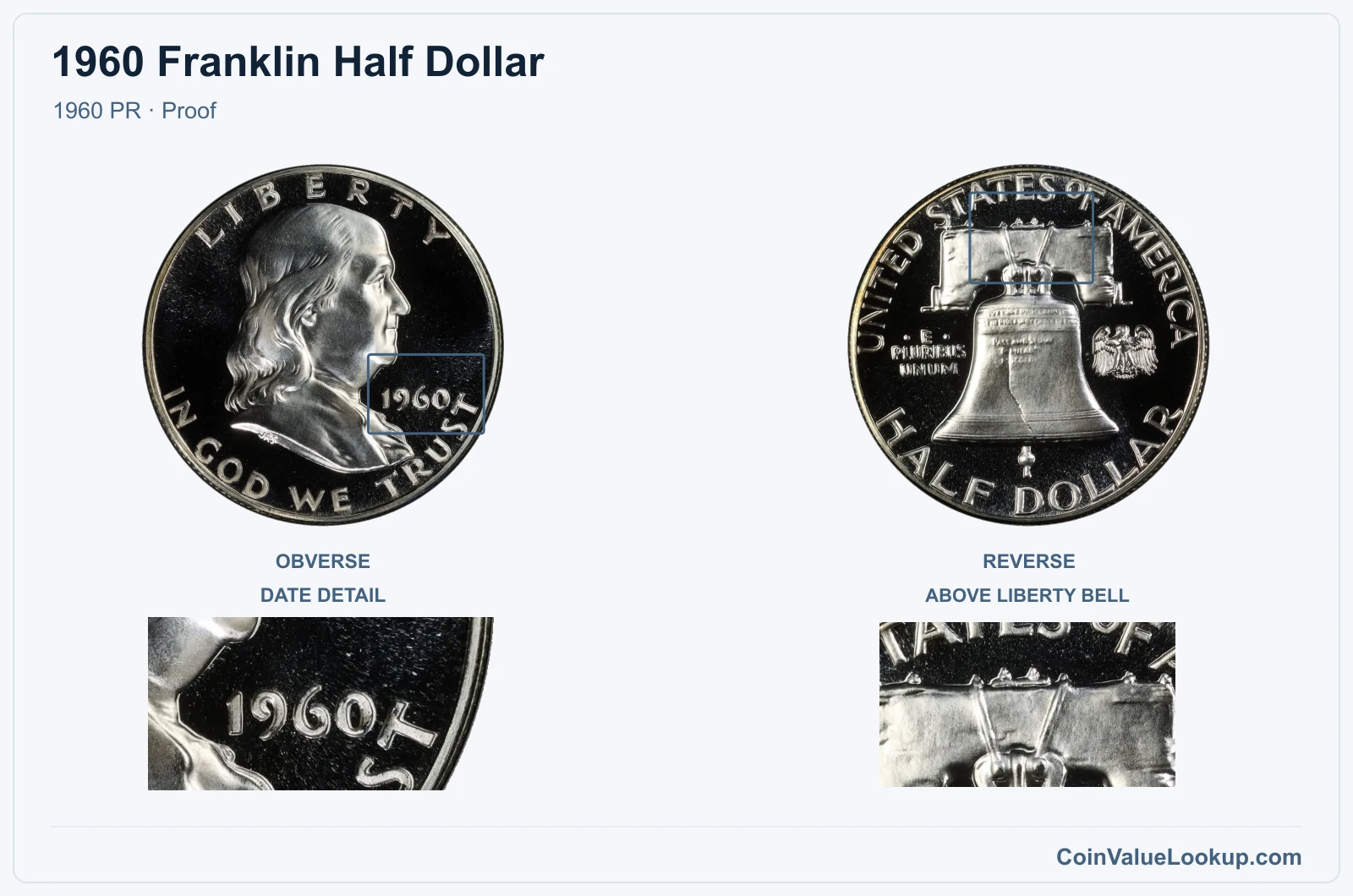
The 1960 proof was struck at Philadelphia with no mintmark, just like the business strike, but the manufacturing process is completely different. Proofs have mirrored fields and sharply struck devices produced by specially prepared dies and planchets.
USA Coin Book estimates PR65 at about $48.00. That is a starting point; cameo contrast or exceptional surfaces could shift the conversation, while hairlines or haze push it the other direction.
To confirm you actually have a proof, look for deep reflectivity in the flat areas of both sides. If the fields look like a dark mirror when tilted under a light, that is the proof finish.
A polished circulation strike will not replicate that effect consistently across the entire surface.
Range Grade
Price Auction Records Appraisal PR PR 1
—
Coin Identifier
PR 2
—
Coin Identifier
PR 3
—
Coin Identifier
PR 4
—
Coin Identifier
PR 6
—
Coin Identifier
PR 8
—
Coin Identifier
PR 10
—
Coin Identifier
PR 12
—
Coin Identifier
PR 15
—
Coin Identifier
PR 20
—
Coin Identifier
PR 25
—
Coin Identifier
PR 30
—
Coin Identifier
PR 35
—
Coin Identifier
PR 40
—
Coin Identifier
PR 45
—
Coin Identifier
PR 50
—
Coin Identifier
PR 53
—
Coin Identifier
PR 55
—
Coin Identifier
PR 58
Coin Identifier
PR 60
Coin Identifier
PR 61
—
Coin Identifier
PR 62
Coin Identifier
PR 63
Coin Identifier
PR 64
Coin Identifier
PR 65
Coin Identifier
PR 66
Coin Identifier
PR 67
Coin Identifier
PR 68
Coin Identifier
PR 69
Coin Identifier
PR 70
—
—
—
1960 Franklin Half Dollar Error List
1. 1960 Franklin Half Dollar — Doubled Die Obverse
A Doubled Die Obverse has been reported specifically on the 1960 proof Franklin Half Dollar. On this variety, look for consistent doubling on obverse lettering or design elements: separation, notching, or a secondary image that repeats in the same direction across multiple letters.
Compare your coin to a normal proof under the same lighting. Genuine hub doubling shows a distinct, repeatable shift.
Machine doubling, by contrast, tends to create a flat shelf on one side of the lettering without true separation.
Reflections on proof surfaces can also mimic doubling, so use a single-point light source and tilt slowly. The value of a confirmed doubled die depends on the visibility of the doubling, the coin's overall condition, and collector demand for the specific variety.
No numerical price range is available here, so individual assessment is the way to go.
2. 1960 Franklin Half Dollar — Lamination / Split Planchet
Lamination errors occur when the planchet has an internal flaw that causes part of the metal to peel, flake, or separate. On a 1960 Franklin Half Dollar, look for a raised flap of metal, a missing layer exposing rough surface beneath, or a visible crack along the edge where the alloy has split.
Photograph both the affected face and the edge together so the full extent of the separation is visible. This helps distinguish the error from surface damage.
Scraping, corrosion pitting, or a coin that someone deliberately cut will sometimes look similar at first glance. The key difference is that a genuine lamination follows the contour of the planchet and typically has a smooth interior where the layers parted.
Value depends on the size, location, and the coin's overall condition. No specific price range is adopted for this error.
3. 1960 Franklin Half Dollar — Struck-Through Error
A struck-through error happens when foreign material sits between the die and the planchet during striking, leaving a depression or an incomplete area in the design. On a 1960 Franklin Half Dollar, look for a localized indentation that does not match normal wear patterns, or an area where detail is missing in a shape that suggests an obstruction.
Grease fills and retained foreign objects are two distinct subtypes. A grease fill tends to obscure an area smoothly, while a retained object may leave a recognizable impression of whatever was trapped.
Ordinary weak strikes, cleaning marks, and scratches can all mimic a struck-through at a casual glance. The difference is that a genuine struck-through creates a recessed area with a consistent depth, not a surface scratch or gradual thinning of detail.
Value varies with visibility and the coin's condition. No numerical price is available for this category.