1820 Capped Bust Half Dollar Coin Value: How Much Is It Worth?
The 1820 Capped Bust Half Dollar comes in several distinct varieties, and which one you have matters a lot. Ordinary circulated examples start around $142 at G4 and climb to roughly $1,262 at AU50 for common branches, while scarcer varieties and the rare early Proof occupy entirely different price territory.
Condition and correct variety attribution drive everything here.
Fast Way to Identify Your 1820 Capped Bust Half Dollar
Snap clear, well-lit photos of both the front and back of your coin and upload them to our identifier. This gives you a preliminary identification of the variety and general condition, which is the first step toward understanding what you have.
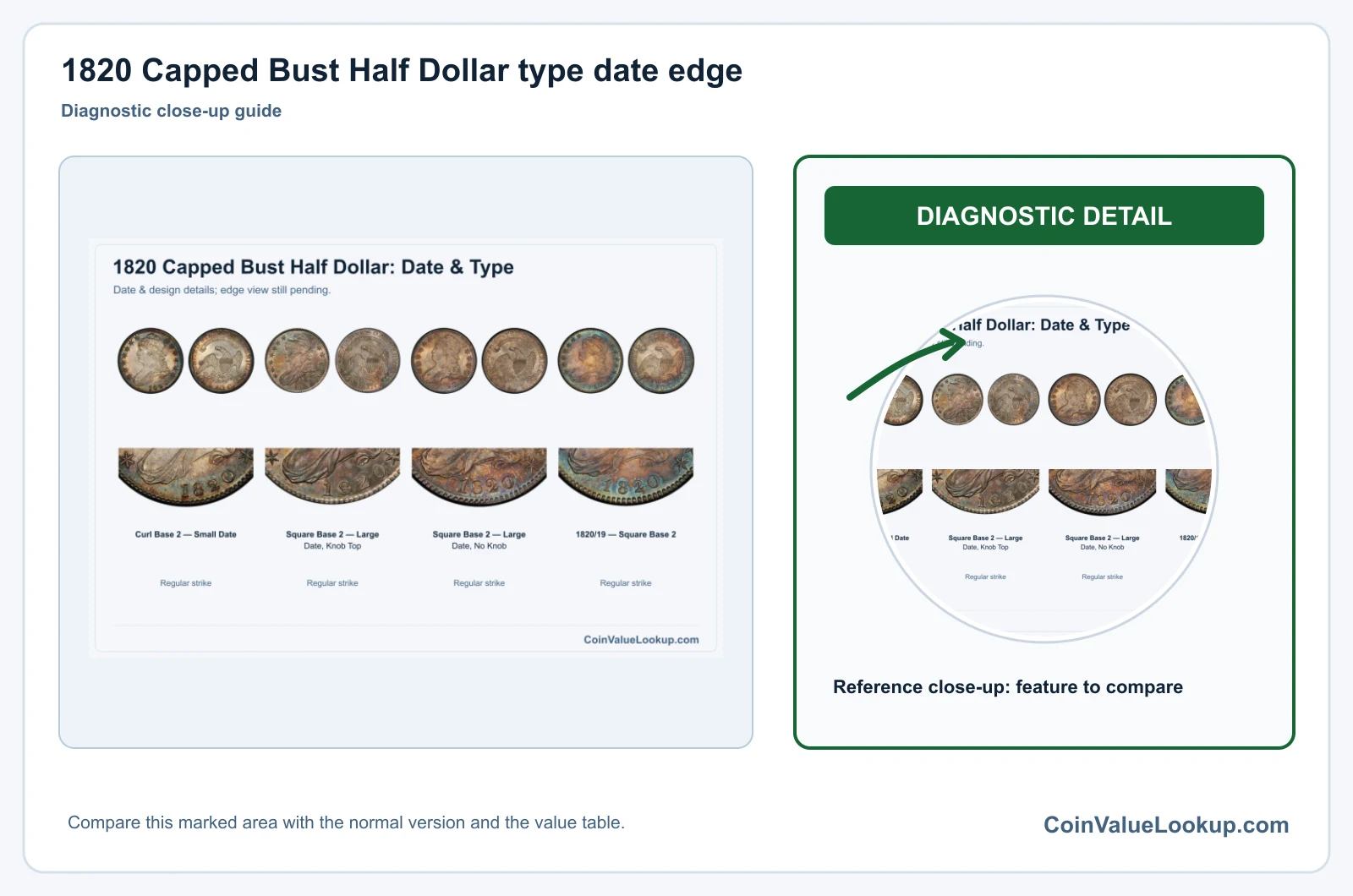
Make sure the date digits and the base of the 2 are in focus, since that detail separates multiple branches.
1820 Capped Bust Half Dollar Value
Upload both sides of your 1820 Capped Bust Half Dollar.
Front Obverse
Upload photo
Back Reverse
Upload photo
Which 1820 Capped Bust Half Dollar Versions Are Worth Money?
- The 1820/19 overdate with Square Base 2 carries higher guide values than standard varieties — around $152 at G4 and $2,130 at AU50 — because of visible remnants of 19 beneath the corrected date.
- The No Serifs on E Letters reverse variety stands out sharply, with guide estimates of $1,262 at G4 climbing to $15,264 at AU50, reflecting its scarcity among 1820 die pairings.
- The 1820/19 Curl Base 2 overdate pairs the date correction with a curved-base 2 and lists up to $1,541 at AU50, a meaningful premium over common date versions.
- Early Proof specimens are extremely rare specialist coins; one sold at PR63 for $35,200 in May 1998, illustrating how far these stand from the regular-strike market.
Step 1: Identify Your 1820 Capped Bust Half Dollar Mint Mark and Version
Every 1820 Capped Bust Half Dollar was struck at Philadelphia. There is no mintmark to look for, so do not worry about searching for one.
The obverse shows Liberty facing left in a cap, while the reverse features an eagle with a shield and the denomination 50C. The edge is lettered: FIFTY CENTS OR HALF A DOLLAR.
The coin is a silver-copper alloy of approximately 89.24 percent silver, with a nominal weight of 13.48 grams and a diameter of 32.5 millimeters. A correct weight alone does not authenticate a coin, but a wildly off-spec weight is a red flag.
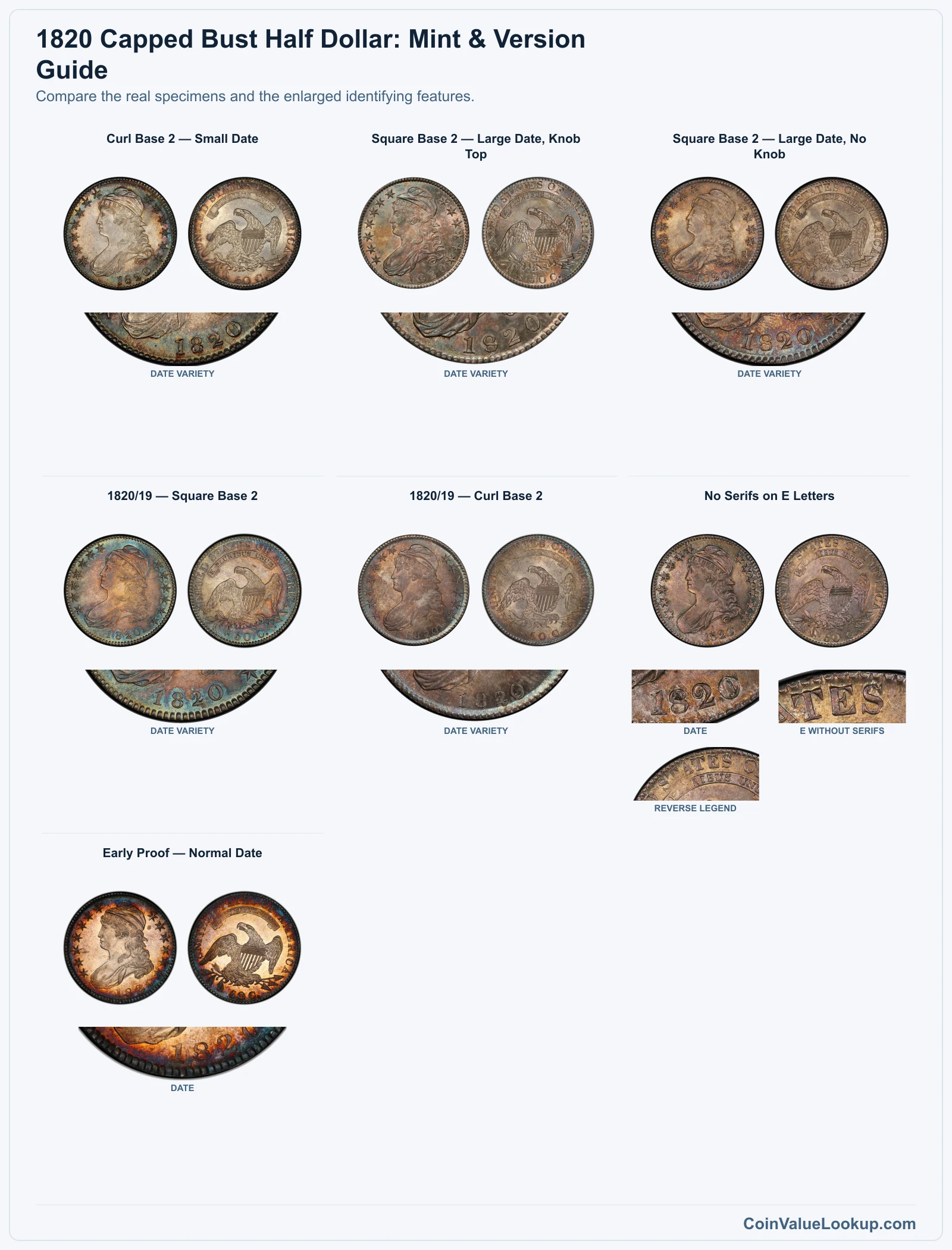
Your main job is identifying the base of the numeral 2 in the date. A curved, curling base means Curl Base 2.
A flat, straight base means Square Base 2. From there, check whether the date is large or small relative to the surrounding design elements, whether the top of the 2 has a rounded knob, and whether traces of an underlying 19 appear beneath the 20.
One reverse variety lacks serifs on the E letters entirely. Do not call worn or weakly struck letters "no serifs" — this is a specific die identity that requires positive attribution, ideally under magnification on a sharp example.
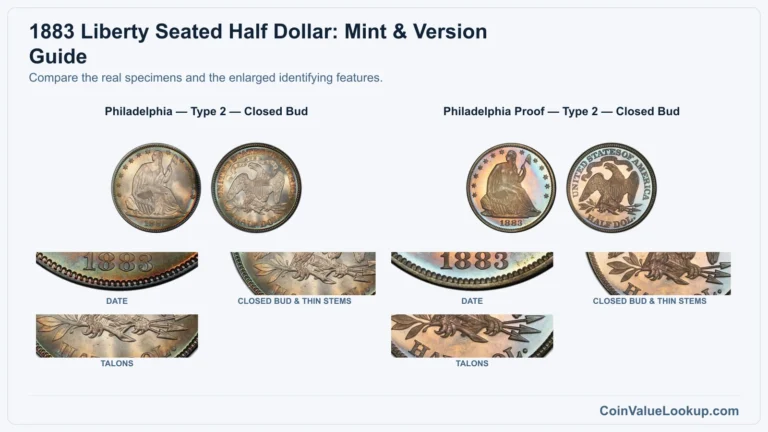
Early Proof specimens are a separate category requiring specialist die-pair identification, surface analysis, and provenance evidence. A shiny, polished, or prooflike regular coin is not automatically a Proof.
Step 2: Check Your 1820 Capped Bust Half Dollar Grade
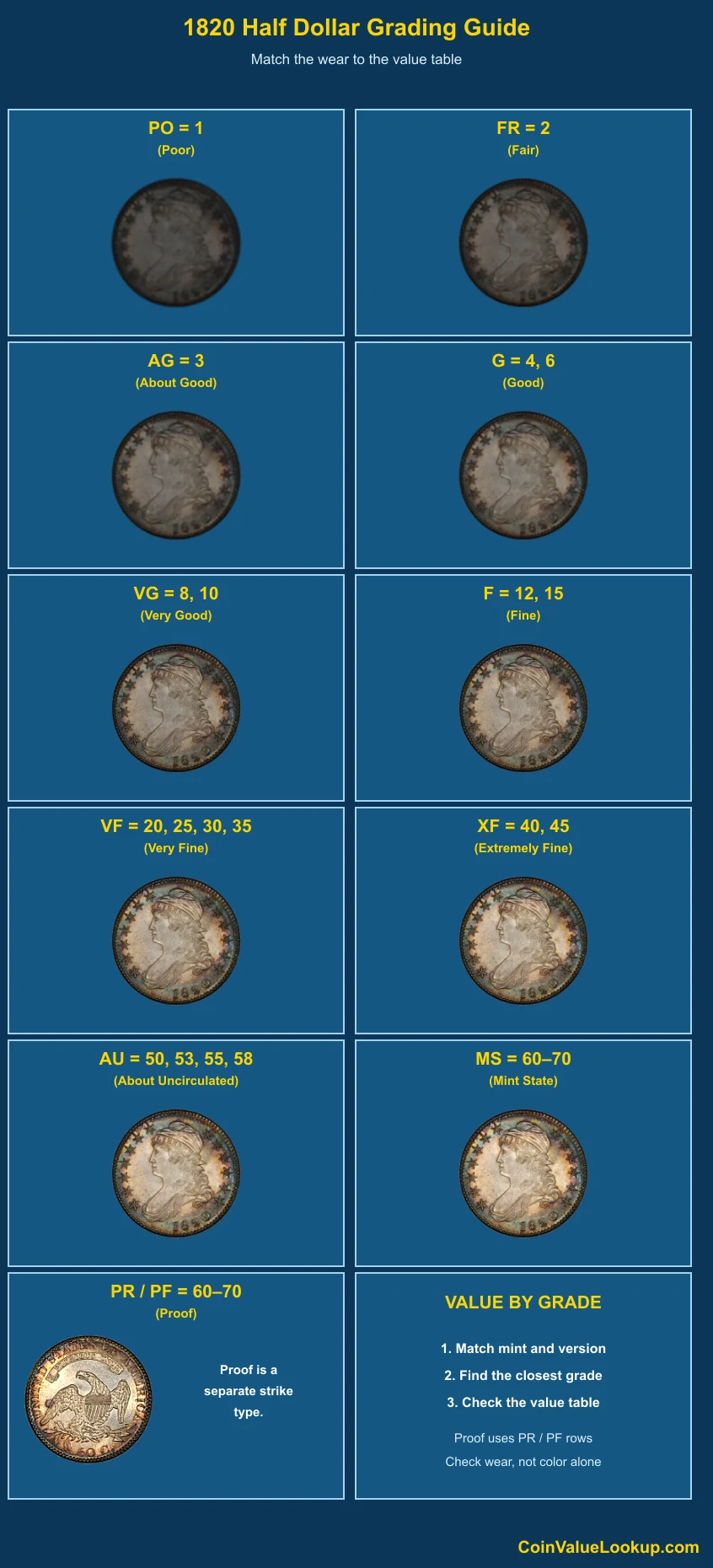
Start at the obverse. The first areas to lose detail are the hair above Liberty's forehead and ear, followed by the cheek and the top of the cap.
On a well-worn coin, the shoulder clasp flattens into the drapery.
Flip the coin over. The eagle's breast feathers and wing tips show wear next.
Be careful here: some 1820 half dollars came off the press with a soft strike in these areas, so missing detail does not always mean wear. Look for interrupted or absent luster across the high points before concluding the coin saw circulation.
Use the comparison image to match your coin's remaining detail against known grade benchmarks. A G4 coin retains a visible outline of the major design but little interior detail, while an AU50 shows only the slightest friction on the highest points with most original luster intact.
Coins that have been cleaned, holed, tooled, or scratched typically receive a "Details" designation from grading services, and their market value runs well below straight-graded examples at the same apparent wear level. Resist the urge to clean your coin.
Ever.
Step 3: Check 1820 Capped Bust Half Dollar Value by Mint and Version
1820 Capped Bust Half Dollar — Curl Base 2 — Small Date
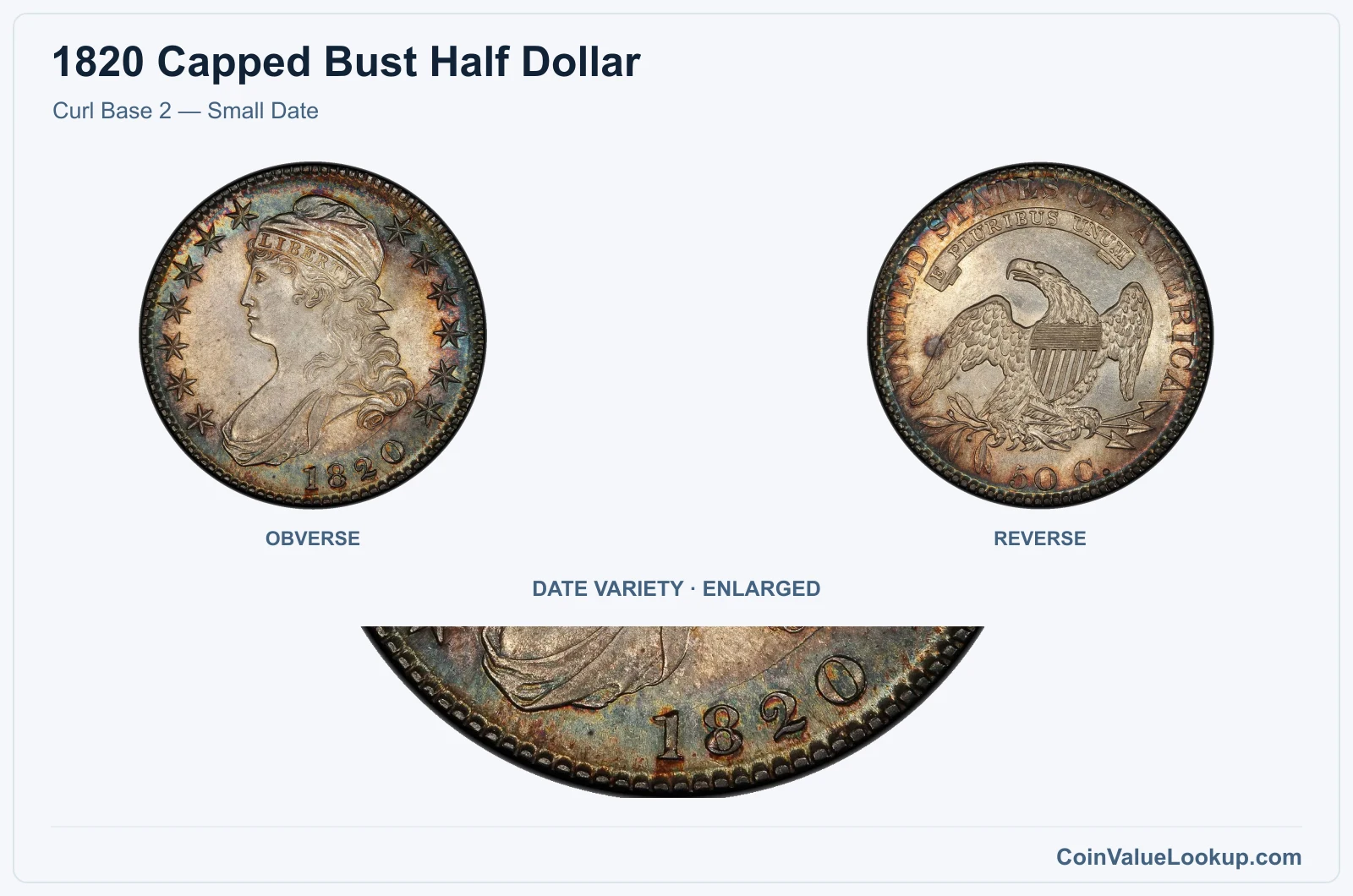
This is one of the more common 1820 varieties. The identifying feature is a curved, curling base on the numeral 2 in the date, paired with a noticeably smaller overall date size compared to the Large Date versions.
Make sure no remnants of an underlying 19 are visible — if they are, you have an overdate instead. Guide estimates from USA Coin Book place this branch at roughly $142 in G4, $364 in VF20, and $1,262 in AU50.
Range Grade
Price Auction Records Appraisal PO PO 1
—
Coin Identifier FR FR 2
—
Coin Identifier AG AG 3
—
Coin Identifier G G 4
—
Coin Identifier
G 6
—
Coin Identifier VG VG 8
—
Coin Identifier
VG 10
Coin Identifier F F 12
Coin Identifier
F 15
Coin Identifier VF VF 20
Coin Identifier
VF 25
Coin Identifier
VF 30
Coin Identifier
VF 35
Coin Identifier XF XF 40
Coin Identifier
XF 45
Coin Identifier AU AU 50
Coin Identifier
AU 53
Coin Identifier
AU 55
Coin Identifier
AU 58
Coin Identifier MS MS 60
—
Coin Identifier
MS 61
—
Coin Identifier
MS 62
Coin Identifier
MS 63
Coin Identifier
MS 64
—
Coin Identifier
MS 65
—
Coin Identifier
MS 66
—
Coin Identifier
MS 67
—
—
—
MS 68
—
—
—
MS 69
—
—
—
MS 70
—
—
—
1820 Capped Bust Half Dollar — Square Base 2 — Large Date, Knob Top
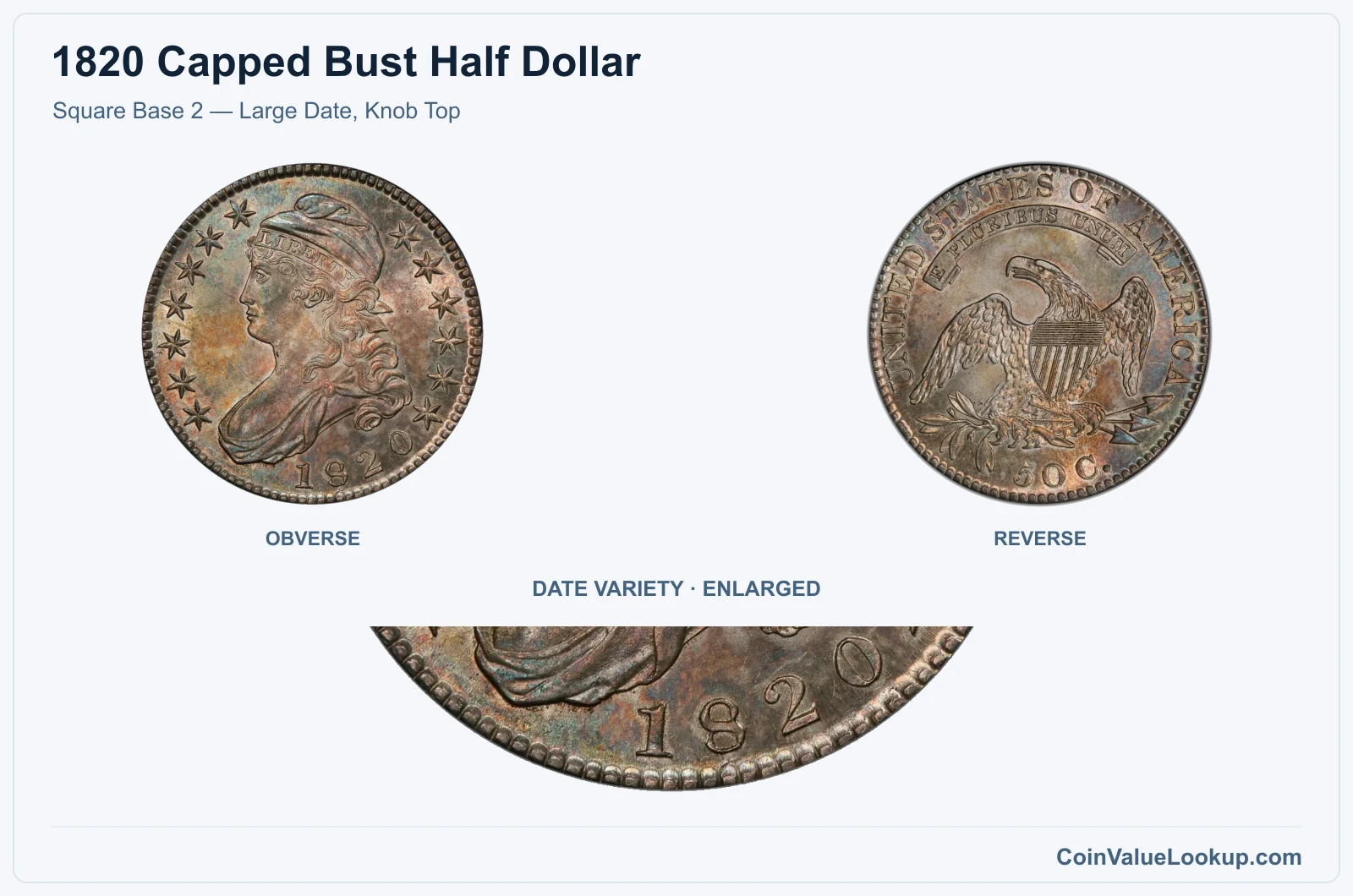
Here the base of the 2 is flat and straight rather than curved, and the overall date is visibly larger. The distinguishing sub-detail is the top of the 2, which ends in a small rounded knob.
Compare this carefully against the No Knob version below, because the difference is subtle under a loupe. Guide estimates run about $142 at G4, $332 at VF20, and $1,262 at AU50 — essentially matching the Curl Base variety in most grades.
Range Grade
Price Auction Records Appraisal PO PO 1
—
Coin Identifier FR FR 2
—
Coin Identifier AG AG 3
—
Coin Identifier G G 4
—
Coin Identifier
G 6
Coin Identifier VG VG 8
Coin Identifier
VG 10
Coin Identifier F F 12
—
Coin Identifier
F 15
Coin Identifier VF VF 20
Coin Identifier
VF 25
—
Coin Identifier
VF 30
Coin Identifier
VF 35
Coin Identifier XF XF 40
Coin Identifier
XF 45
Coin Identifier AU AU 50
Coin Identifier
AU 53
Coin Identifier
AU 55
Coin Identifier
AU 58
Coin Identifier MS MS 60
Coin Identifier
MS 61
Coin Identifier
MS 62
Coin Identifier
MS 63
Coin Identifier
MS 64
Coin Identifier
MS 65
Coin Identifier
MS 66
—
—
—
MS 67
—
—
—
MS 68
—
—
—
MS 69
—
—
—
MS 70
—
—
—
1820 Capped Bust Half Dollar — Square Base 2 — Large Date, No Knob
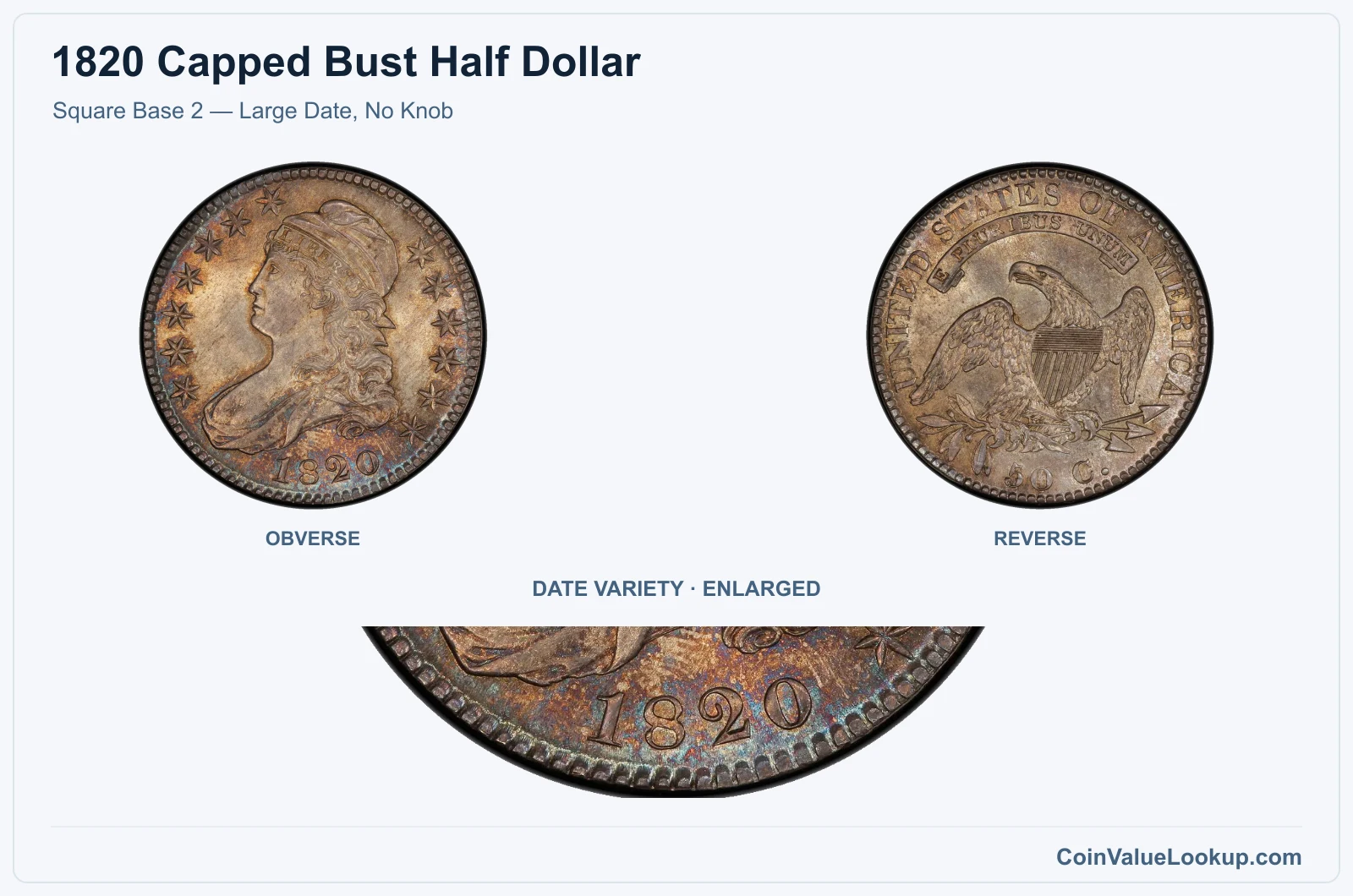
Same flat-base 2 and large date as the Knob Top variety, but the upper terminal of the 2 lacks that rounded knob. It simply ends.
You really need magnification and good lighting to separate this from the Knob Top. Guide values are close: approximately $142 at G4, $332 at VF20, and $1,206 at AU50.
The slight AU50 difference from the Knob Top branch is minor and may reflect normal guide-estimate variance rather than a meaningful rarity gap.
Range Grade
Price Auction Records Appraisal PO PO 1
—
Coin Identifier FR FR 2
—
Coin Identifier AG AG 3
Coin Identifier G G 4
—
Coin Identifier
G 6
—
Coin Identifier VG VG 8
—
Coin Identifier
VG 10
—
Coin Identifier F F 12
Coin Identifier
F 15
—
Coin Identifier VF VF 20
Coin Identifier
VF 25
Coin Identifier
VF 30
Coin Identifier
VF 35
Coin Identifier XF XF 40
Coin Identifier
XF 45
Coin Identifier AU AU 50
Coin Identifier
AU 53
Coin Identifier
AU 55
Coin Identifier
AU 58
Coin Identifier MS MS 60
—
Coin Identifier
MS 61
—
Coin Identifier
MS 62
Coin Identifier
MS 63
Coin Identifier
MS 64
—
Coin Identifier
MS 65
Coin Identifier
MS 66
—
Coin Identifier
MS 67
—
—
—
MS 68
—
—
—
MS 69
—
—
—
MS 70
—
—
—
1820 Capped Bust Half Dollar — /19 — Square Base 2
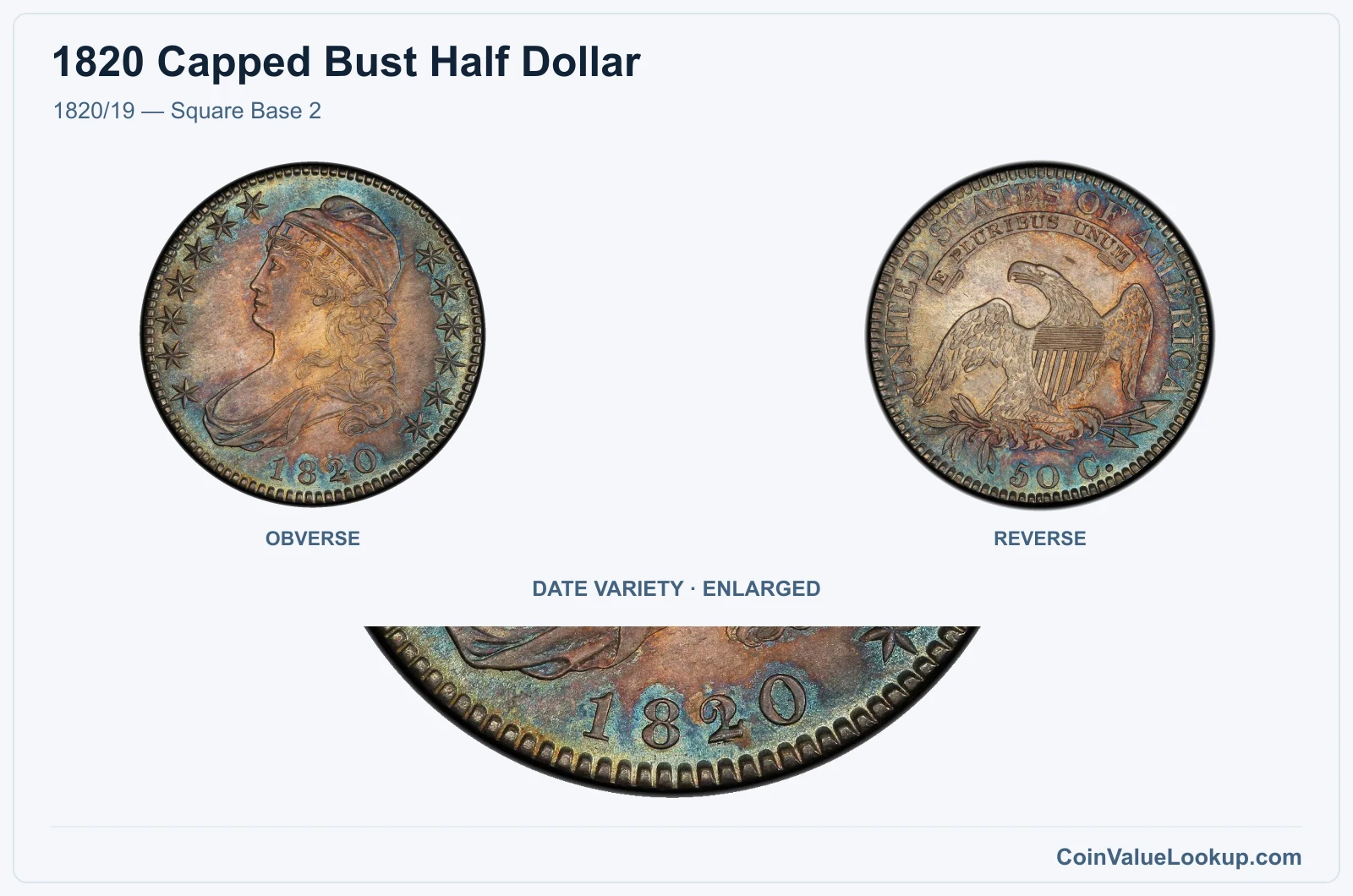
This is the overdate variety with a flat-base Square 2. Under magnification, you can see traces of the original 19 beneath the corrected 20, particularly around the lower portions of the final two digits.
Ordinary date scratches or corrosion do not qualify — you need clear, die-produced remnants of both the 1 and the 9.
The overdate commands a consistent premium. USA Coin Book guide estimates are about $152 at G4, $395 at VF20, and $2,130 at AU50.
That AU50 figure is noticeably higher than any of the standard-date branches, making correct attribution worth the effort.
Coin Value Lookup is a good starting point if you want to compare this coin's value against other early half dollar dates and varieties.
Range Grade
Price Auction Records Appraisal PO PO 1
—
Coin Identifier FR FR 2
—
Coin Identifier AG AG 3
—
Coin Identifier G G 4
Coin Identifier
G 6
Coin Identifier VG VG 8
Coin Identifier
VG 10
—
Coin Identifier F F 12
Coin Identifier
F 15
Coin Identifier VF VF 20
Coin Identifier
VF 25
Coin Identifier
VF 30
Coin Identifier
VF 35
Coin Identifier XF XF 40
Coin Identifier
XF 45
Coin Identifier AU AU 50
Coin Identifier
AU 53
Coin Identifier
AU 55
Coin Identifier
AU 58
Coin Identifier MS MS 60
Coin Identifier
MS 61
Coin Identifier
MS 62
Coin Identifier
MS 63
Coin Identifier
MS 64
Coin Identifier
MS 65
Coin Identifier
MS 66
—
—
—
MS 67
—
—
—
MS 68
—
—
—
MS 69
—
—
—
MS 70
—
—
—
1820 Capped Bust Half Dollar — /19 — Curl Base 2
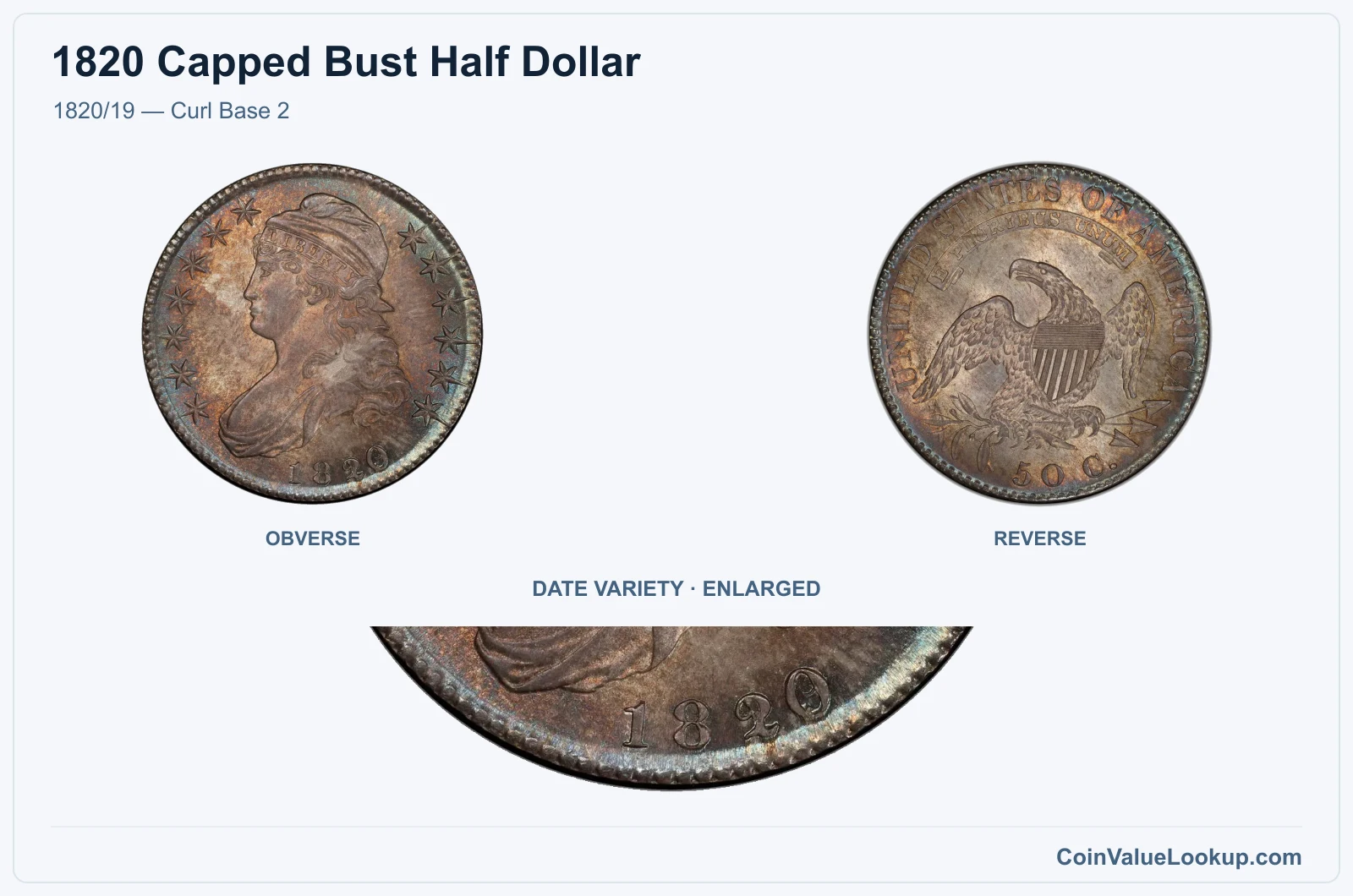
The other overdate pairing. This one combines the remnants of the underlying 19 with a curved-base 2 instead of the flat-base version above.
You need to confirm both features independently: the overdate evidence and the curl base.
Guide estimates sit at about $142 in G4, $332 in VF20, and $1,541 in AU50. The AU50 premium over standard Curl Base coins is real but smaller than the Square Base overdate's premium, so make sure you are distinguishing the two overdates correctly.
Range Grade
Price Auction Records Appraisal PO PO 1
—
Coin Identifier FR FR 2
—
Coin Identifier AG AG 3
—
Coin Identifier G G 4
—
Coin Identifier
G 6
—
Coin Identifier VG VG 8
—
Coin Identifier
VG 10
Coin Identifier F F 12
Coin Identifier
F 15
Coin Identifier VF VF 20
Coin Identifier
VF 25
Coin Identifier
VF 30
Coin Identifier
VF 35
Coin Identifier XF XF 40
Coin Identifier
XF 45
Coin Identifier AU AU 50
Coin Identifier
AU 53
Coin Identifier
AU 55
Coin Identifier
AU 58
Coin Identifier MS MS 60
Coin Identifier
MS 61
Coin Identifier
MS 62
Coin Identifier
MS 63
Coin Identifier
MS 64
Coin Identifier
MS 65
Coin Identifier
MS 66
—
—
—
MS 67
—
—
—
MS 68
—
—
—
MS 69
—
—
—
MS 70
—
—
—
1820 Capped Bust Half Dollar — No Serifs on E Letters
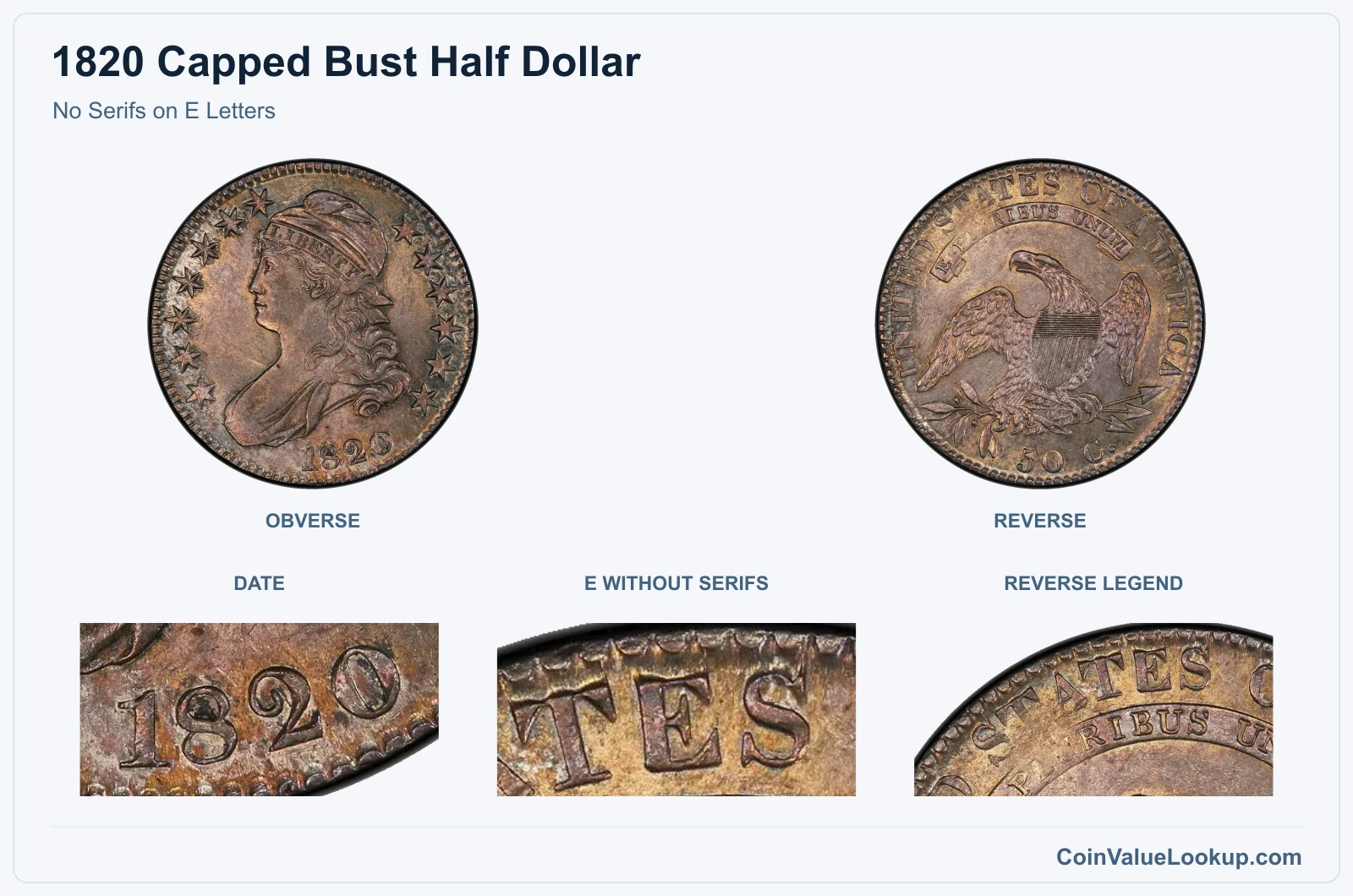
This is the scarce one. On a specific reverse die, the E letters throughout the design — in UNITED, STATES, and AMERICA — lack their normal serifs entirely.
The letters appear plain and slightly different in character from every other 1820 reverse.
Do not diagnose this from a heavily worn coin or a blurry photograph. Wear naturally erodes thin serifs, so you can easily convince yourself a tired VF coin has this variety when it does not.
You need a positively attributed example or a sharp enough coin to see that the serifs were never there.
Guide values reflect genuine scarcity: approximately $1,262 at G4, $4,960 at VF20, and $15,264 at AU50 per USA Coin Book. Even in low grades this variety trades at multiples of the common branches.
Range Grade
Price Auction Records Appraisal PO PO 1
—
Coin Identifier FR FR 2
—
Coin Identifier AG AG 3
—
Coin Identifier G G 4
—
Coin Identifier
G 6
—
Coin Identifier VG VG 8
—
Coin Identifier
VG 10
—
Coin Identifier F F 12
Coin Identifier
F 15
—
Coin Identifier VF VF 20
—
Coin Identifier
VF 25
—
Coin Identifier
VF 30
—
Coin Identifier
VF 35
Coin Identifier XF XF 40
—
Coin Identifier
XF 45
—
—
— AU AU 50
—
Coin Identifier
AU 53
—
Coin Identifier
AU 55
—
Coin Identifier
AU 58
Coin Identifier MS MS 60
—
—
—
MS 61
—
—
—
MS 62
—
Coin Identifier
MS 63
—
—
—
MS 64
—
—
—
MS 65
—
—
—
MS 66
—
—
—
MS 67
—
—
—
MS 68
—
—
—
MS 69
—
—
—
MS 70
—
—
—
1820 Capped Bust Half Dollar — Early Proof — Normal Date
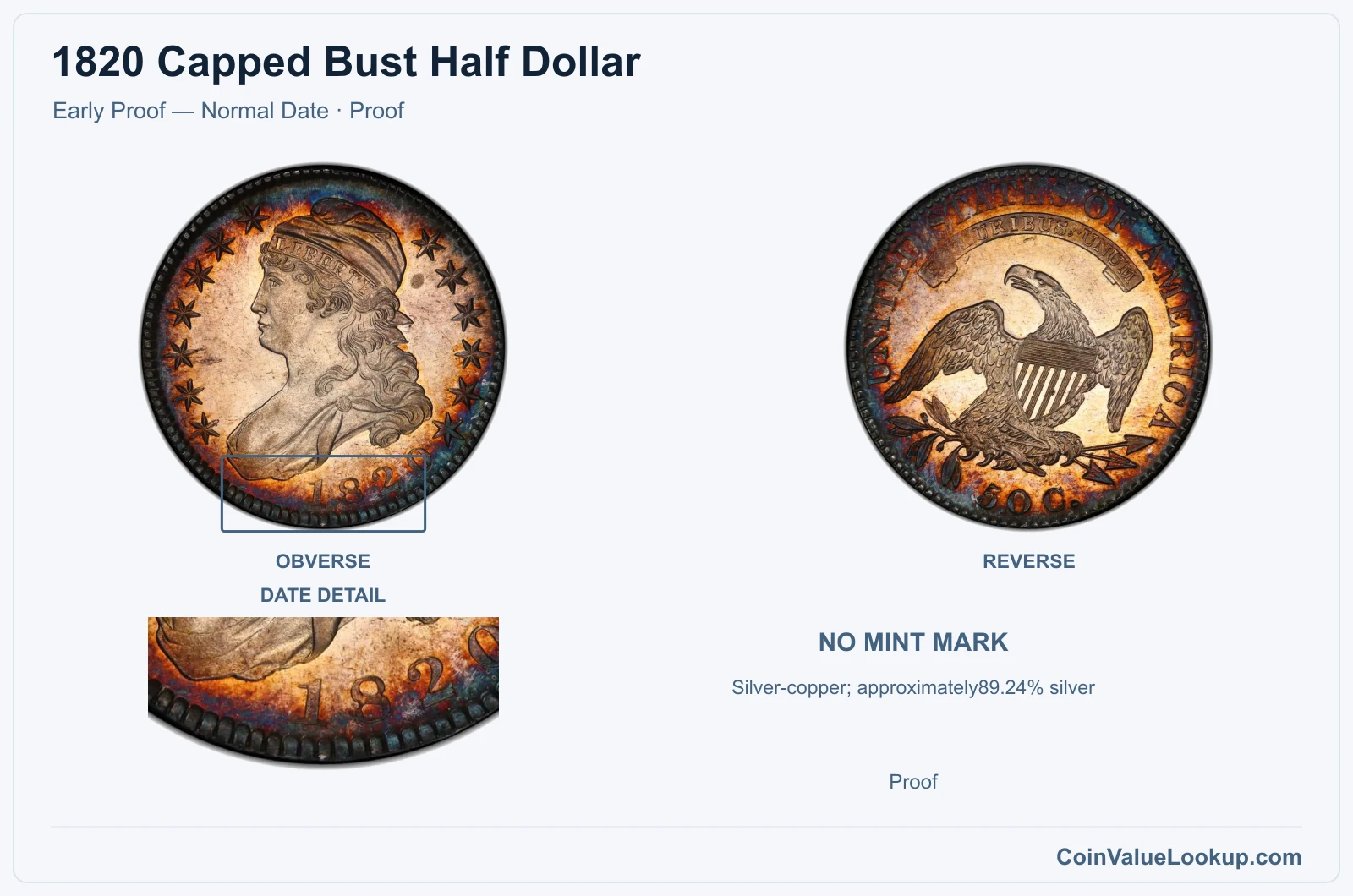
Early Proof Capped Bust Half Dollars from 1820 are rare specialist coins. These were produced using a distinct manufacturing process — not simply polished or carefully handled regular strikes.
Attribution requires examination of specific die pairs, surface characteristics, and ideally documented provenance.
A shiny coin is not a Proof. A prooflike coin is not a Proof.
This distinction matters because the value gap is enormous.
The historical anchor here is a single recorded sale: a PR63 example sold through David Akers in May 1998 for $35,200. That is one sale from over two decades ago, not a current market range or a basis for grading-curve extrapolation.
If you believe you have a Proof 1820 half dollar, professional certification from a major grading service is the only credible path forward.
Range Grade
Price Auction Records Appraisal PR PR 1
—
Coin Identifier
PR 2
—
Coin Identifier
PR 3
—
Coin Identifier
PR 4
—
Coin Identifier
PR 6
—
Coin Identifier
PR 8
—
Coin Identifier
PR 10
—
Coin Identifier
PR 12
—
Coin Identifier
PR 15
—
Coin Identifier
PR 20
—
Coin Identifier
PR 25
—
Coin Identifier
PR 30
—
Coin Identifier
PR 35
—
Coin Identifier
PR 40
—
Coin Identifier
PR 45
—
Coin Identifier
PR 50
—
Coin Identifier
PR 53
—
Coin Identifier
PR 55
—
Coin Identifier
PR 58
—
Coin Identifier
PR 60
—
Coin Identifier
PR 61
—
Coin Identifier
PR 62
—
Coin Identifier
PR 63
—
Coin Identifier
PR 64
—
—
—
PR 65
—
—
—
PR 66
—
—
—
PR 67
—
—
—
PR 68
—
—
—
PR 69
—
—
—
PR 70
—
—
—
1820 Capped Bust Half Dollar Error List
1. 1820 Capped Bust Half Dollar — Lamination / Split Planchet
A lamination error occurs when a layer of the coin's alloy separates or peels away from the surface, creating a visible split or flap. On the reported 1820 example, the lamination appears on the obverse of a Square Base 2, Knob Top, Large Date variety.
Look for a raised flap, a shallow cavity where metal has lifted, or a thin crack where the surface is beginning to separate. The split follows the coin's surface plane rather than cutting across it.
Do not confuse this with scraping, corrosion pitting, or a deliberately cut or gouged coin. Genuine laminations have a characteristic layered appearance that looks like the metal itself delaminated during or shortly after striking.
The value of a lamination error depends on its size, visibility, and the overall condition of the coin, so no single price range applies.
2. 1820 Capped Bust Half Dollar — Double / Multiple Strike
A multiple-strike error means the coin received more than one impression from the dies, with the coin or dies shifting between strikes. The reported 1820 example is actually a triple strike, with the second impression rotated and the reverse showing displaced dentil tracks visible above the right wing.
The result is dramatic: you will see overlapping design elements, ghosted outlines, and misaligned rim features that could not come from a single normal striking. The displacement is usually obvious to the naked eye.
Do not confuse this with a doubled die, which is a single strike from a die that was itself improperly made. Also rule out post-mint damage where someone deliberately struck the coin against another object.
Genuine multiple strikes show consistent die-produced detail in each impression. Value depends on the severity, number of strikes, and the coin's condition.
3. 1820 Capped Bust Half Dollar — Die Crack / Die Chip
Die cracks are raised lines on a coin's surface caused by fractures in the steel die itself. As the die develops a crack, metal flows into the gap during striking, leaving a thin raised ridge on every coin struck from that die.
The reported 1820 example is a Curl Base 2, Small Date variety with a crack running through the 50C denomination on the reverse. Look for a fine raised line that crosses design elements or fields near the denomination — it will be raised above the surrounding surface, not incised into it.
Do not mistake incuse scratches, corrosion tracks, or foreign material sitting on the surface for a die crack. Scratches are recessed; die cracks are raised.
The value impact depends on the crack's prominence and location, along with the coin's overall grade.