1841 Liberty Seated Half Dollar Coin Value: How Much Is It Worth?
The 1841 Liberty Seated Half Dollar is a 90% silver coin struck at Philadelphia and New Orleans. What yours is worth depends heavily on which mint produced it, its condition, and whether it carries any unusual die characteristics.
Guide estimates for regular circulation strikes run from around $80 at G4 up to $741 at AU50, depending on the mint. Proof examples are a different animal entirely — one sold at auction for $69,000 — so don't assume your shiny coin is one of those without professional confirmation.
Fast Way to Identify Your 1841 Liberty Seated Half Dollar
The quickest way to start figuring out what you have is to upload clear photos of both the front and back of your coin. Our identifier can give you a preliminary read on the mint, version, and general condition.
Good lighting and a steady hand help — blurry phone shots make identification harder than it needs to be.
1841 Liberty Seated Half Dollar Value
Upload both sides of your 1841 Liberty Seated Half Dollar.
Front Obverse
Upload photo
Back Reverse
Upload photo
Which 1841 Liberty Seated Half Dollar Versions Are Worth Money?
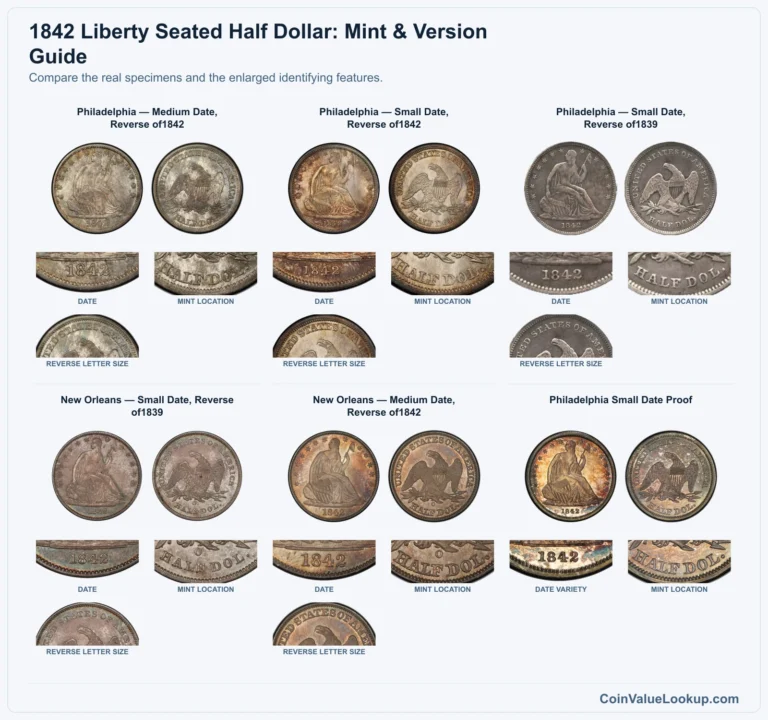
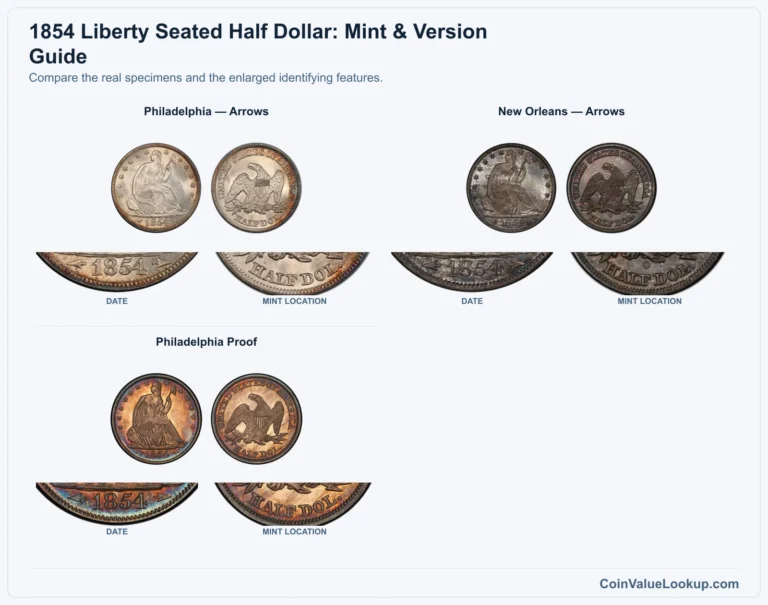
- Philadelphia Regular Strike — No mintmark; guide estimates range from about $100 at G4 to $741 at AU50. Check the date digits closely for repunching.
- New Orleans Regular Strike — Look for the O mintmark below the eagle on the reverse; guide values start around $80 at G4 and reach $741 at AU50. Weak detail on the eagle may be original, not damage.
- Philadelphia Proof — Extremely rare presentation strikes exist; a PR64 example sold for $69,000 at Heritage in May 2008. Professional attribution is essential to confirm proof manufacture.
Step 1: Identify Your 1841 Liberty Seated Half Dollar Mint Mark and Version
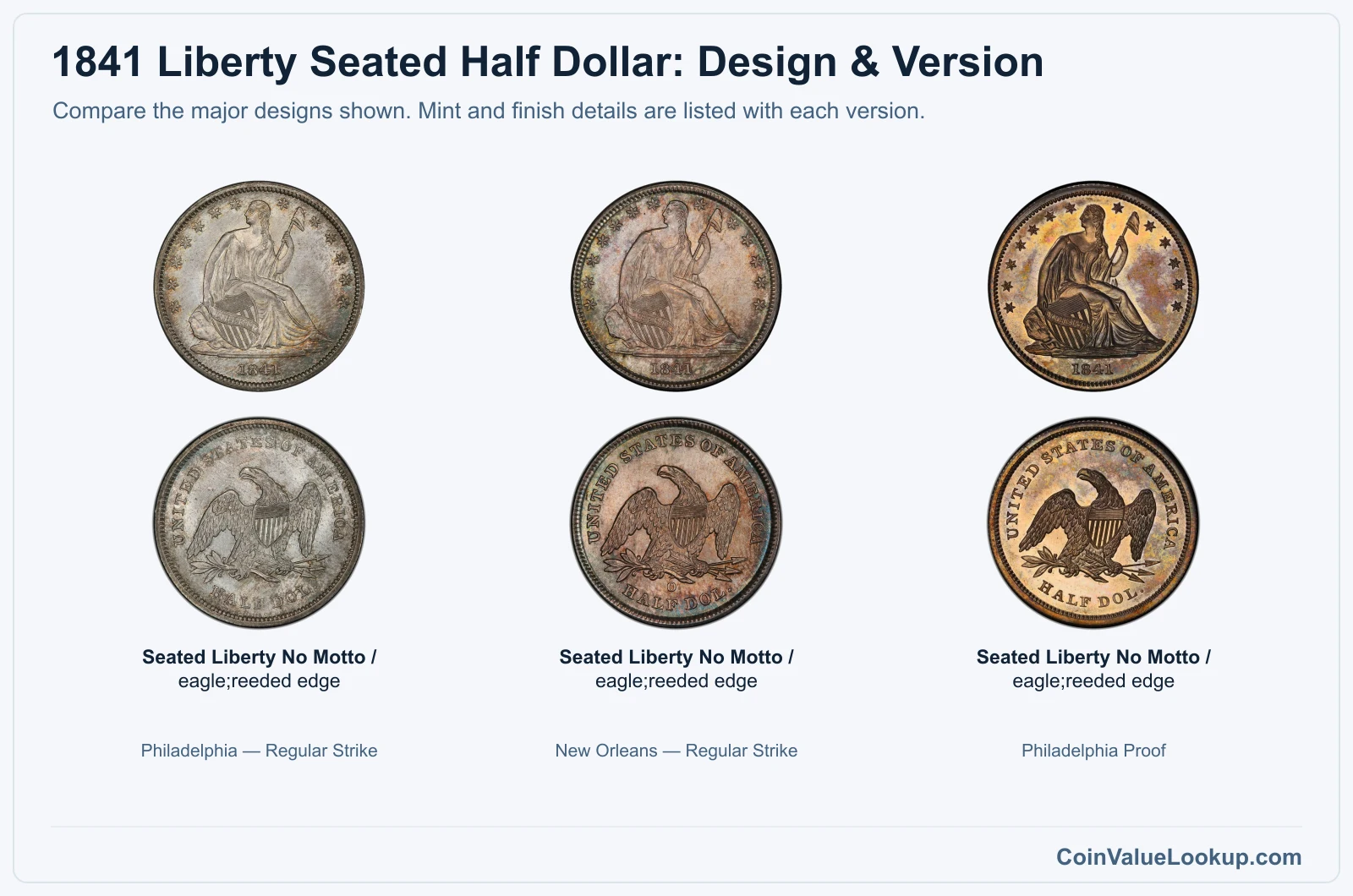
The 1841 half dollar uses the Seated Liberty design: Miss Liberty sits on the obverse holding a pole and cap, while a heraldic eagle graces the reverse above the words HALF DOL. There is no IN GOD WE TRUST motto on this type.
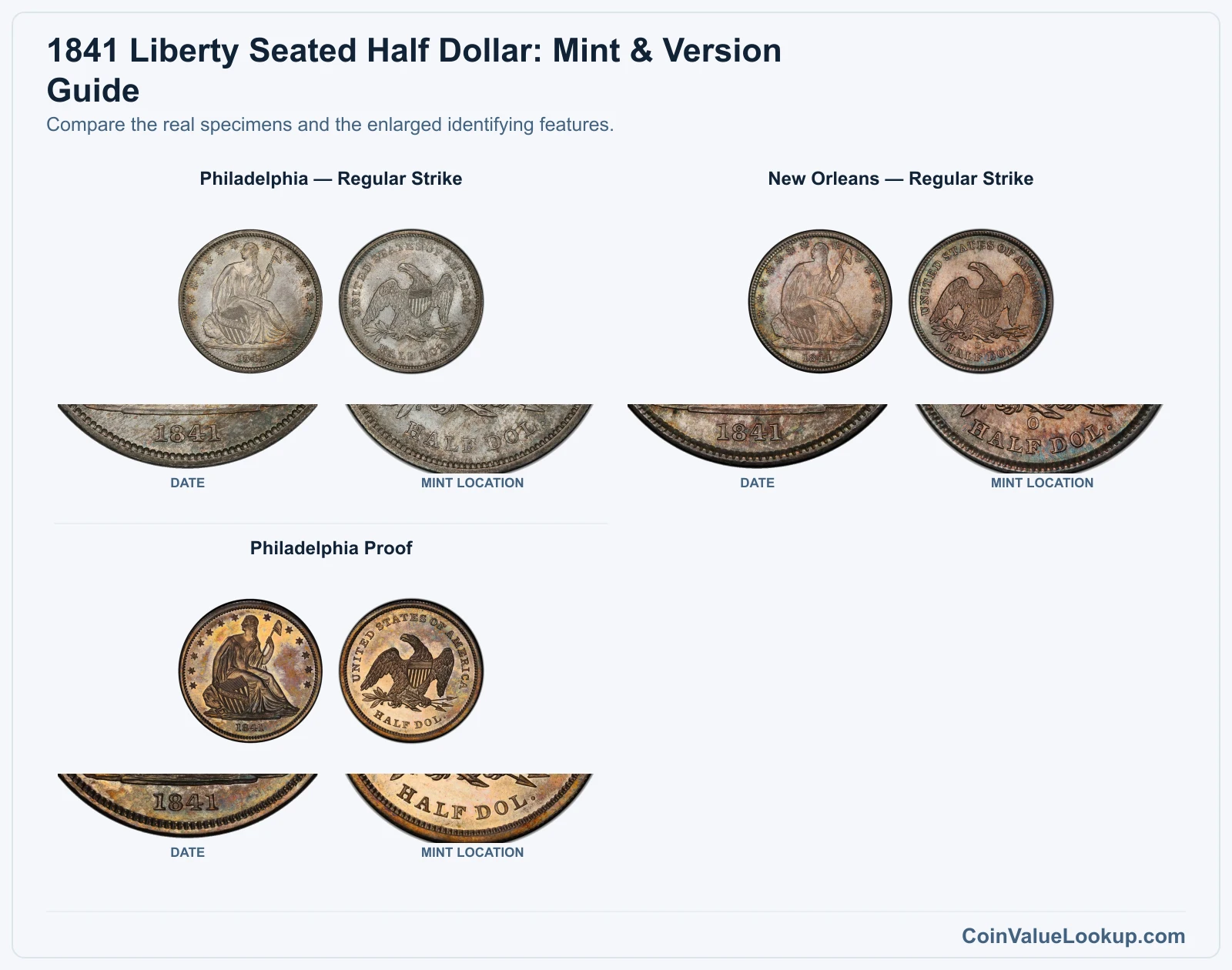
Philadelphia coins carry no mintmark at all. New Orleans coins have a small "O" on the reverse beneath the eagle.
Don't confuse the absence of a mintmark with damage or wear — Philadelphia simply didn't use one.
The coin is 90% silver and 10% copper, with a nominal weight of 13.36 grams and a reeded edge. Don't judge purity by how shiny or dark it looks; toning and cleaning both change surface appearance without changing metal content.
Proof or special presentation strikes were also made at Philadelphia. These are a manufacturing method, not a grade above Mint State.
A bright, well-preserved regular strike is not a proof. That distinction requires professional attribution examining surface characteristics, rim details, and die finish.
Step 2: Check Your 1841 Liberty Seated Half Dollar Grade
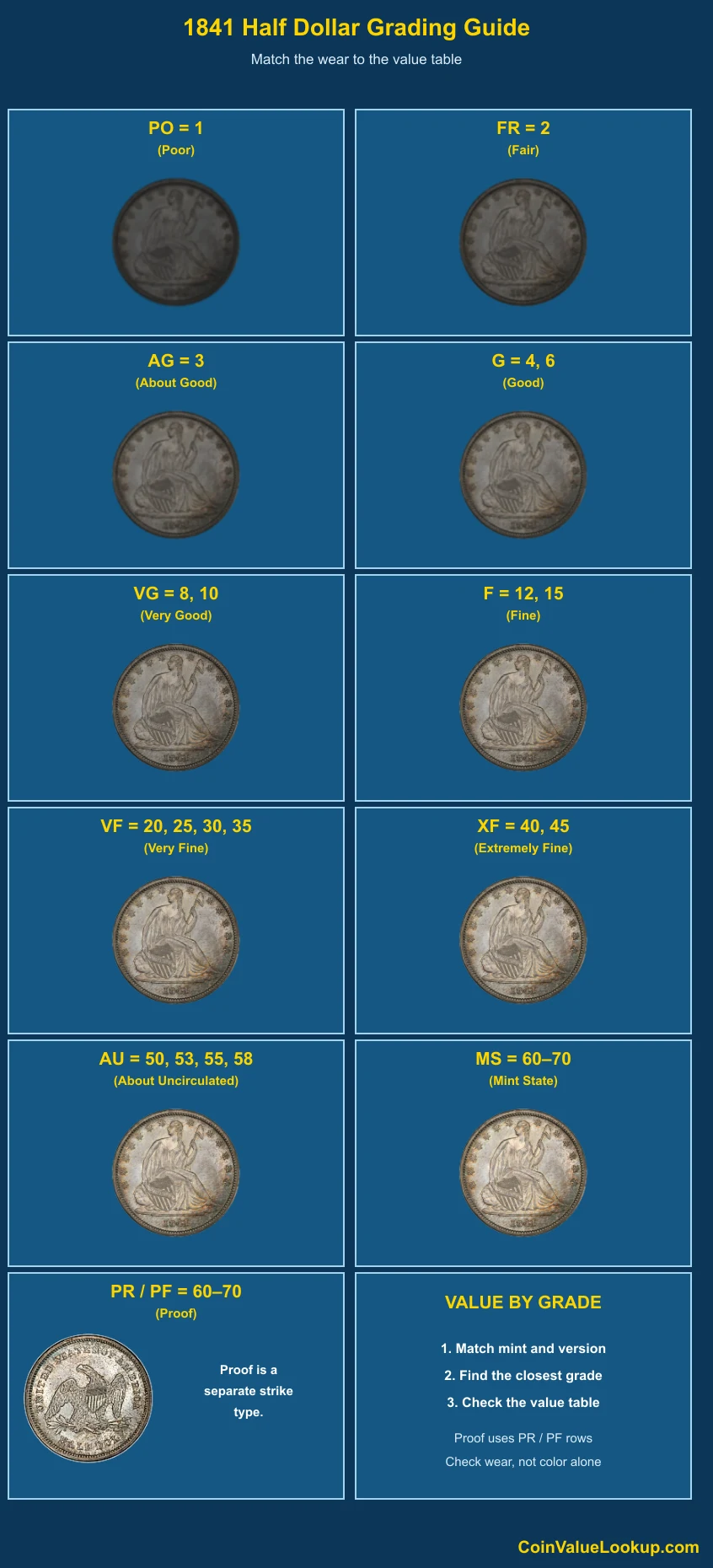
Start by examining Liberty's head, breast, knee, and the lines in her shield on the obverse. Then flip the coin and check the eagle's breast feathers, wing detail, and claws.
These are the first areas to lose detail as a coin circulates.
Here's the tricky part with Seated halves: the New Orleans mint often struck coins with softer detail right from the press. Weak breast feathers or mushy claw tips on an O-mint coin might be original striking weakness, not wear.
Look at the surrounding luster and field surfaces to tell the difference.
Compare your coin side-by-side with the type-matched grading comparison image. A coin at G4 will show Liberty as a flat outline with a readable date.
By VF20, major gown folds and most shield lines return. AU50 means only slight friction on the highest points with most original luster intact.
Cleaning, holes, scratches, and other surface alterations all reduce value. If you're tempted to polish your coin, don't.
Step 3: Check 1841 Liberty Seated Half Dollar Value by Mint and Version
1841 Liberty Seated Half Dollar — Philadelphia — Regular Strike
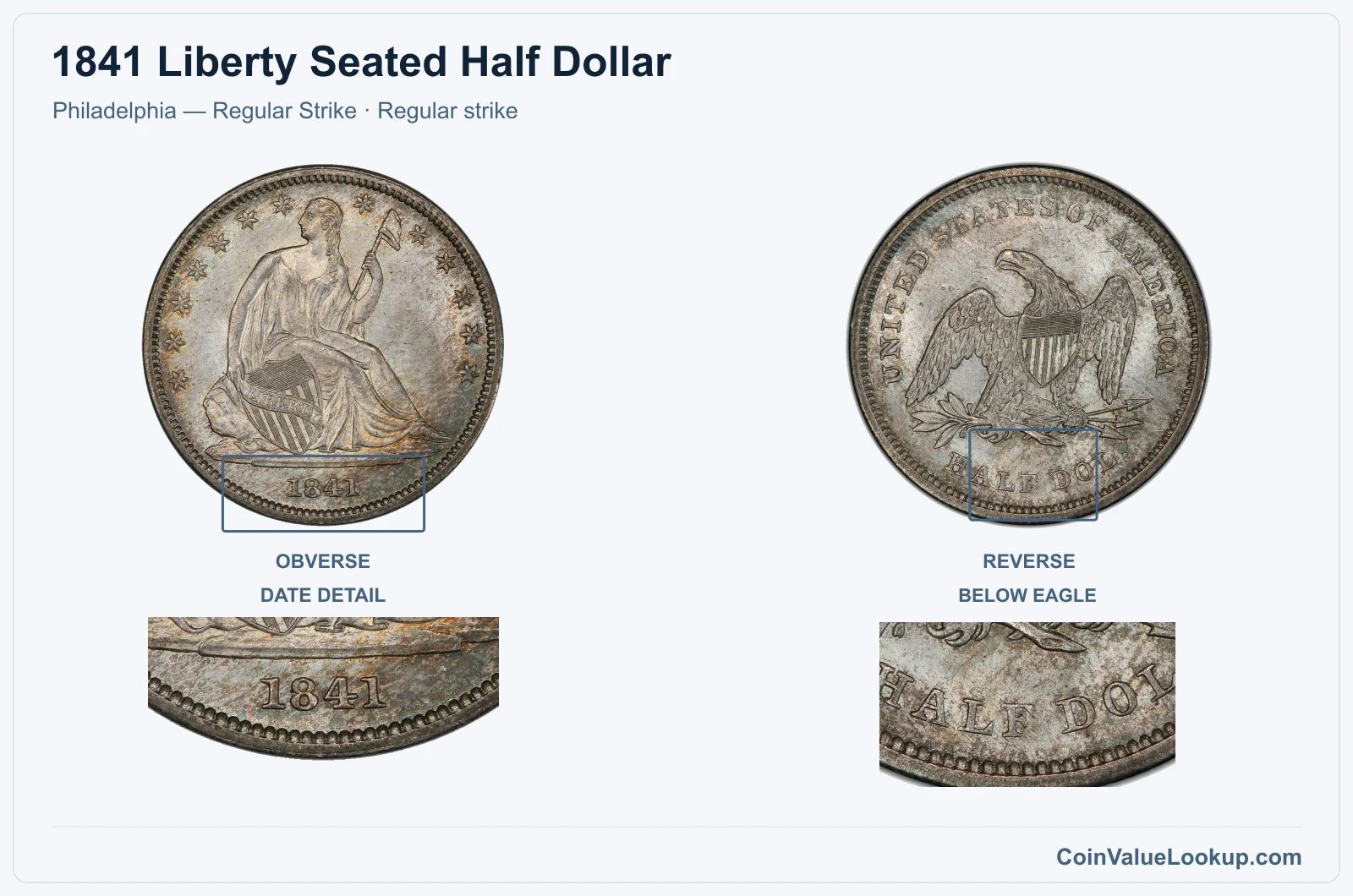
The Philadelphia regular strike is the no-mintmark version. If you flip the coin over and see nothing below the eagle, that's normal for a Philly coin.
Guide estimates from USA Coin Book place this issue at roughly $100 in G4, $332 in VF20, and $741 in AU50.
Pay close attention to the date. Some 1841 Philadelphia coins show repunched digits, which is a different category from an overdate.
A repunched date means the same year was impressed more than once with slight misalignment, not that one year was stamped over another.
Range Grade
Price Auction Records Appraisal PO PO 1
—
Coin Identifier FR FR 2
—
Coin Identifier AG AG 3
—
Coin Identifier G G 4
—
Coin Identifier
G 6
—
Coin Identifier VG VG 8
—
Coin Identifier
VG 10
—
Coin Identifier F F 12
Coin Identifier
F 15
—
Coin Identifier VF VF 20
—
Coin Identifier
VF 25
Coin Identifier
VF 30
Coin Identifier
VF 35
Coin Identifier XF XF 40
Coin Identifier
XF 45
Coin Identifier AU AU 50
Coin Identifier
AU 53
Coin Identifier
AU 55
Coin Identifier
AU 58
Coin Identifier MS MS 60
Coin Identifier
MS 61
Coin Identifier
MS 62
Coin Identifier
MS 63
Coin Identifier
MS 64
Coin Identifier
MS 65
Coin Identifier
MS 66
—
—
—
MS 67
—
—
—
MS 68
—
—
—
MS 69
—
—
—
MS 70
—
—
—
1841 Liberty Seated Half Dollar — New Orleans — Regular Strike
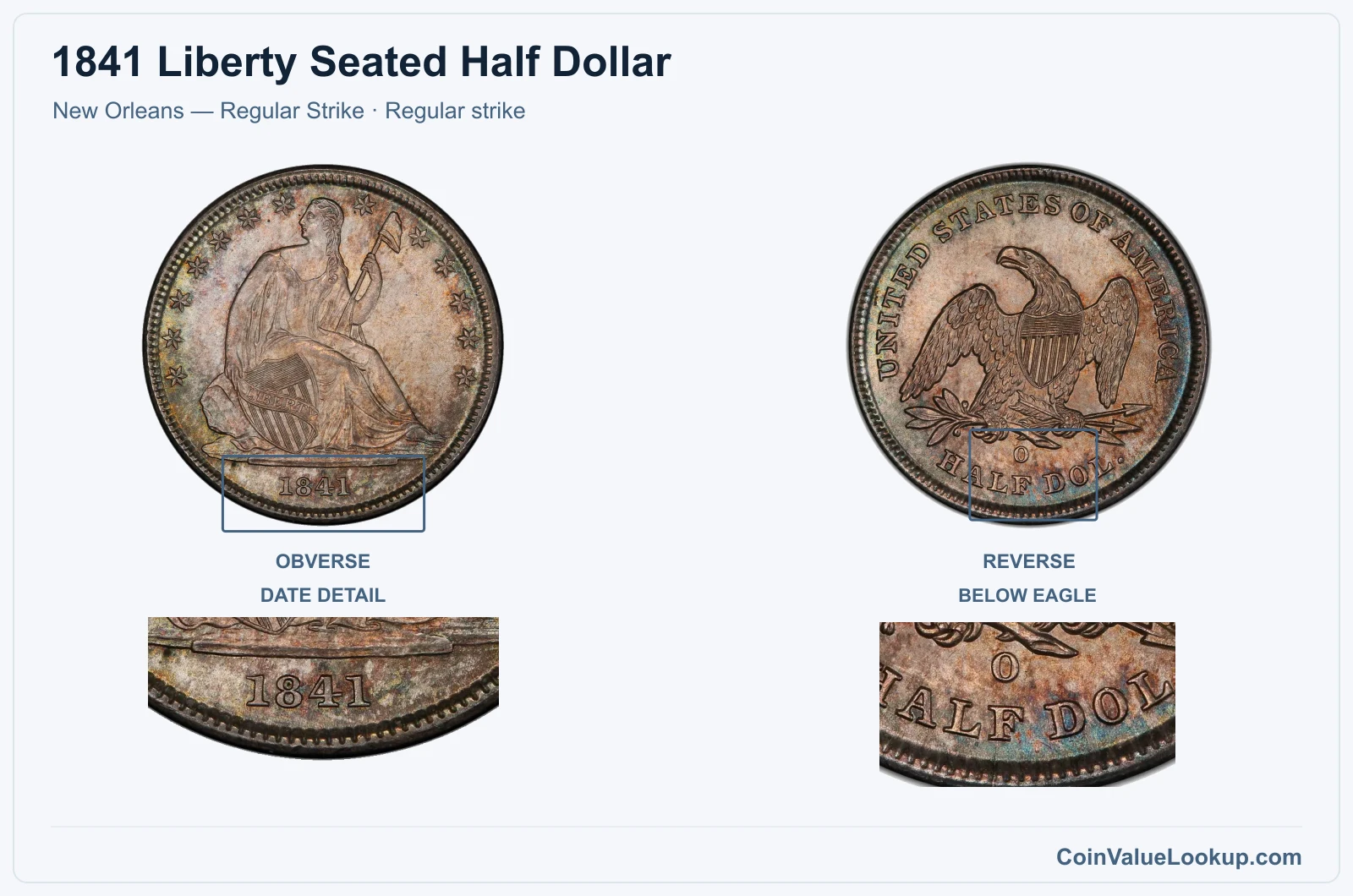
The New Orleans version carries a small "O" mintmark on the reverse, positioned below the eagle. Guide estimates start a bit lower than Philadelphia — about $80 at G4 — but converge at $332 for VF20 and $741 at AU50.
These coins were often weakly struck, particularly on the eagle's breast feathers and claws. That means a coin grading VF20 by wear standards might still look soft in those areas.
Don't downgrade an O-mint coin just because the eagle lacks crisp detail — compare the fields and Liberty's high points to assess actual circulation wear.
Coin Value Lookup is a good starting point if you want to look up guides for other dates and mints in the Seated Liberty half dollar series.
Range Grade
Price Auction Records Appraisal PO PO 1
—
Coin Identifier FR FR 2
—
Coin Identifier AG AG 3
—
Coin Identifier G G 4
—
Coin Identifier
G 6
—
Coin Identifier VG VG 8
Coin Identifier
VG 10
—
Coin Identifier F F 12
Coin Identifier
F 15
—
Coin Identifier VF VF 20
Coin Identifier
VF 25
Coin Identifier
VF 30
Coin Identifier
VF 35
Coin Identifier XF XF 40
Coin Identifier
XF 45
Coin Identifier AU AU 50
Coin Identifier
AU 53
Coin Identifier
AU 55
Coin Identifier
AU 58
Coin Identifier MS MS 60
Coin Identifier
MS 61
Coin Identifier
MS 62
Coin Identifier
MS 63
Coin Identifier
MS 64
Coin Identifier
MS 65
Coin Identifier
MS 66
Coin Identifier
MS 67
—
—
—
MS 68
—
—
—
MS 69
—
—
—
MS 70
—
—
—
1841 Liberty Seated Half Dollar — Philadelphia Proof
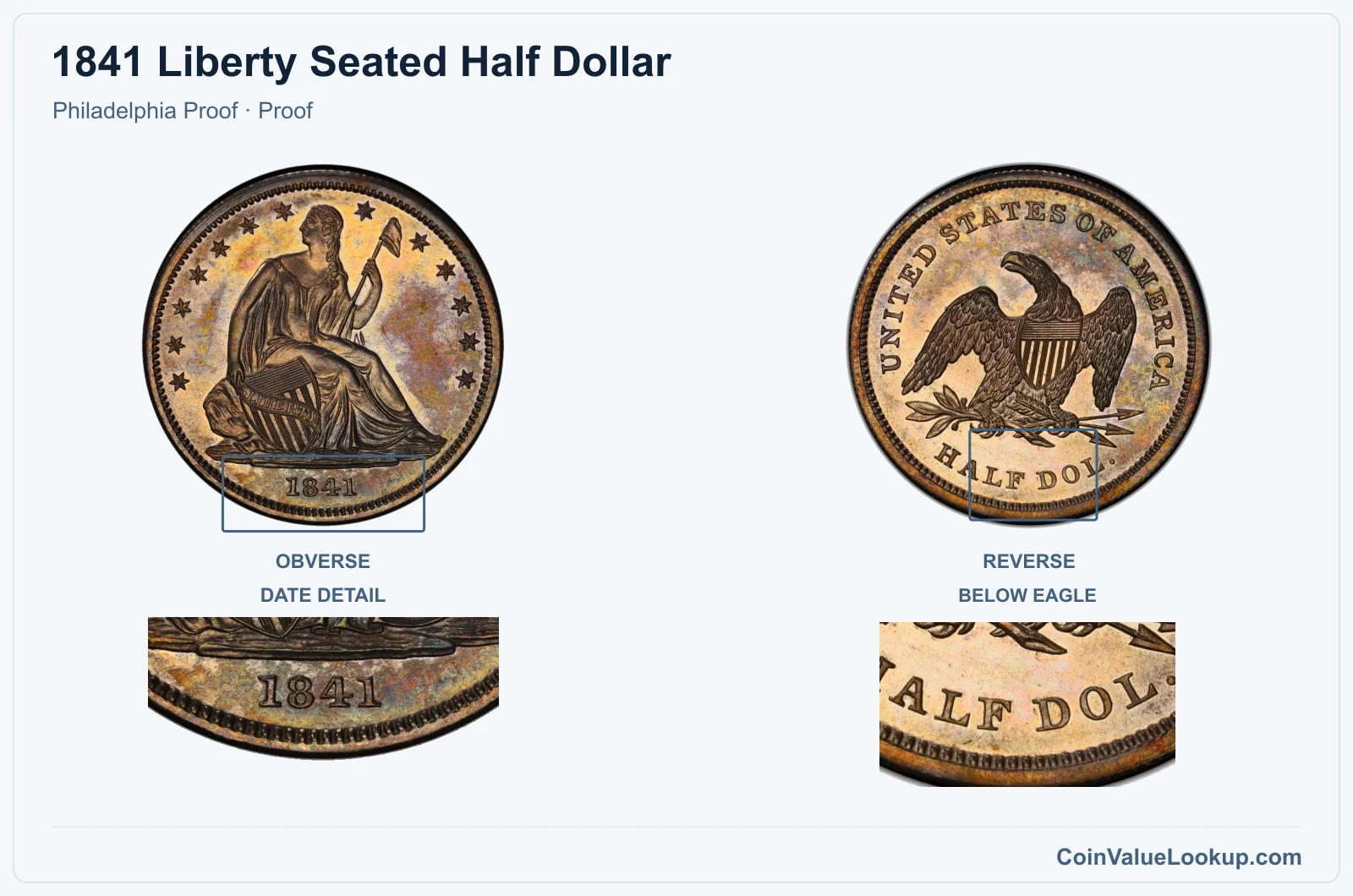
Philadelphia proof half dollars from 1841 are genuinely rare. These were specially manufactured with polished dies and prepared planchets, producing mirror-like fields and sharp detail that regular strikes simply cannot match.
A single confirmed sale anchors what we know about value here: a PR64 example brought $69,000 at a Heritage auction in May 2008. That is one historical result, not a current market range, so treat it as a reference point rather than a price tag.
Do not assume your coin is a proof because it looks bright or has strong detail. Proofs require professional attribution examining die finish, rim characteristics, and surface quality.
Show both faces, the edge, and any diagnostic details to a grading service before drawing conclusions.
Range Grade
Price Auction Records Appraisal PR PR 1
—
Coin Identifier
PR 2
—
Coin Identifier
PR 3
—
Coin Identifier
PR 4
—
Coin Identifier
PR 6
—
Coin Identifier
PR 8
—
Coin Identifier
PR 10
—
Coin Identifier
PR 12
—
Coin Identifier
PR 15
—
Coin Identifier
PR 20
—
Coin Identifier
PR 25
—
Coin Identifier
PR 30
—
Coin Identifier
PR 35
—
Coin Identifier
PR 40
—
Coin Identifier
PR 45
—
Coin Identifier
PR 50
—
Coin Identifier
PR 53
—
Coin Identifier
PR 55
—
Coin Identifier
PR 58
—
Coin Identifier
PR 60
—
Coin Identifier
PR 61
Coin Identifier
PR 62
Coin Identifier
PR 63
—
Coin Identifier
PR 64
Coin Identifier
PR 65
Coin Identifier
PR 66
—
—
—
PR 67
—
—
—
PR 68
—
—
—
PR 69
—
—
—
PR 70
—
—
—
1841 Liberty Seated Half Dollar Error List
1. 1841 Liberty Seated Half Dollar — Repunched Date
Some 1841 Philadelphia half dollars show a repunched date — light extra impressions visible at the bases of the 1 and 8 in the date. This happened when the date punch was applied to the die more than once with a slight shift between strikes.
To spot it, examine the lower portions of those digits under magnification. You should see faint secondary outlines or thickened bases that don't match the normal contour of the numbers.
Compare against a standard 1841 date to see the difference.
This is not an overdate. An overdate means one year punched over a different year; a repunched date is the same year applied twice.
Also rule out machine doubling, which produces flat, shelf-like distortion, and post-mint damage that creates irregular scratches or dents in the date area.
The value of a repunched date depends on how visible the extra punching is and the coin's overall condition. No fixed premium applies across the board.
2. 1841 Liberty Seated Half Dollar — Die Crack / Die Chip
A documented die crack on the 1841-O half dollar runs from the M in AMERICA across the right wing and down to the rim below the F in HALF on the reverse. Die cracks appear as thin raised lines on the coin's surface — they're ridges, not grooves, because they formed as fractures in the steel die that then filled with metal during striking.
When examining your coin, trace that path with a loupe. A genuine die crack will be raised and follow a consistent line that relates to the die's stress pattern.
Other 1841 coins may show cracks at different stages of the same die's life, from hairline fractures to wider breaks.
Don't confuse die cracks with incuse scratches, corrosion lines, or bits of foreign material stuck to the surface. Scratches are recessed into the metal, and corrosion tends to be irregular and pitted.
Die cracks follow a clean, slightly wandering path.
The value impact depends on the crack's prominence and the coin's grade. No standard premium range is established for this specific variety.