1854 Liberty Seated Half Dollar Coin Value: How Much Is It Worth?
An 1854 Liberty Seated Half Dollar in circulated grades can range from roughly $79 in G4 to about $456 near AU50, based on USA Coin Book guide estimates. Proof strikes and specific mint varieties can shift that picture dramatically.
Grade, mintmark, and version are the three things that determine what your coin is actually worth.
Fast Way to Identify Your 1854 Liberty Seated Half Dollar
The quickest way to start figuring out what you have is to upload clear photos of both the front and back of your coin. Our identifier can give you a preliminary read on the mint, version, and general condition.
Snap the images in good light, keep the coin flat, and avoid any cleaning before you photograph it.
1854 Liberty Seated Half Dollar Value
Upload both sides of your 1854 Liberty Seated Half Dollar.
Front Obverse
Upload photo
Back Reverse
Upload photo
Which 1854 Liberty Seated Half Dollar Versions Are Worth Money?
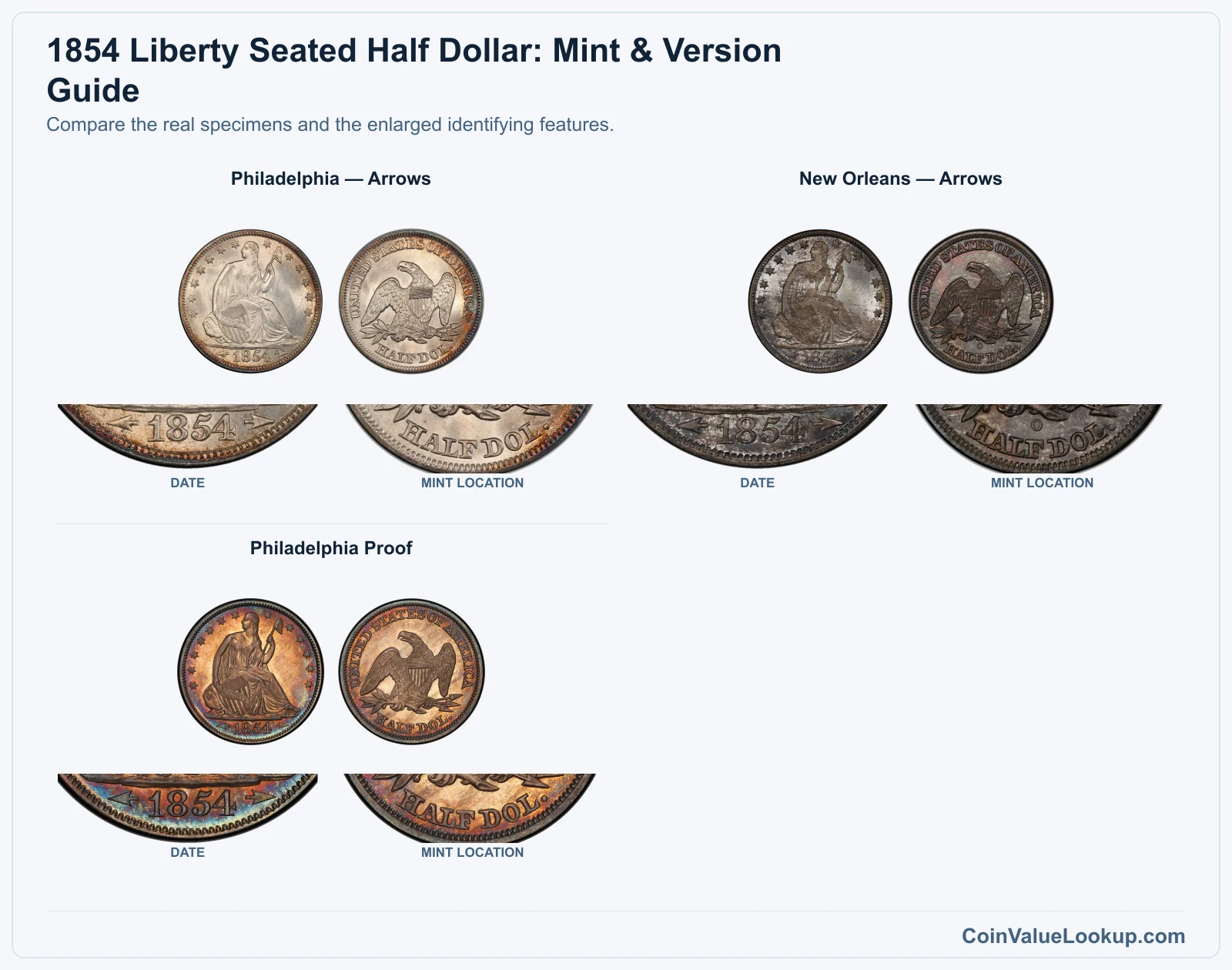
- Philadelphia Arrows — the standard 1854 issue, with guide values from about $79 at G4 to $456 at AU50, making even worn examples worth checking for silver content and grade.
- New Orleans Arrows — carries the O mintmark below the eagle, with similar guide anchors to Philadelphia; confirm the mintmark under magnification since it can be weak.
- Philadelphia Proof — a scarce collector-only striking; a single PR67 example sold for $70,500 at Heritage in 2013, though that result reflects one coin and grade, not a general market price.
Step 1: Identify Your 1854 Liberty Seated Half Dollar Mint Mark and Version
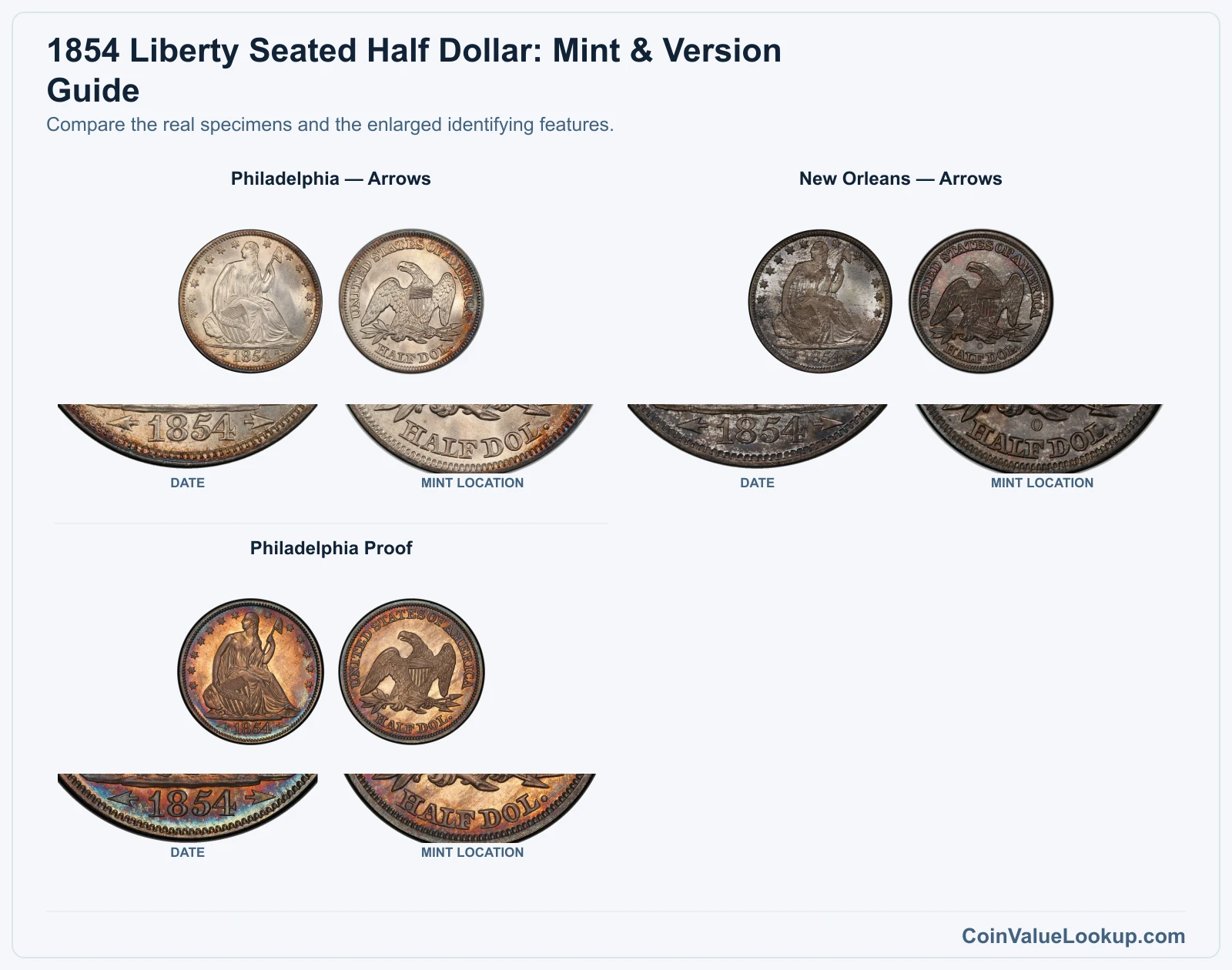
The 1854 half dollar shows the Seated Liberty on the obverse and a heraldic eagle with HALF DOL on the reverse. No IN GOD WE TRUST motto appears on this date.
Two small arrowheads flank the date, but the reverse rays used in 1853 are gone.
Flip the coin over and look below the eagle. A blank space means Philadelphia.
A small "O" means New Orleans. Those are the only two mints that struck half dollars in 1854.
The coin is 90% silver and 10% copper, weighing about 12.44 grams under the reduced standard introduced in 1853. That weight drop is the whole reason the arrows exist — they told the public the silver content had changed.
Proof strikes share the Philadelphia design but are a separate manufacturing category. Mirror-like fields alone do not confirm a Proof; many cleaned or lightly worn business strikes can look shiny.
Genuine Proofs show squared rims and fully reflective surfaces on both sides.
Step 2: Check Your 1854 Liberty Seated Half Dollar Grade
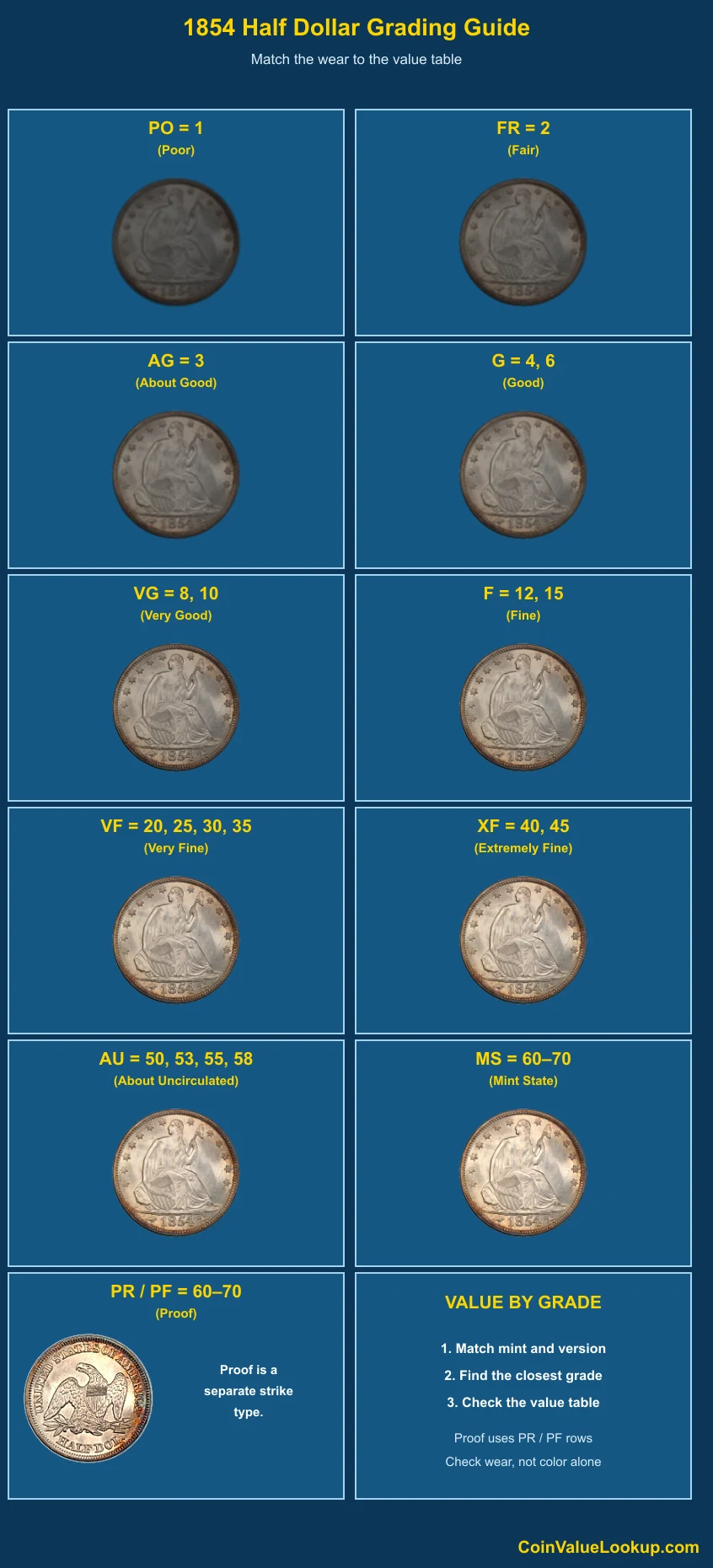
Focus on four obverse checkpoints: Liberty's head, the breast area, the knee, and the shield on her lap. On the reverse, examine the eagle's breast feathers, wing tips, and claws.
As the coin wears, these high points flatten first and lose their original luster.
A tricky part with Seated halves is weak strikes. A softly struck coin can look worn at the centers even in higher grades.
The difference is that wear breaks luster across the high points evenly, while a weak strike leaves luster intact in the surrounding fields.
Compare your coin side-by-side with the type-matched grading image. Photograph both faces and the edge, and resist the urge to clean or polish anything — even a gentle wipe can cut the value in half.
Step 3: Check 1854 Liberty Seated Half Dollar Value by Mint and Version
1854 Liberty Seated Half Dollar — Philadelphia — Arrows
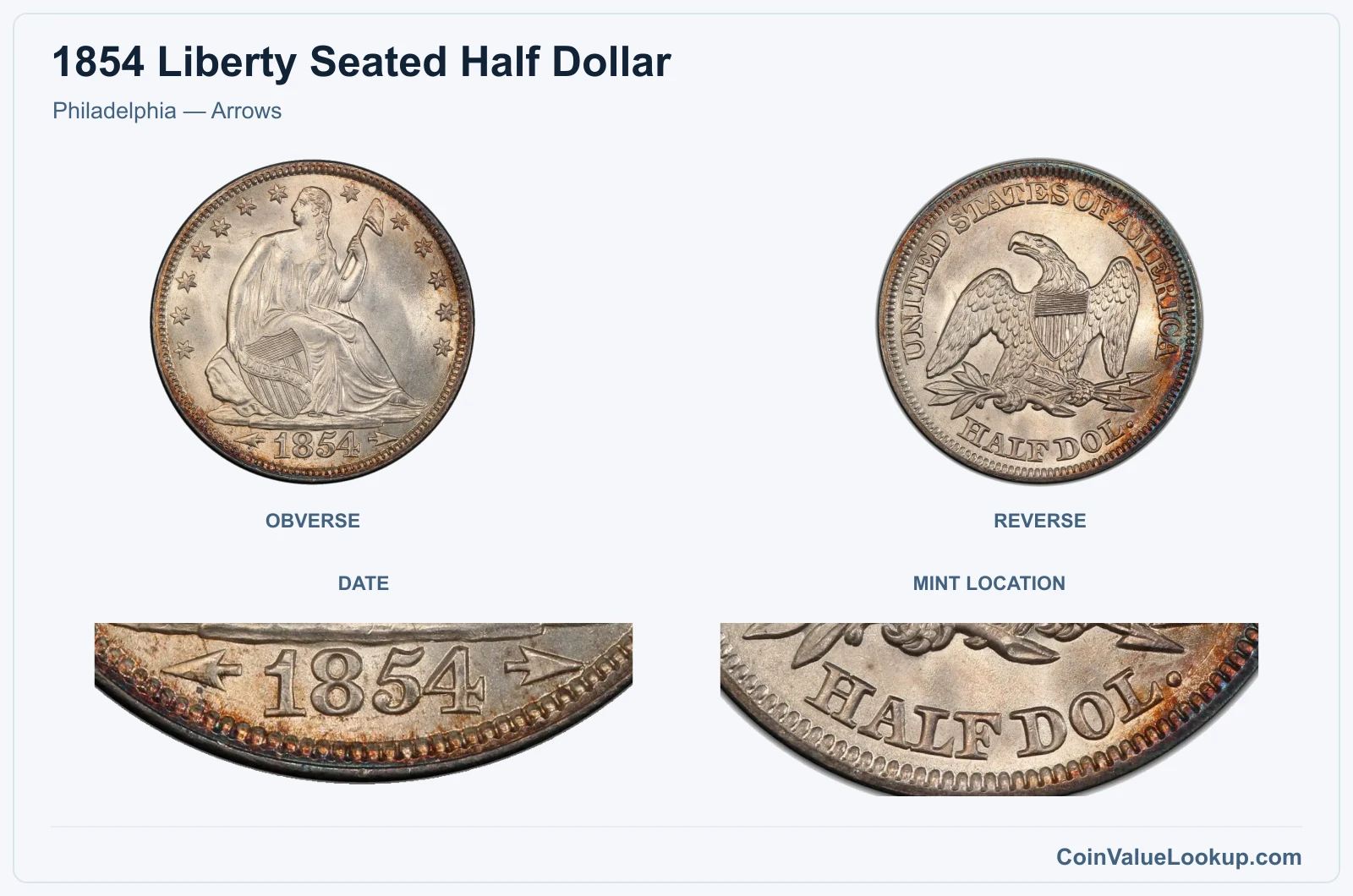
The Philadelphia Arrows half dollar is the most commonly encountered 1854 issue. Arrowheads sit on either side of the date, but the reverse rays from 1853 are gone.
No mintmark appears on the reverse.
USA Coin Book guide estimates place this version at roughly $79 in G4, $236 in VF20, and $456 near AU50. These are reference anchors, not guaranteed buy prices.
With 12.44 grams of 90% silver, even a heavily worn example has meaningful metal content.
Ordinary-issue reference: Ordinary-issue reference only: The table below shows prices for the 1854 Liberty Seated Half Dollar (regular strike). It does not represent the value of the specific Philadelphia — Arrows variety or its variety premium. Year, mint, metal and strike type are matched; the specific variety is not priced by this table.
Range Grade
Price Auction Records Appraisal PO PO 1
—
Coin Identifier FR FR 2
Coin Identifier AG AG 3
—
Coin Identifier G G 4
—
Coin Identifier
G 6
Coin Identifier VG VG 8
—
Coin Identifier
VG 10
Coin Identifier F F 12
Coin Identifier
F 15
—
Coin Identifier VF VF 20
—
Coin Identifier
VF 25
Coin Identifier
VF 30
Coin Identifier
VF 35
Coin Identifier XF XF 40
Coin Identifier
XF 45
Coin Identifier AU AU 50
Coin Identifier
AU 53
Coin Identifier
AU 55
Coin Identifier
AU 58
Coin Identifier MS MS 60
Coin Identifier
MS 61
Coin Identifier
MS 62
Coin Identifier
MS 63
Coin Identifier
MS 64
Coin Identifier
MS 65
Coin Identifier
MS 66
Coin Identifier
MS 67
—
Coin Identifier
MS 68
—
—
—
MS 69
—
—
—
MS 70
—
—
—
1854 Liberty Seated Half Dollar — New Orleans — Arrows
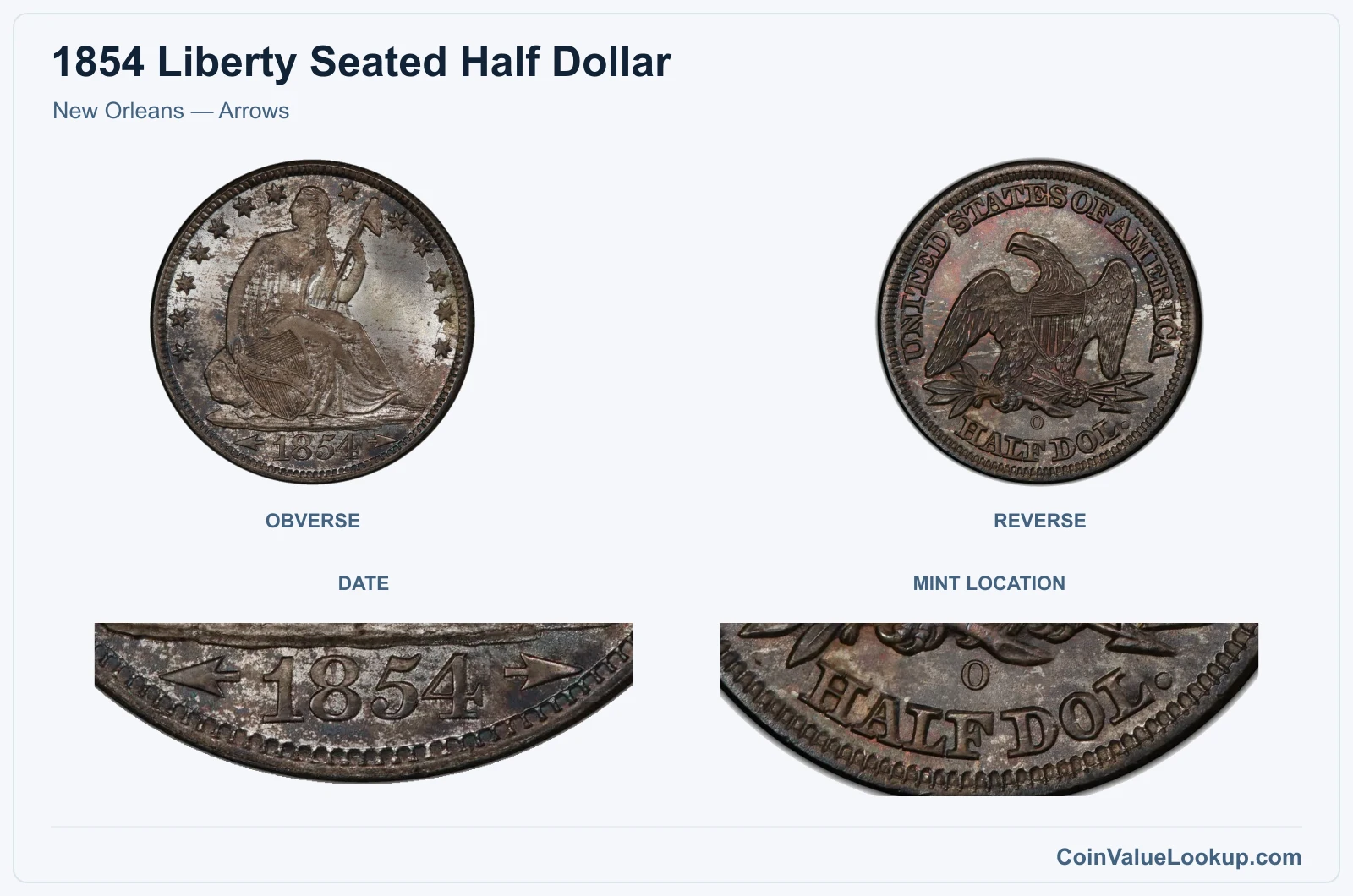
The New Orleans Arrows version carries a small "O" mintmark centered below the eagle on the reverse. Like its Philadelphia sibling, it has arrows flanking the date and no reverse rays.
Guide estimates from USA Coin Book are similar to the Philadelphia issue: about $79 at G4, $236 at VF20, and $456 at AU50. The O mintmark can sometimes be weakly impressed, so use magnification if you are not sure what you see.
Note that a "Huge O" quarter from this era is a different denomination entirely and should not be confused with this half dollar.
Coin Value Lookup is a good starting point if you want to look up other dates and denominations in the Liberty Seated series.
Ordinary-issue reference: Ordinary-issue reference only: The table below shows prices for the 1854-O Liberty Seated Half Dollar (regular strike). It does not represent the value of the specific New Orleans — Arrows variety or its variety premium. Year, mint, metal and strike type are matched; the specific variety is not priced by this table.
Range Grade
Price Auction Records Appraisal PO PO 1
Coin Identifier FR FR 2
—
Coin Identifier AG AG 3
—
Coin Identifier G G 4
—
Coin Identifier
G 6
—
Coin Identifier VG VG 8
Coin Identifier
VG 10
Coin Identifier F F 12
Coin Identifier
F 15
Coin Identifier VF VF 20
Coin Identifier
VF 25
Coin Identifier
VF 30
Coin Identifier
VF 35
Coin Identifier XF XF 40
Coin Identifier
XF 45
Coin Identifier AU AU 50
Coin Identifier
AU 53
Coin Identifier
AU 55
Coin Identifier
AU 58
Coin Identifier MS MS 60
Coin Identifier
MS 61
Coin Identifier
MS 62
Coin Identifier
MS 63
Coin Identifier
MS 64
Coin Identifier
MS 65
Coin Identifier
MS 66
Coin Identifier
MS 67
Coin Identifier
MS 68
—
—
—
MS 69
—
—
—
MS 70
—
—
—
1854 Liberty Seated Half Dollar — Philadelphia Proof
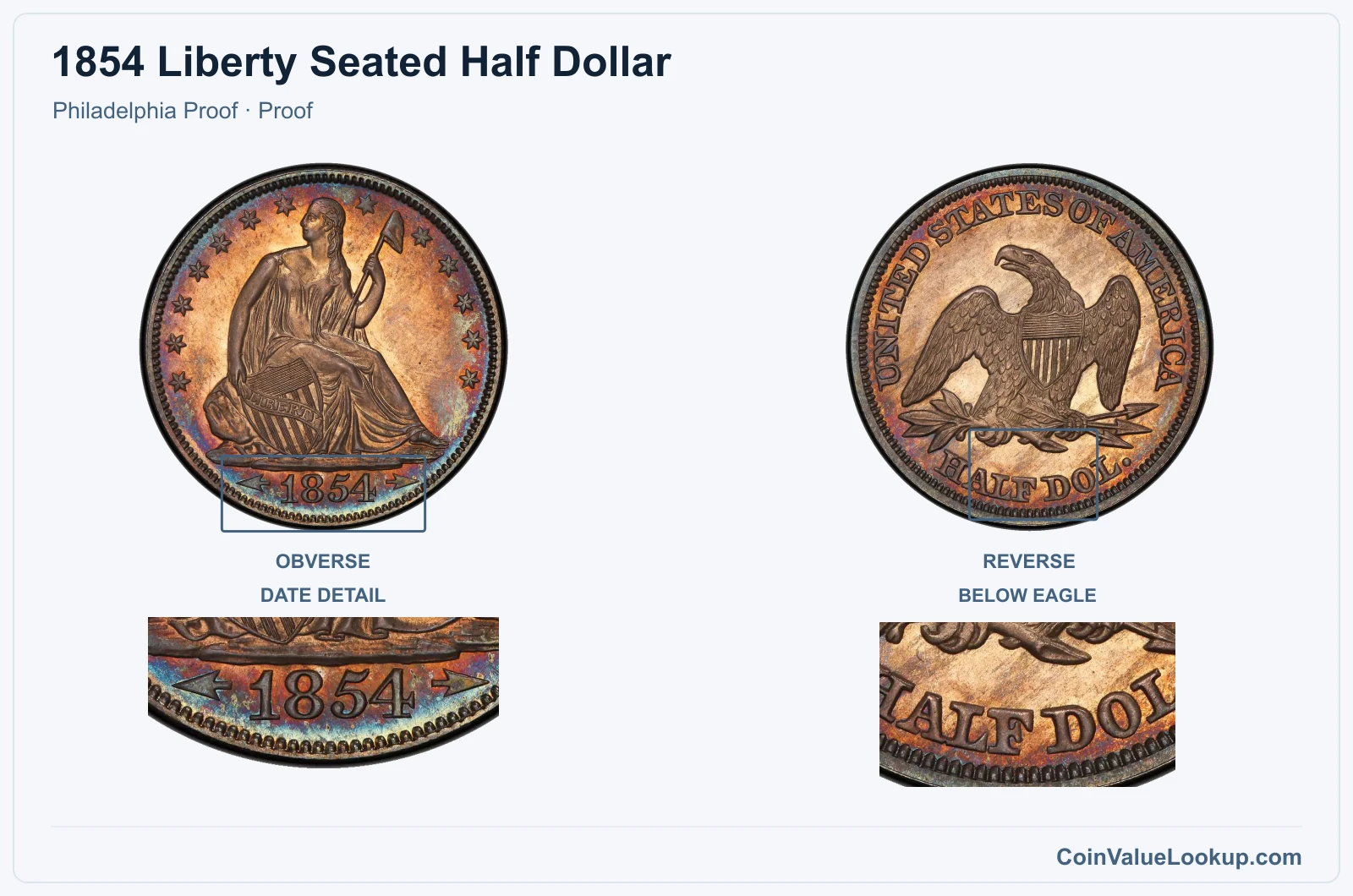
Philadelphia Proof half dollars from 1854 are a scarce collector manufacture, struck with polished dies on prepared planchets. They share the same design as the regular Philadelphia issue but display squared rims, deeply mirrored fields, and sharp detail across both sides.
Do not assume a shiny coin is a Proof. Cleaned or lightly circulated business strikes can mimic reflectivity, but they lack the consistent mirror depth and edge characteristics of genuine Proof manufacture.
CAM and DCAM designations describe the degree of contrast between frosted devices and mirror fields within this version.
The only specific sale in the record is a PR67 that brought $70,500 through Heritage Auctions in 2013. That is a single result at an exceptional grade and should not be read as a general price curve for all Proof examples.
Range Grade
Price Auction Records Appraisal PR PR 1
—
Coin Identifier
PR 2
—
Coin Identifier
PR 3
—
Coin Identifier
PR 4
—
Coin Identifier
PR 6
—
Coin Identifier
PR 8
—
Coin Identifier
PR 10
—
Coin Identifier
PR 12
—
Coin Identifier
PR 15
—
Coin Identifier
PR 20
—
Coin Identifier
PR 25
—
Coin Identifier
PR 30
—
Coin Identifier
PR 35
—
Coin Identifier
PR 40
—
Coin Identifier
PR 45
—
Coin Identifier
PR 50
—
Coin Identifier
PR 53
—
Coin Identifier
PR 55
—
Coin Identifier
PR 58
—
Coin Identifier
PR 60
Coin Identifier
PR 61
—
Coin Identifier
PR 62
—
Coin Identifier
PR 63
Coin Identifier
PR 64
Coin Identifier
PR 65
Coin Identifier
PR 66
—
—
—
PR 67
—
—
—
PR 68
—
—
—
PR 69
—
—
—
PR 70
—
—
—
1854 Liberty Seated Half Dollar Error List
1. 1854 Liberty Seated Half Dollar — Die Crack / Die Chip
Die cracks are raised, irregular lines on the coin's surface caused by fractures in the steel die during production. On 1854 Philadelphia half dollars, a known crack runs from the rim through the rock tip and arrow area into the digits "18" of the date, with a second crack spanning stars 2 through 5.
New Orleans issues from this year are also reported in related scope for die cracks, though the specific crack patterns differ.
Do not confuse a die crack with incuse scratches, corrosion lines, or foreign material stuck to the surface. A genuine die crack is raised above the field because metal filled the gap in the broken die.
Scratches, by contrast, are recessed into the surface.
No fixed price premium is adopted for these. The value depends on the crack's visibility, the coin's overall condition, and collector interest in the specific error.