1914 Barber Half Dollar Coin Value: How Much Is It Worth?
A 1914 Barber Half Dollar can range from about $44 at G4 grade to around $2,920 at MS63, depending on the mint and condition. That spread comes from a USA Coin Book guide snapshot and covers the two business-strike mints plus the Philadelphia Proof, each with its own value track.
Philadelphia struck the fewest business-strike Barber halves of any date in the entire series this year, which makes the 1914-P a coin that draws serious attention. There was no Denver issue for 1914, so you are looking at just two regular mints: Philadelphia and San Francisco.
Proofs were also struck in Philadelphia and are a separate category.
Fast Way to Identify Your 1914 Barber Half Dollar
The quickest way to start figuring out what you have is to upload clear photos of the front and back of your coin. Our identifier can give you a preliminary read on date, mint, and general type from those images.
It will not authenticate errors, certify grade, or pin down an exact price, but it narrows the field so you know what to research next.
1914 Barber Half Dollar Value
Upload both sides of your 1914 Barber Half Dollar.
Front Obverse
Upload photo
Back Reverse
Upload photo
Which 1914 Barber Half Dollar Versions Are Worth Money?
- The 1914 Philadelphia (no mintmark) business strike has the lowest mintage in the entire Barber half series, making it a key date worth checking carefully.
- At MS63 grade, a USA Coin Book guide estimate places the 1914-P around $2,920 — significantly above the San Francisco issue at the same grade.
- The 1914-S is more affordable in lower grades, starting near $44 at G4, but climbs steeply as condition improves.
- Philadelphia Proofs from 1914 carry a guide estimate near $1,541 at PR63 and require mirrored fields to confirm — polishing does not count.
- Problem-free, original-surface examples in upper circulated or Mint State grades can be worth considerably more than heavily worn pieces of the same date and mint.
Step 1: Identify Your 1914 Barber Half Dollar Mint Mark and Version
First, confirm the date reads 1914 and the reverse says HALF DOLLAR. The obverse shows a right-facing Liberty head; the reverse carries a heraldic eagle.
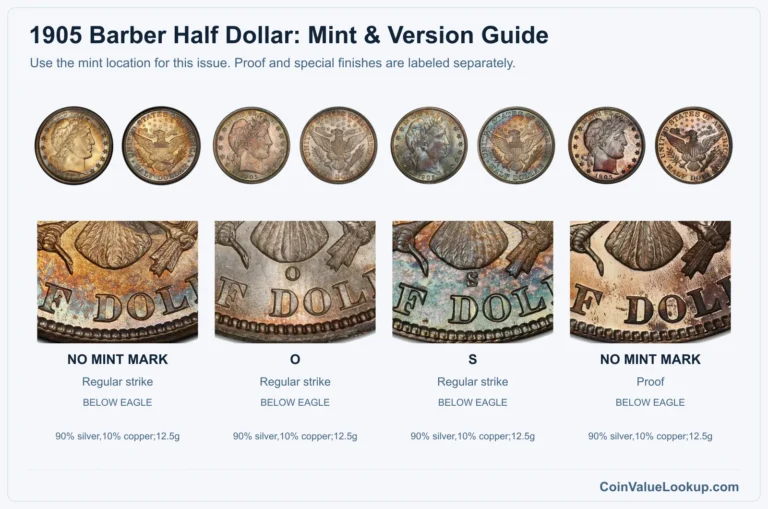
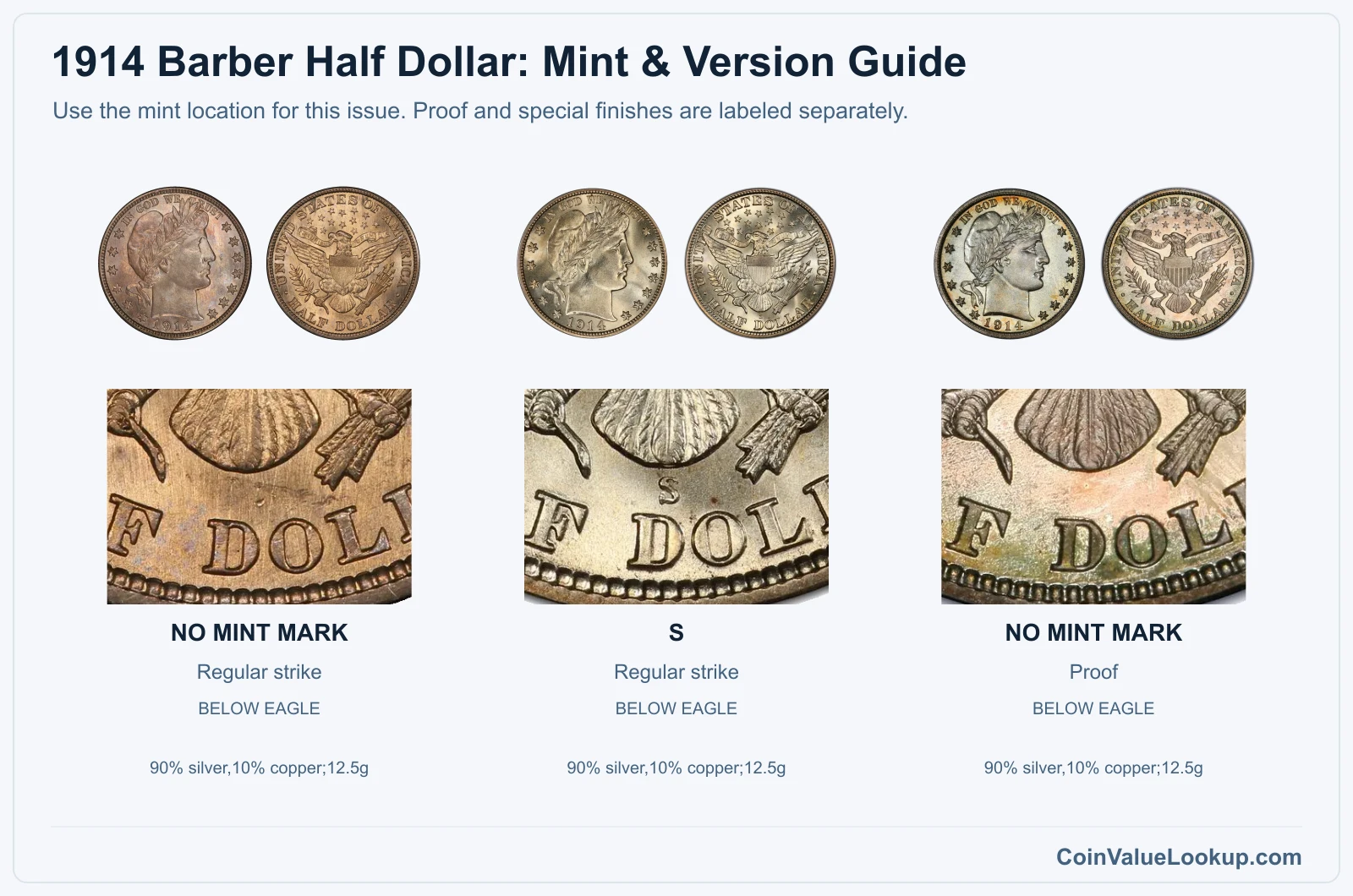
For mintmarks, flip the coin over and look just below the eagle's tail feathers, above the words HALF DOLLAR. A small "S" means San Francisco.
No letter at all means Philadelphia. You will not find a "D" on a genuine 1914 Barber half because Denver did not produce this date.
All regular 1914 halves are struck in 90% silver and 10% copper, weigh about 12.5 grams, measure 30.6 mm across, and have a reeded edge. If yours is noticeably lighter or has a smooth edge, something else is going on.
Coin Value Lookup is a handy starting point if you want to look up other dates or denominations in the Barber series. You can browse guides there organized by coin type and year.
Step 2: Check Your 1914 Barber Half Dollar Grade
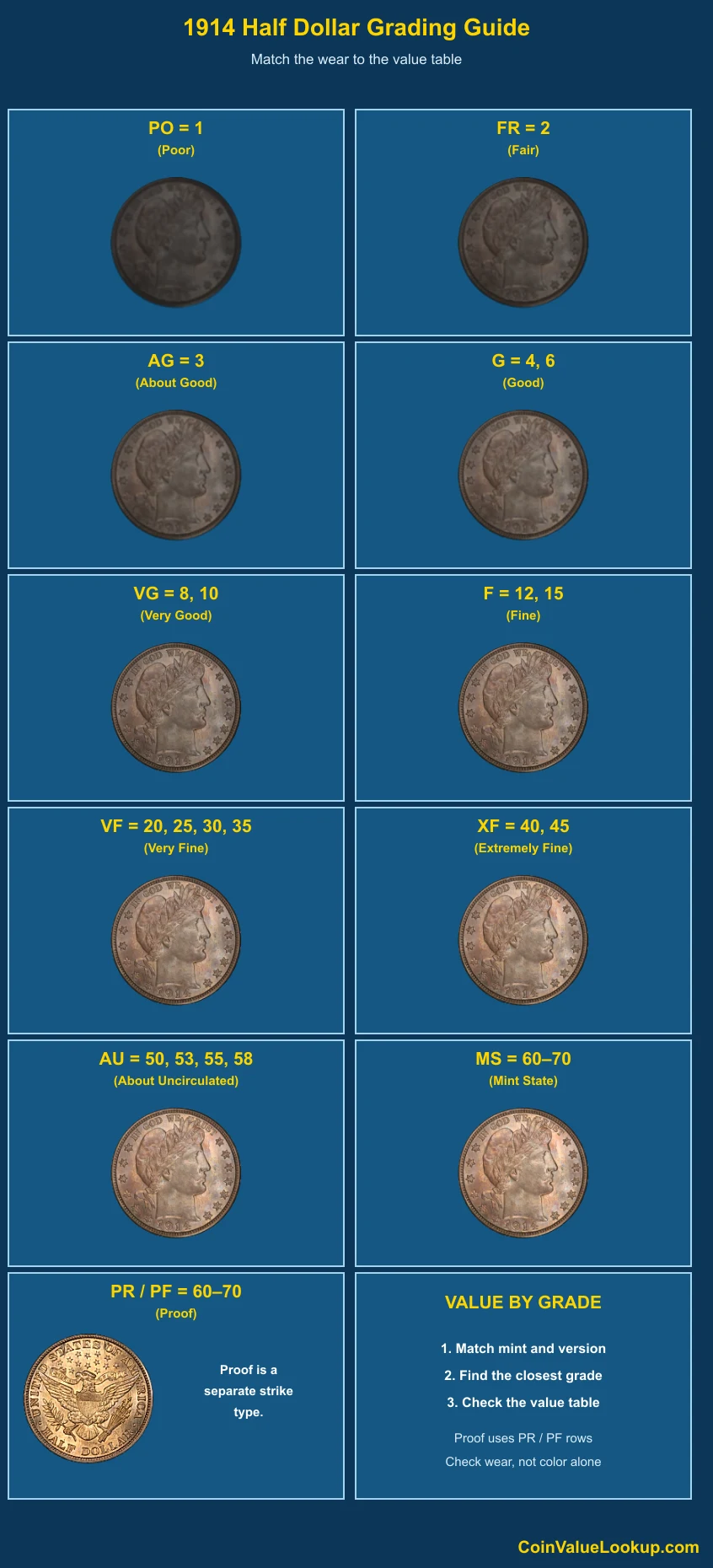
Start by looking at Liberty's cheek, her hair detail above the forehead, and the condition of the headband letters. Then flip the coin and check the eagle's head, wing tips, and tail feathers for corresponding wear.
Do not rely only on whether you can read LIBERTY on the headband. Hub changes during the Barber series affect how quickly those letters wear, so a coin that has lost a letter or two might still have decent detail elsewhere.
Separate actual friction from a weak strike. Some Barber halves, especially from certain mints, came off the press with soft details at the eagle's claws and arrow feathers.
That is not the same as wear from circulation.
Luster matters a lot in the upper grades. A coin with full original surfaces and no cleaning will grade higher than one with sharp detail but wiped fields.
Use the comparison image on this page to match your coin's wear pattern against known grade examples. A genuine Proof is a manufacturing finish with mirrored fields, not simply a grade above Mint State.
Step 3: Check 1914 Barber Half Dollar Value by Mint and Version
1914 Barber Half Dollar — No Mint Mark — Regular Issue
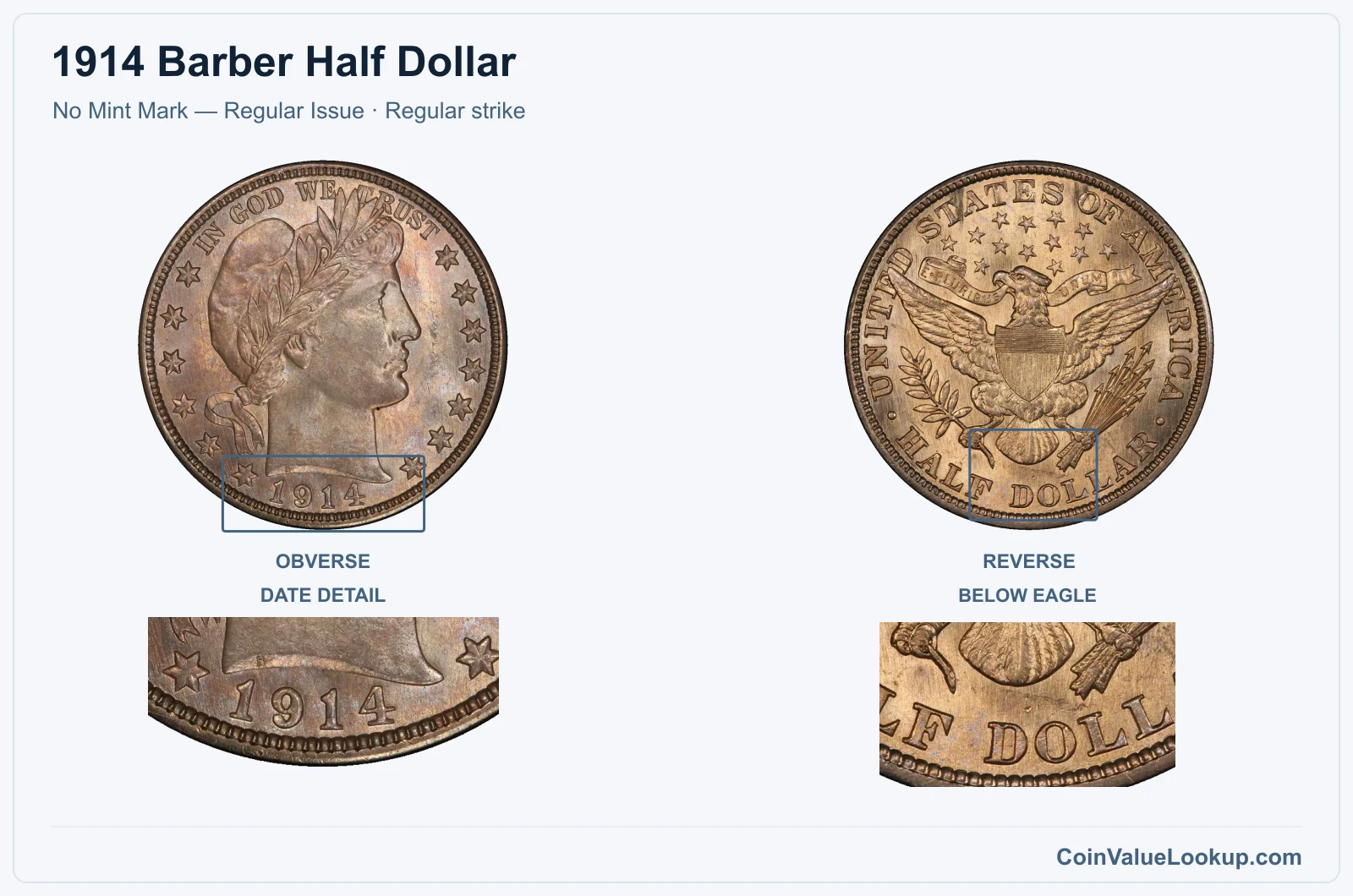
The 1914 Philadelphia Barber half has no mintmark. Look below the eagle's tail on the reverse and confirm the space is blank.
This is the big one. Philadelphia produced the lowest business-strike mintage of any date in the entire Barber half dollar series.
That scarcity drives strong demand across all grades.
A USA Coin Book guide estimate places the 1914-P at about $180 in G4 and roughly $2,920 in MS63. Even well-worn examples carry a meaningful premium over most other Barber halves.
Condition and original surfaces matter here more than usual — a problem-free coin with honest wear will command far more respect than a cleaned or damaged piece at a similar technical grade. Have the full dated obverse and reverse evaluated before assuming value.
Range Grade
Price Auction Records Appraisal PO PO 1
—
Coin Identifier FR FR 2
—
Coin Identifier AG AG 3
Coin Identifier G G 4
Coin Identifier
G 6
Coin Identifier VG VG 8
Coin Identifier
VG 10
Coin Identifier F F 12
Coin Identifier
F 15
Coin Identifier VF VF 20
Coin Identifier
VF 25
Coin Identifier
VF 30
Coin Identifier
VF 35
Coin Identifier XF XF 40
Coin Identifier
XF 45
Coin Identifier AU AU 50
Coin Identifier
AU 53
Coin Identifier
AU 55
Coin Identifier
AU 58
Coin Identifier MS MS 60
—
Coin Identifier
MS 61
Coin Identifier
MS 62
Coin Identifier
MS 63
Coin Identifier
MS 64
Coin Identifier
MS 65
Coin Identifier
MS 66
Coin Identifier
MS 67
—
—
—
MS 68
—
—
—
MS 69
—
—
—
MS 70
—
—
—
1914 Barber Half Dollar — S — Regular Issue
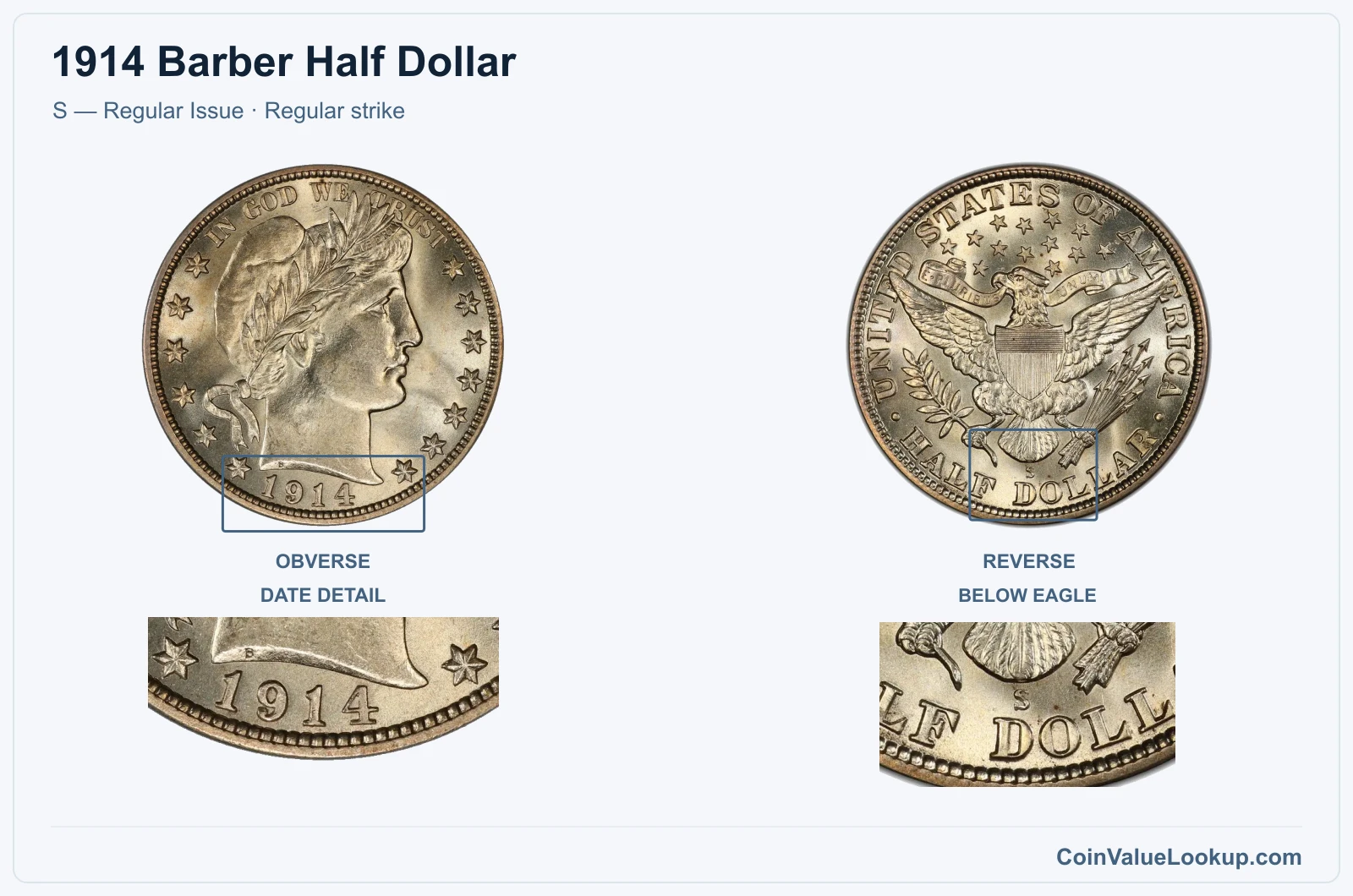
The 1914-S was struck in San Francisco and carries a small "S" mintmark below the eagle's tail feathers on the reverse.
Compared to the Philadelphia issue, the San Francisco coin is considerably more accessible. A USA Coin Book guide estimate puts it around $44 at G4 and about $1,618 at MS63.
Those are still respectable numbers for a Barber half, especially in higher grades where survivors thin out fast.
As with any Barber half, confirm original surfaces before applying guide values. A coin with cleaning, harsh dipping, or rim damage will fall well below these benchmarks regardless of how sharp the details look.
Range Grade
Price Auction Records Appraisal PO PO 1
—
Coin Identifier FR FR 2
—
Coin Identifier AG AG 3
—
Coin Identifier G G 4
Coin Identifier
G 6
Coin Identifier VG VG 8
Coin Identifier
VG 10
Coin Identifier F F 12
Coin Identifier
F 15
Coin Identifier VF VF 20
Coin Identifier
VF 25
Coin Identifier
VF 30
Coin Identifier
VF 35
Coin Identifier XF XF 40
Coin Identifier
XF 45
Coin Identifier AU AU 50
Coin Identifier
AU 53
Coin Identifier
AU 55
Coin Identifier
AU 58
Coin Identifier MS MS 60
—
Coin Identifier
MS 61
Coin Identifier
MS 62
Coin Identifier
MS 63
Coin Identifier
MS 64
Coin Identifier
MS 65
Coin Identifier
MS 66
Coin Identifier
MS 67
—
—
—
MS 68
—
—
—
MS 69
—
—
—
MS 70
—
—
—
1914 Barber Half Dollar — No Mint Mark — Proof
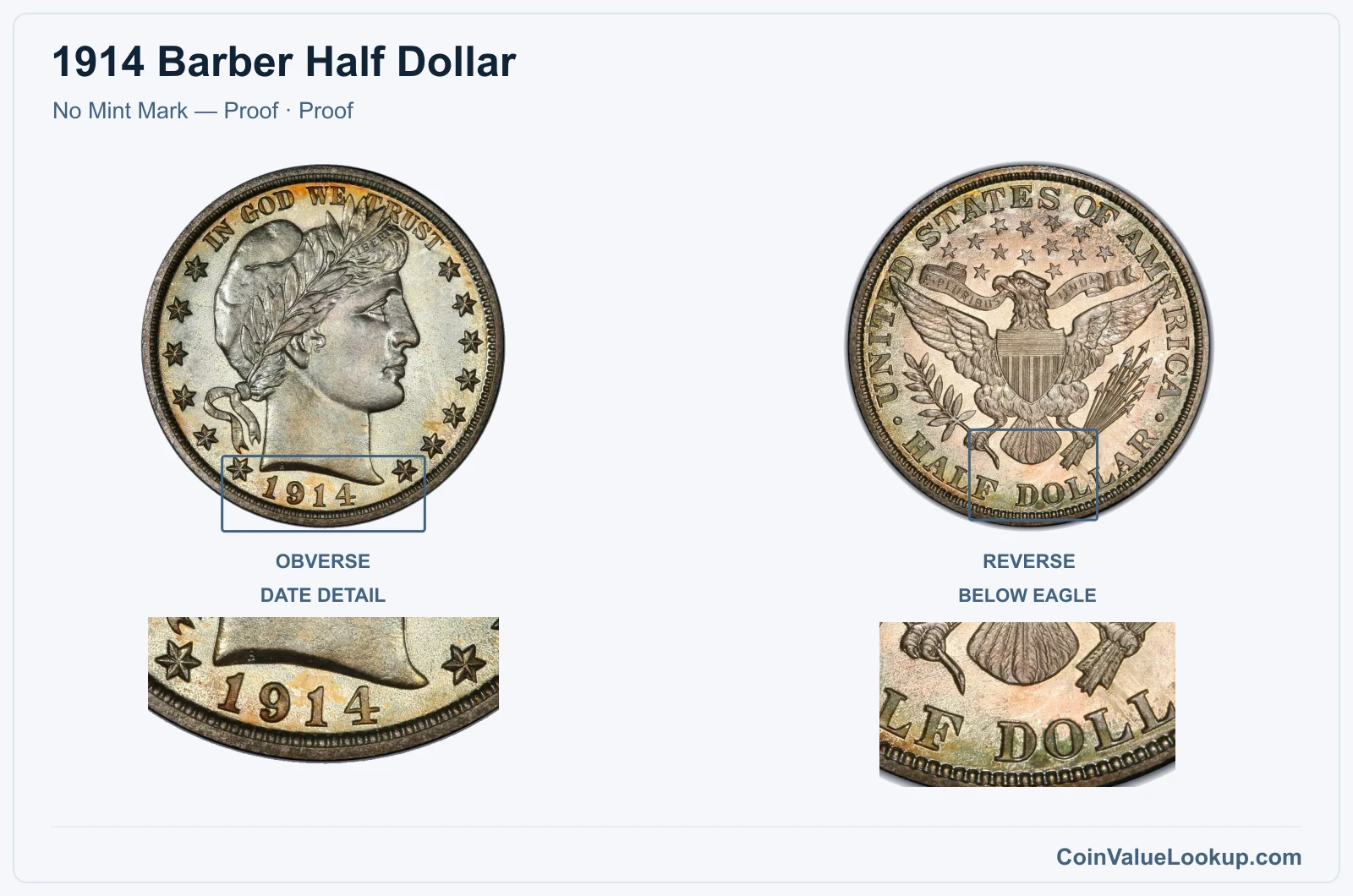
Philadelphia Proofs from 1914 were struck with polished dies on specially prepared planchets, producing mirrored fields and sharp rims. There is no mintmark.
A genuine Proof has deeply reflective surfaces that act almost like a mirror. Do not confuse a polished or lightly circulated business strike for a Proof — polishing a coin cannot replicate the die finish.
Look at the rim sharpness and field quality under good light.
A USA Coin Book guide estimate places the 1914 Proof at about $1,541 in PR63. When comparing Proofs, differences in cameo contrast between the frosted devices and mirrored fields can affect desirability, but that comparison stays within the Proof category rather than creating a separate mint branch.
Range Grade
Price Auction Records Appraisal PR PR 1
—
Coin Identifier
PR 2
—
Coin Identifier
PR 3
—
Coin Identifier
PR 4
—
Coin Identifier
PR 6
—
Coin Identifier
PR 8
—
Coin Identifier
PR 10
—
Coin Identifier
PR 12
—
Coin Identifier
PR 15
—
Coin Identifier
PR 20
—
Coin Identifier
PR 25
—
Coin Identifier
PR 30
—
Coin Identifier
PR 35
—
Coin Identifier
PR 40
—
Coin Identifier
PR 45
—
Coin Identifier
PR 50
—
Coin Identifier
PR 53
—
Coin Identifier
PR 55
—
Coin Identifier
PR 58
Coin Identifier
PR 60
Coin Identifier
PR 61
Coin Identifier
PR 62
Coin Identifier
PR 63
Coin Identifier
PR 64
Coin Identifier
PR 65
Coin Identifier
PR 66
Coin Identifier
PR 67
Coin Identifier
PR 68
Coin Identifier
PR 69
—
—
—
PR 70
—
—
—