1914 Buffalo Nickel Coin Value: How Much Is It Worth?
A 1914 Buffalo Nickel can be worth anywhere from about $25 in well-worn Good-4 condition up to several hundred dollars in Mint State, depending on the mint and surface quality. The 1914/(3) Overdate variety pushes values dramatically higher, with guide estimates reaching $6,259 at MS63.
Matte proofs carry their own premium as well. Let's break down exactly what to look for.
Fast Way to Identify Your 1914 Buffalo Nickel
The quickest way to start figuring out what your 1914 Buffalo Nickel is worth is to upload clear photos of the front and back. Our identifier can give you a preliminary read on the mint, version, and general condition.
Make sure the date is legible and the area below FIVE CENTS on the reverse is visible so the mintmark can be checked.
1914 Buffalo Nickel Value
Upload both sides of your 1914 Buffalo Nickel.
Front Obverse
Upload photo
Back Reverse
Upload photo
Which 1914 Buffalo Nickel Versions Are Worth Money?
- The 1914/(3) Overdate from Philadelphia commands the highest guide estimates, around $313 at G4 and $6,259 at MS63, due to the visible traces of a 3 beneath the date's final digit.
- Denver mint 1914 nickels carry a significant premium over Philadelphia and San Francisco coins, with guide values of $131 at G4 and $666 at MS63.
- San Francisco coins are the second-most-valuable regular issue, estimated at $39 in G4 and $527 in MS63.
- Matte Proof examples, struck only at Philadelphia, carry a guide estimate of $1,243 at PR63 and require careful identification of their distinctive surfaces and rims.
- Recognized mint errors such as clipped planchets, laminations, and repunched mintmarks on specific mints can add value depending on visibility and condition.
Step 1: Identify Your 1914 Buffalo Nickel Mint Mark and Version
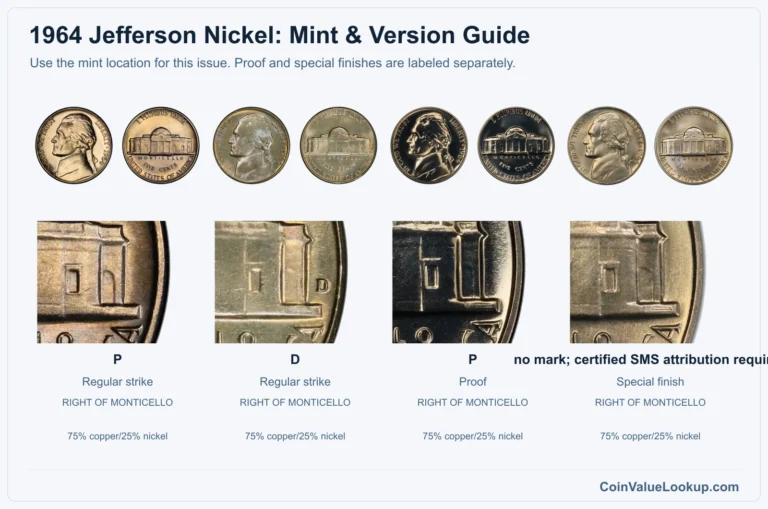
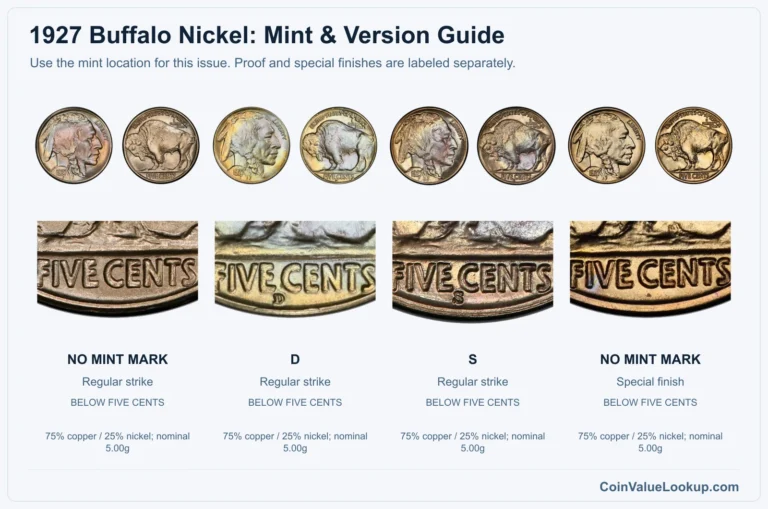
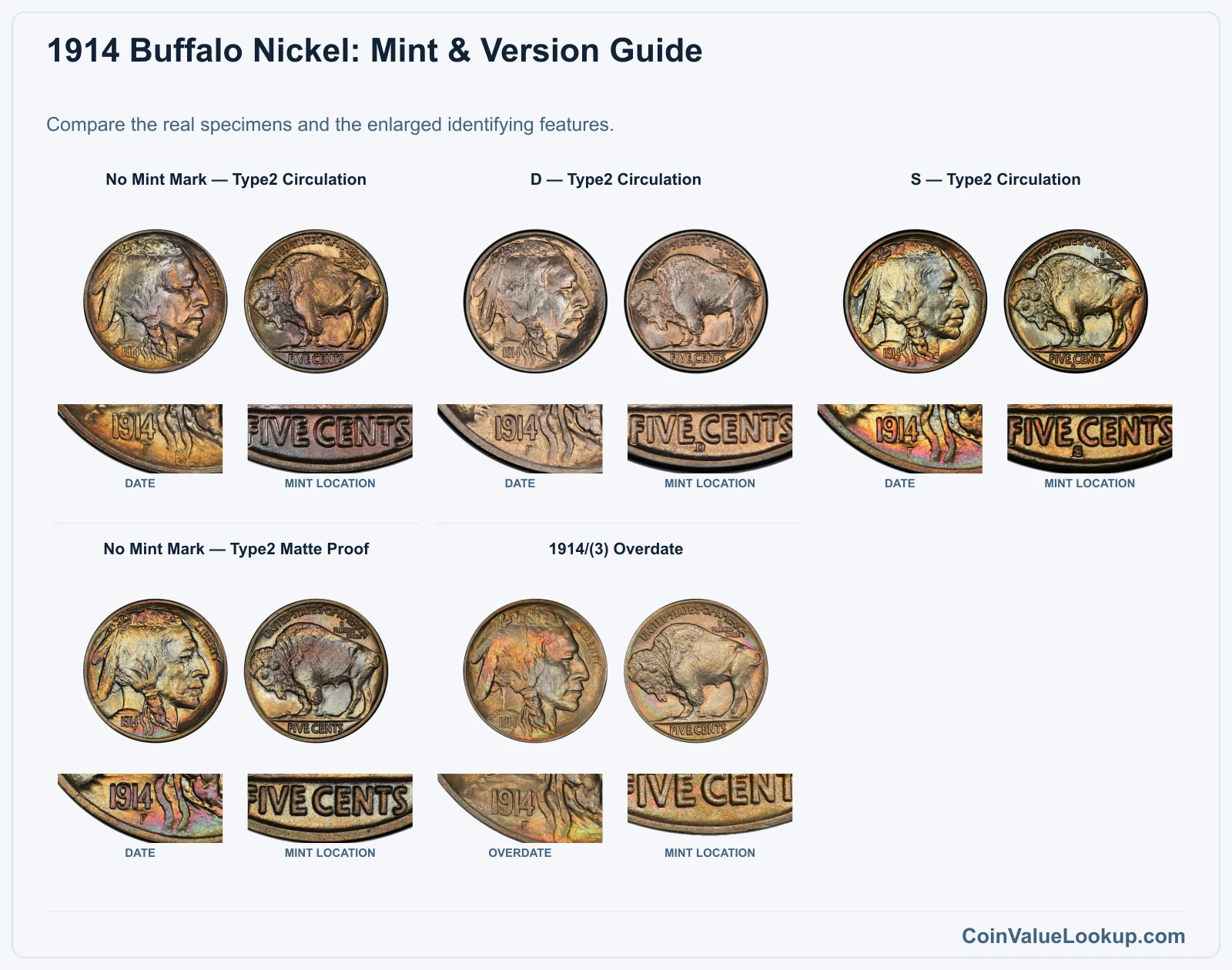
Three mints produced the 1914 Buffalo Nickel: Philadelphia, Denver, and San Francisco. Philadelphia coins carry no mintmark.
Denver coins show a small D on the reverse, just below the words FIVE CENTS. San Francisco coins have an S in the same spot.
All 1914 nickels use the Type 2 reverse design, where FIVE CENTS sits in a recessed area below a flat ground line. There is no Type 1 branch for this year; that design was only used in 1913.
The coin is struck in 75% copper and 25% nickel, weighs 5 grams, measures 21.2 mm across, and has a plain edge. There is no regular silver version, so don't let anyone tell you otherwise.
The major recognized variety is the 1914/(3) Overdate, where traces of a 3 are visible beneath the final digit 4 in the date. This is a catalogued Philadelphia die variety.
A scratched or damaged 4 is not the same thing, so careful examination under magnification is essential before jumping to conclusions.
Step 2: Check Your 1914 Buffalo Nickel Grade
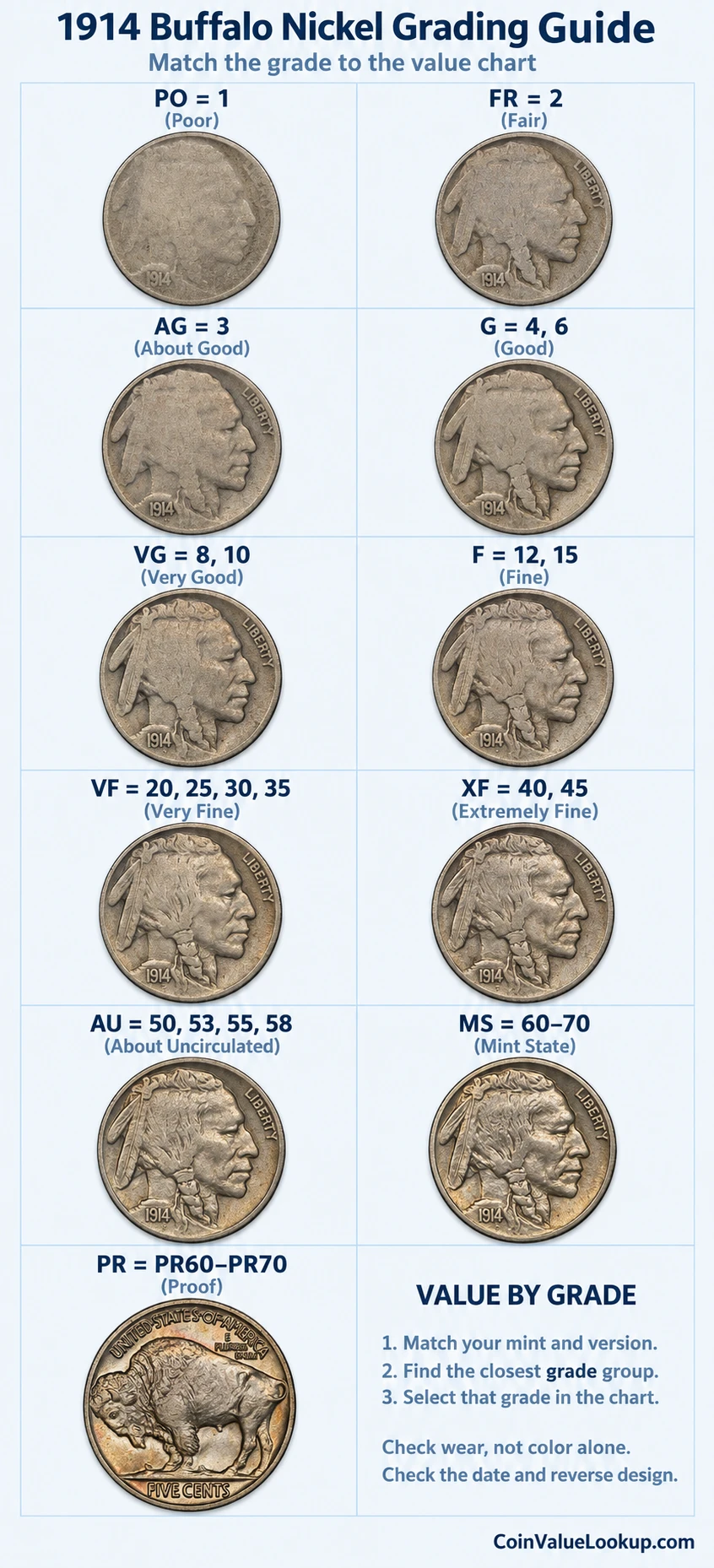
Start by looking at the Native American portrait on the obverse. In lower grades the hair braid and cheek flatten first, then the feathers lose individual separation.
On the reverse, the bison's shoulder and horn are the key wear points.
Here's a trap with Buffalo Nickels: weak strikes can mimic wear. Some coins left the press without full horn detail or sharp braid lines, especially on certain die states.
A coin with original mint luster but a soft horn isn't necessarily circulated. Compare your coin against the grading image to see how genuine wear differs from strike softness.
Never acid-treat or chemically restore a worn date to try to read it. That destroys the coin's surfaces and kills any collector value.
Look at overall luster, surface marks, and remaining design sharpness as a complete picture rather than fixating on one detail.
Step 3: Check 1914 Buffalo Nickel Value by Mint and Version
1914 Buffalo Nickel — No Mint Mark — Type2 Circulation
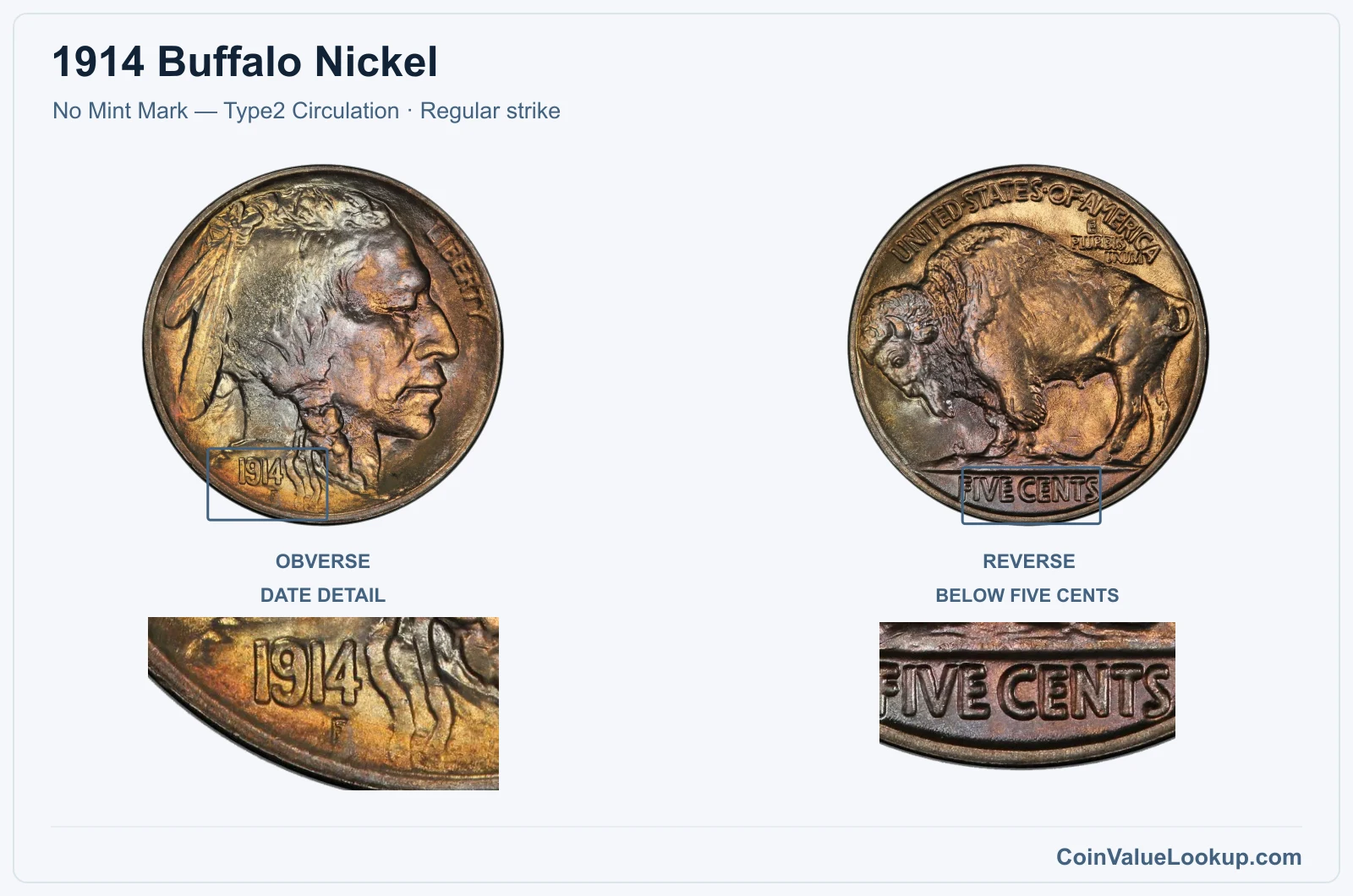
The 1914 Philadelphia nickel has no mintmark. Look at the reverse below FIVE CENTS: it should be blank.
This is the most available mint for the year, with USA Coin Book guide estimates of about $25 at G4 and $123 at MS63.
Original surfaces matter a lot at higher grades. A coin with full, undisturbed luster and no cleaning will always outperform a dull or scrubbed example at the same technical grade.
When photographing, capture both faces, the readable date, and the mintmark area clearly.
Range Grade
Price Auction Records Appraisal PO PO 1
—
Coin Identifier FR FR 2
—
Coin Identifier AG AG 3
—
Coin Identifier G G 4
—
Coin Identifier
G 6
Coin Identifier VG VG 8
Coin Identifier
VG 10
—
Coin Identifier F F 12
Coin Identifier
F 15
—
Coin Identifier VF VF 20
—
Coin Identifier
VF 25
—
Coin Identifier
VF 30
—
Coin Identifier
VF 35
—
Coin Identifier XF XF 40
Coin Identifier
XF 45
—
Coin Identifier AU AU 50
—
Coin Identifier
AU 53
—
Coin Identifier
AU 55
Coin Identifier
AU 58
Coin Identifier MS MS 60
Coin Identifier
MS 61
Coin Identifier
MS 62
Coin Identifier
MS 63
Coin Identifier
MS 64
Coin Identifier
MS 65
Coin Identifier
MS 66
Coin Identifier
MS 67
Coin Identifier
MS 68
—
—
—
MS 69
—
—
—
MS 70
—
—
—
1914 Buffalo Nickel — D — Type2 Circulation
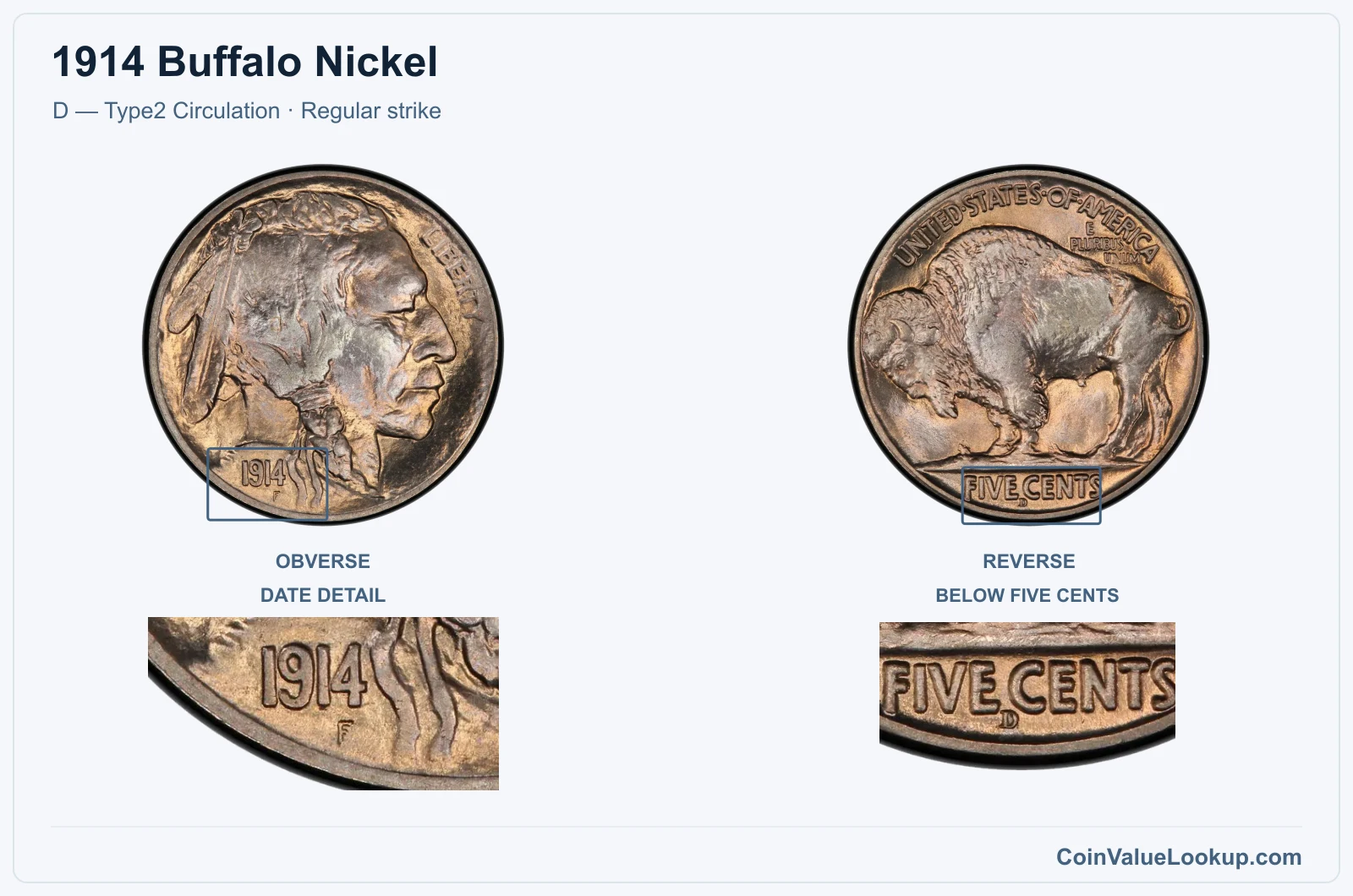
The Denver mint 1914 nickel carries a D mintmark on the reverse below FIVE CENTS. It's the scarcest regular-issue mint this year, and prices reflect that gap.
USA Coin Book lists guide estimates around $131 at G4 and $666 at MS63.
That's a big jump over the Philadelphia coin. The D mintmark should be clear and consistent with the recessed area of the Type 2 reverse.
Confirm the mark under magnification before assuming you have a Denver piece, because damage or die fill can sometimes create confusion.
Coin Value Lookup is a good starting point if you want to compare values across different years and mints in the Buffalo Nickel series.
Range Grade
Price Auction Records Appraisal PO PO 1
—
Coin Identifier FR FR 2
—
Coin Identifier AG AG 3
—
Coin Identifier G G 4
Coin Identifier
G 6
Coin Identifier VG VG 8
Coin Identifier
VG 10
Coin Identifier F F 12
Coin Identifier
F 15
Coin Identifier VF VF 20
Coin Identifier
VF 25
Coin Identifier
VF 30
Coin Identifier
VF 35
Coin Identifier XF XF 40
Coin Identifier
XF 45
Coin Identifier AU AU 50
Coin Identifier
AU 53
Coin Identifier
AU 55
Coin Identifier
AU 58
Coin Identifier MS MS 60
Coin Identifier
MS 61
Coin Identifier
MS 62
Coin Identifier
MS 63
Coin Identifier
MS 64
Coin Identifier
MS 65
Coin Identifier
MS 66
Coin Identifier
MS 67
Coin Identifier
MS 68
—
—
—
MS 69
—
—
—
MS 70
—
—
—
1914 Buffalo Nickel — S — Type2 Circulation
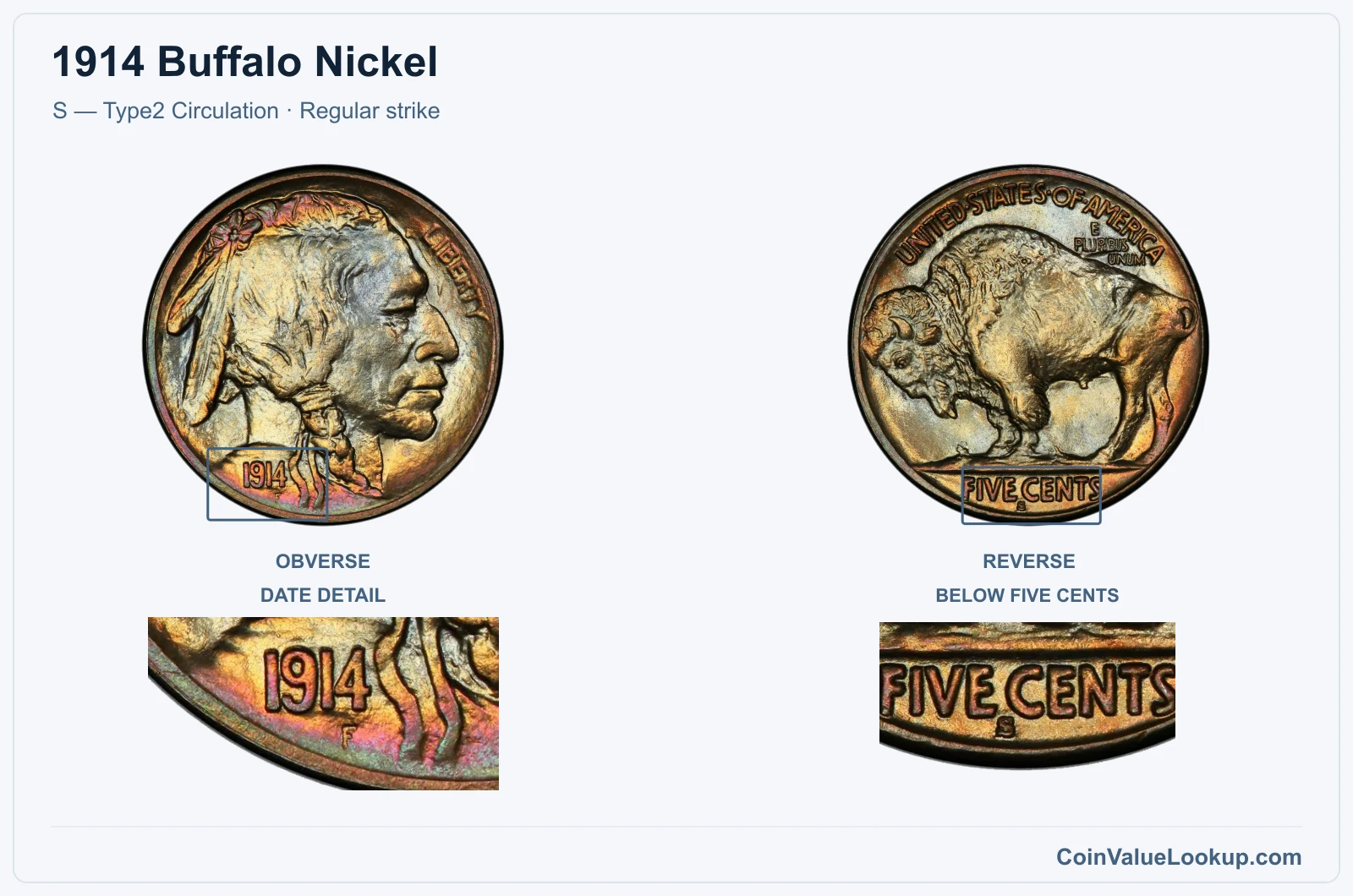
San Francisco 1914 nickels show an S mintmark on the reverse in the same position below FIVE CENTS. Guide estimates from USA Coin Book place this issue at about $39 in G4 and $527 in MS63.
These sit between Philadelphia and Denver in terms of value. Full, original luster and a sharp strike on the bison's horn and shoulder will push any example toward the higher end of its grade range.
Watch for cleaned or polished surfaces, which are common on coins in this price tier.
Range Grade
Price Auction Records Appraisal PO PO 1
—
Coin Identifier FR FR 2
—
Coin Identifier AG AG 3
Coin Identifier G G 4
Coin Identifier
G 6
—
Coin Identifier VG VG 8
Coin Identifier
VG 10
Coin Identifier F F 12
—
Coin Identifier
F 15
Coin Identifier VF VF 20
—
Coin Identifier
VF 25
Coin Identifier
VF 30
Coin Identifier
VF 35
Coin Identifier XF XF 40
Coin Identifier
XF 45
Coin Identifier AU AU 50
Coin Identifier
AU 53
Coin Identifier
AU 55
Coin Identifier
AU 58
Coin Identifier MS MS 60
Coin Identifier
MS 61
Coin Identifier
MS 62
Coin Identifier
MS 63
Coin Identifier
MS 64
Coin Identifier
MS 65
Coin Identifier
MS 66
Coin Identifier
MS 67
Coin Identifier
MS 68
—
—
—
MS 69
—
—
—
MS 70
—
—
—
1914 Buffalo Nickel — No Mint Mark — Type2 Matte Proof
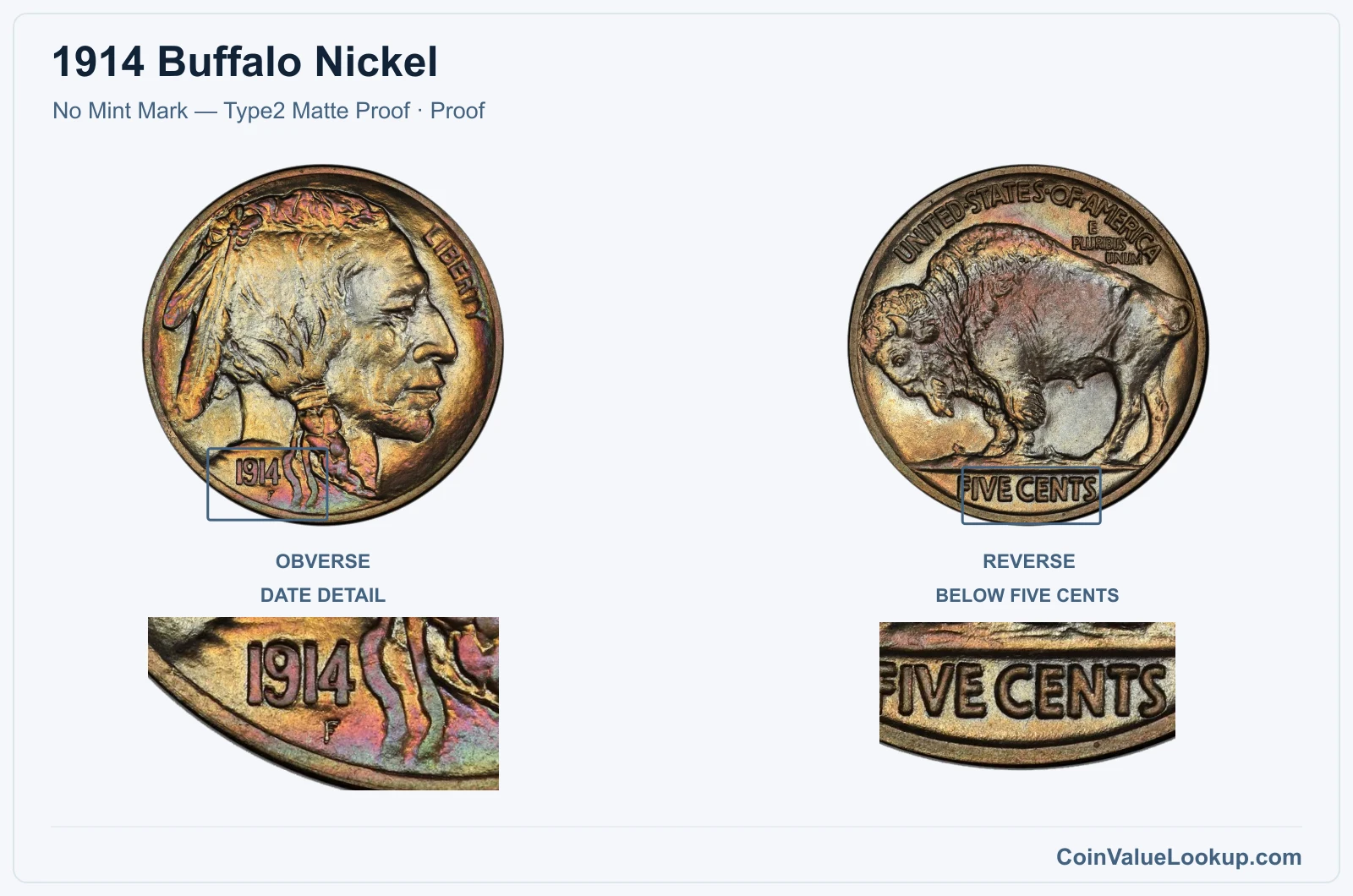
Philadelphia struck matte proof Buffalo Nickels from 1913 through 1916, and the 1914 is part of that run. These are not mirror-bright proofs like later coins.
Instead they have a granular, satiny finish across the fields with exceptionally sharp design details and crisp rims.
USA Coin Book lists a guide estimate of $1,243 at PR63. Don't assume a coin is a matte proof just because it looks sharp or unusually nice.
The rim profile, field texture, and overall strike quality all need to match known matte proof characteristics. Certification by a major grading service is the safest way to confirm this finish.
Range Grade
Price Auction Records Appraisal PR PR 1
—
Coin Identifier
PR 2
—
Coin Identifier
PR 3
—
Coin Identifier
PR 4
—
Coin Identifier
PR 6
—
Coin Identifier
PR 8
—
Coin Identifier
PR 10
—
Coin Identifier
PR 12
—
Coin Identifier
PR 15
—
Coin Identifier
PR 20
—
Coin Identifier
PR 25
—
Coin Identifier
PR 30
—
Coin Identifier
PR 35
—
Coin Identifier
PR 40
—
Coin Identifier
PR 45
—
Coin Identifier
PR 50
—
Coin Identifier
PR 53
—
Coin Identifier
PR 55
—
Coin Identifier
PR 58
—
Coin Identifier
PR 60
—
Coin Identifier
PR 61
—
Coin Identifier
PR 62
—
Coin Identifier
PR 63
Coin Identifier
PR 64
Coin Identifier
PR 65
Coin Identifier
PR 66
Coin Identifier
PR 67
Coin Identifier
PR 68
Coin Identifier
PR 69
—
—
—
PR 70
—
—
—
1914 Buffalo Nickel — /(3) Overdate
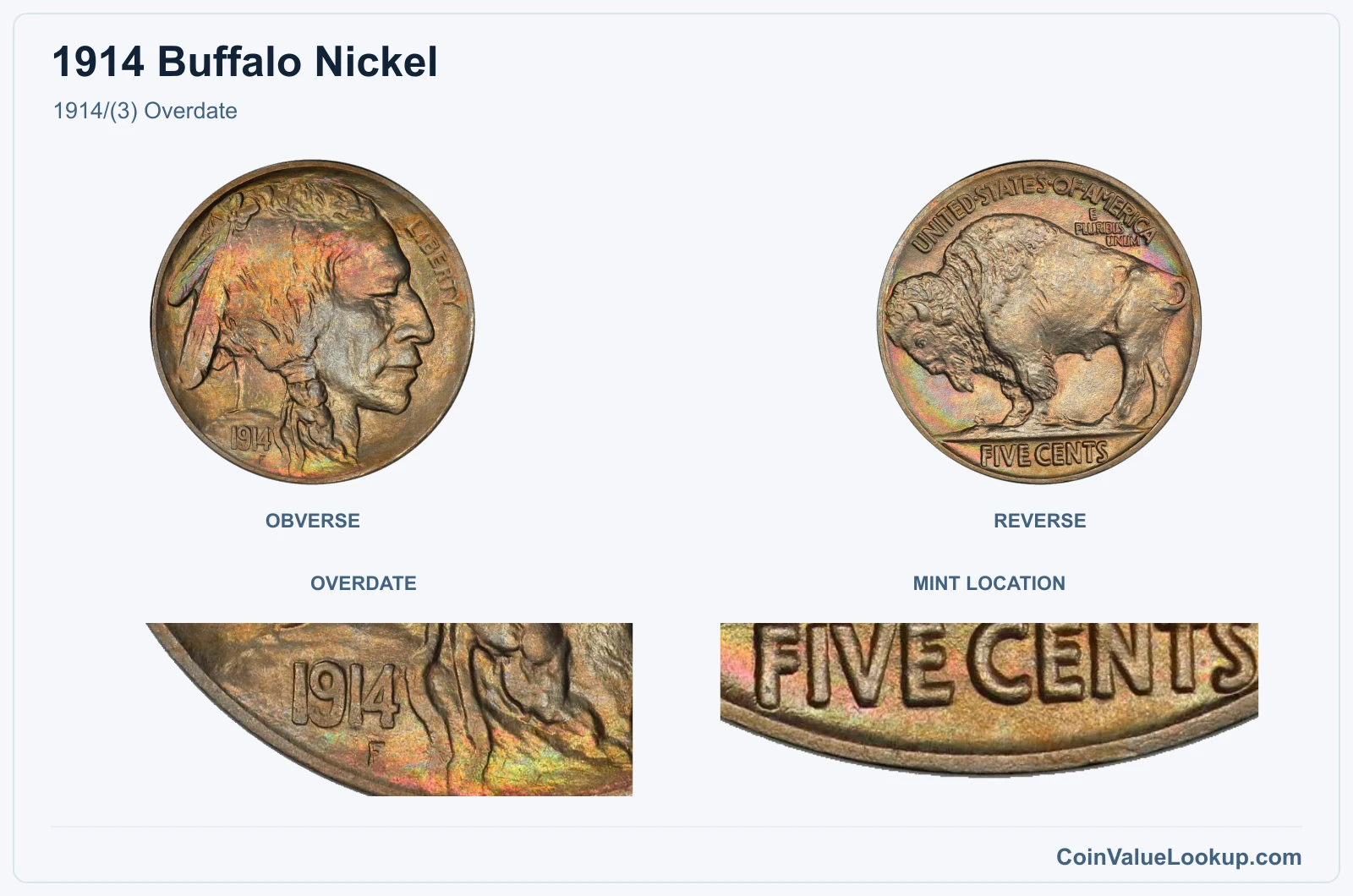
The 1914/(3) Overdate is the headline variety for this year. It's a Philadelphia-mint coin where traces of a previously punched 3 are visible beneath the final 4 in the date.
Under magnification you can see remnants of the 3's curves around the base and upper portion of the 4.
USA Coin Book guide estimates run about $313 at G4 and a substantial $6,259 at MS63. That kind of premium means you need to be certain before celebrating.
A scratched or damaged 4 is not an overdate. The underlying digit must show a consistent, die-produced impression, not random surface marks.
A high-resolution close-up of the date is essential for any attribution attempt, and professional certification is strongly recommended for this variety.
Range Grade
Price Auction Records Appraisal PO PO 1
—
Coin Identifier FR FR 2
—
Coin Identifier AG AG 3
—
Coin Identifier G G 4
Coin Identifier
G 6
—
Coin Identifier VG VG 8
Coin Identifier
VG 10
—
Coin Identifier F F 12
Coin Identifier
F 15
Coin Identifier VF VF 20
Coin Identifier
VF 25
Coin Identifier
VF 30
Coin Identifier
VF 35
—
Coin Identifier XF XF 40
Coin Identifier
XF 45
Coin Identifier AU AU 50
Coin Identifier
AU 53
Coin Identifier
AU 55
Coin Identifier
AU 58
Coin Identifier MS MS 60
—
Coin Identifier
MS 61
Coin Identifier
MS 62
Coin Identifier
MS 63
Coin Identifier
MS 64
Coin Identifier
MS 65
Coin Identifier
MS 66
—
Coin Identifier
MS 67
—
—
—
MS 68
—
—
—
MS 69
—
—
—
MS 70
—
—
—
1914 Buffalo Nickel Error List
1. 1914 Buffalo Nickel — Lamination / Split Planchet
A lamination error on a 1914 Buffalo Nickel shows as peeling, flaking, or splitting within the copper-nickel alloy. You might see a retained metal flap still attached to the surface, or an area where layers have visibly separated.
This has been reported on Philadelphia strikes.
When photographing, capture the edge alongside the affected face so the depth and nature of the separation are visible. The key distinction: legitimate laminations follow the metal's internal structure and occur during the minting process.
Post-mint scraping, corrosion pitting, or a coin that someone deliberately cut into will look different under magnification. Value depends on the size, visibility, and overall condition of the coin, so no single price applies.
2. 1914 Buffalo Nickel — Clipped Planchet
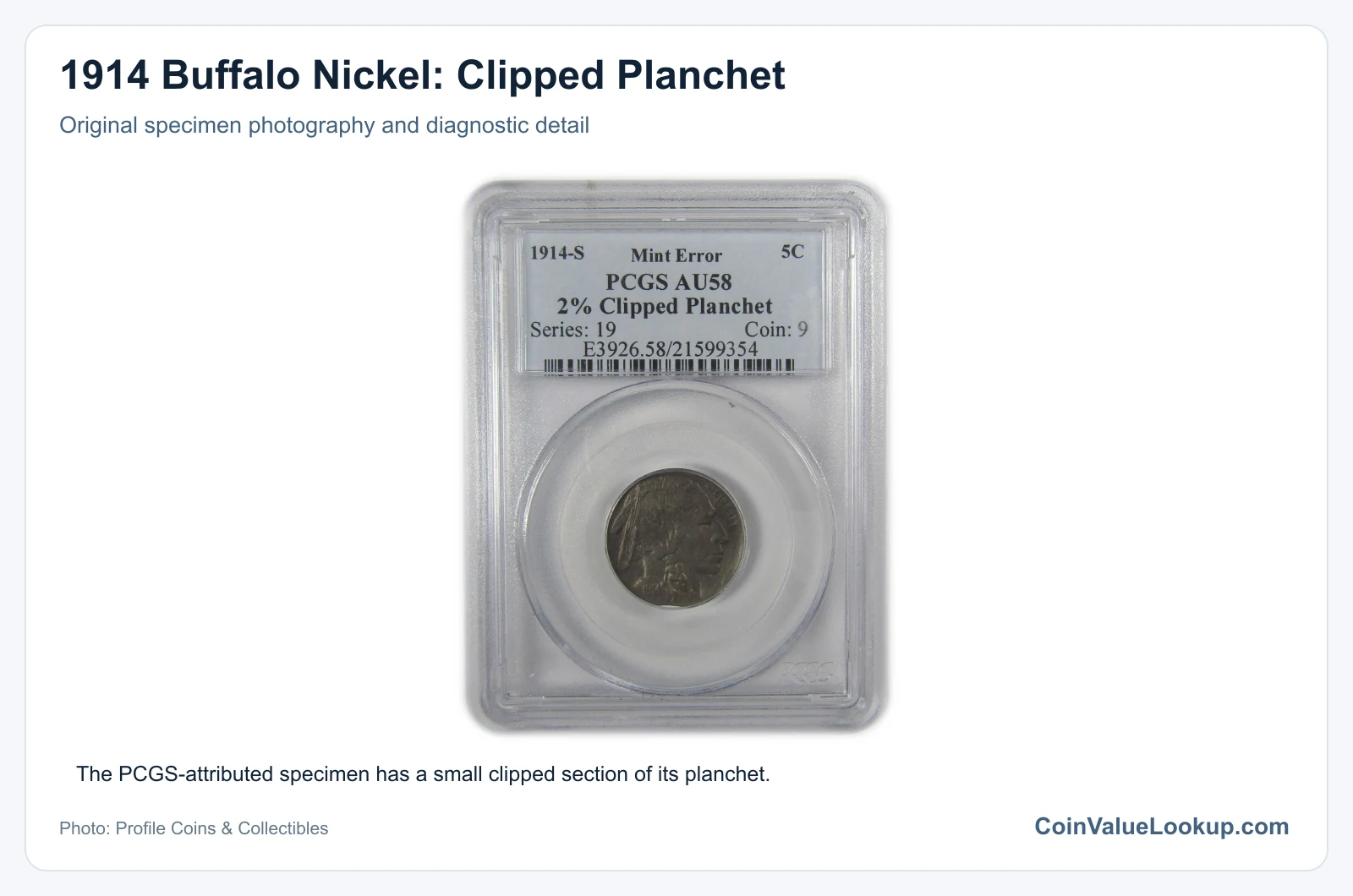
A clipped planchet means the coin blank was incompletely punched from the metal strip before striking. On a 1914-D Buffalo Nickel, this has been reported as a curved clip, where a crescent-shaped section of the rim and design is missing.
Look for a smooth, concave absence along the edge rather than a jagged or filed area. A genuine clip often produces a corresponding area of design weakness on the opposite side of the coin, sometimes called the Blakesley effect.
That opposing weakness helps distinguish a real clip from post-mint damage like someone filing a notch or edge corrosion eating away metal. Condition, clip size, and the overall state of the coin all influence value, so there is no single price to cite.
3. 1914 Buffalo Nickel — Defective Planchet
A defective planchet error means the metal blank itself had a flaw before the coin was struck. On a 1914-S Buffalo Nickel, this has been reported as a void through the blank, meaning an area where metal is missing or severely compromised from the planchet stage.
The struck design typically wraps around or distorts near the void, confirming the flaw was present before the dies impressed the coin. That's your main diagnostic clue.
Post-mint gouges, corrosion holes, or deliberate metal removal will interrupt the design cleanly rather than showing the design flowing into and around the defect. Photograph both faces and the edge near the flaw.
Value varies with severity and coin condition.
4. 1914 Buffalo Nickel — Repunched Mintmark
A repunched mintmark on a 1914-S Buffalo Nickel means the S was impressed into the working die more than once in slightly different positions. Under magnification you'll see remnants of an earlier S impression, a shadow or partial outline offset from the final mintmark.
Compare your coin's S to a normal 1914-S at the same magnification. The extra impression should be consistent and die-produced, not just fuzzy edges.
Machine doubling creates a flat, shelf-like appearance, while die chips add irregular lumps of metal. Corrosion around the mintmark can also mimic doubling to the untrained eye.
A clear, well-lit photo of the mintmark area is the starting point for any attribution. Value depends on the strength of the repunching and the coin's overall grade.