1914 Wheat Penny Coin Value: How Much Is It Worth?
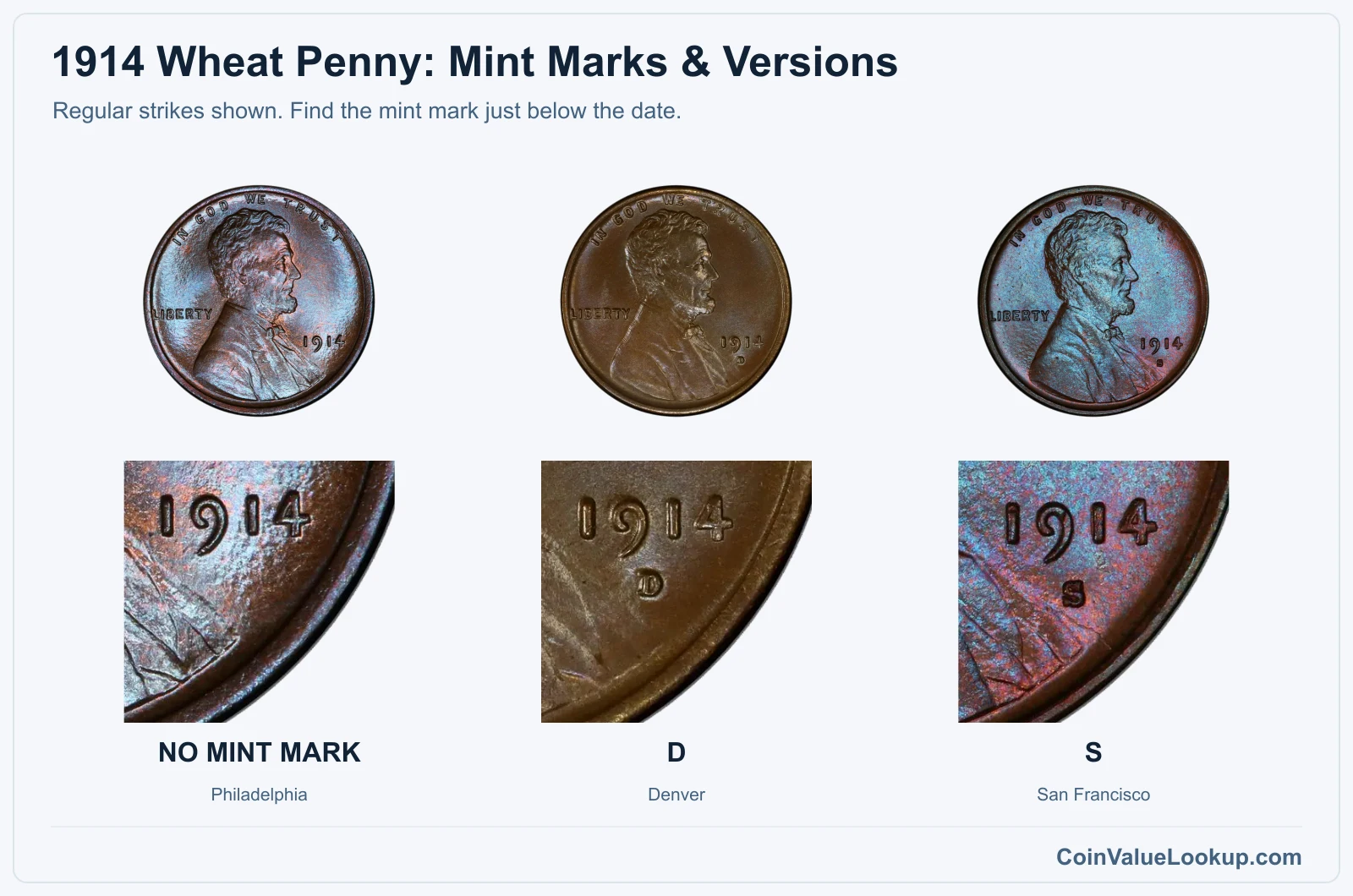
A 1914 Wheat Penny can be worth anywhere from about $1.24 in well-worn Good-4 condition up to $3,634 at the MS63 grade level, depending on which mint struck it. Proofs, major varieties and error coins are priced separately.
Original surfaces, wear and color all affect what a buyer will actually pay.
Fast Way to Identify Your 1914 Wheat Penny
Want a quick read on your 1914 penny? Upload clear photos of the front and back, and our identifier can give you a preliminary idea of which mint and version you have.
Good lighting and a close-up of the area below the date are especially helpful for spotting mintmarks and any unusual features.
1914 Wheat Penny Value
Upload both sides of your 1914 Wheat Penny.
Front Obverse
Upload photo
Back Reverse
Upload photo
Which 1914 Wheat Penny Versions Are Worth Money?
- The 1914-D business strike is the key date of this year, with guide values from about $207 in G4 to $3,634 at MS63. Authentication is critical because altered coins are common.
- The 1914-S carries a solid premium, with guide estimates around $21 in G4 and $612 in MS63.
- The 1914 Philadelphia matte proof is a separate collectible, estimated near $825 at PR63.
- The plain 1914 Philadelphia business strike is the most affordable starting point, from about $1.24 in G4 to $100 at MS63.
- Collectible errors such as off-center strikes, doubled dies or repunched mintmarks can add value, assessed individually by severity and authentication.
Step 1: Identify Your 1914 Wheat Penny Mint Mark and Version
Start by flipping the coin to the back. You should see two wheat ears framing the words ONE CENT.
That confirms it is a Wheat reverse Lincoln cent, the standard design running from 1909 through 1958.
Now check just below the date on the front. A small "D" means Denver, an "S" means San Francisco, and no letter at all means Philadelphia.
This single detail is the biggest driver of value for 1914 pennies.
The 1914-D is a genuine key date in the Lincoln cent series. Because of that, fakes exist.
The most common trick is taking a 1944-D penny and carefully removing part of the first "4" to make it look like a "1," producing a fake 1914-D. Others simply add a "D" mintmark to an authentic 1914 Philadelphia coin.
If you think you have a 1914-D, compare the date spacing and the mintmark position against a known genuine example before celebrating.
The Philadelphia mint also produced matte proof cents in 1914. These have a distinctive prepared surface with squared rims and ultra-sharp detail, quite different from a normal well-struck business coin.
A shiny, lustrous coin is not a matte proof.
All business-strike versions weigh about 3.11 grams, are struck in 95% copper with 5% tin and zinc, and have a plain edge.
Step 2: Check Your 1914 Wheat Penny Grade
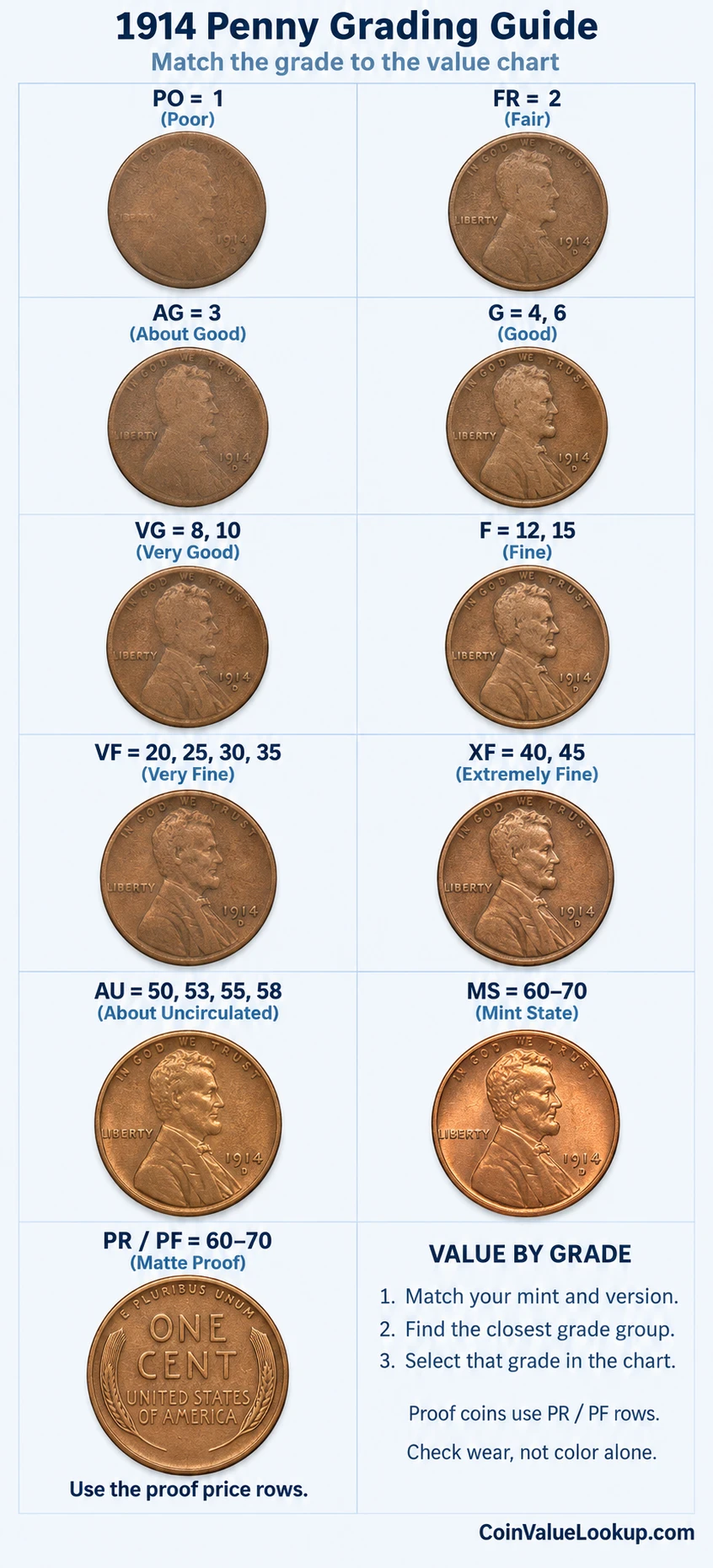
Look at Lincoln's cheekbone, jawline and the fine hair strands above his ear. These are the first areas to lose detail as a coin circulates.
A coin grading Good-4 will show a smooth, mostly flat portrait but a complete outline and readable date.
Flip it over. The wheat stalks should show individual grain lines and separation between the inner and outer lines on higher-grade pieces.
As wear increases, those lines merge and eventually vanish.
A weak strike can mimic wear, so check the surrounding luster. A coin that never circulated but was softly struck will still show cartwheel luster in the fields.
A worn coin will not.
Color matters separately from grade. Red, red-brown and brown are distinct value tiers at the Mint State level, but the guide prices referenced here do not specify color.
Do not assume a listed MS63 price automatically reflects a full-red coin.
Use the comparison image to match your coin's high-point detail against known grade benchmarks. Spots, cleaning and corrosion each reduce appeal regardless of the technical wear grade.
Step 3: Check 1914 Wheat Penny Value by Mint and Version
1914 Wheat Penny
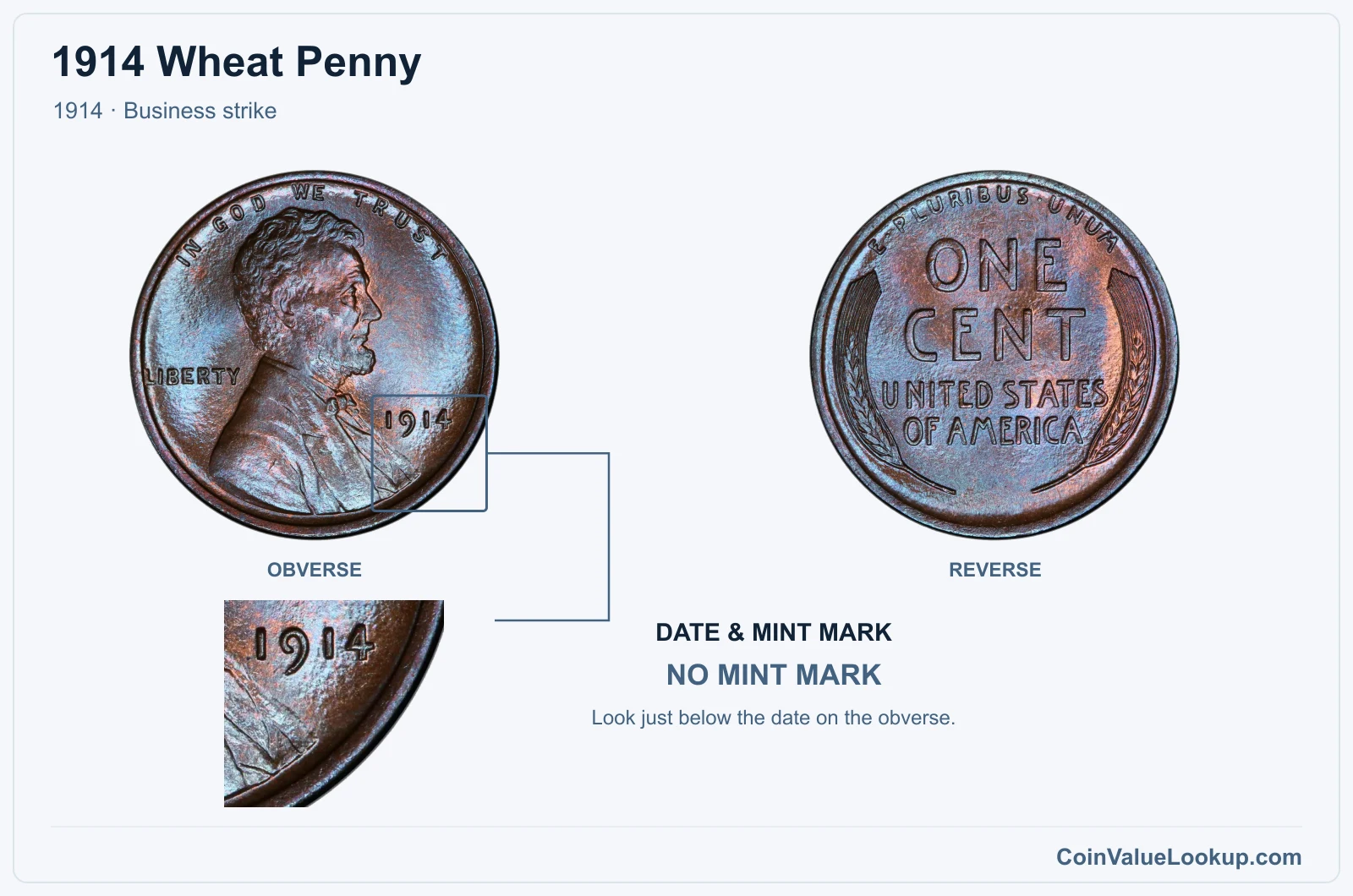
The 1914 Philadelphia business strike carries no mintmark below the date. It is the most common of the three business-strike mints for this year.
Guide estimates place a well-worn G4 example around $1.24 and an MS63 coin near $100.
Look for original brown or red-brown surfaces without cleaning. Even at modest grades, a problem-free example holds steady collector demand.
This is a fine entry point for anyone building a Wheat cent set by date and mint.
| Range | Grade | Price | Auction Records | Appraisal |
|---|---|---|---|---|
| PO | PO 1 | — | Coin Identifier | |
| FR | FR 2 | — | Coin Identifier | |
| AG | AG 3 | — | Coin Identifier | |
| G | G 4 | — | Coin Identifier | |
| G 6 | — | Coin Identifier | ||
| VG | VG 8 | — | Coin Identifier | |
| VG 10 | — | Coin Identifier | ||
| F | F 12 | Coin Identifier | ||
| F 15 | — | Coin Identifier | ||
| VF | VF 20 | Coin Identifier | ||
| VF 25 | — | Coin Identifier | ||
| VF 30 | — | Coin Identifier | ||
| VF 35 | — | Coin Identifier | ||
| XF | XF 40 | Coin Identifier | ||
| XF 45 | Coin Identifier | |||
| AU | AU 50 | Coin Identifier | ||
| AU 53 | Coin Identifier | |||
| AU 55 | Coin Identifier | |||
| AU 58 | Coin Identifier | |||
| MS | MS 60 | — | Coin Identifier | |
| MS 61 | — | Coin Identifier | ||
| MS 62 | Coin Identifier | |||
| MS 63 | Coin Identifier | |||
| MS 64 | Coin Identifier | |||
| MS 65 | Coin Identifier | |||
| MS 66 | Coin Identifier | |||
| MS 67 | — | — | — | |
| MS 68 | — | — | — | |
| MS 69 | — | — | — | |
| MS 70 | — | — | — |
1914 Wheat Penny — D
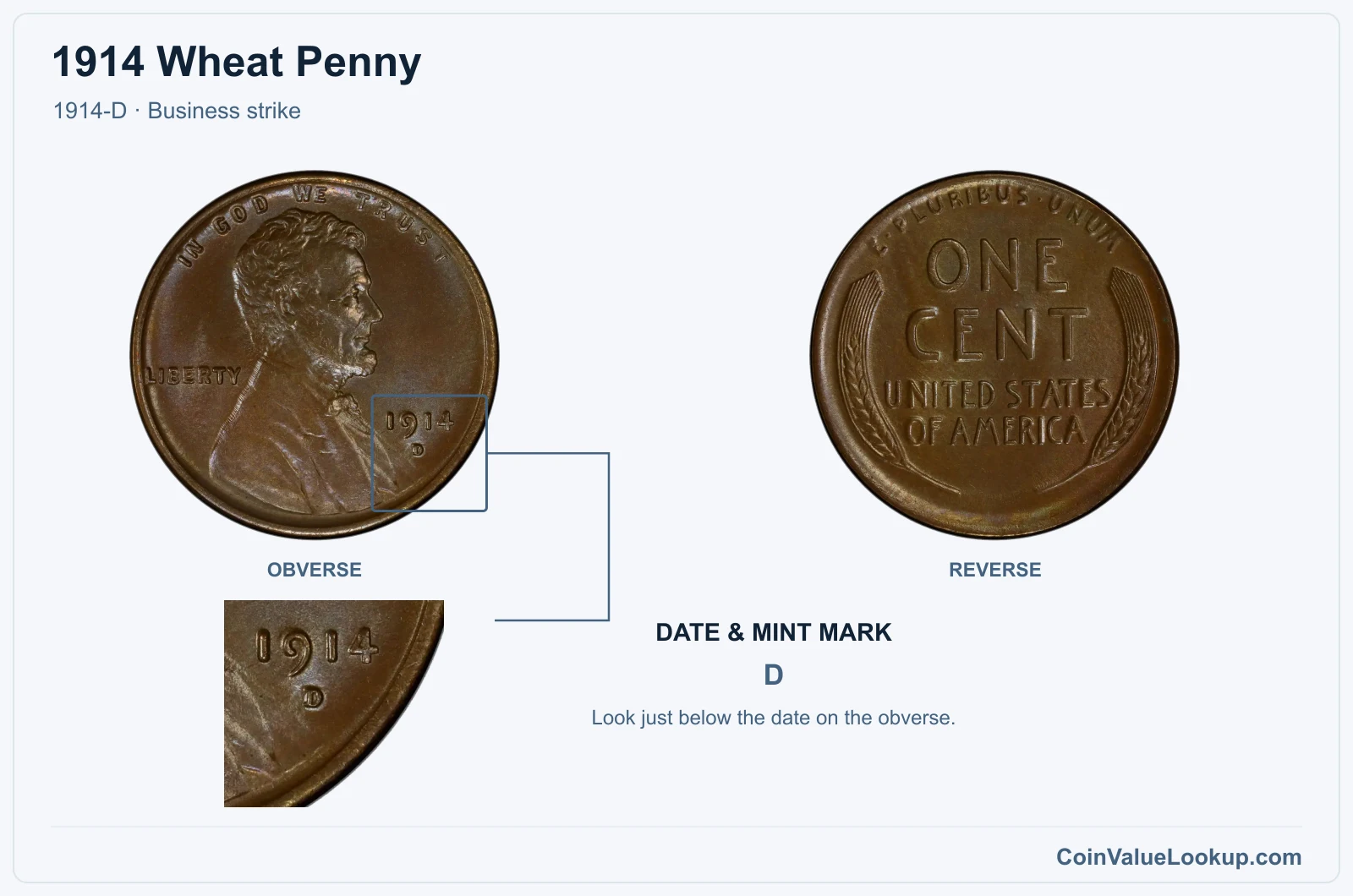
The 1914-D is the coin everyone wants to own from this date. Denver struck far fewer cents than Philadelphia, and survival rates in higher grades are low, which is exactly why this is a recognized key date in the entire Lincoln cent series.
Guide estimates run from about $207 at G4 all the way to $3,634 at MS63. Those numbers explain why counterfeits and alterations are so prevalent.
The most dangerous fake starts with a genuine 1944-D cent, with part of the first "4" tooled away to mimic a "1." Others add a "D" to a real 1914 Philadelphia coin. Always compare the mintmark style, position and the spacing of the date digits against a confirmed genuine example.
Third-party authentication is strongly recommended for any 1914-D purchase or sale.
Coin Value Lookup is a useful starting point when you want to look up guide values for key-date coins like this one before deciding whether professional certification makes sense.
| Range | Grade | Price | Auction Records | Appraisal |
|---|---|---|---|---|
| PO | PO 1 | — | Coin Identifier | |
| FR | FR 2 | Coin Identifier | ||
| AG | AG 3 | Coin Identifier | ||
| G | G 4 | Coin Identifier | ||
| G 6 | Coin Identifier | |||
| VG | VG 8 | Coin Identifier | ||
| VG 10 | Coin Identifier | |||
| F | F 12 | Coin Identifier | ||
| F 15 | Coin Identifier | |||
| VF | VF 20 | Coin Identifier | ||
| VF 25 | Coin Identifier | |||
| VF 30 | Coin Identifier | |||
| VF 35 | Coin Identifier | |||
| XF | XF 40 | Coin Identifier | ||
| XF 45 | Coin Identifier | |||
| AU | AU 50 | Coin Identifier | ||
| AU 53 | Coin Identifier | |||
| AU 55 | Coin Identifier | |||
| AU 58 | Coin Identifier | |||
| MS | MS 60 | Coin Identifier | ||
| MS 61 | Coin Identifier | |||
| MS 62 | Coin Identifier | |||
| MS 63 | Coin Identifier | |||
| MS 64 | Coin Identifier | |||
| MS 65 | Coin Identifier | |||
| MS 66 | Coin Identifier | |||
| MS 67 | — | — | — | |
| MS 68 | — | — | — | |
| MS 69 | — | — | — | |
| MS 70 | — | — | — |
1914 Wheat Penny — S
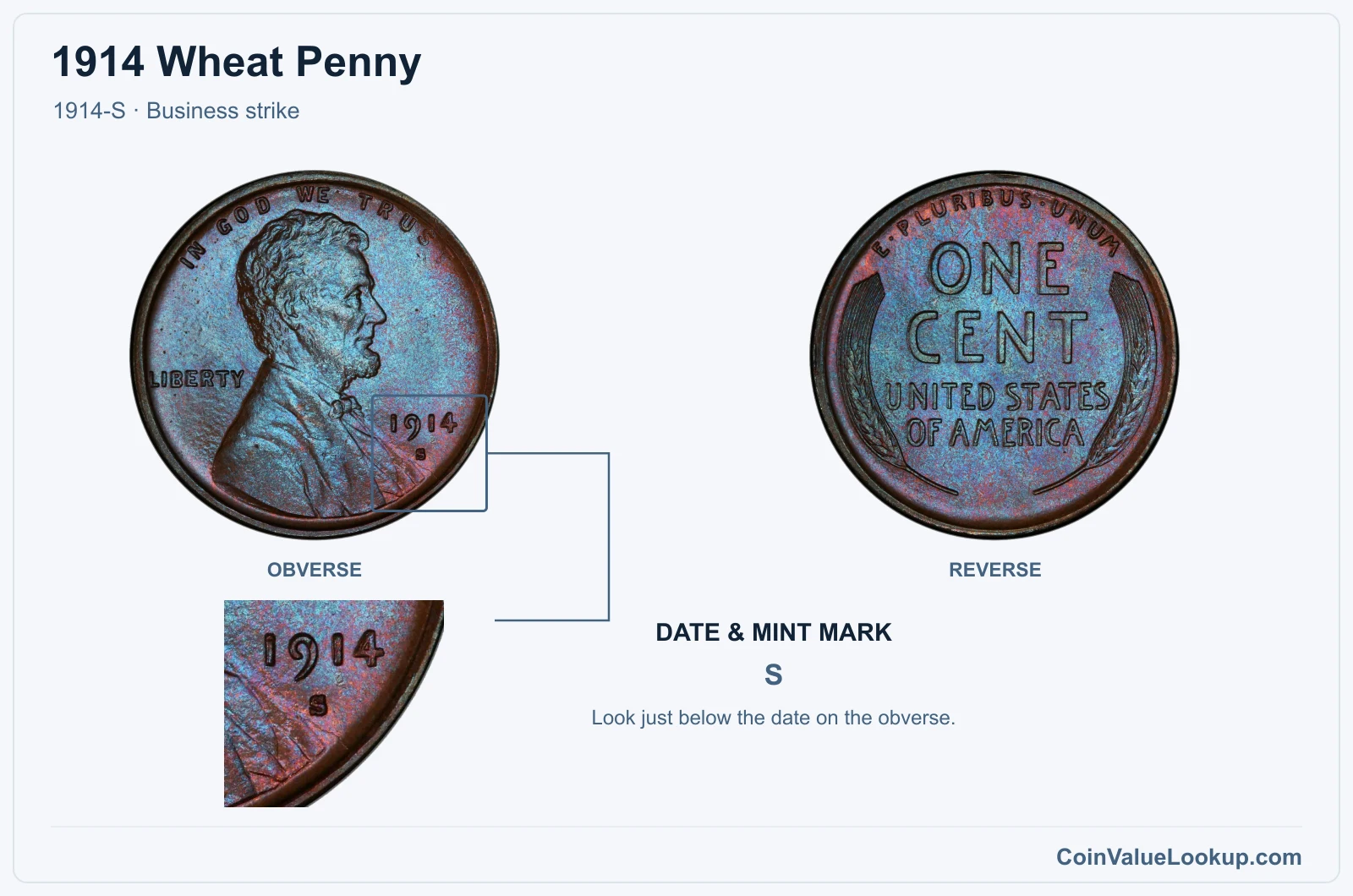
The 1914-S carries a small "S" mintmark below the date. San Francisco cents from this era are generally scarcer than Philadelphia issues, and the 1914-S reflects that with guide estimates of roughly $21 at G4 and $612 at MS63.
While overshadowed by its Denver sibling, the 1914-S is a solid semi-key coin. Original surfaces without corrosion or cleaning make the biggest difference in desirability.
Check that the "S" mintmark looks natural and matches the style used on other confirmed 1914-S cents.
| Range | Grade | Price | Auction Records | Appraisal |
|---|---|---|---|---|
| PO | PO 1 | — | Coin Identifier | |
| FR | FR 2 | — | Coin Identifier | |
| AG | AG 3 | — | Coin Identifier | |
| G | G 4 | — | Coin Identifier | |
| G 6 | — | Coin Identifier | ||
| VG | VG 8 | — | Coin Identifier | |
| VG 10 | Coin Identifier | |||
| F | F 12 | — | Coin Identifier | |
| F 15 | — | Coin Identifier | ||
| VF | VF 20 | Coin Identifier | ||
| VF 25 | Coin Identifier | |||
| VF 30 | Coin Identifier | |||
| VF 35 | Coin Identifier | |||
| XF | XF 40 | Coin Identifier | ||
| XF 45 | Coin Identifier | |||
| AU | AU 50 | Coin Identifier | ||
| AU 53 | Coin Identifier | |||
| AU 55 | Coin Identifier | |||
| AU 58 | Coin Identifier | |||
| MS | MS 60 | — | Coin Identifier | |
| MS 61 | Coin Identifier | |||
| MS 62 | Coin Identifier | |||
| MS 63 | Coin Identifier | |||
| MS 64 | Coin Identifier | |||
| MS 65 | Coin Identifier | |||
| MS 66 | — | Coin Identifier | ||
| MS 67 | — | — | — | |
| MS 68 | — | — | — | |
| MS 69 | — | — | — | |
| MS 70 | — | — | — |
1914 Wheat Penny — PR
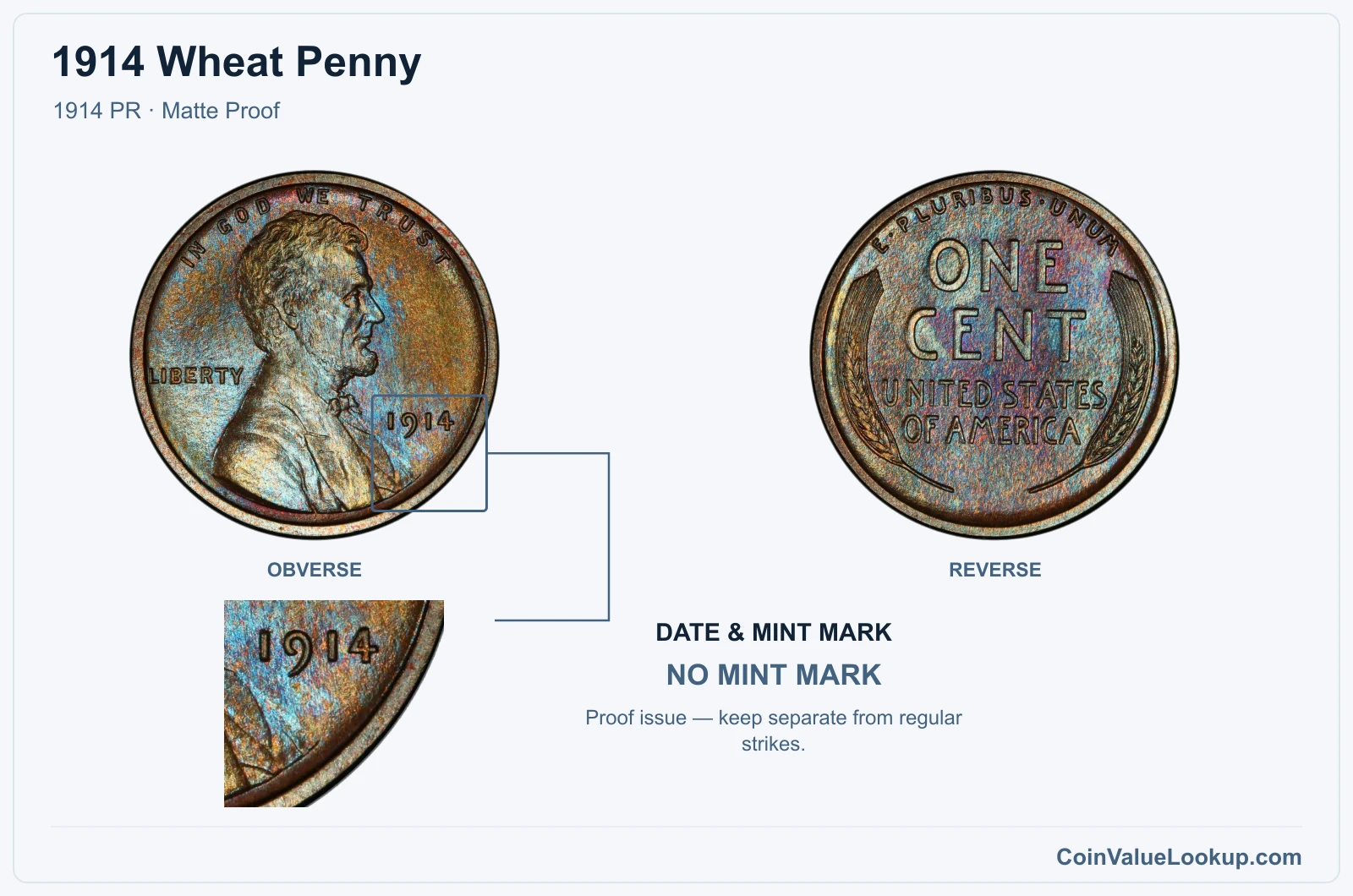
Philadelphia also produced matte proof Lincoln cents in 1914, continuing a special proof format that ran from 1909 through 1916. These are fundamentally different from the brilliant mirror-finish proofs of later decades.
A genuine matte proof has a granular, prepared surface with sharply squared rims and exceptionally precise design detail. It will not show the cartwheel luster of a regular business strike.
The guide estimate for a PR63 example is about $825.
Do not assume a well-struck, attractive business coin is a proof. The matte finish and rim profile are specific diagnostics.
Certification by a major grading service is the safest way to confirm matte proof status.
| Range | Grade | Price | Auction Records | Appraisal |
|---|---|---|---|---|
| PR | PR 1 | — | Coin Identifier | |
| PR 2 | — | Coin Identifier | ||
| PR 3 | — | Coin Identifier | ||
| PR 4 | — | Coin Identifier | ||
| PR 6 | — | Coin Identifier | ||
| PR 8 | — | Coin Identifier | ||
| PR 10 | — | Coin Identifier | ||
| PR 12 | — | Coin Identifier | ||
| PR 15 | — | Coin Identifier | ||
| PR 20 | — | Coin Identifier | ||
| PR 25 | — | Coin Identifier | ||
| PR 30 | — | Coin Identifier | ||
| PR 35 | — | Coin Identifier | ||
| PR 40 | — | Coin Identifier | ||
| PR 45 | — | Coin Identifier | ||
| PR 50 | — | Coin Identifier | ||
| PR 53 | — | Coin Identifier | ||
| PR 55 | — | Coin Identifier | ||
| PR 58 | — | Coin Identifier | ||
| PR 60 | — | Coin Identifier | ||
| PR 61 | Coin Identifier | |||
| PR 62 | Coin Identifier | |||
| PR 63 | Coin Identifier | |||
| PR 64 | Coin Identifier | |||
| PR 65 | Coin Identifier | |||
| PR 66 | Coin Identifier | |||
| PR 67 | Coin Identifier | |||
| PR 68 | — | — | — | |
| PR 69 | — | — | — | |
| PR 70 | — | — | — |
1914 Wheat Penny Error List
1. 1914 Wheat Penny — Die Crack / Die Chip
A die crack shows up as a thin, raised line running across the coin's surface, created when the steel die itself developed a fracture during use. A die chip is a small raised blob where a piece of the die broke away.
Both are genuine mint-made features baked into the coin at the moment of striking.
To confirm, run your finger lightly across the line. A die crack is raised; a scratch is incuse.
Foreign material or corrosion can also mimic a small chip, so check under magnification. A crack that reaches the rim and produces a raised blob of extra metal is sometimes called a cud, which tends to attract more collector interest.
Pricing depends on the size, location and visual drama of the crack or chip, as well as the coin's overall grade. Each piece is assessed individually.
2. 1914 Wheat Penny — Clipped Planchet
A clipped planchet error occurs when the blank was improperly cut from the copper strip before striking. The result is a coin missing a curved, straight or irregularly shaped section of its edge.
Look at the area opposite the clip. Genuine clips often produce a slight weakness in the design there because the metal could not flow fully during striking.
The edge at the clip itself should show the natural texture of the original blank, not a sharp cut or file marks.
Post-mint damage like filing, cutting or heavy corrosion can remove metal and look superficially similar. If the missing area has sharp, bright edges or tool marks, it was likely done after the coin left the mint.
Value depends on the size and type of clip, the coin's grade and authenticated identity.
3. 1914 Wheat Penny — Repunched Mintmark
A repunched mintmark appears on Denver or San Francisco issues only, since Philadelphia coins carry no mintmark to repunch. It happens when the mintmark punch was applied more than once in slightly different positions, leaving traces of the earlier impression.
Under magnification, look for a ghost or partial outline of the letter near the primary mintmark. The remnant should have the same style and shape as the main letter, just offset.
Machine doubling can produce a flat shelf next to the mintmark that looks similar but lacks the rounded, distinct profile of a true repunched impression. Die chips or corrosion around the letter can also confuse things.
Given the high value of the 1914-D, any claimed variety on that mint deserves careful comparison to authenticated examples. Pricing is assessed individually based on the variety, its visibility and the coin's condition.
4. 1914 Wheat Penny — Lamination / Split Planchet
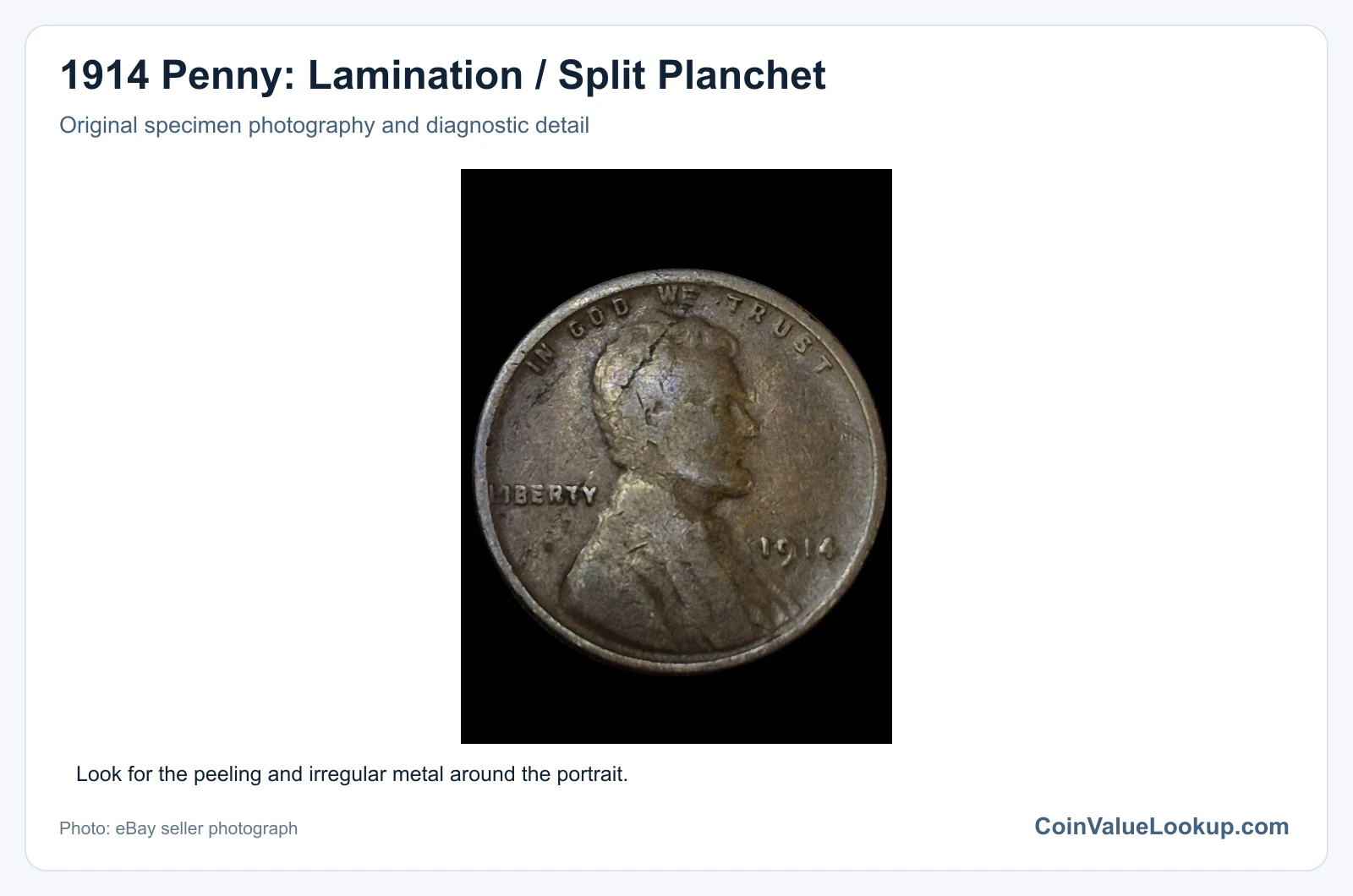
Lamination errors result from impurities or gas trapped within the copper alloy during manufacture. The defect shows up as peeling, flaking or separated layers of metal on one or both faces of the coin.
Look for a retained flap of metal still attached to the surface, or a void where a flap has broken away and exposed a different texture beneath. Photograph the edge of the coin alongside the affected face to document the separation.
Corrosion can eat into a coin's surface and mimic a lamination, and deliberate scraping or cutting can peel metal artificially. A genuine lamination follows the natural plane of the alloy and typically has smooth, rounded edges where the separation occurred.
Value depends on severity, location and the coin's authenticated identity and grade.
5. 1914 Wheat Penny — Off-Center Strike
An off-center strike happens when the planchet is not seated properly between the dies. The result is a design shifted to one side with a blank crescent of unstruck metal on the opposite side.
The most collectible off-center errors still show a complete, readable date. Without the date, the coin cannot be attributed to a specific year, which sharply reduces its appeal.
A small percentage off-center is less dramatic; coins struck 10% to 50% off-center with a visible date tend to draw the most interest.
Do not confuse a clipped planchet or post-mint flattening with a genuine off-center strike. On a true off-center coin, the entire design is displaced in one direction, and the blank crescent is smooth and undetailed.
Pricing is assessed individually by the degree of displacement, date visibility and overall condition.
6. 1914 Wheat Penny — Doubled Die Obverse
A doubled die obverse is created during die manufacture when a working hub impresses the die more than once at slightly different angles. The result is consistent doubling visible on every coin struck by that die, typically showing separation or notching on letters, the date or design elements.
Compare the obverse lettering of your coin with a normal 1914 cent under the same magnification and lighting. True hub doubling produces rounded, distinct secondary images.
Machine doubling, which happens during the striking process rather than die making, creates a flat, shelf-like distortion that lacks depth.
Reflections and worn die contours can also fool the eye. If doubling appears only under certain lighting angles and vanishes when you tilt the coin, be cautious.
Value is assessed individually based on the strength of the doubling, its location and the coin's authenticated grade.
7. 1914 Wheat Penny — Clashed Dies
Clashed dies occur when the obverse and reverse dies strike each other without a planchet between them. The impact transfers faint traces of one die's design onto the face of the other.
On a 1914 Wheat cent, you might see ghostly outlines of wheat stalks on the obverse or hints of Lincoln's portrait on the reverse.
These transferred images should align with where the opposite design would be if the coin were between the dies. Random scratches, raised lines from die polish or a brockage impression from a previously struck coin can mimic a clash but will not match the expected opposing design.
Clash marks are usually subtle and best viewed under low-angle light. Pricing depends on how visible and dramatic the transferred design is, along with the coin's overall grade and authenticated identity.