1913 Wheat Penny Coin Value: How Much Is It Worth?
A 1913 Wheat Penny can range from about $1.24 in well-worn Good-4 condition up to $376 at MS63 for the San Francisco issue, depending on which mint struck your coin. Those are guide estimates for ordinary circulation strikes.
Proofs, major varieties, and error coins sit outside that range. Original surfaces, wear level, and color all affect what a buyer will actually pay.
Fast Way to Identify Your 1913 Wheat Penny
The quickest way to start figuring out what you have is to upload clear photos of both the front and back of your 1913 cent. Our identifier can give you a preliminary read on the mint, design type, and general condition.
Snap the photos in even lighting so the mintmark area below the date is sharp and legible.
1913 Wheat Penny Value
Upload both sides of your 1913 Wheat Penny.
Front Obverse
Upload photo
Back Reverse
Upload photo
Which 1913 Wheat Penny Versions Are Worth Money?
- The 1913-S carries the highest ordinary guide values of the three mints, listed at about $12 in G4 and $376 at MS63, making the S mintmark the first thing to check.
- Denver coins (1913-D) also command a solid premium over Philadelphia, with guide values around $3.62 in G4 and $281 at MS63.
- A genuine 1913 Matte Proof, identifiable by its squared rims and prepared surfaces, lists near $825 at PR63 and is a completely different category from business strikes.
- Branch-mint coins with a confirmed repunched mintmark can carry additional collector interest beyond normal values.
- Strong original surfaces and authenticated striking errors like off-center strikes or die breaks add individual premiums that depend on severity and condition.
Step 1: Identify Your 1913 Wheat Penny Mint Mark and Version
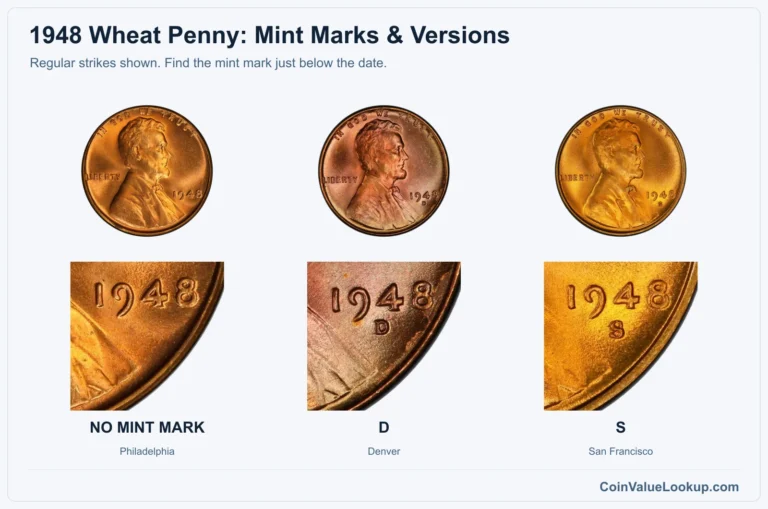
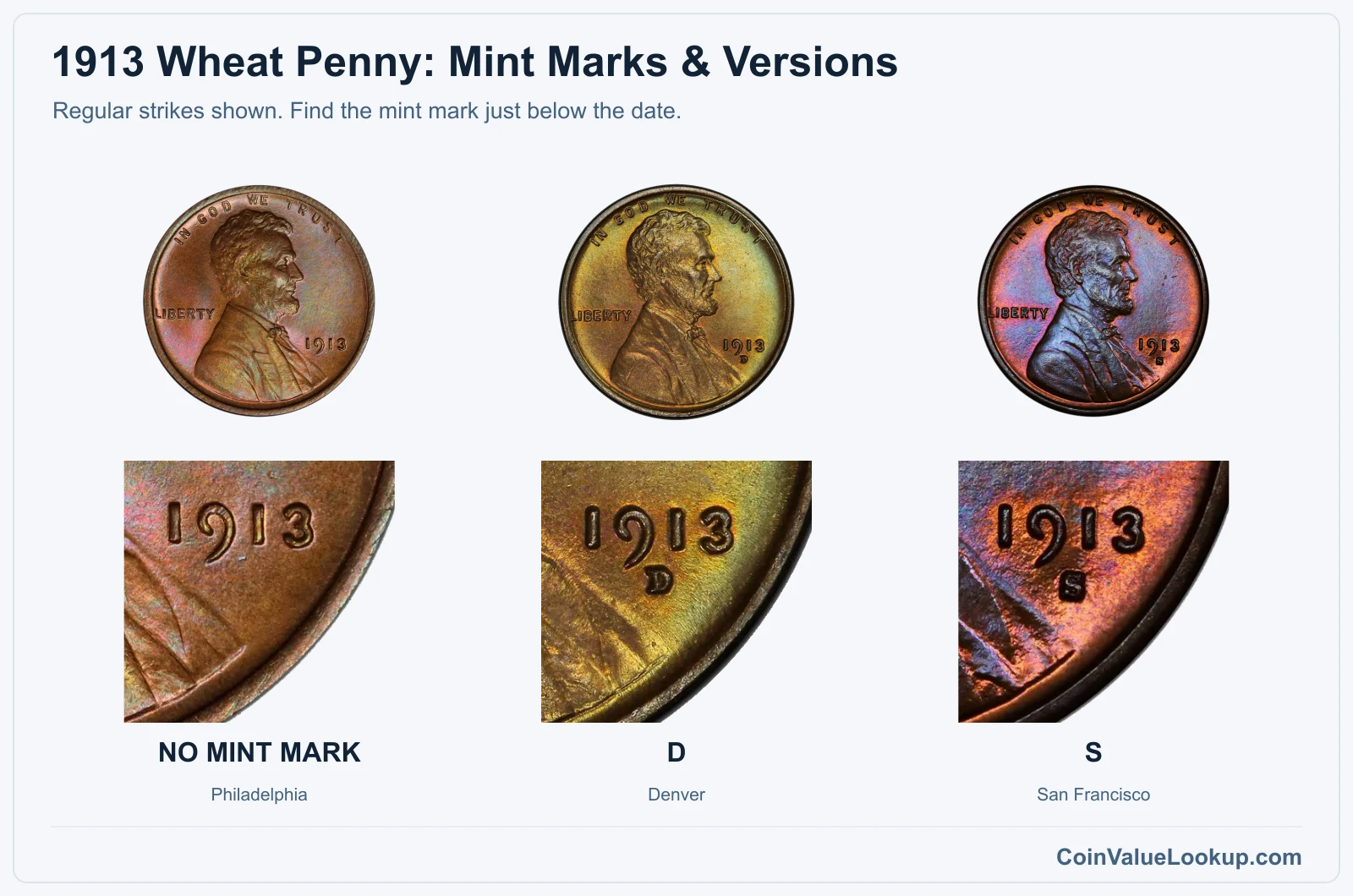
Flip to the obverse first. Below the date you are looking for a small letter: D for Denver, S for San Francisco, or no letter at all for Philadelphia.
That single detail changes the coin's value more than almost anything else on this date.
All three mints struck the same Lincoln portrait obverse paired with the two-ear Wheat reverse. The coin is 95% copper with 5% tin and zinc, weighs approximately 3.11 grams, and has a plain edge.
If your coin is noticeably lighter or doesn't match those specs, you may have a different denomination entirely.
Separating a genuine 1913 Matte Proof from a sharp business strike trips up a lot of people. Matte Proofs have distinctly squared rims and prepared matte surfaces rather than the cartwheel luster you see on a well-preserved circulation coin.
A strong strike alone does not make a proof.
Color descriptions like red, red-brown, or brown describe surface preservation, not grade. Two coins can share the same wear grade yet differ significantly in value because of color.
Step 2: Check Your 1913 Wheat Penny Grade
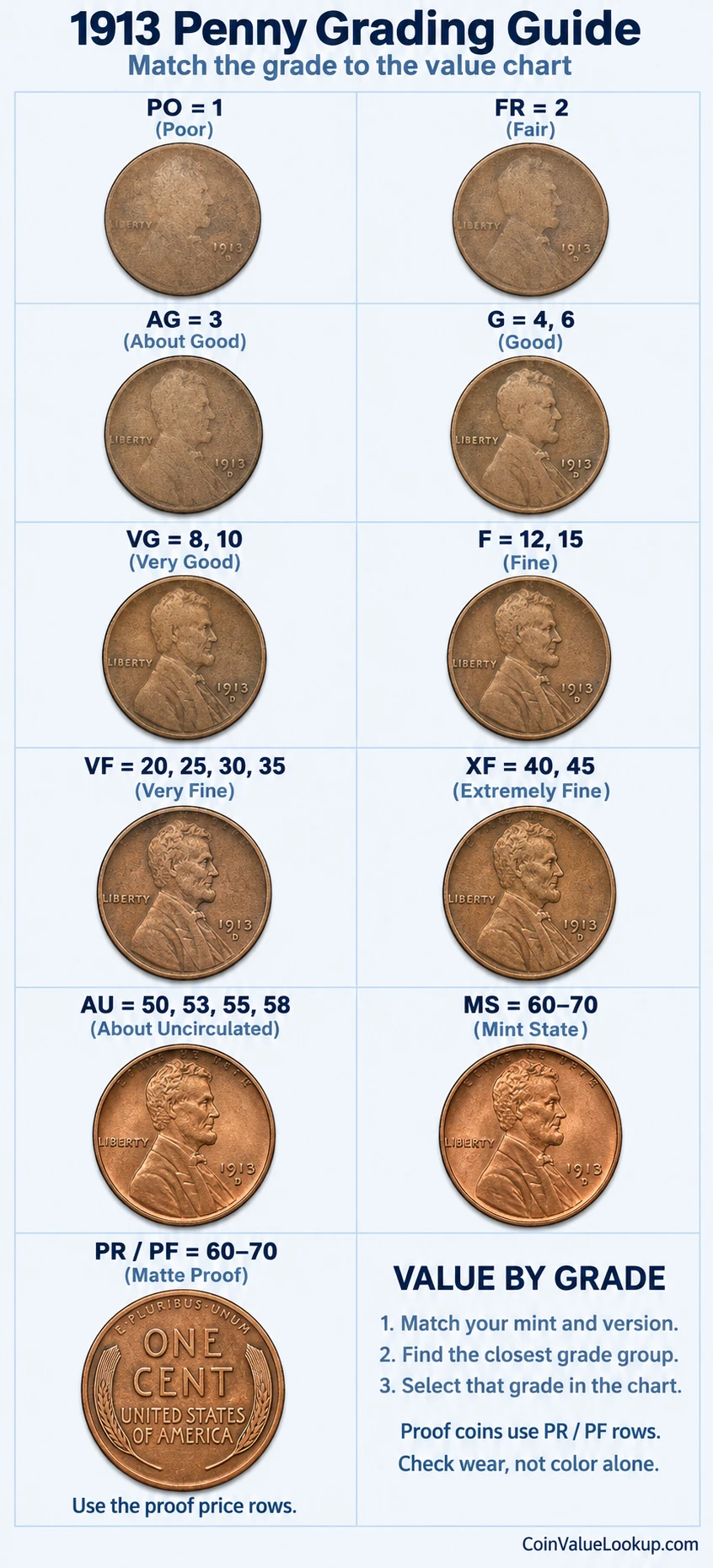
Start with Lincoln's cheekbone, jawline, and the fine hair detail above his ear. These are the highest points on the obverse and the first places circulation wear shows up.
On the reverse, check the individual wheat grains and the horizontal lines between the stalks.
Wear erases those high points gradually, but do not confuse a weak original strike with actual wear. Some 1913 cents left the press with soft detail in spots.
If the surrounding fields still show original luster while one area looks flat, that may be a strike issue rather than a grade issue.
Use the comparison image to match your coin against known wear levels. Look at the overall surface as well: cleaning, corrosion, and spots each reduce collector appeal regardless of the technical grade.
A naturally toned brown coin with honest wear will usually attract more interest than a harshly cleaned example that superficially looks shinier.
Step 3: Check 1913 Wheat Penny Value by Mint and Version
1913 Wheat Penny
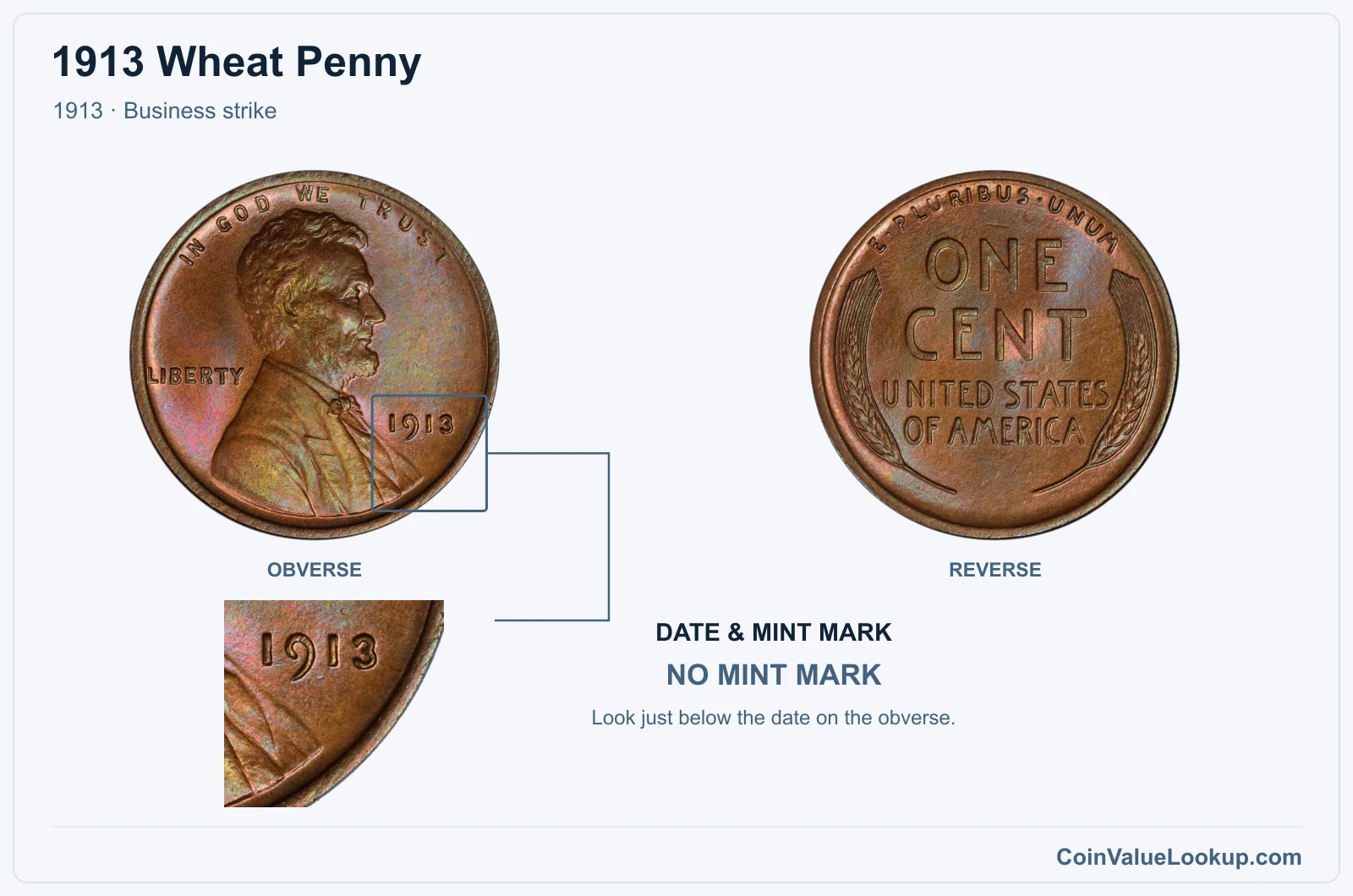
The 1913 Philadelphia cent has no mintmark below the date. It is the most common of the three mints for this year, with guide values running about $1.24 in Good-4 up to roughly $81 at MS63.
Those figures assume an ordinary circulation strike with original surfaces. Cleaned or corroded coins will fall below guide estimates even if the wear grade technically matches.
Color is not specified in these guide figures, so do not assume they reflect a full-red designation.
| Range | Grade | Price | Auction Records | Appraisal |
|---|---|---|---|---|
| PO | PO 1 | — | Coin Identifier | |
| FR | FR 2 | — | Coin Identifier | |
| AG | AG 3 | — | Coin Identifier | |
| G | G 4 | — | Coin Identifier | |
| G 6 | — | Coin Identifier | ||
| VG | VG 8 | — | Coin Identifier | |
| VG 10 | — | Coin Identifier | ||
| F | F 12 | — | Coin Identifier | |
| F 15 | — | Coin Identifier | ||
| VF | VF 20 | — | Coin Identifier | |
| VF 25 | — | Coin Identifier | ||
| VF 30 | — | Coin Identifier | ||
| VF 35 | — | Coin Identifier | ||
| XF | XF 40 | — | Coin Identifier | |
| XF 45 | — | Coin Identifier | ||
| AU | AU 50 | — | Coin Identifier | |
| AU 53 | — | Coin Identifier | ||
| AU 55 | Coin Identifier | |||
| AU 58 | Coin Identifier | |||
| MS | MS 60 | — | Coin Identifier | |
| MS 61 | — | Coin Identifier | ||
| MS 62 | Coin Identifier | |||
| MS 63 | Coin Identifier | |||
| MS 64 | Coin Identifier | |||
| MS 65 | Coin Identifier | |||
| MS 66 | — | Coin Identifier | ||
| MS 67 | — | — | — | |
| MS 68 | — | — | — | |
| MS 69 | — | — | — | |
| MS 70 | — | — | — |
1913 Wheat Penny — D
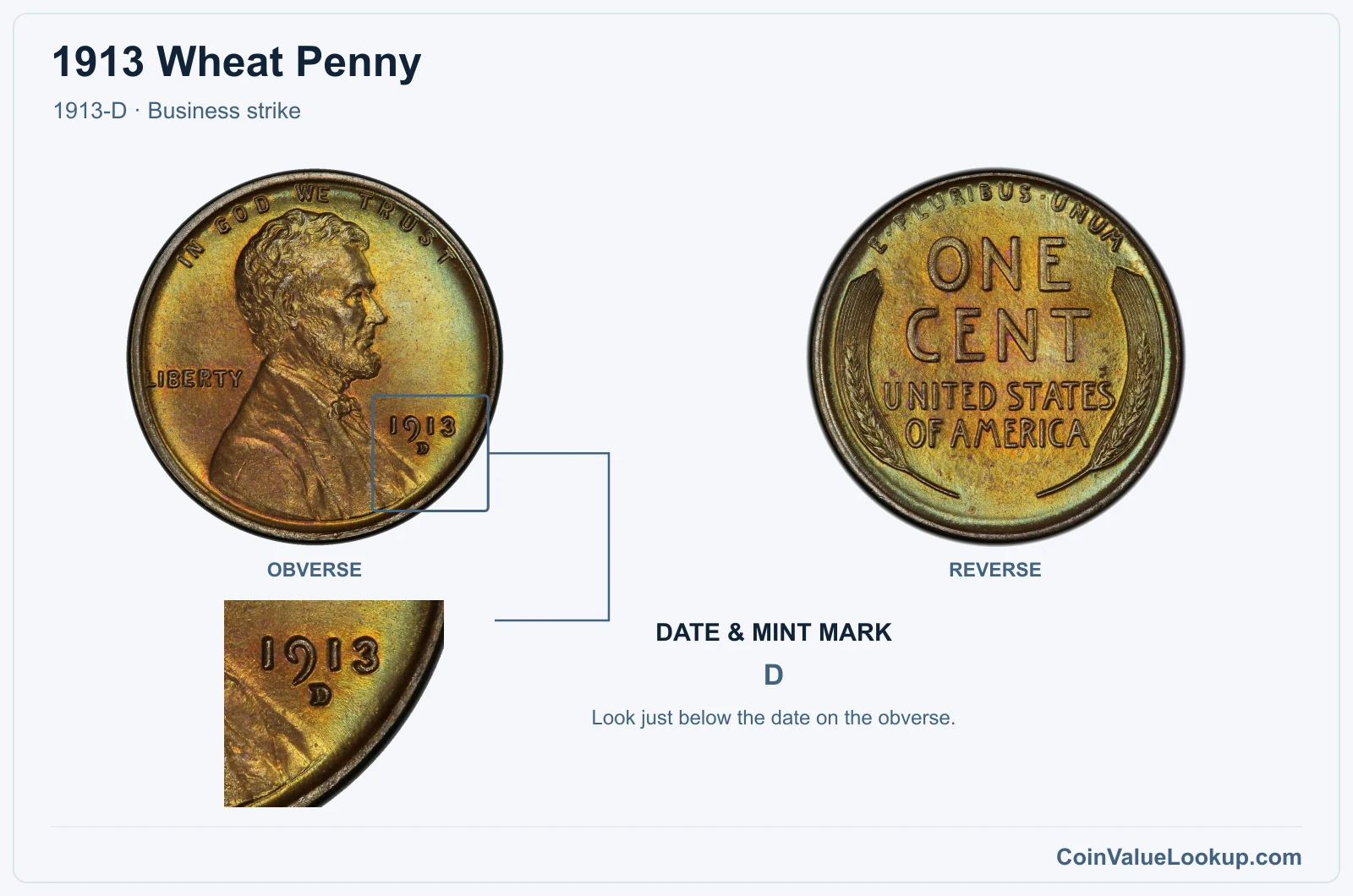
Look for a small D below the date. Denver struck these on the same 95% copper planchets as Philadelphia, but the 1913-D carries a meaningful premium.
Guide values sit around $3.62 in Good-4 and about $281 at MS63.
A well-struck example with original brown or red-brown surfaces in mid-grade is a solid early Lincoln cent. Confirm the D is genuine and not tooled into the field; a real mintmark will sit naturally within the surface texture.
Prices depend on exact condition and surface quality, so use these anchors as a starting reference, not a final number.
| Range | Grade | Price | Auction Records | Appraisal |
|---|---|---|---|---|
| PO | PO 1 | — | Coin Identifier | |
| FR | FR 2 | — | Coin Identifier | |
| AG | AG 3 | — | Coin Identifier | |
| G | G 4 | — | Coin Identifier | |
| G 6 | — | Coin Identifier | ||
| VG | VG 8 | — | Coin Identifier | |
| VG 10 | — | Coin Identifier | ||
| F | F 12 | — | Coin Identifier | |
| F 15 | — | Coin Identifier | ||
| VF | VF 20 | Coin Identifier | ||
| VF 25 | — | Coin Identifier | ||
| VF 30 | — | Coin Identifier | ||
| VF 35 | — | Coin Identifier | ||
| XF | XF 40 | Coin Identifier | ||
| XF 45 | Coin Identifier | |||
| AU | AU 50 | Coin Identifier | ||
| AU 53 | Coin Identifier | |||
| AU 55 | Coin Identifier | |||
| AU 58 | Coin Identifier | |||
| MS | MS 60 | — | Coin Identifier | |
| MS 61 | — | Coin Identifier | ||
| MS 62 | Coin Identifier | |||
| MS 63 | Coin Identifier | |||
| MS 64 | Coin Identifier | |||
| MS 65 | Coin Identifier | |||
| MS 66 | Coin Identifier | |||
| MS 67 | — | — | — | |
| MS 68 | — | — | — | |
| MS 69 | — | — | — | |
| MS 70 | — | — | — |
1913 Wheat Penny — S
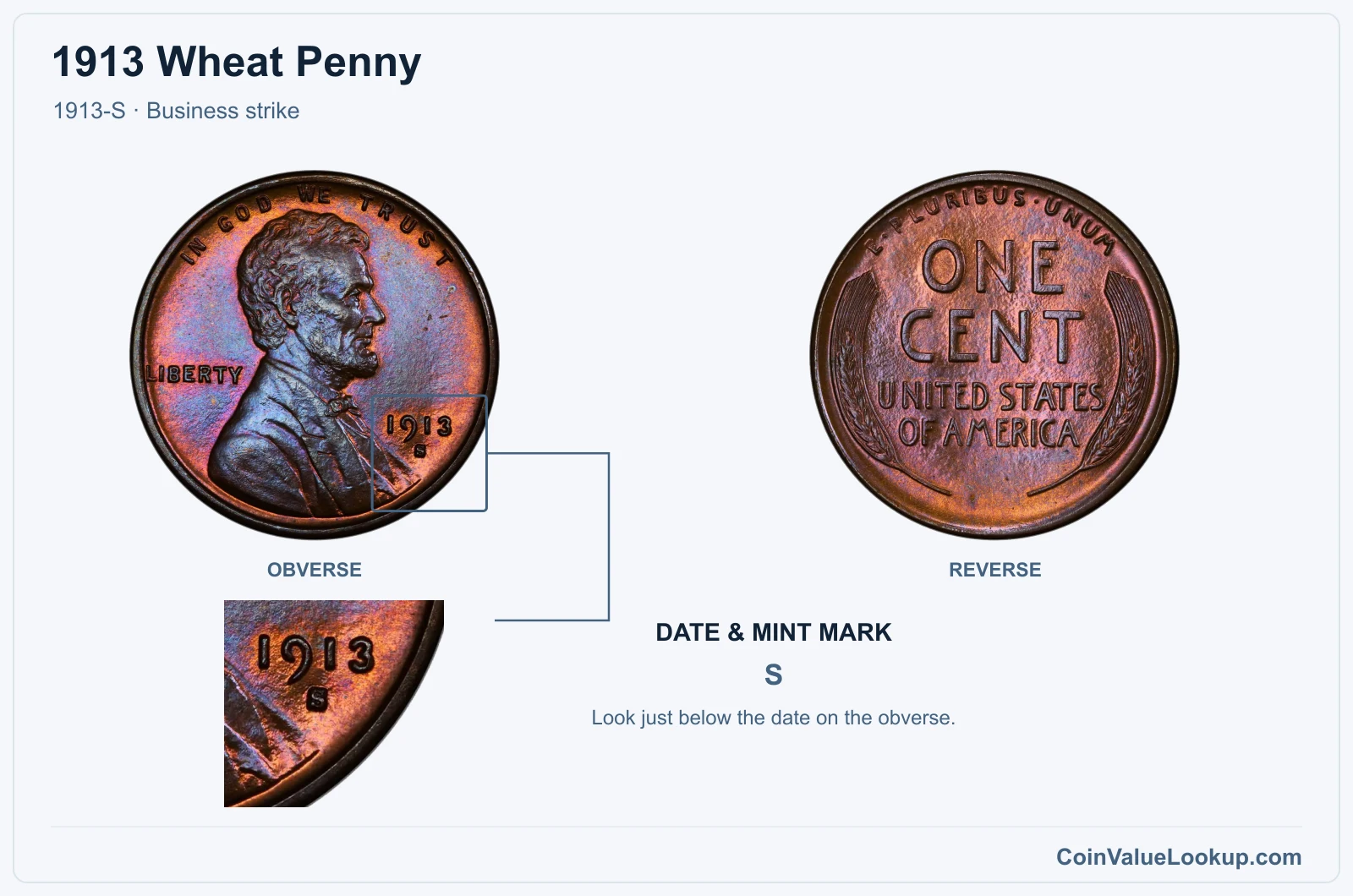
The S mintmark below the date identifies San Francisco production, and this is where the real premium lives for 1913 business strikes. Guide values start around $12 in Good-4 and climb to about $376 at MS63.
That gap between the S and the Philadelphia issue is substantial even in low grades. A legible date and clear S mintmark on a coin with honest wear is still worth checking carefully.
As with the other mints, color and surface quality matter beyond the wear grade alone. Harsh cleaning or environmental damage can cut the realized price well below guide estimates.
Coin Value Lookup is a good starting point if you want to compare values across different years and mints in the Wheat cent series.
| Range | Grade | Price | Auction Records | Appraisal |
|---|---|---|---|---|
| PO | PO 1 | — | Coin Identifier | |
| FR | FR 2 | — | Coin Identifier | |
| AG | AG 3 | — | Coin Identifier | |
| G | G 4 | — | Coin Identifier | |
| G 6 | — | Coin Identifier | ||
| VG | VG 8 | — | Coin Identifier | |
| VG 10 | — | Coin Identifier | ||
| F | F 12 | — | Coin Identifier | |
| F 15 | Coin Identifier | |||
| VF | VF 20 | Coin Identifier | ||
| VF 25 | Coin Identifier | |||
| VF 30 | Coin Identifier | |||
| VF 35 | Coin Identifier | |||
| XF | XF 40 | Coin Identifier | ||
| XF 45 | Coin Identifier | |||
| AU | AU 50 | Coin Identifier | ||
| AU 53 | Coin Identifier | |||
| AU 55 | Coin Identifier | |||
| AU 58 | Coin Identifier | |||
| MS | MS 60 | — | Coin Identifier | |
| MS 61 | Coin Identifier | |||
| MS 62 | Coin Identifier | |||
| MS 63 | Coin Identifier | |||
| MS 64 | Coin Identifier | |||
| MS 65 | Coin Identifier | |||
| MS 66 | Coin Identifier | |||
| MS 67 | — | — | — | |
| MS 68 | — | — | — | |
| MS 69 | — | — | — | |
| MS 70 | — | — | — |
1913 Wheat Penny — PR
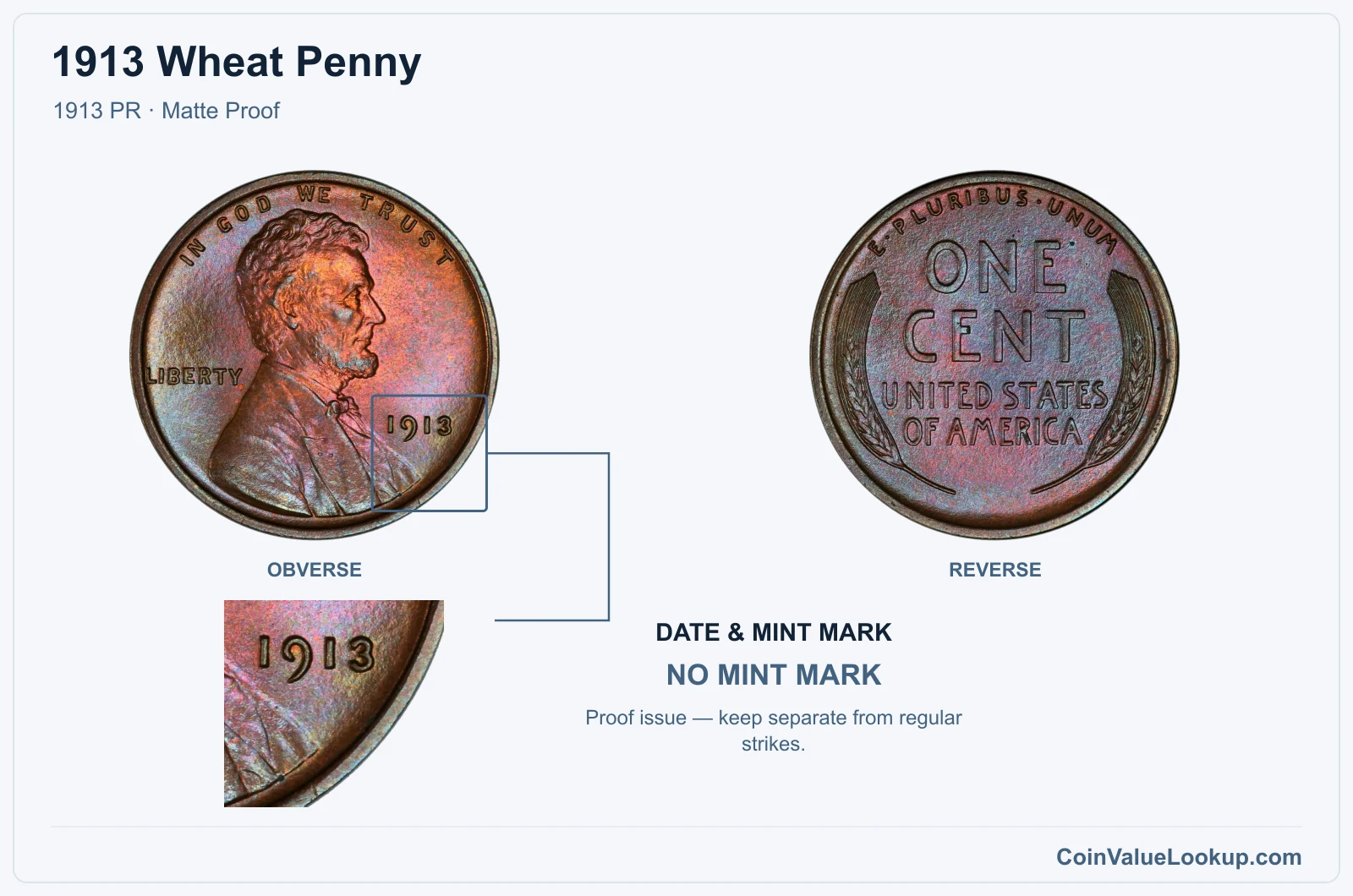
The 1913 Matte Proof was produced at Philadelphia with no mintmark, same as the business strike, but the manufacturing method is entirely different. These were made for collectors using specially prepared dies and planchets that give the surfaces a distinctive granular matte texture rather than the flowing cartwheel luster of a circulation coin.
Key diagnostics: sharp, squared rims and precisely rendered detail across the entire design. A really well-struck business strike can look sharp, but it will not have those squared rims or the characteristic matte surface.
The guide lists approximately $825 at PR63.
Authentication by a major grading service is the practical standard for confirming a matte proof, since the difference from a choice business strike can be subtle in photos.
| Range | Grade | Price | Auction Records | Appraisal |
|---|---|---|---|---|
| PR | PR 1 | — | Coin Identifier | |
| PR 2 | — | Coin Identifier | ||
| PR 3 | — | Coin Identifier | ||
| PR 4 | — | Coin Identifier | ||
| PR 6 | — | Coin Identifier | ||
| PR 8 | — | Coin Identifier | ||
| PR 10 | — | Coin Identifier | ||
| PR 12 | — | Coin Identifier | ||
| PR 15 | — | Coin Identifier | ||
| PR 20 | — | Coin Identifier | ||
| PR 25 | — | Coin Identifier | ||
| PR 30 | — | Coin Identifier | ||
| PR 35 | — | Coin Identifier | ||
| PR 40 | — | Coin Identifier | ||
| PR 45 | — | Coin Identifier | ||
| PR 50 | — | Coin Identifier | ||
| PR 53 | — | Coin Identifier | ||
| PR 55 | — | Coin Identifier | ||
| PR 58 | — | Coin Identifier | ||
| PR 60 | — | Coin Identifier | ||
| PR 61 | — | Coin Identifier | ||
| PR 62 | Coin Identifier | |||
| PR 63 | Coin Identifier | |||
| PR 64 | Coin Identifier | |||
| PR 65 | Coin Identifier | |||
| PR 66 | Coin Identifier | |||
| PR 67 | Coin Identifier | |||
| PR 68 | — | — | — | |
| PR 69 | — | — | — | |
| PR 70 | — | — | — |
1913 Wheat Penny Error List
1. 1913 Wheat Penny — Clipped Planchet
A clipped planchet on a 1913 Wheat cent shows up as a missing section of the coin's edge, which can be curved, straight, or ragged depending on where the blank was cut from the strip. The area directly opposite the clip often shows weakness in the design because metal did not flow fully during striking.
Compare the edge texture carefully. A genuine clip will have a consistent, natural-looking boundary, while a filed notch or post-mint cut will show tool marks or an unnaturally sharp transition.
Corrosion eating away the rim can also mimic a clip at first glance.
Value depends on the size and type of clip, the coin's overall condition, and whether a grading service has authenticated it. No standard price range applies across all examples.
2. 1913 Wheat Penny — Reported Weak Strike
A weak strike means the dies did not fully impress the design into the planchet during production. On a 1913 cent, this can leave areas of Lincoln's portrait or the wheat reverse looking soft or incomplete even though the coin has not circulated.
The key diagnostic is comparing weak regions with adjacent areas that show full, unworn detail. If the luster is intact in the flat spots but the design simply never formed fully, a strike issue is likely.
Missing letters alone do not prove the cause.
Look-alikes include normal circulation wear, grease-filled dies that blocked design transfer, and altered surfaces where someone has flattened detail. Value depends on how dramatic and authenticated the strike anomaly is.
No standard price range covers all weak-strike examples.
3. 1913 Wheat Penny — Repunched Mintmark
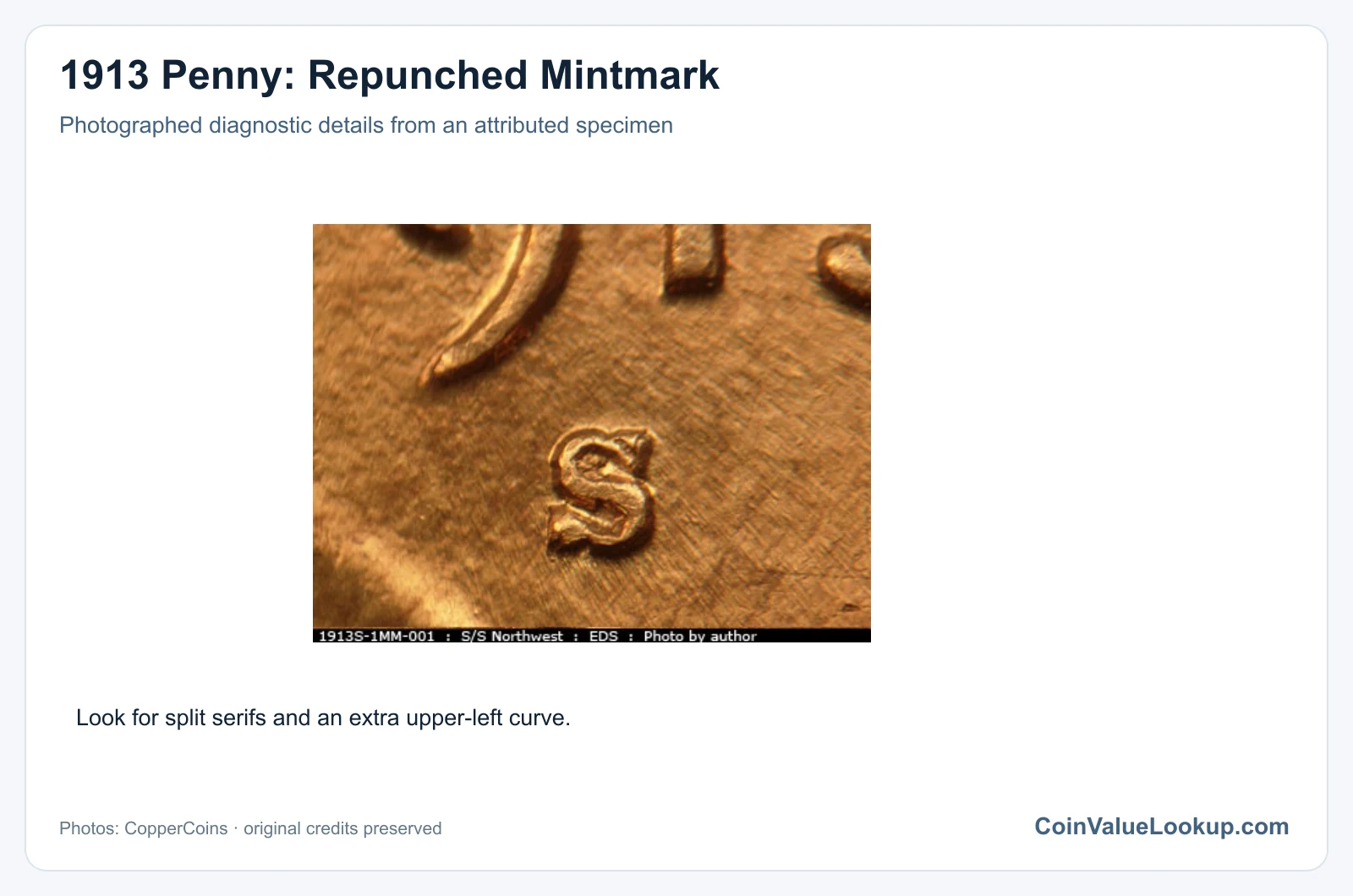
Repunched mintmarks apply only to branch-mint coins, so you are looking at 1913-D and 1913-S cents here. Philadelphia did not use a mintmark, so an RPM on a no-mintmark coin is not possible.
Inspect the mintmark under magnification for traces of a second, slightly offset punch impression. The remnants may appear as extra serifs, a shadow, or a partial duplicate letter beside or beneath the primary mark.
Compare your coin to a known normal mintmark at the same magnification so you have a reliable baseline.
Machine doubling can create a flat shelf around the letter that looks vaguely doubled but lacks the distinct notching or separation of a true RPM. Die chips and corrosion around the mintmark area are other common look-alikes.
Confirmed examples should be evaluated individually based on condition and authentication.
4. 1913 Wheat Penny — Off-Center Strike
An off-center strike happens when the planchet is not seated properly between the dies. The result is a design that is shifted to one side with an unstruck crescent of blank metal on the opposite edge.
The critical factor for value is whether the date remains visible. A 1913 cent struck ten or fifteen percent off-center with a full, readable date is far more collectible than one where the date has shifted out of the field entirely.
Do not confuse an off-center strike with a clipped planchet or one-sided misalignment. A genuine off-center coin will show the design displaced in the same direction on both sides.
Post-mint damage like being flattened on one edge will not produce that matching shift. Value varies by percentage, date visibility, and authenticated condition.
5. 1913 Wheat Penny — Doubled Die Obverse
A doubled die obverse on a 1913 cent would show consistent separation or notching in the obverse lettering, date, or design elements. The doubling comes from a misaligned hub impression during die creation, so it repeats identically on every coin struck from that die.
To check, compare your coin's obverse details, especially the date and motto, against a known normal example under the same lighting and magnification. Genuine hub doubling shows raised, separated outlines rather than a flat mechanical shelf.
Machine doubling is the most common look-alike. It produces a flat, shelf-like distortion rather than the clearly notched or split serifs of a true doubled die.
Reflections and worn die contours can also create misleading impressions in photos. Authentication matters here, and value depends on the specific die variety, its prominence, and coin condition.
6. 1913 Wheat Penny — Struck-Through Error
A struck-through error occurs when foreign material, whether grease, a metal fragment, or debris, gets between the die and the planchet during striking. The result is a localized depression or an incomplete area of the design where the obstruction blocked the die's impression.
On a 1913 cent, look for an area where the design is missing or indented in a way that does not match normal wear. A grease-filled die will leave a smooth, featureless patch, while a retained foreign object might leave an impression of its own shape.
Do not confuse this with ordinary wear, cleaning scratches, or a weak strike that affects a broader area. Struck-through errors tend to be sharply bounded rather than gradually fading.
Value depends on the size, type, and visual impact of the obstruction, plus overall coin condition and authentication.
7. 1913 Wheat Penny — Die Break / Cud
A die break leaves a raised, irregular blob of metal on the coin's surface where a chunk of the die fractured away. When that break connects to the rim, collectors call it a cud.
The displaced area will lack normal design detail and instead show a featureless raised mass.
On a 1913 cent, check both sides along the rim for any lump that disrupts the normal border and design flow. The boundary between the cud and the surviving design should be visible as a distinct edge.
A rim dent from post-mint damage pushes metal inward rather than raising it. Corrosion can build up crusty material that superficially resembles a die break, but it will not show the smooth, raised profile of a genuine cud.
Interior die cracks that do not reach the rim are a related but separate category. Value depends on size, location, and authenticated condition of the specific coin.