2014 Roosevelt Dime Coin Value: How Much Is It Worth?
Most 2014 Roosevelt dimes you pull from pocket change are worth face value — ten cents. Uncirculated examples graded MS65 carry a USA Coin Book guide estimate around $2.50, while San Francisco clad proofs at PR65 sit near $6.25 and silver proofs at PR65 reach about $10.69.
The real questions are which version you have and whether anything unusual happened during striking. Match your coin's mint, metal and finish before jumping to higher-grade prices.
Fast Way to Identify Your 2014 Roosevelt Dime
The quickest way to start figuring out what you have is to upload clear photos of both sides of your 2014 dime. A front and back image lets you get a preliminary identification of the mintmark, finish type and any visible anomalies.
This is not a substitute for professional authentication, but it points you in the right direction before you spend money on grading.
2014 Roosevelt Dime Value
Upload both sides of your 2014 Roosevelt Dime.
Front Obverse
Upload photo
Back Reverse
Upload photo
Which 2014 Roosevelt Dime Versions Are Worth Money?
- Well-preserved P or D mint-state coins with clearly separated torch bands can command a modest premium over face value, guided at $2.50 in MS65.
- San Francisco silver proofs, identified by their heavier 2.50-gram weight and uniform silver edge, carry a higher guide estimate of $10.69 at PR65.
- A 2014-P missing obverse clad layer error has been certified — authenticate before assuming any premium, because toning and damage can mimic the look.
Step 1: Identify Your 2014 Roosevelt Dime Mint Mark and Version
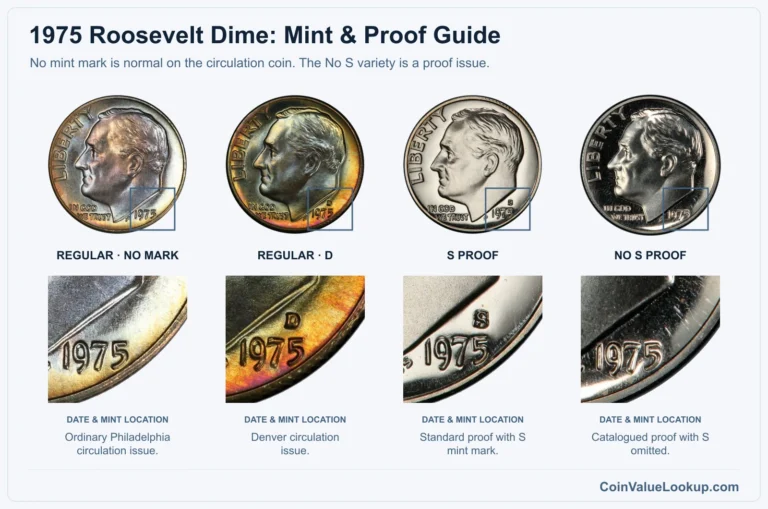
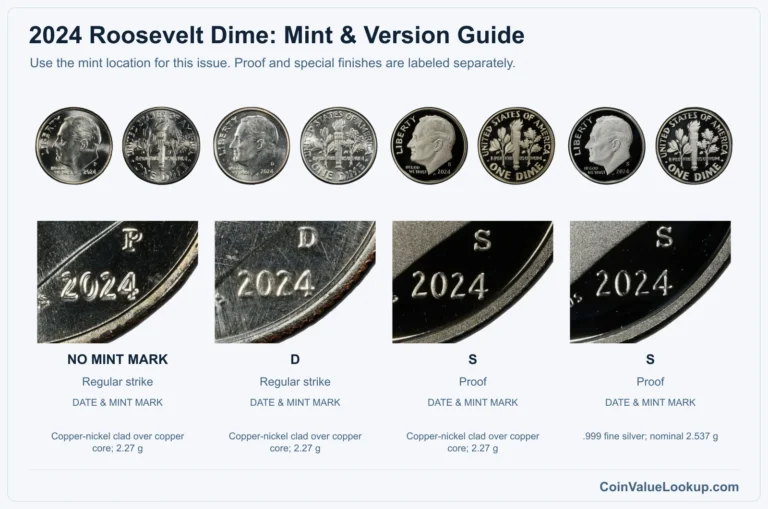
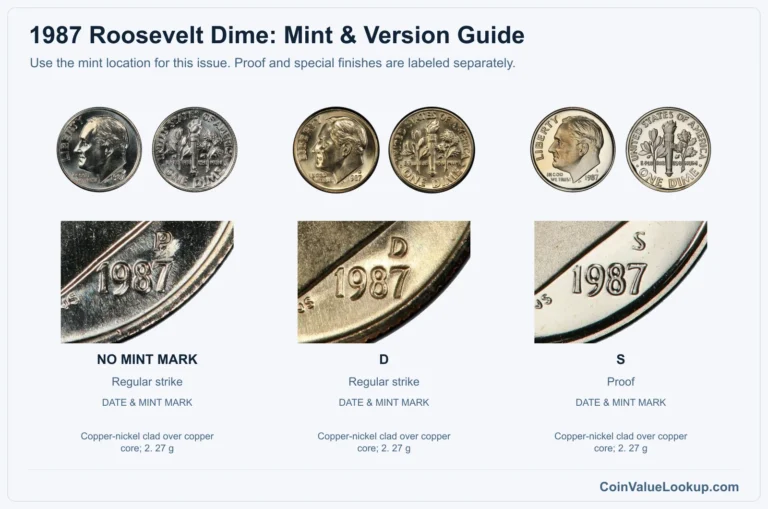
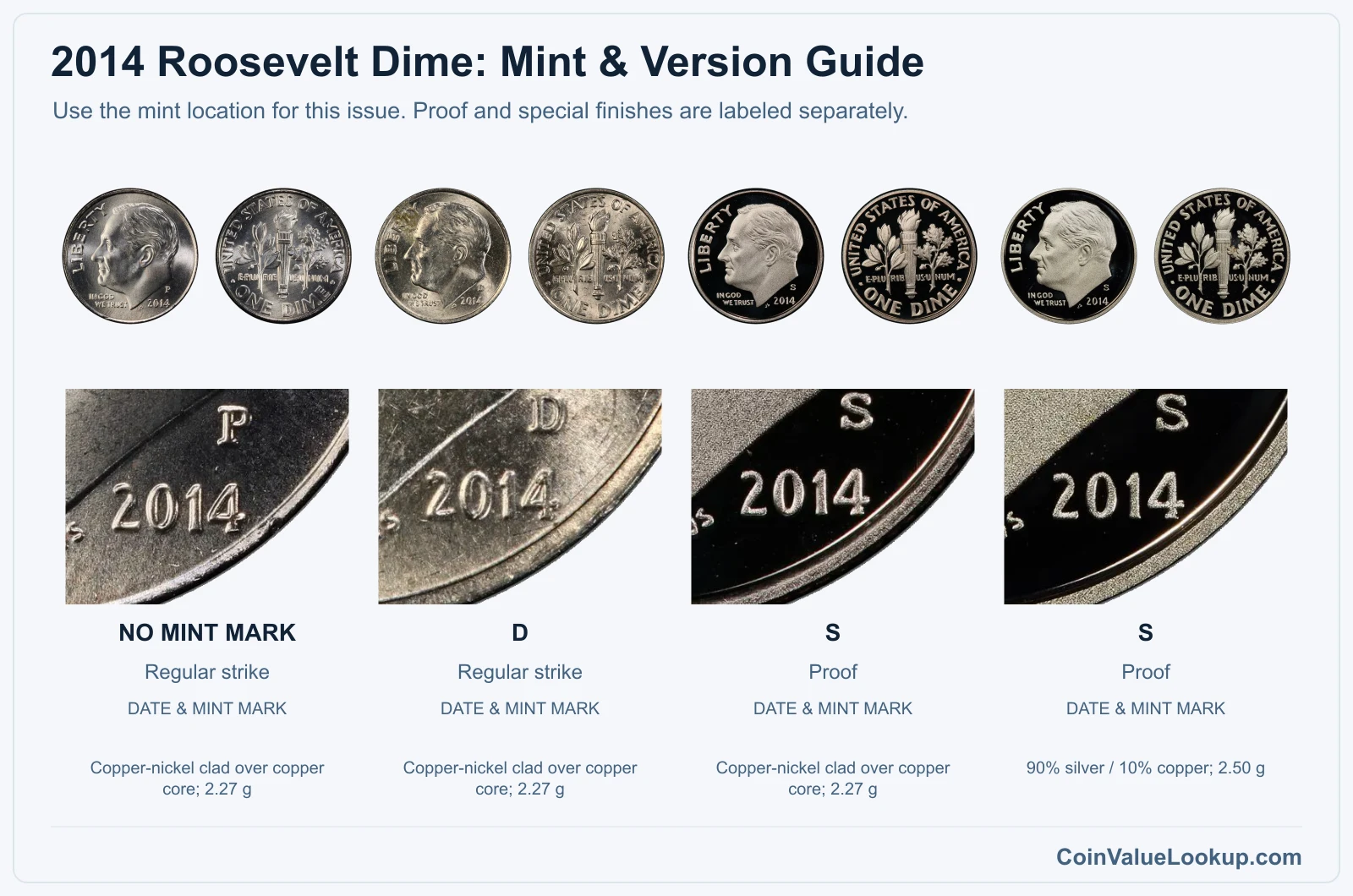
Flip your coin over so Roosevelt faces you. Look just above the date for a small letter: P means Philadelphia, D means Denver, and S means San Francisco.
No mintmark on a 2014 dime should not happen — all three mints used a letter.
Philadelphia and Denver strikes are copper-nickel clad business coins weighing 2.27 grams. San Francisco produced two different proofs sharing the same S mintmark and identical design, so the letter alone does not tell the whole story.
To separate the S clad proof from the S silver proof, check the edge and weigh the coin. A clad proof weighs 2.27 grams and shows a visible layered edge.
The silver proof weighs 2.50 grams and has a uniform silver-gray edge with no copper stripe. Original packaging helps, but weight and edge color together are the most reliable physical tests when the box is gone.
All versions share the same Roosevelt portrait obverse and torch-with-branches reverse, so design alone will not distinguish them. Diameter is about 17.9 mm across the board.
Step 2: Check Your 2014 Roosevelt Dime Grade
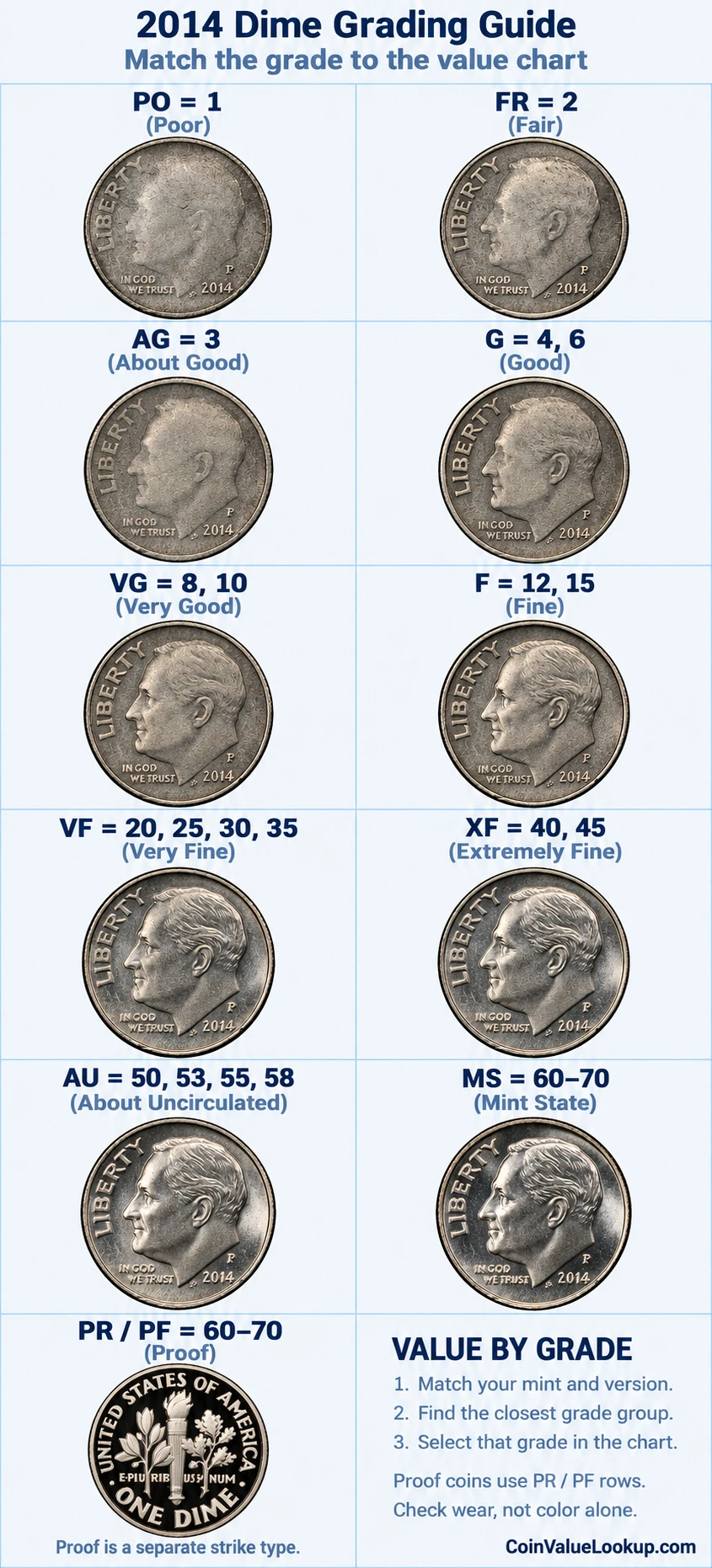
Start with Roosevelt's cheek and jawline — that is where wear shows first. A coin that has been in circulation will lose the fine detail on the cheekbone before anything else fades.
Next, check the hair above the ear. Luster — that cartwheel shimmer when you tilt the coin under a light — should be unbroken on a true uncirculated piece.
A coin that looks shiny but has flat, glassy surfaces may have been cleaned, which is not the same thing.
On the reverse, examine the torch and the horizontal bands that cross it. "Full Bands" means both pairs of horizontal bands are clearly separated, which is a strike designation reflecting die pressure, not a grade.
A weakly struck coin can still be uncirculated.
For proofs, you are looking at mirror fields and frosted devices. Compare your coin to another proof of the same finish and year using the comparison image rather than holding it next to a business strike.
Proof is a way of making a coin, not a grade above Mint State.
Step 3: Check 2014 Roosevelt Dime Value by Mint and Version
2014 Roosevelt Dime — P Business Strike
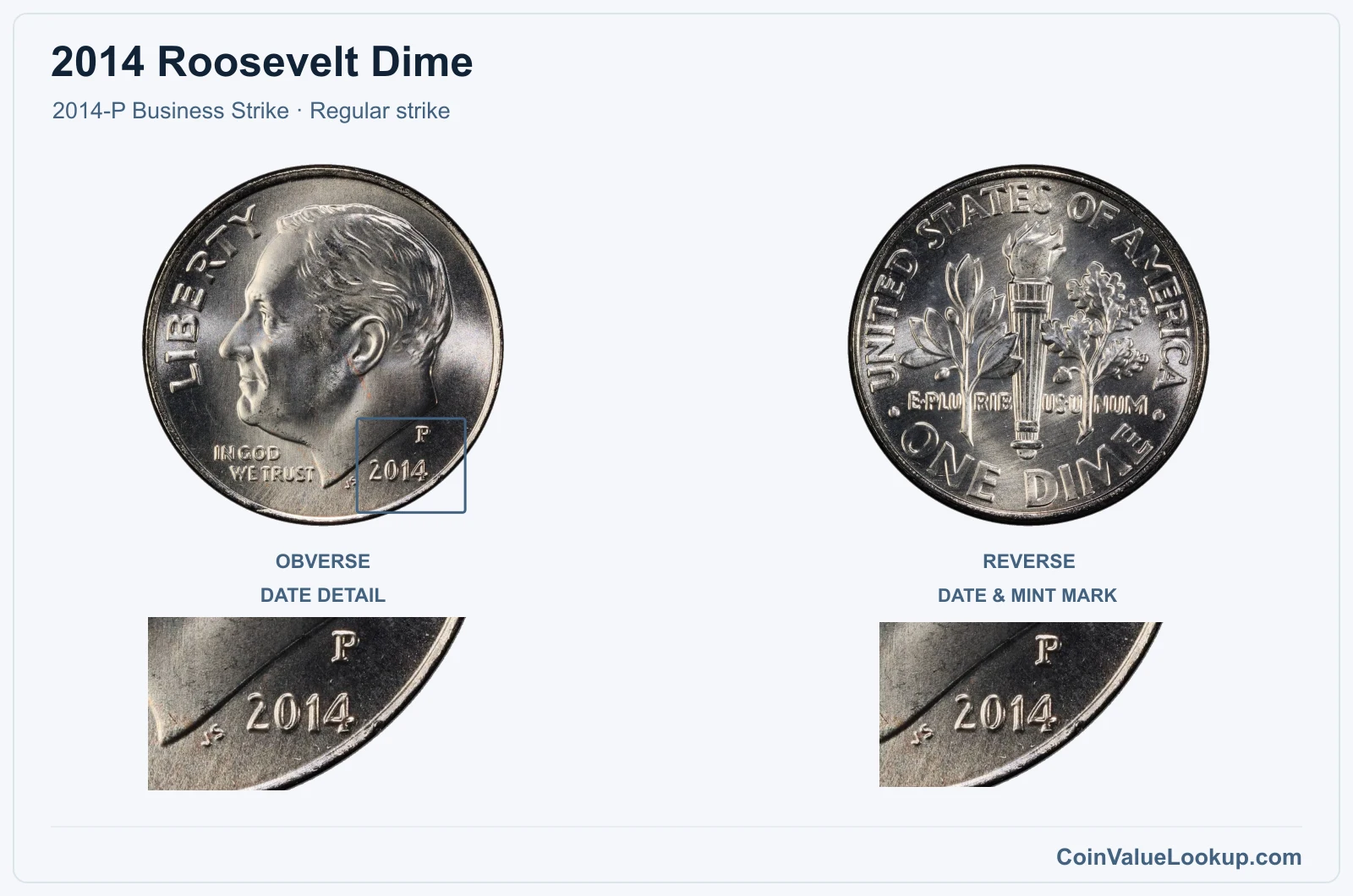
The 2014-P business strike was made in Philadelphia on copper-nickel clad planchets weighing 2.27 grams. Look for the small P above the date.
These are common coins, and most circulated examples are worth ten cents.
At MS65, the USA Coin Book guide places this version at about $2.50. Full separation of the torch's horizontal bands can add appeal, but that is a strike characteristic, not an error.
Confirm you are comparing prices for the P mint specifically, since each branch has its own market.
Range Grade
Price Auction Records Appraisal PO PO 1
—
Coin Identifier FR FR 2
—
Coin Identifier AG AG 3
—
Coin Identifier G G 4
—
Coin Identifier
G 6
—
Coin Identifier VG VG 8
—
Coin Identifier
VG 10
—
Coin Identifier F F 12
—
Coin Identifier
F 15
—
Coin Identifier VF VF 20
—
Coin Identifier
VF 25
—
Coin Identifier
VF 30
—
Coin Identifier
VF 35
—
Coin Identifier XF XF 40
—
Coin Identifier
XF 45
—
Coin Identifier AU AU 50
—
Coin Identifier
AU 53
—
Coin Identifier
AU 55
—
Coin Identifier
AU 58
—
Coin Identifier MS MS 60
—
Coin Identifier
MS 61
—
Coin Identifier
MS 62
—
Coin Identifier
MS 63
—
Coin Identifier
MS 64
—
Coin Identifier
MS 65
—
Coin Identifier
MS 66
—
Coin Identifier
MS 67
—
Coin Identifier
MS 68
—
Coin Identifier
MS 69
—
—
—
MS 70
—
—
—
2014 Roosevelt Dime — D Business Strike
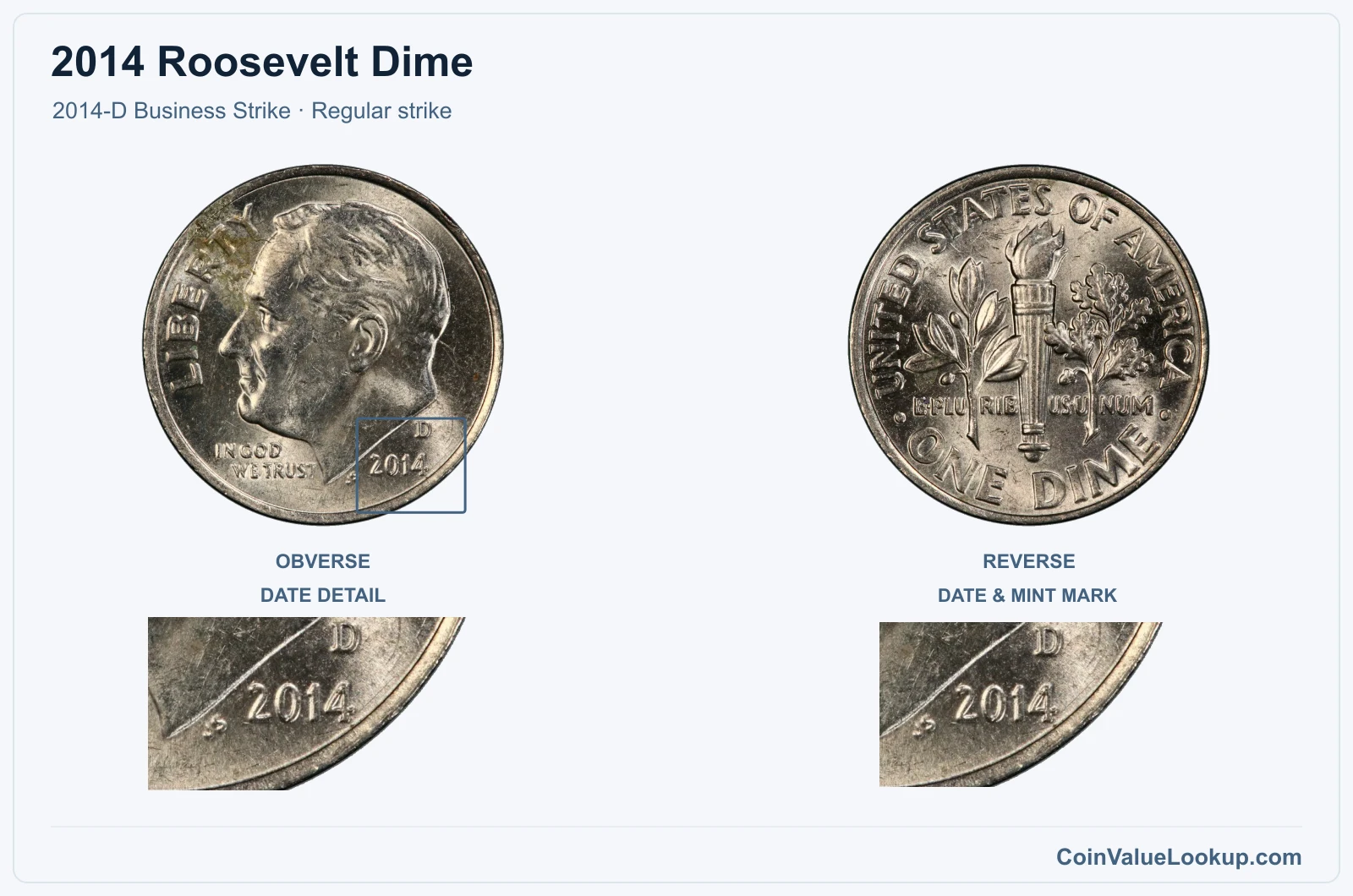
Denver's 2014-D dime is the same copper-nickel clad composition and 2.27-gram weight as its Philadelphia sibling. The D mintmark sits above the date on the obverse.
Guide value at MS65 is also around $2.50 per USA Coin Book. In circulated grades, expect face value.
As with the P, well-struck examples showing full torch band separation are more attractive to registry collectors, but that premium is modest on a modern dime.
Coin Value Lookup is a handy starting point if you want to check guide values for other Roosevelt dime dates or denominations without digging through multiple sources.
Range Grade
Price Auction Records Appraisal PO PO 1
—
Coin Identifier FR FR 2
—
Coin Identifier AG AG 3
—
Coin Identifier G G 4
—
Coin Identifier
G 6
—
Coin Identifier VG VG 8
—
Coin Identifier
VG 10
—
Coin Identifier F F 12
—
Coin Identifier
F 15
—
Coin Identifier VF VF 20
—
Coin Identifier
VF 25
—
Coin Identifier
VF 30
—
Coin Identifier
VF 35
—
Coin Identifier XF XF 40
—
Coin Identifier
XF 45
—
Coin Identifier AU AU 50
—
Coin Identifier
AU 53
—
Coin Identifier
AU 55
—
Coin Identifier
AU 58
—
Coin Identifier MS MS 60
—
Coin Identifier
MS 61
—
Coin Identifier
MS 62
—
Coin Identifier
MS 63
—
Coin Identifier
MS 64
—
Coin Identifier
MS 65
—
Coin Identifier
MS 66
—
Coin Identifier
MS 67
—
Coin Identifier
MS 68
—
—
—
MS 69
—
—
—
MS 70
—
—
—
2014 Roosevelt Dime — S Clad Proof
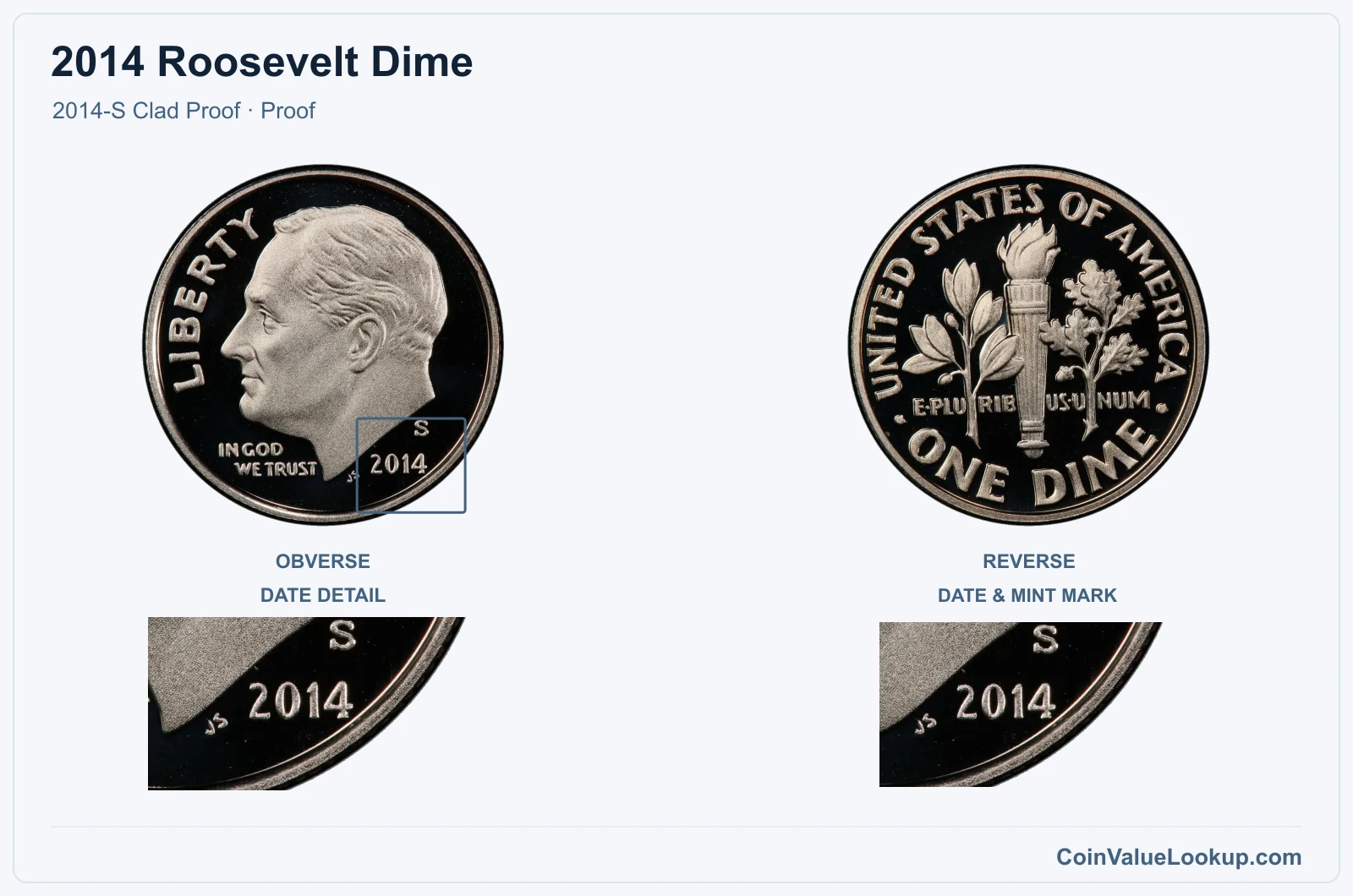
The 2014-S clad proof was struck at San Francisco on the same copper-nickel clad planchets used for business strikes — 2.27 grams. It carries an S mintmark, mirror fields and frosted design elements.
That layered copper-nickel edge is the giveaway separating it from the silver proof.
USA Coin Book estimates PR65 at $6.25. Most of these came in sealed proof sets, so finding one loose and heavily handled is less common.
Still, it is a modern proof from a large mintage year, so do not expect dramatic premiums unless the coin is in top condition.
Range Grade
Price Auction Records Appraisal PR PR 1
—
Coin Identifier
PR 2
—
Coin Identifier
PR 3
—
Coin Identifier
PR 4
—
Coin Identifier
PR 6
—
Coin Identifier
PR 8
—
Coin Identifier
PR 10
—
Coin Identifier
PR 12
—
Coin Identifier
PR 15
—
Coin Identifier
PR 20
—
Coin Identifier
PR 25
—
Coin Identifier
PR 30
—
Coin Identifier
PR 35
—
Coin Identifier
PR 40
—
Coin Identifier
PR 45
—
Coin Identifier
PR 50
—
Coin Identifier
PR 53
—
Coin Identifier
PR 55
—
Coin Identifier
PR 58
—
Coin Identifier
PR 60
—
Coin Identifier
PR 61
—
Coin Identifier
PR 62
—
Coin Identifier
PR 63
—
Coin Identifier
PR 64
—
Coin Identifier
PR 65
—
Coin Identifier
PR 66
—
Coin Identifier
PR 67
—
Coin Identifier
PR 68
—
Coin Identifier
PR 69
—
Coin Identifier
PR 70
Coin Identifier
2014 Roosevelt Dime — S Silver Proof
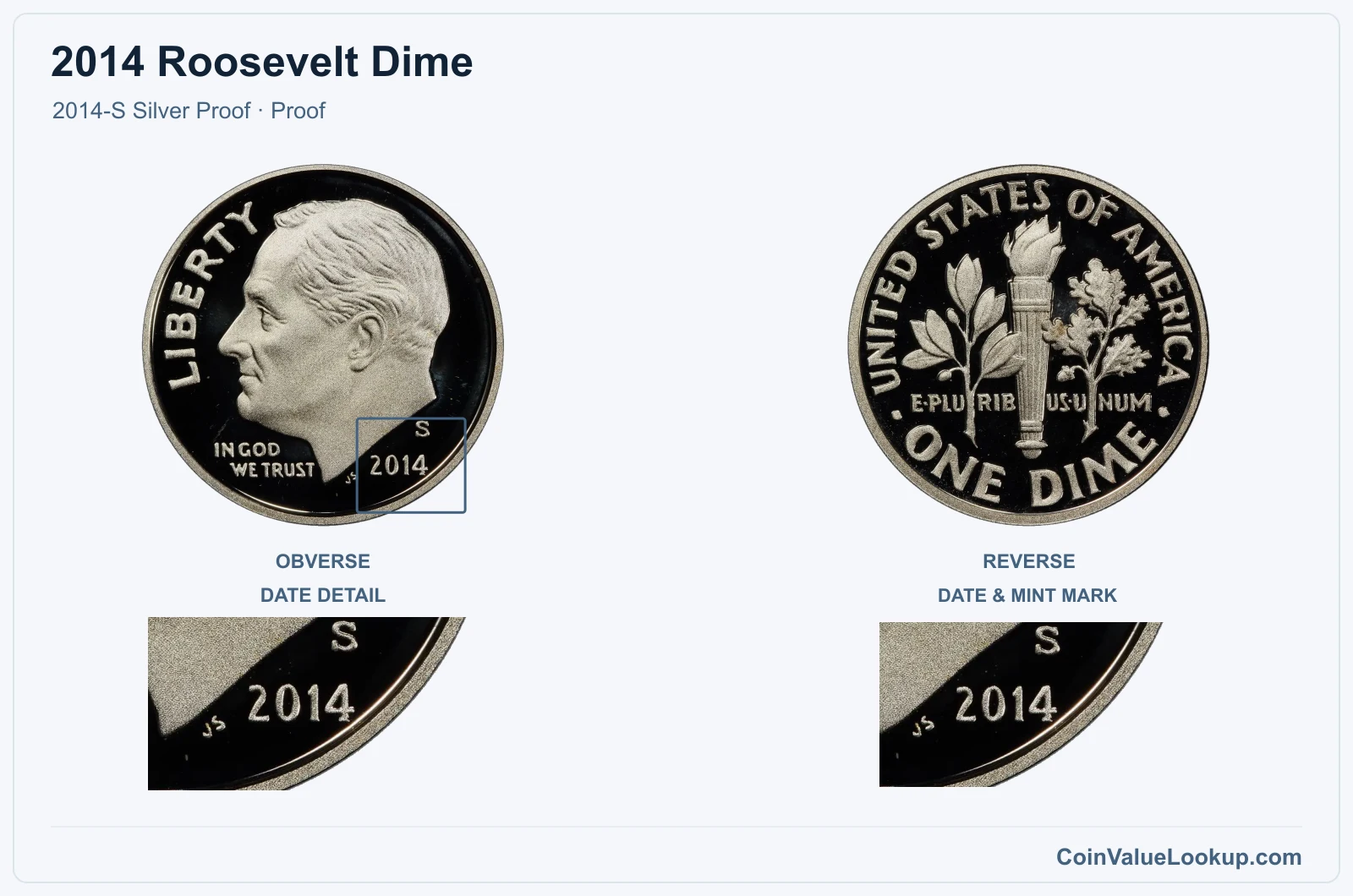
San Francisco also struck a 2014-S silver proof on 90% silver planchets weighing 2.50 grams. Same S mintmark, same design, same mirror-and-frost finish as the clad proof.
Weight and edge color are your tools here: the silver version is heavier and shows a uniform gray edge with no copper stripe.
At PR65, the USA Coin Book guide estimates $10.69. That modest jump over the clad proof reflects the silver content and collector-set packaging.
Confirm your coin's composition independently rather than relying on the mintmark alone, because the S appears on both proof types.
Range Grade
Price Auction Records Appraisal PR PR 1
—
Coin Identifier
PR 2
—
Coin Identifier
PR 3
—
Coin Identifier
PR 4
—
Coin Identifier
PR 6
—
Coin Identifier
PR 8
—
Coin Identifier
PR 10
—
Coin Identifier
PR 12
—
Coin Identifier
PR 15
—
Coin Identifier
PR 20
—
Coin Identifier
PR 25
—
Coin Identifier
PR 30
—
Coin Identifier
PR 35
—
Coin Identifier
PR 40
—
Coin Identifier
PR 45
—
Coin Identifier
PR 50
—
Coin Identifier
PR 53
—
Coin Identifier
PR 55
—
Coin Identifier
PR 58
—
Coin Identifier
PR 60
—
Coin Identifier
PR 61
—
Coin Identifier
PR 62
—
Coin Identifier
PR 63
—
Coin Identifier
PR 64
—
Coin Identifier
PR 65
—
Coin Identifier
PR 66
—
Coin Identifier
PR 67
—
Coin Identifier
PR 68
—
Coin Identifier
PR 69
—
Coin Identifier
PR 70
Coin Identifier
2014 Roosevelt Dime Error List
1. 2014 Roosevelt Dime — Missing Obverse Clad Layer
A 2014-P business strike has been certified by NGC in MS65 with a missing obverse clad layer. On this error, the obverse displays exposed copper core while the reverse retains its normal clad surface.
The edge should show an asymmetric layer structure — one side copper, the other with the expected clad sandwich.
Before assuming you have one, rule out lookalikes. Toning can turn a normal coin coppery.
Acid exposure, fire damage and deliberate plating removal all mimic a missing clad layer. Color alone is not enough — you need the weight, edge profile and ideally a third-party certification.
No supported price range is available for this error. Value depends on the authenticated identity, condition and severity of the missing layer, so individual assessment by a grading service is the prudent path.
2. 2014 Roosevelt Dime — Partial Collar Strike
A partial collar strike on a 2014 dime leaves a stepped or shelf-like rim on part of the coin's edge, where the blank was only partly seated in the collar die during striking. The rest of the edge may appear slightly expanded or irregular compared to a normal coin.
Flip it edge-on and compare with a regular dime. A normal coin has a uniform reeded edge all the way around.
A partial collar will show a clear transition point where the reeding stops or the rim changes height.
Do not confuse this with simple rim dings, a flattened edge from a coin counter, or a complete broadstrike where the collar was entirely absent. Condition, the degree of displacement and overall eye appeal all affect what a partial collar error is worth, but no specific price range is available for this issue.
3. 2014 Roosevelt Dime — Clashed Dies
Die clash marks appear when the obverse and reverse dies strike each other without a planchet between them. The result is faint traces of one die's design pressed into the opposite die, which then transfers onto subsequent coins as ghostly outlines in the fields.
On a 2014 dime, look for portions of the torch or lettering faintly visible on Roosevelt's side, or traces of the portrait showing up in the reverse fields. The transferred elements should align with where the opposing design would sit during normal striking.
Random scratches, raised lines from a damaged die, or a brockage (where a struck coin acts as a die) can look similar at first glance. True clash marks follow the geometry of the opposing design.
Value depends on the clash's visibility and the coin's overall condition; no numerical price range is adopted here.
4. 2014 Roosevelt Dime — Doubled Die
A doubled die on a 2014 dime shows consistent separation or notching of design elements — letters, the date, or portrait features — caused during the die-making process. This is different from the flat, shelf-like distortion of machine doubling, which happens during the strike itself.
Compare suspect areas to a normal 2014 dime. Genuine doubling will appear as a clean secondary image with distinct raised edges.
Machine doubling tends to look mushy and directional, flattening one side of the affected element.
Reflections from proof surfaces and post-mint impressions from other objects are also common lookalikes. The specific mint and die position for reported 2014 doubled dies are not detailed here.
No supported price data is available, so value would depend on the doubling's strength, location and the coin's condition.
5. 2014 Roosevelt Dime — Off-Center Strike
An off-center strike happens when the planchet is not properly centered between the dies. Part of the design is missing, replaced by a blank crescent of unstruck metal.
The more dramatic the shift, the more collector interest — provided the date remains visible.
On a 2014 dime, even a modest percentage off-center is unusual enough to catch attention. Look at both sides: the displacement should be consistent, with the blank crescent on opposite sides of obverse and reverse.
A clipped planchet removes metal from the blank before striking and produces a different shape. Post-mint flattening or a single-side die misalignment can also fool you.
No specific price range is available. Value hinges on the percentage of displacement, date visibility and overall condition.
6. 2014 Roosevelt Dime — Die Crack / Die Chip
Die cracks and die chips on a 2014 dime appear as raised lines or small raised blobs on the coin's surface. They come from fractures in a worn die.
A crack that reaches the rim and produces a substantial raised area is called a cud — it replaces part of the design with a featureless lump.
Smaller interior cracks look like thin raised threads running across the design. Die chips tend to appear as tiny raised bumps, often inside letters.
Both are worth examining under magnification.
Do not confuse these with incuse scratches, corrosion deposits or bits of foreign material stuck to the surface. Raised material from a die crack is part of the strike, so it will not wipe off.
No numerical price is adopted for this category; value depends on visibility, size and the coin's condition.
7. 2014 Roosevelt Dime — Misaligned Die
A misaligned die error shifts one side of the design relative to the other or relative to the planchet. On a 2014 dime, compare both faces: if Roosevelt's portrait is centered but the torch side is visibly offset, or vice versa, you may have a misaligned die.
This is different from an off-center strike, where the entire planchet was displaced. With a misaligned die, only one die has shifted, so one side can look perfectly normal.
It is also different from a rotated die, where the alignment is angular rather than lateral.
Post-mint rim damage and tilted photographs can create the illusion of misalignment. Check the coin flat on a surface and compare rim widths on both sides.
No supported price range is available; value depends on the degree of misalignment and overall condition.
8. 2014 Roosevelt Dime — Struck-Through Error
A struck-through error occurs when a foreign object — grease, thread, metal fragment or other debris — sits between the die and the planchet during striking. The result is a localized depression, a textured impression, or an area of incomplete design on the finished coin.
Grease-filled dies produce smooth, shallow depressions where detail simply did not transfer. A retained foreign object leaves a more distinct impression, sometimes with a recognizable shape.
These are different problems with different collector appeal.
Ordinary wear, cleaning marks and weak strikes from a tired die can all mimic a struck-through at a glance. The key distinction is that a struck-through is localized and does not follow the pattern of normal circulation wear.
No numerical price is available for this error on a 2014 dime; individual assessment considers the object type, affected area and coin condition.