2014 Lincoln Penny Coin Value: How Much Is It Worth?
A circulated 2014 Lincoln cent is worth about one cent — face value, nothing more. In higher uncirculated grades, a guide estimate for an MS65 example sits around $0.36, while a San Francisco proof in PR65 is listed near $6.25.
Collector finishes, recognized varieties, and mint errors each occupy their own pricing lane, so the version and condition of your specific coin matter more than the date alone.
Fast Way to Identify Your 2014 Lincoln Penny
Snap a clear photo of the front and back of your 2014 penny and upload both images for a preliminary identification. This can help you figure out which mint produced your coin, whether it carries a proof finish, and if any obvious variety or error features are visible before you dig deeper into value comparisons.
2014 Penny Value
Upload both sides of your 2014 Lincoln Penny.
Front Obverse
Upload photo
Back Reverse
Upload photo
Which 2014 Lincoln Penny Versions Are Worth Money?
- Uncirculated Philadelphia and Denver cents with full original red luster (MS65 and above) trade above face value, with a guide estimate around $0.36 at MS65.
- San Francisco proof cents (2014-S) are collector issues not found in pocket change; a PR65 carries a guide estimate near $6.25.
Step 1: Identify Your 2014 Lincoln Penny Mint Mark and Version
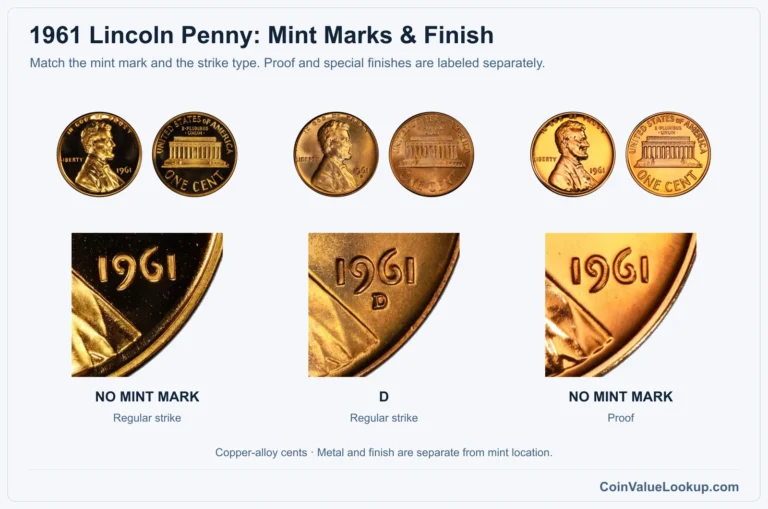
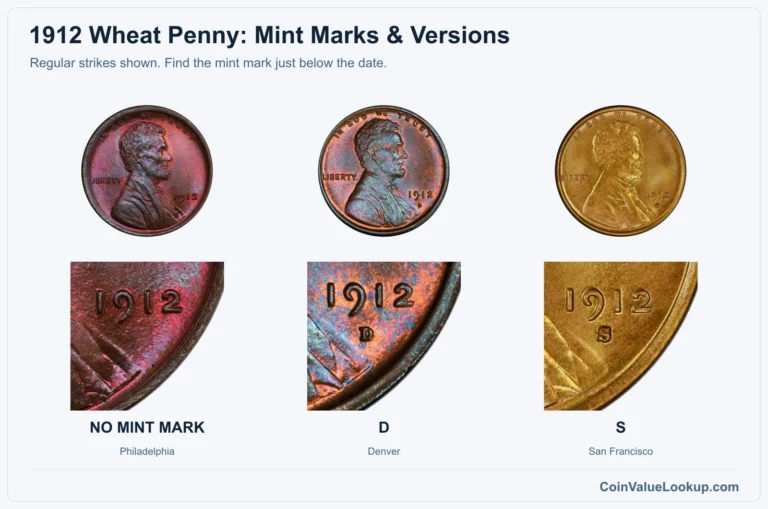
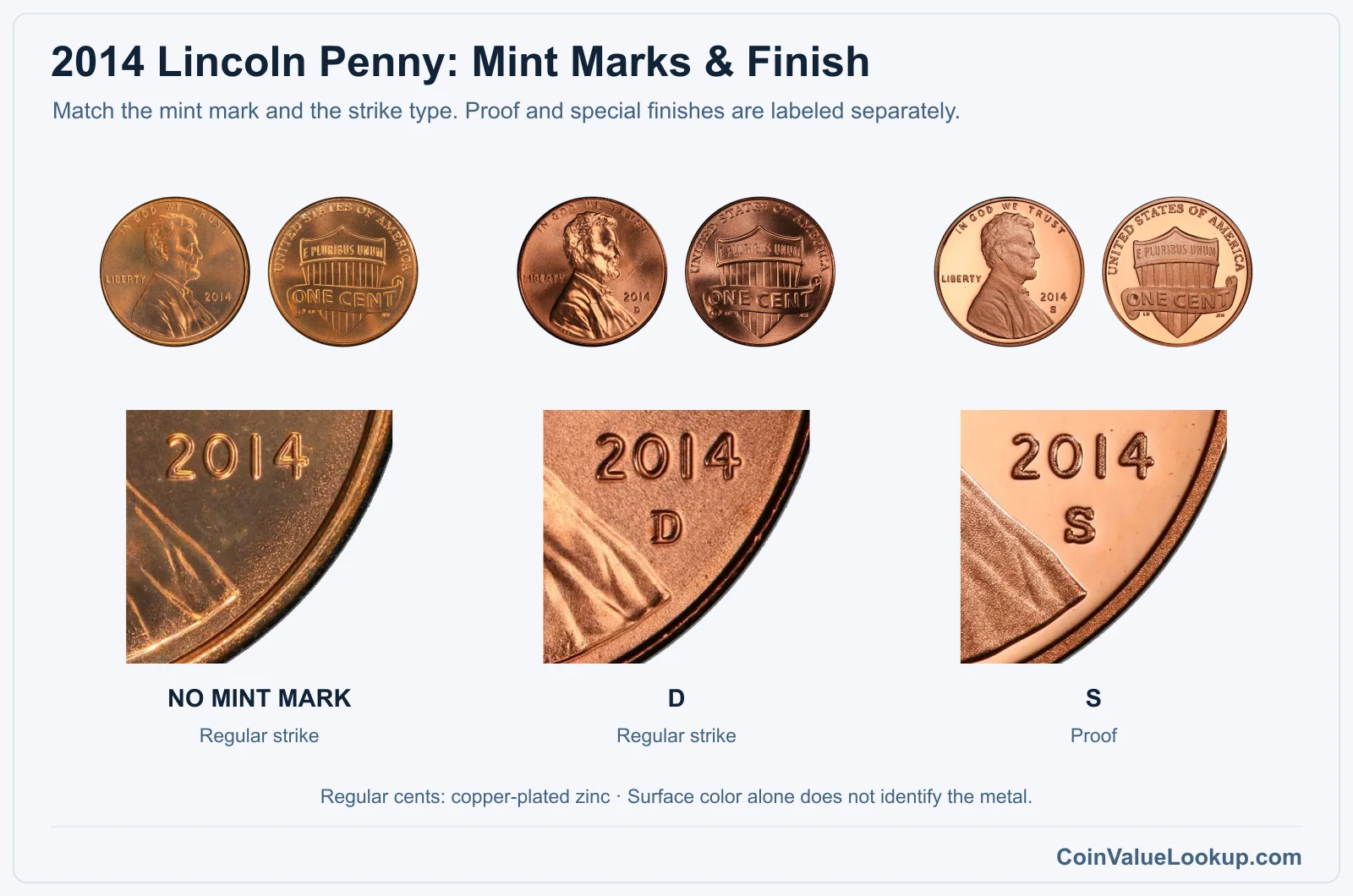
Flip your coin to the front and look just below the date for a small letter. No letter at all means Philadelphia.
A "D" means Denver. An "S" means San Francisco, and those are proof strikes, not regular circulation coins.
The reverse should show the Union Shield design — a shield with horizontal lines, vertical stripes, and a scroll reading E PLURIBUS UNUM across the top. If your reverse looks different (say, the Lincoln Memorial or a scene from Lincoln's life), you're holding a different year's cent.
All standard 2014 cents are copper-plated zinc, weighing about 2.50 grams. They look copper on the outside, but the core is zinc.
You cannot identify an off-metal error by appearance alone; weight and composition testing are needed for that.
Step 2: Check Your 2014 Lincoln Penny Grade
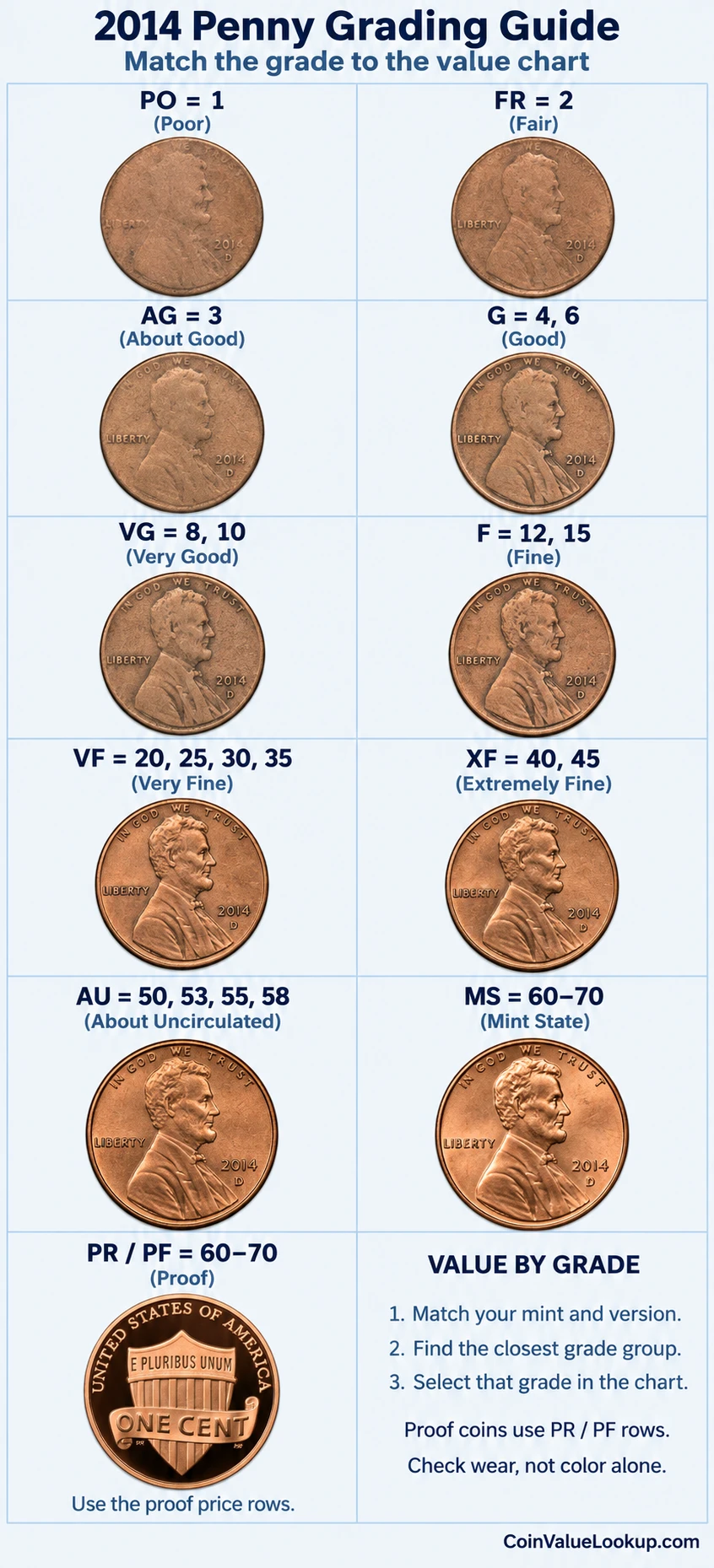
Start with Lincoln's cheek and jawline on the obverse. On a well-worn coin these areas flatten first, losing their rounded contour and fine skin texture.
Next check the hair above Lincoln's ear — individual strands disappear quickly with circulation.
On the reverse, examine the horizontal lines within the shield. Lightly circulated coins retain most of them; heavily worn examples show smooth patches.
Surviving original luster matters too. A coin can have sharp detail but dull, cleaned surfaces, and that distinction affects value.
Color designations — RD (red), RB (red-brown), and BN (brown) — describe the remaining original copper plating tone, not the amount of wear. A coin graded MS65 RD has full red color plus minimal contact marks, while an MS65 BN has the same lack of wear but has toned brown.
Compare your coin to the reference image to gauge where it falls.
Proof and business strike are production methods, not a grading ladder. A proof coin from San Francisco is not "better" than an MS67 business strike in some universal ranking — they are judged on separate scales.
Step 3: Check 2014 Lincoln Penny Value by Mint and Version
2014 Lincoln Penny — Shield
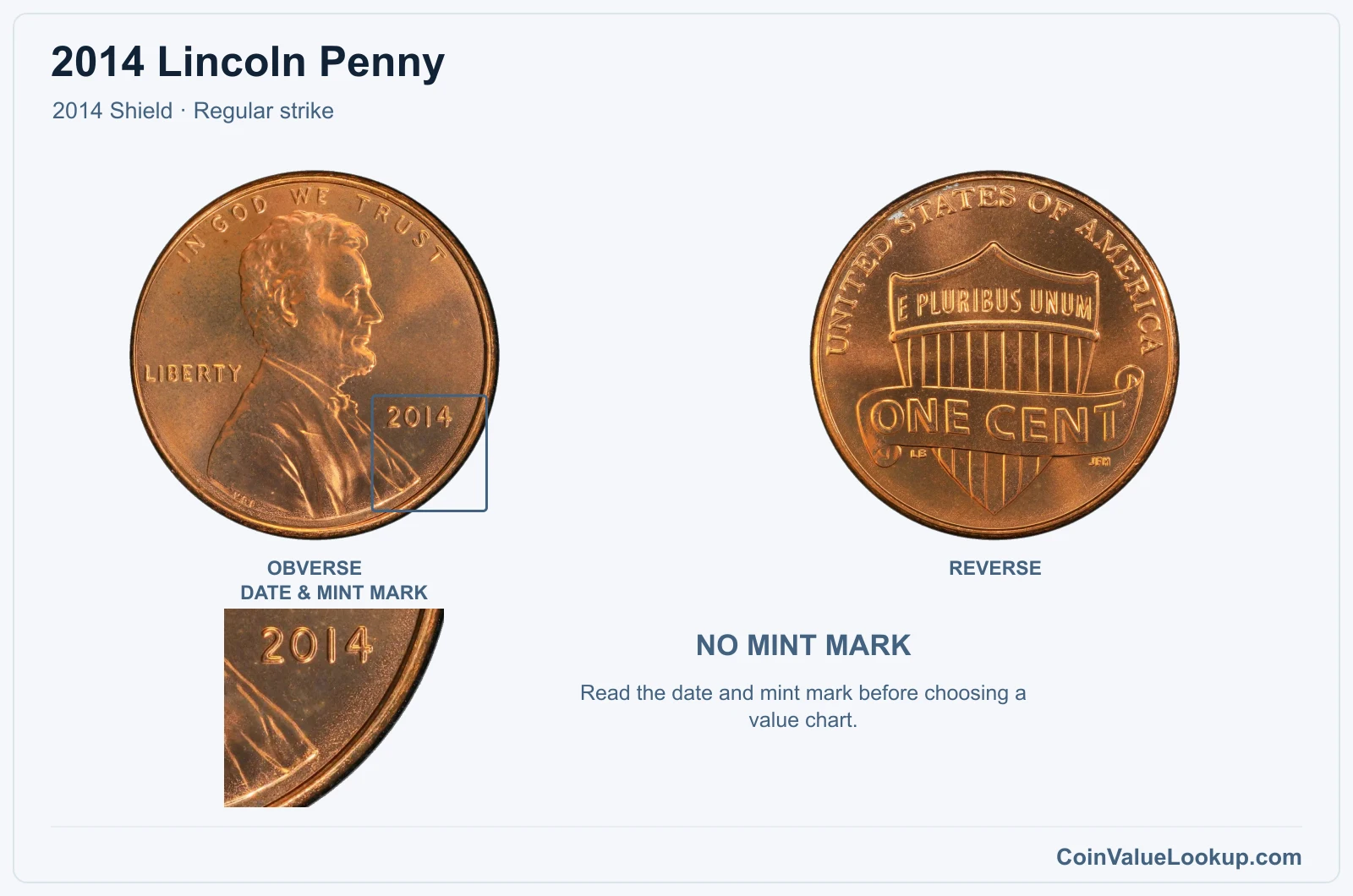
The 2014 Philadelphia cent has no mintmark below the date. Billions were struck, so finding one in your change is easy — finding one in pristine condition is the hard part.
A circulated example is worth one cent. At the MS65 grade with original surfaces, a guide estimate is about $0.36.
To command any premium the coin needs to be uncirculated with minimal bag marks and, ideally, full red color. Look for clean fields and sharp shield lines on the reverse.
| Range | Grade | Price | Auction Records | Appraisal |
|---|---|---|---|---|
| PO | PO 1 | — | Coin Identifier | |
| FR | FR 2 | — | Coin Identifier | |
| AG | AG 3 | — | Coin Identifier | |
| G | G 4 | — | Coin Identifier | |
| G 6 | — | Coin Identifier | ||
| VG | VG 8 | — | Coin Identifier | |
| VG 10 | — | Coin Identifier | ||
| F | F 12 | — | Coin Identifier | |
| F 15 | — | Coin Identifier | ||
| VF | VF 20 | — | Coin Identifier | |
| VF 25 | — | Coin Identifier | ||
| VF 30 | — | Coin Identifier | ||
| VF 35 | — | Coin Identifier | ||
| XF | XF 40 | — | Coin Identifier | |
| XF 45 | — | Coin Identifier | ||
| AU | AU 50 | — | Coin Identifier | |
| AU 53 | — | Coin Identifier | ||
| AU 55 | — | Coin Identifier | ||
| AU 58 | — | Coin Identifier | ||
| MS | MS 60 | — | Coin Identifier | |
| MS 61 | — | Coin Identifier | ||
| MS 62 | — | Coin Identifier | ||
| MS 63 | — | Coin Identifier | ||
| MS 64 | — | Coin Identifier | ||
| MS 65 | — | Coin Identifier | ||
| MS 66 | — | Coin Identifier | ||
| MS 67 | Coin Identifier | |||
| MS 68 | Coin Identifier | |||
| MS 69 | — | — | — | |
| MS 70 | — | — | — |
2014 Lincoln Penny — D Shield
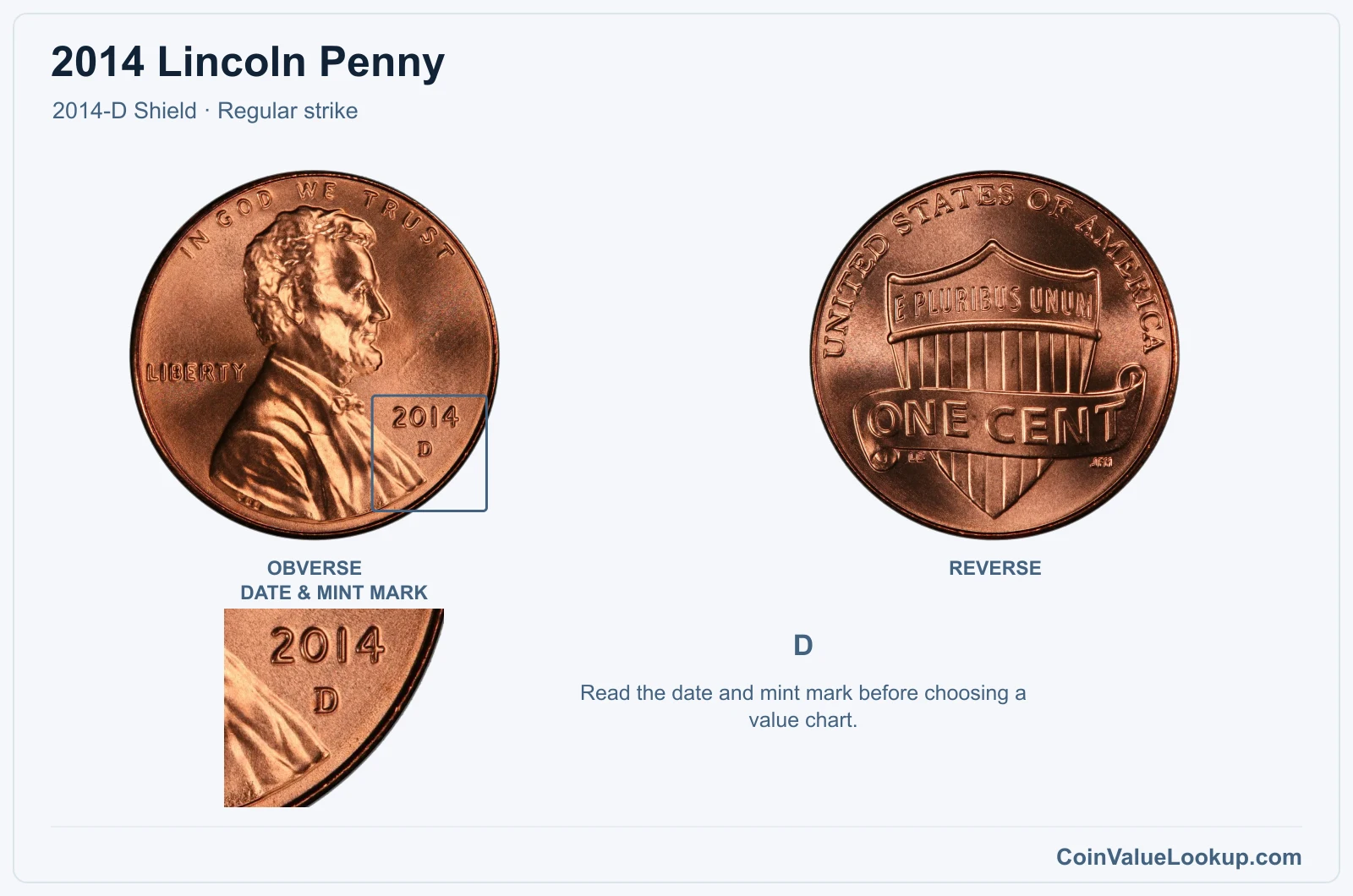
Look for a small "D" below the date to confirm a Denver strike. Like its Philadelphia sibling, the 2014-D cent was produced in huge numbers and circulated examples remain at face value.
The MS65 guide estimate is also around $0.36. Condition is everything here: clean cheek, sharp hair detail, and original luster separate a one-cent coin from one worth a bit more.
Check the reverse shield for full horizontal line separation as a quick sharpness test.
Coin Value Lookup is a handy starting point if you want to look up values for other dates and denominations in the Lincoln cent series or beyond.
| Range | Grade | Price | Auction Records | Appraisal |
|---|---|---|---|---|
| PO | PO 1 | — | Coin Identifier | |
| FR | FR 2 | — | Coin Identifier | |
| AG | AG 3 | — | Coin Identifier | |
| G | G 4 | — | Coin Identifier | |
| G 6 | — | Coin Identifier | ||
| VG | VG 8 | — | Coin Identifier | |
| VG 10 | — | Coin Identifier | ||
| F | F 12 | — | Coin Identifier | |
| F 15 | — | Coin Identifier | ||
| VF | VF 20 | — | Coin Identifier | |
| VF 25 | — | Coin Identifier | ||
| VF 30 | — | Coin Identifier | ||
| VF 35 | — | Coin Identifier | ||
| XF | XF 40 | — | Coin Identifier | |
| XF 45 | — | Coin Identifier | ||
| AU | AU 50 | — | Coin Identifier | |
| AU 53 | — | Coin Identifier | ||
| AU 55 | — | Coin Identifier | ||
| AU 58 | — | Coin Identifier | ||
| MS | MS 60 | — | Coin Identifier | |
| MS 61 | — | Coin Identifier | ||
| MS 62 | — | Coin Identifier | ||
| MS 63 | — | Coin Identifier | ||
| MS 64 | — | Coin Identifier | ||
| MS 65 | — | Coin Identifier | ||
| MS 66 | — | Coin Identifier | ||
| MS 67 | Coin Identifier | |||
| MS 68 | Coin Identifier | |||
| MS 69 | — | Coin Identifier | ||
| MS 70 | — | — | — |
2014 Lincoln Penny — S Shield PR
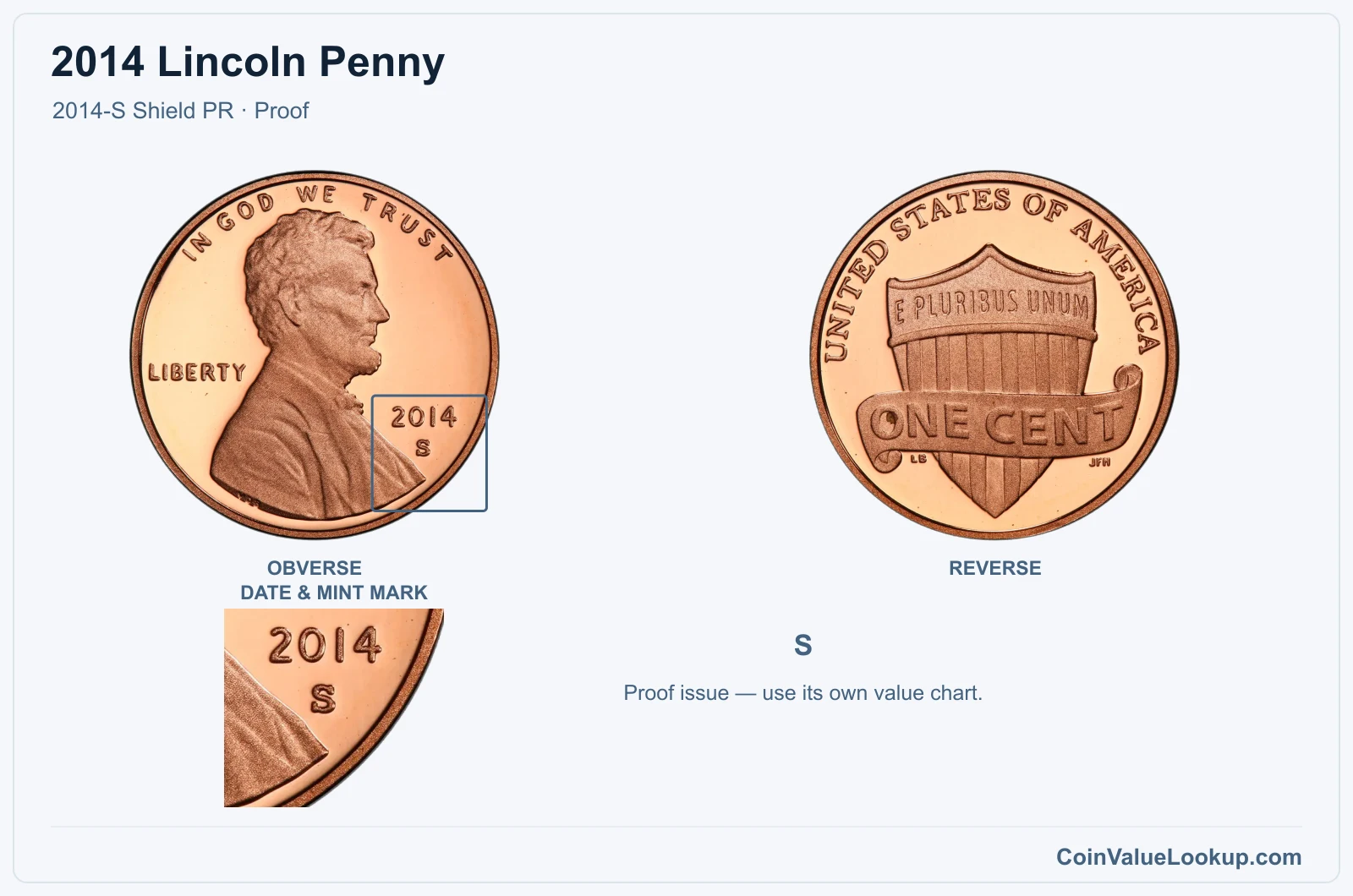
The 2014-S proof was struck at San Francisco exclusively for collector sets, so you will not pull one from a cash register. It carries an "S" mintmark below the date.
Proof cents display mirror-like fields and sharply struck design elements — compare the crispness of the shield lines and lettering against a business strike and the difference is obvious. A PR65 guide estimate sits near $6.25.
Cameo or deep-cameo contrast, where frosted devices float over glassy fields, can affect desirability, but those distinctions should be evaluated on the specific coin. Original, unhandled surfaces are key; fingerprints and haze lower eye appeal fast on proof finishes.
| Range | Grade | Price | Auction Records | Appraisal |
|---|---|---|---|---|
| PR | PR 1 | — | Coin Identifier | |
| PR 2 | — | Coin Identifier | ||
| PR 3 | — | Coin Identifier | ||
| PR 4 | — | Coin Identifier | ||
| PR 6 | — | Coin Identifier | ||
| PR 8 | — | Coin Identifier | ||
| PR 10 | — | Coin Identifier | ||
| PR 12 | — | Coin Identifier | ||
| PR 15 | — | Coin Identifier | ||
| PR 20 | — | Coin Identifier | ||
| PR 25 | — | Coin Identifier | ||
| PR 30 | — | Coin Identifier | ||
| PR 35 | — | Coin Identifier | ||
| PR 40 | — | Coin Identifier | ||
| PR 45 | — | Coin Identifier | ||
| PR 50 | — | Coin Identifier | ||
| PR 53 | — | Coin Identifier | ||
| PR 55 | — | Coin Identifier | ||
| PR 58 | — | Coin Identifier | ||
| PR 60 | — | Coin Identifier | ||
| PR 61 | — | Coin Identifier | ||
| PR 62 | — | Coin Identifier | ||
| PR 63 | — | Coin Identifier | ||
| PR 64 | — | Coin Identifier | ||
| PR 65 | — | Coin Identifier | ||
| PR 66 | — | Coin Identifier | ||
| PR 67 | — | Coin Identifier | ||
| PR 68 | — | Coin Identifier | ||
| PR 69 | Coin Identifier | |||
| PR 70 | Coin Identifier |
2014 Lincoln Penny Error List
1. 2014 Lincoln Penny — BIE Die Break
A BIE die break shows up as a small raised bump or vertical bridge between the letters B and E in LIBERTY on the obverse. It is caused by a crack or chip in the die that fills with metal during striking.
The result looks like an extra letter "I" wedged in there, which is where the nickname comes from.
To confirm it, check that the feature is raised (not incused) and sits naturally between B and E with the same metal texture as the surrounding letters. Dirt, a scratch, or a glued-on piece of metal will look different under magnification — foreign material usually has a different color or sits on top of the surface rather than being part of it.
No specific price range is established for this variety on 2014 cents; value depends on the authenticated identity, the severity of the break, and overall coin condition.
2. 2014 Lincoln Penny — Struck-Through Error
A struck-through error occurs when foreign material — grease, wire, cloth, or debris — sits between the die and the planchet during striking. The result is a localized depression or incomplete area in the design where the obstruction blocked the die's impression.
Grease fill-ins tend to produce soft, rounded voids, while a retained foreign object can leave a sharper, more dramatic impression.
Don't confuse this with normal wear, which removes detail gradually across high points, or with scratches, which are incused lines from post-mint damage. A genuine struck-through will show a distinct boundary between the affected zone and the fully struck surrounding design.
No established price range exists for 2014 struck-through cents; each coin's value hinges on authenticated identity, the size and visual impact of the error, and the coin's overall grade.
3. 2014 Lincoln Penny — Die Crack / Die Chip
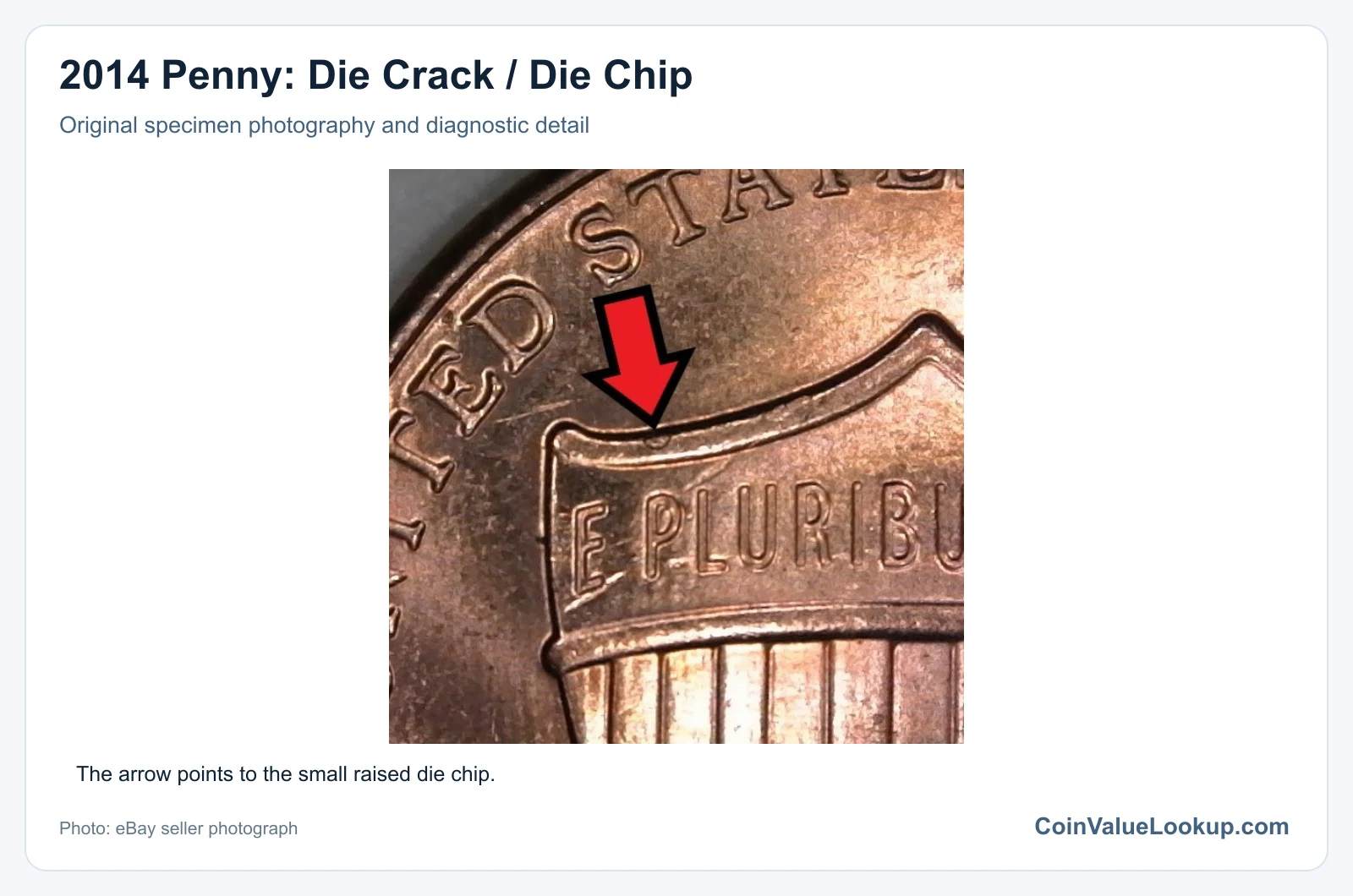
Die cracks appear as thin raised lines running across the coin's surface, formed when a working die develops a fracture. Small raised blobs — die chips — happen when a tiny piece of the die face breaks away, leaving a recessed spot in the die that fills with metal.
A cud is a larger die break connected to the rim, creating a raised, featureless lump at the edge.
These features are raised because they fill voids in the damaged die. That is the key distinction: incused scratches, corrosion pits, or foreign material sitting on the surface are post-mint damage, not die cracks.
Under magnification, a genuine die crack has the same metal flow and luster as the surrounding design. Pricing for 2014 die cracks and chips varies with severity, location, and authenticated condition, so individual assessment is necessary.
4. 2014 Lincoln Penny — Off-Center Strike
An off-center strike happens when the planchet is not seated properly in the collar before the dies come together. The result is a design shifted to one side with a blank, unstruck crescent on the opposite edge.
The percentage of off-center displacement matters a lot — a 5% shift is minor, while 50% or more with a visible date is a different conversation entirely.
Make sure the date is readable; without it, attributing the coin to 2014 specifically becomes difficult and value drops. Do not confuse an off-center strike with a clipped planchet (which has a curved bite out of the edge) or with post-mint damage from a vise or hammer.
A genuine off-center coin retains normal thickness in the struck area. Pricing depends on the degree of displacement, date visibility, and authenticated condition.
5. 2014 Lincoln Penny — Broadstrike
A broadstrike occurs when a coin is struck without the retaining collar that normally constrains the planchet's edge and forms the rim. The metal spreads outward, making the coin slightly wider than normal with a weak or absent rim.
The full design is generally present — it is just spread out rather than displaced to one side like an off-center strike.
Check the edge profile. A broadstruck coin will have a rounded, expanded edge rather than the normal reeded or plain raised rim.
Post-mint flattening from a railroad track or a hammer can mimic the wider diameter, but it usually distorts the design unevenly and shows surface damage. Value for a 2014 broadstrike depends on severity, overall condition, and authenticated confirmation of the error.
6. 2014 Lincoln Penny — Doubled Die Obverse
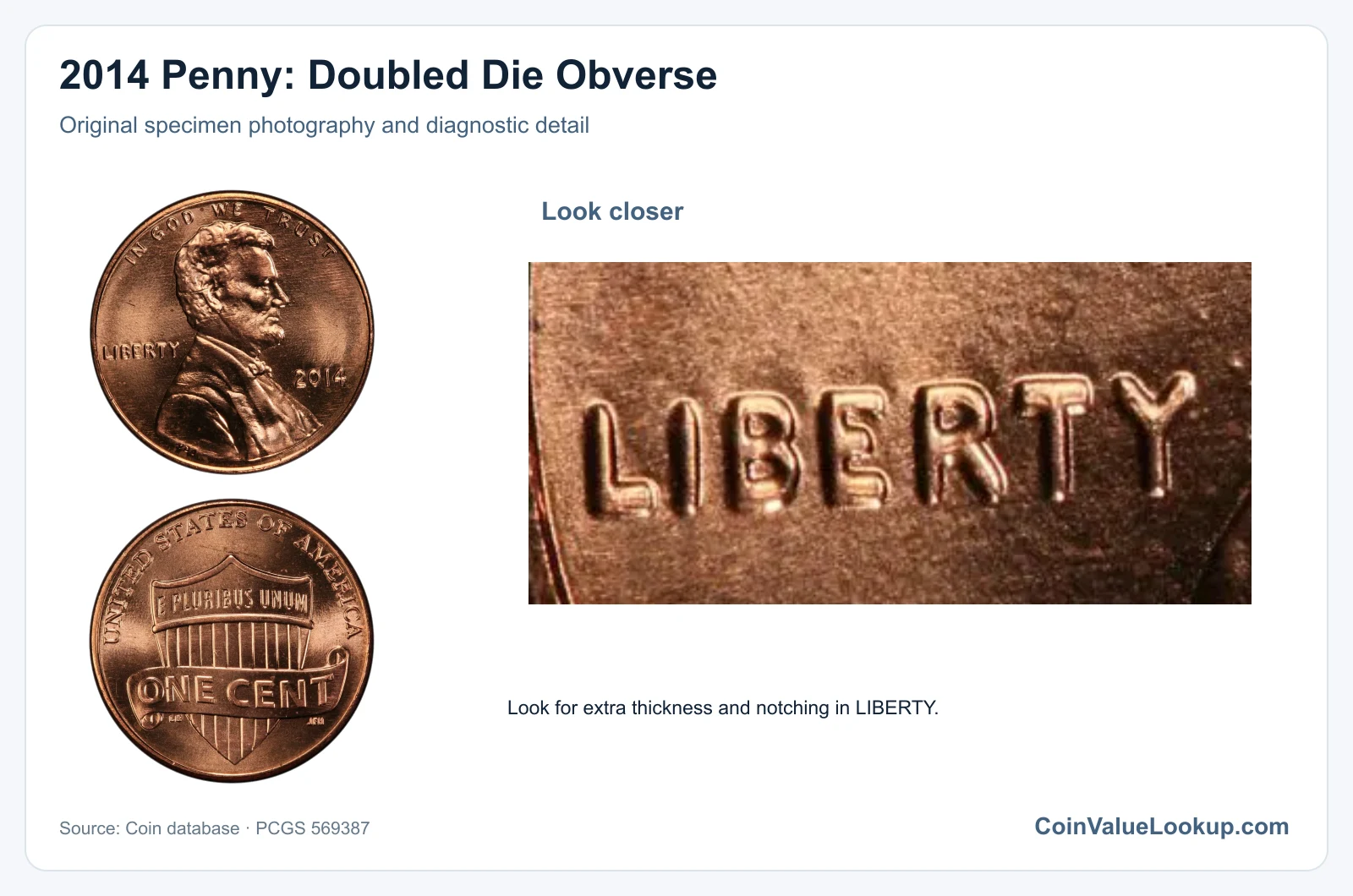
A doubled die obverse on a 2014 cent would show consistent doubling — separation, notching, or a second image — on obverse design elements such as lettering or the date. The key word is consistent: true hub doubling repeats in the same direction across multiple features because it originates from the die itself.
Machine doubling, which is far more common, produces a flat, shelf-like distortion usually visible on just one side of raised elements. It looks mushy rather than sharply separated.
Reflections under poor lighting or worn die contours can also mimic doubling to the untrained eye. Compare suspect areas to a known normal 2014 cent under the same light and magnification.
No specific price data is established for 2014 doubled die obverse cents; value would depend on the authenticated variety, the strength of the doubling, and the coin's grade.
7. 2014 Lincoln Penny — Feeder-Finger Marks
Feeder-finger marks are parallel, evenly spaced lines or impressions left on a planchet by the mechanical feeding mechanism that moves blanks into striking position. They are pressed into the surface before or during the strike, so they can appear beneath or integrated with the struck design rather than sitting on top like a post-mint scratch.
The pattern is the giveaway: look for multiple parallel lines with consistent spacing. Random handling scratches go in different directions, cleaning hairlines tend to radiate outward, and die-polish lines are usually finer and follow the die's contour.
Not every scratch on a coin is a feeder-finger mark, so careful comparison under magnification matters. Pricing for 2014 examples is not established; individual assessment based on authenticated identity and visual severity would apply.
8. 2014 Lincoln Penny — Clashed Dies
Clashed dies result when the obverse and reverse dies strike each other without a planchet between them. This transfers a ghost image of one die's design onto the other.
On a coin struck afterward from those clashed dies, you can see faint traces of the opposite design in the fields — for instance, a faint outline of Lincoln's profile might appear on the reverse.
These ghost impressions align with where the opposing design would naturally sit during a normal strike. That alignment is what separates a genuine clash from random scratches, raised lines, or a brockage (which involves a previously struck coin, not empty dies).
Check both sides of the coin under angled light to spot the transferred design elements. No specific price range is adopted for 2014 clashed-die cents; value depends on the strength of the clash impression, authenticated identity, and overall coin condition.