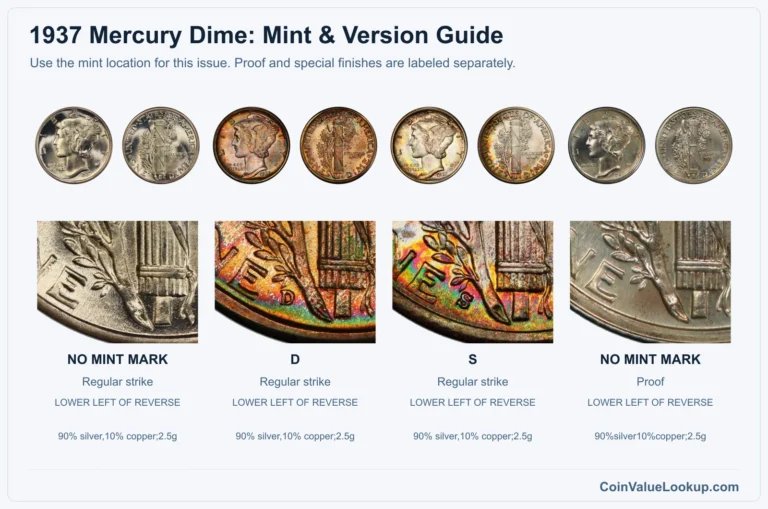
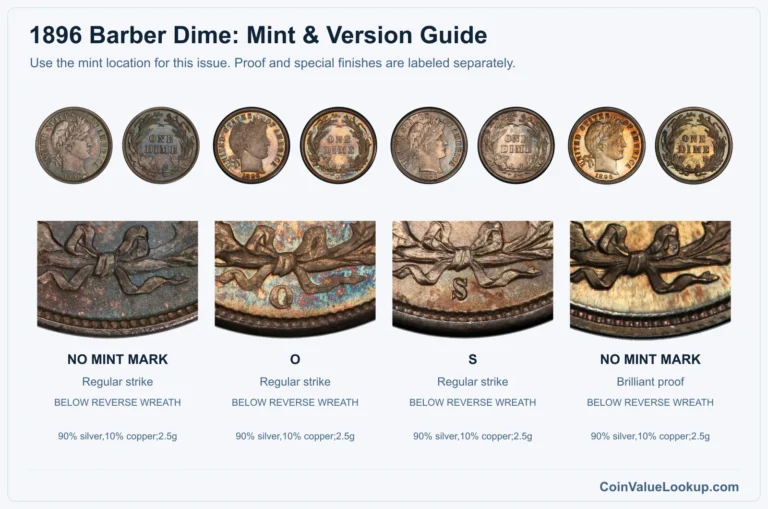
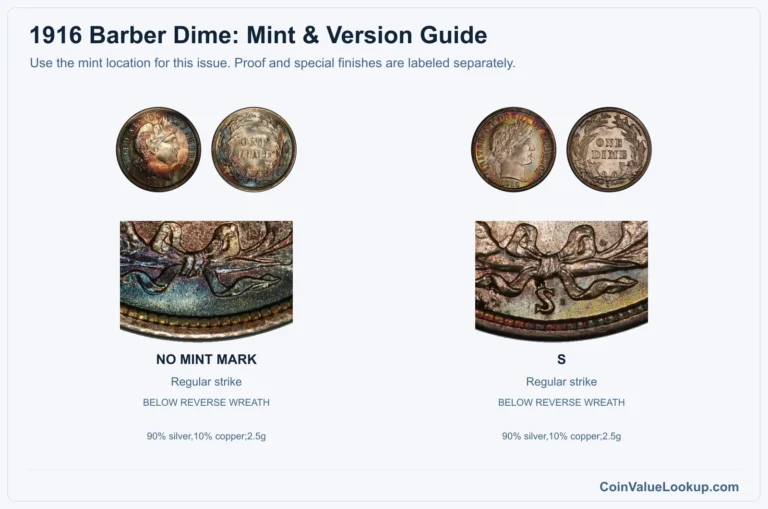
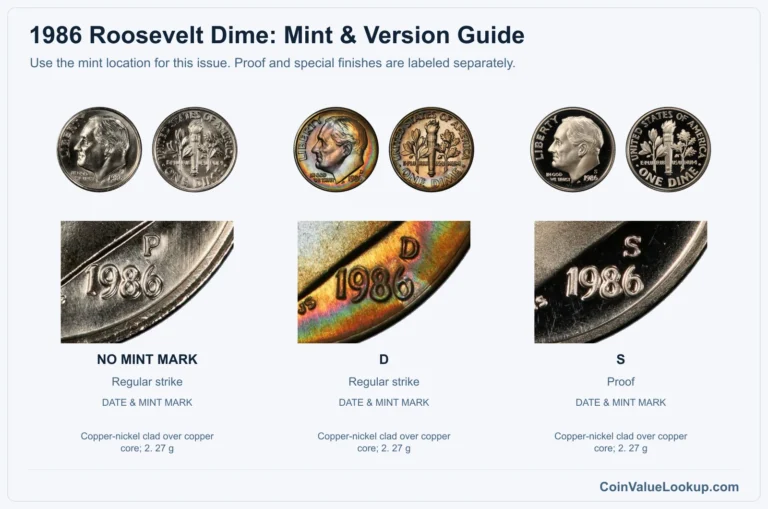
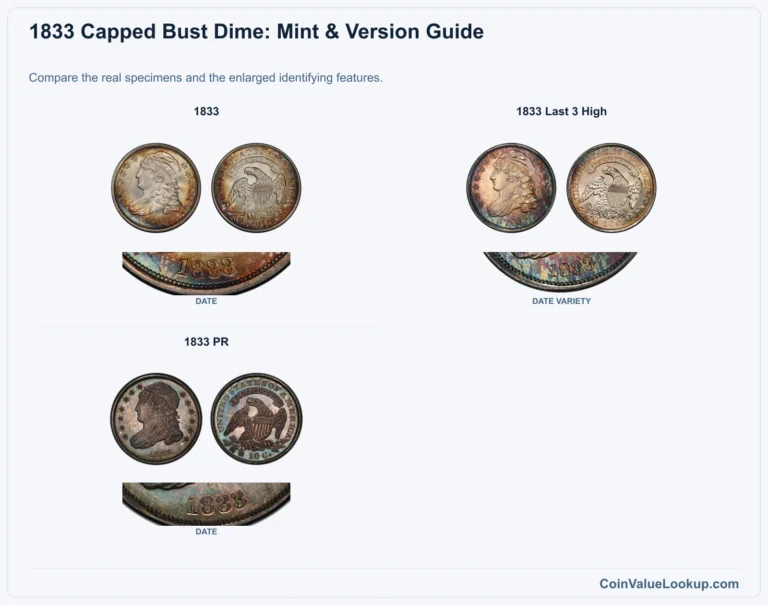
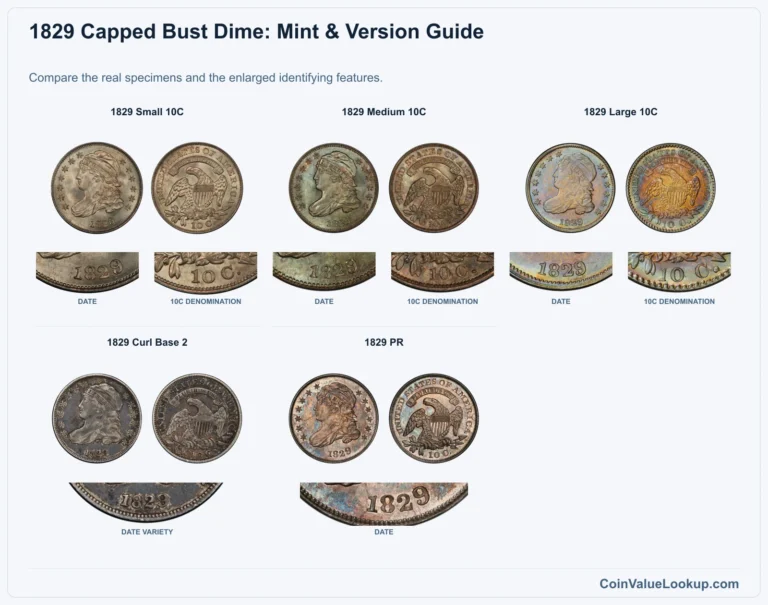
1852 Liberty Seated Dime Coin Value: How Much Is It Worth?
The 1852 Liberty Seated Dime spans a wide value range depending on mint, condition and variety. A USA Coin Book guide estimate places the Philadelphia issue at about $29 in G4 and $794 in MS63, while the New Orleans mint coin lists around $47 in G4 up to $4,371 in MS63.
Proof strikes from Philadelphia are rare and carry a separate price structure. Repunched dates, die cracks and cuds can also affect what your coin is worth.
Fast Way to Identify Your 1852 Liberty Seated Dime
The quickest way to start figuring out what you have is to upload clear photos of both the front and back of your coin. Our identifier can offer a preliminary identification of your coin's mint, design type and general condition based on those images.
It is not a substitute for professional authentication or precise grading, but it gives you a useful starting point before digging deeper.
1852 Liberty Seated Dime Value
Upload both sides of your 1852 Liberty Seated Dime.
Front Obverse
Upload photo
Back Reverse
Upload photo
Which 1852 Liberty Seated Dime Versions Are Worth Money?
- The 1852-O (New Orleans) regular issue lists at about $4,371 in MS63 per USA Coin Book, far above the Philadelphia version at the same grade, making high-grade O-mint coins worth close attention.
- Philadelphia Proof strikes from this era were not routine collector products; a PR63 example carries a PCGS guide value around $17,500, reflecting genuine rarity.
- Repunched date varieties show extra digit impressions near the final date and can carry a premium depending on visibility and condition.
- Die breaks that reach the rim, called cuds, leave a distinctive raised blob of metal and are collected as a separate category from interior cracks.
- Original surfaces and correct mint and design identification matter more than a shiny appearance; a cleaned or polished coin loses collector value even if it looks bright.
Step 1: Identify Your 1852 Liberty Seated Dime Mint Mark and Version
First, confirm you are looking at a Liberty Seated Dime and not a half dime. The reverse should read ONE DIME inside a small wreath, with a legend around the outside.
Next, check the date. It should clearly read 1852 below the seated figure of Liberty.
Now flip the coin over. Look below the wreath on the reverse for a mintmark.
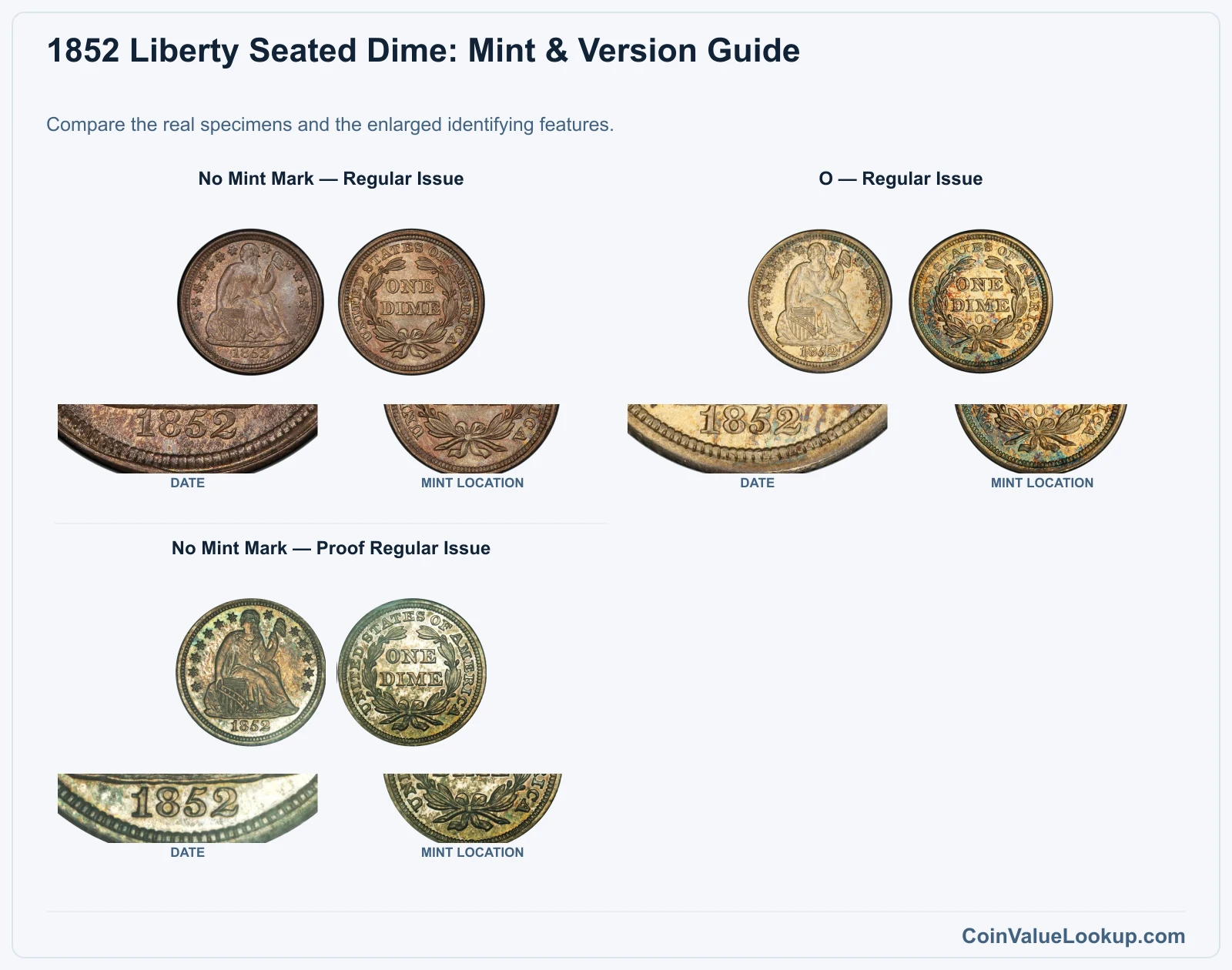
If there is no letter, you have a Philadelphia issue. A small "O" means New Orleans.
All 1852 dimes share the Stars Obverse, With Drapery subtype. The obverse has stars around the rim, and Liberty's elbow shows a small fold of drapery.
The coin is 90% silver and 10% copper, weighs about 2.67 grams, measures 17.9 mm across, and has a reeded edge.
Beyond mint identification, look closely for repunched date digits, raised die cracks or rim-connected die breaks. These are distinct varieties, not just wear, and they are covered in the error section below.
Step 2: Check Your 1852 Liberty Seated Dime Grade
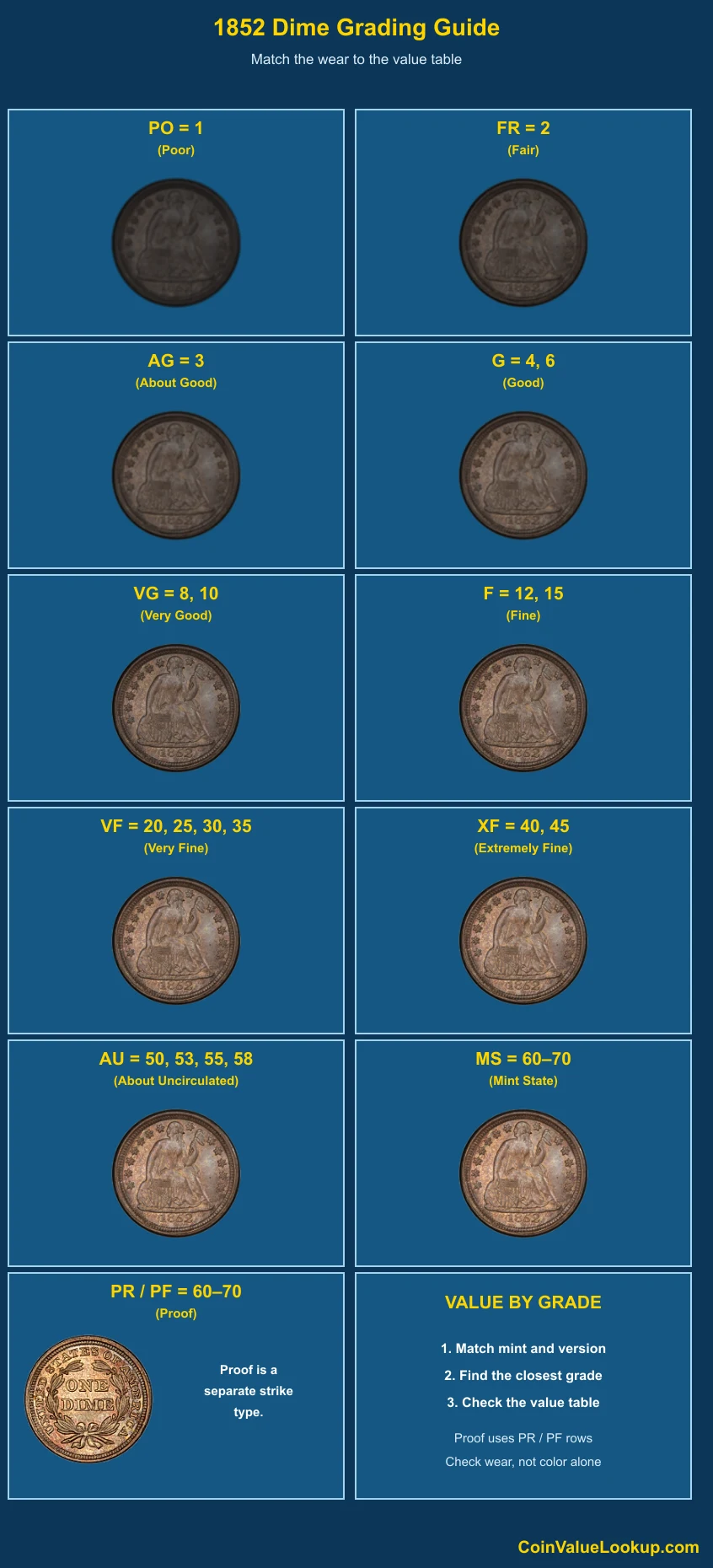
When grading an 1852 dime, compare your coin to the subtype-specific grading images. The key wear points on the obverse are Liberty's head, the shield on her arm, the gown folds near her knees and her feet.
On the reverse, check the wreath leaves, especially near the base.
A coin in G4 (Good) will show a clear outline of Liberty with most detail worn smooth. At MS63 (Mint State), you should see full original luster with only minor contact marks.
Separate actual circulation wear from weak strike or worn-die softness. A coin can look flat in certain areas because the die was tired, not because someone spent it.
Original luster is the giveaway: a weakly struck coin still has its mint sheen, while a circulated coin does not.
Polished coins are not Proofs. A genuine Proof has deeply mirrored fields from a specially prepared die, and hairlines from cleaning do not recreate that effect.
Keep Proof and Mint State evaluations on completely separate tracks.
Step 3: Check 1852 Liberty Seated Dime Value by Mint and Version
1852 Liberty Seated Dime — No Mint Mark — Regular Issue
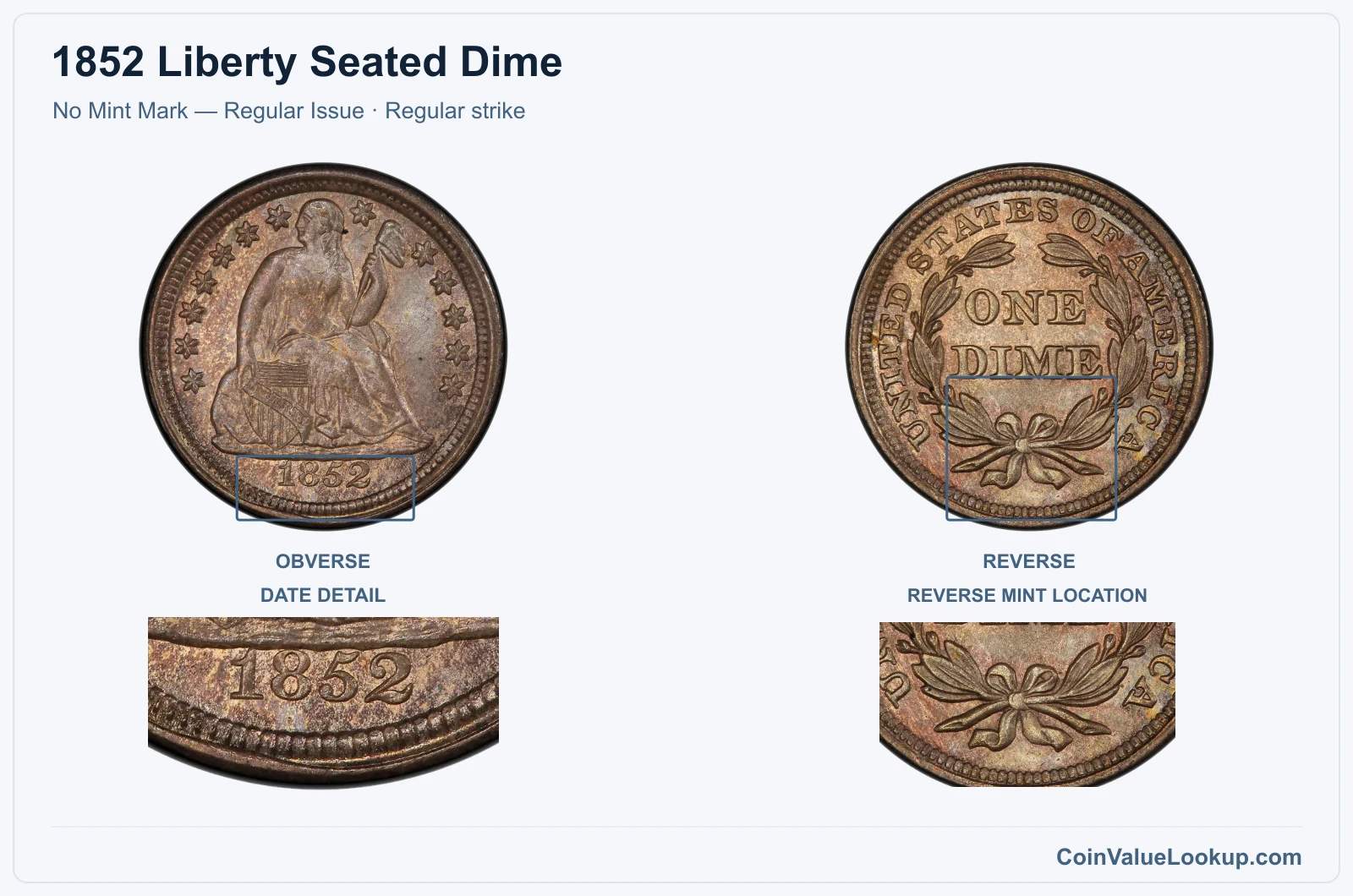
The Philadelphia regular issue has no mintmark anywhere on the coin. It uses the Stars Obverse with Drapery design: thirteen stars ring the seated Liberty on the front, and a small fold of drapery hangs from her elbow.
The reverse carries ONE DIME inside a wreath.
USA Coin Book lists this version at about $29 in G4 and around $794 in MS63. That is a big jump, so condition matters enormously.
Check for original luster and minimal contact marks before assuming a high grade.
The coin is 90% silver, 10% copper, with a nominal weight of 2.67 grams and a reeded edge. If the weight is significantly off, you may have a counterfeit or a heavily damaged piece.
Range Grade
Price Auction Records Appraisal PO PO 1
—
Coin Identifier FR FR 2
—
Coin Identifier AG AG 3
—
Coin Identifier G G 4
—
Coin Identifier
G 6
—
Coin Identifier VG VG 8
—
Coin Identifier
VG 10
—
Coin Identifier F F 12
—
Coin Identifier
F 15
—
Coin Identifier VF VF 20
—
Coin Identifier
VF 25
—
Coin Identifier
VF 30
Coin Identifier
VF 35
Coin Identifier XF XF 40
Coin Identifier
XF 45
Coin Identifier AU AU 50
—
Coin Identifier
AU 53
Coin Identifier
AU 55
Coin Identifier
AU 58
Coin Identifier MS MS 60
Coin Identifier
MS 61
Coin Identifier
MS 62
Coin Identifier
MS 63
Coin Identifier
MS 64
Coin Identifier
MS 65
Coin Identifier
MS 66
Coin Identifier
MS 67
Coin Identifier
MS 68
—
—
—
MS 69
—
—
—
MS 70
—
—
—
1852 Liberty Seated Dime — O — Regular Issue
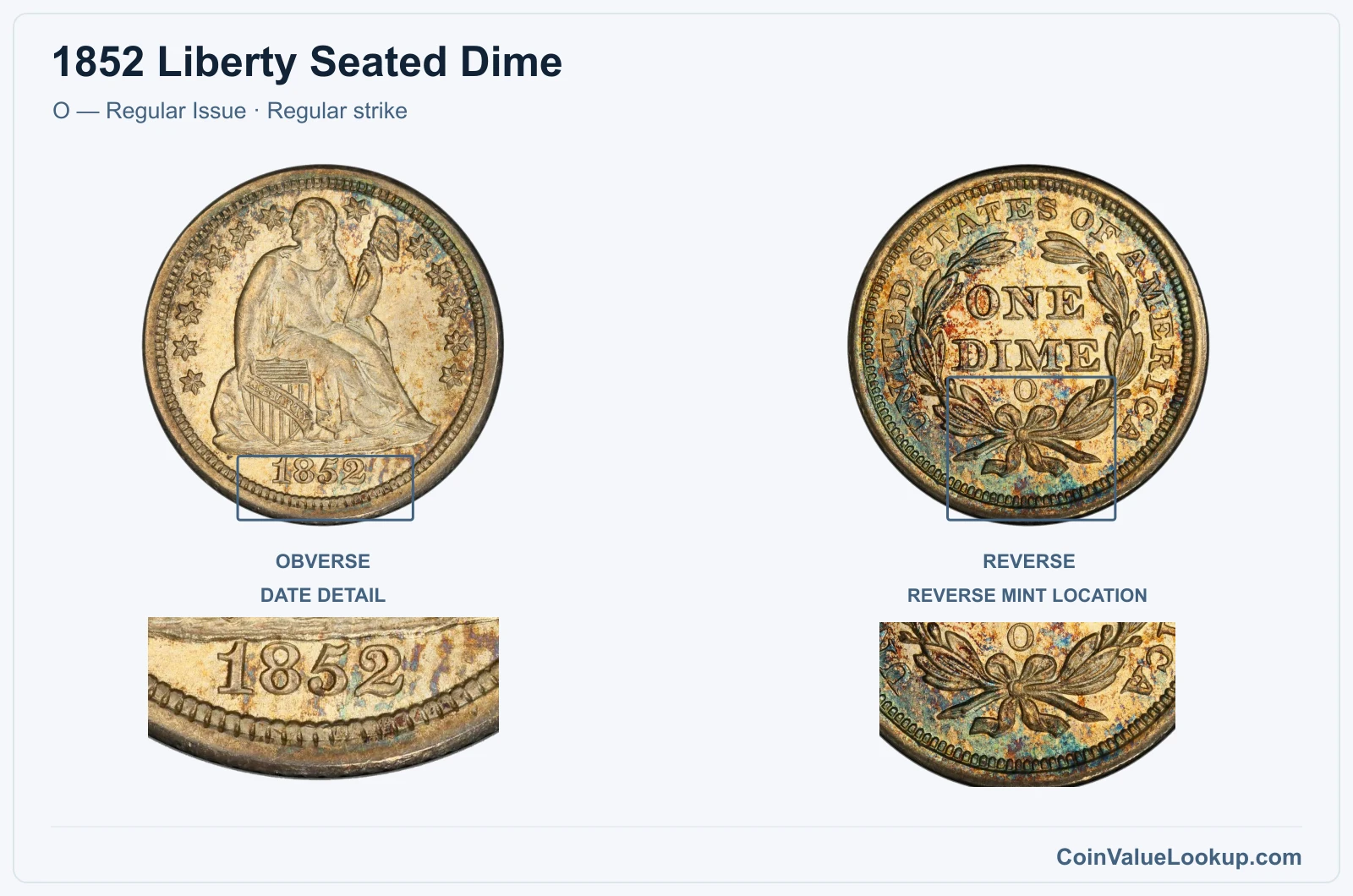
Look for a small "O" mintmark on the reverse, positioned below the wreath. That tells you the coin was struck at the New Orleans Mint.
The design is identical to the Philadelphia version: Stars Obverse with Drapery on the front, small wreath and ONE DIME legend on the back. Same 90% silver, 10% copper composition and 2.67-gram target weight.
Where it gets interesting is the price. USA Coin Book estimates about $47 in G4 and roughly $4,371 in MS63.
That MS63 figure dwarfs the Philadelphia version at the same grade. Surviving high-grade examples from New Orleans are simply harder to find, which drives the gap.
Coin Value Lookup is a useful place to look up value guides for other dates and mints in the Liberty Seated Dime series as you build out your knowledge.
Range Grade
Price Auction Records Appraisal PO PO 1
—
Coin Identifier FR FR 2
—
Coin Identifier AG AG 3
—
Coin Identifier G G 4
—
Coin Identifier
G 6
—
Coin Identifier VG VG 8
—
Coin Identifier
VG 10
—
Coin Identifier F F 12
Coin Identifier
F 15
Coin Identifier VF VF 20
—
Coin Identifier
VF 25
Coin Identifier
VF 30
Coin Identifier
VF 35
Coin Identifier XF XF 40
Coin Identifier
XF 45
Coin Identifier AU AU 50
Coin Identifier
AU 53
Coin Identifier
AU 55
Coin Identifier
AU 58
Coin Identifier MS MS 60
—
Coin Identifier
MS 61
Coin Identifier
MS 62
Coin Identifier
MS 63
—
Coin Identifier
MS 64
Coin Identifier
MS 65
Coin Identifier
MS 66
Coin Identifier
MS 67
—
—
—
MS 68
—
—
—
MS 69
—
—
—
MS 70
—
—
—
1852 Liberty Seated Dime — No Mint Mark — Proof Regular Issue
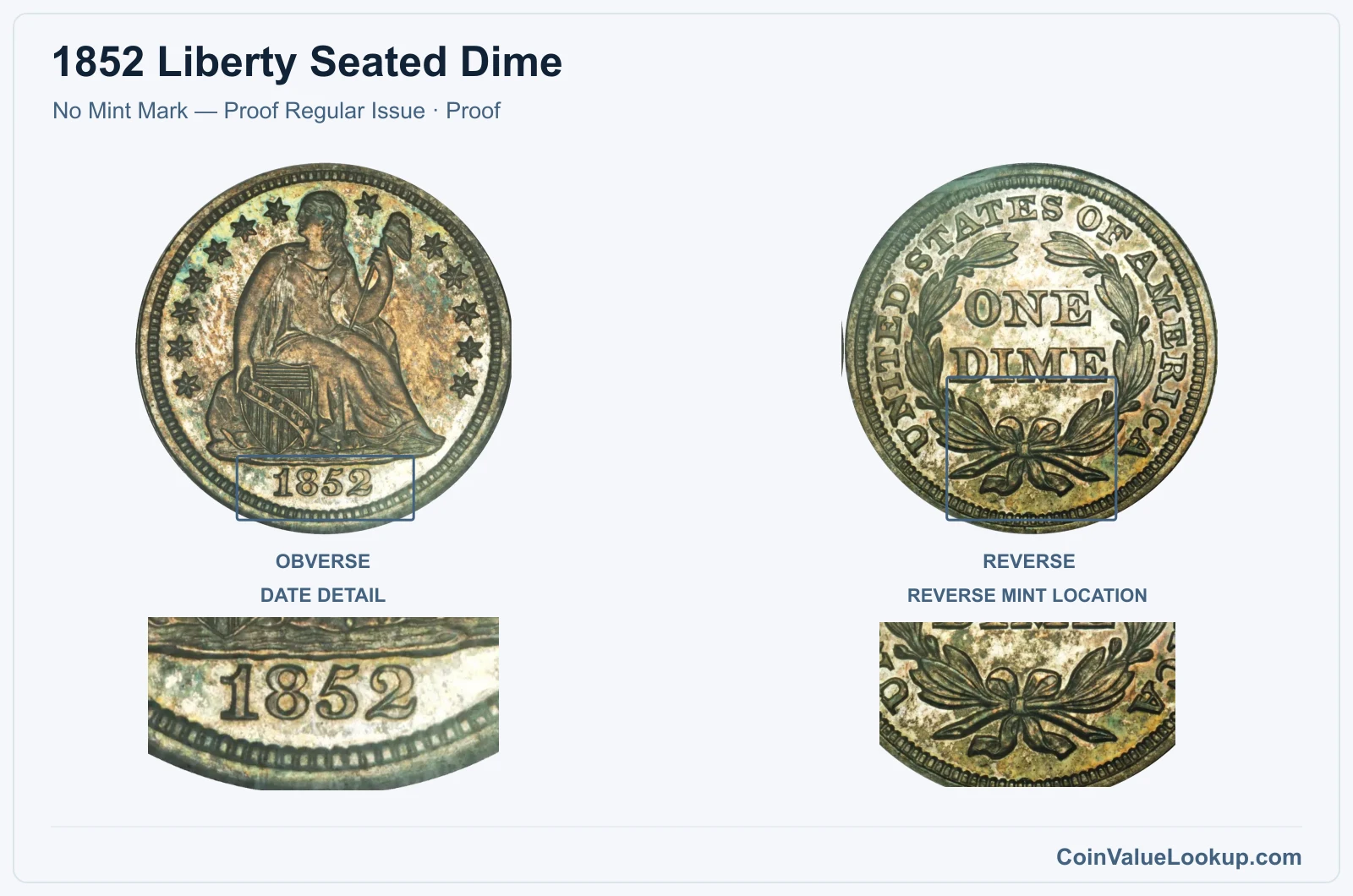
Proof 1852 dimes were struck at Philadelphia using specially prepared dies that produced deeply mirrored fields. There is no mintmark.
These are genuinely rare coins from an era when Proof production was not a routine annual program for collectors.
A PCGS guide estimate places a PR63 example at around $17,500. That is a single-grade anchor, not a guaranteed sale price, and actual results depend on eye appeal, toning and surface quality.
Do not confuse a polished circulation coin with a Proof. Real Proofs show a distinctive mirror-like depth in the flat fields that no amount of buffing can replicate.
If you suspect you have one, professional authentication is the logical next step. Cameo contrast, where the devices appear frosty against mirror fields, is a surface characteristic, not a separate mint or variety.
Range Grade
Price Auction Records Appraisal PR PR 1
—
Coin Identifier
PR 2
—
Coin Identifier
PR 3
—
Coin Identifier
PR 4
—
Coin Identifier
PR 6
—
Coin Identifier
PR 8
—
Coin Identifier
PR 10
—
Coin Identifier
PR 12
—
Coin Identifier
PR 15
—
Coin Identifier
PR 20
—
Coin Identifier
PR 25
—
Coin Identifier
PR 30
—
Coin Identifier
PR 35
—
Coin Identifier
PR 40
—
Coin Identifier
PR 45
—
Coin Identifier
PR 50
—
Coin Identifier
PR 53
—
Coin Identifier
PR 55
—
Coin Identifier
PR 58
—
Coin Identifier
PR 60
Coin Identifier
PR 61
—
Coin Identifier
PR 62
Coin Identifier
PR 63
—
Coin Identifier
PR 64
Coin Identifier
PR 65
Coin Identifier
PR 66
Coin Identifier
PR 67
—
—
—
PR 68
—
—
—
PR 69
—
—
—
PR 70
—
—
—
1852 Liberty Seated Dime Error List
1. 1852 Liberty Seated Dime — Repunched Date
A repunched date on an 1852 dime shows traces of an earlier position of one or more date digits sitting next to or overlapping the final numerals. The Mint punched dates into working dies by hand, and if the first impression landed slightly off, the correction left ghost images.
Look at each digit, especially the "1" and "8," under magnification. You may see a shadow or partial outline offset to one side.
This is different from machine doubling, which produces flat, shelf-like distortion across the whole design, and from post-mint damage such as a scratched or gouged date area.
No specific price range is adopted here. The value of a repunched date depends on how visible the extra impression is, the overall condition of the coin and collector demand for that particular variety.
Have the coin examined by a specialist if the doubling on the date is clear and distinct.
2. 1852 Liberty Seated Dime — Die Crack / Die Chip
Die cracks appear as thin, raised lines on the coin's surface. They form when a working die develops a fracture from repeated striking pressure.
A small raised blob, called a die chip, is a related defect where a tiny piece of the die face breaks away, leaving a raised lump on the struck coin.
On an 1852 dime, inspect both sides carefully under good light. Cracks often run between stars, from the rim toward the date, or across the wreath.
They are raised above the field, which distinguishes them from scratches or hairlines, which are incised into the surface. Corrosion or dirt deposits can also mimic a small chip, so clean viewing conditions matter.
No set price premium applies to every crack. The value depends on severity, location, and the coin's overall grade.
A dramatic crack commands more attention than a faint hairline fracture.
3. 1852 Liberty Seated Dime — Die Break / Cud
A cud is a major die break that connects to the rim. When a section of the die edge breaks away entirely, the corresponding area on every coin struck afterward shows a raised, featureless blob of metal fused to the rim.
It displaces part of the normal design, which is what makes it visually dramatic.
On an 1852 dime, check the entire rim on both sides. A cud will feel raised and smooth where design detail should be.
Its boundary against the remaining design is usually sharp and irregular.
Do not confuse a cud with a simple rim dent or ding from post-mint damage. Damage is pressed into the surface; a cud is raised from it.
An interior die chip that does not touch the rim is a different, lesser category. No numerical price is adopted here.
The premium depends on the cud's size, location, and the coin's condition, so individual assessment is necessary.