1937 Mercury Dime Coin Value: How Much Is It Worth?
The 1937 Mercury Dime is a common-date silver coin that still rewards a careful look. Guide estimates for regular business strikes run from about $5.73 in Good-4 to $60 in MS-65, depending on mint.
Philadelphia also produced proof strikes that year, and those carry a separate premium. Full Bands designations, mint errors and individual condition all shift the picture, so the details matter.
Fast Way to Identify Your 1937 Mercury Dime
Want a quick read on your 1937 dime? Upload clear photos of the front and back, and our identifier can give you a preliminary take on which mint and version you may be holding.
Good lighting and a steady shot help — get both sides in focus so the mintmark area and date are visible.
1937 Mercury Dime Value
Upload both sides of your 1937 Mercury Dime.
Front Obverse
Upload photo
Back Reverse
Upload photo
Which 1937 Mercury Dime Versions Are Worth Money?
- Philadelphia business strikes range from about $5.73 in G-4 to $41 in MS-65 per guide estimates — the most available version this year.
- Denver business strikes carry a guide estimate up to about $60 in MS-65, the highest regular-strike figure among the three mints.
- San Francisco business strikes list up to roughly $53 in MS-65, sitting between the Philadelphia and Denver figures.
- Philadelphia proof strikes are estimated around $643 in PR-65, a significant step above any business-strike version.
- Coins with a Full Bands designation can command premiums above the standard Mint State values shown here.
- Identified mint errors such as doubled dies or repunched mintmarks may carry additional value depending on visibility and condition.
Step 1: Identify Your 1937 Mercury Dime Mint Mark and Version
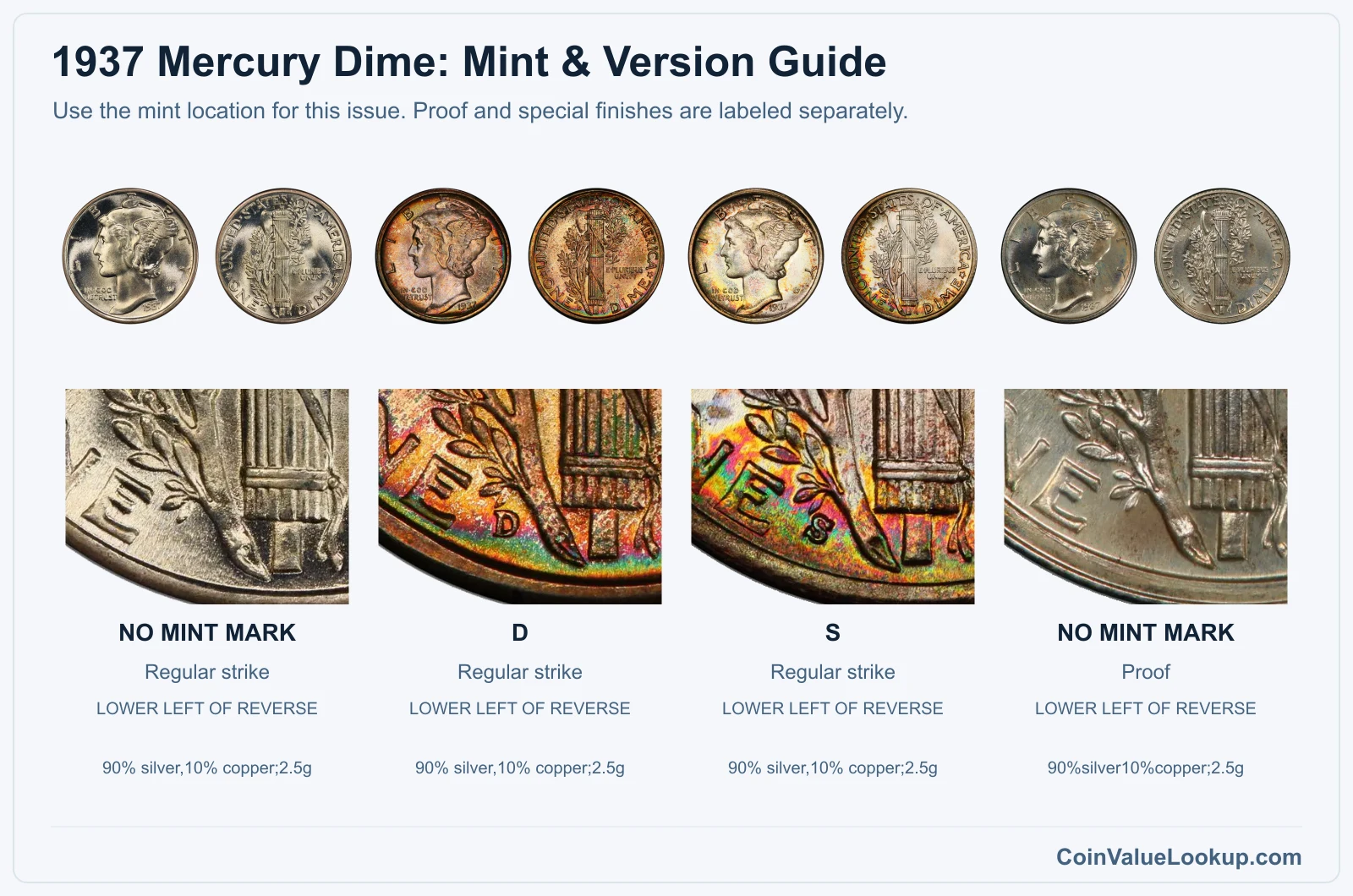
Three mints struck business dimes in 1937: Philadelphia, Denver and San Francisco. Philadelphia coins carry no mintmark.
Denver shows a small D and San Francisco an S, both found on the reverse at the lower left beside the word ONE.
The small AW on the obverse near the neck truncation is Adolph Weinman's designer monogram — it is not a mintmark or an error. Every version on this page is 90% silver and 10% copper, weighing about 2.5 grams with a reeded edge and a diameter of 17.9 mm.
Philadelphia also produced proof strikes in 1937. A proof is a manufacturing method, not a higher grade than Mint State, so it belongs in its own comparison lane.
If your coin has deeply reflective fields and razor-sharp rims, it may be a proof rather than a well-preserved business strike.
Step 2: Check Your 1937 Mercury Dime Grade
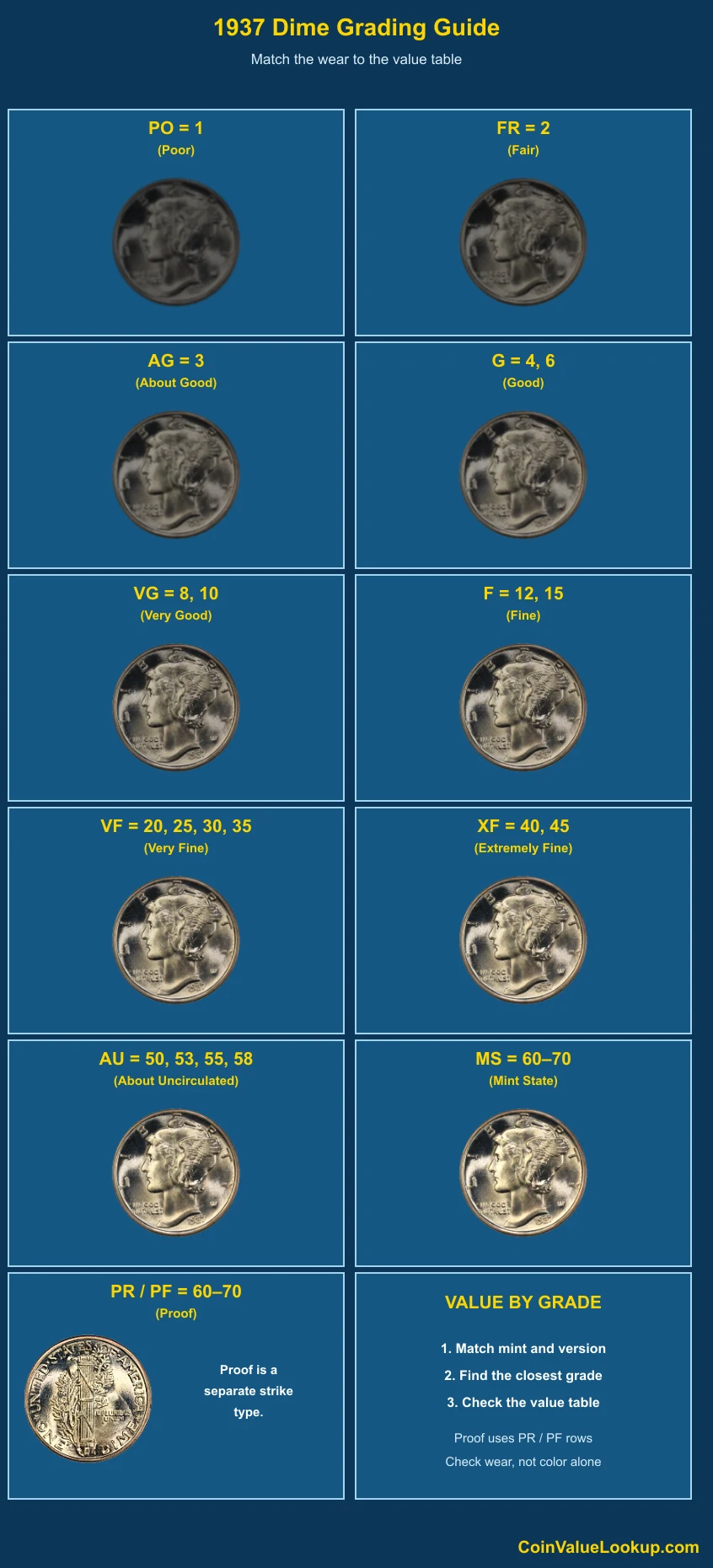
Start with Liberty's hair detail above and in front of the ear. On a well-worn coin that area flattens first, followed by the wing feathers on the cap.
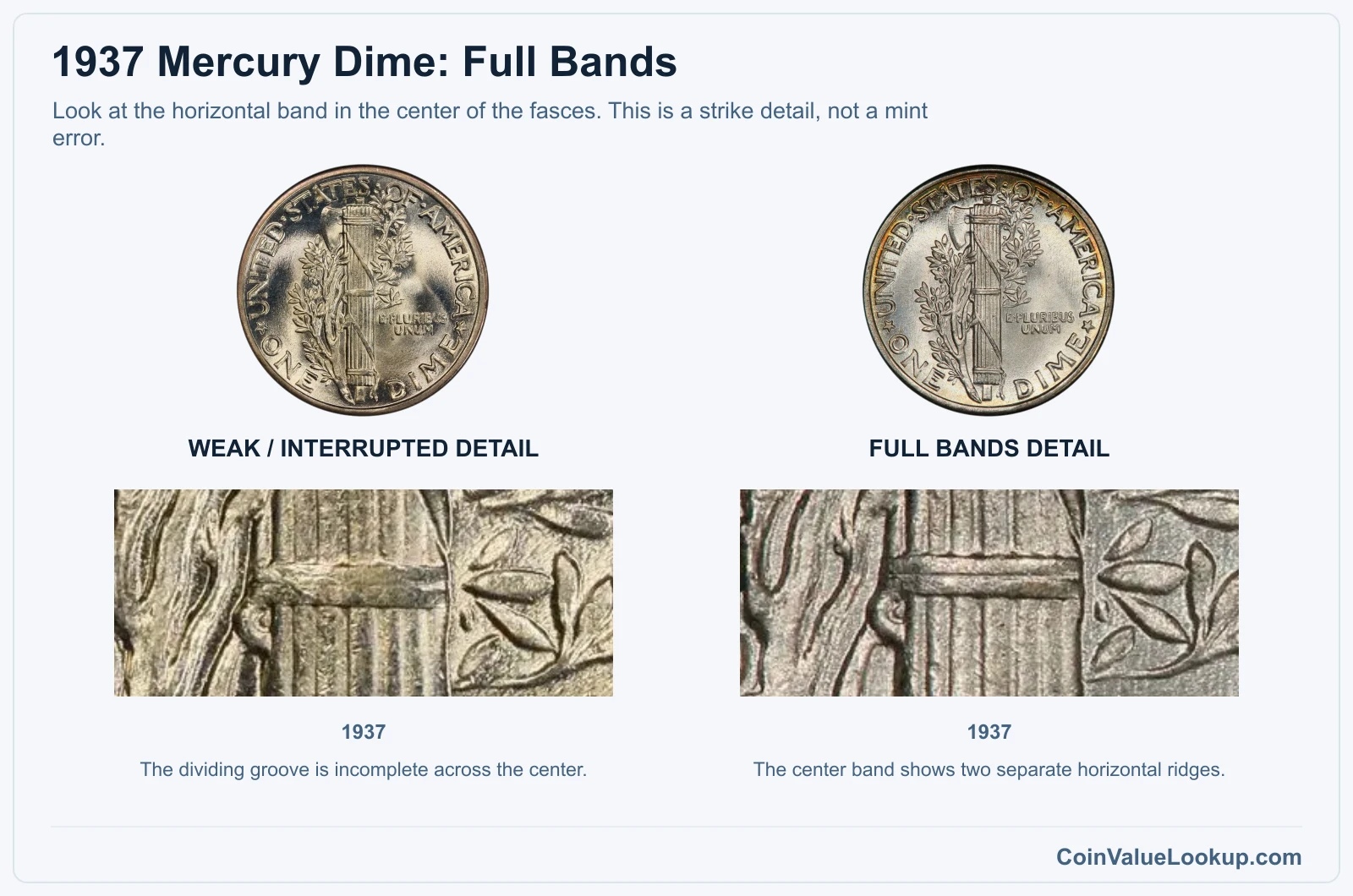
Flip it over and check the fasces — the horizontal bands across the center lose definition as the coin circulates.
Luster matters as much as detail. A coin can show full design yet have dull, cleaned surfaces that knock the grade down.
Contact marks from bag storage are normal on Mint State pieces but heavy ones still count against the grade.
Use the comparison image to match your coin's wear pattern. Weak bands or soft peripheral legends are not always from circulation; some branch-mint strikes simply came off the press that way.
Full Bands is a separate strike designation that NGC evaluates by checking band separation, and different grading services may apply slightly different criteria.
Step 3: Check 1937 Mercury Dime Value by Mint and Version
1937 Mercury Dime — No Mint Mark — Silver Circulation
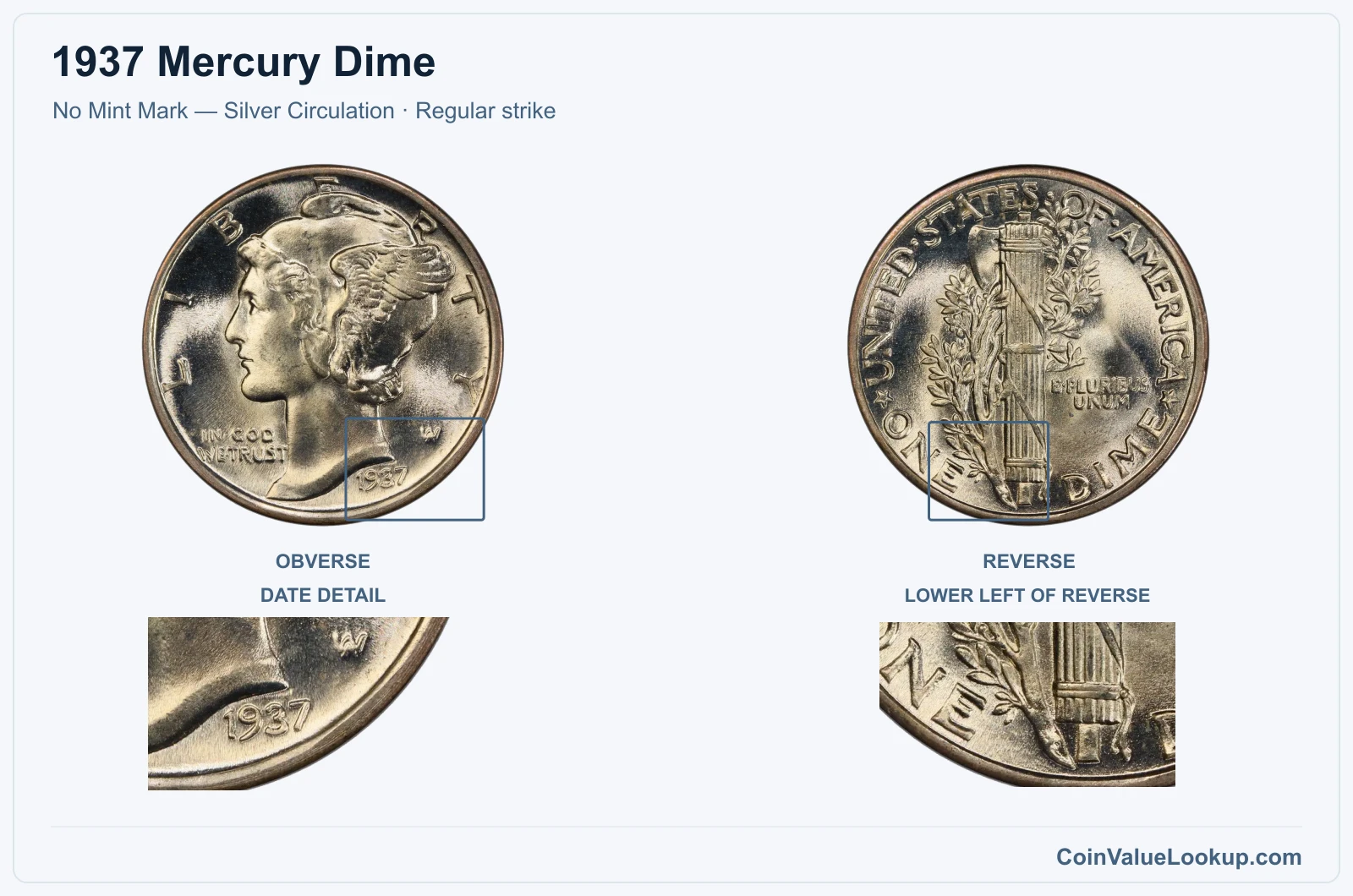
The no-mintmark Philadelphia business strike is the baseline 1937 Mercury Dime. Guide estimates place it at about $5.73 in Good-4 and around $41 in MS-65.
In lower grades the coin's value tracks close to its silver content, so condition is everything if you want to clear that floor.
Look at both sides under good light. The obverse should show the date clearly, and the reverse should have no mintmark near the base of the fasces.
A Full Bands designation can push the value above the standard MS-65 figure, but no separate FB price is provided here — treat it as its own comparison when you are ready to submit to a grading service.
Range Grade
Price Auction Records Appraisal PO PO 1
—
Coin Identifier FR FR 2
—
Coin Identifier AG AG 3
—
Coin Identifier G G 4
—
Coin Identifier
G 6
—
Coin Identifier VG VG 8
—
Coin Identifier
VG 10
—
Coin Identifier F F 12
—
Coin Identifier
F 15
—
Coin Identifier VF VF 20
—
Coin Identifier
VF 25
—
Coin Identifier
VF 30
—
Coin Identifier
VF 35
—
Coin Identifier XF XF 40
—
Coin Identifier
XF 45
—
Coin Identifier AU AU 50
—
Coin Identifier
AU 53
—
Coin Identifier
AU 55
Coin Identifier
AU 58
Coin Identifier MS MS 60
Coin Identifier
MS 61
—
Coin Identifier
MS 62
Coin Identifier
MS 63
Coin Identifier
MS 64
Coin Identifier
MS 65
Coin Identifier
MS 66
Coin Identifier
MS 67
Coin Identifier
MS 68
Coin Identifier
MS 69
—
—
—
MS 70
—
—
—
1937 Mercury Dime — D — Silver Circulation
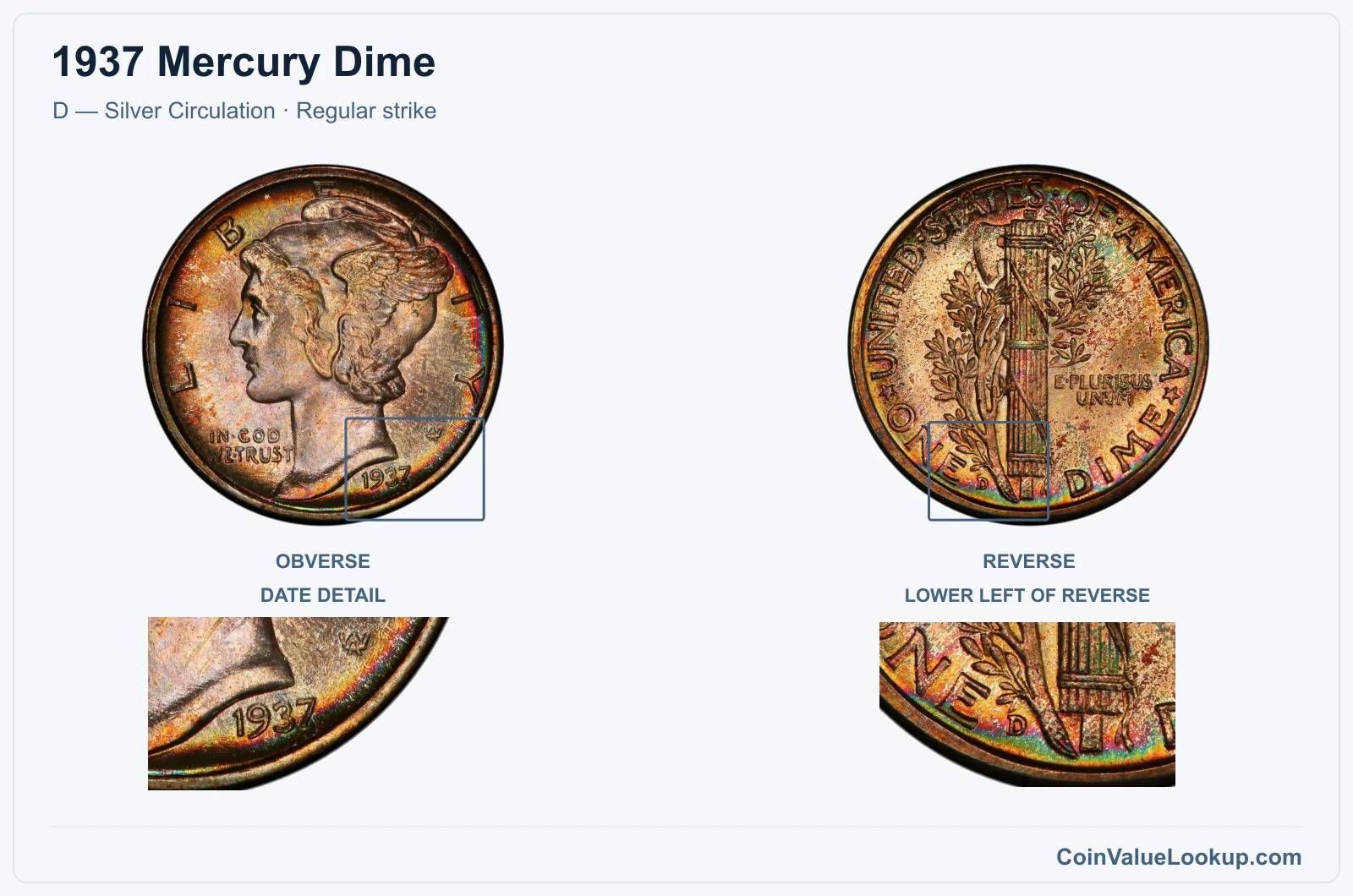
Denver strikes carry a small D on the lower-left reverse. Guide estimates run from about $5.73 in G-4 up to roughly $60 in MS-65, the highest business-strike figure for 1937.
Why the premium over Philadelphia? Denver dimes from this era sometimes came with softer strikes, so a genuinely sharp MS-65 example stands out.
Check the fasces bands carefully — a well-struck Denver coin with full separation is less routine than you might expect. As with the Philadelphia version, Full Bands adds a layer of value beyond the standard Mint State estimate, but no FB-specific price is provided here.
Coin Value Lookup can help you look up guides for other Mercury Dime dates and mints if you are working through a collection.
Range Grade
Price Auction Records Appraisal PO PO 1
—
Coin Identifier FR FR 2
—
Coin Identifier AG AG 3
—
Coin Identifier G G 4
—
Coin Identifier
G 6
—
Coin Identifier VG VG 8
—
Coin Identifier
VG 10
—
Coin Identifier F F 12
—
Coin Identifier
F 15
—
Coin Identifier VF VF 20
—
Coin Identifier
VF 25
—
Coin Identifier
VF 30
—
Coin Identifier
VF 35
—
Coin Identifier XF XF 40
—
Coin Identifier
XF 45
—
Coin Identifier AU AU 50
—
Coin Identifier
AU 53
—
Coin Identifier
AU 55
—
Coin Identifier
AU 58
Coin Identifier MS MS 60
—
Coin Identifier
MS 61
—
Coin Identifier
MS 62
Coin Identifier
MS 63
Coin Identifier
MS 64
Coin Identifier
MS 65
Coin Identifier
MS 66
Coin Identifier
MS 67
Coin Identifier
MS 68
Coin Identifier
MS 69
—
—
—
MS 70
—
—
—
1937 Mercury Dime — S — Silver Circulation
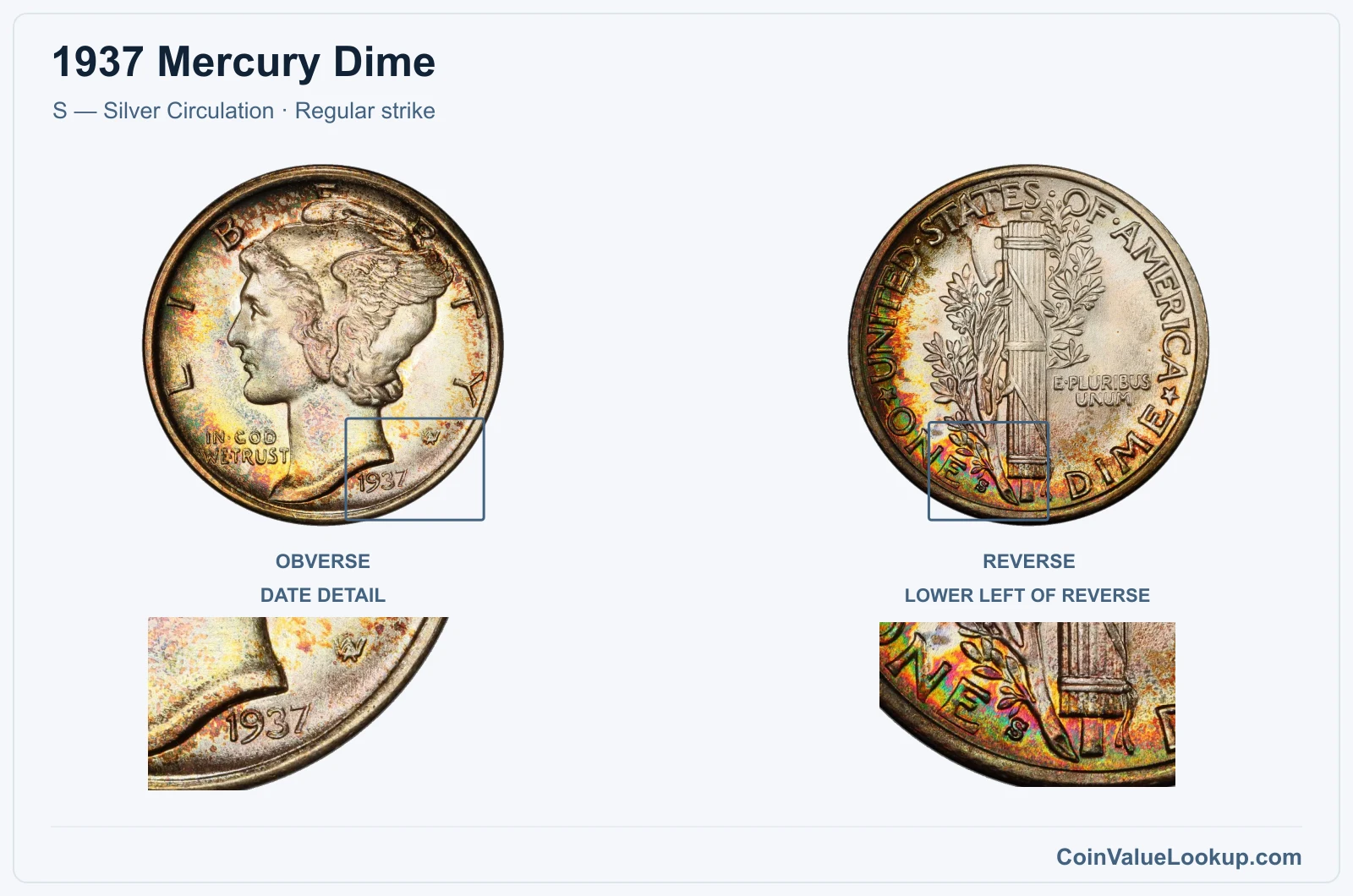
San Francisco's 1937 dime shows an S mintmark at the lower-left reverse. Guide estimates range from about $5.73 in G-4 to around $53 in MS-65, landing between the Philadelphia and Denver figures.
San Francisco strikes of this period can be inconsistent in sharpness, so do not assume a soft strike means heavy wear. Compare your coin's hair detail and fasces bands against the grading image before deciding.
Full Bands examples again trade at their own level, though no separate FB price is available from the guide data used here.
Range Grade
Price Auction Records Appraisal PO PO 1
—
Coin Identifier FR FR 2
—
Coin Identifier AG AG 3
—
Coin Identifier G G 4
—
Coin Identifier
G 6
—
Coin Identifier VG VG 8
—
Coin Identifier
VG 10
—
Coin Identifier F F 12
—
Coin Identifier
F 15
—
Coin Identifier VF VF 20
—
Coin Identifier
VF 25
—
Coin Identifier
VF 30
—
Coin Identifier
VF 35
—
Coin Identifier XF XF 40
—
Coin Identifier
XF 45
—
Coin Identifier AU AU 50
—
Coin Identifier
AU 53
—
Coin Identifier
AU 55
Coin Identifier
AU 58
Coin Identifier MS MS 60
—
Coin Identifier
MS 61
—
Coin Identifier
MS 62
—
Coin Identifier
MS 63
—
Coin Identifier
MS 64
Coin Identifier
MS 65
Coin Identifier
MS 66
Coin Identifier
MS 67
Coin Identifier
MS 68
Coin Identifier
MS 69
—
—
—
MS 70
—
—
—
1937 Mercury Dime — No Mint Mark — Silver Proof
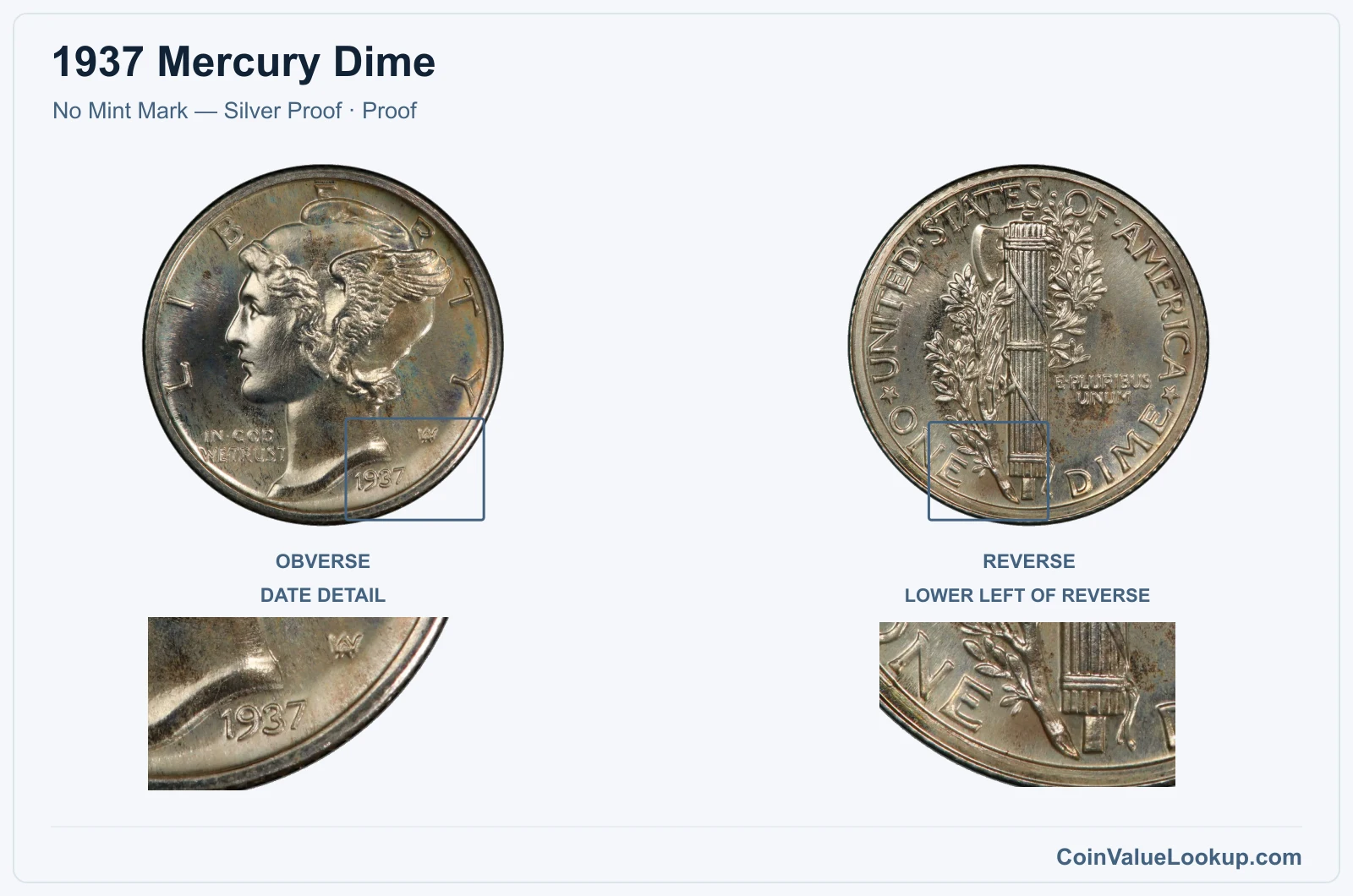
Philadelphia produced proof Mercury Dimes from 1936 through 1942, and the 1937 is part of that run. These are brilliant silver proofs with deeply mirrored fields and crisp, squared-off rims that business strikes simply do not have.
A guide estimate places the PR-65 value at about $643.
Proof is a manufacturing category, not a grade above Mint State. A proof can still have contact marks or haze that lower its assigned number.
If your coin has flashy, reflective surfaces and every design element is knife-sharp, compare it against known proof images before assuming it is just a nice business strike. Cameo contrast — frosted devices against mirror fields — may appear on some examples, though no separate cameo price is provided here.
Range Grade
Price Auction Records Appraisal PR PR 1
—
Coin Identifier
PR 2
—
Coin Identifier
PR 3
—
Coin Identifier
PR 4
—
Coin Identifier
PR 6
—
Coin Identifier
PR 8
—
Coin Identifier
PR 10
—
Coin Identifier
PR 12
—
Coin Identifier
PR 15
—
Coin Identifier
PR 20
—
Coin Identifier
PR 25
—
Coin Identifier
PR 30
—
Coin Identifier
PR 35
—
Coin Identifier
PR 40
—
Coin Identifier
PR 45
—
Coin Identifier
PR 50
—
Coin Identifier
PR 53
Coin Identifier
PR 55
—
Coin Identifier
PR 58
—
Coin Identifier
PR 60
Coin Identifier
PR 61
Coin Identifier
PR 62
Coin Identifier
PR 63
Coin Identifier
PR 64
Coin Identifier
PR 65
Coin Identifier
PR 66
Coin Identifier
PR 67
Coin Identifier
PR 68
Coin Identifier
PR 69
—
—
—
PR 70
—
—
—
1937 Mercury Dime Error List
1. 1937 Mercury Dime — Doubled Die Obverse
A Doubled Die Obverse on a 1937 dime shows consistent doubling on obverse letters or design elements. Under magnification, look for separation or notching on inscriptions like LIBERTY or IN GOD WE TRUST.
The doubling should repeat in the same direction across multiple letters — that consistency is the hallmark of a genuine hub-doubled die.
The main lookalike is machine doubling, which tends to produce a flat, shelf-like distortion rather than distinct separated outlines. Reflections, worn die contours and post-strike damage can also mimic doubling at first glance.
Value depends on the visibility of the doubling and the coin's overall condition; no specific price range is available, so individual assessment by a grading service is the best path if you think you have one.
2. 1937 Mercury Dime — Off-Center Strike
An off-center strike happens when the planchet is not seated properly between the dies. The result is a displaced design with a blank, unstruck crescent on one side.
On a 1937 dime, the key factor for collectibility is whether the date remains visible — without it, the coin loses most of its appeal.
Do not confuse an off-center strike with a clipped planchet or one-sided die misalignment. Post-mint flattening from a vise or similar tool can also shift the appearance.
A genuine off-center strike shows a clean, uniform blank area rather than a damaged or filed edge. Exact value depends on the percentage of offset and overall condition; no price range is provided here, so have a professional examine the coin if the offset is significant.
3. 1937 Mercury Dime — Clipped Planchet
A clipped planchet means a piece of the blank was missing before the coin was struck. On a 1937 dime, look for a curved, straight or irregular absence along the edge.
The metal near the clip often shows a slight weakness on the opposite side of the coin where the dies could not fully compress the thinner area.
Edge texture helps separate a real clip from post-mint damage. A genuine clip will show undisturbed original edge flow, while a filed notch or deliberate cut leaves tool marks.
Corrosion can eat away an edge too, but it usually leaves rough, pitted surfaces rather than the smooth contour of a planchet clip. Value varies with size and placement; no specific price is available, so condition and visual impact drive the conversation.
4. 1937 Mercury Dime — Repunched Mintmark
A repunched mintmark is specific to the 1937-D dime. During production, mintmarks were hand-punched into the working die, and sometimes the punch landed in a slightly different spot on a second attempt.
The result is remnants of an extra mintmark visible under magnification near the primary D.
To spot one, compare the D on your coin against a normal 1937-D at the same magnification. Look for a secondary outline, a notch or a shadow that sits at a consistent offset from the main letter.
Machine doubling can blur or shelf the mintmark, but it lacks the distinct second-punch character. A die chip or localized corrosion around the mark can also fool you.
No price range is available for this variety, so value depends on the clarity of the repunch and the coin's overall grade.