1872 Liberty Seated Dime Coin Value: How Much Is It Worth?
The 1872 Liberty Seated Dime spans a wide value range depending on mint and condition. A Philadelphia regular issue starts around $26 in G4, while the scarce Carson City version can reach an estimated $278,927 at MS63 according to USA Coin Book guide figures.
San Francisco and Proof strikes fill out the middle ground.
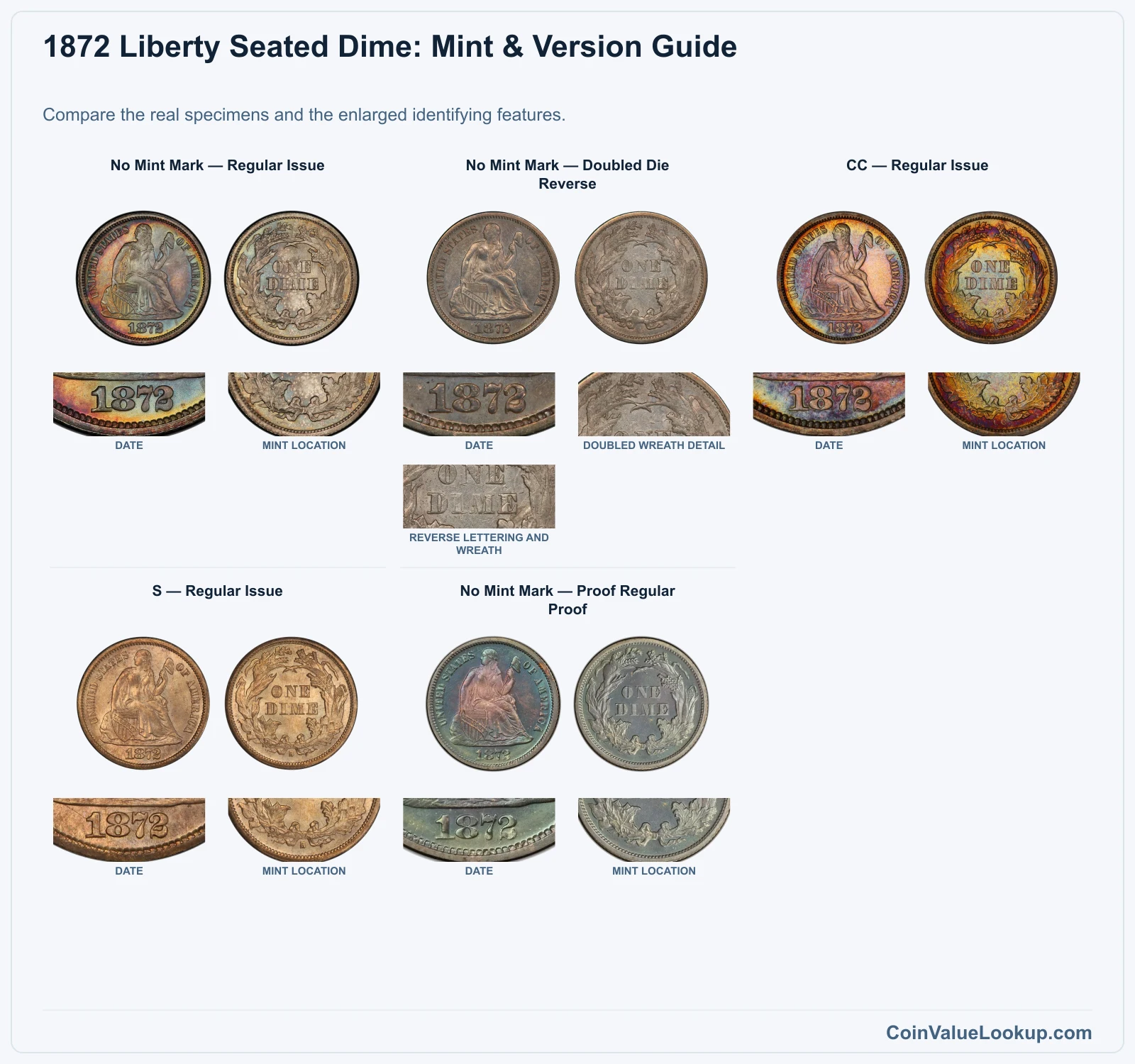
Three mints produced dimes this year, and a recognized doubled die reverse variety from Philadelphia adds another layer of collectibility. Sorting out which version you have is the first step toward understanding what your coin might be worth.
Fast Way to Identify Your 1872 Liberty Seated Dime
The quickest way to start identifying your 1872 Seated Dime is to upload clear photos of the front and back. Our identifier can offer a preliminary read on the mint, version and approximate condition from those images alone.
It does not replace professional authentication or exact grading, but it gives you a useful starting point before you dig deeper.
1872 Liberty Seated Dime Value
Upload both sides of your 1872 Liberty Seated Dime.
Front Obverse
Upload photo
Back Reverse
Upload photo
Which 1872 Liberty Seated Dime Versions Are Worth Money?
- The Carson City (CC) regular issue is the rarest mint for 1872, with guide values from about $1,882 at G4 to $278,927 at MS63.
- The Philadelphia Doubled Die Reverse carries a significant premium over the normal strike, estimated at $126 in G4 and $4,946 at MS63.
- San Francisco (S) regular issues are more affordable but still climb steeply in higher grades, reaching an estimated $4,250 at MS63.
- Philadelphia Proof dimes in PR63 carry a guide estimate around $725, reflecting their limited original production for collectors.
- Several die errors including repunched dates, misplaced dates and die cracks have been reported for this year and can add value depending on visibility and condition.
Step 1: Identify Your 1872 Liberty Seated Dime Mint Mark and Version
The 1872 dime shows a seated Liberty figure on the obverse with a legend around the border and the date below. The reverse carries the words ONE DIME inside an agricultural wreath.
All regular issues are struck in 90% silver and 10% copper, weigh about 2.49 grams and measure 17.9mm with a reeded edge.
Mintmark location is key. Philadelphia coins carry no mintmark at all.
San Francisco pieces show a small "S" on the reverse, and Carson City coins display "CC" in the same position within the wreath. If you see no mintmark, you still need to check the reverse carefully for signs of a doubled die, which is a recognized variety for this year.
Don't confuse this coin with the smaller Liberty Seated half dime, which has a different denomination inscription and diameter. The ONE DIME reverse legend confirms you have the right series.
Step 2: Check Your 1872 Liberty Seated Dime Grade
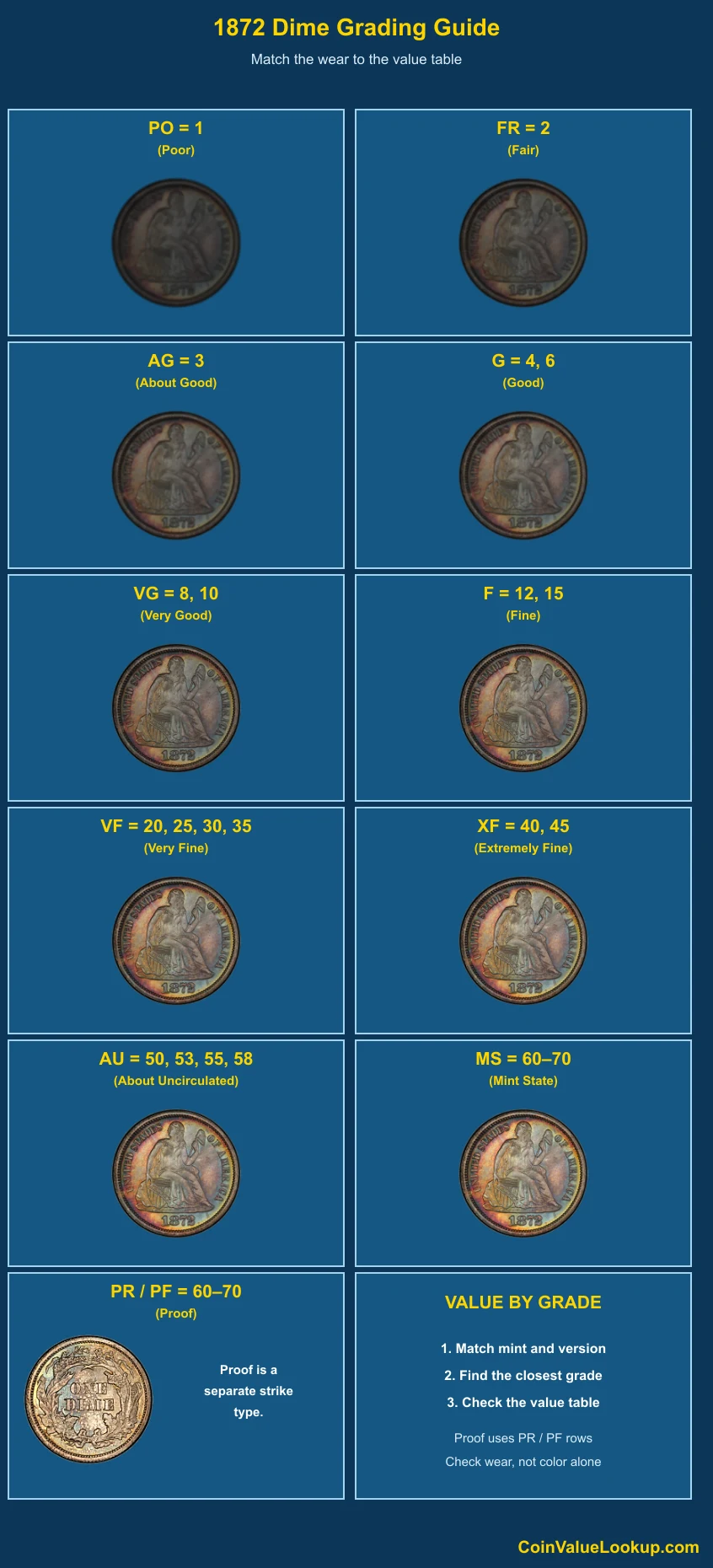
Start by looking at the high points on both sides. On the obverse, Liberty's head, the area across her breast and knee, and the shield on her lap wear first.
On the reverse, the highest wreath leaves lose detail before anything else.
Compare your coin to the reference image. A G4 coin will show a clear outline of Liberty but most interior detail is gone.
Moving up through VG and Fine, the shield lines and gown folds gradually emerge.
Luster matters just as much as detail. A coin can have sharp design elements but dull, cleaned surfaces, which drags the grade down.
Conversely, some pieces come weakly struck from tired dies, leaving soft features even without wear.
Polished coins are not Proofs. Proof is a specific manufacturing method, not a condition grade above Mint State.
If your coin has mirror-like fields, look for the telltale signs of deliberate die preparation rather than buffing marks from someone's attempt at restoration.
Step 3: Check 1872 Liberty Seated Dime Value by Mint and Version
1872 Liberty Seated Dime — No Mint Mark — Regular Issue
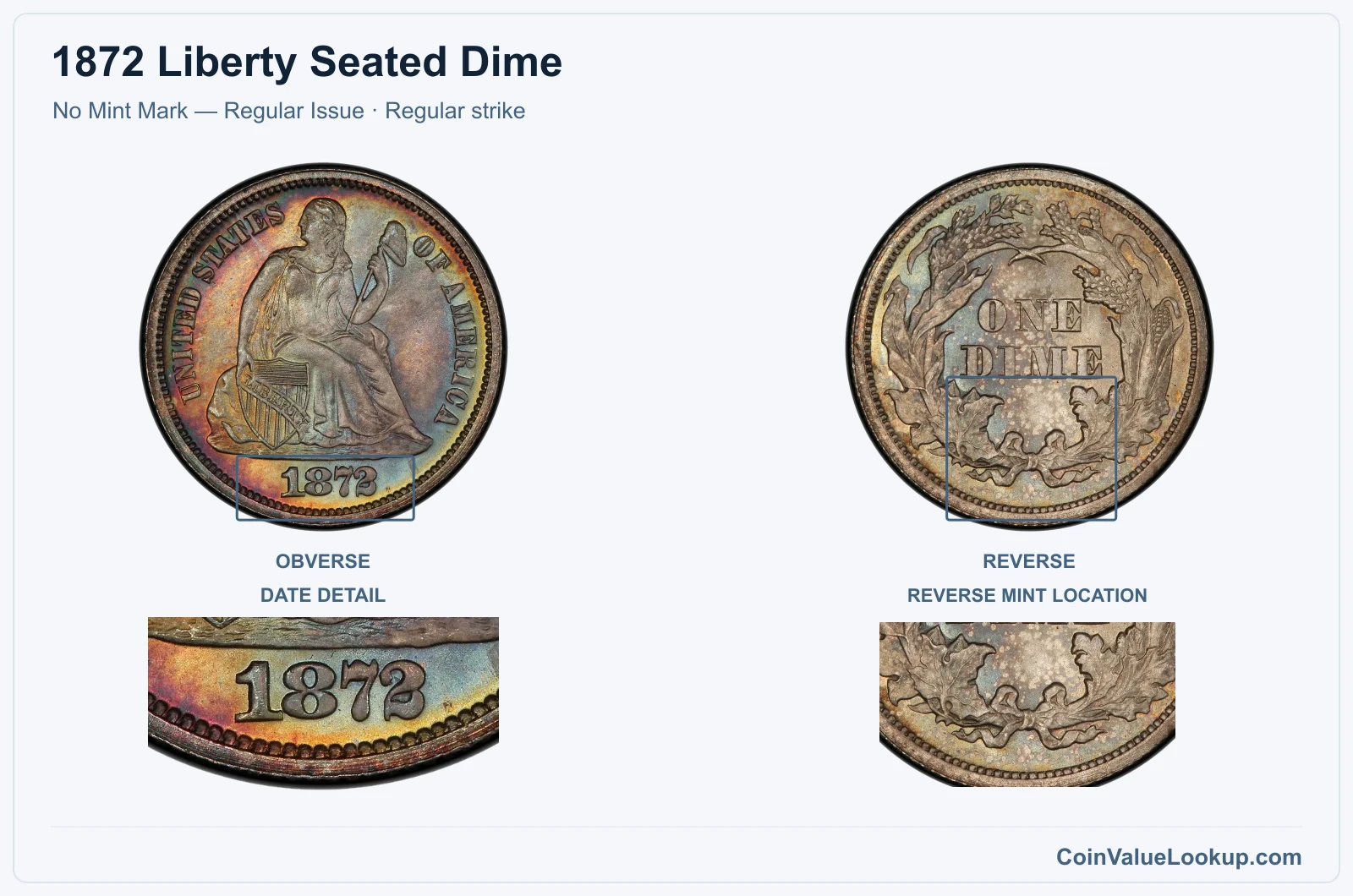
The Philadelphia regular issue carries no mintmark on either side. In well-worn G4 condition, USA Coin Book estimates about $26, climbing to roughly $379 at the MS63 level.
This is the most available mint for the year and the baseline against which you compare the other versions.
Look at the reverse carefully before filing this one away as ordinary. The doubled die reverse variety also comes from Philadelphia with no mintmark, so the absence of a mint letter does not rule out a premium coin.
Range Grade
Price Auction Records Appraisal PO PO 1
—
Coin Identifier FR FR 2
—
Coin Identifier AG AG 3
—
Coin Identifier G G 4
—
Coin Identifier
G 6
—
Coin Identifier VG VG 8
—
Coin Identifier
VG 10
—
Coin Identifier F F 12
—
Coin Identifier
F 15
—
Coin Identifier VF VF 20
—
Coin Identifier
VF 25
—
Coin Identifier
VF 30
—
Coin Identifier
VF 35
—
Coin Identifier XF XF 40
—
Coin Identifier
XF 45
—
Coin Identifier AU AU 50
—
Coin Identifier
AU 53
Coin Identifier
AU 55
Coin Identifier
AU 58
Coin Identifier MS MS 60
—
Coin Identifier
MS 61
Coin Identifier
MS 62
Coin Identifier
MS 63
Coin Identifier
MS 64
Coin Identifier
MS 65
Coin Identifier
MS 66
Coin Identifier
MS 67
Coin Identifier
MS 68
Coin Identifier
MS 69
—
—
—
MS 70
—
—
—
1872 Liberty Seated Dime — No Mint Mark — Doubled Die Reverse
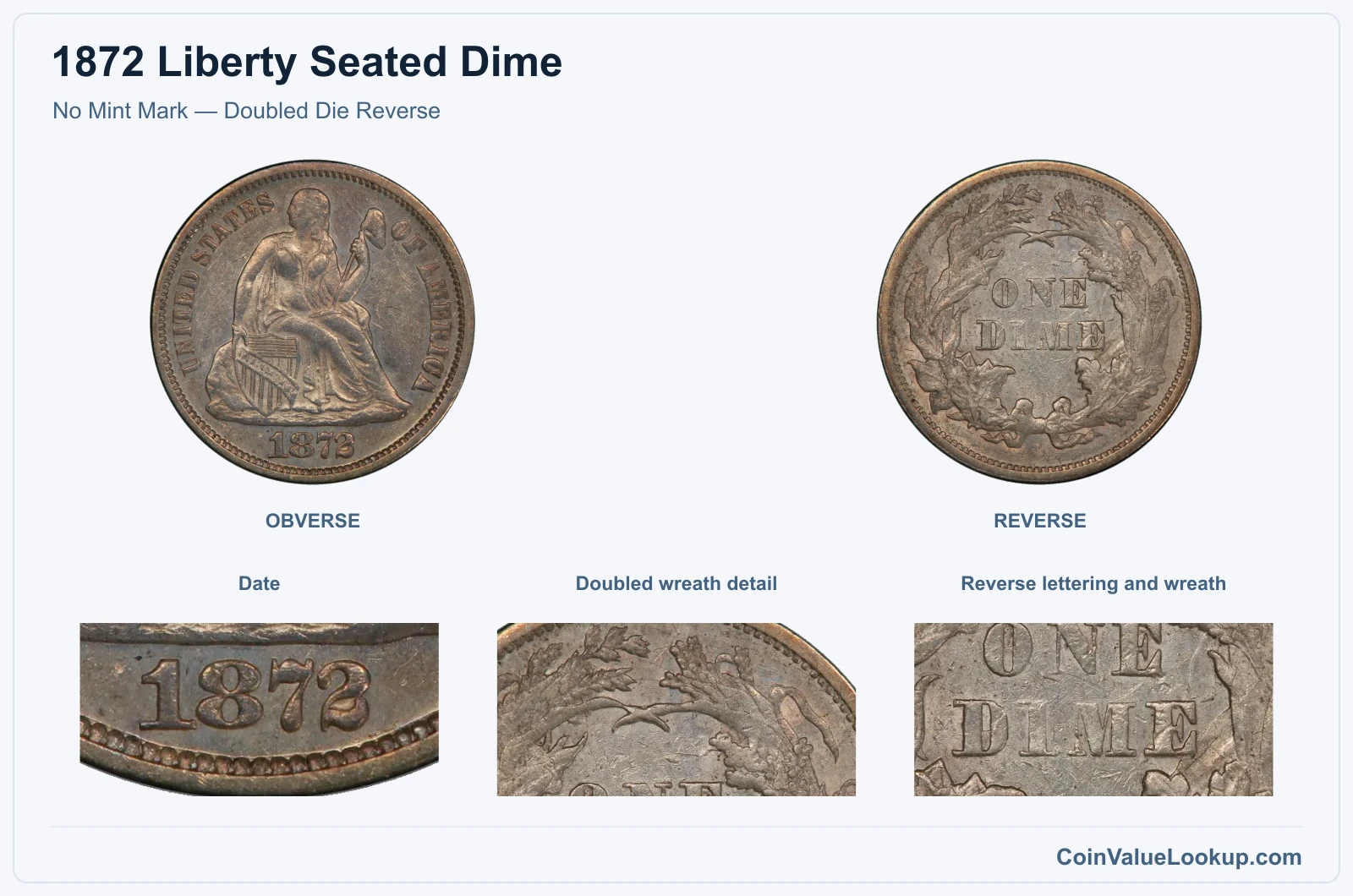
This Philadelphia variety shows doubling on the reverse design elements, visible when compared side by side with a normal reverse. It is a true hub-doubled die, not mechanical doubling from loose equipment.
The difference matters: hub doubling produces raised, shelf-like secondary images, while machine doubling tends to look flat and shelf-less.
Guide values from USA Coin Book place this variety at about $126 in G4 and around $4,946 at MS63, a substantial jump over the regular Philadelphia strike. Some examples of this doubled die also display dramatic die rotation, where the obverse and reverse are misaligned from normal coin-turn orientation.
That rotation is part of the same die pairing, not a separate error category.
If you have a no-mintmark 1872 dime, inspect the reverse legends and wreath under magnification before assuming it is a standard issue.
Ordinary-issue reference: Ordinary-issue reference only: The table below shows prices for the 1872 Liberty Seated Dime (regular strike). It does not represent the value of the specific No Mint Mark — Doubled Die Reverse variety or its variety premium. Year, mint, metal and strike type are matched; the specific variety is not priced by this table.
Range Grade
Price Auction Records Appraisal PO PO 1
—
Coin Identifier FR FR 2
—
Coin Identifier AG AG 3
—
Coin Identifier G G 4
—
Coin Identifier
G 6
—
Coin Identifier VG VG 8
—
Coin Identifier
VG 10
—
Coin Identifier F F 12
—
Coin Identifier
F 15
—
Coin Identifier VF VF 20
—
Coin Identifier
VF 25
—
Coin Identifier
VF 30
—
Coin Identifier
VF 35
—
Coin Identifier XF XF 40
—
Coin Identifier
XF 45
—
Coin Identifier AU AU 50
—
Coin Identifier
AU 53
Coin Identifier
AU 55
Coin Identifier
AU 58
Coin Identifier MS MS 60
—
Coin Identifier
MS 61
Coin Identifier
MS 62
Coin Identifier
MS 63
Coin Identifier
MS 64
Coin Identifier
MS 65
Coin Identifier
MS 66
Coin Identifier
MS 67
Coin Identifier
MS 68
Coin Identifier
MS 69
—
—
—
MS 70
—
—
—
1872 Liberty Seated Dime — CC — Regular Issue
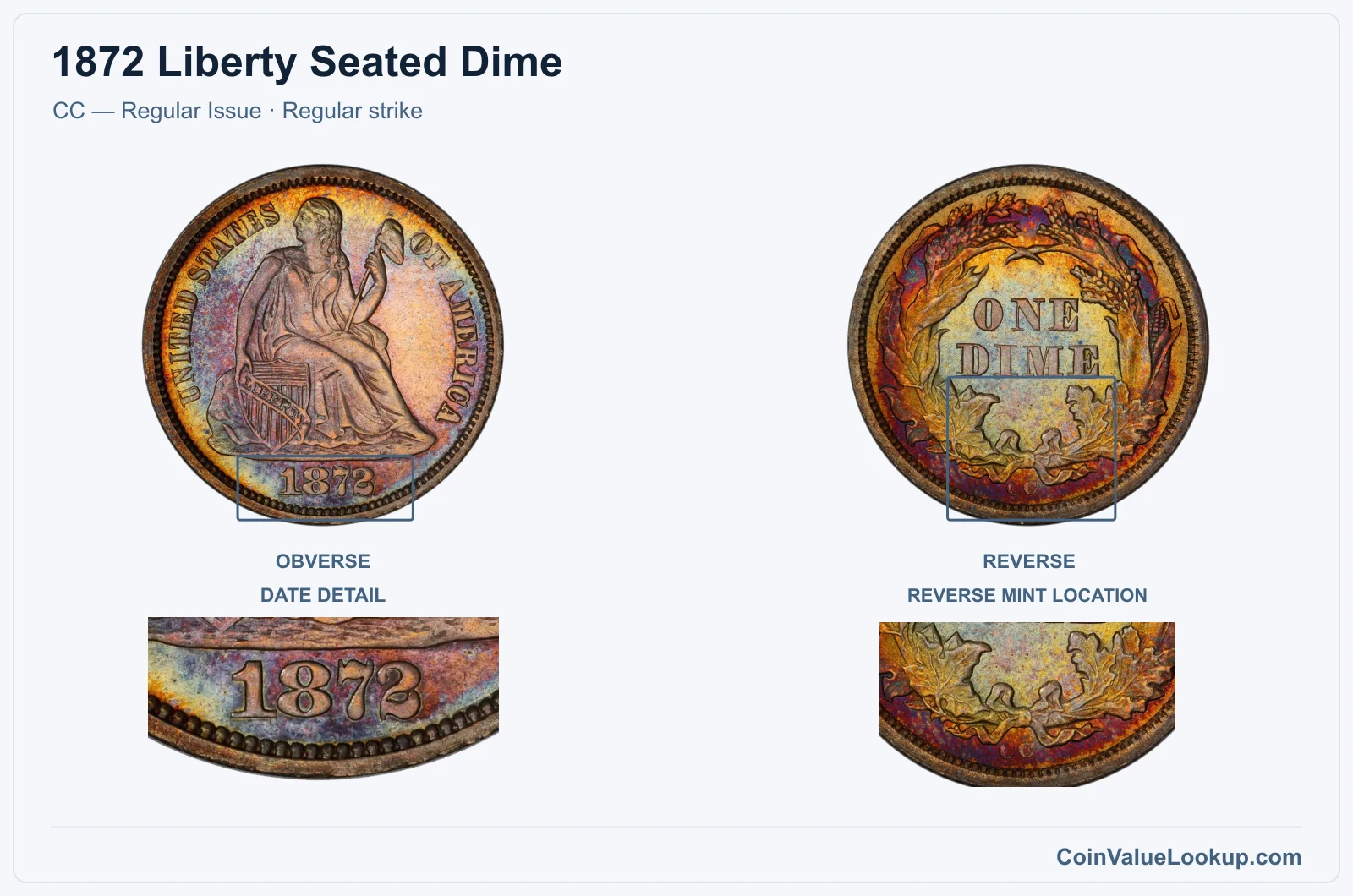
Carson City dimes from 1872 are genuinely scarce. The CC mintmark appears on the reverse inside the wreath, and even a heavily worn example commands serious money.
USA Coin Book lists a guide estimate of about $1,882 in G4, rising to an extraordinary $278,927 at MS63.
Those upper-end figures reflect how few survive in high grades. Most CC dimes circulated hard in Western commerce, so finding one above VF is uncommon.
Confirm the mintmark is a genuine CC and not a tooled or added letter. Under magnification, an authentic mintmark sits naturally within the field, while an altered one often shows disturbed metal or mismatched texture around the letters.
Coin Value Lookup is a good place to look up guides for other dates and mints in the Liberty Seated Dime series if you are building a set or comparing across years.
Range Grade
Price Auction Records Appraisal PO PO 1
—
Coin Identifier FR FR 2
Coin Identifier AG AG 3
Coin Identifier G G 4
Coin Identifier
G 6
Coin Identifier VG VG 8
Coin Identifier
VG 10
Coin Identifier F F 12
Coin Identifier
F 15
—
Coin Identifier VF VF 20
Coin Identifier
VF 25
Coin Identifier
VF 30
Coin Identifier
VF 35
Coin Identifier XF XF 40
Coin Identifier
XF 45
Coin Identifier AU AU 50
Coin Identifier
AU 53
—
Coin Identifier
AU 55
Coin Identifier
AU 58
Coin Identifier MS MS 60
—
Coin Identifier
MS 61
Coin Identifier
MS 62
—
Coin Identifier
MS 63
Coin Identifier
MS 64
—
—
—
MS 65
—
—
—
MS 66
—
—
—
MS 67
—
—
—
MS 68
—
—
—
MS 69
—
—
—
MS 70
—
—
—
1872 Liberty Seated Dime — S — Regular Issue
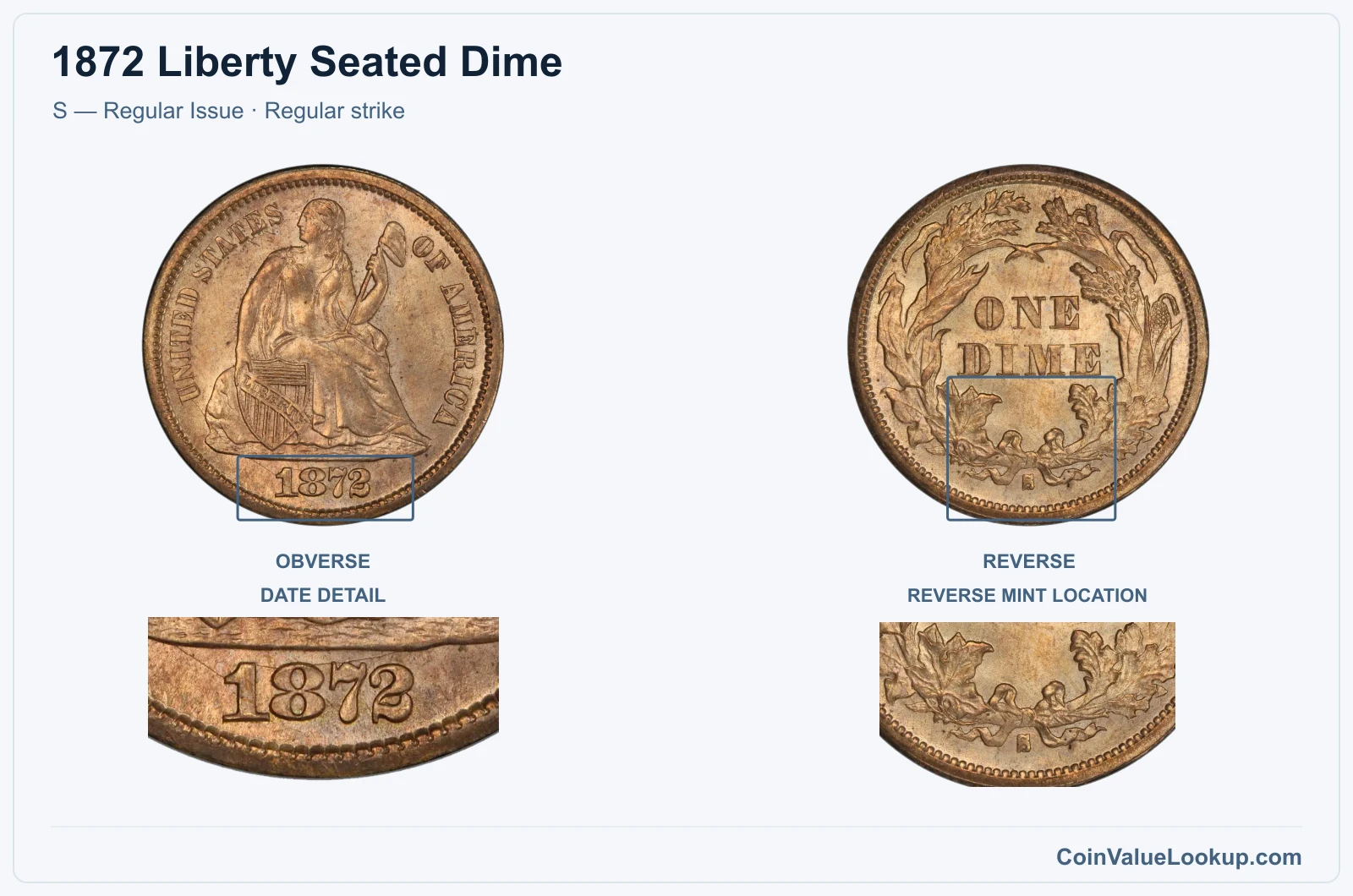
San Francisco struck 1872 dimes with a small "S" mintmark on the reverse. These are more common than Carson City pieces but less available than Philadelphia issues.
USA Coin Book guide estimates run about $34 at G4 and roughly $4,250 at MS63.
The jump from circulated to mint-state value is steep, which tells you that surviving uncirculated examples are scarce. When checking the mintmark, make sure you are reading an "S" and not a weak or partially struck CC.
Range Grade
Price Auction Records Appraisal PO PO 1
—
Coin Identifier FR FR 2
—
Coin Identifier AG AG 3
—
Coin Identifier G G 4
—
Coin Identifier
G 6
—
Coin Identifier VG VG 8
—
Coin Identifier
VG 10
Coin Identifier F F 12
—
Coin Identifier
F 15
Coin Identifier VF VF 20
Coin Identifier
VF 25
—
Coin Identifier
VF 30
Coin Identifier
VF 35
—
Coin Identifier XF XF 40
Coin Identifier
XF 45
Coin Identifier AU AU 50
Coin Identifier
AU 53
Coin Identifier
AU 55
Coin Identifier
AU 58
Coin Identifier MS MS 60
—
Coin Identifier
MS 61
Coin Identifier
MS 62
Coin Identifier
MS 63
Coin Identifier
MS 64
Coin Identifier
MS 65
Coin Identifier
MS 66
—
—
—
MS 67
—
—
—
MS 68
—
—
—
MS 69
—
—
—
MS 70
—
—
—
1872 Liberty Seated Dime — No Mint Mark — Proof Regular Proof
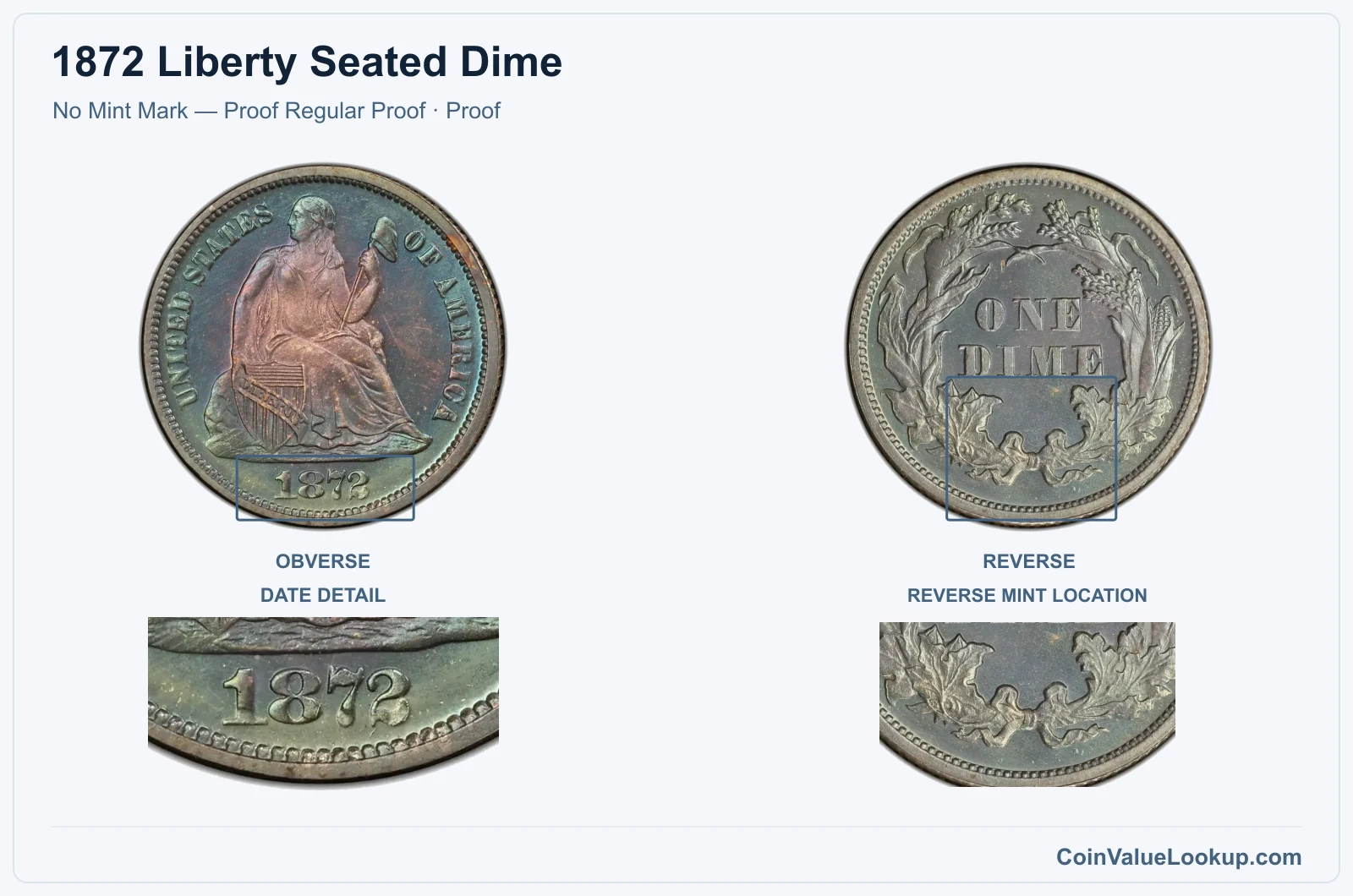
Proof 1872 dimes were struck at Philadelphia for collectors, using specially prepared dies and planchets. The fields should show deep, mirror-like reflectiveness, and the design elements are typically sharp and well-defined.
USA Coin Book places a PR63 example at about $725.
Do not confuse a Proof with a coin that has simply been cleaned to a shine. Genuine Proofs display consistent reflective fields from deliberate die polishing, and the rims are usually sharp and squared.
Hairlines from handling are common on Proofs and will affect the grade, but they do not disqualify the coin as a Proof. If you suspect you have one, professional attribution is worth pursuing.
Range Grade
Price Auction Records Appraisal PR PR 1
—
Coin Identifier
PR 2
—
Coin Identifier
PR 3
—
Coin Identifier
PR 4
—
Coin Identifier
PR 6
—
Coin Identifier
PR 8
—
Coin Identifier
PR 10
—
Coin Identifier
PR 12
—
Coin Identifier
PR 15
—
Coin Identifier
PR 20
—
Coin Identifier
PR 25
—
Coin Identifier
PR 30
—
Coin Identifier
PR 35
—
Coin Identifier
PR 40
—
Coin Identifier
PR 45
—
Coin Identifier
PR 50
—
Coin Identifier
PR 53
—
Coin Identifier
PR 55
Coin Identifier
PR 58
Coin Identifier
PR 60
Coin Identifier
PR 61
Coin Identifier
PR 62
Coin Identifier
PR 63
Coin Identifier
PR 64
Coin Identifier
PR 65
Coin Identifier
PR 66
Coin Identifier
PR 67
Coin Identifier
PR 68
—
—
—
PR 69
—
—
—
PR 70
—
—
—
1872 Liberty Seated Dime Error List
1. 1872 Liberty Seated Dime — Repunched Date
A repunched date on an 1872 dime shows remnants of an earlier position of one or more date numerals alongside the final placement. The effect looks like a shadow or extra outline near the base of a digit.
Under magnification, you can see that the secondary impression matches the shape of the numeral itself, not random damage.
This is different from a doubled die, which affects the entire design from a misaligned hub impression. A repunched date is strictly a date-punch variety, where the engraver placed the individual date punch, lifted it, and struck again in a slightly different position.
Do not confuse this with post-strike damage to the date area or flat, shelf-like machine doubling. The value of a repunched date depends on how visible and dramatic the repunching is, as well as the coin's overall condition.
No specific price range is established here, so individual assessment is necessary.
2. 1872 Liberty Seated Dime — Misplaced Date
A misplaced date occurs when numeral fragments appear outside the normal date area. On 1872 dimes, specialists have reported looking at the base of the design and the gown area for stray digit impressions.
You might find part of the numeral 2 or another date digit pressed into the field where it does not belong.
The key diagnostic is that the stray mark matches the contour of a known date digit. It should have the raised profile of a die-punched numeral, not the incuse look of a scratch or the randomness of a die line.
These are collectible when clearly identifiable, but the premium depends entirely on how visible the misplaced numeral is and the coin's grade. No specific dollar figure can be offered here.
A loupe at 10x or higher is usually necessary to confirm what you are seeing.
3. 1872 Liberty Seated Dime — Rotated Dies
Rotated dies mean the obverse and reverse are not aligned in the standard 180-degree coin-turn orientation. To check, hold the obverse upright, then flip the coin top to bottom.
If the reverse is tilted rather than perfectly upright, you have some degree of die rotation.
Small rotations of a few degrees are relatively common and carry modest interest. Dramatic rotations of 45 degrees or more attract more attention.
The 1872 Philadelphia doubled die reverse is reported with significant rotation as part of the same die pairing.
Be careful not to mistake a casually rotated photograph for actual die rotation. The test must be done with the physical coin in hand.
Value depends on the degree of rotation and the coin's condition, with no established price range available here.
4. 1872 Liberty Seated Dime — Doubled Die Reverse
A doubled die reverse on the 1872 dime shows secondary raised images on the reverse legends, wreath or denomination. When placed next to a normal reverse, the doubling should be apparent on specific design elements.
True hub doubling creates a distinct, slightly offset copy of design features that looks raised and three-dimensional. Machine doubling, by contrast, produces flat, shelf-like distortions that are far less collectible.
Reflections or surface damage can also mimic doubling to the untrained eye.
The recognized Philadelphia doubled die reverse is listed as a separate version above. Other doubled die reverse examples may exist from different die pairings.
Value depends on the strength and visibility of the doubling and the coin's overall grade. Professional attribution is recommended for any suspected doubled die.
5. 1872 Liberty Seated Dime — Die Crack / Die Chip
Die cracks appear as thin, raised lines on the coin's surface, created when a working die develops fractures from repeated use. On 1872 Philadelphia dimes, die cracks have been documented by specialists.
A die chip is a small raised blob where a piece of the die face broke away, leaving a void that fills with metal during striking.
Distinguish these from incuse scratches, which are pressed into the surface rather than raised above it. Corrosion pitting and foreign material stuck to the surface can also look suspicious but lack the linear, raised character of a genuine crack.
A crack running from the rim through a major design element or lettering is generally more collectible than a minor interior crack. No specific premium can be stated here; value depends on the crack's size, location and the coin's condition.
6. 1872 Liberty Seated Dime — Clashed Dies
Clashed dies result from the obverse and reverse dies striking each other without a planchet between them. The impact transfers faint traces of each die's design onto the opposing die face.
On the struck coin, you see ghost-like impressions of the opposite side's features in the fields.
On an 1872 dime, look for faint outlines of the wreath or lettering on the obverse fields, or traces of Liberty's figure on the reverse. These transferred images should align with where the opposite design would naturally contact the die.
Do not confuse clash marks with random scratches, raised lines from a damaged die or a brockage, which is a much more dramatic error involving a previously struck coin acting as a die. Clash marks follow the geometry of the opposing design.
Value varies with visibility and coin condition, and no specific price range is provided here.