1872 Liberty Seated Half Dollar Coin Value: How Much Is It Worth?
A Philadelphia 1872 Liberty Seated Half Dollar in well-worn G4 condition carries a guide estimate around $91, climbing to roughly $425 at AU50. But mint, grade, and exact variety shift the picture substantially.
Carson City pieces occupy a different price tier entirely, and Proofs require their own comparison. Knowing which version you hold is the first step.
Fast Way to Identify Your 1872 Liberty Seated Half Dollar
The quickest way to start identifying your 1872 half dollar is to upload clear photos of both the front and back. Our preliminary identification tool can help you narrow down the mint, variety, and general condition from your images.
Snap both sides in even lighting, and avoid glare so the mintmark area beneath the eagle is visible.
1872 Liberty Seated Half Dollar Value
Upload both sides of your 1872 Liberty Seated Half Dollar.
Front Obverse
Upload photo
Back Reverse
Upload photo
Which 1872 Liberty Seated Half Dollar Versions Are Worth Money?
- Carson City (CC mintmark) coins are scarce — guide estimates start at $425 in G4, far above Philadelphia.
- Proofs carry a guide estimate near $1,540 at PR63; look for mirror fields and sharp rims with no mintmark.
- San Francisco pieces in two mintmark styles (Small Wide S and Medium Small S) carry higher baselines than Philadelphia across all grades.
Step 1: Identify Your 1872 Liberty Seated Half Dollar Mint Mark and Version
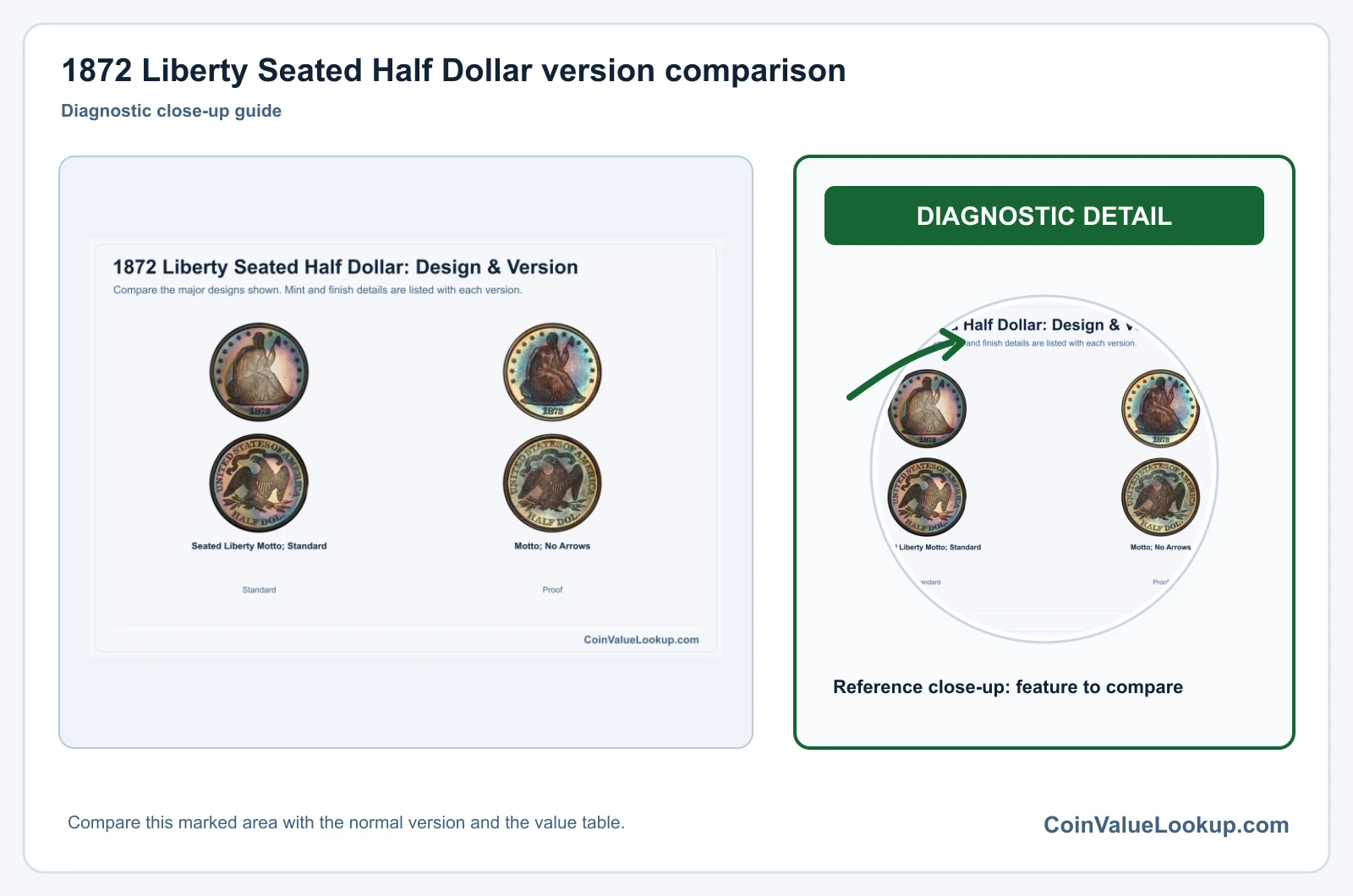
The obverse shows Liberty seated on a rock, holding a shield and liberty pole. The reverse features an eagle beneath a motto banner reading IN GOD WE TRUST, with HALF DOL below.
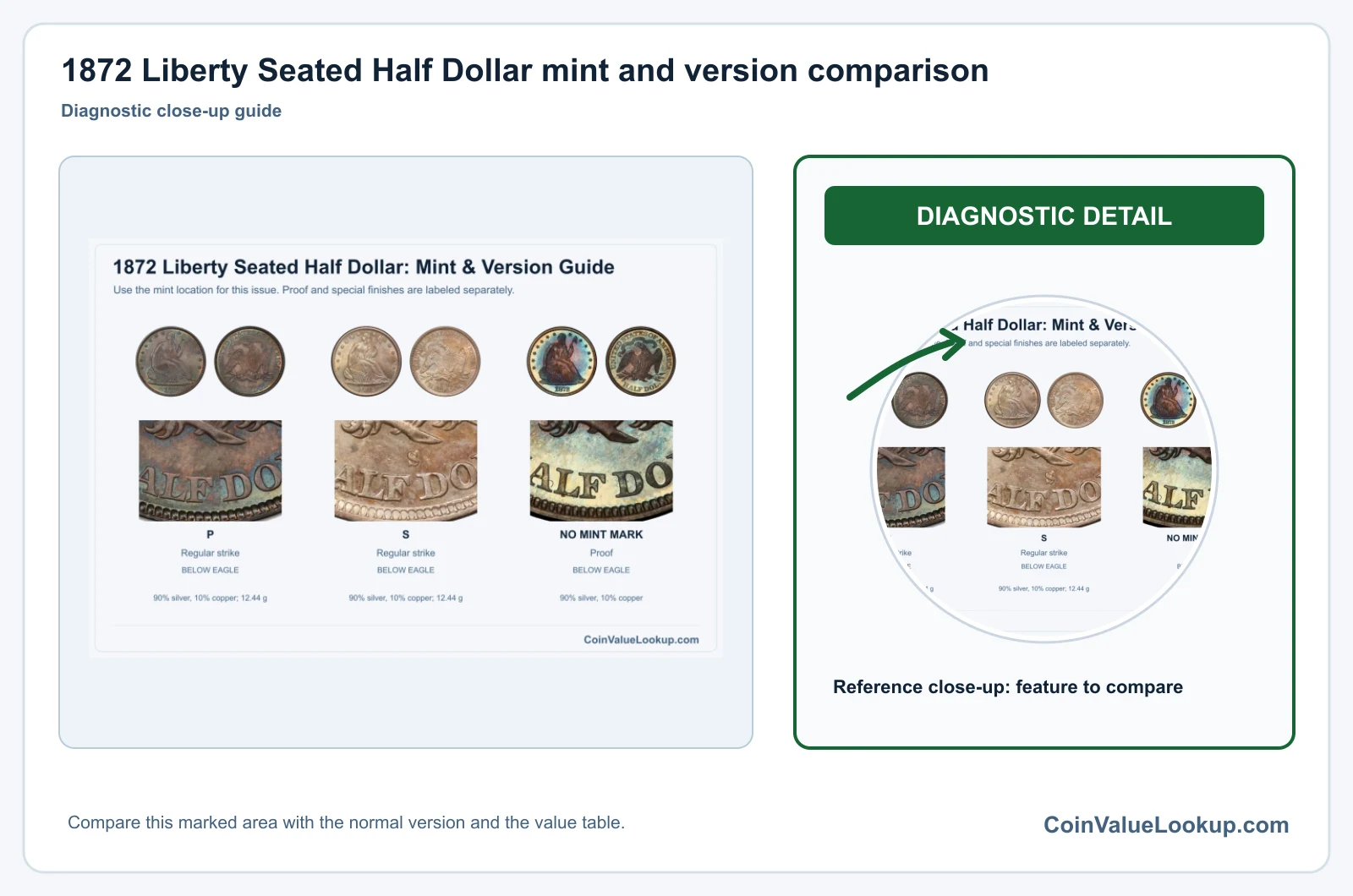
Flip the coin over and look directly below the eagle. If there is no mintmark, it was struck in Philadelphia.
A small "S" means San Francisco. The letters "CC" mean Carson City, Nevada, and that is the one collectors watch for most closely.
San Francisco coins come in two mintmark styles for 1872: a Small Wide S and a Medium Small S. The difference is in letter width and proportions, so compare yours carefully against dated reference images for that specific year.
All 1872 half dollars are 90% silver and 10% copper, weighing 12.44 grams. The slightly heavier 12.50-gram standard did not arrive until the 1873 Arrows redesign.
A Proof 1872 half dollar is a special manufacturing finish with mirror-like surfaces and sharp rims; it is not a grade above Mint State.
Step 2: Check Your 1872 Liberty Seated Half Dollar Grade
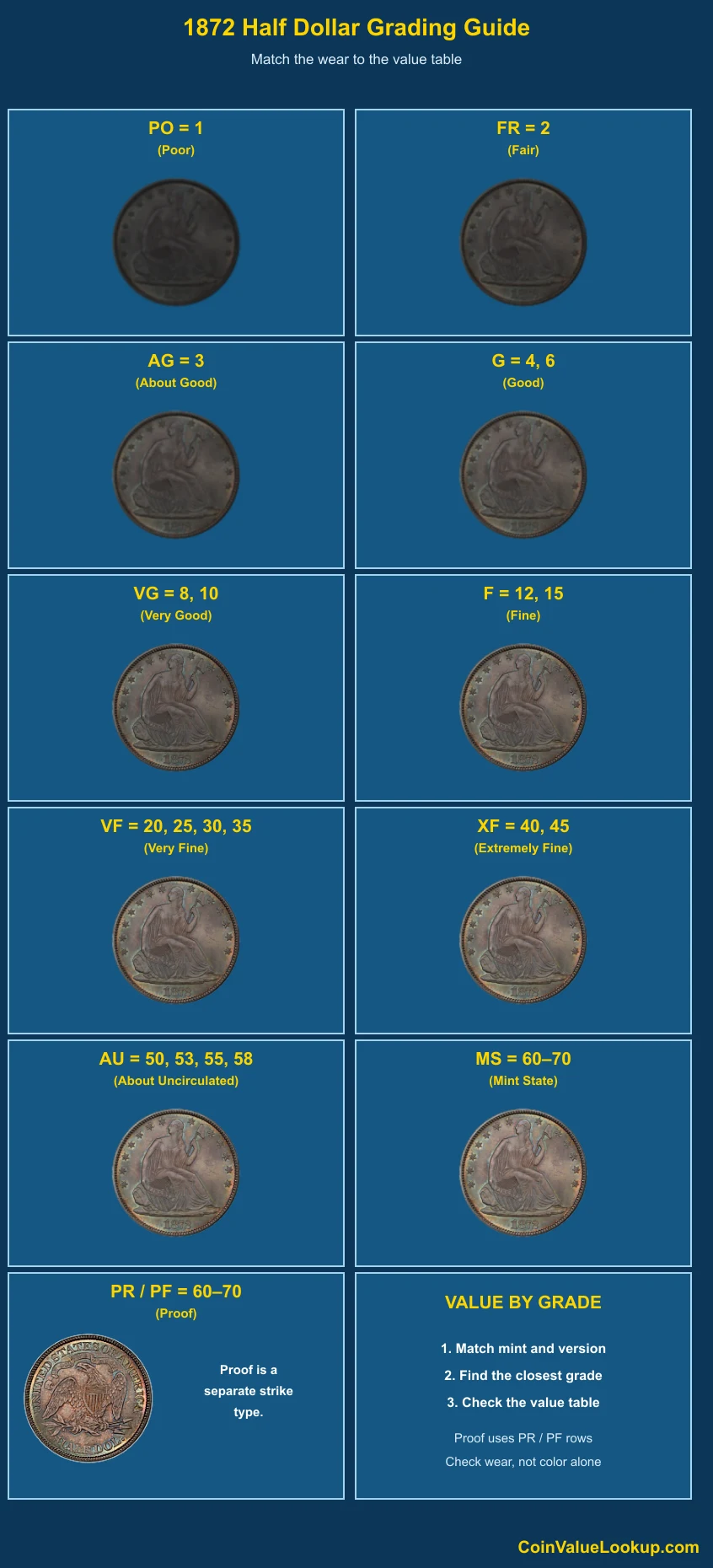
Start with Liberty's head on the obverse. In lower grades the hair detail above her ear disappears first.
Next check the breast area, knee, and the horizontal lines on the shield. On the reverse, the eagle's breast feathers and wing tips lose definition as wear increases.
A weakly struck coin can look worn even when it is not. Check for remaining original luster in the protected areas around the stars and letters.
If luster survives in those recesses, the coin may grade higher than the flat spots suggest.
Use the comparison image to match your coin's wear pattern against known grade benchmarks for the Seated Liberty type. Cleaning, rim dings, and holes each reduce value independently of wear grade, so note those separately.
Step 3: Check 1872 Liberty Seated Half Dollar Value by Mint and Version
1872 Liberty Seated Half Dollar — Philadelphia — Standard
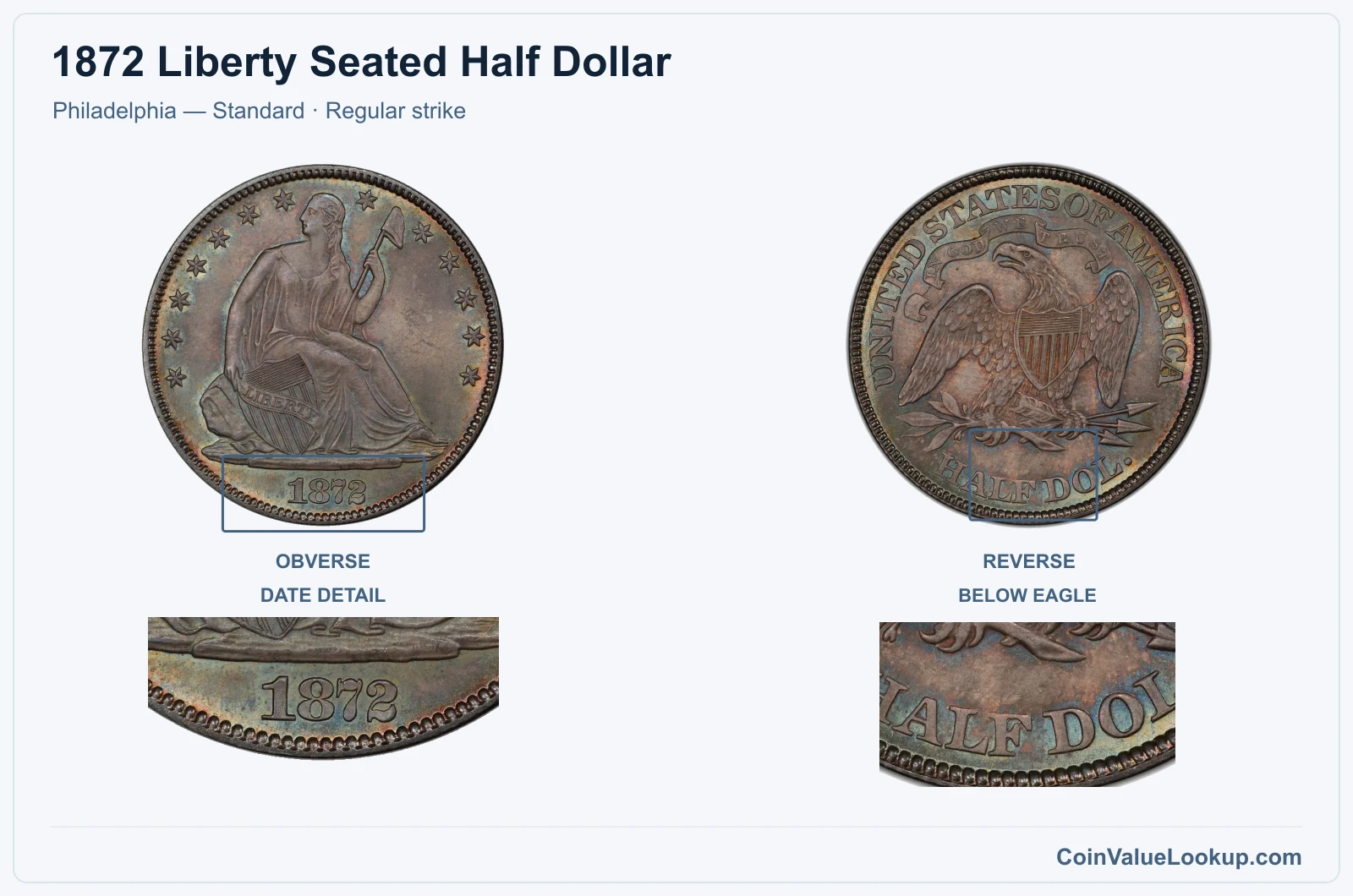
The Philadelphia strike is the most common 1872 half dollar. No mintmark appears below the reverse eagle.
Guide estimates place this version at about $91 in G4, $267 in VF20, and $425 at AU50.
These are 90% silver, 10% copper, weighing 12.44 grams. Even a well-circulated example has meaningful silver content, but condition drives the collector premium.
Look for even wear and original surfaces without cleaning or tooling.
Range Grade
Price Auction Records Appraisal PO PO 1
—
Coin Identifier FR FR 2
—
Coin Identifier AG AG 3
—
Coin Identifier G G 4
—
Coin Identifier
G 6
—
Coin Identifier VG VG 8
—
Coin Identifier
VG 10
—
Coin Identifier F F 12
—
Coin Identifier
F 15
Coin Identifier VF VF 20
—
Coin Identifier
VF 25
Coin Identifier
VF 30
—
Coin Identifier
VF 35
Coin Identifier XF XF 40
Coin Identifier
XF 45
Coin Identifier AU AU 50
Coin Identifier
AU 53
Coin Identifier
AU 55
Coin Identifier
AU 58
Coin Identifier MS MS 60
—
Coin Identifier
MS 61
—
Coin Identifier
MS 62
Coin Identifier
MS 63
Coin Identifier
MS 64
Coin Identifier
MS 65
—
Coin Identifier
MS 66
Coin Identifier
MS 67
—
—
—
MS 68
—
—
—
MS 69
—
—
—
MS 70
—
—
—
1872 Liberty Seated Half Dollar — Carson City — Large CC
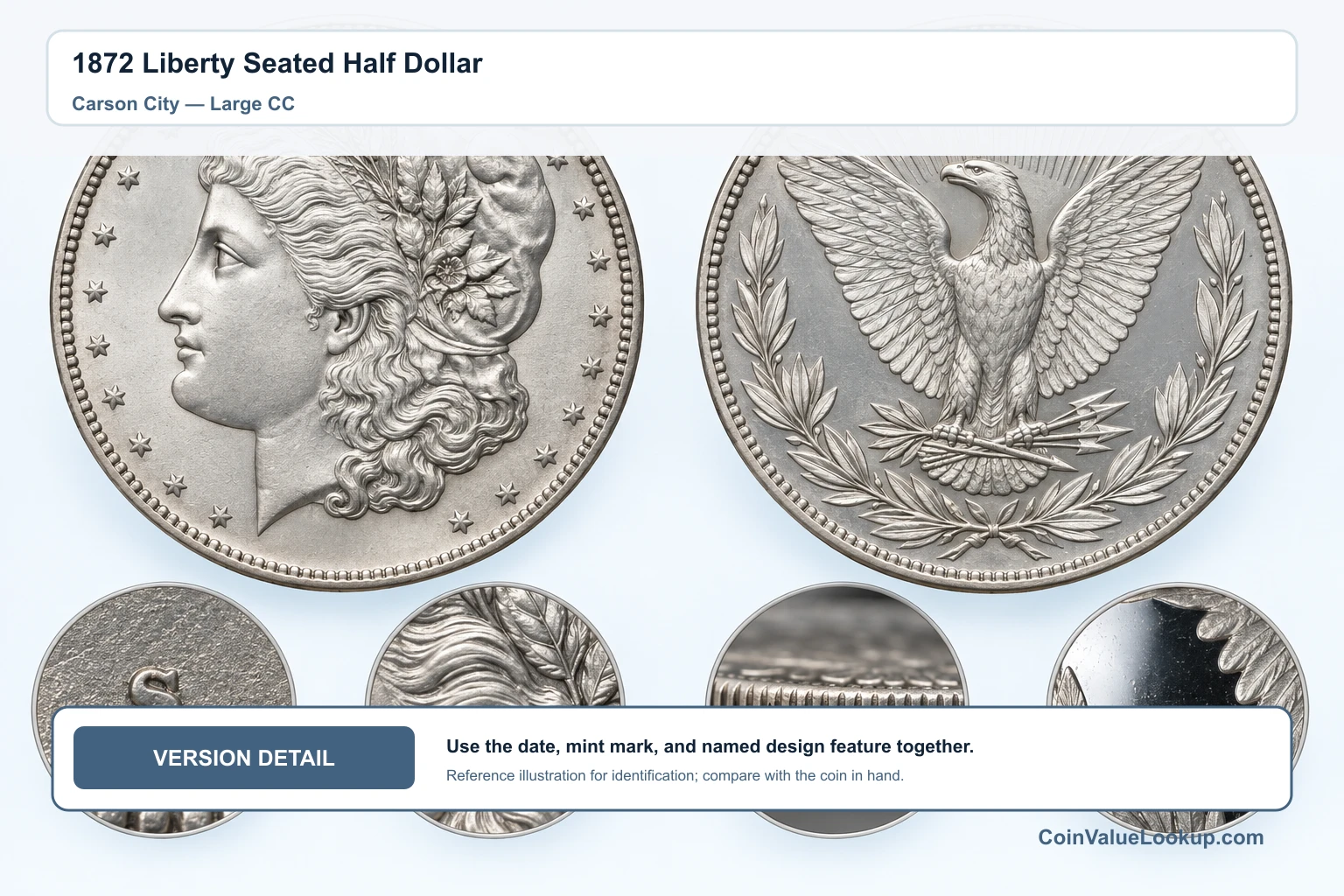
Carson City coins carry the large "CC" mintmark below the eagle. The 1872-CC is a genuinely scarce coin, and pricing reflects it: guide estimates run roughly $425 at G4, $1,617 at VF20, and $4,839 at AU50.
A reflective surface alone does not make a branch-mint coin a Proof. Polished circulation dies were used at Carson City and can mimic proof-like fields.
Authentication by a professional grading service is the safest route before assuming you have something extraordinary.
Coin Value Lookup is a good starting point if you want to compare this and other Liberty Seated Half Dollar dates before deciding on next steps.
Ordinary-issue reference: Ordinary-issue reference only: The table below shows prices for the 1872-CC Liberty Seated Half Dollar (regular strike). It does not represent the value of the specific Carson City — Large CC variety or its variety premium. Year, mint, metal and strike type are matched; the specific variety is not priced by this table.
Range Grade
Price Auction Records Appraisal PO PO 1
—
Coin Identifier FR FR 2
Coin Identifier AG AG 3
Coin Identifier G G 4
Coin Identifier
G 6
Coin Identifier VG VG 8
Coin Identifier
VG 10
Coin Identifier F F 12
Coin Identifier
F 15
Coin Identifier VF VF 20
Coin Identifier
VF 25
Coin Identifier
VF 30
Coin Identifier
VF 35
Coin Identifier XF XF 40
Coin Identifier
XF 45
Coin Identifier AU AU 50
Coin Identifier
AU 53
Coin Identifier
AU 55
Coin Identifier
AU 58
Coin Identifier MS MS 60
Coin Identifier
MS 61
—
Coin Identifier
MS 62
Coin Identifier
MS 63
Coin Identifier
MS 64
—
—
—
MS 65
—
—
—
MS 66
—
—
—
MS 67
—
—
—
MS 68
—
—
—
MS 69
—
—
—
MS 70
—
—
—
1872 Liberty Seated Half Dollar — San Francisco — Small Wide S
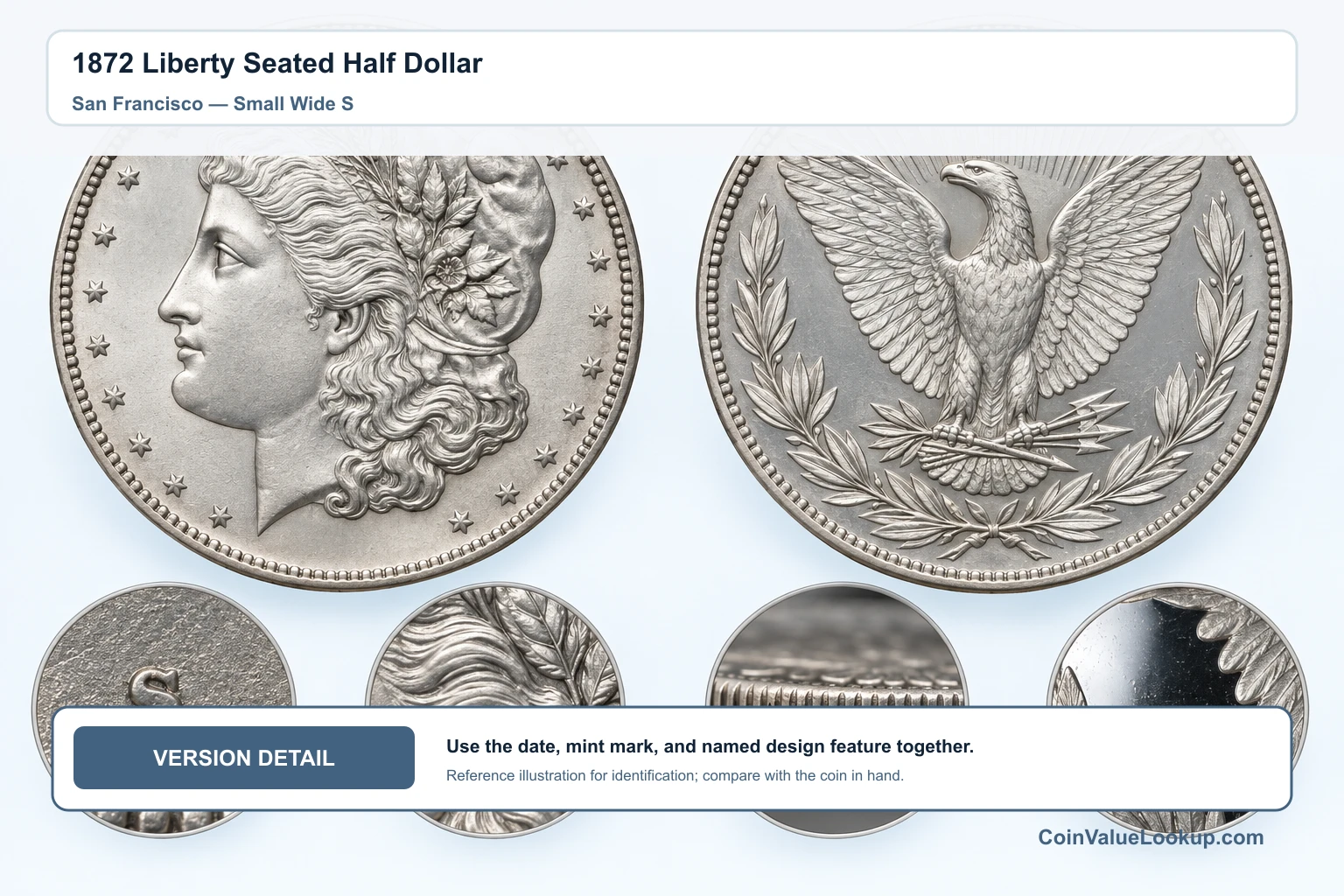
The Small Wide S mintmark sits below the eagle and is noticeably broader than the Medium Small S used on other 1872-S dies. This is one of two San Francisco mintmark styles cataloged for the year.
Aggregate date-and-mint guide baselines for 1872-S half dollars run about $141 at G4, $394 at VF20, and $947 at AU50. No separate subtype premium has been adopted for the Small Wide S specifically, so these figures reflect the general San Francisco range rather than a variety-specific price.
Ordinary-issue reference: Ordinary-issue reference only: The table below shows prices for the 1872-S Liberty Seated Half Dollar (regular strike). It does not represent the value of the specific San Francisco — Small Wide S variety or its variety premium. Year, mint, metal and strike type are matched; the specific variety is not priced by this table.
Range Grade
Price Auction Records Appraisal PO PO 1
—
Coin Identifier FR FR 2
—
Coin Identifier AG AG 3
—
Coin Identifier G G 4
—
Coin Identifier
G 6
—
Coin Identifier VG VG 8
—
Coin Identifier
VG 10
Coin Identifier F F 12
—
Coin Identifier
F 15
—
Coin Identifier VF VF 20
—
Coin Identifier
VF 25
—
Coin Identifier
VF 30
Coin Identifier
VF 35
Coin Identifier XF XF 40
Coin Identifier
XF 45
Coin Identifier AU AU 50
Coin Identifier
AU 53
Coin Identifier
AU 55
Coin Identifier
AU 58
Coin Identifier MS MS 60
—
Coin Identifier
MS 61
Coin Identifier
MS 62
Coin Identifier
MS 63
Coin Identifier
MS 64
Coin Identifier
MS 65
Coin Identifier
MS 66
Coin Identifier
MS 67
—
—
—
MS 68
—
—
—
MS 69
—
—
—
MS 70
—
—
—
1872 Liberty Seated Half Dollar — San Francisco — Medium Small S
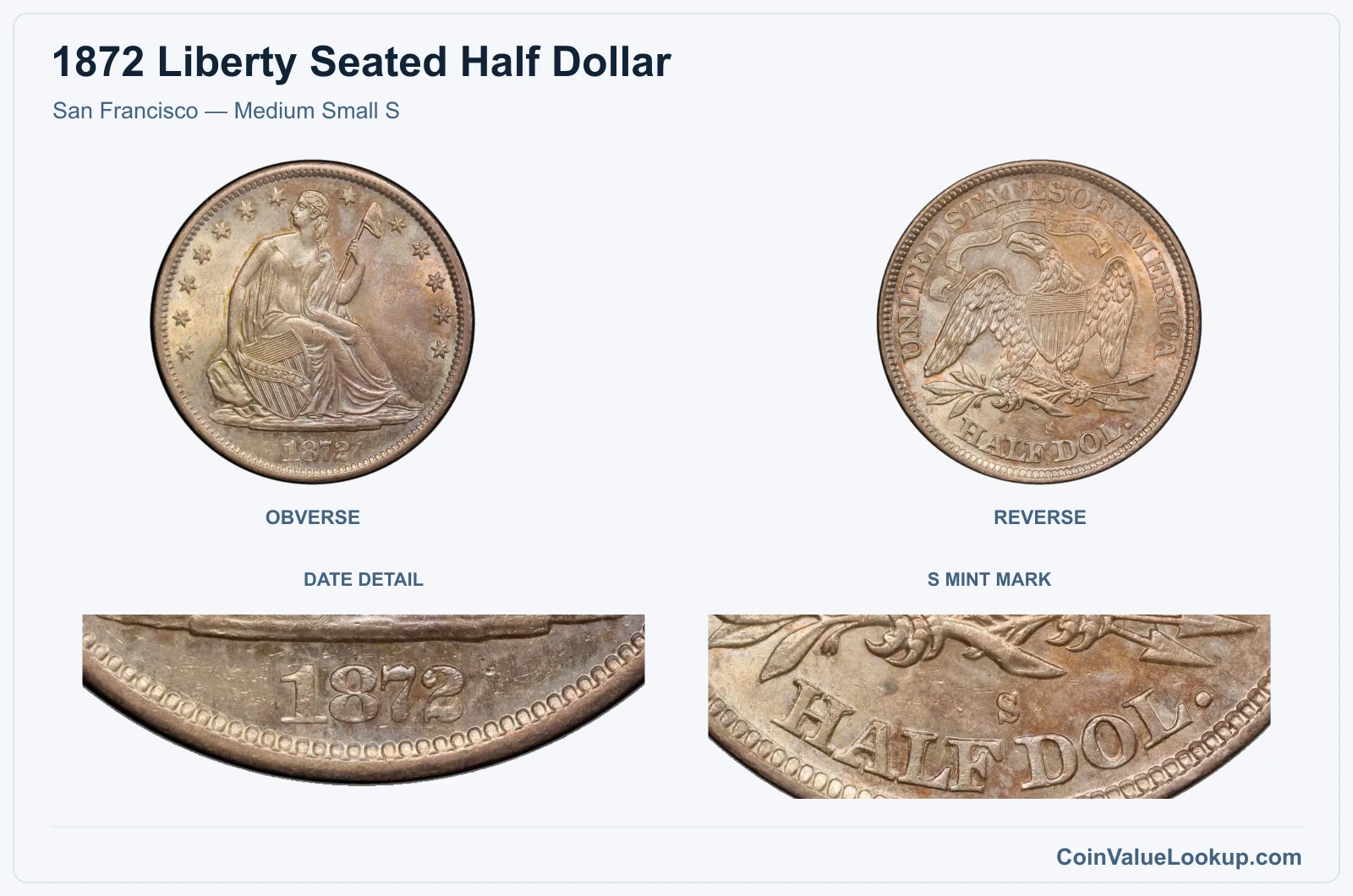
The Medium Small S mintmark is narrower and more compact than the Small Wide S. Both styles appear on 1872-S half dollars, so a side-by-side reference image for this exact year is helpful.
The same aggregate San Francisco baselines apply here: roughly $141 at G4, $394 at VF20, and $947 at AU50. These are guide estimates, not guaranteed offers, and no independent subtype premium has been adopted for the Medium Small S.
As with any mintmark variety, confirmation against a dated reference strengthens identification.
Ordinary-issue reference: Ordinary-issue reference only: The table below shows prices for the 1872-S Liberty Seated Half Dollar (regular strike). It does not represent the value of the specific San Francisco — Medium Small S variety or its variety premium. Year, mint, metal and strike type are matched; the specific variety is not priced by this table.
Range Grade
Price Auction Records Appraisal PO PO 1
—
Coin Identifier FR FR 2
—
Coin Identifier AG AG 3
—
Coin Identifier G G 4
—
Coin Identifier
G 6
—
Coin Identifier VG VG 8
—
Coin Identifier
VG 10
Coin Identifier F F 12
—
Coin Identifier
F 15
—
Coin Identifier VF VF 20
—
Coin Identifier
VF 25
—
Coin Identifier
VF 30
Coin Identifier
VF 35
Coin Identifier XF XF 40
Coin Identifier
XF 45
Coin Identifier AU AU 50
Coin Identifier
AU 53
Coin Identifier
AU 55
Coin Identifier
AU 58
Coin Identifier MS MS 60
—
Coin Identifier
MS 61
Coin Identifier
MS 62
Coin Identifier
MS 63
Coin Identifier
MS 64
Coin Identifier
MS 65
Coin Identifier
MS 66
Coin Identifier
MS 67
—
—
—
MS 68
—
—
—
MS 69
—
—
—
MS 70
—
—
—
1872 Liberty Seated Half Dollar — Philadelphia Proof
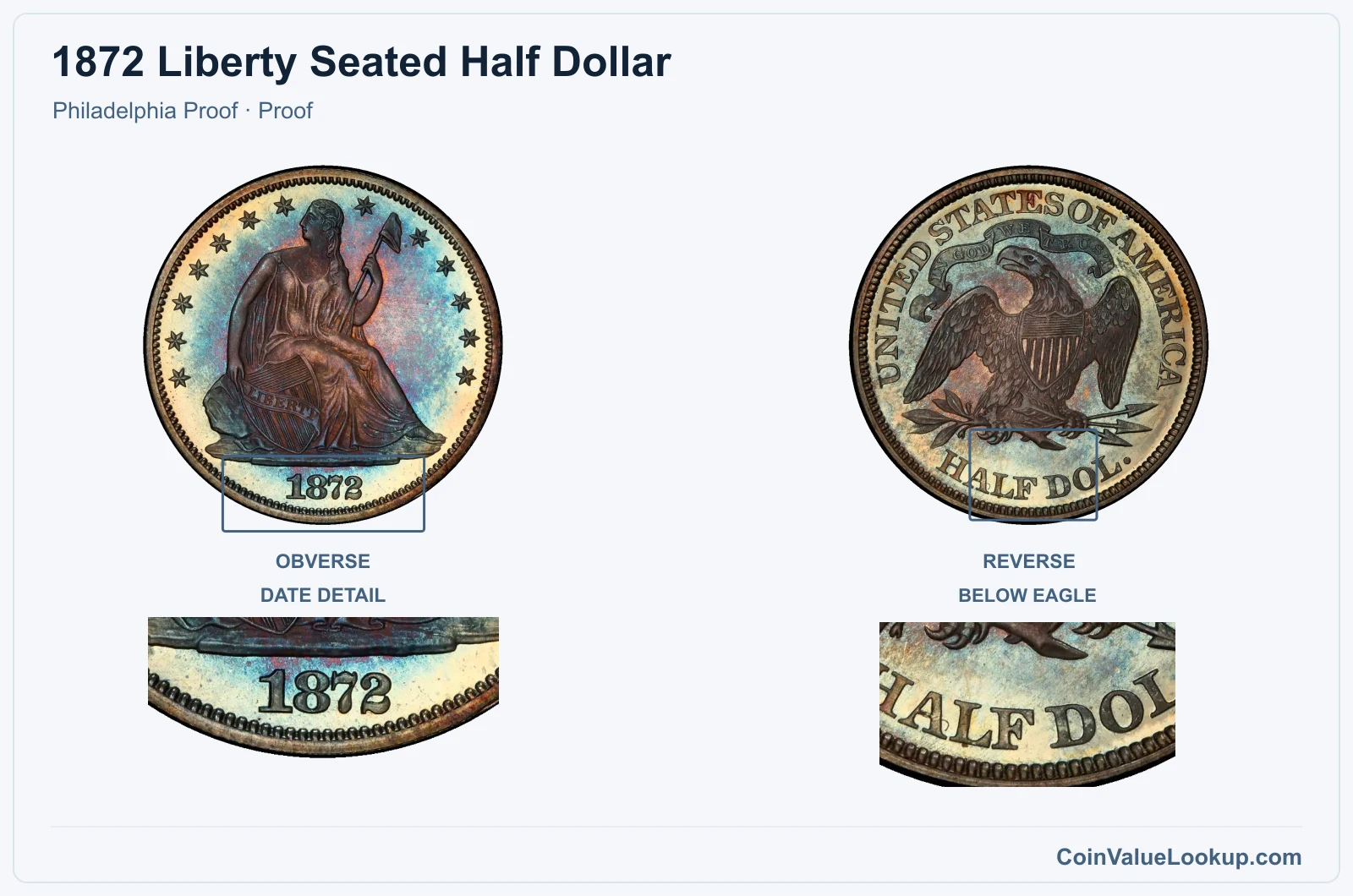
Philadelphia Proof half dollars of 1872 were struck with specially prepared dies on polished planchets, producing mirror fields and razor-sharp rims. There is no mintmark.
A guide estimate places the PR63 example around $1,540.
Proof is a finish, not a grade above Mint State. Within the Proof designation, coins can range from impaired pieces with hairlines to deeply mirrored gems.
Contrast between frosted devices and reflective fields varies and is noted by grading services as a separate designation. These were made in small numbers for collectors of the era, and survivors in original condition are uncommon.
Range Grade
Price Auction Records Appraisal PR PR 1
—
Coin Identifier
PR 2
—
Coin Identifier
PR 3
—
Coin Identifier
PR 4
—
Coin Identifier
PR 6
—
Coin Identifier
PR 8
—
Coin Identifier
PR 10
—
Coin Identifier
PR 12
—
Coin Identifier
PR 15
—
Coin Identifier
PR 20
—
Coin Identifier
PR 25
—
Coin Identifier
PR 30
—
Coin Identifier
PR 35
—
Coin Identifier
PR 40
—
Coin Identifier
PR 45
—
Coin Identifier
PR 50
Coin Identifier
PR 53
—
Coin Identifier
PR 55
—
Coin Identifier
PR 58
—
Coin Identifier
PR 60
Coin Identifier
PR 61
Coin Identifier
PR 62
Coin Identifier
PR 63
Coin Identifier
PR 64
Coin Identifier
PR 65
Coin Identifier
PR 66
Coin Identifier
PR 67
Coin Identifier
PR 68
—
—
—
PR 69
—
—
—
PR 70
—
—
—
1872 Liberty Seated Half Dollar Error List
1. 1872 Liberty Seated Half Dollar — Misplaced Date
A Misplaced Date error on the 1872 half dollar means remnants of a date digit appear somewhere outside the normal date position — for example, partially visible in the denticles or rock base. This is cataloged for the Philadelphia mint.
To identify one, examine the area around and below the date under magnification. You are looking for faint outlines or partial impressions of numerals that do not belong there.
The die was entered once in the wrong spot before the engraver corrected placement.
Do not confuse ordinary design elements, wear patterns, or post-mint scratches with a misplaced digit. Compare against a known reference image for the 1872 Philadelphia issue specifically.
Value depends on the visibility of the misplaced digit and the coin's overall condition; no specific price range is established here.
2. 1872 Liberty Seated Half Dollar — Doubled Die Reverse
A Doubled Die Reverse has been reported for the 1872 half dollar. This occurs when the reverse die receives a second, slightly misaligned impression from the hub during manufacture, leaving doubled lettering or design elements on every coin struck from that die.
Look at the reverse lettering — HALF DOL, UNITED STATES OF AMERICA, and the motto banner — for any consistent doubling or thickening. True hub doubling will be uniform across multiple letters or features.
Machine doubling is a common lookalike. It tends to produce flat, shelf-like secondary images rather than the rounded, equally strong doubling of a true doubled die.
Random surface damage or reflections can also mimic the effect. No specific price has been adopted for this variety, so value will depend on the strength of the doubling and the coin's condition.
3. 1872 Liberty Seated Half Dollar — Die Crack / Die Chip
Die cracks are raised lines on the coin's surface caused by fractures in the steel die. For 1872, late-state San Francisco dies show cracks running through the date bases and extending through several stars on the obverse.
These cracks appear as thin, slightly raised ridges that follow no design element. They are random paths dictated by stress in the die, not intentional design.
A die chip is a small raised blob where a fragment broke away from the die face.
Do not confuse incuse scratches, corrosion lines, or foreign material stuck to the surface with a die crack. Scratches are recessed into the metal, while die cracks are always raised.
Value depends on the prominence of the crack and overall coin condition; no adopted price range is available for this category.
4. 1872 Liberty Seated Half Dollar — Clashed Dies
Clashed dies occur when the obverse and reverse dies strike each other without a planchet between them, transferring ghost impressions of one design onto the other. For 1872, a San Francisco example shows clash marks below Liberty's elbow on the obverse — traces of the opposing reverse design pressed into the wrong die.
To spot a clash, look for faint design outlines that do not belong on that side of the coin. Below the elbow area, you might see elements from the eagle or lettering ghosted onto the obverse surface.
Scratches, random raised lines, or contact marks are common lookalikes. A true die clash produces symmetrical ghost images that correspond to the opposing die's layout.
Value depends on visibility and condition, and no specific price has been adopted for this error on the 1872 half dollar.