1954 Franklin Half Dollar Coin Value: How Much Is It Worth?
The 1954 Franklin Half Dollar is a 90% silver coin that remains popular with collectors and silver stackers alike. Guide estimates for problem-free examples range from about $32.00 in well-worn grades to $140.00 for a proof in PR65, depending on the mint, condition and finish.
These are guide anchors from USA Coin Book, not guaranteed selling prices or current silver-melt quotes. Mint location, original surfaces and strike quality all shift the number.
Fast Way to Identify Your 1954 Franklin Half Dollar
Want a quick read on your 1954 Franklin half? Upload clear photos of both the front and back of your coin.
The identifier can help with preliminary identification of your mint branch and general condition. Good lighting and a steady hand make a real difference, so skip the blurry phone shots if you can.
1954 Franklin Half Dollar Value
Upload both sides of your 1954 Franklin Half Dollar.
Front Obverse
Upload photo
Back Reverse
Upload photo
Which 1954 Franklin Half Dollar Versions Are Worth Money?
- 1954 PR (Proof) — guide estimate of $140.00 at PR65; mirrored fields and sharp devices distinguish genuine proofs from polished circulation strikes.
- 1954-D — guide estimate reaches $109.00 at MS65, the highest business-strike anchor this year; check for the D mintmark above the bell.
- 1954-S — guide estimate of $87.00 at MS65; San Francisco pieces carry an S mintmark in the same reverse location.
- 1954 Philadelphia business strike — guide estimate of $74.00 at MS65; no mintmark present on the reverse.
- Full Bell Lines designation on any business-strike branch can increase value beyond standard guide figures, but requires intact lower bell-line detail confirmed under magnification.
Step 1: Identify Your 1954 Franklin Half Dollar Mint Mark and Version
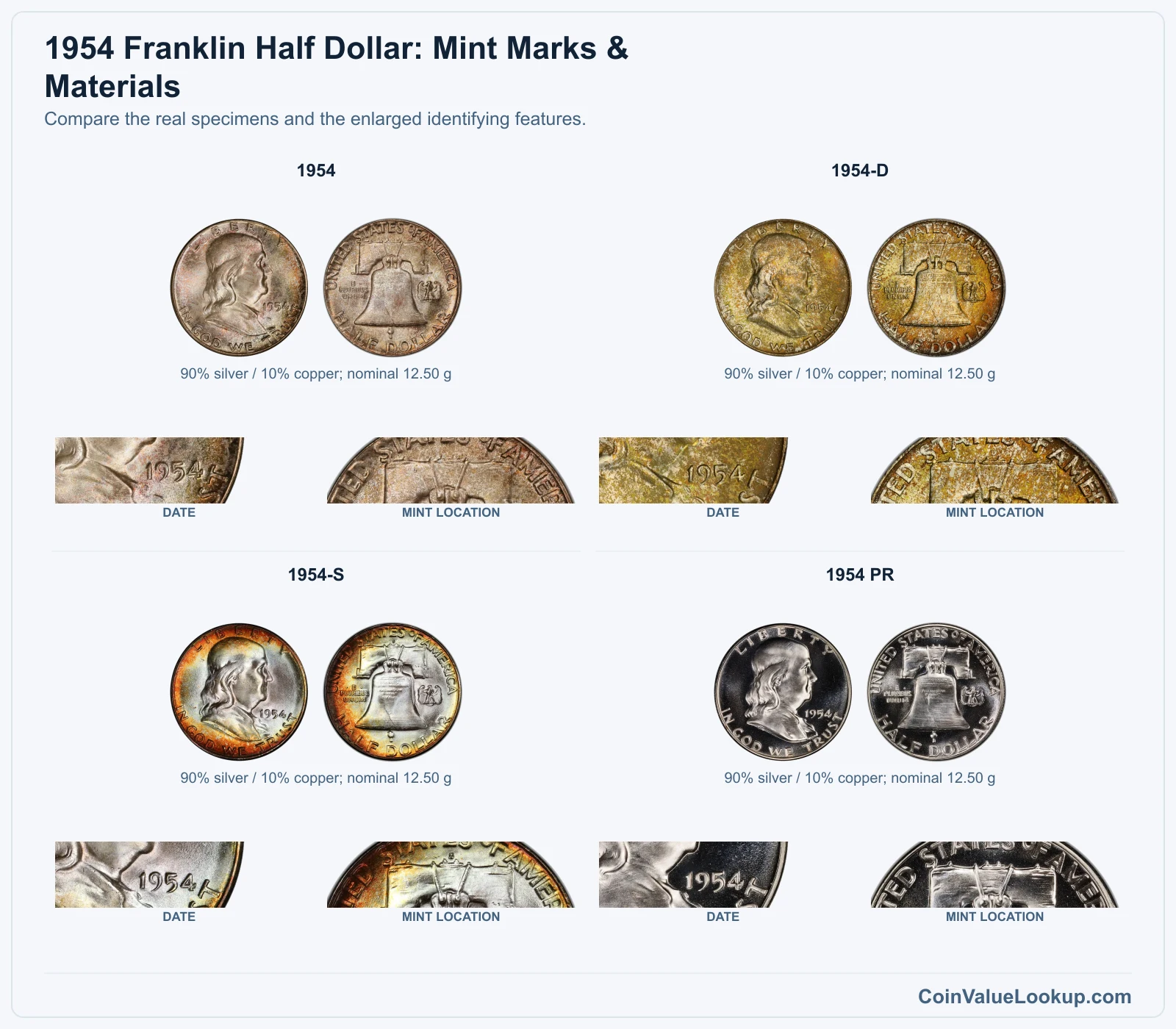
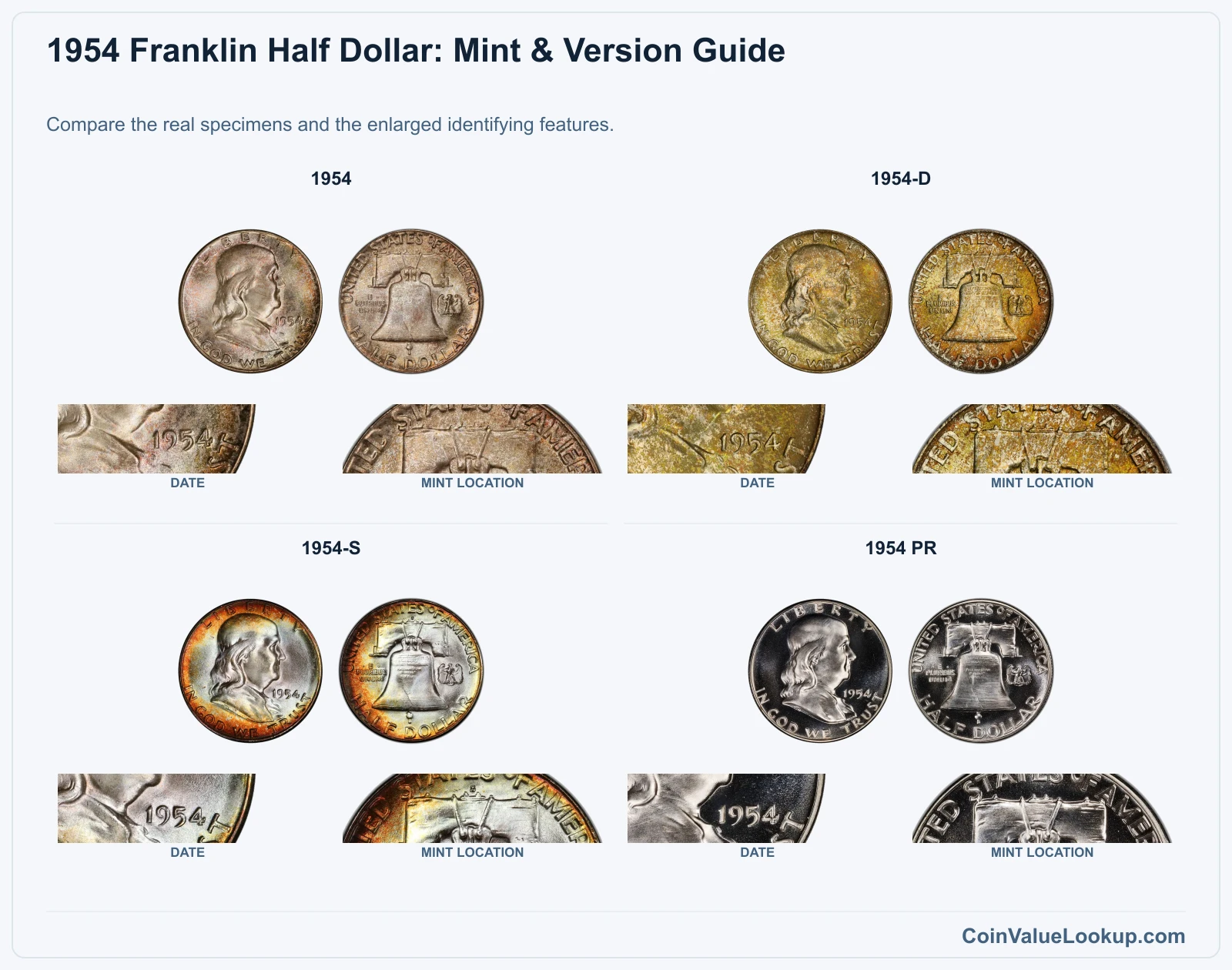
The 1954 Franklin Half Dollar was struck at three mints. Philadelphia coins carry no mintmark.
Denver pieces show a small "D" and San Francisco coins a small "S," both located on the reverse just above the Liberty Bell and below the words E PLURIBUS UNUM.
All business strikes share the same composition: 90% silver and 10% copper, weighing a nominal 12.50 grams. Toning does not change the underlying alloy, so a dark coin is still a silver coin.
Philadelphia also produced proof issues in 1954, designated 1954 PR. Proofs have mirror-like fields and sharply struck devices.
A polished circulation strike is not a proof, no matter how shiny someone got it.
Full Bell Lines is a strike-detail designation, not a separate mint or metal variety. It describes intact horizontal lines on the lower portion of the Liberty Bell.
Coins with this designation can command a premium, but you need the actual detail present, confirmed under magnification.
Step 2: Check Your 1954 Franklin Half Dollar Grade
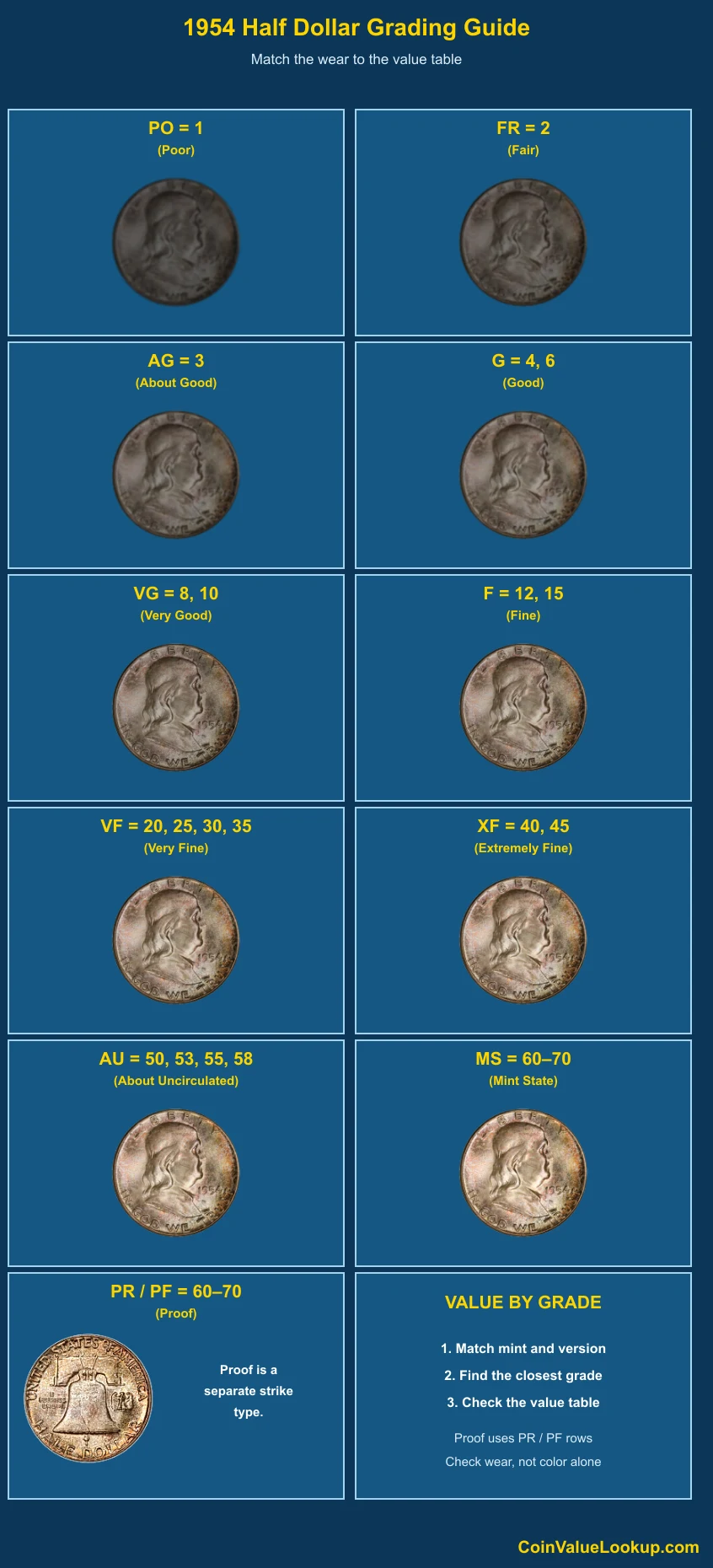
Start with Franklin's cheek and the hair behind his ear. On a lightly circulated coin those areas flatten first, losing fine strand detail before the rest of the portrait shows wear.
The shoulder is another early-wear checkpoint.
Flip the coin over. The lettering around the Liberty Bell, the rim sharpness and the lower bell lines all tell a story about how much the coin circulated.
Contact marks from bag handling are different from the smooth, even loss of detail you see on a worn coin.
Use the comparison image to match your coin's wear pattern against known grade examples. Proof coins get graded on a separate scale that focuses on hairlines, haze and surface quality rather than circulation wear.
A proof with heavy hairlines can grade lower than a pristine business strike.
Step 3: Check 1954 Franklin Half Dollar Value by Mint and Version
1954 Franklin Half Dollar
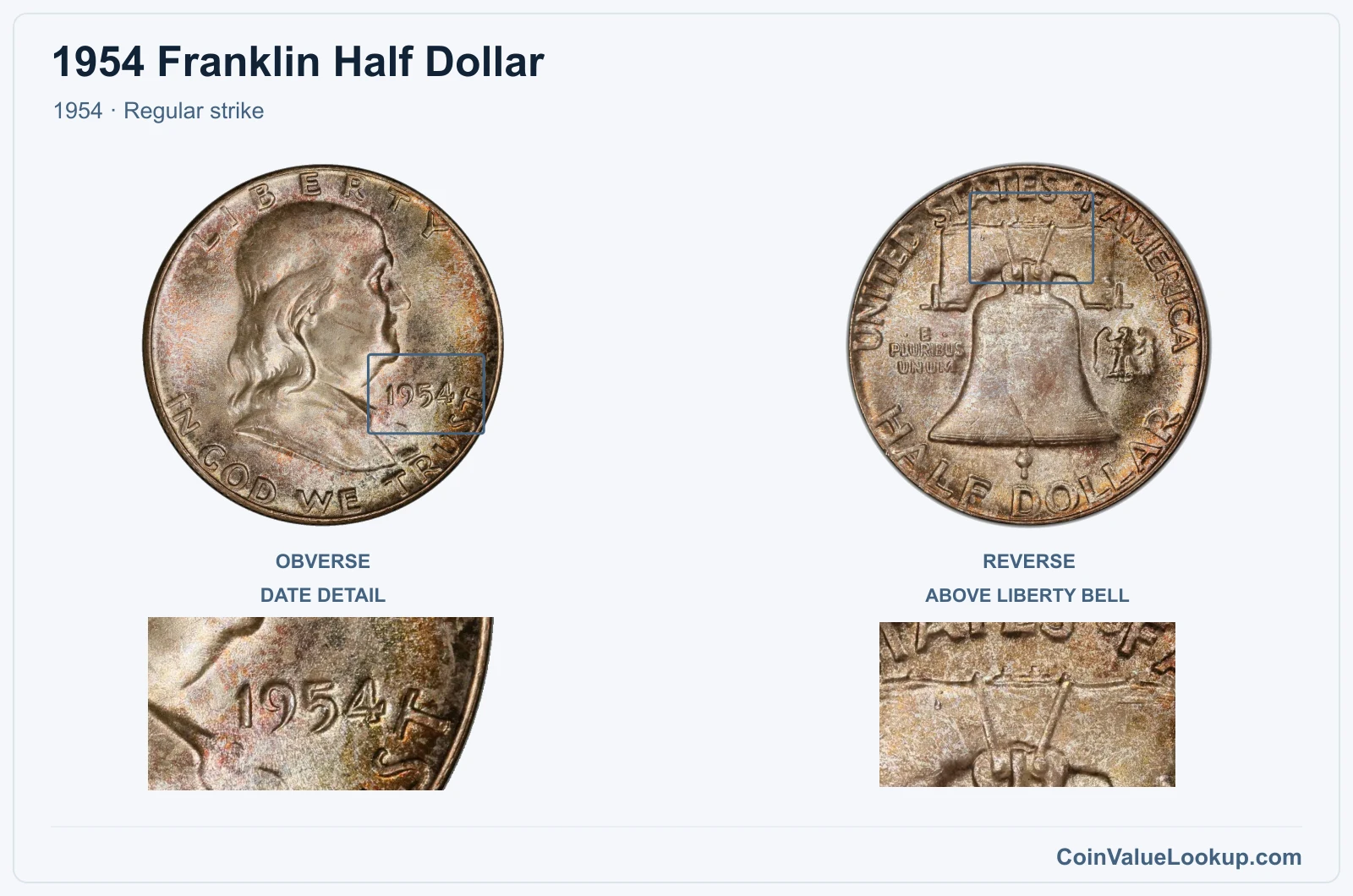
The 1954 Philadelphia business strike carries no mintmark on the reverse. Look above the Liberty Bell, below E PLURIBUS UNUM — if the space is blank, you have a Philly coin.
USA Coin Book guide estimates place this branch at about $32.00 in G4 (a well-worn but readable coin) and $74.00 in MS65 (gem uncirculated with minimal marks). These are guide figures, not offers.
Cleaned or damaged pieces fall below these anchors regardless of how much silver they contain.
Original surfaces matter. A coin with natural toning and no signs of cleaning or tooling will always trade more favorably than one that has been scrubbed bright.
Range Grade
Price Auction Records Appraisal PO PO 1
—
Coin Identifier FR FR 2
—
Coin Identifier AG AG 3
—
Coin Identifier G G 4
—
Coin Identifier
G 6
—
Coin Identifier VG VG 8
—
Coin Identifier
VG 10
—
Coin Identifier F F 12
—
Coin Identifier
F 15
—
Coin Identifier VF VF 20
—
Coin Identifier
VF 25
—
Coin Identifier
VF 30
—
Coin Identifier
VF 35
—
Coin Identifier XF XF 40
—
Coin Identifier
XF 45
—
Coin Identifier AU AU 50
—
Coin Identifier
AU 53
—
Coin Identifier
AU 55
—
Coin Identifier
AU 58
Coin Identifier MS MS 60
—
Coin Identifier
MS 61
—
Coin Identifier
MS 62
Coin Identifier
MS 63
Coin Identifier
MS 64
Coin Identifier
MS 65
Coin Identifier
MS 66
Coin Identifier
MS 67
Coin Identifier
MS 68
—
—
—
MS 69
—
—
—
MS 70
—
—
—
1954 Franklin Half Dollar — D
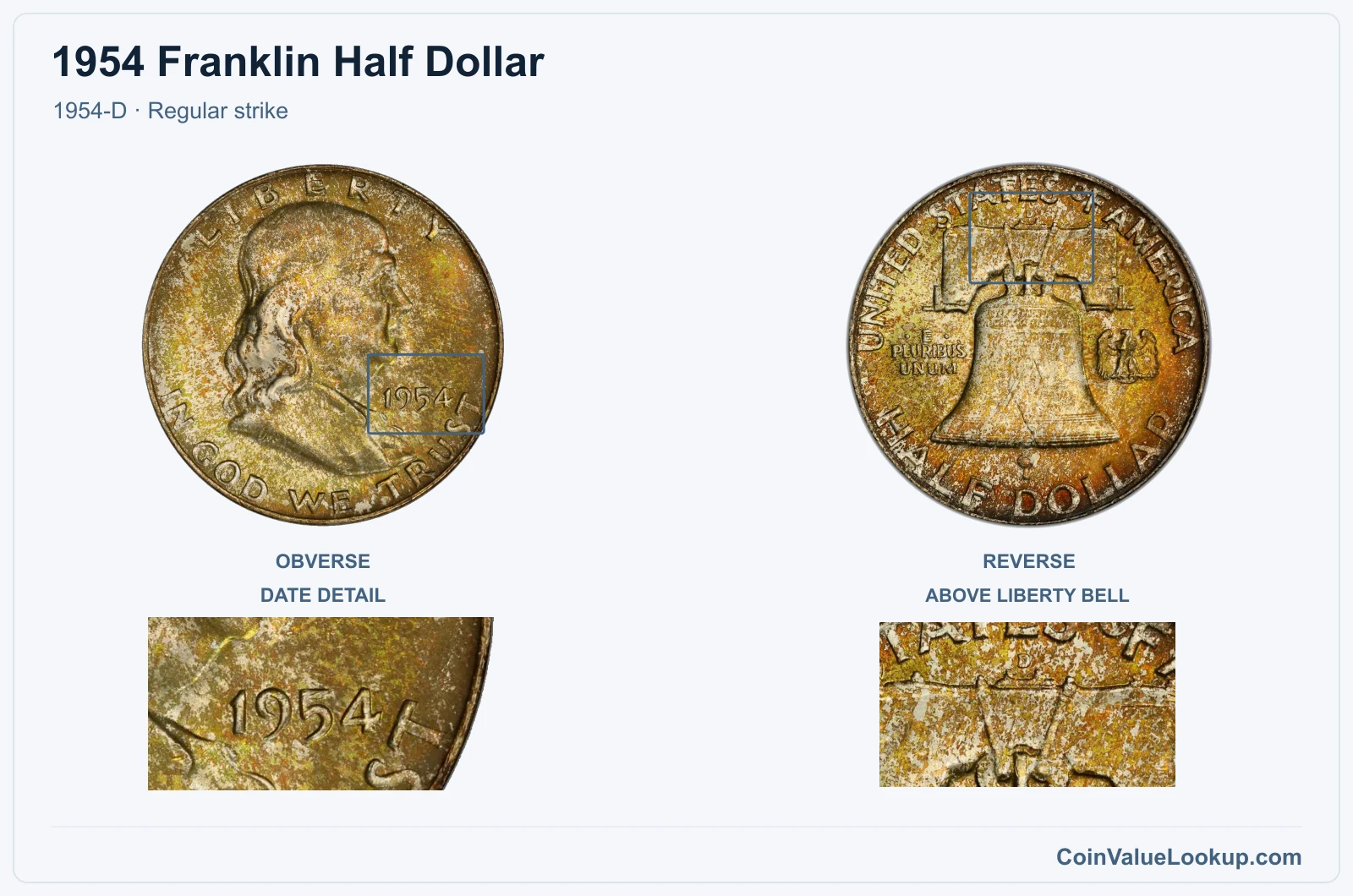
The 1954-D was struck at Denver and shows a small "D" mintmark on the reverse above the Liberty Bell. This branch has the strongest uncirculated guide anchor among the three business strikes.
USA Coin Book estimates run from about $32.00 at G4 to $109.00 at MS65. That MS65 figure reflects problem-free, original coins with strong eye appeal.
Bag marks, cleaning and rim dings all push the grade — and the value — down.
Coin Value Lookup is a good starting point if you want to compare your Franklin half to other denominations and years. You can browse guides for many U.S. series in one place.
Range Grade
Price Auction Records Appraisal PO PO 1
—
Coin Identifier FR FR 2
—
Coin Identifier AG AG 3
—
Coin Identifier G G 4
—
Coin Identifier
G 6
—
Coin Identifier VG VG 8
—
Coin Identifier
VG 10
—
Coin Identifier F F 12
—
Coin Identifier
F 15
—
Coin Identifier VF VF 20
—
Coin Identifier
VF 25
Coin Identifier
VF 30
—
Coin Identifier
VF 35
—
Coin Identifier XF XF 40
—
Coin Identifier
XF 45
—
Coin Identifier AU AU 50
—
Coin Identifier
AU 53
—
Coin Identifier
AU 55
—
Coin Identifier
AU 58
Coin Identifier MS MS 60
—
Coin Identifier
MS 61
—
Coin Identifier
MS 62
Coin Identifier
MS 63
Coin Identifier
MS 64
Coin Identifier
MS 65
Coin Identifier
MS 66
Coin Identifier
MS 67
—
—
—
MS 68
—
—
—
MS 69
—
—
—
MS 70
—
—
—
1954 Franklin Half Dollar — S
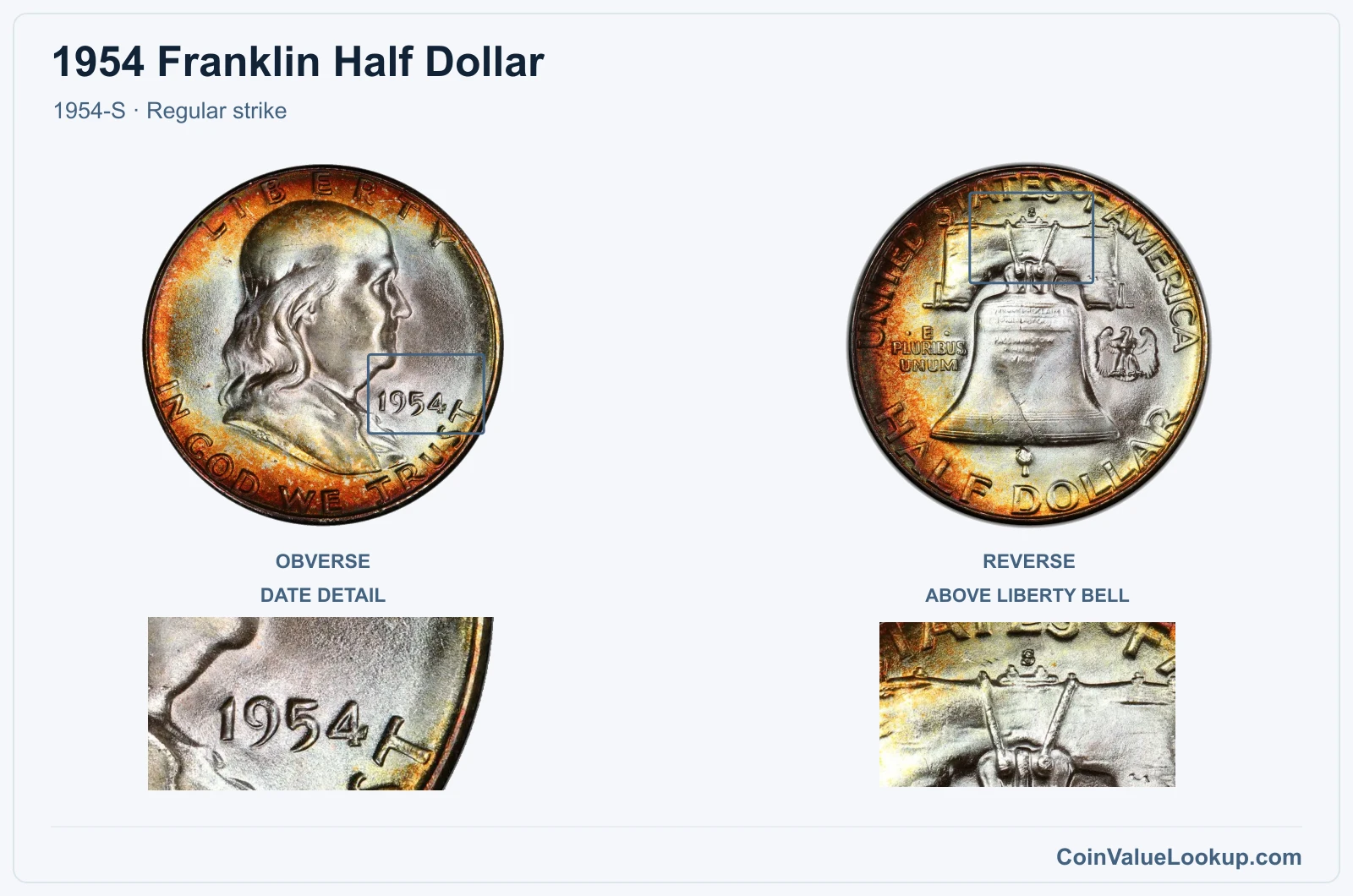
San Francisco struck the 1954-S, identified by a small "S" mintmark above the Liberty Bell on the reverse. Same 90% silver composition, same 12.50-gram nominal weight.
Guide estimates from USA Coin Book put the 1954-S at roughly $32.00 in G4 and $87.00 in MS65. As with all Franklin halves, Full Bell Lines detail can add a premium on top of the standard grade, but only when the lower bell lines are truly intact under magnification.
Always confirm the mintmark under light rather than guessing. A worn S can look faint, and you do not want to mistake it for a Philadelphia coin.
Range Grade
Price Auction Records Appraisal PO PO 1
—
Coin Identifier FR FR 2
—
Coin Identifier AG AG 3
—
Coin Identifier G G 4
—
Coin Identifier
G 6
—
Coin Identifier VG VG 8
—
Coin Identifier
VG 10
—
Coin Identifier F F 12
—
Coin Identifier
F 15
—
Coin Identifier VF VF 20
Coin Identifier
VF 25
—
Coin Identifier
VF 30
—
Coin Identifier
VF 35
—
Coin Identifier XF XF 40
—
Coin Identifier
XF 45
—
Coin Identifier AU AU 50
—
Coin Identifier
AU 53
—
Coin Identifier
AU 55
—
Coin Identifier
AU 58
—
Coin Identifier MS MS 60
—
Coin Identifier
MS 61
—
Coin Identifier
MS 62
Coin Identifier
MS 63
Coin Identifier
MS 64
Coin Identifier
MS 65
Coin Identifier
MS 66
Coin Identifier
MS 67
Coin Identifier
MS 68
—
—
—
MS 69
—
—
—
MS 70
—
—
—
1954 Franklin Half Dollar — PR
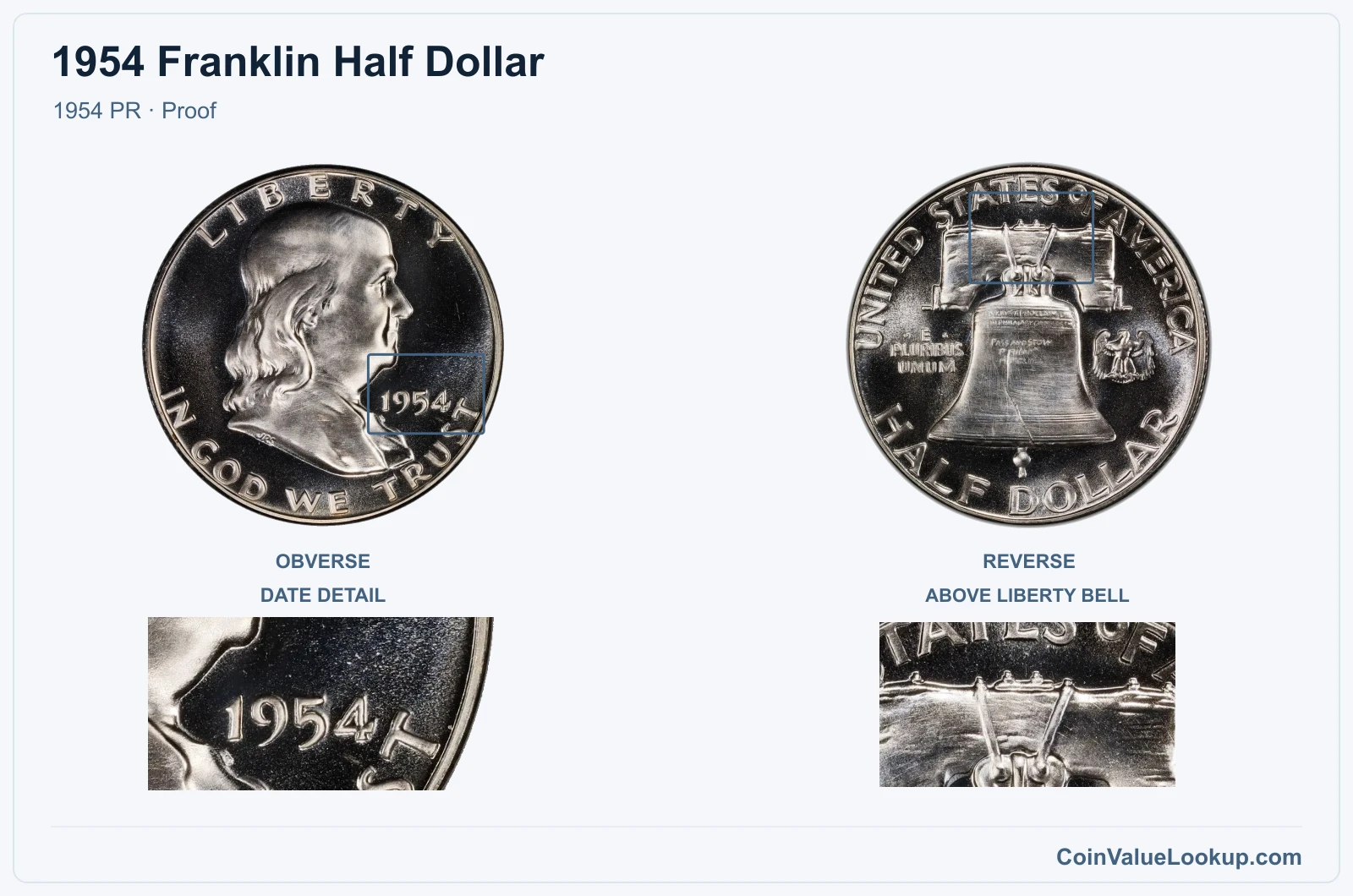
The 1954 proof was produced at Philadelphia for collectors, not for circulation. It carries no mintmark, same as the business strike, but the manufacturing method is entirely different.
Genuine proofs show deeply mirrored fields and razor-sharp design elements. Confirm this by tilting the coin under a direct light source — the flat fields should reflect like a mirror while the raised devices stay frosted or at least distinctly sharp.
A polished ordinary coin will not replicate that contrast or edge definition.
USA Coin Book estimates the 1954 proof at about $140.00 in PR65. Hairlines, haze and any signs of mishandling lower the proof grade.
Cameo contrast, where frosted devices sit against mirror fields, can increase desirability beyond the standard proof figure, but that distinction is separate from the base proof designation.
Range Grade
Price Auction Records Appraisal PR PR 1
—
Coin Identifier
PR 2
—
Coin Identifier
PR 3
—
Coin Identifier
PR 4
—
Coin Identifier
PR 6
—
Coin Identifier
PR 8
—
Coin Identifier
PR 10
—
Coin Identifier
PR 12
—
Coin Identifier
PR 15
—
Coin Identifier
PR 20
—
Coin Identifier
PR 25
—
Coin Identifier
PR 30
—
Coin Identifier
PR 35
—
Coin Identifier
PR 40
—
Coin Identifier
PR 45
—
Coin Identifier
PR 50
—
Coin Identifier
PR 53
—
Coin Identifier
PR 55
—
Coin Identifier
PR 58
—
Coin Identifier
PR 60
Coin Identifier
PR 61
—
Coin Identifier
PR 62
Coin Identifier
PR 63
Coin Identifier
PR 64
Coin Identifier
PR 65
Coin Identifier
PR 66
Coin Identifier
PR 67
Coin Identifier
PR 68
Coin Identifier
PR 69
Coin Identifier
PR 70
—
—
—
1954 Franklin Half Dollar Error List
1. 1954 Franklin Half Dollar — Bugs Bunny Die Clash
The "Bugs Bunny" die clash is one of the more visually entertaining Franklin errors. It occurs when obverse and reverse dies contact each other without a planchet between them, leaving transferred design elements on both dies.
On the 1954, the result shows up as raised, tooth-like marks near Franklin's mouth — giving him a buck-toothed appearance.
To check, magnify the area around the lips and compare to a normal 1954 portrait. The clash marks should be raised, consistent and match the expected transferred design.
Random scratches, contact marks or altered surfaces can mimic the look at first glance but will lack the uniform pattern of a genuine clash. No specific price range is adopted for this variety; value depends on the visibility of the clash, the coin's overall condition and demand from error collectors.
2. 1954 Franklin Half Dollar — Lamination / Split Planchet
Lamination errors happen when the planchet's alloy separates internally, creating peeling metal, a retained flap or an outright split in the coin's surface. On a 1954 Franklin half, look for a section where the metal appears to be lifting away or where a thin layer has already broken off, exposing a rough underlayer.
Photograph both the affected face and the edge together — the edge often confirms that the separation runs through the coin rather than sitting on the surface. This helps distinguish a genuine lamination from scraping, corrosion or a coin that someone deliberately cut or gouged.
Corrosion tends to pit the surface irregularly, while a lamination follows the metal's internal structure.
No specific price range is adopted for 1954 lamination errors. Value depends on the size and visibility of the flaw, plus overall coin condition.
3. 1954 Franklin Half Dollar — Doubled Die Obverse
A doubled die obverse on the 1954 Franklin half shows consistent doubling on obverse design elements — letters, date or portrait details — created during the die-making process. The doubling appears as separation or notching that repeats uniformly across affected areas.
To identify it, compare the obverse lettering and date of your coin to a normal 1954 under the same lighting. Genuine hub doubling produces a distinct secondary image with consistent direction and spacing.
Machine doubling, by contrast, tends to show flat shelf-like displacement rather than true separation.
Worn die contours and light reflections can also trick the eye, so magnification and comparison are essential. No specific price range is adopted for 1954 doubled die obverse examples.
Value hinges on the strength and visibility of the doubling, as well as the coin's overall grade.
4. 1954 Franklin Half Dollar — Clipped Planchet
A clipped planchet error means the coin blank was incompletely punched from the strip before striking. On a 1954 Franklin half, this typically appears as a curved missing section along the rim, though straight or ragged clips are also reported.
Look at the edge texture around the missing area. Genuine clips often show a slightly different metal-flow pattern, and you may notice design weakness on the opposite side of the coin from the clip — a telltale called the Blakesley effect.
An edge that has been filed, cut or corroded after striking will lack these characteristics.
Compare rim thickness at the clip to the rest of the coin. No specific price range is adopted for 1954 clipped planchet errors; the size and type of clip, plus the coin's condition, drive collector interest.
5. 1954 Franklin Half Dollar — Struck-Through Error
A struck-through error occurs when foreign material — grease, thread, a metal fragment — sits between the die and the planchet during striking. The result on a 1954 Franklin half is a localized depression or incomplete design area that matches the shape of whatever was trapped.
Grease fill-ins tend to produce soft, rounded depressions across a design element. Retained foreign objects can leave a sharper, more defined impression.
Both are distinct from ordinary wear, which removes metal evenly across high points rather than creating isolated voids.
Scratches, cleaning and simple weak strikes can mimic the look, so compare the affected area to a known normal coin. On the 1954, reverse struck-through examples have been reported specifically.
No numerical price range is adopted; value depends on the size, clarity and nature of the struck-through impression along with the coin's overall grade.