1891 Liberty Seated Half Dollar Coin Value: How Much Is It Worth?
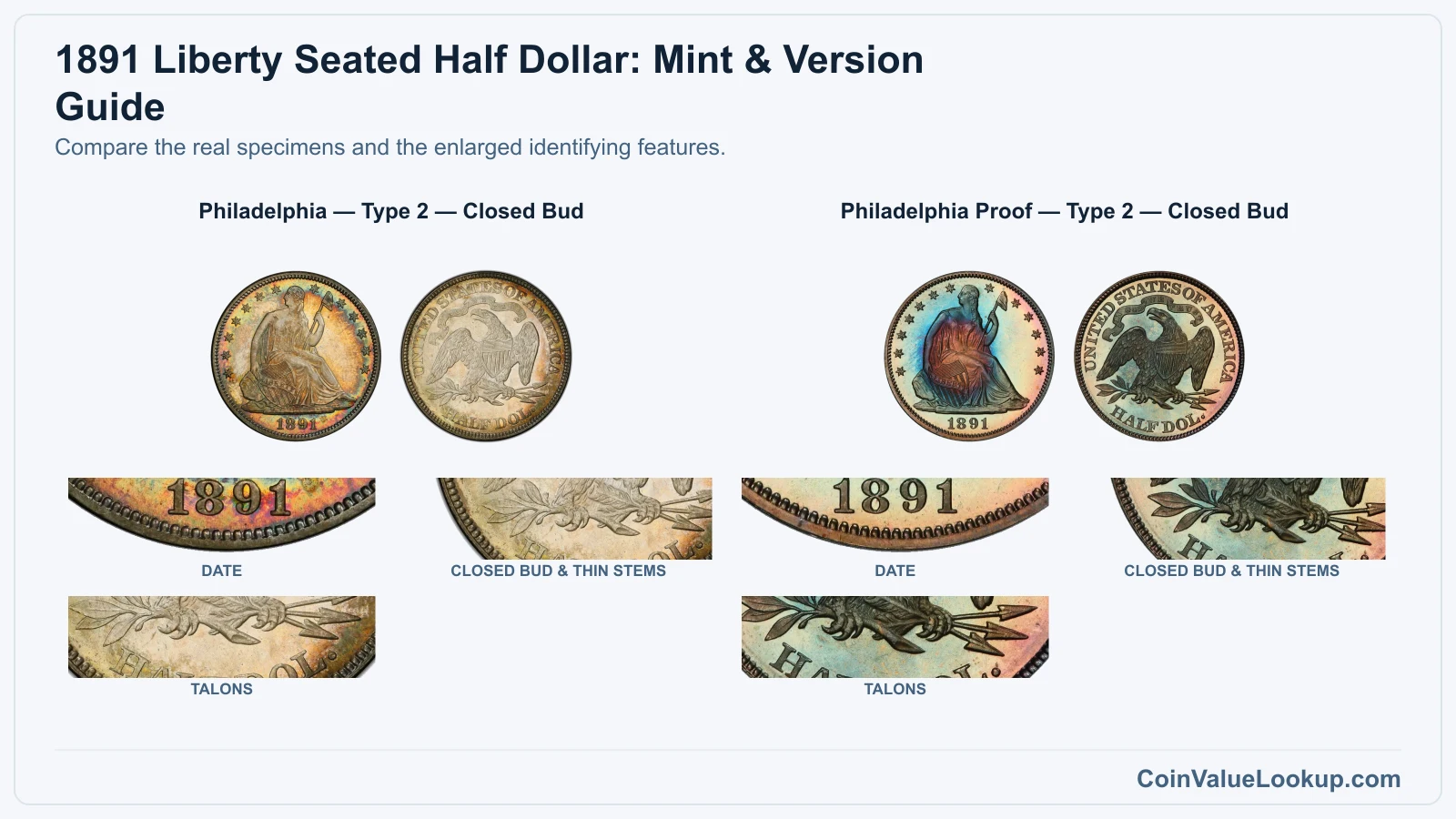
The 1891 Liberty Seated Half Dollar is the final year of a long-running series, and that alone gets collectors' attention. Guide estimates for a Philadelphia circulation strike range from around $141 in G4 (a heavily worn but readable coin) up to about $878 in AU50 (nearly uncirculated).
Proofs in PR63 carry a guide estimate near $1,409. These are retail guide figures, not guaranteed buy prices — actual offers depend on the specific coin's surfaces, strike and eye appeal.
Fast Way to Identify Your 1891 Liberty Seated Half Dollar
Want a quick read on what you have? Upload clear photos of the front and back of your coin, and our identifier can give you a preliminary idea of the version and condition.
Good lighting at a slight angle helps capture surface detail and any remaining luster, which matters a lot on these old silver pieces.
1891 Liberty Seated Half Dollar Value
Upload both sides of your 1891 Liberty Seated Half Dollar.
Front Obverse
Upload photo
Back Reverse
Upload photo
Which 1891 Liberty Seated Half Dollar Versions Are Worth Money?
- The 1891 is the last year of the Seated Liberty half dollar series, struck in low numbers for circulation, making any original-surface example collectible.
- Proof strikes in PR63 carry a guide estimate around $1,409 — correctly identifying the Proof finish versus a prooflike circulation strike is critical.
- Original mint-state surfaces with strong luster can push value well above the AU50 guide anchor of $878, depending on eye appeal and strike quality.
Step 1: Identify Your 1891 Liberty Seated Half Dollar Mint Mark and Version
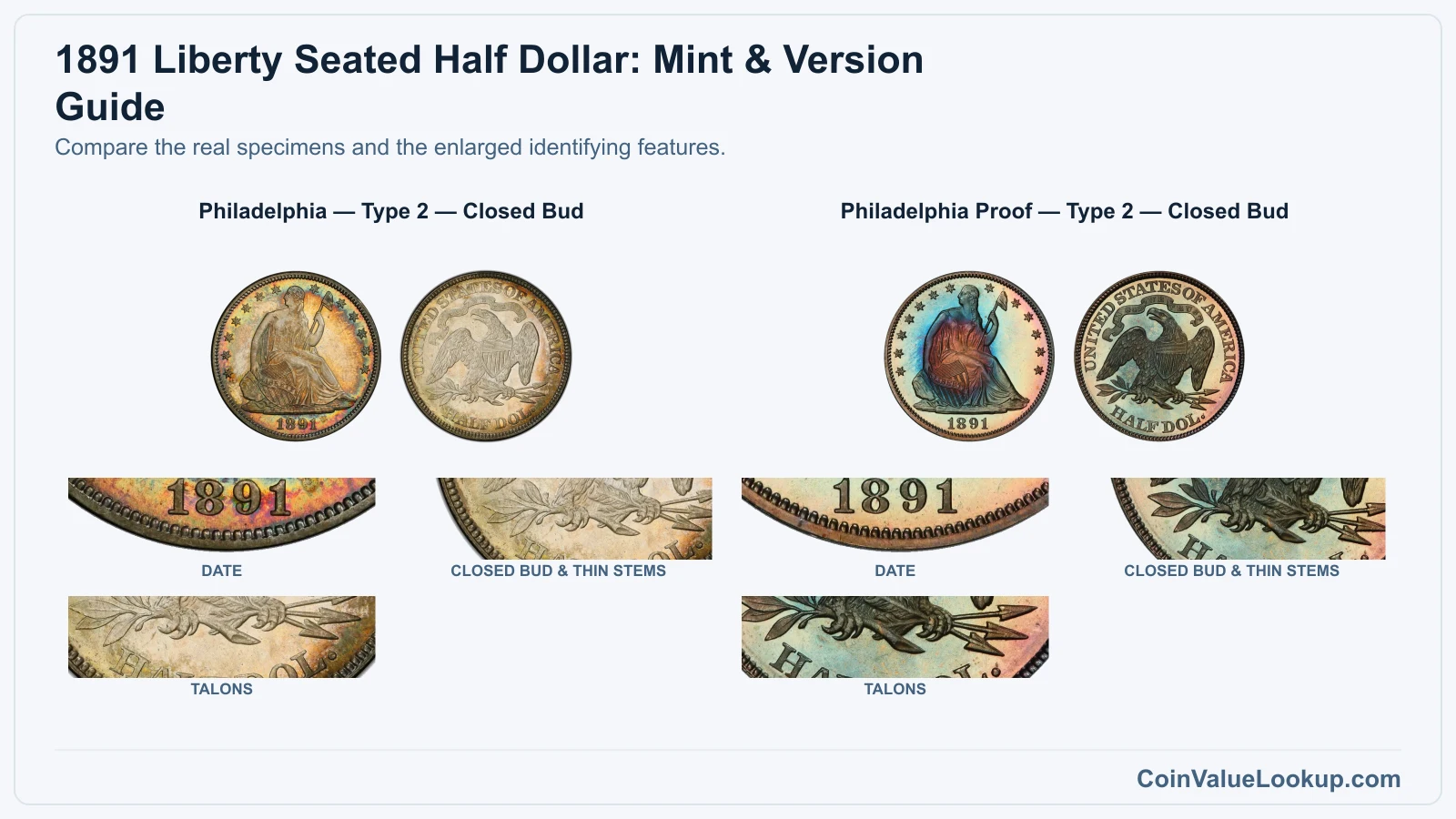
The 1891 half dollar shows the familiar Seated Liberty on the obverse, with an eagle holding an olive branch, arrows and a motto banner on the reverse, plus HALF DOL at the bottom. It is struck in 90% silver and 10% copper, weighing 12.50 grams with a reeded edge.
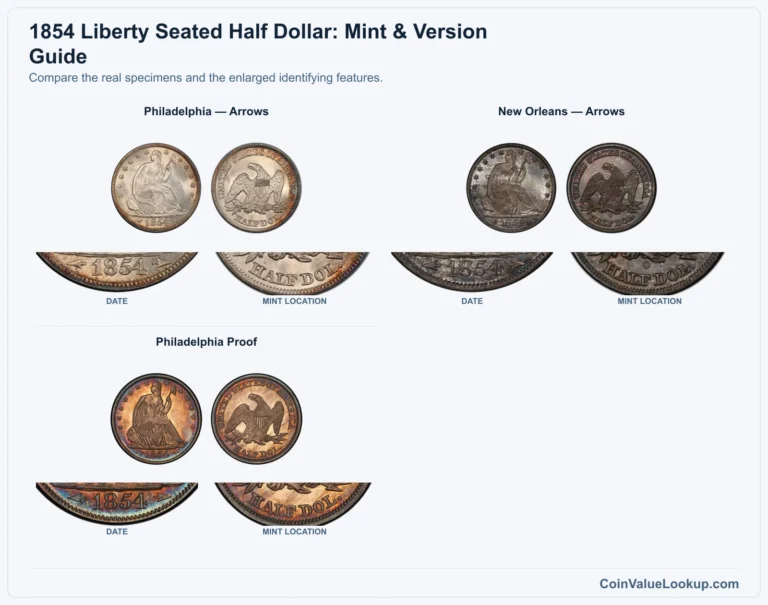
Philadelphia strikes carry no mintmark. The reverse mintmark area below the eagle should be blank.
If you see an S, O or CC there, you have a different coin from a different date range — no branch-mint 1891 half dollars exist in this series.
The reverse hub used for 1891 is the Type 2, identified by a closed lower olive bud and stronger olive stems. Earlier Type 1 reverses have an open bud and weaker stems.
Look at the small cluster of olives on the branch the eagle holds — if the lowest bud is solid and closed, that matches the expected hub.
One important distinction: Proof and circulation strike are manufacturing categories, not grade levels. A Proof is not simply a "better" coin above Mint State.
Some regular strikes can show prooflike reflective fields, but mirror brightness alone does not make a coin a Proof. True Proofs have specific rim and surface characteristics that require careful attribution.
Step 2: Check Your 1891 Liberty Seated Half Dollar Grade
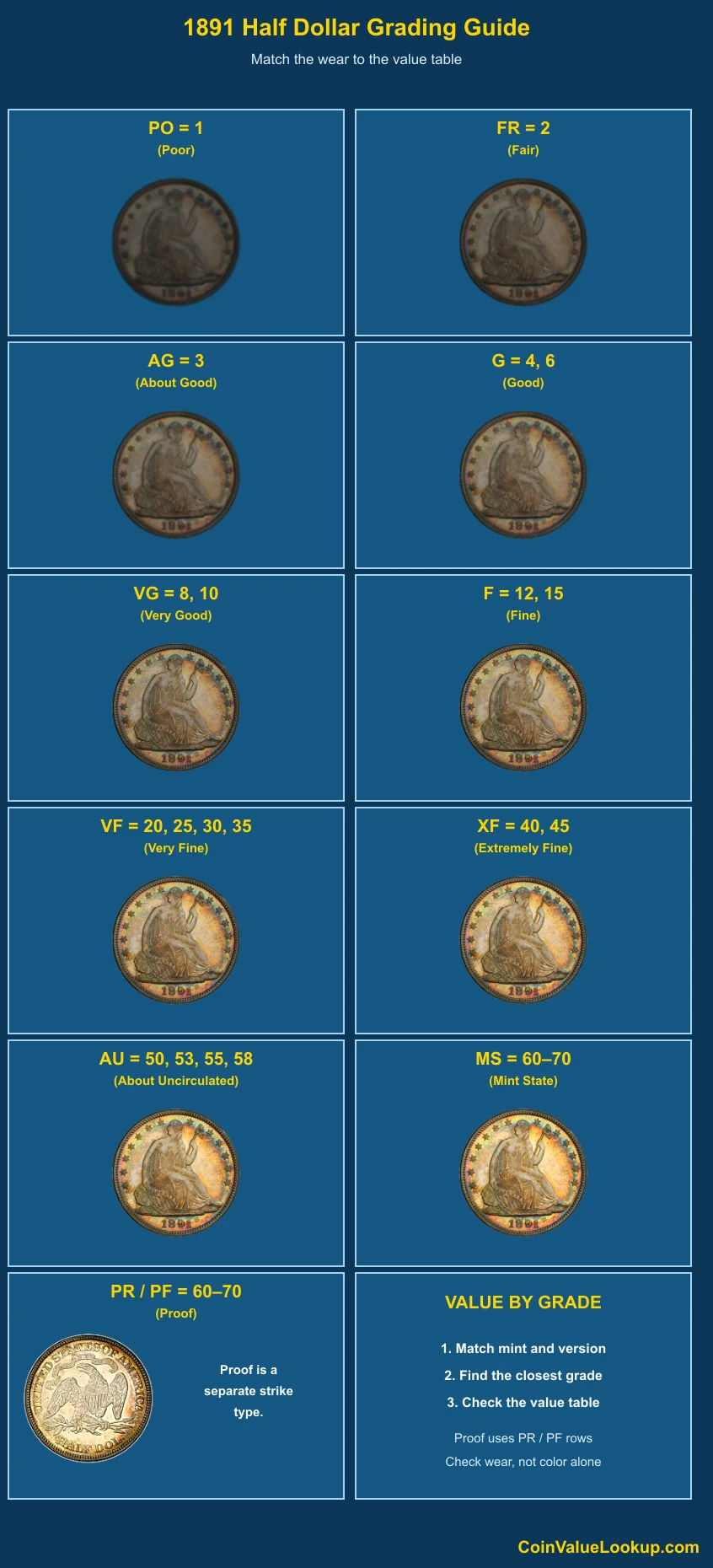
Start with the high points on Liberty's figure: the head, breast, knee and the horizontal lines on the shield. These wear first.
On the reverse, check the eagle's breast feathers and wing tips.
A coin grading G4 will have a clear date and outline of Liberty but almost no interior detail. By VF20, the shield lines and knee contour become visible.
AU50 shows only the slightest friction on the absolute highest points, with most original luster still present.
Weak strikes can mimic wear. If both sides still show cartwheel luster when tilted under a light, the soft detail may be a strike issue rather than circulation wear.
Use the comparison image to check specific points at each grade level.
Avoid cleaning your coin. Hairlines from polishing, holes and rim damage all reduce value far more than honest wear does.
A naturally toned G4 is often more desirable than a harshly cleaned VF.
Step 3: Check 1891 Liberty Seated Half Dollar Value by Mint and Version
1891 Liberty Seated Half Dollar — Philadelphia — Type 2 — Closed Bud
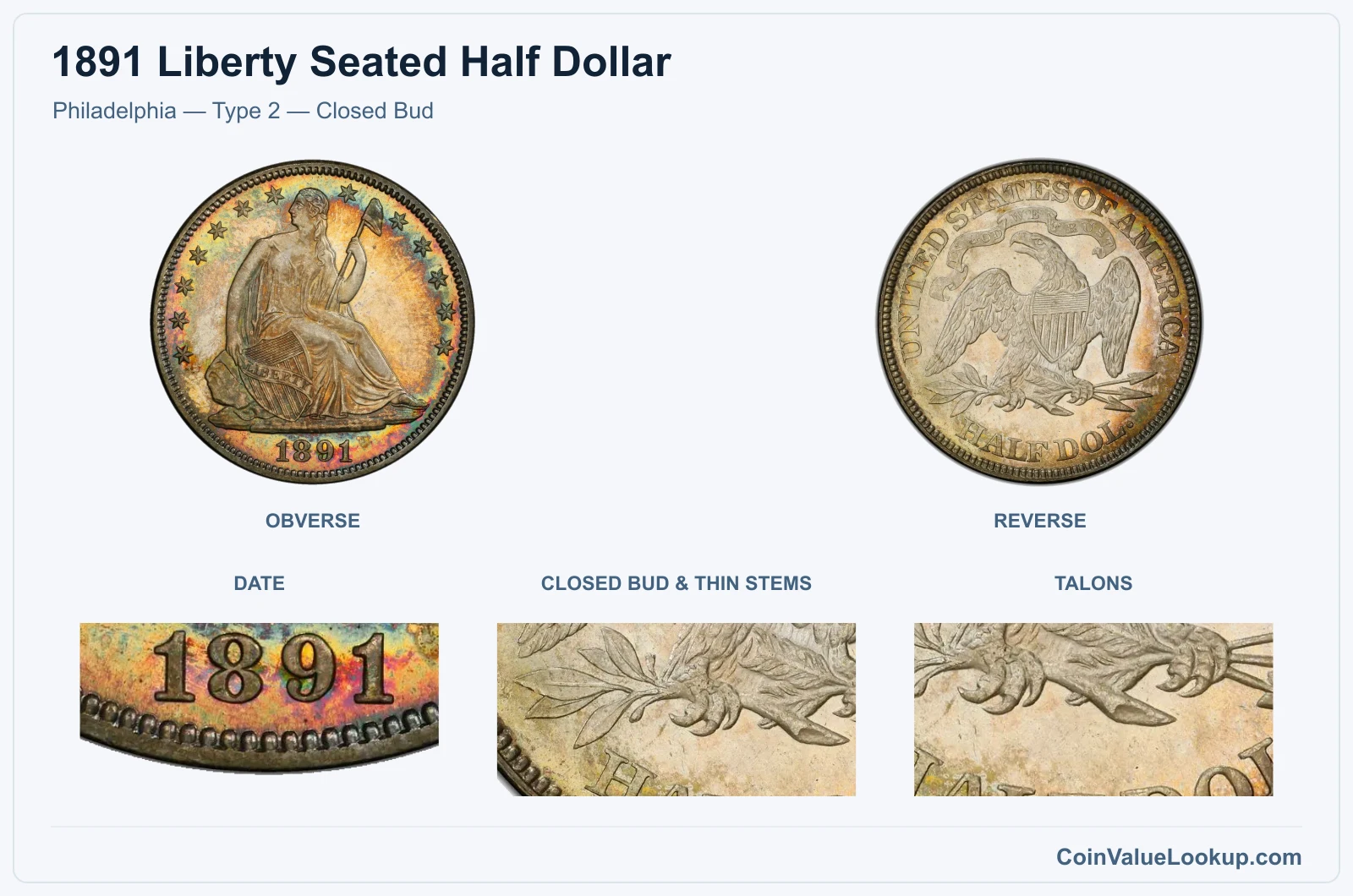
The standard 1891 Philadelphia half dollar uses the Type 2 reverse hub, recognized by its closed lower olive bud and strong stem detail. No mintmark appears on the reverse.
Guide estimates place this coin at roughly $141 in G4, $394 in VF20 and $878 in AU50.
These are the only circulation strikes for this date — no branch mints produced half dollars in 1891. Some examples display prooflike reflective fields, which can look dramatic but do not indicate a Proof finish.
The distinction matters because Proofs are attributed by surface and rim characteristics, not just shininess. Check the olive bud cluster carefully to confirm the closed-bud Type 2 hub.
Coin Value Lookup is a handy starting point if you want to look up guides for other dates in this series or compare across denominations.
Ordinary-issue reference: Ordinary-issue reference only: The table below shows prices for the 1891 Liberty Seated Half Dollar (regular strike). It does not represent the value of the specific Philadelphia — Type 2 — Closed Bud variety or its variety premium. Year, mint, metal and strike type are matched; the specific variety is not priced by this table.
Range Grade
Price Auction Records Appraisal PO PO 1
—
Coin Identifier FR FR 2
—
Coin Identifier AG AG 3
—
Coin Identifier G G 4
—
Coin Identifier
G 6
—
Coin Identifier VG VG 8
Coin Identifier
VG 10
—
Coin Identifier F F 12
—
Coin Identifier
F 15
Coin Identifier VF VF 20
Coin Identifier
VF 25
Coin Identifier
VF 30
Coin Identifier
VF 35
Coin Identifier XF XF 40
Coin Identifier
XF 45
Coin Identifier AU AU 50
Coin Identifier
AU 53
Coin Identifier
AU 55
Coin Identifier
AU 58
Coin Identifier MS MS 60
—
Coin Identifier
MS 61
Coin Identifier
MS 62
Coin Identifier
MS 63
Coin Identifier
MS 64
Coin Identifier
MS 65
Coin Identifier
MS 66
Coin Identifier
MS 67
Coin Identifier
MS 68
—
—
—
MS 69
—
—
—
MS 70
—
—
—
1891 Liberty Seated Half Dollar — Philadelphia Proof — Type 2 — Closed Bud
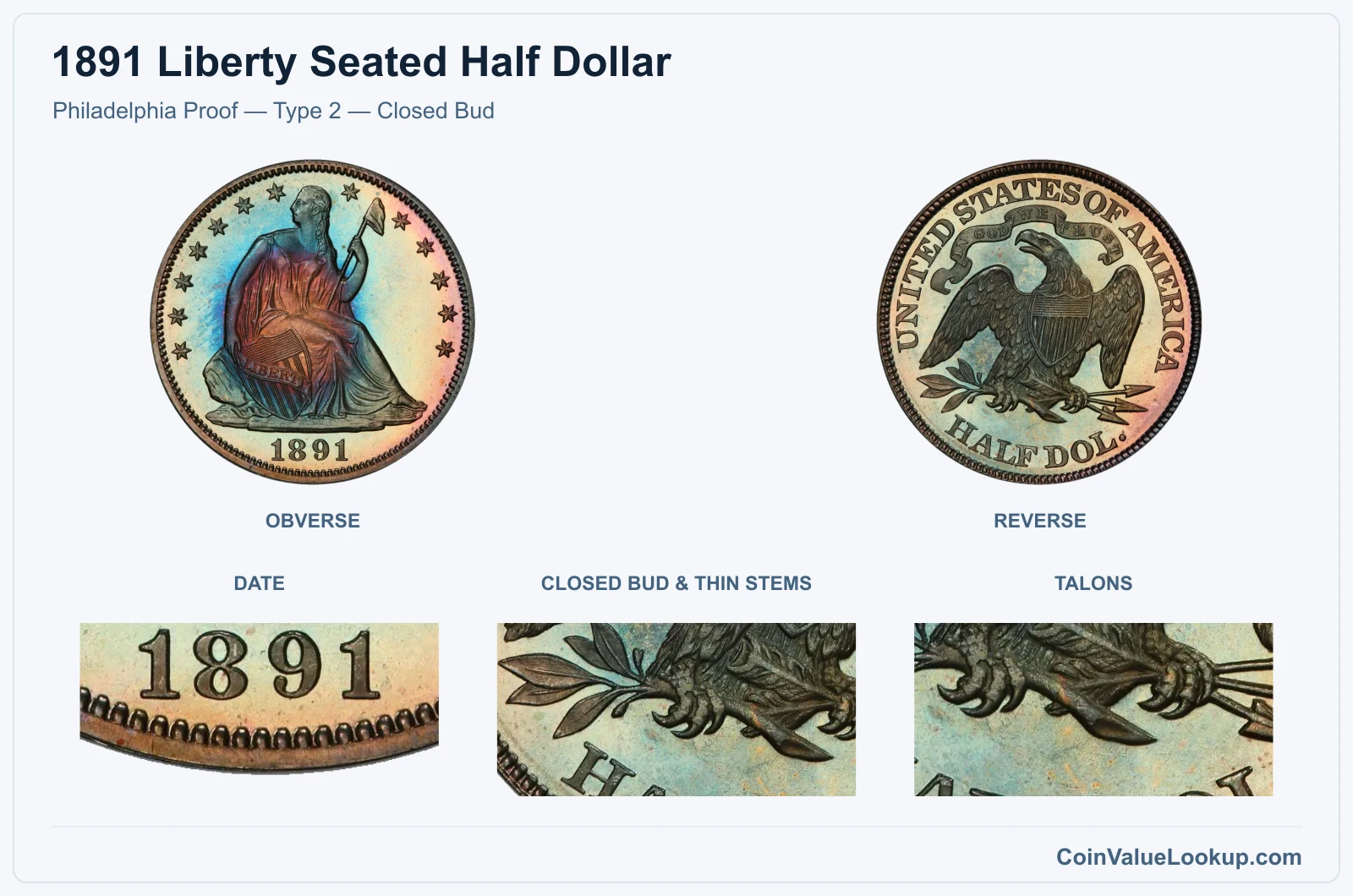
Philadelphia Proofs of 1891 share the same Type 2 closed-bud reverse hub as the circulation strikes, so hub details alone will not separate them. True Proofs show squared, knife-sharp rims and deeply mirrored fields that differ from the softer rims on business strikes, even prooflike ones.
The guide estimate for a PR63 example is about $1,409. Cameo and Deep Cameo are contrast designations within the Proof finish describing the degree of frost on the devices against the mirrored fields — they are not separate categories.
Because late-date Seated Liberty regular strikes can look very reflective, expert attribution is recommended before assuming you hold a Proof. The 1891 is the final Proof issue of this type, which gives it a natural bookend appeal among series collectors.
Ordinary-issue reference: Ordinary-issue reference only: The table below shows prices for the 1891 Liberty Seated Half Dollar (proof). It does not represent the value of the specific Philadelphia Proof — Type 2 — Closed Bud variety or its variety premium. Year, mint, metal and strike type are matched; the specific variety is not priced by this table.
Range Grade
Price Auction Records Appraisal PR PR 1
—
Coin Identifier
PR 2
—
Coin Identifier
PR 3
—
Coin Identifier
PR 4
—
Coin Identifier
PR 6
—
Coin Identifier
PR 8
—
Coin Identifier
PR 10
—
Coin Identifier
PR 12
—
Coin Identifier
PR 15
—
Coin Identifier
PR 20
—
Coin Identifier
PR 25
—
Coin Identifier
PR 30
—
Coin Identifier
PR 35
—
Coin Identifier
PR 40
—
Coin Identifier
PR 45
—
Coin Identifier
PR 50
—
Coin Identifier
PR 53
—
Coin Identifier
PR 55
—
Coin Identifier
PR 58
Coin Identifier
PR 60
Coin Identifier
PR 61
Coin Identifier
PR 62
Coin Identifier
PR 63
Coin Identifier
PR 64
Coin Identifier
PR 65
Coin Identifier
PR 66
Coin Identifier
PR 67
Coin Identifier
PR 68
Coin Identifier
PR 69
—
—
—
PR 70
—
—
—
1891 Liberty Seated Half Dollar Error List
1. 1891 Liberty Seated Half Dollar — Clashed Dies
Clashed dies occur when the obverse and reverse dies strike each other without a planchet between them, transferring faint mirror-image impressions of each design onto the opposite die. On an 1891 half dollar, look for ghostly outlines in the open reverse fields — traces that correspond to actual features of the Seated Liberty obverse, not random marks.
This category has been reported for 1891 regular strikes. No specific price premium has been adopted because the value depends on how bold and visible the clash marks are, the coin's overall condition, and buyer interest at the time of sale.
Be careful not to confuse die clash impressions with post-mint scratches, random raised lines or contact marks from other coins. Genuine clash traces will be perfectly positioned relative to the opposing design and will repeat consistently across multiple examples from the same die pair.