1891 Morgan Silver Dollar Coin Value: How Much Is It Worth?
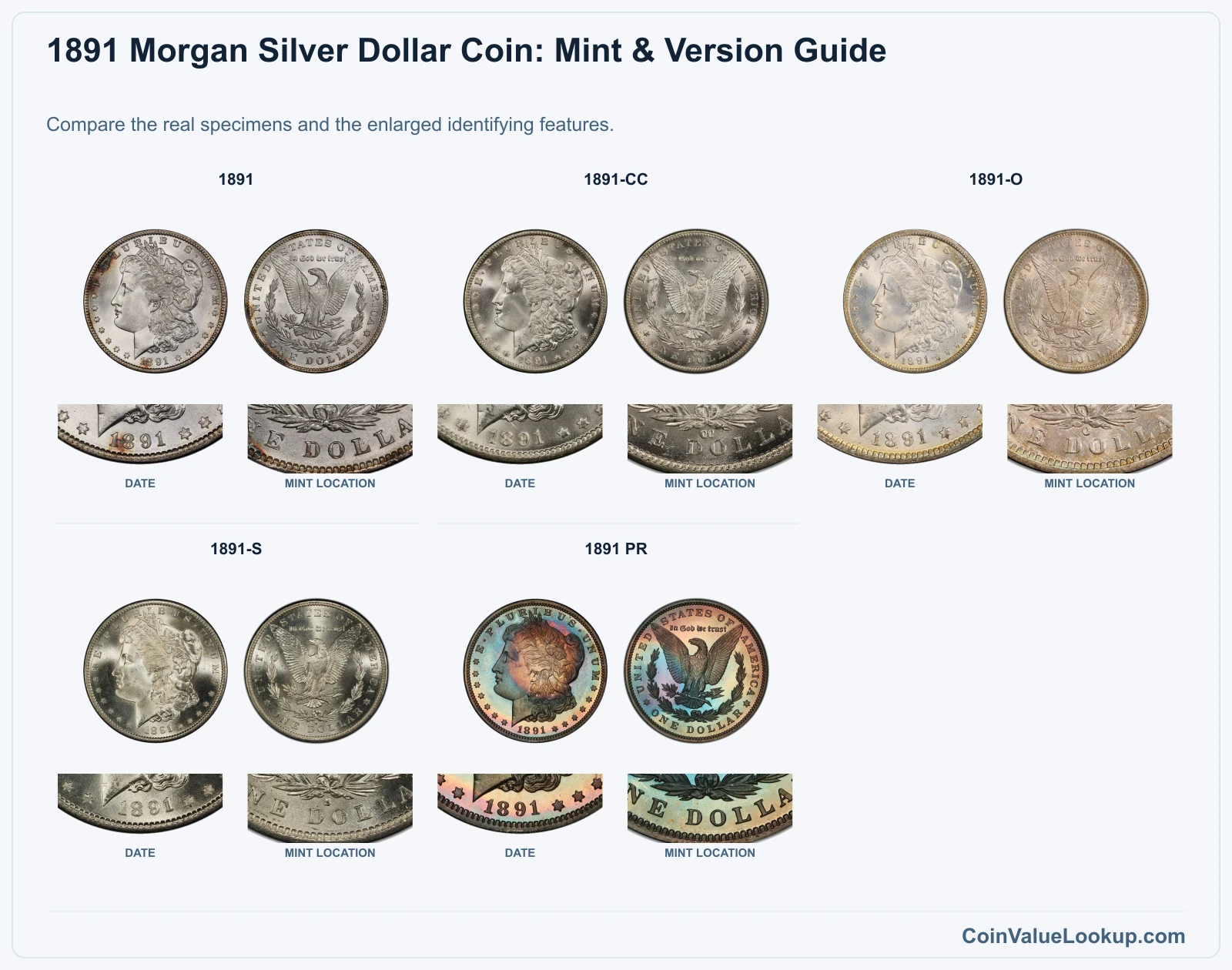
The 1891 Morgan Silver Dollar was struck at up to four mints, and values swing widely depending on which one you have. Guide estimates from USA Coin Book range from about $74.00 in well-worn Good-4 condition to $4,979.00 for a top Mint State example, depending on mint and grade.
A proof version also exists. Identifying your exact mint, surface quality and condition is the first step before assigning any value.
Fast Way to Identify Your 1891 Morgan Silver Dollar
The quickest way to get a preliminary identification of your 1891 Morgan Dollar is to upload clear photos of the front and back. That lets the identifier check the mintmark location, surface condition and overall wear pattern.
Snap both sides in even, natural light and avoid glare so details around the ear, cap and eagle breast are visible.
1891 Morgan Silver Dollar Value
Upload both sides of your 1891 Morgan Silver Dollar.
Front Obverse
Upload photo
Back Reverse
Upload photo
Which 1891 Morgan Silver Dollar Versions Are Worth Money?
- The 1891-CC (Carson City) starts at $212.00 in G4 and reaches $4,405.00 at MS65, making it the branch with the highest low-grade entry point.
- The 1891-O (New Orleans) reaches $4,979.00 at MS65 per USA Coin Book, the highest single guide figure among the business strikes listed.
- The 1891 PR (proof) requires authenticated identification and individual assessment; no standard guide range is adopted here.
- Prooflike or deep-mirror prooflike surface designations on eligible business strikes can affect pricing, but a shiny surface alone does not qualify.
- Do not pay a premium for ordinary wear, cleaning, plating, glare or an unverified error claim.
Step 1: Identify Your 1891 Morgan Silver Dollar Mint Mark and Version
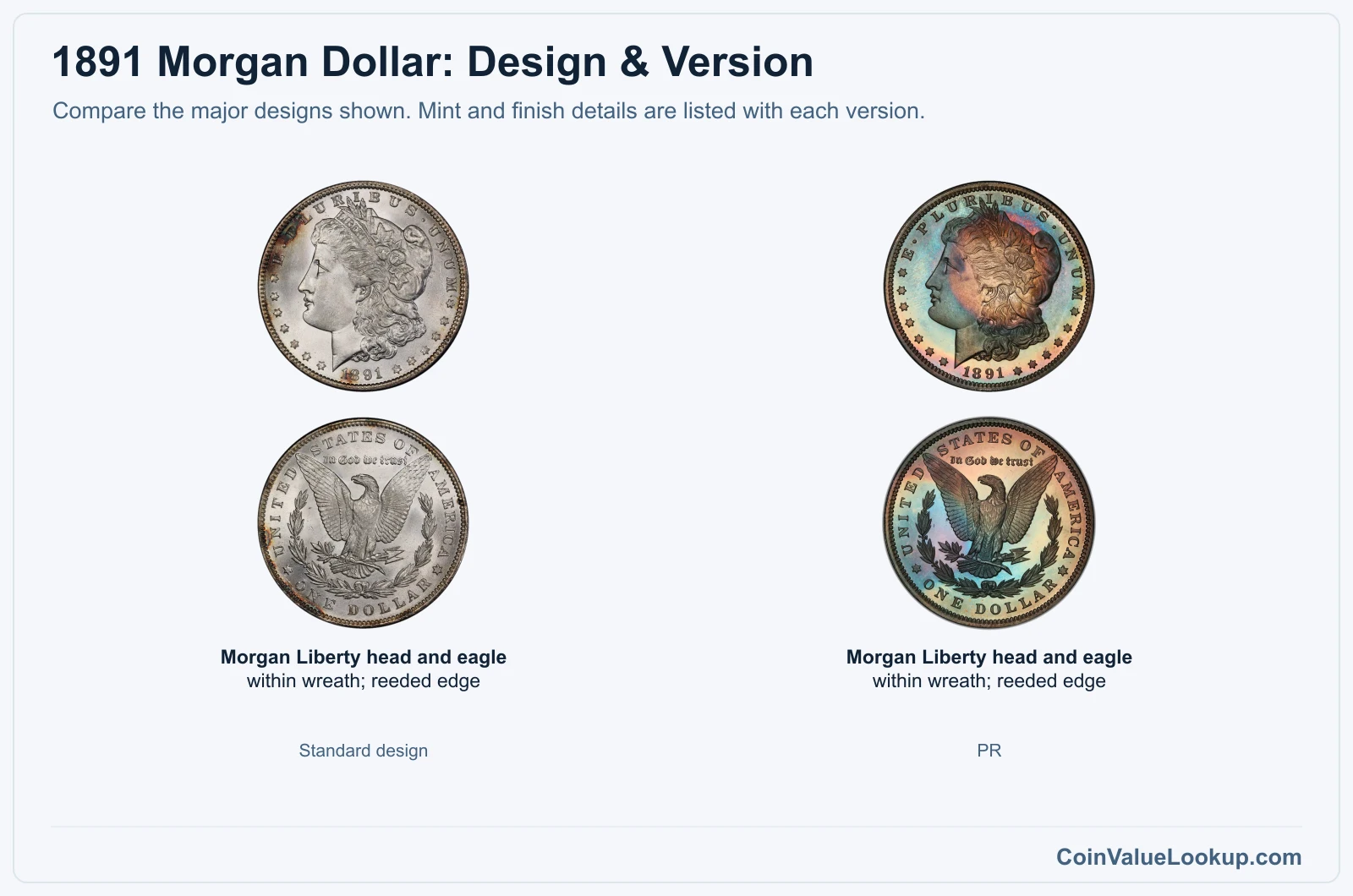
The 1891 Morgan Dollar comes in five collectible branches: Philadelphia (no mintmark), Carson City (CC), New Orleans (O), San Francisco (S) and a proof issue from Philadelphia. To find your mintmark, flip the coin to the eagle side and look just below the bow that ties the wreath.
No letter means Philadelphia. A small CC, O or S tells you exactly which branch mint struck your coin.
All business-strike versions are 90% silver, 10% copper, weighing 26.73 grams with a reeded edge. The obverse shows George T.
Morgan's Liberty head; the reverse features an eagle clutching arrows and an olive branch inside a wreath.
Some business strikes display prooflike (PL) or deep-mirror prooflike (DMPL) surfaces. These are surface designations on regular coins, not proof manufacture.
A shiny coin is not automatically prooflike, and prooflike is not the same thing as a proof. Cleaned, polished or plated coins lose collector comparability regardless of how reflective they look.
Step 2: Check Your 1891 Morgan Silver Dollar Grade
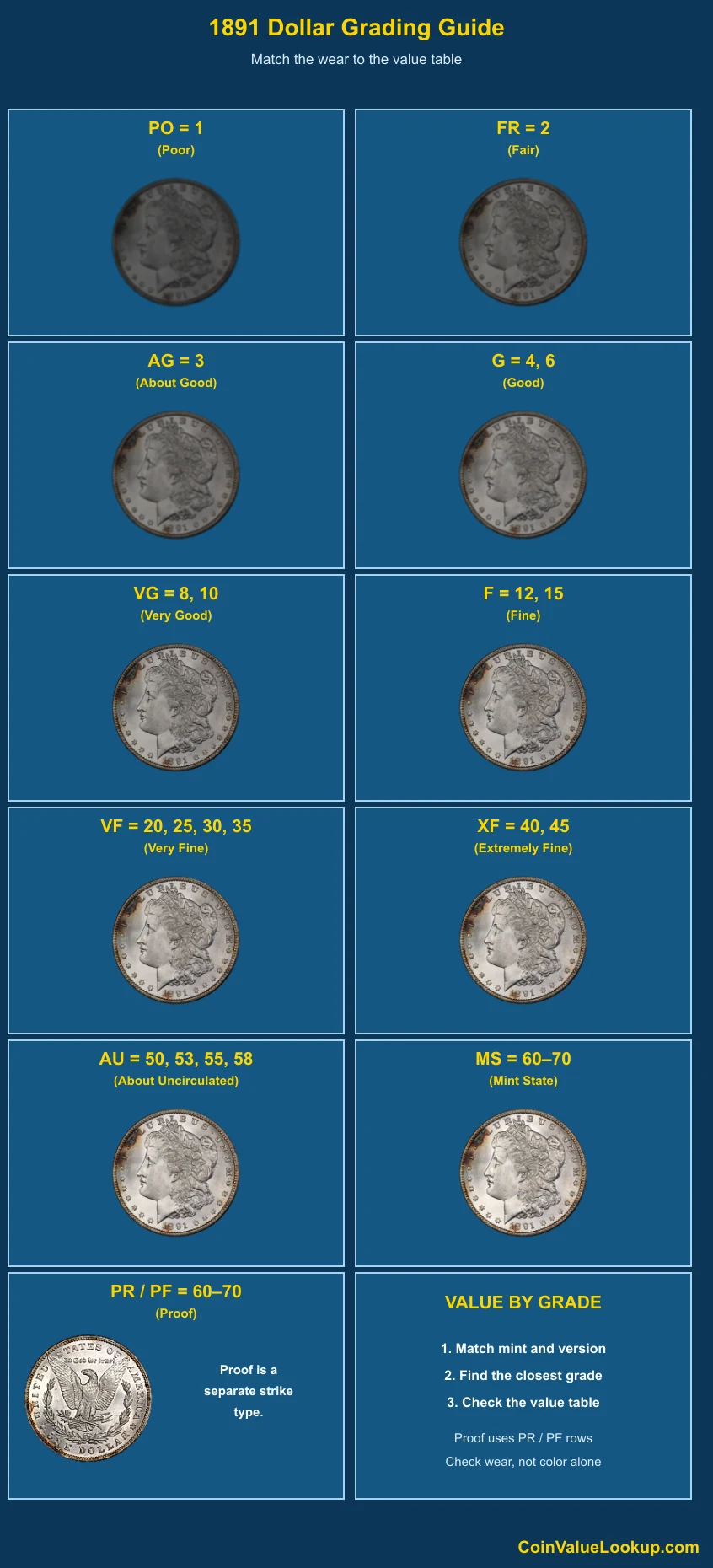
Start at the hair above Liberty's ear and her cheek. On a well-circulated coin these areas are flat, with no fine strands visible.
An About Uncirculated piece retains most detail but shows slight friction on the cheek and cap. In Mint State, full hair detail and original luster survive.
On the reverse, the eagle's breast feathers wear first. A coin grading Good-4 will show a mostly smooth breast; by MS-60 every feather is sharp.
Bag marks are a Morgan Dollar reality. Two coins might both be uncirculated, but one covered in contact marks from bouncing around in a mint bag grades lower than a clean example.
Use the comparison image to see the difference between honest circulation wear and bag-mark damage at similar grade levels.
Cleaned or polished coins grade differently from original-surface pieces. If you see hairline scratches running in one direction under a light, that coin has likely been wiped.
Original toning and luster matter.
Step 3: Check 1891 Morgan Silver Dollar Value by Mint and Version
1891 Morgan Silver Dollar
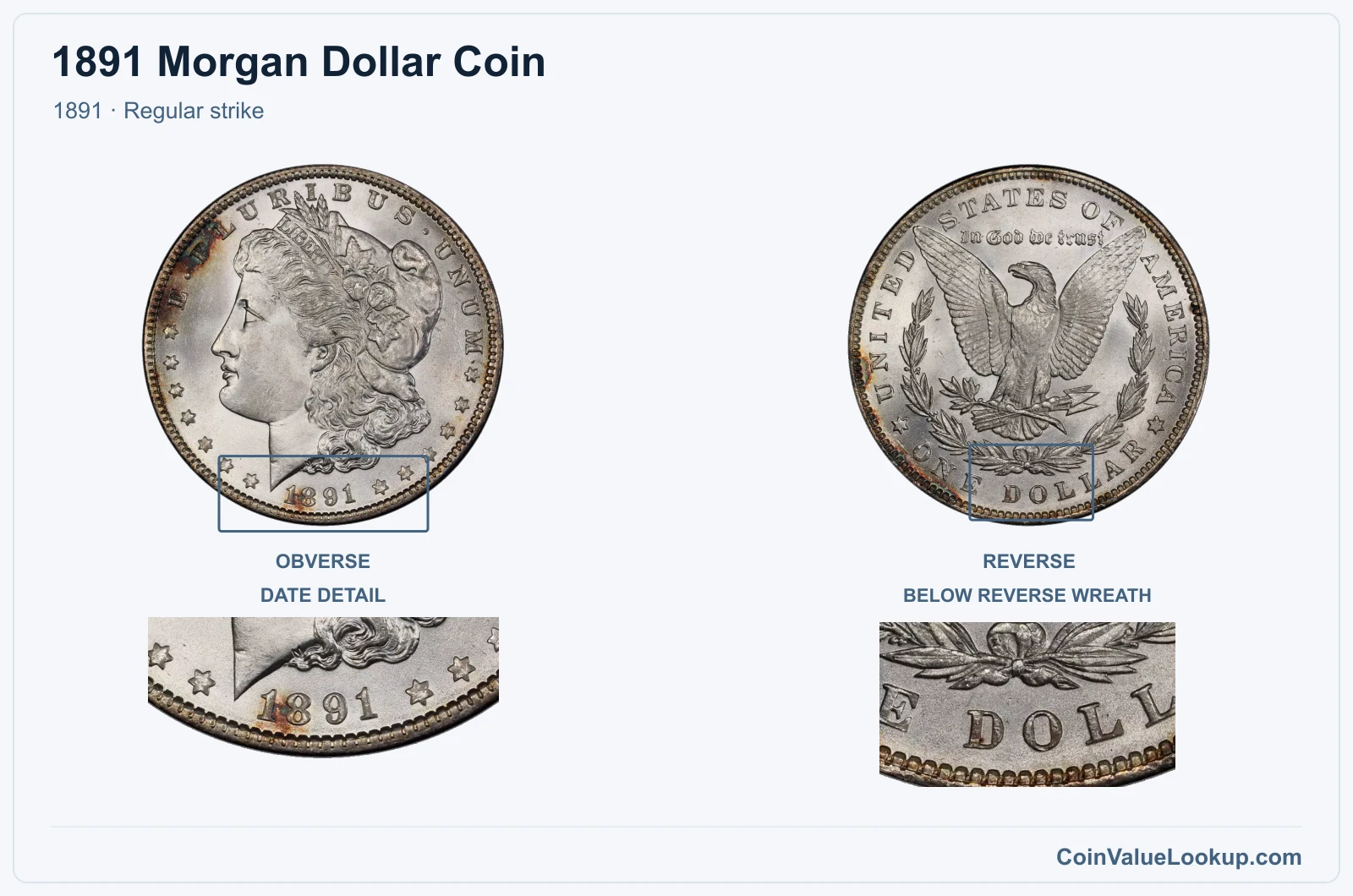
The 1891 Philadelphia Morgan Dollar carries no mintmark. In heavily worn Good-4 condition, USA Coin Book estimates it at about $74.00.
Jump to a gem MS65 and the guide figure rises to $2,938.00.
Look below the reverse wreath bow: no letter confirms Philadelphia. Original surfaces matter here.
A cleaned or polished coin, even one that looks shiny, is not equivalent to a naturally lustrous example at the same technical grade. Prooflike or deep-mirror prooflike designations can apply to qualifying business strikes and may shift the price, but that attribution requires more than casual observation.
Range Grade
Price Auction Records Appraisal PO PO 1
—
Coin Identifier FR FR 2
—
Coin Identifier AG AG 3
—
Coin Identifier G G 4
—
Coin Identifier
G 6
—
Coin Identifier VG VG 8
—
Coin Identifier
VG 10
—
Coin Identifier F F 12
Coin Identifier
F 15
Coin Identifier VF VF 20
Coin Identifier
VF 25
—
Coin Identifier
VF 30
Coin Identifier
VF 35
Coin Identifier XF XF 40
Coin Identifier
XF 45
Coin Identifier AU AU 50
Coin Identifier
AU 53
Coin Identifier
AU 55
Coin Identifier
AU 58
Coin Identifier MS MS 60
Coin Identifier
MS 61
Coin Identifier
MS 62
Coin Identifier
MS 63
Coin Identifier
MS 64
Coin Identifier
MS 65
Coin Identifier
MS 66
Coin Identifier
MS 67
—
Coin Identifier
MS 68
—
—
—
MS 69
—
—
—
MS 70
—
—
—
1891 Morgan Silver Dollar — CC
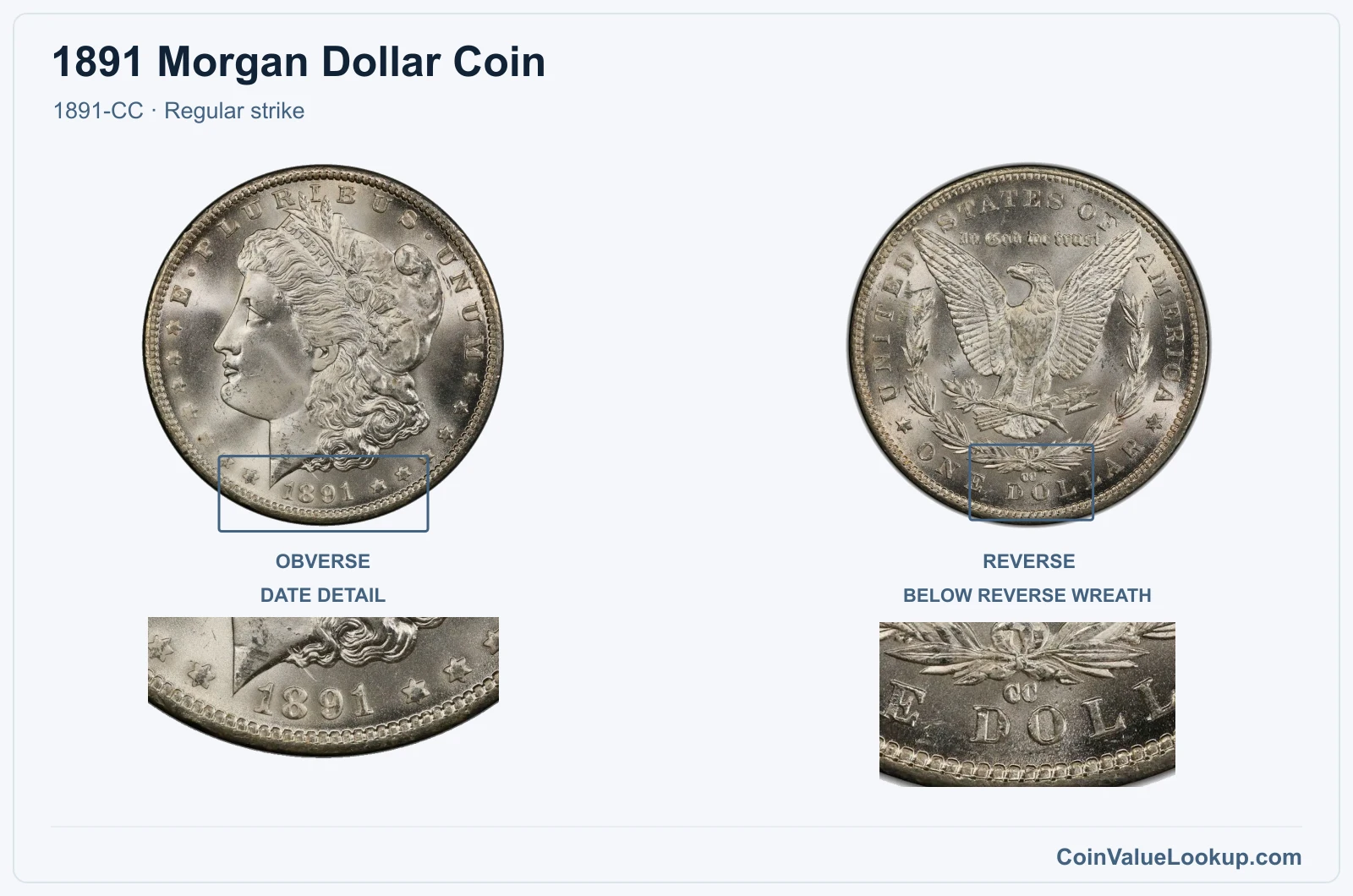
The 1891-CC is the Carson City issue, and it carries a premium at every grade. A CC mintmark sits below the wreath bow on the reverse.
In Good-4 the USA Coin Book guide estimate is $212.00, nearly triple the Philadelphia coin. At MS65 the figure reaches $4,405.00.
Carson City dollars are popular because the mint had a relatively short operational life and lower production runs compared to Philadelphia or New Orleans. That popularity means fakes and added mintmarks exist.
Compare the CC closely to known genuine examples: it should sit naturally in the field without tool marks or unusual font spacing. Cleaned examples are common in this date and reduce collector comparability.
Coin Value Lookup is a good starting point if you want to compare your 1891-CC against other Morgan Dollar dates and mints before deciding on professional grading.
Range Grade
Price Auction Records Appraisal PO PO 1
Coin Identifier FR FR 2
Coin Identifier AG AG 3
Coin Identifier G G 4
Coin Identifier
G 6
Coin Identifier VG VG 8
Coin Identifier
VG 10
Coin Identifier F F 12
Coin Identifier
F 15
Coin Identifier VF VF 20
Coin Identifier
VF 25
Coin Identifier
VF 30
Coin Identifier
VF 35
Coin Identifier XF XF 40
Coin Identifier
XF 45
Coin Identifier AU AU 50
Coin Identifier
AU 53
Coin Identifier
AU 55
Coin Identifier
AU 58
Coin Identifier MS MS 60
Coin Identifier
MS 61
Coin Identifier
MS 62
Coin Identifier
MS 63
Coin Identifier
MS 64
Coin Identifier
MS 65
Coin Identifier
MS 66
Coin Identifier
MS 67
Coin Identifier
MS 68
—
—
—
MS 69
—
—
—
MS 70
—
—
—
1891 Morgan Silver Dollar — O
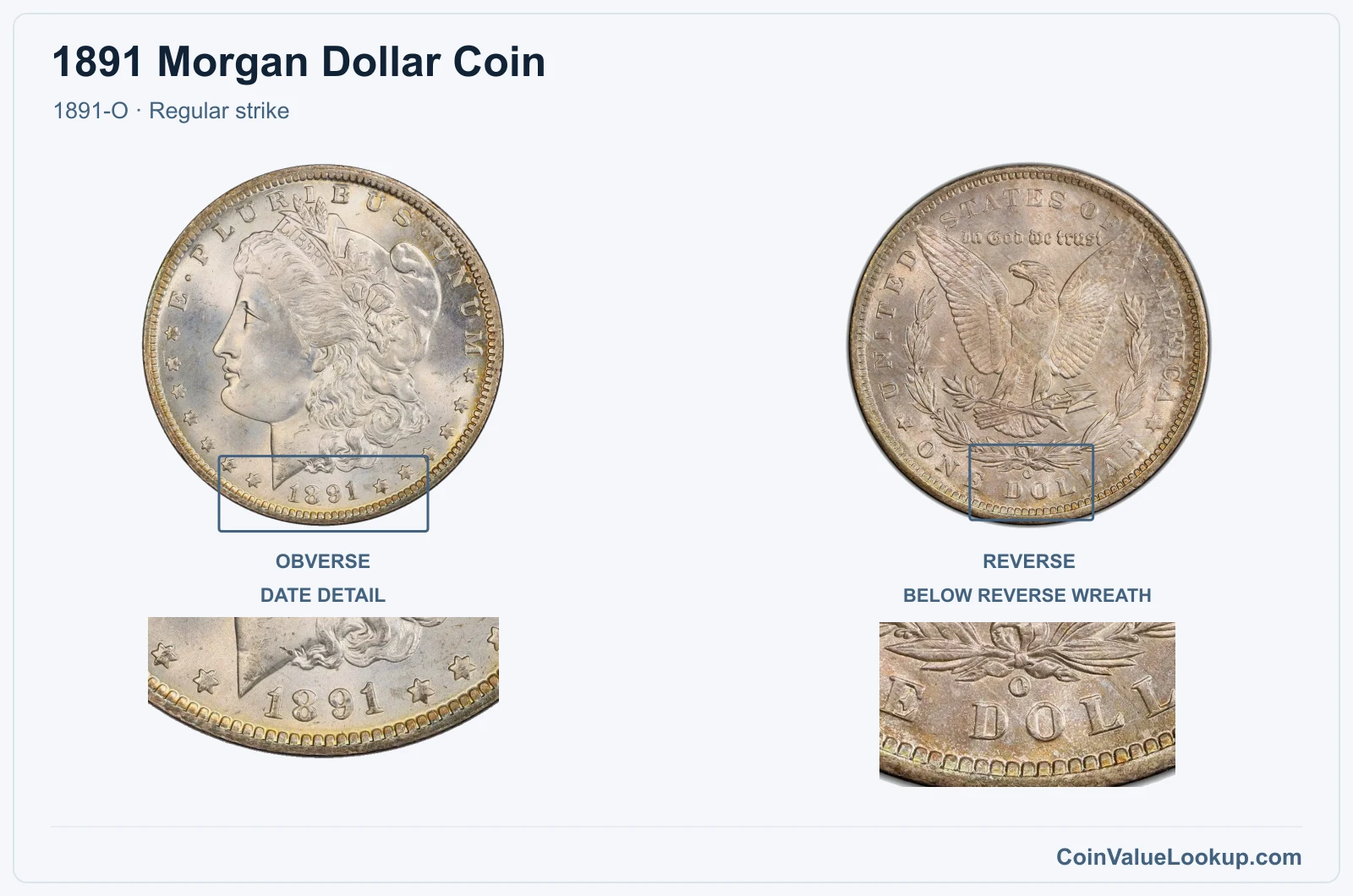
The 1891-O was struck in New Orleans, identified by a small O below the wreath bow. In Good-4 the USA Coin Book guide places it at $74.00, matching the Philadelphia issue.
The gap opens dramatically in high grades: an MS65 example reaches $4,979.00, the highest guide figure among the 1891 business strikes listed.
That jump tells you something. Surviving gem-quality 1891-O dollars are scarce relative to demand.
Most examples come with bag marks or weak strikes, so a truly clean, well-struck MS65 commands a serious premium. As always, verify the mintmark is genuine and that surfaces have not been improved by cleaning or artificial toning.
Range Grade
Price Auction Records Appraisal PO PO 1
Coin Identifier FR FR 2
Coin Identifier AG AG 3
—
Coin Identifier G G 4
—
Coin Identifier
G 6
—
Coin Identifier VG VG 8
—
Coin Identifier
VG 10
—
Coin Identifier F F 12
—
Coin Identifier
F 15
—
Coin Identifier VF VF 20
Coin Identifier
VF 25
—
Coin Identifier
VF 30
—
Coin Identifier
VF 35
Coin Identifier XF XF 40
Coin Identifier
XF 45
Coin Identifier AU AU 50
Coin Identifier
AU 53
Coin Identifier
AU 55
Coin Identifier
AU 58
Coin Identifier MS MS 60
Coin Identifier
MS 61
Coin Identifier
MS 62
Coin Identifier
MS 63
Coin Identifier
MS 64
Coin Identifier
MS 65
Coin Identifier
MS 66
Coin Identifier
MS 67
—
—
—
MS 68
—
—
—
MS 69
—
—
—
MS 70
—
—
—
1891 Morgan Silver Dollar — S
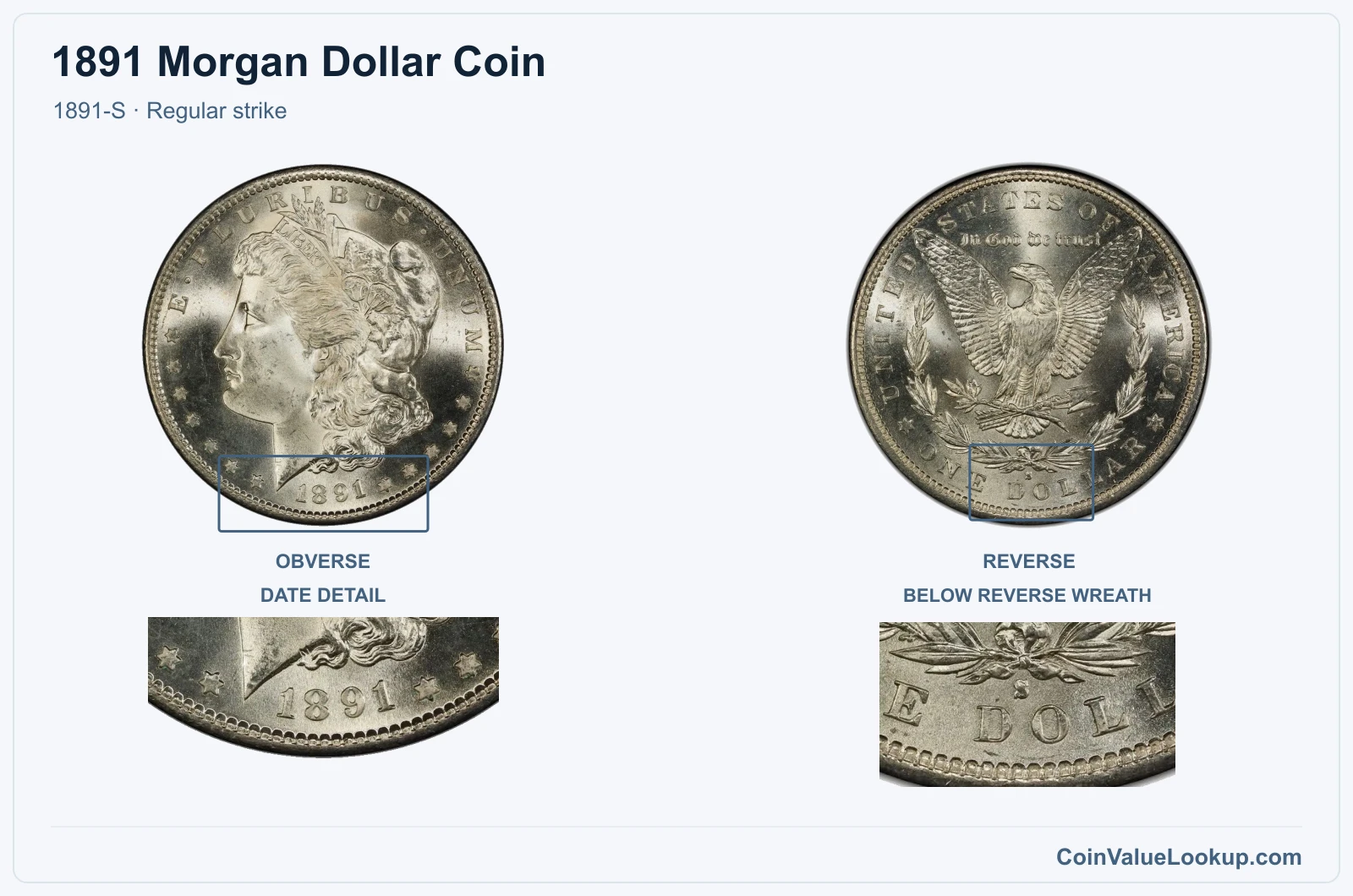
The 1891-S carries a small S mintmark below the wreath bow on the reverse, indicating the San Francisco Mint. In Good-4 condition, USA Coin Book estimates it at $74.00.
At MS65 the guide figure is $1,784.00, the lowest gem price among the four business-strike mints for this date.
San Francisco strikes often come well-made, which means surviving examples in middle Mint State grades are not especially scarce. Original luster and the absence of heavy bag marks still separate ordinary uncirculated coins from gem-level pieces.
Confirm the S mintmark sits cleanly in the field with no signs of alteration.
Range Grade
Price Auction Records Appraisal PO PO 1
—
Coin Identifier FR FR 2
—
Coin Identifier AG AG 3
—
Coin Identifier G G 4
—
Coin Identifier
G 6
—
Coin Identifier VG VG 8
—
Coin Identifier
VG 10
—
Coin Identifier F F 12
—
Coin Identifier
F 15
—
Coin Identifier VF VF 20
—
Coin Identifier
VF 25
—
Coin Identifier
VF 30
—
Coin Identifier
VF 35
—
Coin Identifier XF XF 40
Coin Identifier
XF 45
Coin Identifier AU AU 50
Coin Identifier
AU 53
Coin Identifier
AU 55
Coin Identifier
AU 58
Coin Identifier MS MS 60
Coin Identifier
MS 61
Coin Identifier
MS 62
Coin Identifier
MS 63
Coin Identifier
MS 64
Coin Identifier
MS 65
Coin Identifier
MS 66
Coin Identifier
MS 67
Coin Identifier
MS 68
—
—
—
MS 69
—
—
—
MS 70
—
—
—
1891 Morgan Silver Dollar — PR
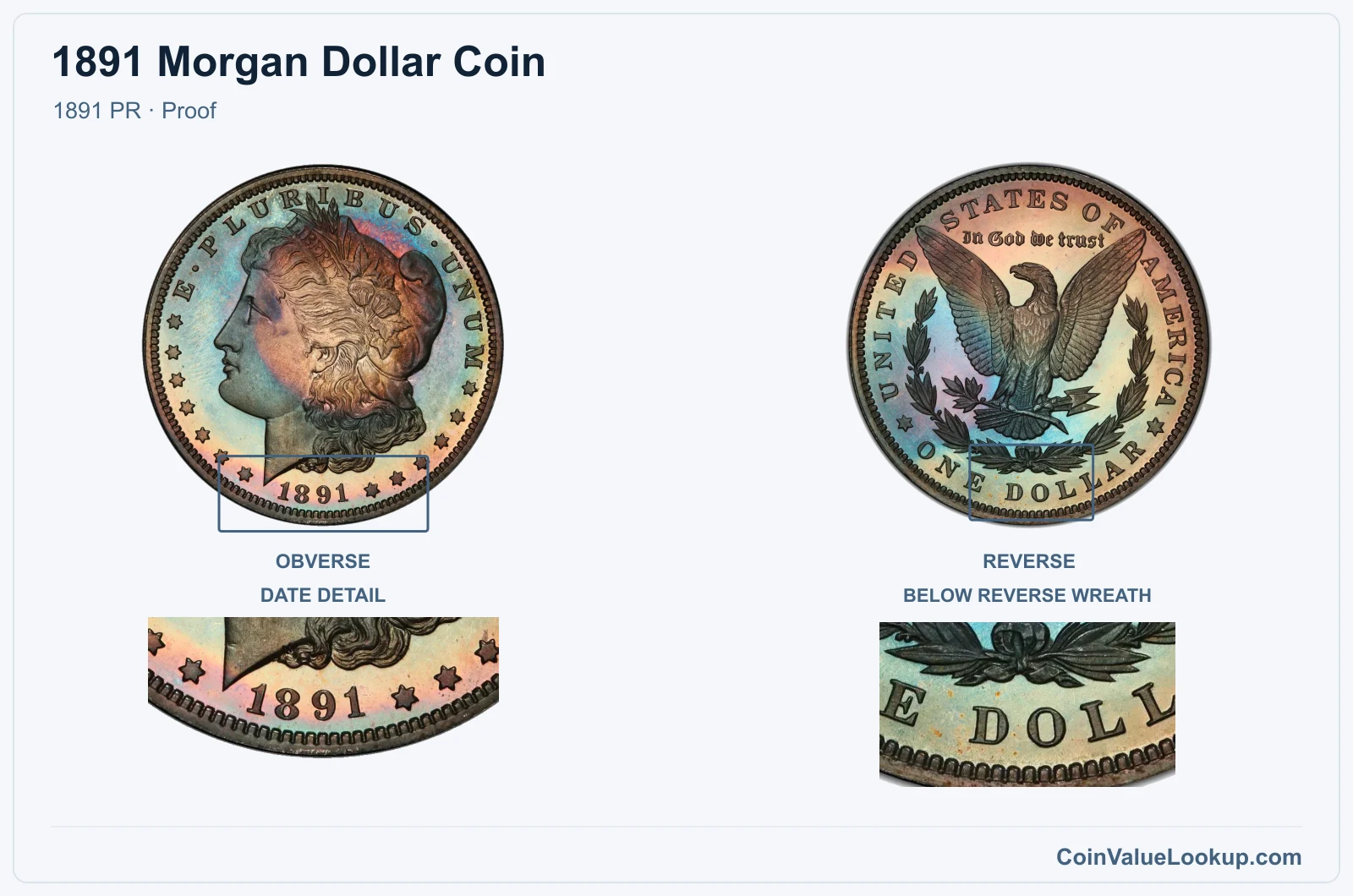
The 1891 PR is a proof Morgan Dollar, struck at Philadelphia with no mintmark. A proof is a specific manufacturing finish involving specially prepared dies and planchets.
It is not simply a high-grade or shiny business strike.
No standard guide price range is adopted here. Value depends on authenticated identity, the coin's specific condition, and whether it has been cleaned or impaired.
Proof Morgan Dollars from this era were produced in small quantities for collectors, and they require professional authentication to confirm. A business strike with prooflike surfaces is not a proof, regardless of how mirror-like it appears.
If you suspect you have one, third-party certification is the path forward.
Range Grade
Price Auction Records Appraisal PR PR 1
—
Coin Identifier
PR 2
—
Coin Identifier
PR 3
—
Coin Identifier
PR 4
—
Coin Identifier
PR 6
—
Coin Identifier
PR 8
—
Coin Identifier
PR 10
—
Coin Identifier
PR 12
—
Coin Identifier
PR 15
—
Coin Identifier
PR 20
—
Coin Identifier
PR 25
—
Coin Identifier
PR 30
—
Coin Identifier
PR 35
—
Coin Identifier
PR 40
—
Coin Identifier
PR 45
—
Coin Identifier
PR 50
—
Coin Identifier
PR 53
—
Coin Identifier
PR 55
—
Coin Identifier
PR 58
Coin Identifier
PR 60
Coin Identifier
PR 61
Coin Identifier
PR 62
Coin Identifier
PR 63
Coin Identifier
PR 64
Coin Identifier
PR 65
Coin Identifier
PR 66
Coin Identifier
PR 67
Coin Identifier
PR 68
Coin Identifier
PR 69
—
—
—
PR 70
—
—
—
1891 Morgan Silver Dollar Error List
1. 1891 Morgan Silver Dollar — Off-Center Strike
An off-center strike on an 1891 Morgan Dollar occurs when the planchet is not properly seated between the dies at the moment of striking. The result is a displaced design with an unstruck crescent-shaped blank area along part of the rim.
The more dramatic the shift and the more of the date that remains visible, the more collector interest it generates.
No specific price range is adopted for this error. Value depends on the percentage of off-center displacement, overall condition, and whether the date and mintmark are fully readable.
Be careful not to confuse a clipped planchet, a one-sided misalignment or post-mint damage with a genuine off-center strike. A real off-center coin will show the entire design shifted uniformly in one direction.
2. 1891 Morgan Silver Dollar — Doubled Die Obverse
A doubled die obverse on the 1891 Morgan Dollar has been reported with doubling visible on the ear and moustache. This type of doubling happens during the die-making process and appears as consistent separation or notching on affected design elements.
Under magnification, compare Liberty's ear and the area around the moustache to a normal 1891 dollar.
Genuine die doubling shows raised, split contours that repeat on every coin struck by that die. Machine doubling, by contrast, tends to produce flat shelf-like distortion and is far less collectible.
Reflections from prooflike surfaces can also mimic doubling to the untrained eye. No specific price range is adopted for this variety.
Condition, the strength of the doubling and professional attribution all affect what a buyer will pay.
3. 1891 Morgan Silver Dollar — Die Crack / Die Chip
The 1891 Morgan Dollar has a reported die chip variety nicknamed the Spitting Eagle. A die chip is a small piece of the die that breaks away, leaving a raised blob of metal on the struck coin.
In the Spitting Eagle variety, this blob appears near the eagle's beak on the reverse, giving the impression the bird is spitting.
Die cracks show up as thin raised lines, sometimes connecting to the rim. An interior chip that does not reach the rim is different from a rim-connected break known as a cud.
No specific price range is adopted for these errors. Value depends on the size, location and visual appeal of the feature, plus the coin's overall condition.
Do not confuse incuse scratches, corrosion spots or debris stuck to the surface with genuine die damage. Real die cracks and chips are raised, not recessed.
4. 1891 Morgan Silver Dollar — Rotated Dies
A rotated die error on the 1891 Morgan Dollar means the obverse and reverse dies were not properly aligned during striking. To check, hold the obverse upright, then flip the coin top to bottom along a vertical axis.
On a normal U.S. coin the reverse should also appear upright. If the reverse is tilted, you may have a rotated die error.
The degree of rotation matters. A few degrees is minor and relatively common across many series.
Significant rotations of 45 degrees or more draw more collector attention. No specific price range is adopted for this error.
Value depends on the severity of rotation, the coin's overall condition and buyer demand. Make sure you are not simply looking at a photograph taken at an odd angle or holding the coin sideways.
Verify by physically flipping the coin yourself.