1873 Liberty Seated Half Dollar Coin Value: How Much Is It Worth?
The 1873 Liberty Seated Half Dollar starts around $91 in well-worn G4 condition and climbs to roughly $603 near AU50 for the basic Philadelphia Arrows issue, per guide estimates. But mint, grade and the specific design variety can shift that number dramatically.
Carson City coins, No Arrows versions and Proofs each follow their own pricing, and some branches reach into the thousands even in lower grades.
Fast Way to Identify Your 1873 Liberty Seated Half Dollar
Snap clear photos of both sides of your coin and upload them here. A front-and-back image lets us offer a preliminary identification of your mint, design variety and approximate condition.
That is the quickest way to figure out which of the many 1873 half dollar branches you actually have before diving into detailed comparisons.
1873 Liberty Seated Half Dollar Value
Upload both sides of your 1873 Liberty Seated Half Dollar.
Front Obverse
Upload photo
Back Reverse
Upload photo
Which 1873 Liberty Seated Half Dollar Versions Are Worth Money?
- Carson City half dollars from 1873 carry guide values starting around $425 at G4, several times the Philadelphia baseline.
- The No Arrows Open 3 Philadelphia issue is a scarce variety with guide estimates beginning near $4,088 even in G4.
- Proof versions exist in both the Arrows and No Arrows Closed 3 designs, each with distinct collector demand.
- No Arrows Closed 3 coins from Carson City carry guide values starting around $516 at G4, well above the Arrows baseline.
- San Francisco Arrows coins with the Small S mintmark guide around $141 at G4, roughly matching the Philadelphia No Arrows Closed 3.
Step 1: Identify Your 1873 Liberty Seated Half Dollar Mint Mark and Version
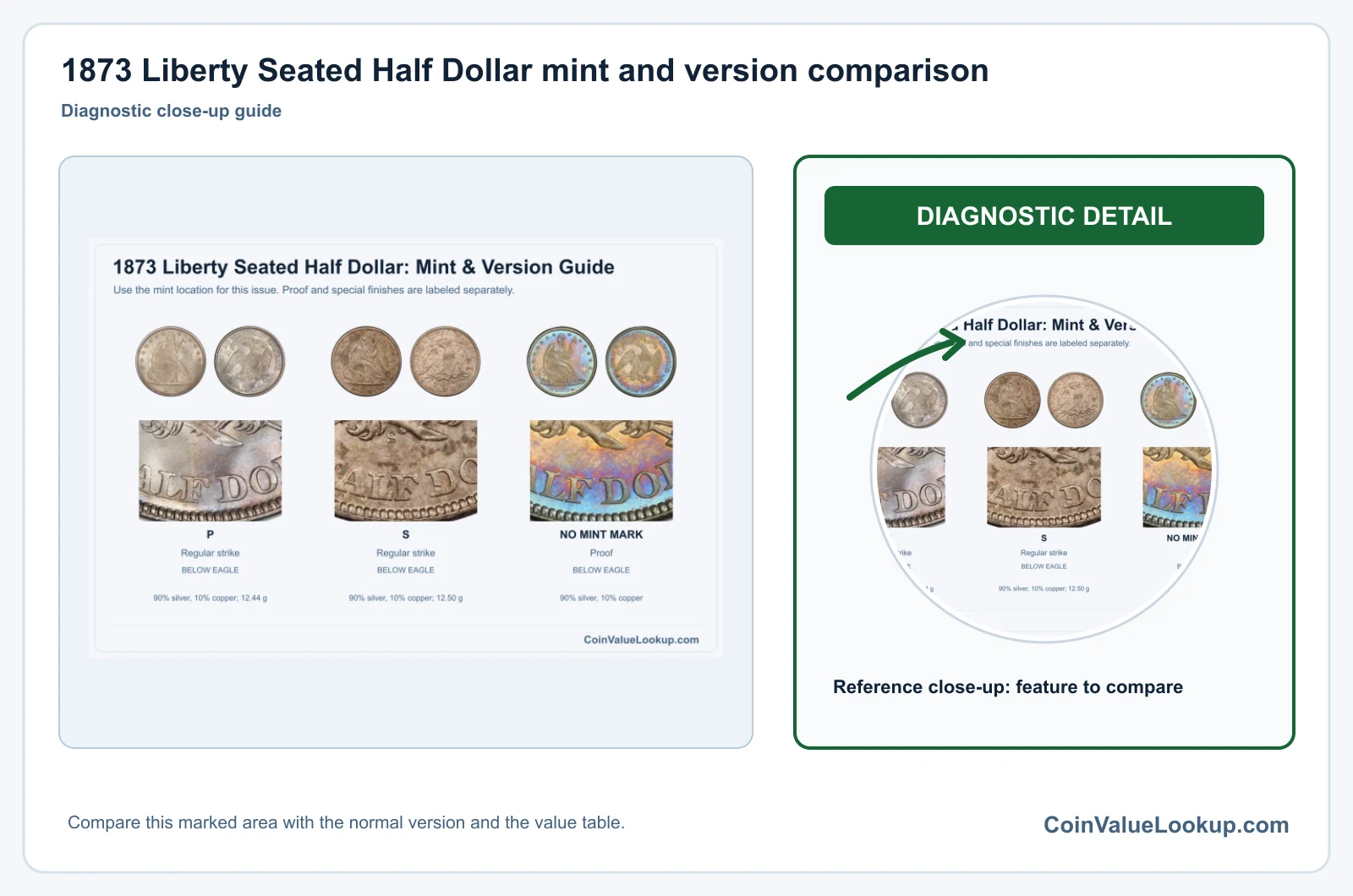
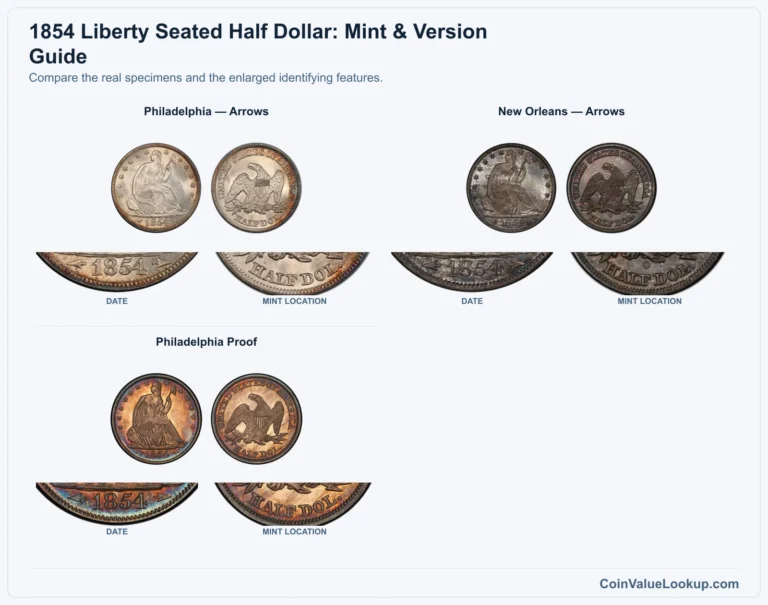
The obverse shows Liberty seated on a rock, holding a pole with a cap. The reverse features an eagle clutching arrows and an olive branch, with HALF DOL below and a motto banner reading IN GOD WE TRUST above.
Flip the coin over and look beneath the eagle for a mintmark. No letter means Philadelphia.
An "S" means San Francisco. "CC" means Carson City.
All 1873 half dollars are struck in 90% silver and 10% copper. However, not all weigh the same.
The earlier No Arrows design uses the old standard of 12.44 grams, while the Arrows version weighs 12.50 grams.
Arrows flanking the date indicate the new, heavier weight standard adopted in 1873. If your coin has no arrows beside the date, it was struck under the old weight before the changeover.
The arrows were removed in 1875 but the heavier weight stayed.
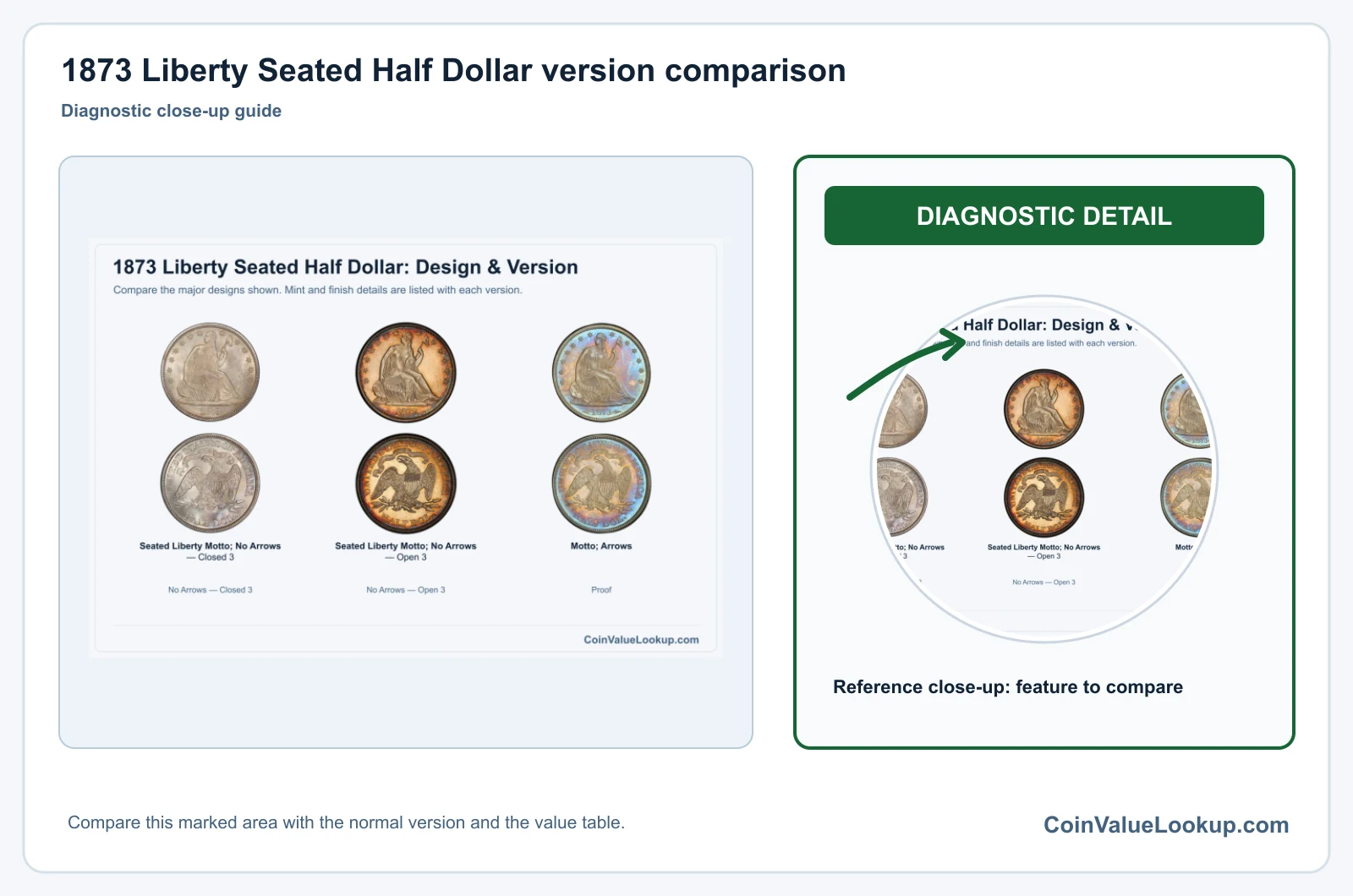
Also check the shape of the "3" in the date. A Closed 3 has its upper and lower tips curving inward, nearly touching.
An Open 3 has tips that spread apart clearly. This distinction matters a lot for No Arrows Philadelphia coins.
A Proof is a special manufacturing finish with mirrored fields and sharp rims, not a higher grade than Mint State. Do not assume a shiny coin is a Proof.
Step 2: Check Your 1873 Liberty Seated Half Dollar Grade
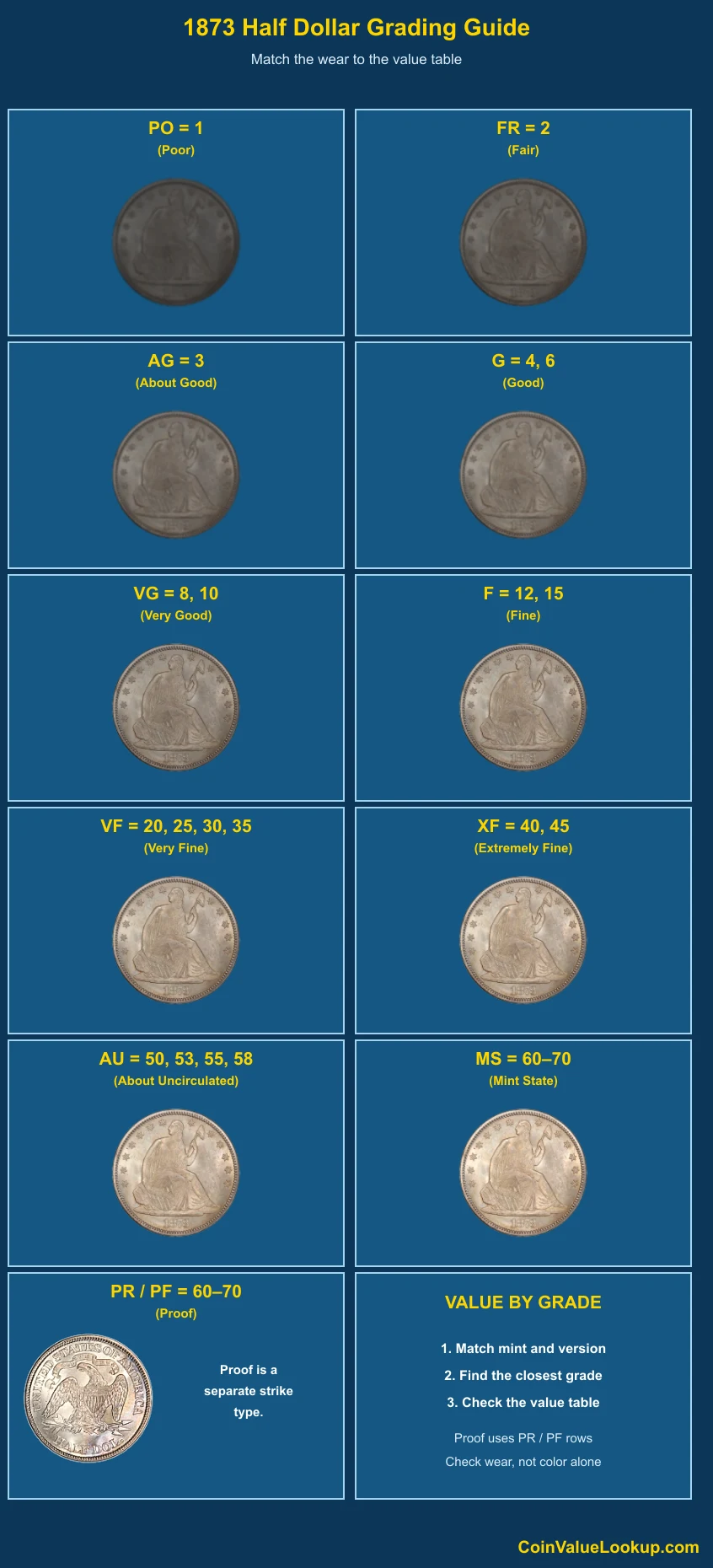
Start with Liberty's head and knee on the obverse. These are the highest points and show friction first.
In lower grades the head blends into the cap and the knee loses its rounded contour entirely.
On the reverse, check the eagle's breast feathers and the top of the shield. A coin grading VF still shows moderate feather detail with some flatness.
At AU, nearly full feathers remain with only slight rub on the highest ridges.
Luster matters as much as detail. A coin can look sharp but show no original mint sheen, which limits its grade.
Weak strikes can also flatten detail without any wear, so look for remaining cartwheel luster in the fields to tell the difference.
Use the comparison image to match your coin's wear pattern against known grade examples. Cleaning, rim nicks and holes reduce value independently of the wear grade, so note those separately.
Step 3: Check 1873 Liberty Seated Half Dollar Value by Mint and Version
1873 Liberty Seated Half Dollar — Philadelphia — Arrows — Large Arrows
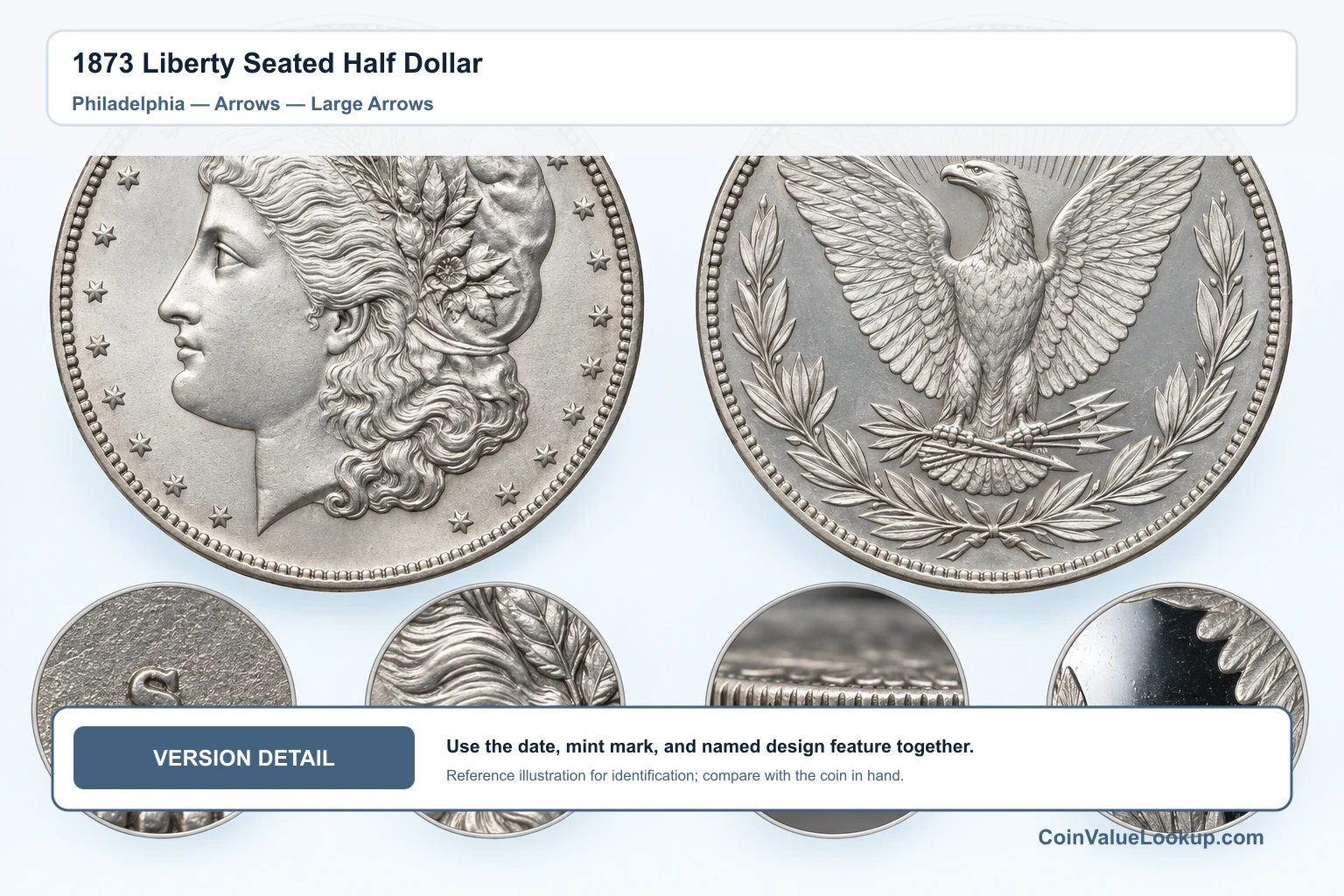
The Philadelphia Arrows with Large Arrows variety shows prominent arrowheads flanking the date, marking the 1873 weight increase to 12.50 grams. There is no mintmark below the eagle.
Guide estimates place this issue around $91 at G4, $236 at VF20 and $603 at AU50. These are aggregate date-and-mint figures and do not reflect a confirmed subtype premium for the Large Arrows style specifically.
Still, identifying the arrow size helps narrow down your die variety. The arrowheads on this version are distinctly wider and taller than those on the Small Arrows counterpart.
Ordinary-issue reference: Ordinary-issue reference only: The table below shows the related standard issue (1873 Arrows). It does not represent the value of the specific Philadelphia — Arrows — Large Arrows variety or its variety premium. The year, mint, metal and strike type are matched; the specific variety is not priced by this table.
Range Grade
Price Auction Records Appraisal PO PO 1
Coin Identifier FR FR 2
Coin Identifier AG AG 3
—
Coin Identifier G G 4
Coin Identifier
G 6
—
Coin Identifier VG VG 8
Coin Identifier
VG 10
—
Coin Identifier F F 12
—
Coin Identifier
F 15
Coin Identifier VF VF 20
Coin Identifier
VF 25
Coin Identifier
VF 30
Coin Identifier
VF 35
Coin Identifier XF XF 40
Coin Identifier
XF 45
Coin Identifier AU AU 50
Coin Identifier
AU 53
Coin Identifier
AU 55
Coin Identifier
AU 58
Coin Identifier MS MS 60
—
Coin Identifier
MS 61
Coin Identifier
MS 62
Coin Identifier
MS 63
Coin Identifier
MS 64
Coin Identifier
MS 65
Coin Identifier
MS 66
Coin Identifier
MS 67
—
—
—
MS 68
—
—
—
MS 69
—
—
—
MS 70
—
—
—
1873 Liberty Seated Half Dollar — Philadelphia — Arrows — Small Arrows
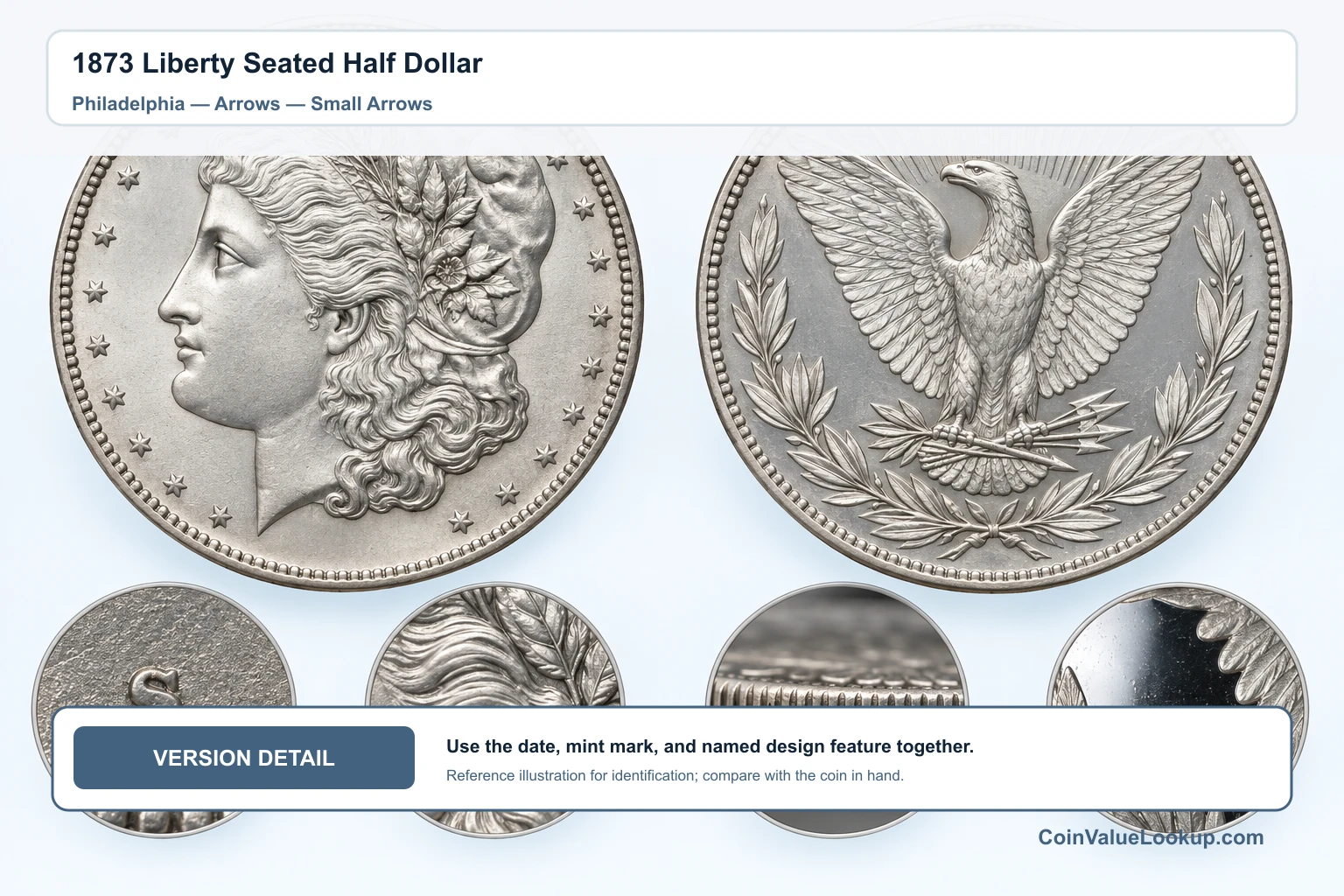
The Philadelphia Arrows with Small Arrows variety also weighs 12.50 grams and lacks a mintmark. The difference from the Large Arrows version is exactly what it sounds like: the arrowheads beside the date are noticeably smaller and more delicate.
Guide estimates are the same aggregate baseline as the Large variety, around $91 at G4, $236 at VF20 and $603 at AU50. No separate subtype premium has been adopted for Small Arrows here.
Distinguishing between arrow sizes matters more for die-variety attribution than for a dramatic price jump at this level.
Ordinary-issue reference: Ordinary-issue reference only: The table below shows the related standard issue (1873 Arrows). It does not represent the value of the specific Philadelphia — Arrows — Small Arrows variety or its variety premium. The year, mint, metal and strike type are matched; the specific variety is not priced by this table.
Range Grade
Price Auction Records Appraisal PO PO 1
Coin Identifier FR FR 2
Coin Identifier AG AG 3
—
Coin Identifier G G 4
Coin Identifier
G 6
—
Coin Identifier VG VG 8
Coin Identifier
VG 10
—
Coin Identifier F F 12
—
Coin Identifier
F 15
Coin Identifier VF VF 20
Coin Identifier
VF 25
Coin Identifier
VF 30
Coin Identifier
VF 35
Coin Identifier XF XF 40
Coin Identifier
XF 45
Coin Identifier AU AU 50
Coin Identifier
AU 53
Coin Identifier
AU 55
Coin Identifier
AU 58
Coin Identifier MS MS 60
—
Coin Identifier
MS 61
Coin Identifier
MS 62
Coin Identifier
MS 63
Coin Identifier
MS 64
Coin Identifier
MS 65
Coin Identifier
MS 66
Coin Identifier
MS 67
—
—
—
MS 68
—
—
—
MS 69
—
—
—
MS 70
—
—
—
1873 Liberty Seated Half Dollar — Philadelphia — No Arrows — Closed 3
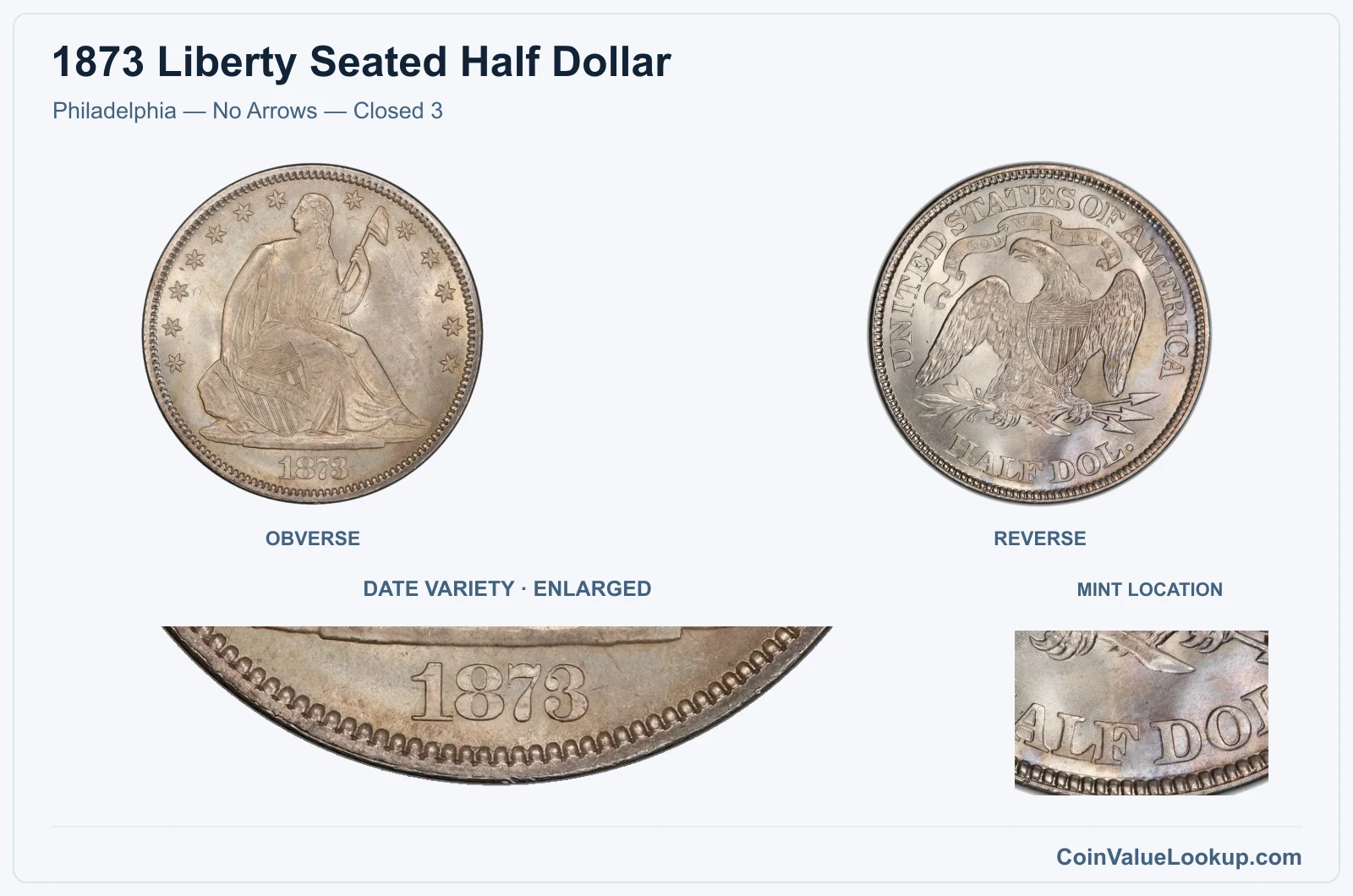
The Philadelphia No Arrows Closed 3 was struck under the older 12.44-gram weight standard, before Congress mandated the increase. No arrows appear beside the date, and the "3" in 1873 has tips that curve inward toward each other.
Guide estimates run $141 at G4, $394 at VF20 and $739 at AU50. That is a meaningful step above the Arrows issues from the same mint.
Fewer were struck before the changeover, which accounts for the premium. Confirm the closed shape of the 3 carefully, because the Open 3 version is an entirely different price tier.
Range Grade
Price Auction Records Appraisal PO PO 1
—
Coin Identifier FR FR 2
—
Coin Identifier AG AG 3
—
Coin Identifier G G 4
—
Coin Identifier
G 6
Coin Identifier VG VG 8
Coin Identifier
VG 10
—
Coin Identifier F F 12
—
Coin Identifier
F 15
—
Coin Identifier VF VF 20
Coin Identifier
VF 25
Coin Identifier
VF 30
Coin Identifier
VF 35
Coin Identifier XF XF 40
Coin Identifier
XF 45
Coin Identifier AU AU 50
Coin Identifier
AU 53
Coin Identifier
AU 55
Coin Identifier
AU 58
Coin Identifier MS MS 60
—
Coin Identifier
MS 61
Coin Identifier
MS 62
Coin Identifier
MS 63
Coin Identifier
MS 64
Coin Identifier
MS 65
Coin Identifier
MS 66
—
—
—
MS 67
—
—
—
MS 68
—
—
—
MS 69
—
—
—
MS 70
—
—
—
1873 Liberty Seated Half Dollar — Philadelphia — No Arrows — Open 3
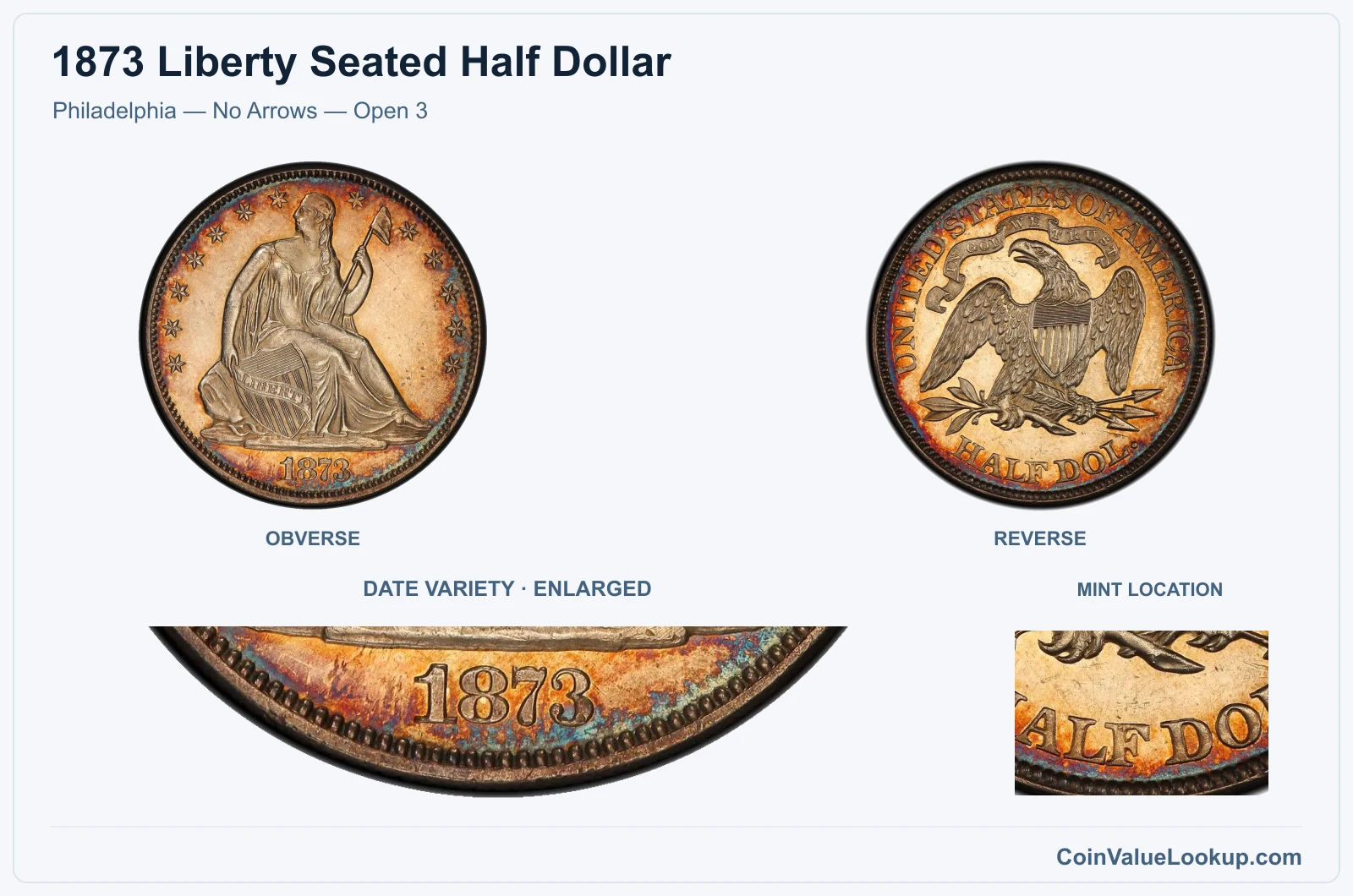
This is the one that gets collectors excited. The Philadelphia No Arrows Open 3 is a scarce variety where the tips of the "3" in the date spread outward rather than curling inward.
It weighs 12.44 grams and carries no mintmark.
Guide estimates begin around $4,088 at G4, jump to $8,456 at VF20 and reach $16,599 near AU50. That is roughly 30 to 40 times the price of the common Arrows issue in the same grades.
Confirming the open shape of the 3 is critical. Wear can make a Closed 3 look slightly open, so compare yours side by side with a reference image.
If you think you have one, professional authentication is worthwhile.
Range Grade
Price Auction Records Appraisal PO PO 1
—
Coin Identifier FR FR 2
Coin Identifier AG AG 3
—
Coin Identifier G G 4
Coin Identifier
G 6
Coin Identifier VG VG 8
Coin Identifier
VG 10
Coin Identifier F F 12
Coin Identifier
F 15
Coin Identifier VF VF 20
Coin Identifier
VF 25
Coin Identifier
VF 30
Coin Identifier
VF 35
Coin Identifier XF XF 40
Coin Identifier
XF 45
—
Coin Identifier AU AU 50
Coin Identifier
AU 53
—
Coin Identifier
AU 55
Coin Identifier
AU 58
Coin Identifier MS MS 60
—
Coin Identifier
MS 61
Coin Identifier
MS 62
—
Coin Identifier
MS 63
—
Coin Identifier
MS 64
—
—
—
MS 65
—
—
—
MS 66
—
—
—
MS 67
—
—
—
MS 68
—
—
—
MS 69
—
—
—
MS 70
—
—
—
1873 Liberty Seated Half Dollar — Carson City — Arrows — Small CC
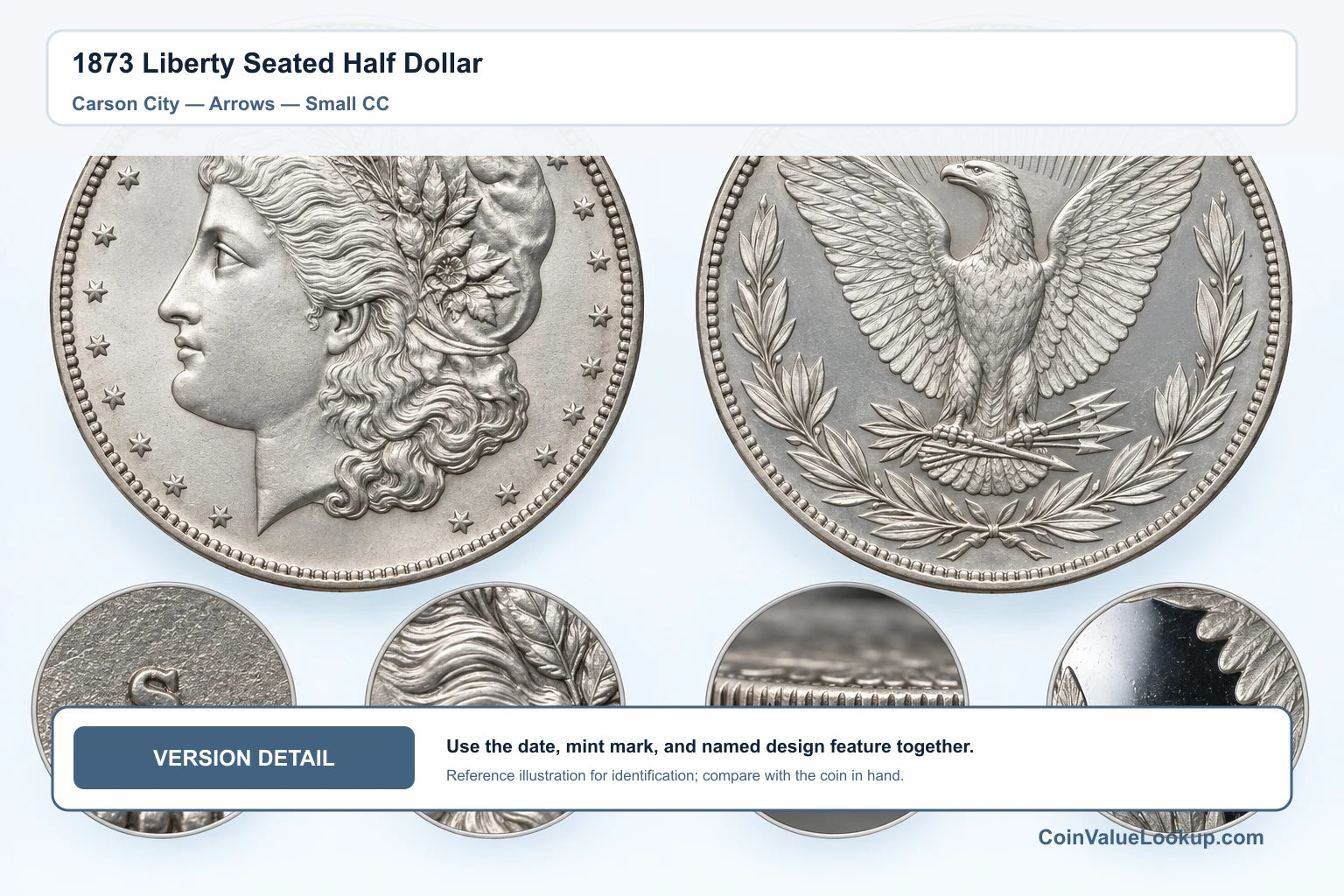
Carson City Arrows with a Small CC mintmark. Look below the eagle for a relatively compact "CC" punch.
All Carson City half dollars from this era carry a premium because of lower production numbers and strong Western-history collector demand.
Guide estimates sit around $425 at G4, $1,463 at VF20 and $4,265 at AU50. These are aggregate figures for the Carson City Arrows date and do not include a confirmed subtype premium for the small mintmark style.
A reflective surface alone does not establish a Proof; branch-mint Proofs require authenticated attribution.
Ordinary-issue reference: Ordinary-issue reference only: The table below shows the related standard issue (1873-CC Arrows). It does not represent the value of the specific Carson City — Arrows — Small CC variety or its variety premium. The year, mint, metal and strike type are matched; the specific variety is not priced by this table.
Range Grade
Price Auction Records Appraisal PO PO 1
—
Coin Identifier FR FR 2
Coin Identifier AG AG 3
Coin Identifier G G 4
Coin Identifier
G 6
Coin Identifier VG VG 8
Coin Identifier
VG 10
Coin Identifier F F 12
Coin Identifier
F 15
Coin Identifier VF VF 20
Coin Identifier
VF 25
Coin Identifier
VF 30
Coin Identifier
VF 35
Coin Identifier XF XF 40
Coin Identifier
XF 45
Coin Identifier AU AU 50
Coin Identifier
AU 53
Coin Identifier
AU 55
Coin Identifier
AU 58
Coin Identifier MS MS 60
—
Coin Identifier
MS 61
Coin Identifier
MS 62
Coin Identifier
MS 63
Coin Identifier
MS 64
Coin Identifier
MS 65
Coin Identifier
MS 66
Coin Identifier
MS 67
—
—
—
MS 68
—
—
—
MS 69
—
—
—
MS 70
—
—
—
1873 Liberty Seated Half Dollar — Carson City — Arrows — Large CC
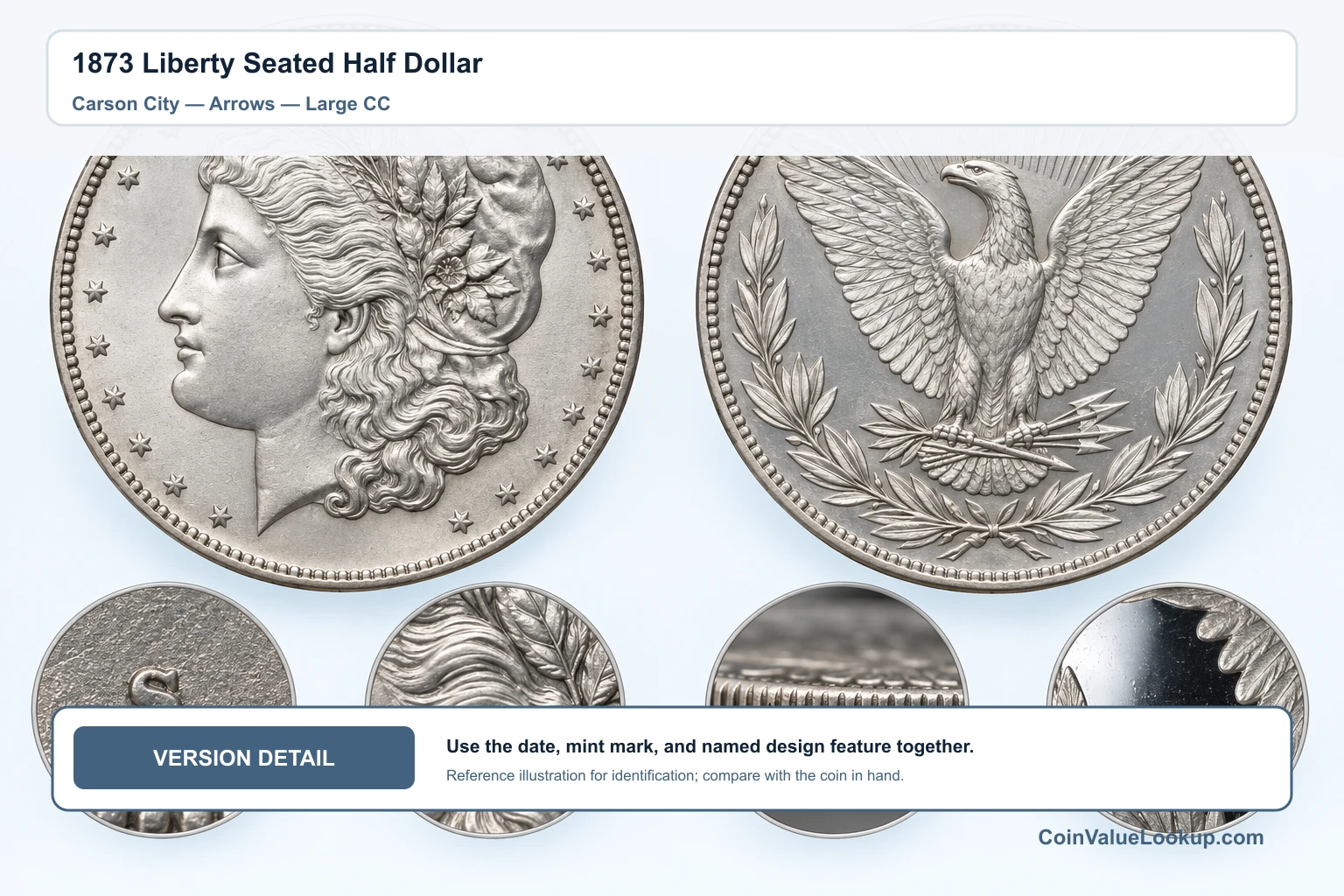
The Carson City Arrows with Large CC variety shows a bigger, bolder mintmark punch beneath the eagle. Same weight, same silver content, same design as the Small CC, just a different size of the CC letters struck into the die.
Guide estimates match the aggregate Carson City Arrows baseline: $425 at G4, $1,463 at VF20, $4,265 at AU50. No specific premium for the Large CC subtype has been adopted.
Identifying which mintmark size you have is still useful for accurate attribution. As with all CC coins, do not assume a shiny or prooflike surface means you have a Proof.
Ordinary-issue reference: Ordinary-issue reference only: The table below shows the related standard issue (1873-CC Arrows). It does not represent the value of the specific Carson City — Arrows — Large CC variety or its variety premium. The year, mint, metal and strike type are matched; the specific variety is not priced by this table.
Range Grade
Price Auction Records Appraisal PO PO 1
—
Coin Identifier FR FR 2
Coin Identifier AG AG 3
Coin Identifier G G 4
Coin Identifier
G 6
Coin Identifier VG VG 8
Coin Identifier
VG 10
Coin Identifier F F 12
Coin Identifier
F 15
Coin Identifier VF VF 20
Coin Identifier
VF 25
Coin Identifier
VF 30
Coin Identifier
VF 35
Coin Identifier XF XF 40
Coin Identifier
XF 45
Coin Identifier AU AU 50
Coin Identifier
AU 53
Coin Identifier
AU 55
Coin Identifier
AU 58
Coin Identifier MS MS 60
—
Coin Identifier
MS 61
Coin Identifier
MS 62
Coin Identifier
MS 63
Coin Identifier
MS 64
Coin Identifier
MS 65
Coin Identifier
MS 66
Coin Identifier
MS 67
—
—
—
MS 68
—
—
—
MS 69
—
—
—
MS 70
—
—
—
1873 Liberty Seated Half Dollar — Carson City — No Arrows — Closed 3
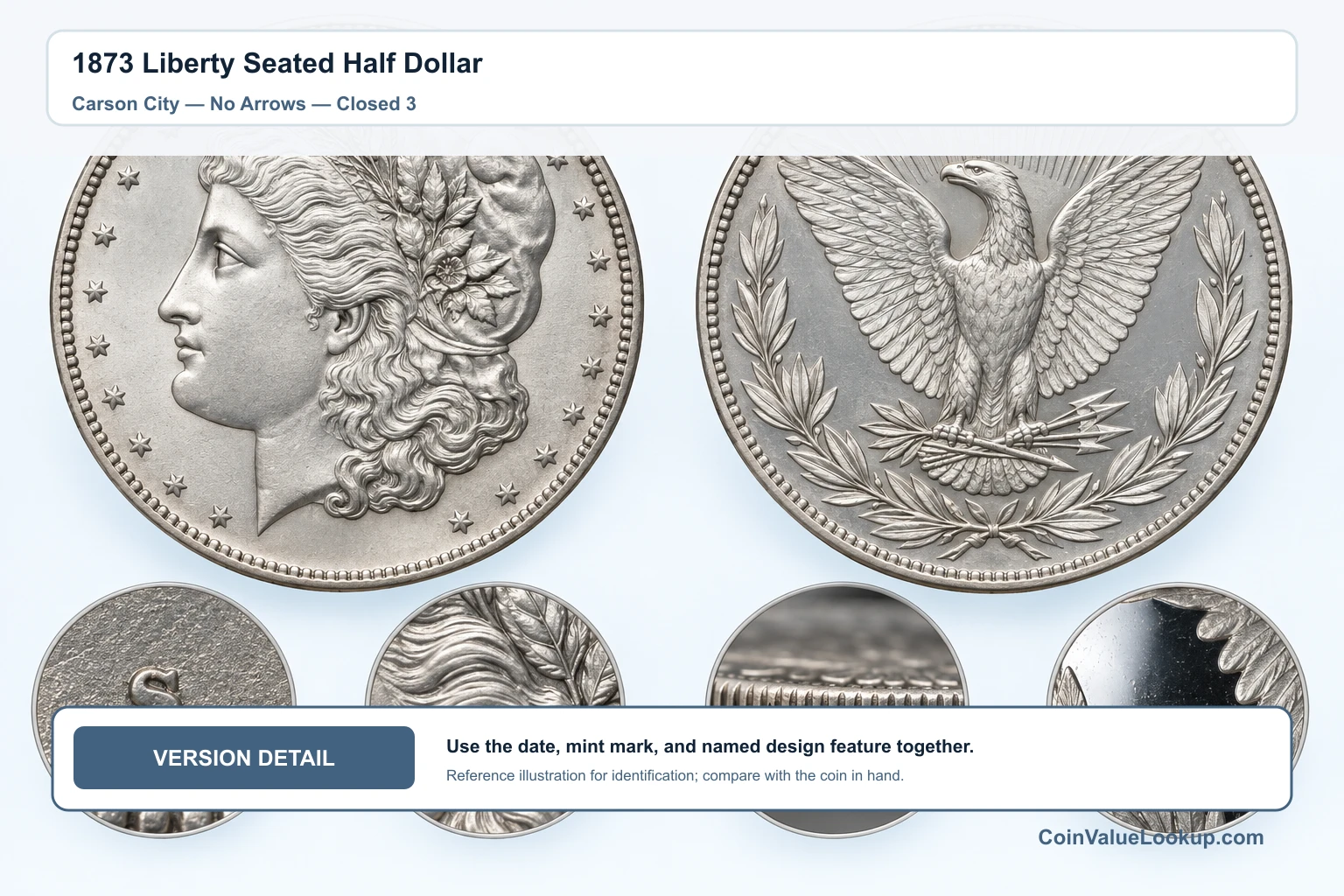
The Carson City No Arrows Closed 3 is struck at the old 12.44-gram weight and carries the CC mintmark. The "3" in the date has inward-curving tips.
This issue was produced before the Arrows changeover, making it a short-run CC coin.
Guide estimates are $516 at G4, $2,092 at VF20 and $7,351 at AU50. Those figures run well above the Arrows versions from the same mint.
Carson City coins already command a premium, and the No Arrows window of production was narrow. Authentication of the mintmark is worth the effort at these values.
Coin Value Lookup is a good starting point if you want to compare this coin with other Liberty Seated half dollar years or denominations. You can look up guides organized by series and date.
Range Grade
Price Auction Records Appraisal PO PO 1
—
Coin Identifier FR FR 2
Coin Identifier AG AG 3
Coin Identifier G G 4
Coin Identifier
G 6
Coin Identifier VG VG 8
Coin Identifier
VG 10
Coin Identifier F F 12
Coin Identifier
F 15
Coin Identifier VF VF 20
Coin Identifier
VF 25
Coin Identifier
VF 30
Coin Identifier
VF 35
Coin Identifier XF XF 40
Coin Identifier
XF 45
Coin Identifier AU AU 50
Coin Identifier
AU 53
Coin Identifier
AU 55
Coin Identifier
AU 58
Coin Identifier MS MS 60
—
Coin Identifier
MS 61
Coin Identifier
MS 62
Coin Identifier
MS 63
Coin Identifier
MS 64
Coin Identifier
MS 65
Coin Identifier
MS 66
Coin Identifier
MS 67
—
Coin Identifier
MS 68
—
—
—
MS 69
—
—
—
MS 70
—
—
—
1873 Liberty Seated Half Dollar — San Francisco — Arrows — Small S
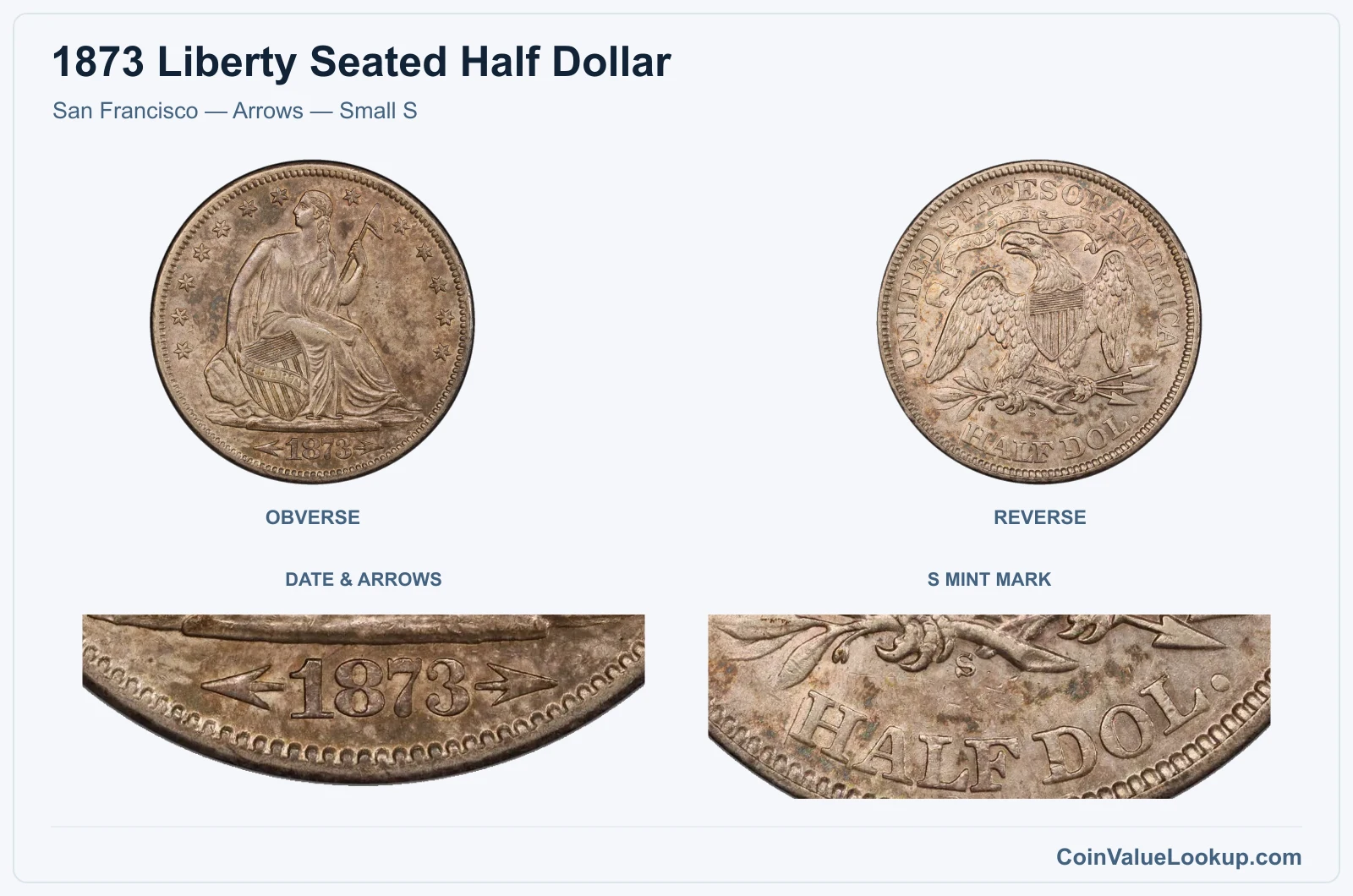
San Francisco struck Arrows half dollars in 1873 with a Small S mintmark positioned below the eagle. The coin weighs 12.50 grams under the new standard.
Guide estimates place this issue at $141 for G4, $456 at VF20 and $1,262 at AU50. That puts it above the common Philadelphia Arrows coins but well below Carson City.
The small "S" mintmark can be faint on worn examples, so tilt the coin under good light to confirm it. San Francisco coins from this period sometimes show weaker strikes, which is a manufacturing trait rather than wear.
Ordinary-issue reference: Ordinary-issue reference only: The table below shows the related standard issue (1873-S Arrows). It does not represent the value of the specific San Francisco — Arrows — Small S variety or its variety premium. The year, mint, metal and strike type are matched; the specific variety is not priced by this table.
Range Grade
Price Auction Records Appraisal PO PO 1
—
Coin Identifier FR FR 2
—
Coin Identifier AG AG 3
—
Coin Identifier G G 4
—
Coin Identifier
G 6
Coin Identifier VG VG 8
—
Coin Identifier
VG 10
—
Coin Identifier F F 12
Coin Identifier
F 15
—
Coin Identifier VF VF 20
Coin Identifier
VF 25
Coin Identifier
VF 30
Coin Identifier
VF 35
Coin Identifier XF XF 40
Coin Identifier
XF 45
Coin Identifier AU AU 50
Coin Identifier
AU 53
Coin Identifier
AU 55
Coin Identifier
AU 58
Coin Identifier MS MS 60
—
Coin Identifier
MS 61
Coin Identifier
MS 62
Coin Identifier
MS 63
—
Coin Identifier
MS 64
Coin Identifier
MS 65
Coin Identifier
MS 66
—
—
—
MS 67
—
—
—
MS 68
—
—
—
MS 69
—
—
—
MS 70
—
—
—
1873 Liberty Seated Half Dollar — Philadelphia Proof — Arrows
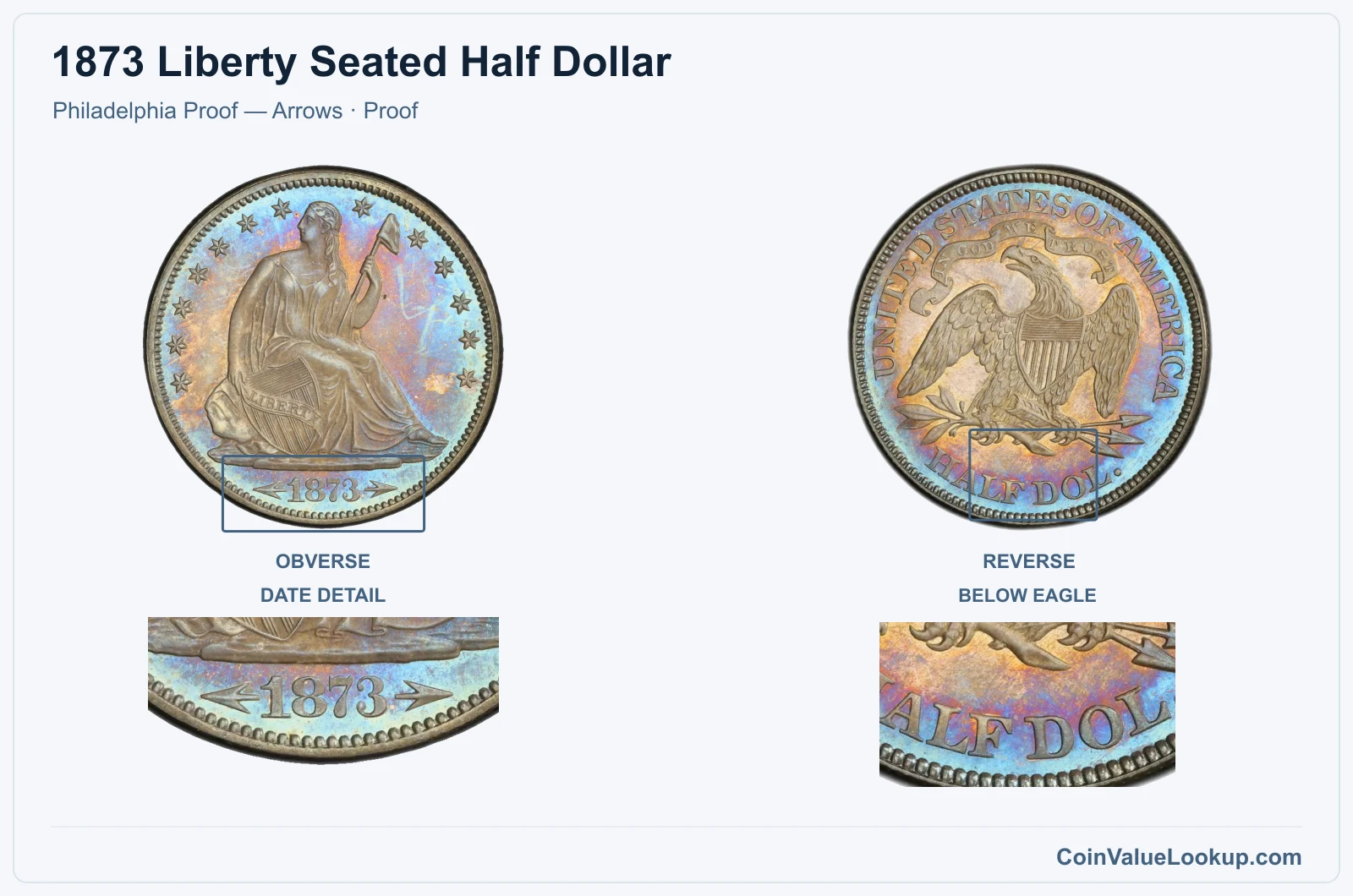
The 1873 Philadelphia Proof with Arrows was struck as a special presentation finish, featuring mirrored fields and crisp, squared rims. No mintmark appears.
These were made in small quantities for collectors, not for circulation.
A guide estimate of $2,747 at PR63 gives a sense of this finish's value. Proof status is about the method of manufacture, not a grade above Mint State.
Look for deeply reflective fields, frosted devices and sharp edge detail. A shiny circulated coin that has been cleaned is not a Proof.
Professional certification is strongly recommended before buying or selling at Proof valuations.
Range Grade
Price Auction Records Appraisal PR PR 1
—
Coin Identifier
PR 2
—
Coin Identifier
PR 3
—
Coin Identifier
PR 4
—
Coin Identifier
PR 6
—
Coin Identifier
PR 8
—
Coin Identifier
PR 10
—
Coin Identifier
PR 12
—
Coin Identifier
PR 15
—
Coin Identifier
PR 20
—
Coin Identifier
PR 25
—
Coin Identifier
PR 30
—
Coin Identifier
PR 35
—
Coin Identifier
PR 40
—
Coin Identifier
PR 45
—
Coin Identifier
PR 50
—
Coin Identifier
PR 53
—
Coin Identifier
PR 55
—
Coin Identifier
PR 58
Coin Identifier
PR 60
Coin Identifier
PR 61
Coin Identifier
PR 62
Coin Identifier
PR 63
Coin Identifier
PR 64
Coin Identifier
PR 65
Coin Identifier
PR 66
Coin Identifier
PR 67
—
—
—
PR 68
—
—
—
PR 69
—
—
—
PR 70
—
—
—
1873 Liberty Seated Half Dollar — Philadelphia Proof — No Arrows, Closed 3
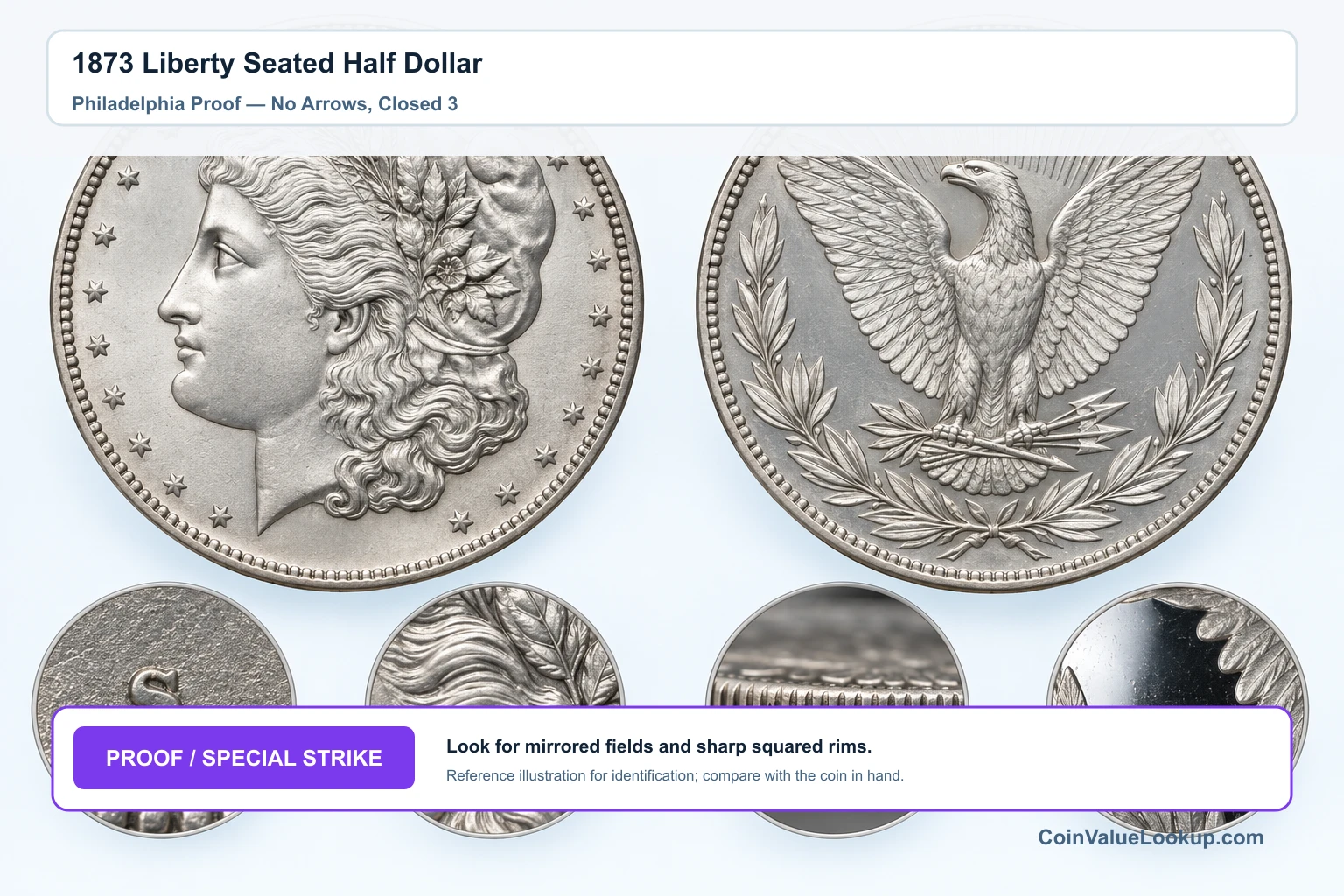
The Philadelphia Proof No Arrows Closed 3 represents the old-weight standard in Proof format. It weighs 12.44 grams, has no arrows beside the date and shows the Closed 3 date style with inward-curving tips.
The No Arrows Open 3 is a rare circulation variety, not a routine Proof option.
Guide estimate at PR63 is $1,541. That sits below the Arrows Proof, but these remain scarce coins struck in very limited numbers.
Full mirrored fields and sharp rims distinguish a genuine Proof from a prooflike business strike. If you believe you have one, third-party grading is the right next step.
Range Grade
Price Auction Records Appraisal PR PR 1
—
Coin Identifier
PR 2
—
Coin Identifier
PR 3
—
Coin Identifier
PR 4
—
Coin Identifier
PR 6
—
Coin Identifier
PR 8
—
Coin Identifier
PR 10
—
Coin Identifier
PR 12
—
Coin Identifier
PR 15
—
Coin Identifier
PR 20
—
Coin Identifier
PR 25
—
Coin Identifier
PR 30
—
Coin Identifier
PR 35
—
Coin Identifier
PR 40
—
Coin Identifier
PR 45
—
Coin Identifier
PR 50
—
Coin Identifier
PR 53
—
Coin Identifier
PR 55
—
Coin Identifier
PR 58
—
Coin Identifier
PR 60
Coin Identifier
PR 61
Coin Identifier
PR 62
Coin Identifier
PR 63
Coin Identifier
PR 64
Coin Identifier
PR 65
Coin Identifier
PR 66
Coin Identifier
PR 67
Coin Identifier
PR 68
—
—
—
PR 69
—
—
—
PR 70
—
—
—
1873 Liberty Seated Half Dollar Error List
1. 1873 Liberty Seated Half Dollar — Repunched Date
A repunched date on the 1873 half dollar shows traces of an earlier date impression beneath or slightly offset from the final numbers. This happened when a die was struck more than once by the date punch, with slight misalignment between impressions.
You may see doubled or thickened serifs on one or more digits.
Repunched-date entries have been reported for both Philadelphia and Carson City coins across the Arrows and No Arrows families. The value of any repunched date depends on the visibility of the doubling, the coin's condition and which specific die pairing produced it.
Do not confuse a repunched date with simple damage to the date area or with machine doubling, which produces flat, shelf-like doubling rather than the rounded secondary impression of a true repunch.
2. 1873 Liberty Seated Half Dollar — Misplaced Date
A misplaced date means part of a digit appears somewhere it should not, often partially visible in the denticles or field below the normal date position. This occurs when the date punch accidentally contacts the die in the wrong spot before the final impression is placed correctly.
Reported examples include the Philadelphia No Arrows Closed 3 and the Carson City Arrows issues. Look for a partial numeral peeking out of the rim area or the lower field near the date.
Condition and how clearly the misplaced digit shows will affect collector interest and value. Compare against a normal example of the same subtype before drawing conclusions.
Ordinary wear, minor die scratches or contact marks near the date can mimic this error to untrained eyes.
3. 1873 Liberty Seated Half Dollar — Doubled Die Obverse
The 1873 Philadelphia Arrows half dollar has a reported doubled die obverse visible as doubled or even quadrupled lines on the shield stripes. Under magnification, you will see distinct repeated vertical lines within the shield on Liberty's lap, where the die received multiple hub impressions at slightly different angles.
This is different from machine doubling, which leaves flat, shelf-like distortion without the crisp separation of true hub doubling. Reflections from polished or prooflike surfaces can also mimic doubling in photos, so examine the coin under direct light and magnification.
The value depends on the strength of the doubling and the coin's overall condition. If the shield lines look cleanly repeated with clear separation, you may have a genuine doubled die worth professional verification.
4. 1873 Liberty Seated Half Dollar — Die Cap / Capped-Die Strike
A die cap occurs when a struck coin sticks to the upper die and acts as a new striking surface for subsequent blanks. The stuck coin gradually cups into a cap shape while impressing its image in reverse onto the coins beneath it.
A published 1873 Arrows half dollar die cap shows this combined effect: the obverse became the cap, and the reverse displays a brockage, an incuse mirror image transferred from the capped die. The coin also shows an expanded diameter from repeated strikes.
This is a dramatic error and quite rare for this series. Do not confuse a coin bent from a vise or post-mint damage with a genuine die cap.
A real cap has a uniform curvature and evidence of progressive striking, not random bending. Condition, visual impact and the specific characteristics of the cap all influence value.
5. 1873 Liberty Seated Half Dollar — Double / Multiple Strike
A double or multiple strike occurs when a coin receives two or more impressions from the dies, usually with slight movement between strikes. The result is overlapping design elements, sometimes with a ghosted second image offset from the first.
A recorded example is an 1873-CC double strike in collar, graded F12 by PCGS. "In collar" means the coin stayed within the retaining collar during both strikes, so the diameter remains normal but design elements overlap.
Look for doubled lettering, a shifted eagle or duplicated date digits that do not align with the primary impression.
Do not mistake a doubled die for a double strike. Doubled dies show consistent doubling on every coin from that die.
A double strike is unique to one coin. Post-mint damage or added impressions from tools can also create misleading overlaps, so comparing against verified examples is important.