1861 Liberty Seated Dime Coin Value: How Much Is It Worth?
The 1861 Liberty Seated Dime spans a wide value range depending on mint, design type, and condition. Philadelphia business strikes start around $23 at G4 and reach roughly $410 at MS63 per USA Coin Book guide estimates, while the scarcer San Francisco issue runs from about $229 at G4 up to around $22,514 at MS63.
Proofs carry their own pricing. Identifying whether you hold a Type I or Type II obverse is the first step.
Fast Way to Identify Your 1861 Liberty Seated Dime
Snap clear photos of both sides of your coin and upload them for a preliminary identification. The tool can help you sort out mint, obverse type, and general condition from your images.
Make sure the date, any mintmark below the wreath, and the shield details are in focus — those are the features that matter most for this date.
1861 Liberty Seated Dime Value
Upload both sides of your 1861 Liberty Seated Dime.
Front Obverse
Upload photo
Back Reverse
Upload photo
Which 1861 Liberty Seated Dime Versions Are Worth Money?
- The 1861-S (Type I obverse) is the scarcest regular issue, with guide values from about $229 at G4 to roughly $22,514 at MS63.
- Philadelphia Proofs (Type II obverse) are a separate collectible finish; a PR63 example is estimated around $933 per PCGS guide data.
- Correctly identifying Type I versus Type II on a Philadelphia business strike matters for specialist collectors, even though current guide prices are pooled for the date.
- Several die errors — clashed dies, die cracks, doubled die reverse, die gouges, and rusted-die varieties — are documented for 1861 and can carry premiums depending on visibility and condition.
Step 1: Identify Your 1861 Liberty Seated Dime Mint Mark and Version
First, confirm you have a seated Liberty obverse and a ONE DIME reverse with an agricultural wreath. Half dimes are smaller and say HALF DIME — set those aside.
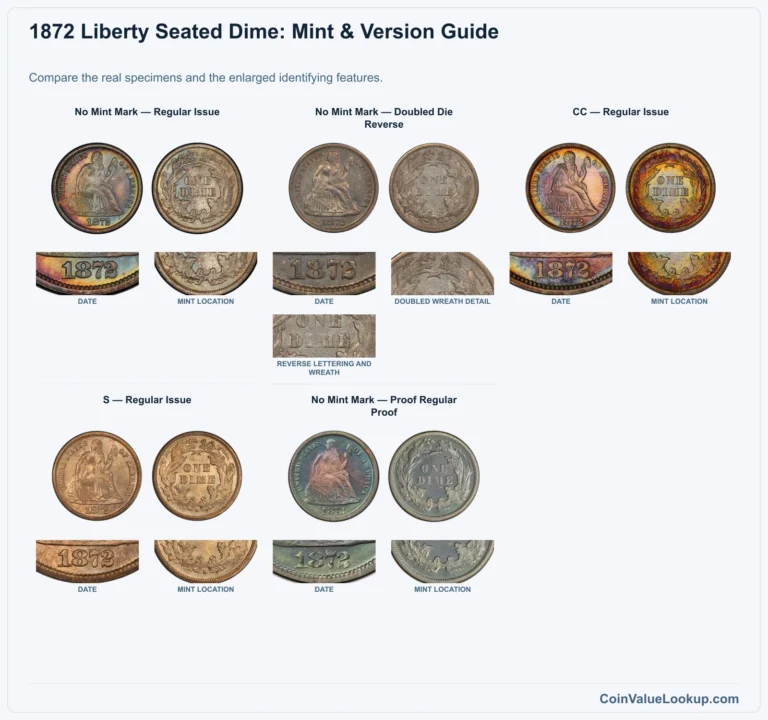
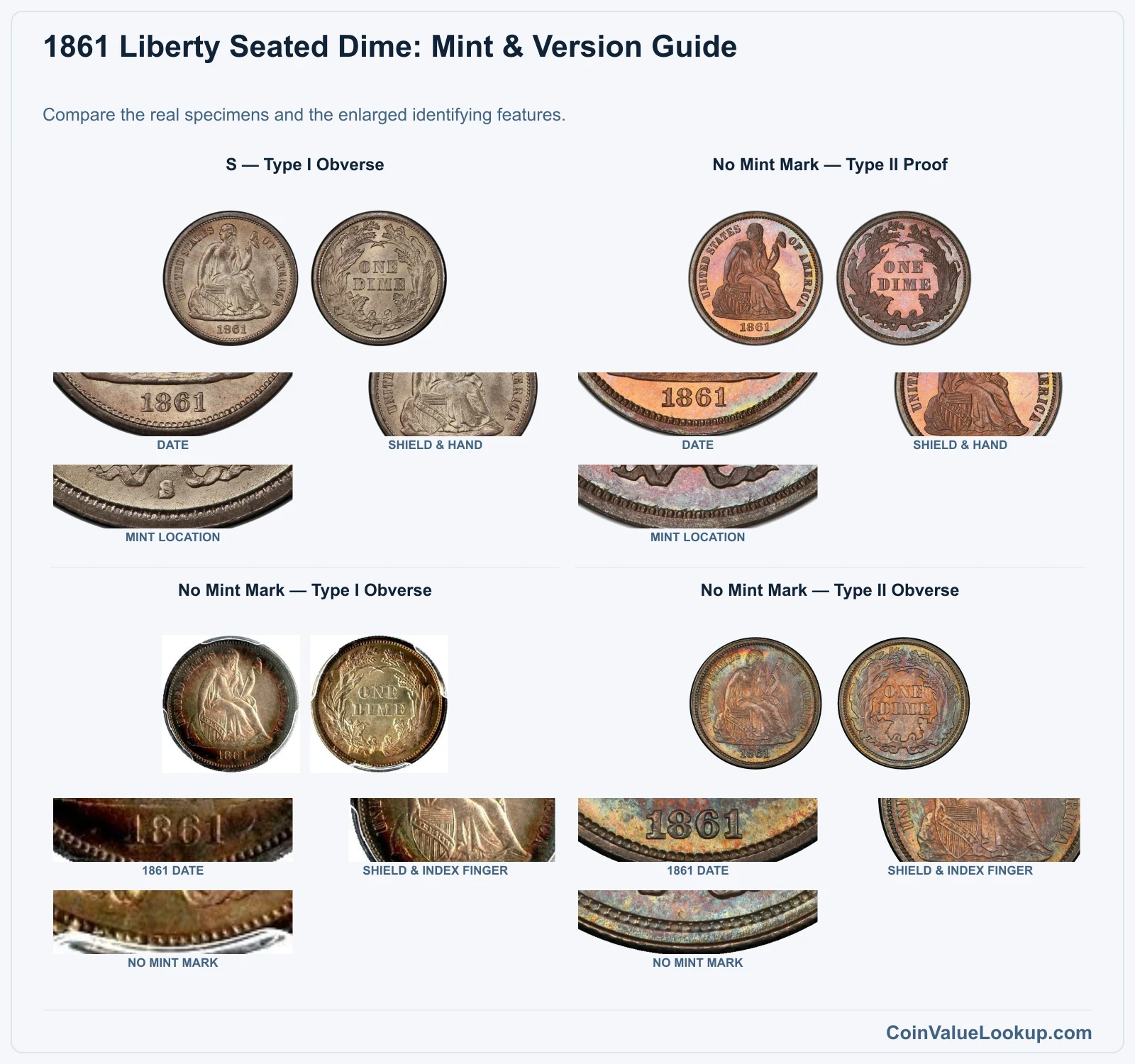
Flip to the reverse and look below the wreath for a mintmark. An "S" means San Francisco; no letter means Philadelphia.
Now count the lines across the upper portion of Liberty's shield. Type I has five lines, and the index finger sits outside the shield edge.
Type II has six lines, and the index finger runs down the left edge of the shield. This is the key diagnostic.
Philadelphia business strikes come in both Type I and Type II. San Francisco used only Type I.
Philadelphia Proofs are Type II exclusively.
All versions are 90% silver and 10% copper, with a nominal weight of 2.49 grams, a diameter of 17.9 mm, and a reeded edge. If the weight is way off, you may have a problem — or a different coin entirely.
Step 2: Check Your 1861 Liberty Seated Dime Grade
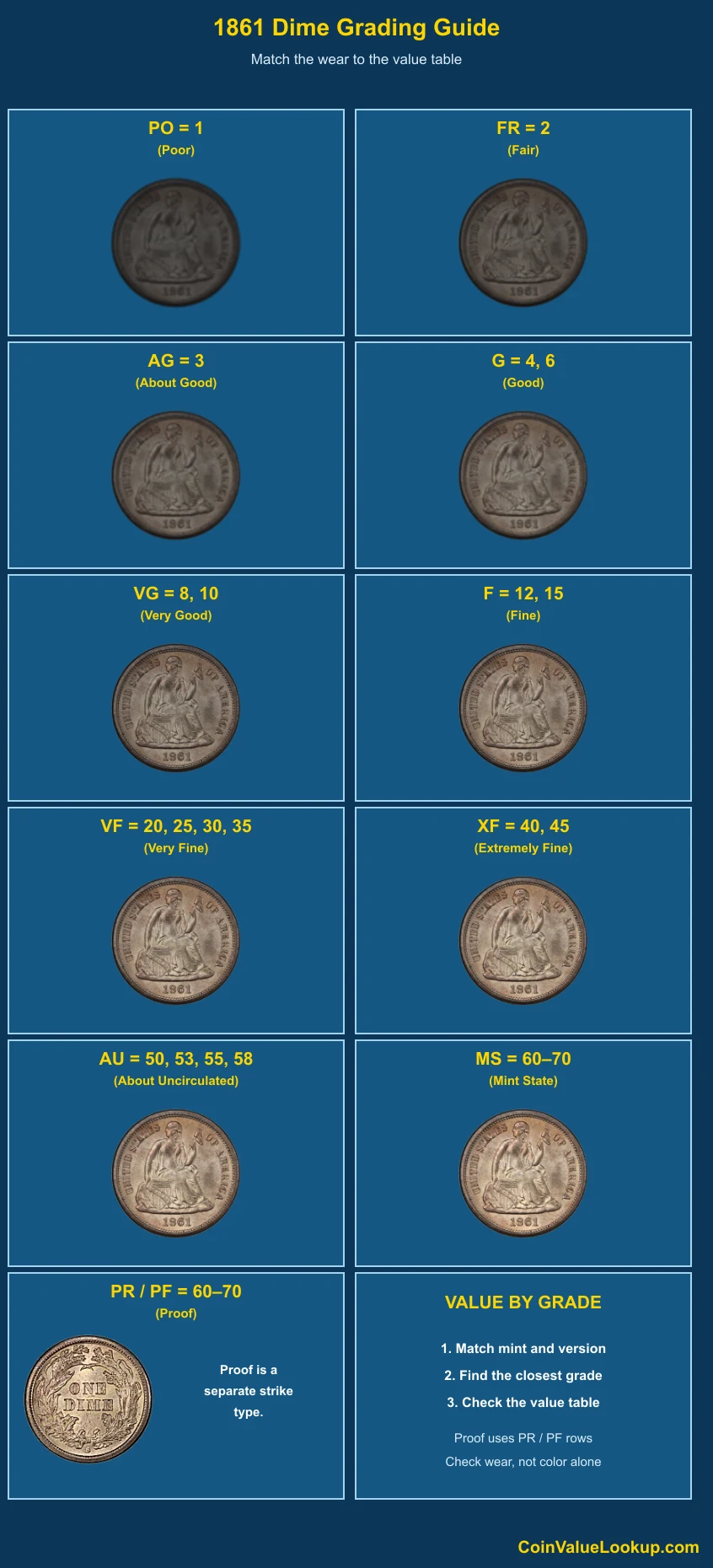
Use the subtype-specific grading comparison image to judge wear, not a generic Seated Dime chart. Type I and Type II have slightly different high points.
On the obverse, check Liberty's head, the gown folds over the knee, the shield detail, and the feet. These wear in roughly that order.
On the reverse, the wreath tips opposite the base show early friction.
Original luster matters. A coin can look shiny from cleaning but actually be damaged — luster should be even and undisturbed in protected areas.
Separate genuine wear from weak strikes and tired dies; some 1861 dimes were struck from worn equipment, so soft details do not always mean heavy circulation.
Proof coins are a separate category. They were made with a different striking process and show mirrored fields.
A polished circulation coin is not a Proof, no matter how reflective it appears. Hairlines on a Proof surface reduce the grade, so handle with care.
Step 3: Check 1861 Liberty Seated Dime Value by Mint and Version
1861 Liberty Seated Dime — S — Type I Obverse
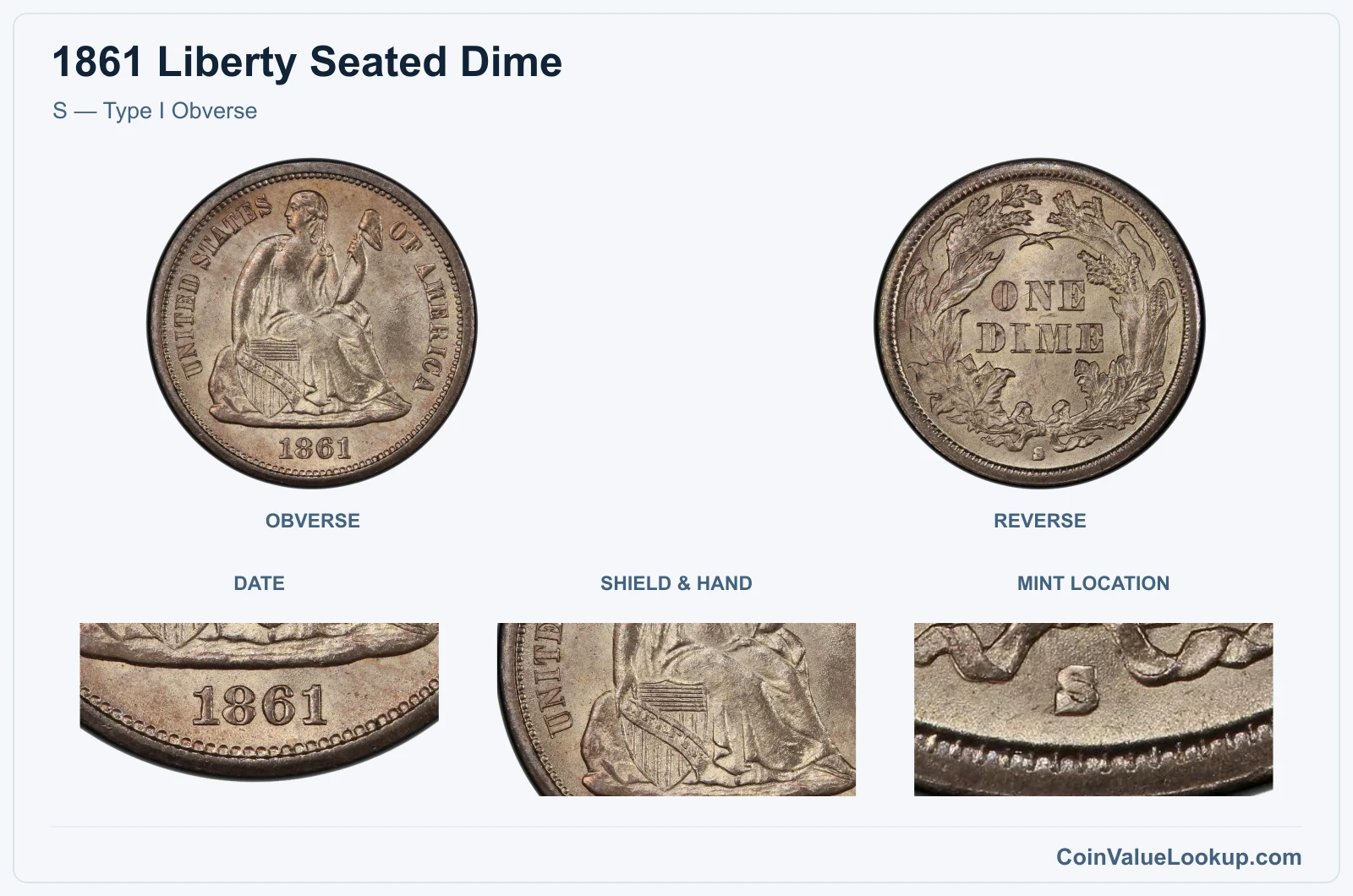
The 1861-S dime was struck in San Francisco and carries an "S" mintmark below the reverse wreath. It uses the Type I obverse exclusively — five lines across the upper shield, index finger outside the shield edge.
Check both features to confirm.
This is the key date for the year. USA Coin Book estimates place it around $229 in G4 and roughly $22,514 in MS63.
That gap tells you condition drives serious money here. Even well-worn examples carry meaningful value because of the mint and type combination.
The coin is 90% silver and 10% copper with a nominal weight of 2.49 grams. A short-lived obverse hub makes this a transitional piece for Seated Dime specialists.
Ordinary-issue reference: Ordinary-issue reference only: The table below shows prices for the 1861-S Liberty Seated Dime (regular strike). It does not represent the value of the specific S — Type I Obverse variety or its variety premium. Year, mint, metal and strike type are matched; the specific variety is not priced by this table.
Range Grade
Price Auction Records Appraisal PO PO 1
—
Coin Identifier FR FR 2
—
Coin Identifier AG AG 3
—
Coin Identifier G G 4
Coin Identifier
G 6
Coin Identifier VG VG 8
Coin Identifier
VG 10
Coin Identifier F F 12
Coin Identifier
F 15
Coin Identifier VF VF 20
Coin Identifier
VF 25
Coin Identifier
VF 30
—
Coin Identifier
VF 35
Coin Identifier XF XF 40
Coin Identifier
XF 45
Coin Identifier AU AU 50
Coin Identifier
AU 53
Coin Identifier
AU 55
Coin Identifier
AU 58
Coin Identifier MS MS 60
—
Coin Identifier
MS 61
Coin Identifier
MS 62
Coin Identifier
MS 63
—
Coin Identifier
MS 64
Coin Identifier
MS 65
—
Coin Identifier
MS 66
Coin Identifier
MS 67
—
—
—
MS 68
—
—
—
MS 69
—
—
—
MS 70
—
—
—
1861 Liberty Seated Dime — No Mint Mark — Type II Proof
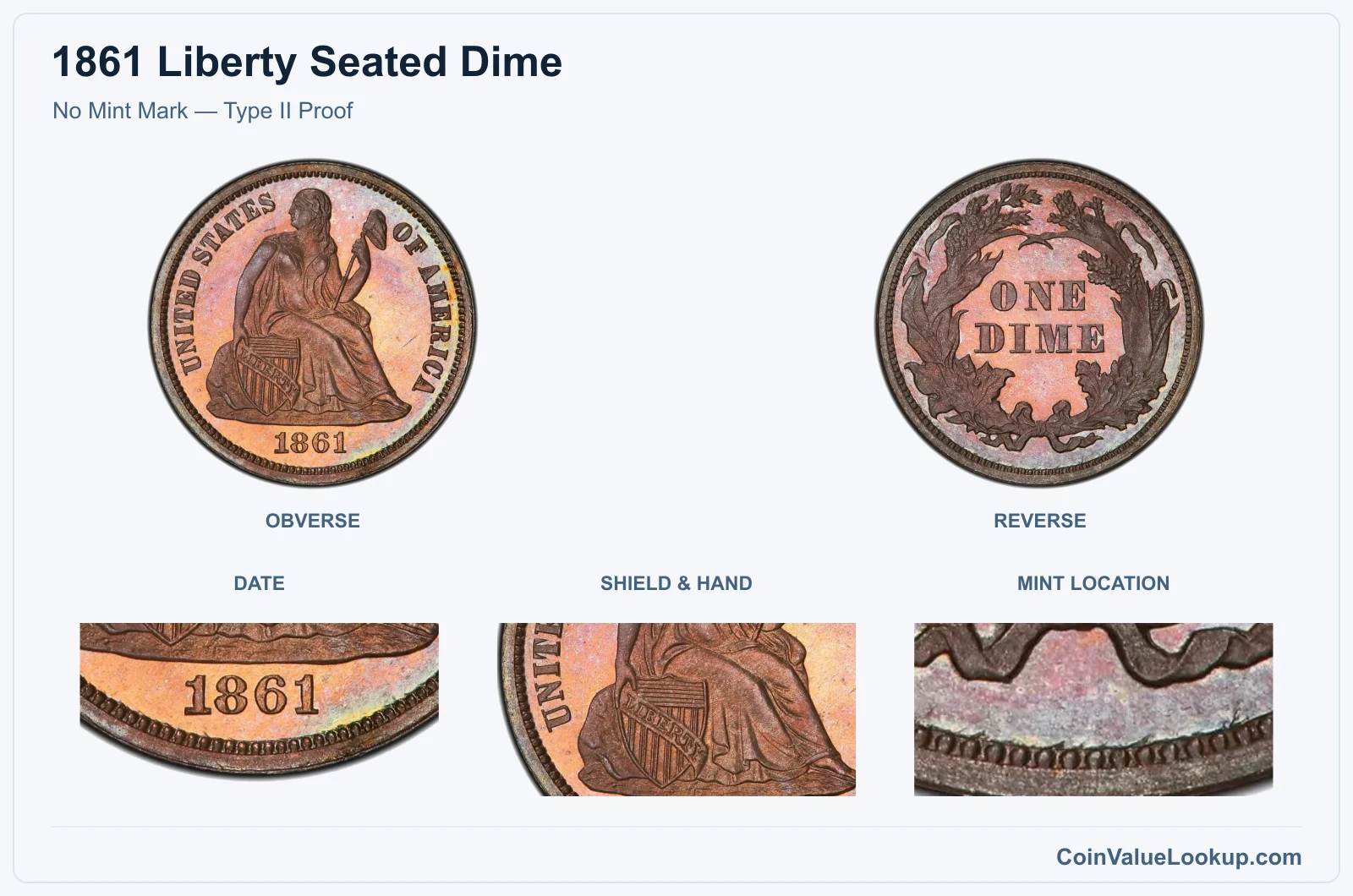
Philadelphia Proofs of 1861 use the Type II obverse: six upper shield lines and the index finger running down the left edge of the shield. These were struck with polished dies on prepared planchets, producing mirrored fields.
A genuine Proof needs proper attribution. Polishing a business strike does not create one.
Look for squared rims, deep mirrors, and sharp detail that goes beyond what you see on even a pristine circulation coin.
PCGS guide data places a PR63 example at about $933. Proof grading hinges on the quality of the mirror surfaces and the presence of hairlines or haze.
If you think you have one, professional certification is the way to go.
Coin Value Lookup is a good starting point if you want to look up guide values for other Seated Dime dates and types before deciding on next steps.
Ordinary-issue reference: Ordinary-issue reference only: The table below shows prices for the 1861 Liberty Seated Dime (proof). It does not represent the value of the specific No Mint Mark — Type II Proof variety or its variety premium. Year, mint, metal and strike type are matched; the specific variety is not priced by this table.
Range Grade
Price Auction Records Appraisal PR PR 1
—
Coin Identifier
PR 2
—
Coin Identifier
PR 3
—
Coin Identifier
PR 4
—
Coin Identifier
PR 6
—
Coin Identifier
PR 8
—
Coin Identifier
PR 10
—
Coin Identifier
PR 12
—
Coin Identifier
PR 15
—
Coin Identifier
PR 20
—
Coin Identifier
PR 25
—
Coin Identifier
PR 30
—
Coin Identifier
PR 35
—
Coin Identifier
PR 40
—
Coin Identifier
PR 45
—
Coin Identifier
PR 50
—
Coin Identifier
PR 53
—
Coin Identifier
PR 55
—
Coin Identifier
PR 58
—
Coin Identifier
PR 60
—
Coin Identifier
PR 61
Coin Identifier
PR 62
Coin Identifier
PR 63
Coin Identifier
PR 64
Coin Identifier
PR 65
Coin Identifier
PR 66
Coin Identifier
PR 67
Coin Identifier
PR 68
—
—
—
PR 69
—
—
—
PR 70
—
—
—
1861 Liberty Seated Dime — No Mint Mark — Type I Obverse
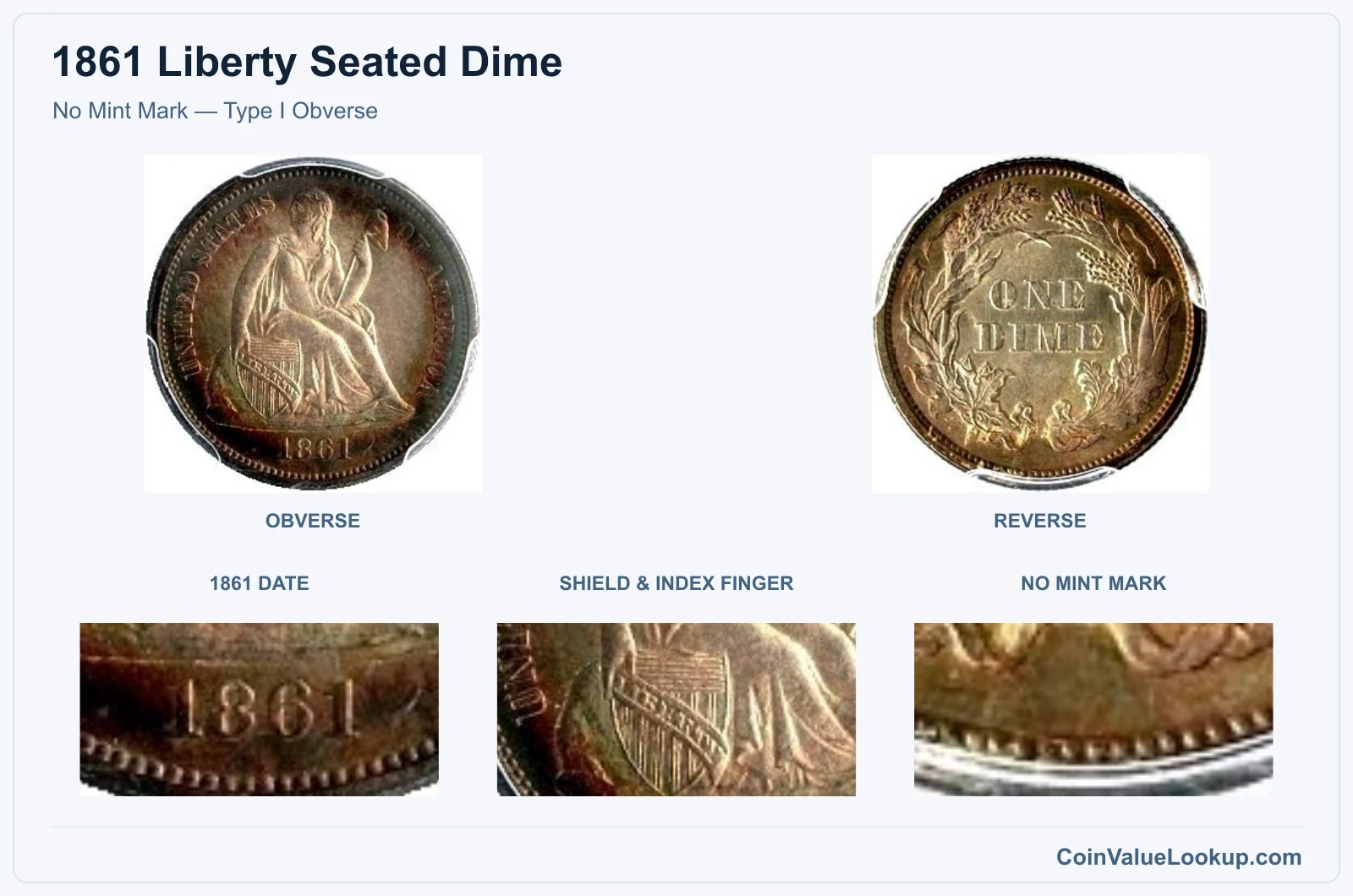
Philadelphia Type I business strikes show five lines across the upper shield and the index finger positioned outside the shield edge. No mintmark appears on the reverse.
Current USA Coin Book guide estimates for 1861 Philadelphia dimes are pooled across both types — roughly $23 at G4 and about $410 at MS63. That means the guide does not yet assign a separate type premium, but specialist collectors still track the distinction.
Knowing your type puts you ahead of most holders.
Weight is nominally 2.49 grams in the standard 90% silver, 10% copper alloy.
Ordinary-issue reference: Ordinary-issue reference only: The table below shows prices for the 1861 Liberty Seated Dime (regular strike). It does not represent the value of the specific No Mint Mark — Type I Obverse variety or its variety premium. Year, mint, metal and strike type are matched; the specific variety is not priced by this table.
Range Grade
Price Auction Records Appraisal PO PO 1
—
Coin Identifier FR FR 2
—
Coin Identifier AG AG 3
—
Coin Identifier G G 4
—
Coin Identifier
G 6
—
Coin Identifier VG VG 8
—
Coin Identifier
VG 10
—
Coin Identifier F F 12
—
Coin Identifier
F 15
—
Coin Identifier VF VF 20
—
Coin Identifier
VF 25
Coin Identifier
VF 30
—
Coin Identifier
VF 35
—
Coin Identifier XF XF 40
Coin Identifier
XF 45
—
Coin Identifier AU AU 50
Coin Identifier
AU 53
—
Coin Identifier
AU 55
Coin Identifier
AU 58
Coin Identifier MS MS 60
Coin Identifier
MS 61
Coin Identifier
MS 62
Coin Identifier
MS 63
Coin Identifier
MS 64
Coin Identifier
MS 65
Coin Identifier
MS 66
Coin Identifier
MS 67
Coin Identifier
MS 68
—
—
—
MS 69
—
—
—
MS 70
—
—
—
1861 Liberty Seated Dime — No Mint Mark — Type II Obverse
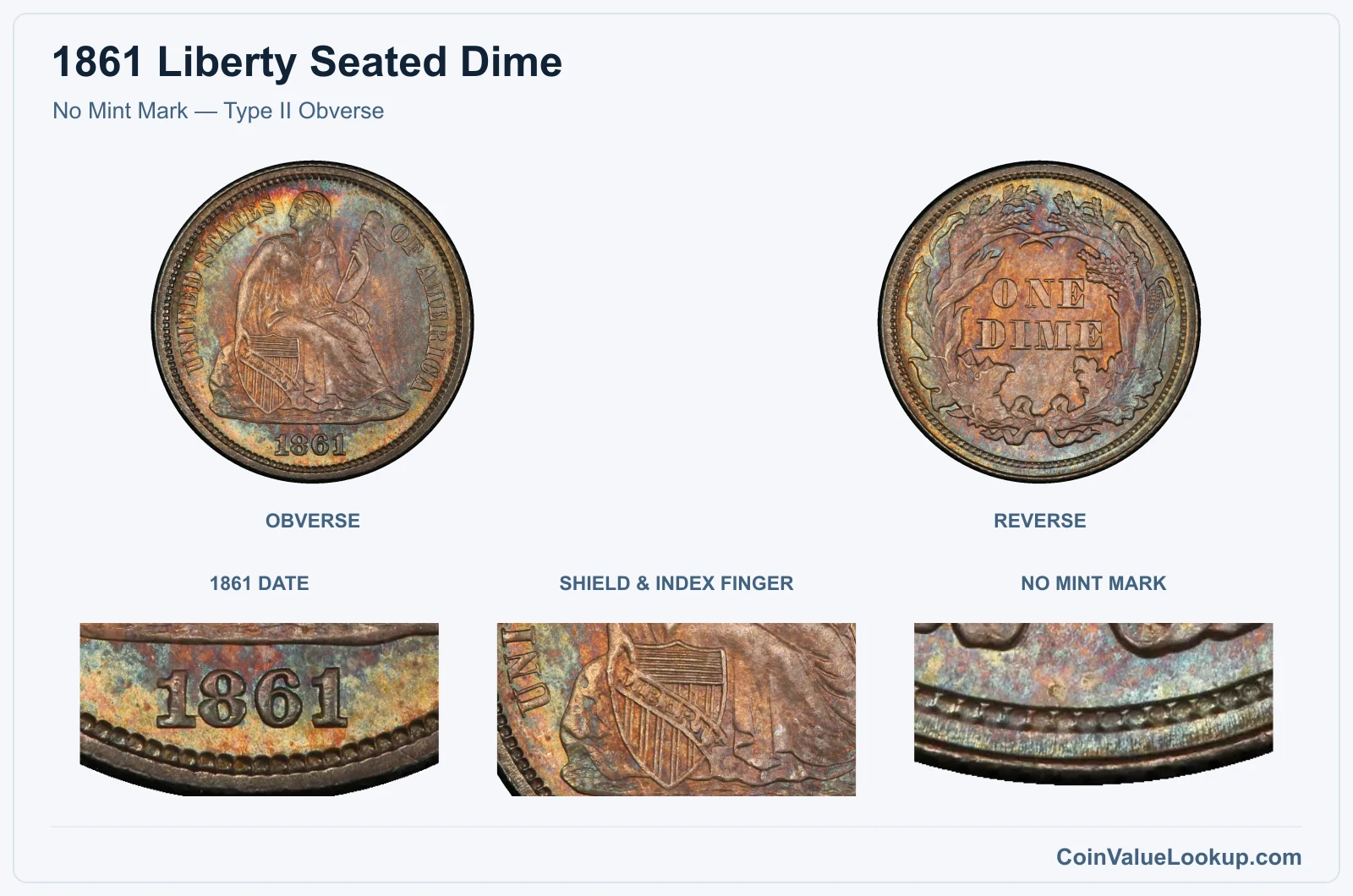
The Type II obverse has six lines across the upper shield and the index finger pointing down along the left shield edge. No mintmark on the reverse confirms Philadelphia.
Like the Type I, guide prices for the Philadelphia business strike are pooled at the date level — about $23 at G4 and around $410 at MS63 per USA Coin Book. No separate type premium is currently reflected in that source.
Still, this is the same hub used for Proofs, so it connects to a different part of the production story.
The composition and weight match all other 1861 dimes: 90% silver, 10% copper, nominally 2.49 grams.
Ordinary-issue reference: Ordinary-issue reference only: The table below shows prices for the 1861 Liberty Seated Dime (regular strike). It does not represent the value of the specific No Mint Mark — Type II Obverse variety or its variety premium. Year, mint, metal and strike type are matched; the specific variety is not priced by this table.
Range Grade
Price Auction Records Appraisal PO PO 1
—
Coin Identifier FR FR 2
—
Coin Identifier AG AG 3
—
Coin Identifier G G 4
—
Coin Identifier
G 6
—
Coin Identifier VG VG 8
—
Coin Identifier
VG 10
—
Coin Identifier F F 12
—
Coin Identifier
F 15
—
Coin Identifier VF VF 20
—
Coin Identifier
VF 25
Coin Identifier
VF 30
—
Coin Identifier
VF 35
—
Coin Identifier XF XF 40
Coin Identifier
XF 45
—
Coin Identifier AU AU 50
Coin Identifier
AU 53
—
Coin Identifier
AU 55
Coin Identifier
AU 58
Coin Identifier MS MS 60
Coin Identifier
MS 61
Coin Identifier
MS 62
Coin Identifier
MS 63
Coin Identifier
MS 64
Coin Identifier
MS 65
Coin Identifier
MS 66
Coin Identifier
MS 67
Coin Identifier
MS 68
—
—
—
MS 69
—
—
—
MS 70
—
—
—
1861 Liberty Seated Dime Error List
1. 1861 Liberty Seated Dime — Clashed Dies
A die clash happens when the obverse and reverse dies strike each other without a planchet between them. The result is ghost-like impressions of the opposite design transferred onto each die, which then appear as faint raised traces on subsequent coins.
On an 1861 dime, look for outlines of wreath elements on the obverse or traces of Liberty's figure on the reverse, positioned where the opposing design would naturally align. These marks repeat from coin to coin struck by the same die pair.
Do not confuse clashed-die traces with random scratches, contact marks, or raised lines from other causes. Genuine clashes follow the geometry of the opposing design.
Value depends on the visibility of the clash, the coin's overall condition, and collector demand for the specific die pair.
2. 1861 Liberty Seated Dime — Die Crack / Die Chip
Die cracks show up as raised lines on the coin's surface, following the path of a fracture in the steel die. A die chip is a small raised blob where a piece of the die broke away.
Both are common on heavily used dies.
On the 1861 dime, the reverse wreath area is a documented location for die cracks. Look for raised lines that cross design elements — they will be slightly irregular, unlike the sharp edges of intentional design.
Do not mistake incuse scratches, corrosion lines, or debris stuck to the surface for a die crack. A crack is always raised above the field.
The value of a cracked-die coin depends on how prominent the crack is, where it falls, and the coin's grade. Not every crack adds a meaningful premium.
3. 1861 Liberty Seated Dime — Doubled Die Reverse
A doubled die reverse shows doubling in the design elements that was created during the die-making process. On the 1861 dime, the documented area to inspect is the upper oak leaves and the right side of the wreath, where doubled contours may be visible under magnification.
This is a die-level variety, so every coin struck from that die will show the same doubling in the same location. That consistency is what separates it from machine doubling, which tends to look flat and shelf-like.
Reflections, lighting tricks, and post-strike damage can all mimic doubling at first glance. Use a loupe and compare against known examples.
The value of any doubled die depends on the strength of the doubling, the coin's condition, and how visible the effect is without heroic magnification.
4. 1861 Liberty Seated Dime — Die Gouge / Named Raised-Line Variety
A die gouge is a raised line or lump on the coin caused by a scratch or nick cut into the die itself. Because the die is incuse, damage to it shows up as raised metal on every coin it strikes.
For the 1861 dime, documented examples involve raised lines near the ONE and DIME lettering on the reverse. Compare your coin against known source images for position and shape.
The critical distinction: a gouge on the die produces a raised feature on the coin, while a scratch on the coin itself is incuse (cut into the surface). If the mark is sunk into the metal, that is post-mint damage, not a die gouge.
Value depends on how distinct and well-documented the gouge is, plus the coin's overall condition.
5. 1861 Liberty Seated Dime — Rusted-Die Surface Variety
When a die corrodes between uses, the rust pits transfer as small raised bumps or a rough, pebbly texture onto struck coins. This is a die-level feature — every coin from that die shows the same pattern in the same area.
Compare the texture on your 1861 dime against a clean same-year example. Die rust produces a distinctive repeated raised roughness, not the random pitting you see from environmental damage after the coin left the mint.
That distinction matters. Corrosion that eats into the coin's surface happened post-strike and reduces value.
Dirt and grime can also mimic roughness. A rusted-die variety needs to show the pattern consistently in the documented location.
Premiums vary with visibility, the coin's condition, and collector interest — not every rough surface commands extra money.