1862 Liberty Seated Dime Coin Value: How Much Is It Worth?
An 1862 Liberty Seated Dime can range from about $23 at G4 for a Philadelphia strike up to around $11,091 at MS63 for the scarcer San Francisco issue, based on USA Coin Book guide estimates. Proofs and die varieties carry their own separate pricing.
The mint, condition, and specific variety all matter when figuring out what yours is worth.
Fast Way to Identify Your 1862 Liberty Seated Dime
Snap a clear photo of both the front and back of your coin and upload them here for a preliminary identification. This helps confirm the date, mintmark, and design type so you can narrow down which branch you have.
Good lighting at a slight angle brings out details that flat scans can miss.
1862 Liberty Seated Dime Value
Upload both sides of your 1862 Liberty Seated Dime.
Front Obverse
Upload photo
Back Reverse
Upload photo
Which 1862 Liberty Seated Dime Versions Are Worth Money?
- The 1862-S (San Francisco) business strike is substantially scarcer than the Philadelphia issue, with a USA Coin Book guide estimate reaching about $11,091 at MS63 versus $441 for the Philadelphia coin at the same grade.
- Philadelphia Proof strikes carry a guide value around $933 at PR63 per PCGS estimates and are rare early-date collector pieces, not routine annual issues.
- Documented die varieties including repunched dates, doubled die obverses, die gouges, and the 1862-S rotated-die variety can add premiums that depend on visibility and condition.
- Even common Philadelphia business strikes in lower circulated grades hold a silver-content floor and start around $23 at G4 per guide estimates.
Step 1: Identify Your 1862 Liberty Seated Dime Mint Mark and Version
Start by confirming you have a seated Liberty on the obverse with "UNITED STATES OF AMERICA" around the top and a large agricultural wreath on the reverse surrounding "ONE DIME." Half dimes are smaller and say HALF DIME, so set those aside.
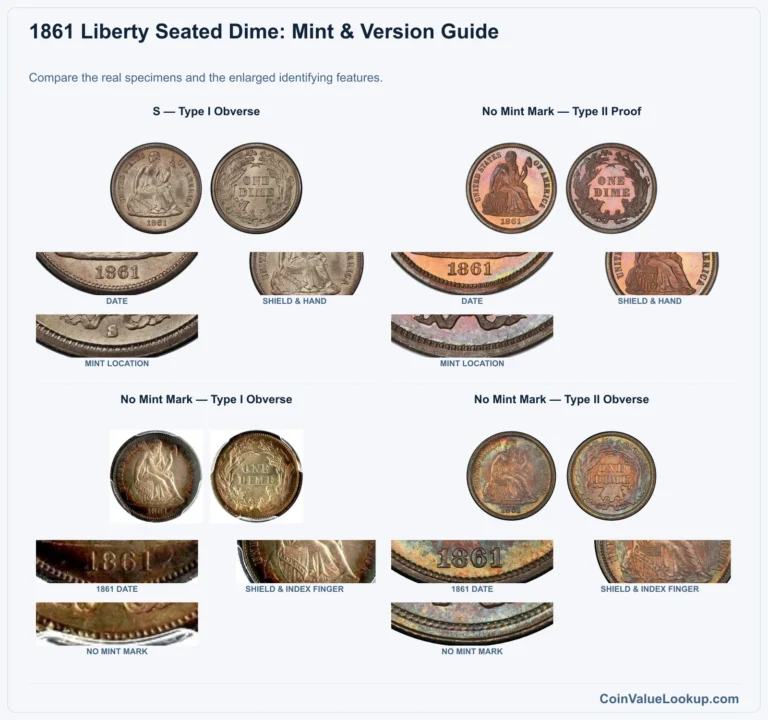
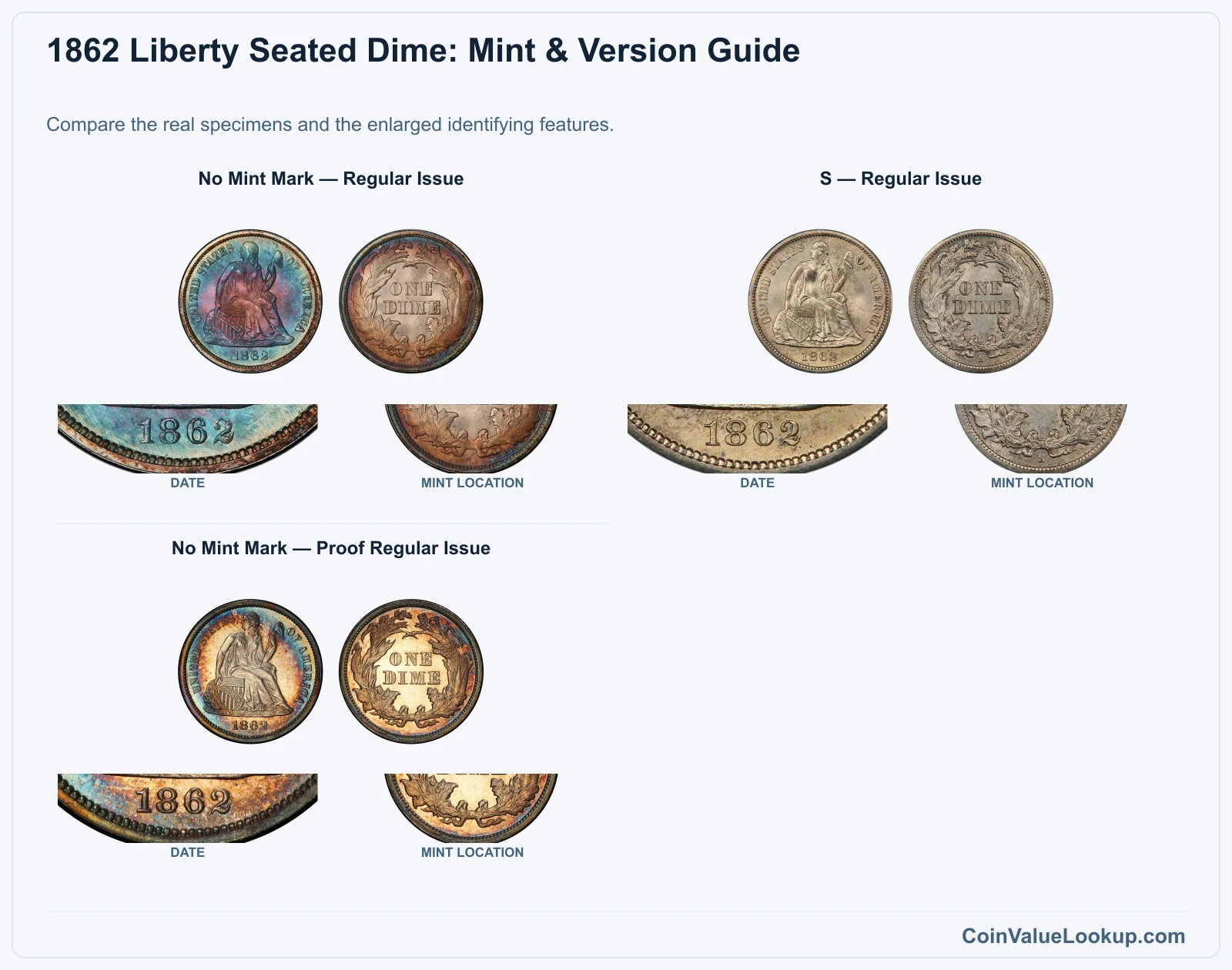
Flip to the reverse and look below the wreath for a mintmark. Philadelphia coins carry no letter at all.
A small "S" means San Francisco, and that distinction dramatically affects value.
The 1862 dime uses the Legend Obverse design, where the country name moved to the obverse rather than sitting on the reverse as in earlier subtypes. All business strikes are 90% silver and 10% copper, weigh a nominal 2.49 grams, measure 17.9 mm across, and have a reeded edge.
Once you know the mint, check whether you might have a Proof. Proofs were struck only at Philadelphia and show deeply mirrored fields, not just a shiny surface from cleaning.
Then look for the specific die errors listed below: repunched dates, doubled dies, die gouges, and rotated dies are all documented for this year.
Step 2: Check Your 1862 Liberty Seated Dime Grade
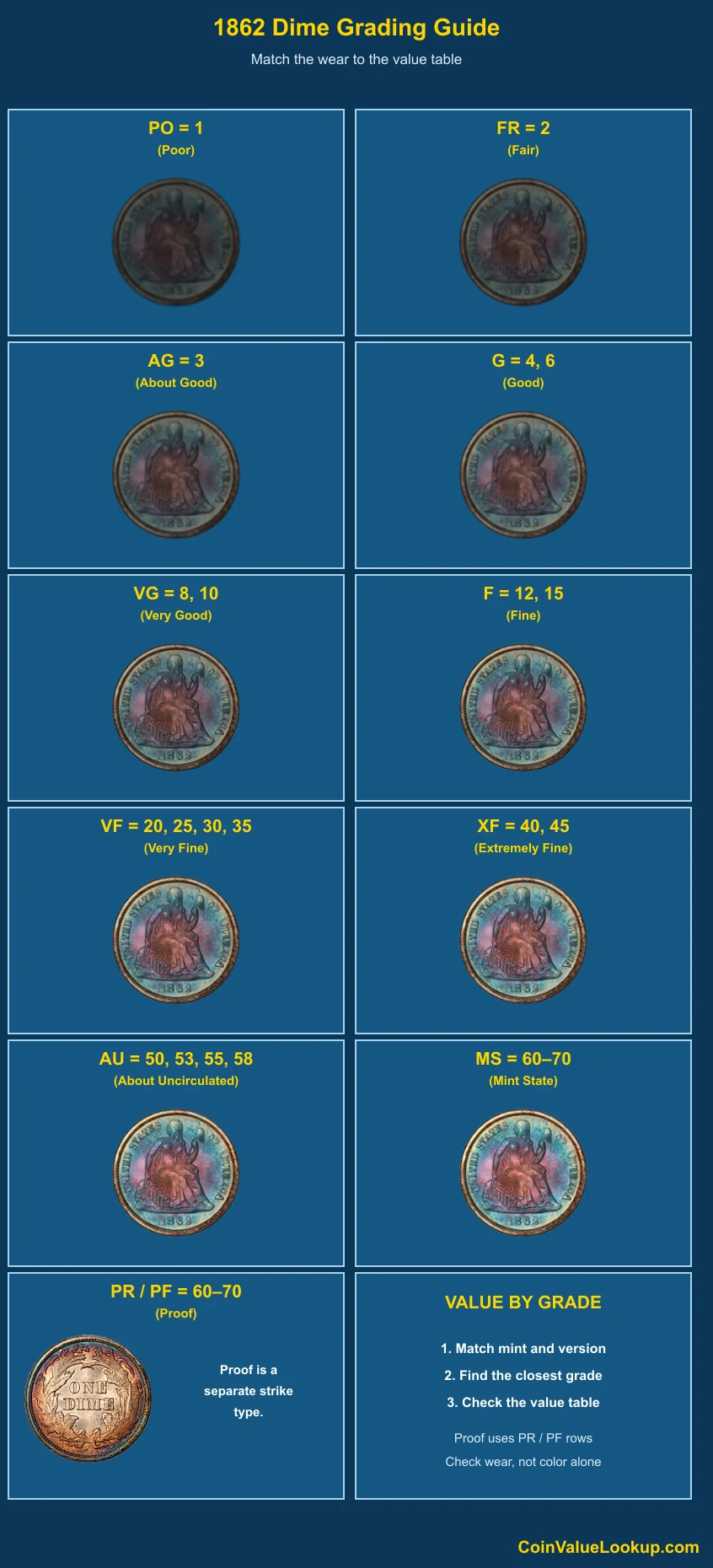
Use a grading image showing the same Legend Obverse subtype to compare your coin. The key wear points on the obverse are Liberty's head, the shield on her arm, and her gown folds near the knees and feet.
On the reverse, check the wreath leaves near the bow at the base.
A G4 coin will have a visible date and a mostly flat Liberty outline with little interior detail. Around VF, you should see partial gown lines and a clear shield.
At MS63, full original luster survives with only minor contact marks.
Separate actual circulation wear from strike weakness. Some 1862 dimes, especially San Francisco strikes, left the press with softer detail in spots.
That is not the same as a coin that spent decades in pockets.
Proof coins belong in their own grading lane. A polished or whizzed business strike is not a Proof, no matter how shiny it looks.
Genuine Proofs show squared rims and mirror-like fields created during manufacture, plus hairlines from handling rather than the rolling contact marks of circulation.
Step 3: Check 1862 Liberty Seated Dime Value by Mint and Version
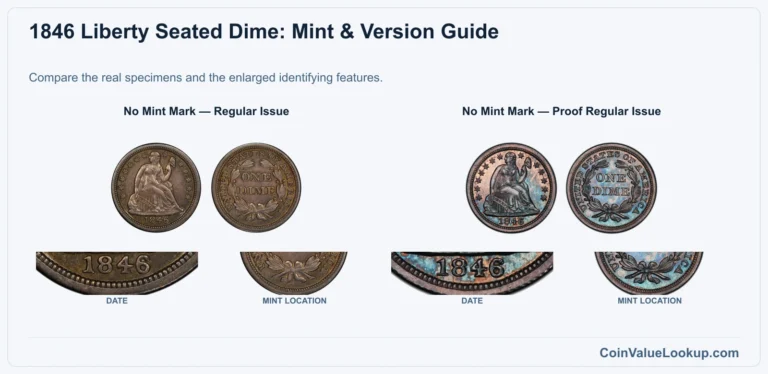
1862 Liberty Seated Dime — No Mint Mark — Regular Issue
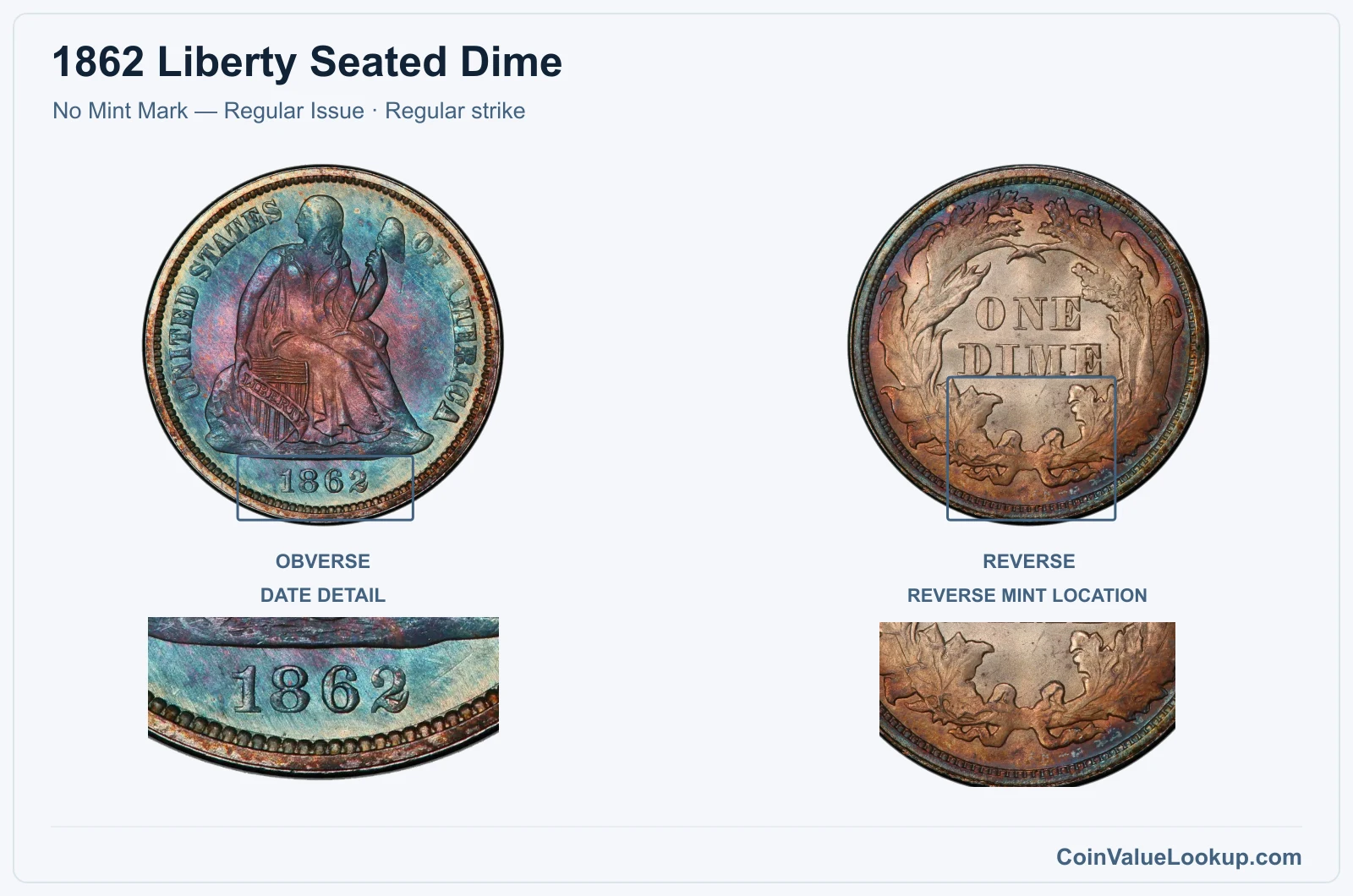
The Philadelphia business strike has no mintmark anywhere on the coin. It uses the Legend Obverse design with "UNITED STATES OF AMERICA" on the obverse and a large wreath on the reverse.
This is the more available issue for 1862.
USA Coin Book guide estimates place this coin at about $23 in G4 and around $441 in MS63. Condition matters enormously across that spread, so accurate grading is essential before assuming a value.
Check for original surfaces rather than cleaning, which can actually reduce what a collector will pay.
Range Grade
Price Auction Records Appraisal PO PO 1
—
Coin Identifier FR FR 2
—
Coin Identifier AG AG 3
Coin Identifier G G 4
—
Coin Identifier
G 6
—
Coin Identifier VG VG 8
—
Coin Identifier
VG 10
—
Coin Identifier F F 12
—
Coin Identifier
F 15
Coin Identifier VF VF 20
—
Coin Identifier
VF 25
—
Coin Identifier
VF 30
—
Coin Identifier
VF 35
—
Coin Identifier XF XF 40
—
Coin Identifier
XF 45
Coin Identifier AU AU 50
Coin Identifier
AU 53
—
Coin Identifier
AU 55
Coin Identifier
AU 58
Coin Identifier MS MS 60
Coin Identifier
MS 61
Coin Identifier
MS 62
Coin Identifier
MS 63
Coin Identifier
MS 64
Coin Identifier
MS 65
Coin Identifier
MS 66
Coin Identifier
MS 67
Coin Identifier
MS 68
—
—
—
MS 69
—
—
—
MS 70
—
—
—
1862 Liberty Seated Dime — S — Regular Issue
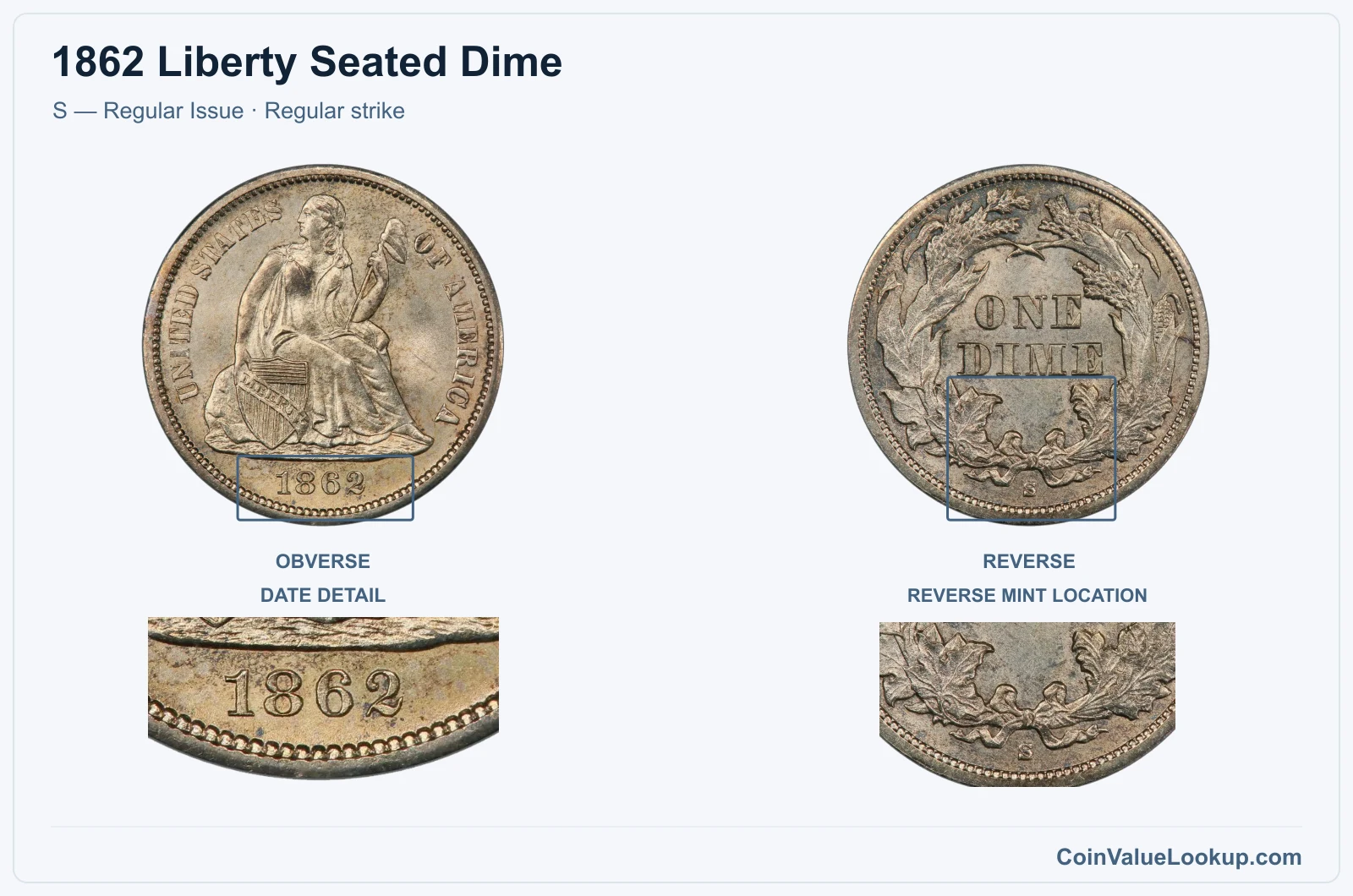
Look for a small "S" mintmark on the reverse beneath the wreath. The San Francisco issue shares the same Legend Obverse design, 90% silver composition, and 2.49-gram nominal weight as its Philadelphia counterpart, but it is considerably scarcer.
Guide estimates from USA Coin Book run about $210 at G4 and climb steeply to roughly $11,091 at MS63. That gap reflects how few survive in upper grades.
Original surfaces and honest wear are critical here. A cleaned or damaged example loses much of that premium.
If you think you have an uncirculated 1862-S dime, professional grading is worth considering given the value at stake.
Coin Value Lookup is a good starting point if you want to look up guides for other dates and mints in the Liberty Seated Dime series.
Range Grade
Price Auction Records Appraisal PO PO 1
—
Coin Identifier FR FR 2
—
Coin Identifier AG AG 3
—
Coin Identifier G G 4
Coin Identifier
G 6
Coin Identifier VG VG 8
—
Coin Identifier
VG 10
Coin Identifier F F 12
Coin Identifier
F 15
Coin Identifier VF VF 20
Coin Identifier
VF 25
Coin Identifier
VF 30
Coin Identifier
VF 35
Coin Identifier XF XF 40
Coin Identifier
XF 45
Coin Identifier AU AU 50
Coin Identifier
AU 53
—
Coin Identifier
AU 55
Coin Identifier
AU 58
Coin Identifier MS MS 60
—
Coin Identifier
MS 61
—
Coin Identifier
MS 62
—
Coin Identifier
MS 63
Coin Identifier
MS 64
—
Coin Identifier
MS 65
Coin Identifier
MS 66
—
—
—
MS 67
—
—
—
MS 68
—
—
—
MS 69
—
—
—
MS 70
—
—
—
1862 Liberty Seated Dime — No Mint Mark — Proof Regular Issue
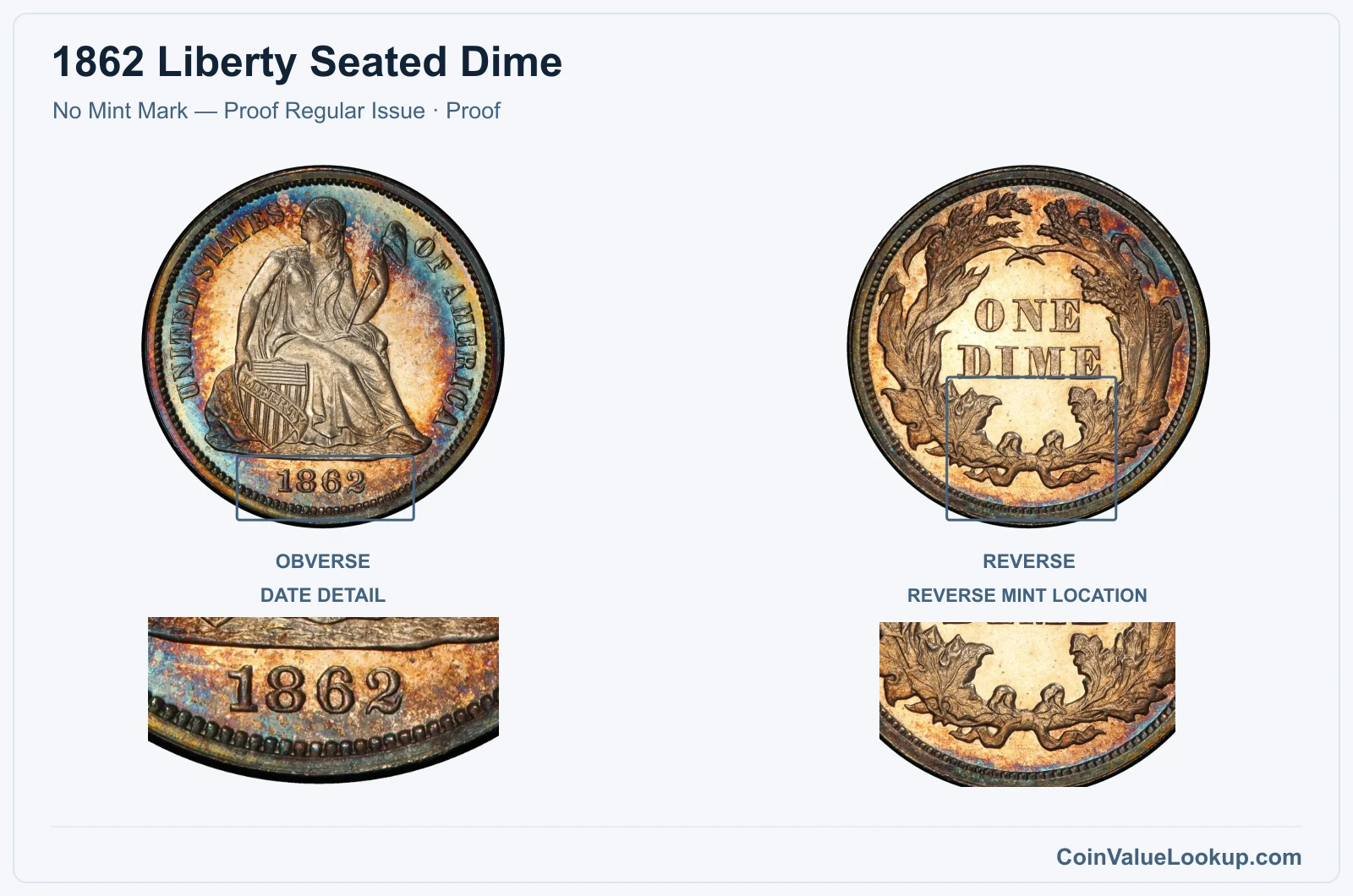
Philadelphia Proofs from 1862 are genuinely rare collector pieces, not the mass-produced annual sets of later eras. They were struck with polished dies on polished planchets, producing deeply mirrored fields and sharp design details.
A PCGS guide estimate places the PR63 grade at about $933. Do not confuse a polished or lightly circulated business strike for a Proof.
Real Proofs show squared-off rims and a distinctive liquid-mirror look in the fields that cleaning cannot replicate. Hairlines from handling are the typical surface issue on Proofs, quite different from the rolling luster breaks seen on circulated coins.
Range Grade
Price Auction Records Appraisal PR PR 1
—
Coin Identifier
PR 2
—
Coin Identifier
PR 3
—
Coin Identifier
PR 4
—
Coin Identifier
PR 6
—
Coin Identifier
PR 8
—
Coin Identifier
PR 10
—
Coin Identifier
PR 12
—
Coin Identifier
PR 15
—
Coin Identifier
PR 20
—
Coin Identifier
PR 25
—
Coin Identifier
PR 30
—
Coin Identifier
PR 35
—
Coin Identifier
PR 40
—
Coin Identifier
PR 45
—
Coin Identifier
PR 50
—
Coin Identifier
PR 53
—
Coin Identifier
PR 55
Coin Identifier
PR 58
—
Coin Identifier
PR 60
—
Coin Identifier
PR 61
Coin Identifier
PR 62
Coin Identifier
PR 63
Coin Identifier
PR 64
Coin Identifier
PR 65
Coin Identifier
PR 66
Coin Identifier
PR 67
—
—
—
PR 68
—
—
—
PR 69
—
—
—
PR 70
—
—
—
1862 Liberty Seated Dime Error List
1. 1862 Liberty Seated Dime — Repunched Date
Repunched date varieties on the 1862 dime show traces of an earlier position of one or more date numerals alongside the final placement. Under magnification, look for doubling or offset shadows specifically on the digits of "1862" near the base of the obverse.
This is a die variety created when the date punch was applied more than once in slightly different positions. It is not the same as a doubled die, which affects the entire design, nor is it simple damage.
Strike doubling (machine doubling) leaves flat, shelf-like marks rather than the distinct separated impressions of a true repunched date.
Condition, the clarity of the remnant punch, and collector demand for the specific variety all affect what a repunched-date 1862 dime might bring. No single price applies across all examples.
2. 1862 Liberty Seated Dime — Die Gouge / Named Raised-Line Variety
A die gouge variety shows a raised line or blob of extra metal on the coin's surface, caused by damage to the die itself. On the 1862 dime, these can appear in specific positions within the design and may carry collector nicknames tied to their location.
Because the defect is in the die, every coin struck from that die carries the same mark in the same spot. That repeatability is what separates a genuine die gouge from a random scratch or contact mark on an individual coin.
An incuse scratch cuts into the surface; a die gouge sits above it.
Value depends on the prominence of the feature, the coin's overall condition, and collector interest in that particular variety. There is no fixed premium that applies to every die-gouge example.
3. 1862 Liberty Seated Dime — Doubled Die Obverse
A doubled die obverse on the 1862 dime is visible as doubling in the "UNITED STATES OF AMERICA" lettering on the obverse. Compare the letter profiles under consistent magnification against a normal example.
True hub doubling produces a second, offset image with rounded contours matching the original design.
Machine doubling, which is far more common and far less valuable, looks different. It creates flat, shelf-like distortions rather than a distinct second image.
Worn die impressions and photographic reflections can also mimic doubling to the untrained eye.
The value of a doubled die obverse depends on how bold the doubling is, the coin's grade, and demand among variety collectors. No single price range covers all doubled die examples for this date.
4. 1862 Liberty Seated Dime — Rotated Dies
The 1862-S dime has been documented with a die rotation of approximately 35 degrees to the right. To check for this, hold the obverse upright and flip the coin top to bottom along a vertical axis.
On a normally aligned U.S. coin, the reverse should also appear upright. A rotated die will show the reverse tilted noticeably.
Make sure you are flipping the coin correctly, not turning it sideways like a page. A photograph taken at an angle can also create a false impression of rotation.
Confirm with the actual coin in hand.
This variety is specific to the San Francisco mint issue. The degree of rotation, the coin's condition, and collector interest all factor into any premium.
Because no adopted price is available, individual assessment is the way to gauge what a particular example might bring.