1912 Barber Dime Coin Value: How Much Is It Worth?
The 1912 Barber Dime was struck at three mints in 90% silver, and guide estimates for ordinary business strikes run from about $10.42 in G4 to $410 in MS63, depending on the mint. Philadelphia proof coins carry their own premium.
Condition, mintmark, and any genuine striking errors all matter when sorting out what a particular coin is worth.
Fast Way to Identify Your 1912 Barber Dime
The quickest way to start is to snap a clear photo of both sides of your coin and upload them here. Our identifier can give you a preliminary read on the mint, general condition, and whether anything unusual jumps out.
Good lighting and a steady hand help — prop the coin on a dark cloth and shoot straight down.
1912 Barber Dime Value
Upload both sides of your 1912 Barber Dime.
Front Obverse
Upload photo
Back Reverse
Upload photo
Which 1912 Barber Dime Versions Are Worth Money?
- The San Francisco (S) mint issue carries the highest guide estimate among business strikes, listed at about $15 in G4 and $410 in MS63 — worth checking your mintmark.
- Philadelphia proof coins are listed around $616 at PR63, a distinct premium over any business-strike grade in the guide.
- Genuine error coins such as doubled die obverse or repunched mintmark examples can carry additional value depending on visibility and condition — see the error section below.
Step 1: Identify Your 1912 Barber Dime Mint Mark and Version
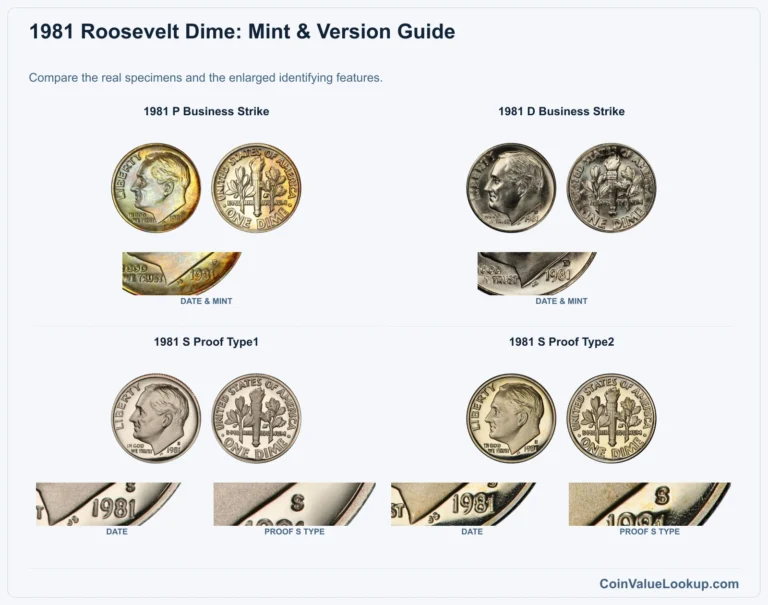
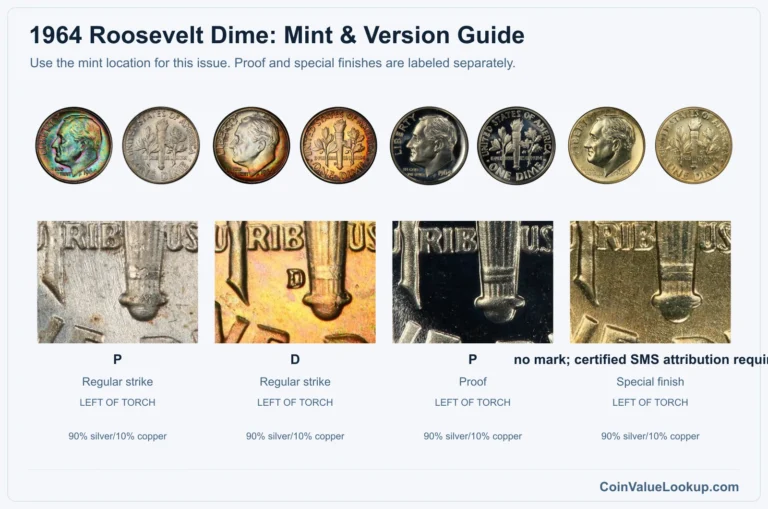
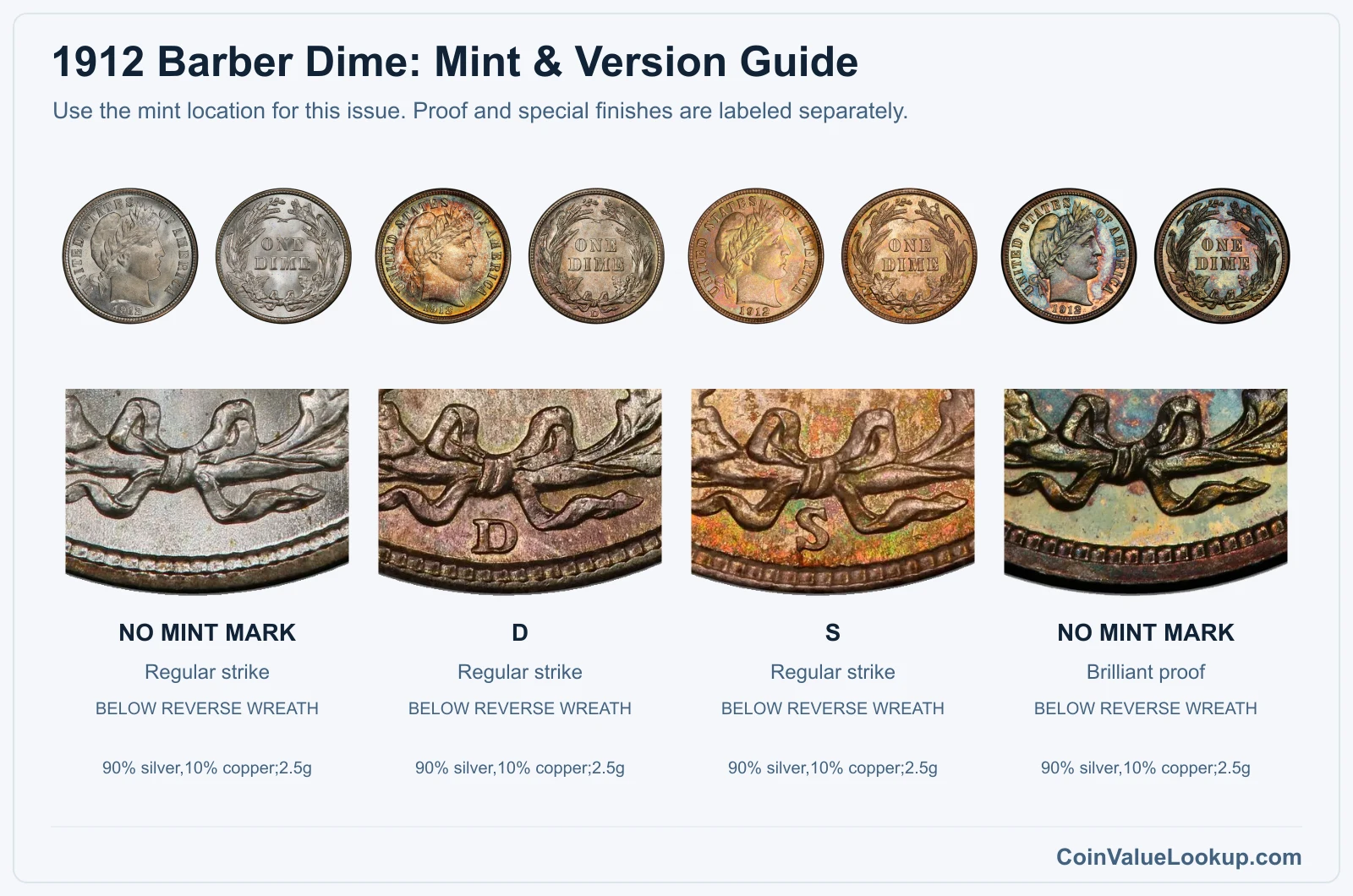
The 1912 Barber Dime shows Charles Barber's right-facing Liberty head on the obverse, wearing a cap and laurel wreath. The reverse reads ONE DIME inside a cereal wreath tied with a bow at the bottom.
If your coin has wings on the head, that is a Mercury Dime, not a Barber.
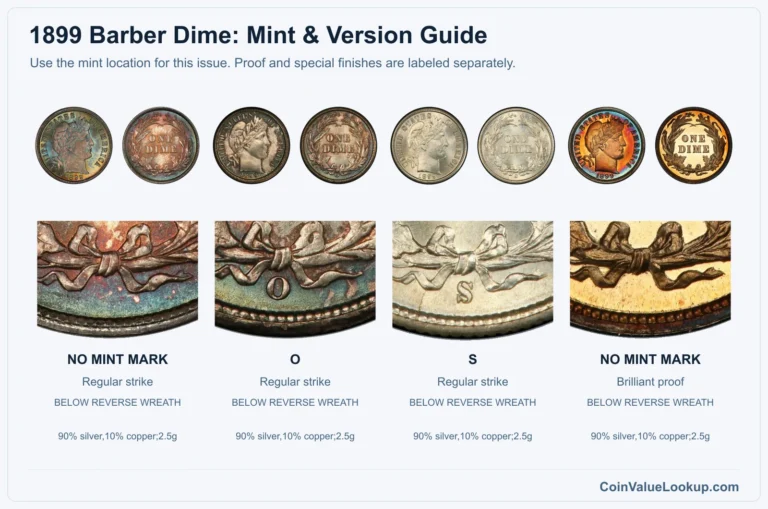
Three mints produced business strikes: Philadelphia, Denver, and San Francisco. Philadelphia also made proof coins.
The mintmark — D or S — sits on the reverse just below the wreath bow. No mintmark means Philadelphia.
All regular 1912 dimes are 90% silver and 10% copper, weigh 2.5 grams, measure 17.9 mm across, and have a reeded edge. If the edge is smooth or the weight is way off, you may have a counterfeit or a different denomination entirely.
Step 2: Check Your 1912 Barber Dime Grade
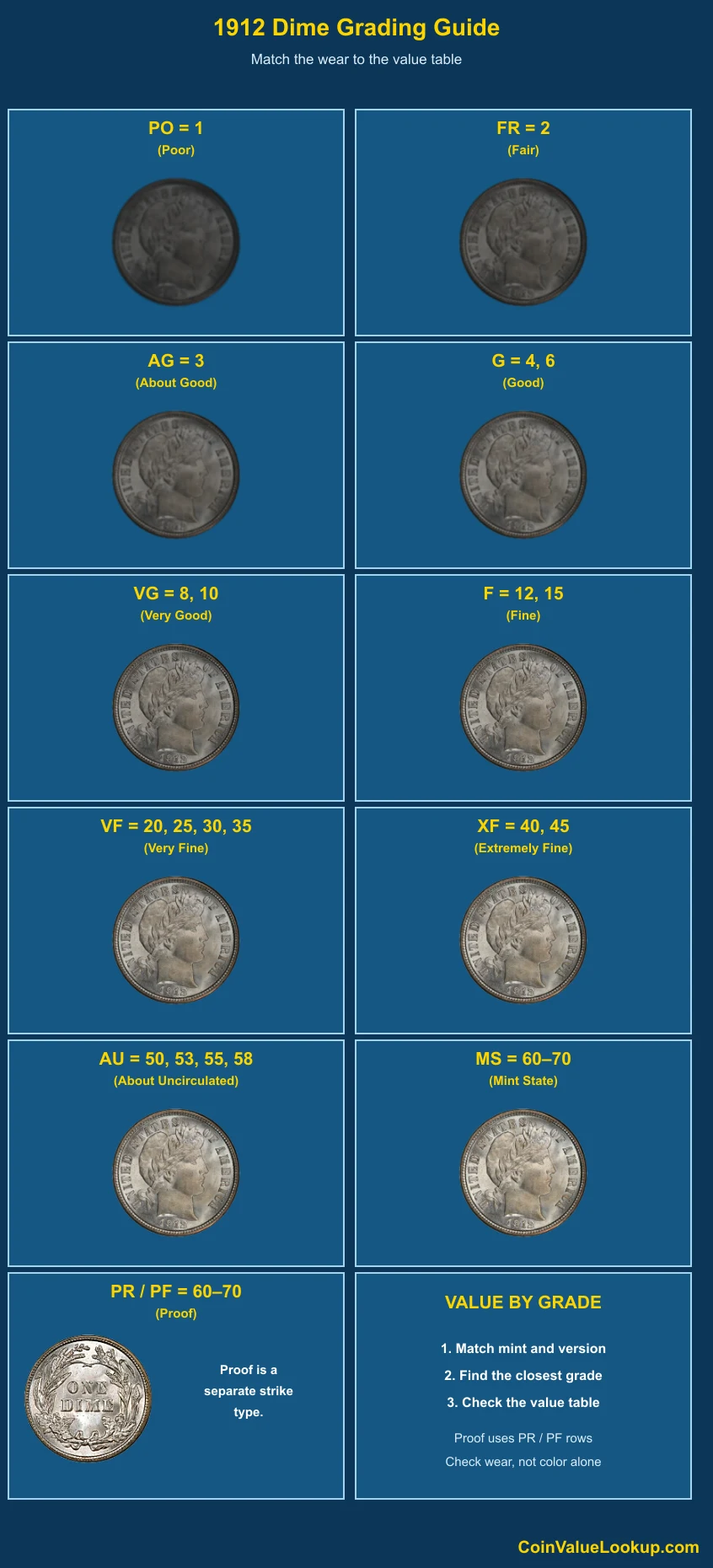
Start with the word LIBERTY on the headband. On a well-worn coin, some or all letters will be faint or gone.
But do not grade by letter count alone — look at the overall hair detail, the cheek, and the wreath leaves together.
A coin grading around G4 will show a clear outline and date but little interior detail. By VF the headband letters are complete, and you can see individual hair strands near the ear.
Mint State means unbroken luster across the entire surface with no wear on the high points.
Compare your coin side-by-side with the grading image. Check for hairlines from old cleaning, which can make a coin look shiny but actually lower the grade.
Proof is a way the coin was manufactured — with polished dies and planchets — not simply a grade above Mint State.
Soft strikes exist, especially on certain mint issues from this era, so a flat area is not always wear. Tilt the coin under a single light source and watch for luster breaks on the cheek and hair above the ear — those are the first places real circulation wear shows up.
Step 3: Check 1912 Barber Dime Value by Mint and Version
1912 Barber Dime — No Mint Mark — Silver Circulation
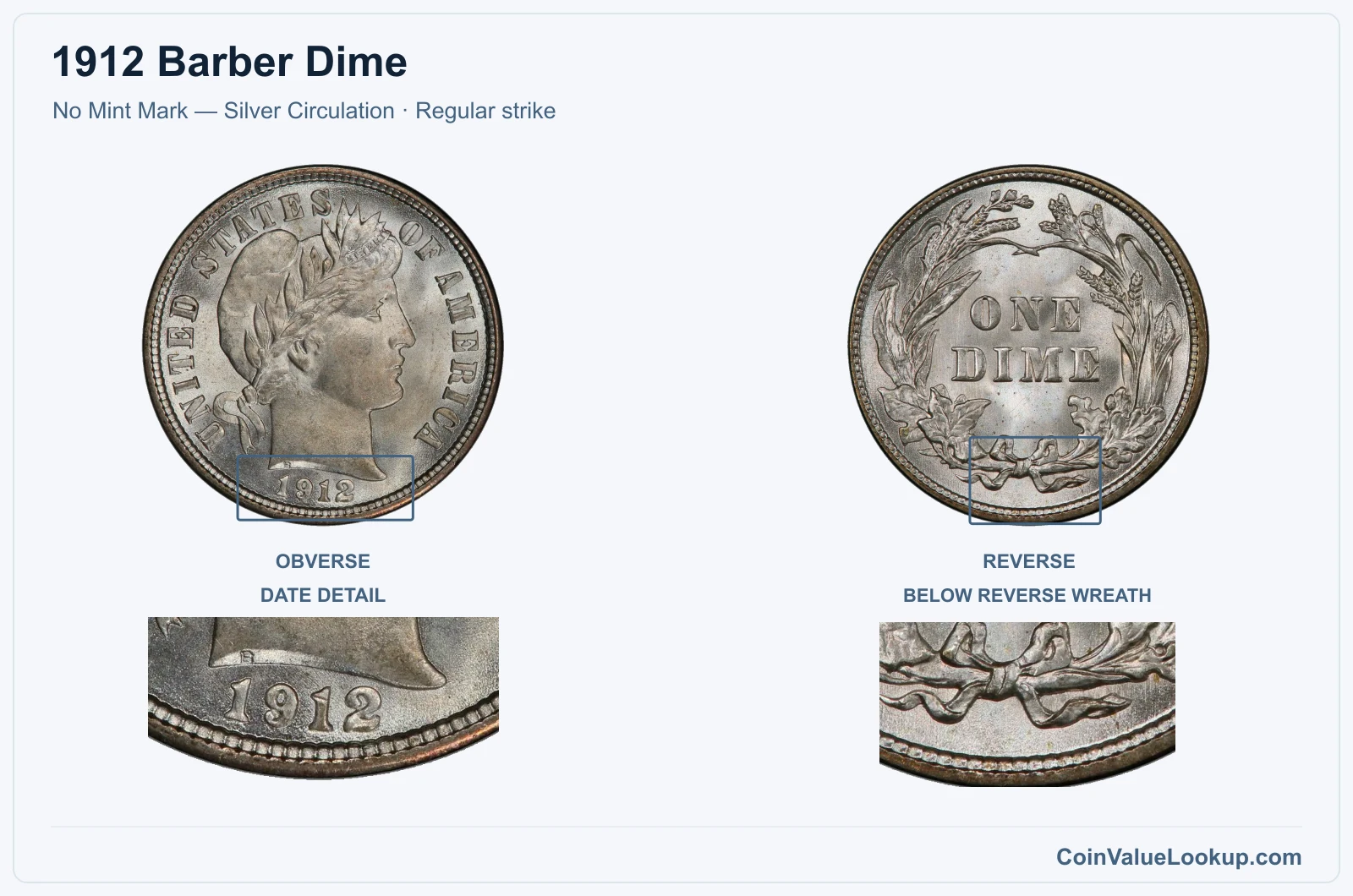
The Philadelphia issue has no mintmark. Look below the wreath bow on the reverse — if the space is empty, you have the P-mint coin.
Guide estimates place this version at roughly $10.42 in G4 and $253 in MS63.
Philadelphia generally produced well-struck coins for this date. Even so, check both sides for full detail before assuming a high grade.
Cleaned or damaged pieces trade well below guide figures regardless of the date.
Range Grade
Price Auction Records Appraisal PO PO 1
—
Coin Identifier FR FR 2
—
Coin Identifier AG AG 3
—
Coin Identifier G G 4
Coin Identifier
G 6
—
Coin Identifier VG VG 8
—
Coin Identifier
VG 10
—
Coin Identifier F F 12
—
Coin Identifier
F 15
—
Coin Identifier VF VF 20
—
Coin Identifier
VF 25
—
Coin Identifier
VF 30
—
Coin Identifier
VF 35
—
Coin Identifier XF XF 40
—
Coin Identifier
XF 45
Coin Identifier AU AU 50
Coin Identifier
AU 53
Coin Identifier
AU 55
Coin Identifier
AU 58
Coin Identifier MS MS 60
Coin Identifier
MS 61
Coin Identifier
MS 62
Coin Identifier
MS 63
Coin Identifier
MS 64
Coin Identifier
MS 65
Coin Identifier
MS 66
Coin Identifier
MS 67
Coin Identifier
MS 68
—
—
—
MS 69
—
—
—
MS 70
—
—
—
1912 Barber Dime — D — Silver Circulation
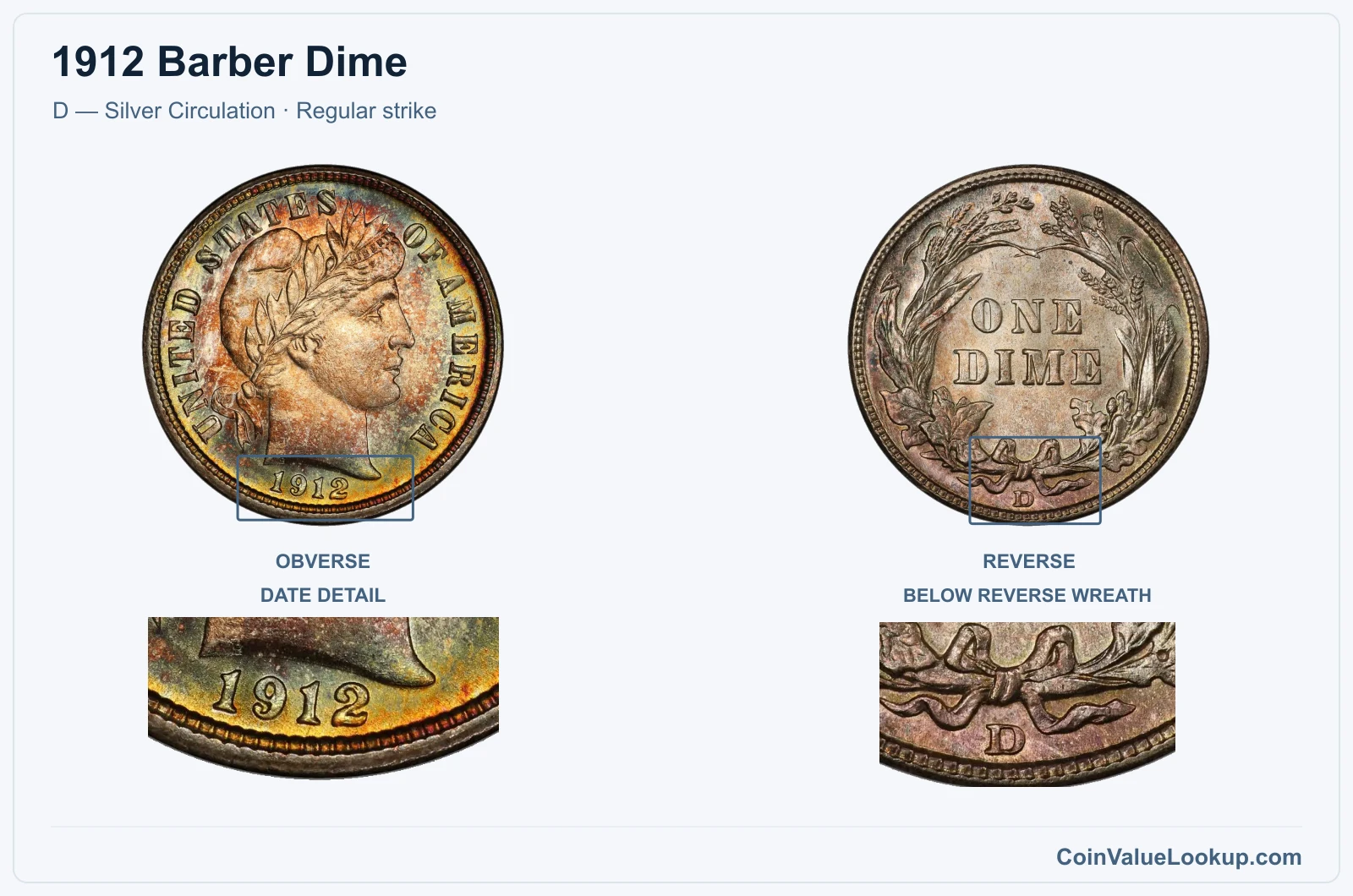
Denver coins carry a small D below the wreath bow on the reverse. Guide estimates are about $10.42 in G4 and $253 in MS63, matching the Philadelphia business strike at those benchmarks.
The D mintmark should be clearly punched and centered. While examining the mintmark, look closely for any signs of a repunched mintmark — traces of a second impression can indicate a collectible variety worth investigating further.
Range Grade
Price Auction Records Appraisal PO PO 1
—
Coin Identifier FR FR 2
—
Coin Identifier AG AG 3
—
Coin Identifier G G 4
—
Coin Identifier
G 6
—
Coin Identifier VG VG 8
—
Coin Identifier
VG 10
—
Coin Identifier F F 12
—
Coin Identifier
F 15
—
Coin Identifier VF VF 20
—
Coin Identifier
VF 25
—
Coin Identifier
VF 30
—
Coin Identifier
VF 35
—
Coin Identifier XF XF 40
Coin Identifier
XF 45
—
Coin Identifier AU AU 50
Coin Identifier
AU 53
Coin Identifier
AU 55
Coin Identifier
AU 58
Coin Identifier MS MS 60
Coin Identifier
MS 61
Coin Identifier
MS 62
Coin Identifier
MS 63
Coin Identifier
MS 64
Coin Identifier
MS 65
Coin Identifier
MS 66
Coin Identifier
MS 67
Coin Identifier
MS 68
—
—
—
MS 69
—
—
—
MS 70
—
—
—
1912 Barber Dime — S — Silver Circulation
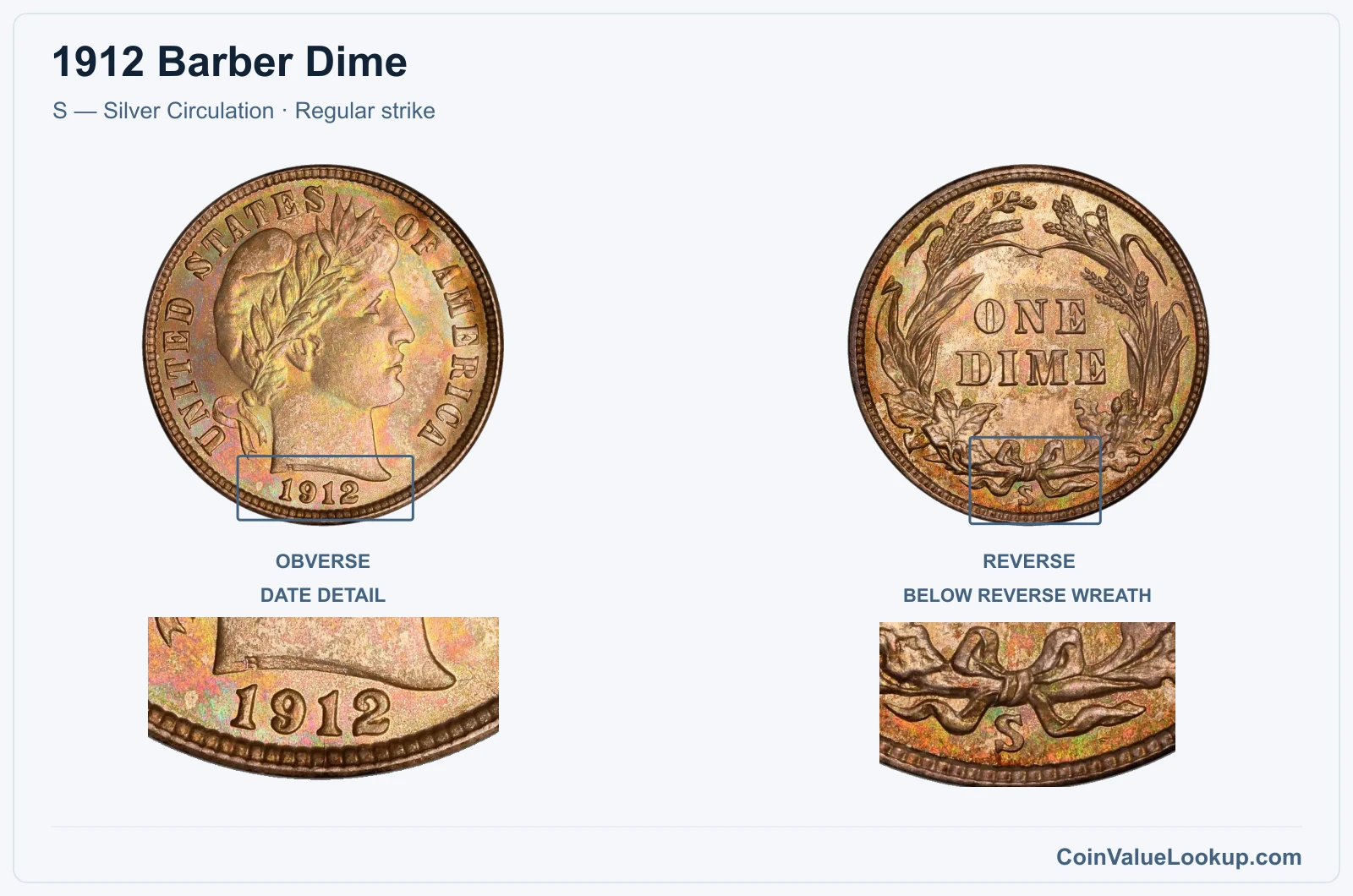
San Francisco dimes display an S mintmark below the reverse wreath bow. This mint's 1912 issue carries the highest business-strike guide values listed here: about $15 in G4 and $410 in MS63.
That gap above the Philadelphia and Denver figures means the S-mint coin is the one to look for if you are sorting a group of Barber Dimes by date. Confirm the mintmark under magnification — a worn S can sometimes look like a blob.
Original, uncleaned surfaces help preserve full value at any grade level.
Coin Value Lookup is a handy starting point if you want to check guide values for other dates or denominations in the Barber series.
Range Grade
Price Auction Records Appraisal PO PO 1
—
Coin Identifier FR FR 2
—
Coin Identifier AG AG 3
—
Coin Identifier G G 4
—
Coin Identifier
G 6
—
Coin Identifier VG VG 8
—
Coin Identifier
VG 10
—
Coin Identifier F F 12
—
Coin Identifier
F 15
—
Coin Identifier VF VF 20
—
Coin Identifier
VF 25
—
Coin Identifier
VF 30
—
Coin Identifier
VF 35
Coin Identifier XF XF 40
Coin Identifier
XF 45
Coin Identifier AU AU 50
Coin Identifier
AU 53
—
Coin Identifier
AU 55
Coin Identifier
AU 58
Coin Identifier MS MS 60
Coin Identifier
MS 61
Coin Identifier
MS 62
Coin Identifier
MS 63
Coin Identifier
MS 64
Coin Identifier
MS 65
Coin Identifier
MS 66
Coin Identifier
MS 67
Coin Identifier
MS 68
—
—
—
MS 69
—
—
—
MS 70
—
—
—
1912 Barber Dime — No Mint Mark — Brilliant Silver Proof
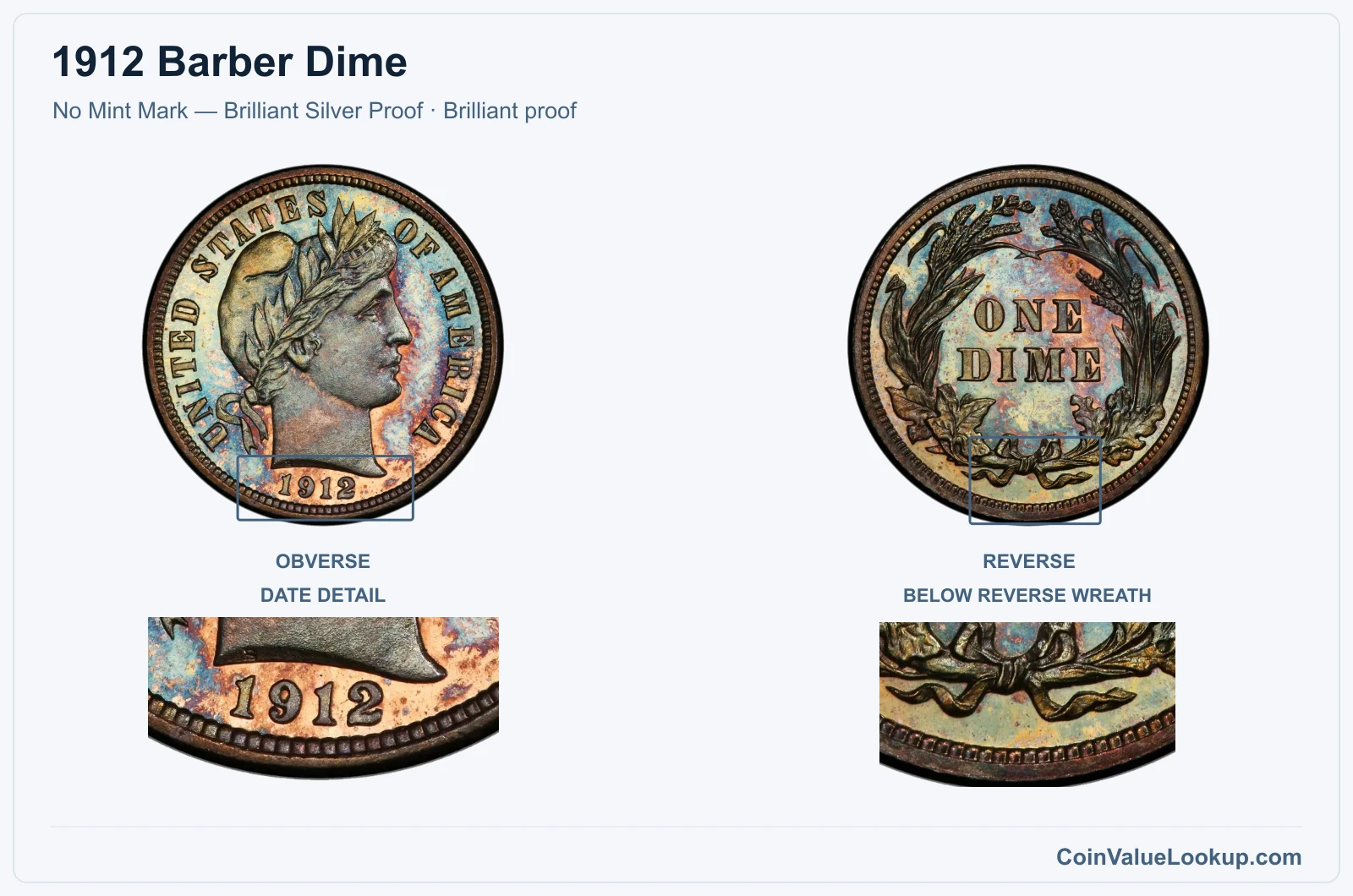
Philadelphia struck proof Barber Dimes for collectors, and the 1912 proof is listed at about $616 in PR63. These coins have mirrored fields and sharply defined rims that are visually distinct from even the best business strikes.
Do not confuse a well-preserved business strike with a proof. True proofs show deeply reflective surfaces and razor-sharp detail on the denticles and letters.
Cameo and Deep Cameo designations describe the contrast between frosted devices and mirror fields; they are not interchangeable with a plain PR63 price. If your coin shows strong contrast, it falls into a different category that this guide estimate does not cover.
Range Grade
Price Auction Records Appraisal PR PR 1
—
Coin Identifier
PR 2
—
Coin Identifier
PR 3
—
Coin Identifier
PR 4
—
Coin Identifier
PR 6
—
Coin Identifier
PR 8
—
Coin Identifier
PR 10
—
Coin Identifier
PR 12
—
Coin Identifier
PR 15
—
Coin Identifier
PR 20
—
Coin Identifier
PR 25
—
Coin Identifier
PR 30
—
Coin Identifier
PR 35
—
Coin Identifier
PR 40
—
Coin Identifier
PR 45
—
Coin Identifier
PR 50
—
Coin Identifier
PR 53
—
Coin Identifier
PR 55
Coin Identifier
PR 58
—
Coin Identifier
PR 60
Coin Identifier
PR 61
Coin Identifier
PR 62
Coin Identifier
PR 63
Coin Identifier
PR 64
Coin Identifier
PR 65
Coin Identifier
PR 66
Coin Identifier
PR 67
Coin Identifier
PR 68
Coin Identifier
PR 69
—
—
—
PR 70
—
—
—
1912 Barber Dime Error List
1. 1912 Barber Dime — Doubled Die Obverse
A doubled die obverse on a 1912 Barber Dime shows consistent doubling on obverse design elements — letters, the date, or parts of Liberty's profile. Under magnification, look for separation or notching that appears in the same direction on multiple features.
That consistency is the key.
Machine doubling is the most common lookalike. It tends to produce a flat, shelf-like appearance on one side of the letter rather than true notching with distinct serifs.
Reflections and worn die lines can also fool you under certain lighting.
No specific price data is available here for this variety. Value depends heavily on which elements are doubled, how visible the doubling is to the naked eye, and the coin's overall condition.
A strong, eye-visible doubled die will always command more attention than one needing 10x magnification to confirm.
2. 1912 Barber Dime — Off-Center Strike
An off-center strike happens when the planchet is not properly seated between the dies at the moment of striking. On a 1912 Barber Dime, this produces a crescent-shaped blank area on one side and a shifted design on the other.
The date must remain visible for the coin to be attributable — and attributable coins are the ones collectors want. A 5% off-center coin barely catches the eye, while 10–20% or more with a full date is considerably more desirable.
Watch out for lookalikes. A clipped planchet removes metal before striking, not during.
Post-mint damage — like a coin smashed in a vise — can flatten one side but will not leave a proper unstruck crescent. No specific pricing is supplied for this error; value depends on the degree of misalignment and the coin's overall condition.
3. 1912 Barber Dime — Broadstrike
A broadstrike occurs when the collar die — the ring that normally confines the planchet during striking — is missing or fails to engage. The result is a 1912 Barber Dime that spreads outward, appearing slightly larger than normal with a distorted or absent reeded edge.
The full design should still be present, just expanded. If significant design is missing, you may be looking at an off-center strike instead.
Post-mint flattening from machinery or deliberate squashing can mimic the spread, but it will not show the same edge profile or metal flow pattern.
No numerical price data is available for this error on the 1912 Dime. Condition, the degree of spread, and whether the coin retains sharp detail all influence what a collector would pay.
4. 1912 Barber Dime — Clipped Planchet
A clipped planchet means part of the blank was missing before the coin was struck. On a 1912 Barber Dime, you will see a curved, straight, or irregular bite out of the edge where metal simply is not there.
The design near the clip is often weak, and there may be a corresponding area of weakness on the opposite side — a useful diagnostic called the Blakesley effect.
Check the edge texture carefully. A genuine clip shows natural metal flow at the boundary, not file marks or a sharp cut.
Corrosion eating into the rim can also mimic a clip but will leave pitting and rough texture rather than a smooth missing section.
Pricing depends on the size and type of clip and the coin's overall preservation. No specific value is listed here for this error.
5. 1912 Barber Dime — Lamination / Split Planchet
A lamination or split planchet error on a 1912 Barber Dime appears as peeling metal, a retained flap, or an actual separation within the coin's alloy. These happen when impurities or gas pockets in the original metal cause layers to separate during or after striking.
Photograph the edge alongside the affected face — that edge view is often the clearest evidence of a genuine split versus surface damage. Scraping from a tool, active corrosion, or a deliberately shaved coin can all look similar at first glance, but none will show the natural internal separation pattern of a true lamination.
No price data is supplied for this error. Value varies with the size of the affected area and whether the flap or layer is still attached.
A dramatic, clearly original lamination on a well-dated coin draws more interest than a tiny peel.
6. 1912 Barber Dime — Repunched Mintmark
A repunched mintmark on a 1912 Barber Dime means the mintmark punch was applied more than once in slightly different positions. You will see traces of the earlier impression — a ghost outline, a notch, or partial doubling around the D or S below the wreath bow.
Compare your mintmark at matching magnification to a known normal example. The remnant should be consistent and positional, not random.
Machine doubling can affect the mintmark area too, but it leaves flat, shelf-like distortion rather than a clearly offset second impression. Die chips or corrosion around the mintmark can also create confusing lumps that mimic a repunch.
No specific price is available here for this variety. The clarity and direction of the repunch, along with the coin's condition, drive collector interest.
A bold, easily visible repunch is worth far more attention than a subtle one.