1912 Barber Quarter Coin Value: How Much Is It Worth?
The 1912 Barber quarter is a 90% silver coin struck across two mints plus a proof issue at Philadelphia. Guide estimates for this year range from $21.00 to $1,136.00 depending on the specific mint, finish and grade.
That spread is not one price for every coin — your particular quarter's place in that range depends on its mintmark, whether it is a proof, and how much wear it has.
Fast Way to Identify Your 1912 Barber Quarter
If you want a quick starting point, snap clear photos of the front and back of your 1912 quarter and upload them to our identification tool. It can provide a preliminary identification of your coin's version and mintmark based on the images.
This is not a certified authentication or exact grade assignment, but it helps you figure out which branch of the guide to consult.
1912 Barber Quarter Value
Upload both sides of your 1912 Barber Quarter.
Front Obverse
Upload photo
Back Reverse
Upload photo
Which 1912 Barber Quarter Versions Are Worth Money?
- 1912-S quarters carry the highest guide estimates in this group, listed at $1,136.00 in MS63 condition, making the S mintmark the first thing to check.
- 1912 proof issues (1912 PR) are listed at $799.00 in PR63 — look for mirror-like fields and sharp rims that distinguish proof manufacture from a regular strike.
- Philadelphia business strikes (1912, no mintmark) reach $477.00 at MS63 in the guide, rewarding coins with strong original luster and minimal contact marks.
- Confirm mint and finish before assuming value; a cleaned or damaged coin does not qualify for these guide-level estimates regardless of its date.
Step 1: Identify Your 1912 Barber Quarter Mint Mark and Version
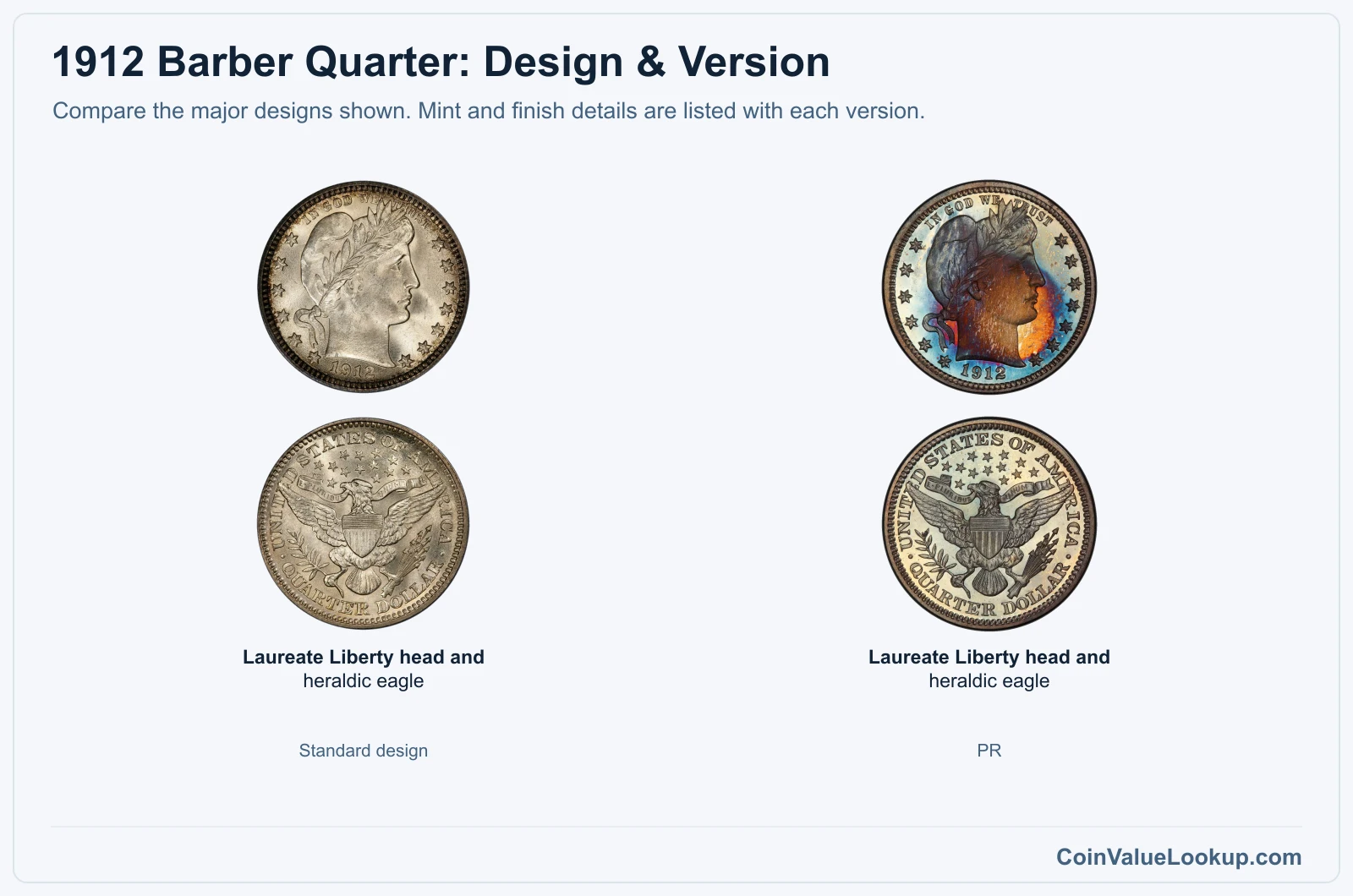
The 1912 Barber quarter shows a laureate Liberty head on the obverse and a heraldic eagle on the reverse. All versions share the same 90% silver, 10% copper composition at 6.25 grams.
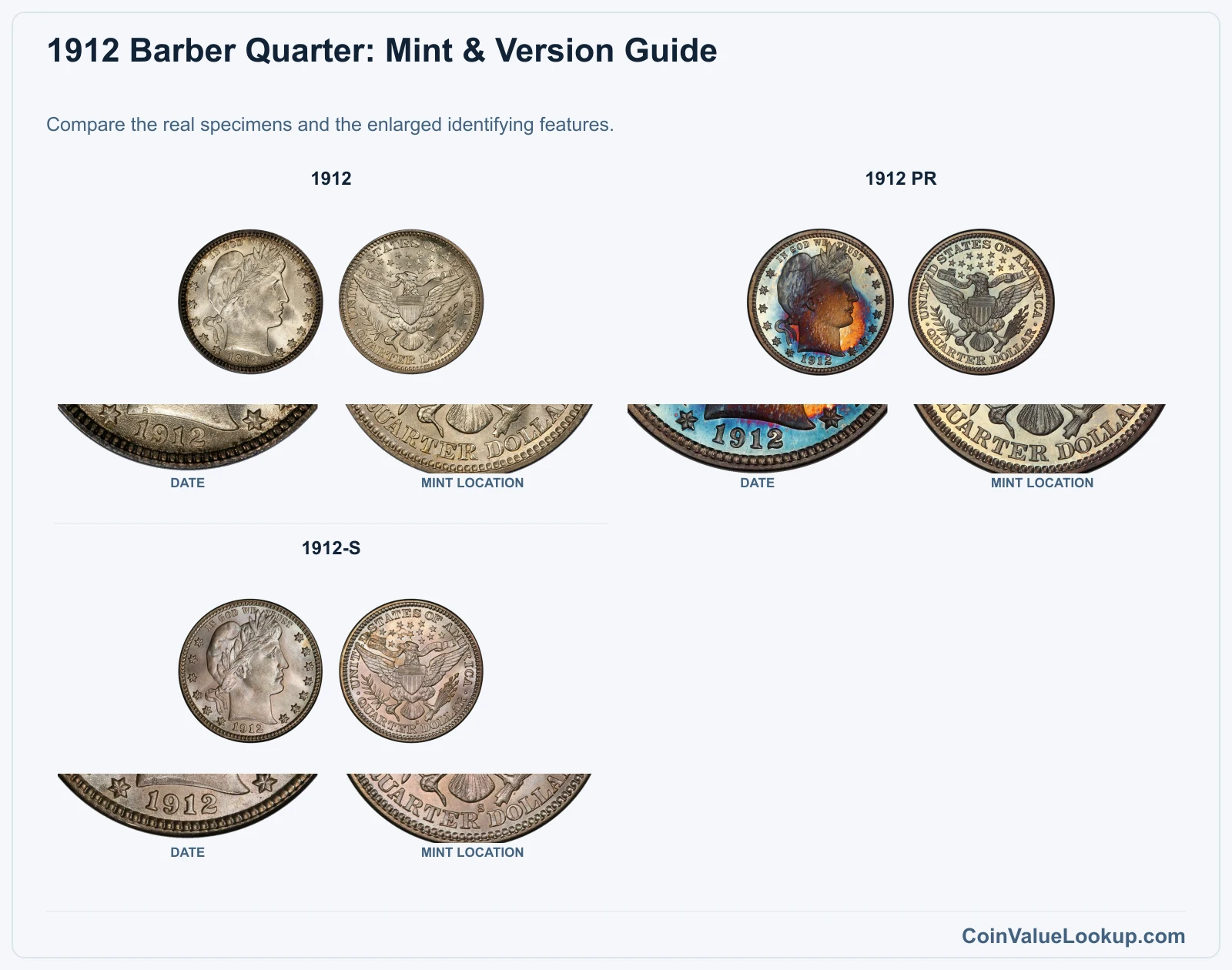
To figure out which version you have, flip the coin over. Look below the eagle's tail feathers and above the denomination.
No letter means Philadelphia. An "S" means San Francisco.
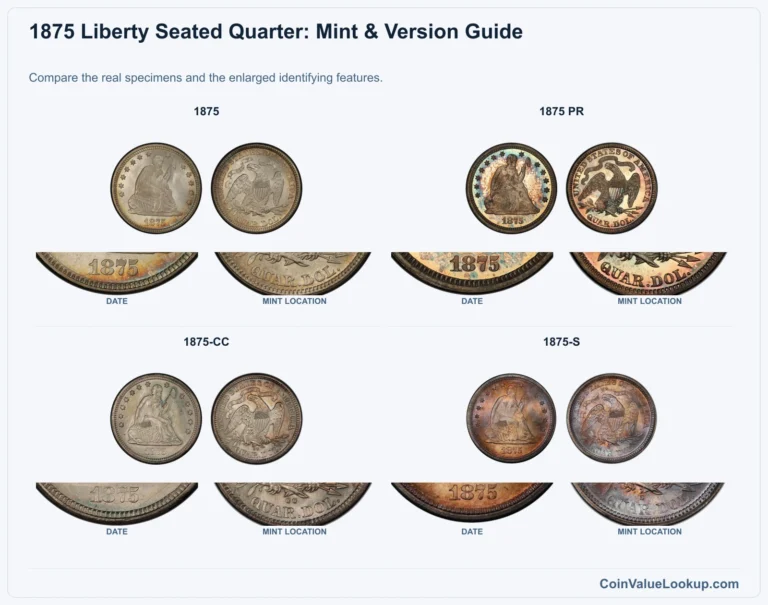
Philadelphia struck both regular business strikes and proofs in 1912, so the absence of a mintmark alone does not tell the whole story. A proof has a distinctly different surface quality from a business strike — sharper rims, mirror-like fields, and squared-off edge details from the proof manufacturing process.
Do not assume a shiny coin is a proof; cleaned business strikes can look deceptively reflective.
Your three possible branches are: 1912 (Philadelphia business strike), 1912 PR (Philadelphia proof), and 1912-S (San Francisco business strike). No Denver-mint quarters were produced this year.
Step 2: Check Your 1912 Barber Quarter Grade
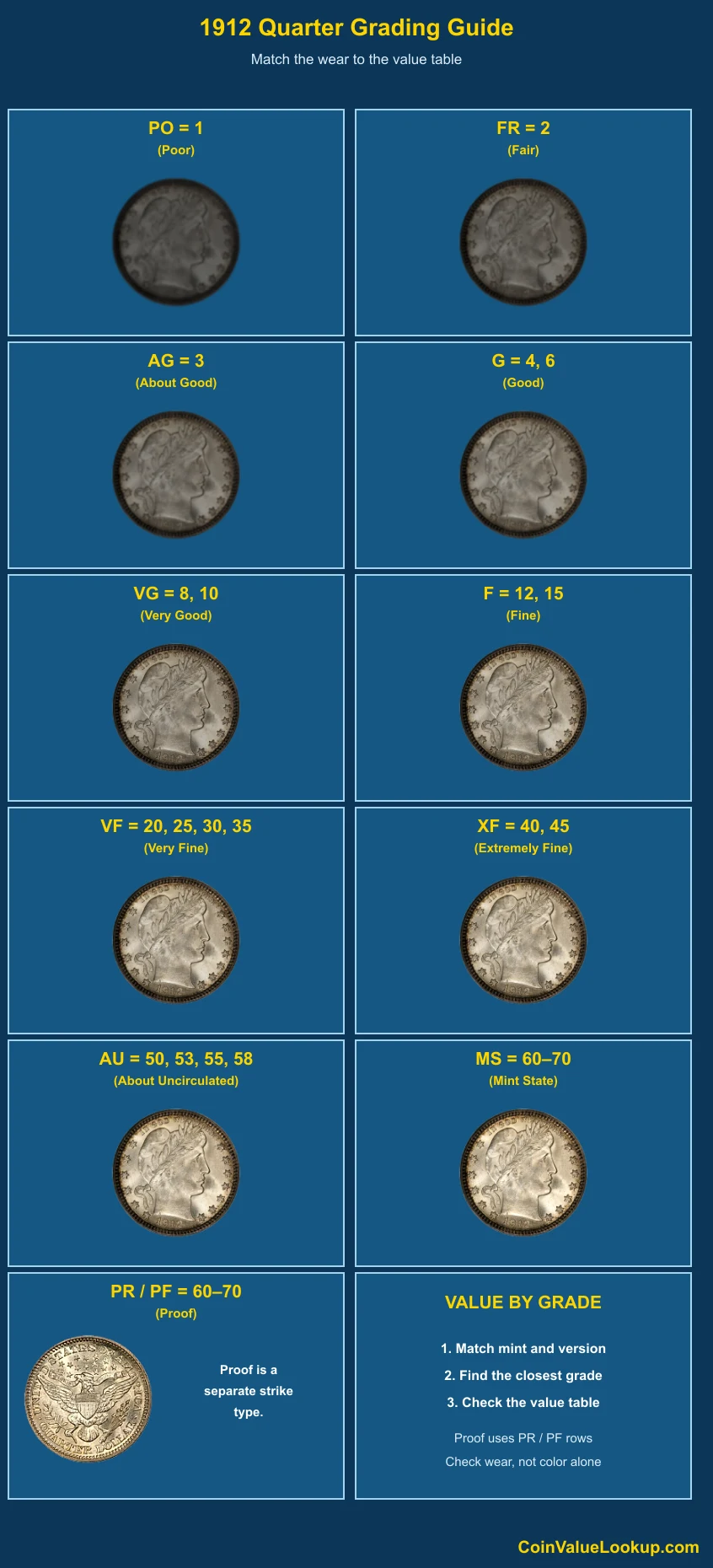
Start with Liberty's hair above the forehead. On a lightly worn coin the individual strands there begin to merge first.
The cheek flattens next, then the wreath leaves lose their vein detail.
On the reverse, check the eagle's breast feathers, wing tops and tail. These high points wear in roughly the same sequence as the obverse.
The word LIBERTY on the headband is a well-known wear indicator, but do not use it alone. A coin can retain partial LIBERTY letters while showing heavy smoothing elsewhere, which means the letters survived by luck of the strike, not by preservation.
Compare wear and luster together using the reference comparison image. A weakly struck coin can look worn even in uncirculated condition because the die did not fully impress the design.
Conversely, a coin with artificial luster from cleaning may appear bright but will show unnatural surfaces under magnification.
Hairlines from cleaning, rim dings and environmental damage all reduce a coin's desirability regardless of how much original detail remains.
Step 3: Check 1912 Barber Quarter Value by Mint and Version
1912 Barber Quarter
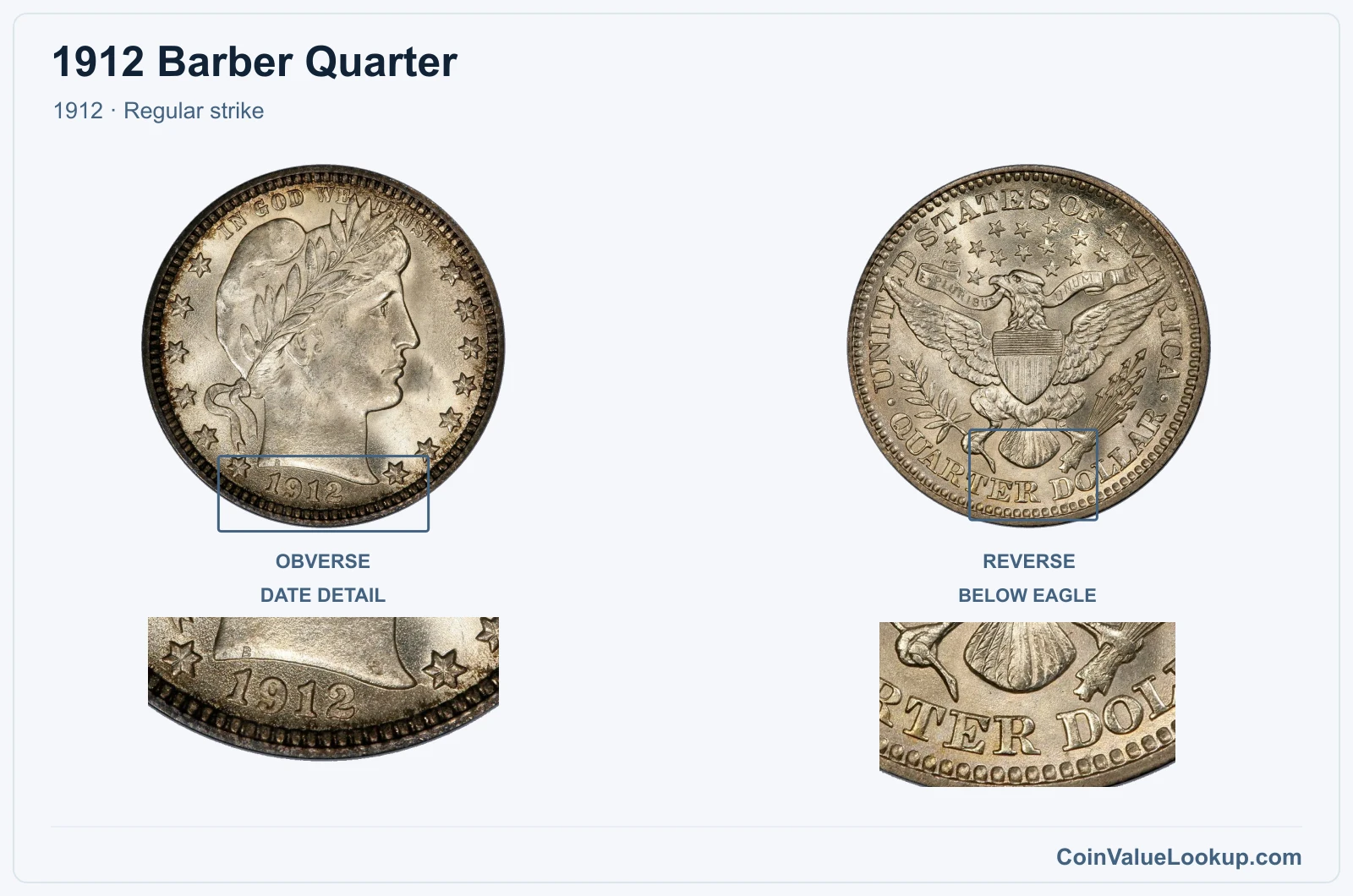
The 1912 Philadelphia business strike has no mintmark. You will find a blank space below the eagle's tail on the reverse.
In well-worn Good-4 condition, USA Coin Book lists this version at about $21.00. At the uncirculated MS60 level the estimate jumps to $309.00, and a choice MS63 example reaches $477.00.
These are guide estimates, not guaranteed sale prices.
Original surfaces matter here. A coin with natural grey or golden toning and no signs of cleaning will compare more favorably than one that has been polished to look shiny.
Match the mint, design and version before comparing grade — this is a Philadelphia coin only if there is no mintmark on the reverse.
Range Grade
Price Auction Records Appraisal PO PO 1
—
Coin Identifier FR FR 2
—
Coin Identifier AG AG 3
—
Coin Identifier G G 4
—
Coin Identifier
G 6
—
Coin Identifier VG VG 8
—
Coin Identifier
VG 10
—
Coin Identifier F F 12
—
Coin Identifier
F 15
—
Coin Identifier VF VF 20
—
Coin Identifier
VF 25
—
Coin Identifier
VF 30
Coin Identifier
VF 35
Coin Identifier XF XF 40
Coin Identifier
XF 45
Coin Identifier AU AU 50
Coin Identifier
AU 53
Coin Identifier
AU 55
Coin Identifier
AU 58
Coin Identifier MS MS 60
Coin Identifier
MS 61
Coin Identifier
MS 62
Coin Identifier
MS 63
Coin Identifier
MS 64
Coin Identifier
MS 65
Coin Identifier
MS 66
Coin Identifier
MS 67
Coin Identifier
MS 68
—
—
—
MS 69
—
—
—
MS 70
—
—
—
1912 Barber Quarter — PR
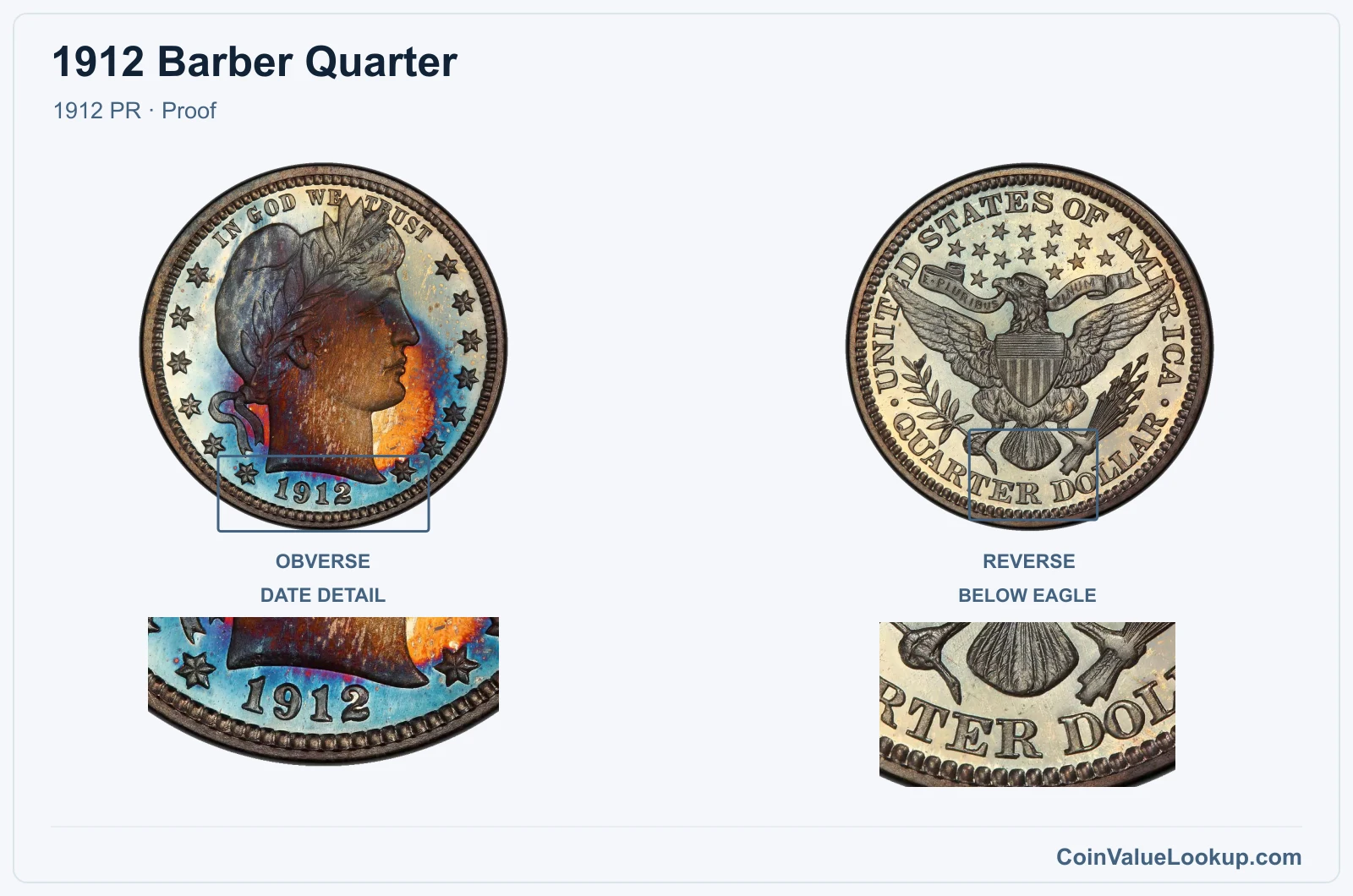
The 1912 proof quarter was made at Philadelphia using specially prepared dies and polished planchets. Like the business strike, it carries no mintmark.
The difference is in the surfaces: genuine proofs display mirror-like fields, frosted or fully brilliant devices, and sharp square-edged rims that regular strikes do not replicate.
Coin Value Lookup is a useful starting point if you are trying to compare your coin against other Barber quarter years and mints.
USA Coin Book lists the 1912 PR at $799.00 in PR63 condition. Surface haze and hairlines — tiny parallel scratches from improper storage or handling — are the main factors that separate a PR63 from higher or lower proof grades.
A cleaned proof with wiped fields is not the same as one with original surfaces, even if both look reflective at first glance.
Range Grade
Price Auction Records Appraisal PR PR 1
—
Coin Identifier
PR 2
—
Coin Identifier
PR 3
—
Coin Identifier
PR 4
—
Coin Identifier
PR 6
—
Coin Identifier
PR 8
—
Coin Identifier
PR 10
—
Coin Identifier
PR 12
—
Coin Identifier
PR 15
—
Coin Identifier
PR 20
—
Coin Identifier
PR 25
—
Coin Identifier
PR 30
—
Coin Identifier
PR 35
—
Coin Identifier
PR 40
—
Coin Identifier
PR 45
—
Coin Identifier
PR 50
—
Coin Identifier
PR 53
—
Coin Identifier
PR 55
—
Coin Identifier
PR 58
—
Coin Identifier
PR 60
—
Coin Identifier
PR 61
Coin Identifier
PR 62
Coin Identifier
PR 63
Coin Identifier
PR 64
Coin Identifier
PR 65
Coin Identifier
PR 66
Coin Identifier
PR 67
Coin Identifier
PR 68
Coin Identifier
PR 69
Coin Identifier
PR 70
—
—
—
1912 Barber Quarter — S
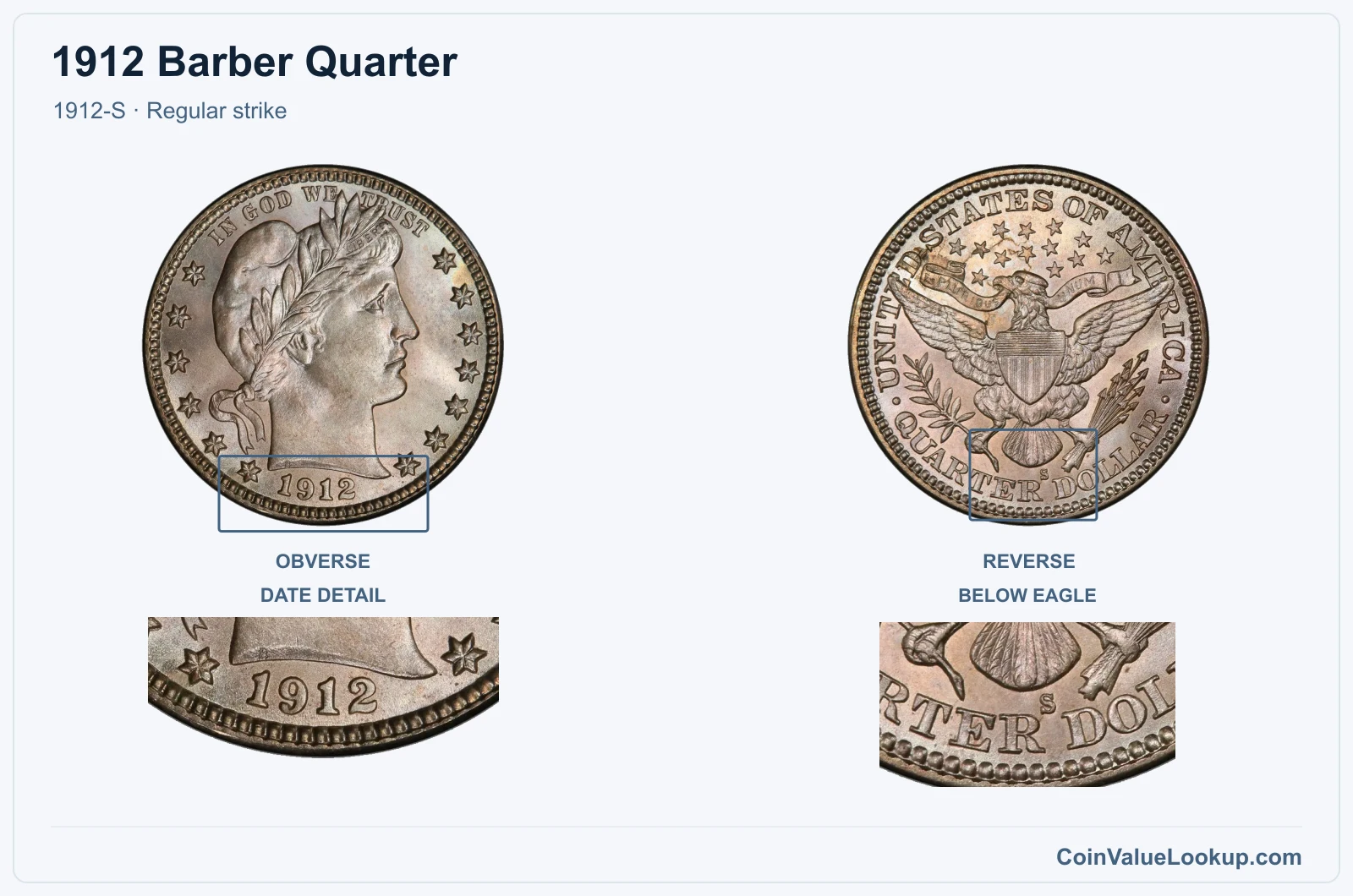
The 1912-S was struck at the San Francisco Mint and carries a small "S" mintmark on the reverse below the eagle's tail. This is the version with the highest guide estimates in the 1912 Barber quarter lineup.
At a well-worn Good-4, USA Coin Book estimates about $35.00. An MS60 uncirculated example jumps to $601.00, and a choice MS63 reaches $1,136.00.
The steep climb from circulated to uncirculated reflects how few survived without heavy wear — most 1912-S quarters saw years of pocket use in the West.
Original surfaces and strike quality are critical for uncirculated examples. Cleaning or damage will push the value well below these guide figures.
Confirm the S mintmark under magnification before drawing any conclusions, as wear or corrosion can sometimes obscure it.
Range Grade
Price Auction Records Appraisal PO PO 1
—
Coin Identifier FR FR 2
—
Coin Identifier AG AG 3
—
Coin Identifier G G 4
—
Coin Identifier
G 6
—
Coin Identifier VG VG 8
—
Coin Identifier
VG 10
Coin Identifier F F 12
—
Coin Identifier
F 15
Coin Identifier VF VF 20
—
Coin Identifier
VF 25
Coin Identifier
VF 30
Coin Identifier
VF 35
Coin Identifier XF XF 40
—
Coin Identifier
XF 45
Coin Identifier AU AU 50
Coin Identifier
AU 53
Coin Identifier
AU 55
Coin Identifier
AU 58
Coin Identifier MS MS 60
—
Coin Identifier
MS 61
—
Coin Identifier
MS 62
Coin Identifier
MS 63
Coin Identifier
MS 64
Coin Identifier
MS 65
Coin Identifier
MS 66
Coin Identifier
MS 67
Coin Identifier
MS 68
Coin Identifier
MS 69
—
—
—
MS 70
—
—
—