1838 Liberty Seated Dime Coin Value: How Much Is It Worth?
The 1838 Liberty Seated Dime spans a surprisingly wide value range depending on which branch you hold. Retail guide estimates run from about $42 at G4 for a Philadelphia business strike up through $7,135 at MS63 for a New Orleans issue.
Rare Proofs and specific die varieties sit in their own territory entirely. Sorting out your exact version is the first step to knowing what you have.
Fast Way to Identify Your 1838 Liberty Seated Dime
The quickest way to start figuring out what your 1838 dime is worth is to upload clear photos of both sides. A sharp front image shows the date, star arrangement, and any drapery detail, while the back reveals the mintmark location and reverse design.
This gives a preliminary identification of your coin's branch and condition so you can narrow down its place in the guide.
1838 Liberty Seated Dime Value
Upload both sides of your 1838 Liberty Seated Dime.
Front Obverse
Upload photo
Back Reverse
Upload photo
Which 1838 Liberty Seated Dime Versions Are Worth Money?
- New Orleans (O mintmark) No Stars dimes carry the highest guide values among business strikes, listed at $127 in G4 and up to $7,135 in MS63.
- Philadelphia Partial Drapery pieces, created by a die-clash artifact, list higher at MS63 ($1,882) than the Small Stars or Large Stars branches.
- Proof 1838 dimes are extremely rare early issues, with a guide estimate around $150,000 at PR65.
- Repunched dates and repunched mintmarks are reported varieties for this year and can carry a premium depending on visibility and condition.
- Small Stars and Large Stars Philadelphia dimes are distinct branches worth distinguishing, with different MS63 guide values ($1,678 vs. $1,067).
Step 1: Identify Your 1838 Liberty Seated Dime Mint Mark and Version
First, confirm you have a Liberty Seated Dime and not the smaller half dime. Your coin should show a seated Liberty on the front and the words ONE DIME inside a wreath on the back.
The diameter is 17.9 mm with a reeded edge, struck in 90% silver and 10% copper at a nominal weight of 2.67 grams.
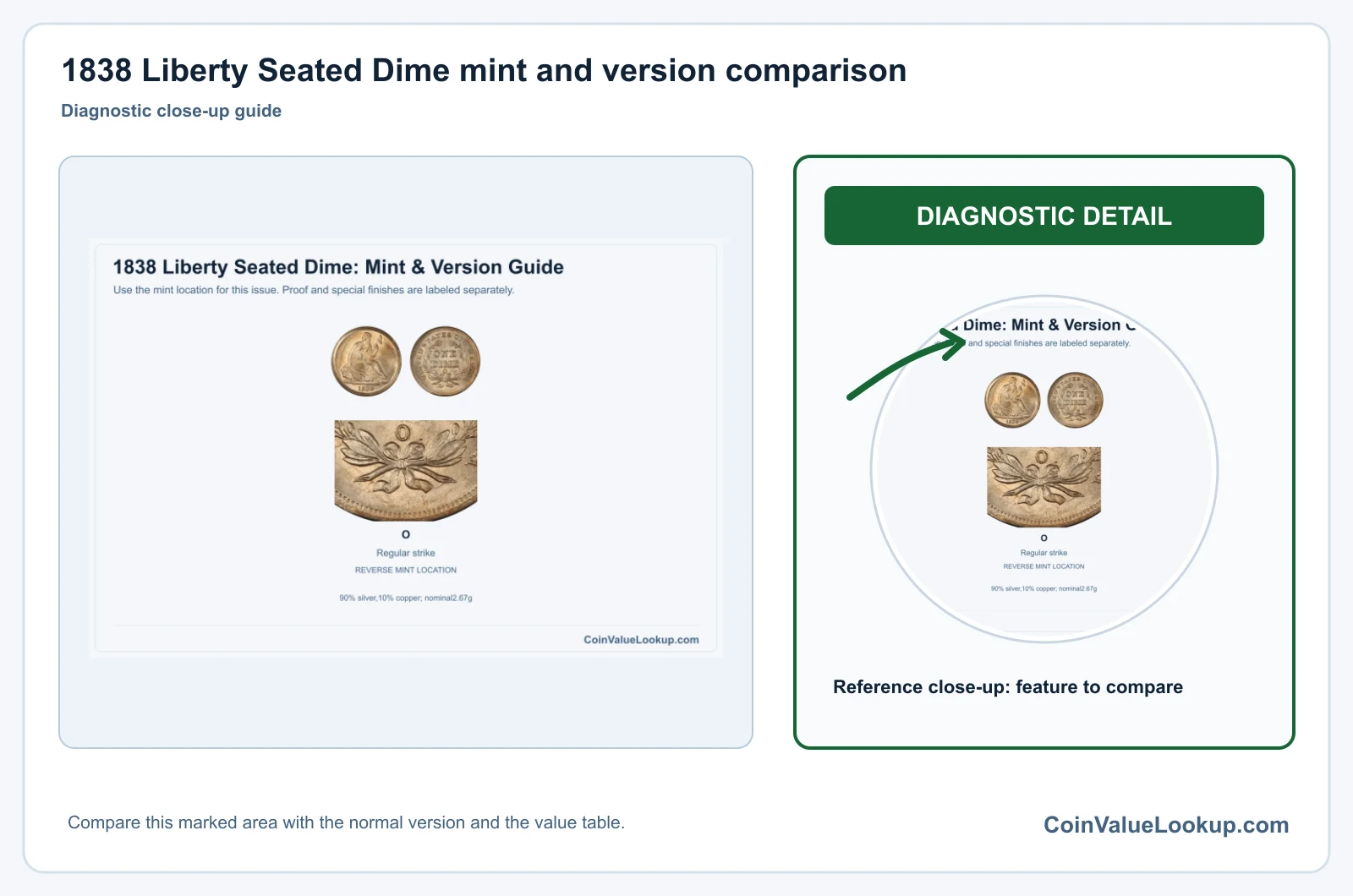
Next, check the reverse below the wreath for a mintmark. If you see an "O," it was struck at New Orleans.
No letter means Philadelphia.
New Orleans coins from 1838 have no stars around Liberty on the obverse, which is the earlier No Stars design. Philadelphia pieces added stars, and those come in three business-strike flavors: Small Stars, Large Stars, and Partial Drapery.
The Partial Drapery variety is not the later intentional design change seen on Seated dimes from 1840 onward. On the 1838, it is a die-clash artifact, where the impression of the opposite die transferred extra detail near Liberty's elbow.
Learn what each branch looks like before you try to price your coin.
Extremely rare Philadelphia Proofs also exist from this year, but they are a separate category with their own identification requirements.
Step 2: Check Your 1838 Liberty Seated Dime Grade
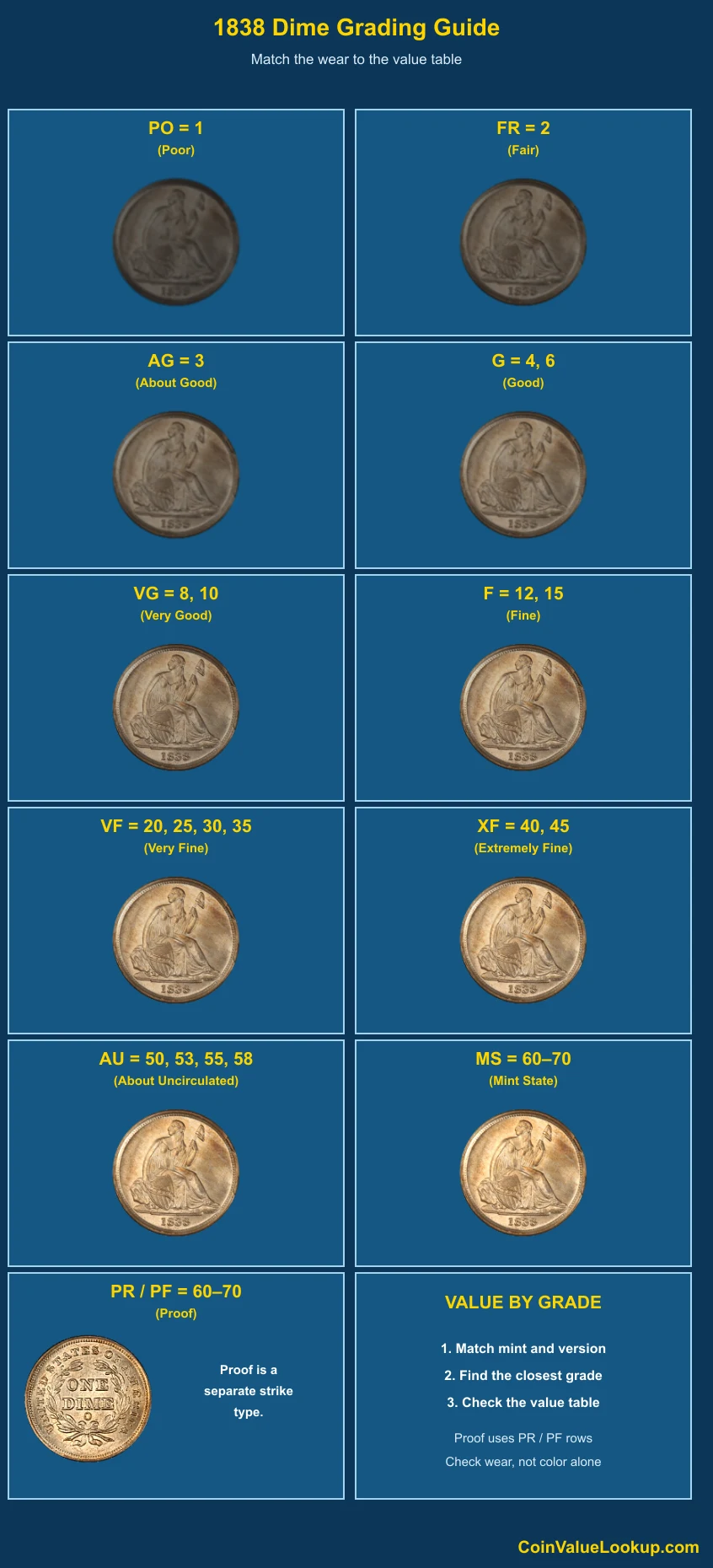
Compare your coin's wear against the correct subtype grading image. Because the 1838 comes in different design branches, the high points that wear first can shift slightly between them.
On the obverse, focus on Liberty's head, the shield on her arm, her gown folds, and her feet. These are where friction shows up earliest.
On the reverse, the wreath base and lettering take the first hits.
Separate actual circulation wear from original strike weakness or tired dies. A softly struck coin and a worn coin can look alike at a glance, but luster patterns tell the story.
An uncirculated coin with a weak strike still shows full mint luster in the protected areas.
Proof coins are a manufacturing method, not a grade above Mint State. Mirrored fields and sharp rims are hallmarks.
A polished circulated coin is not a Proof, no matter how shiny someone has made it. Hairlines on genuine Proofs are graded differently from bag marks on business strikes.
Step 3: Check 1838 Liberty Seated Dime Value by Mint and Version
1838 Liberty Seated Dime — O — Regular Issue
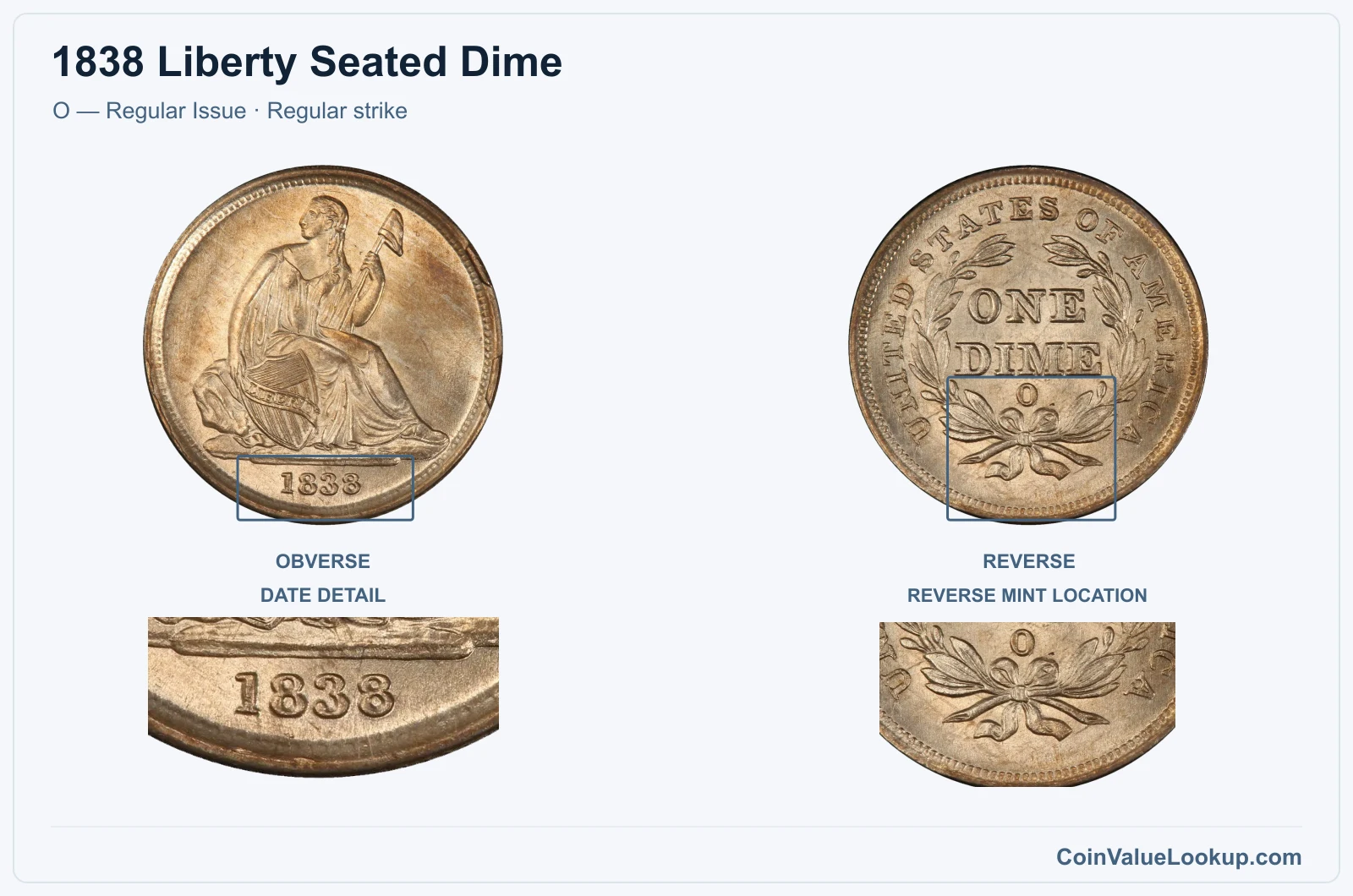
The New Orleans issue is the only 1838 dime with a mintmark, an "O" located below the wreath on the reverse. It also keeps the earlier No Stars obverse design, so Liberty sits alone without surrounding stars.
That combination makes it visually distinct from every Philadelphia version.
Guide estimates from USA Coin Book place this branch at about $127 in G4 and $7,135 in MS63. Those are the highest business-strike figures for the year, reflecting both the design transition and New Orleans production realities.
Confirm the "O" mintmark and the plain obverse field before applying these values.
Range Grade
Price Auction Records Appraisal PO PO 1
Coin Identifier FR FR 2
Coin Identifier AG AG 3
Coin Identifier G G 4
Coin Identifier
G 6
Coin Identifier VG VG 8
Coin Identifier
VG 10
Coin Identifier F F 12
Coin Identifier
F 15
Coin Identifier VF VF 20
Coin Identifier
VF 25
Coin Identifier
VF 30
Coin Identifier
VF 35
Coin Identifier XF XF 40
Coin Identifier
XF 45
Coin Identifier AU AU 50
Coin Identifier
AU 53
Coin Identifier
AU 55
Coin Identifier
AU 58
Coin Identifier MS MS 60
—
Coin Identifier
MS 61
Coin Identifier
MS 62
Coin Identifier
MS 63
Coin Identifier
MS 64
Coin Identifier
MS 65
Coin Identifier
MS 66
Coin Identifier
MS 67
—
—
—
MS 68
—
—
—
MS 69
—
—
—
MS 70
—
—
—
1838 Liberty Seated Dime — No Mint Mark — Small Stars
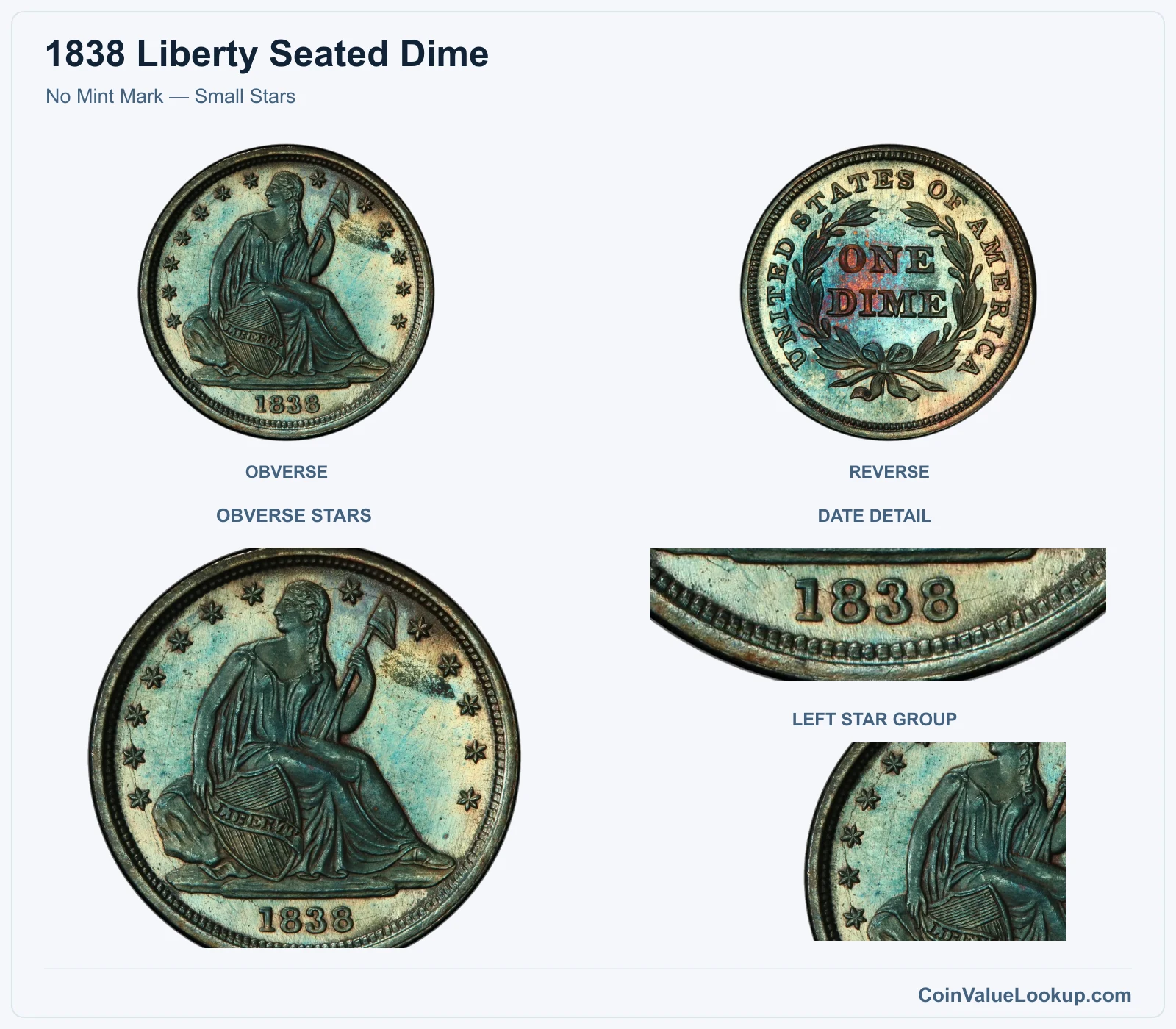
Philadelphia Small Stars dimes show relatively compact star punches arranged around Liberty on the obverse. There is no mintmark on the reverse.
The stars are noticeably smaller than the Large Stars variety, so placing both side by side (or comparing against reference images) is the clearest way to tell them apart.
USA Coin Book guide estimates sit at about $42 in G4 and $1,678 in MS63. That MS63 figure is higher than the Large Stars branch, so getting the star size right matters when you price your coin.
Range Grade
Price Auction Records Appraisal PO PO 1
—
Coin Identifier FR FR 2
—
Coin Identifier AG AG 3
—
Coin Identifier G G 4
—
Coin Identifier
G 6
—
Coin Identifier VG VG 8
—
Coin Identifier
VG 10
—
Coin Identifier F F 12
—
Coin Identifier
F 15
—
Coin Identifier VF VF 20
—
Coin Identifier
VF 25
Coin Identifier
VF 30
Coin Identifier
VF 35
Coin Identifier XF XF 40
Coin Identifier
XF 45
Coin Identifier AU AU 50
Coin Identifier
AU 53
—
Coin Identifier
AU 55
Coin Identifier
AU 58
Coin Identifier MS MS 60
—
Coin Identifier
MS 61
Coin Identifier
MS 62
Coin Identifier
MS 63
Coin Identifier
MS 64
Coin Identifier
MS 65
Coin Identifier
MS 66
Coin Identifier
MS 67
Coin Identifier
MS 68
—
—
—
MS 69
—
—
—
MS 70
—
—
—
1838 Liberty Seated Dime — No Mint Mark — Large Stars
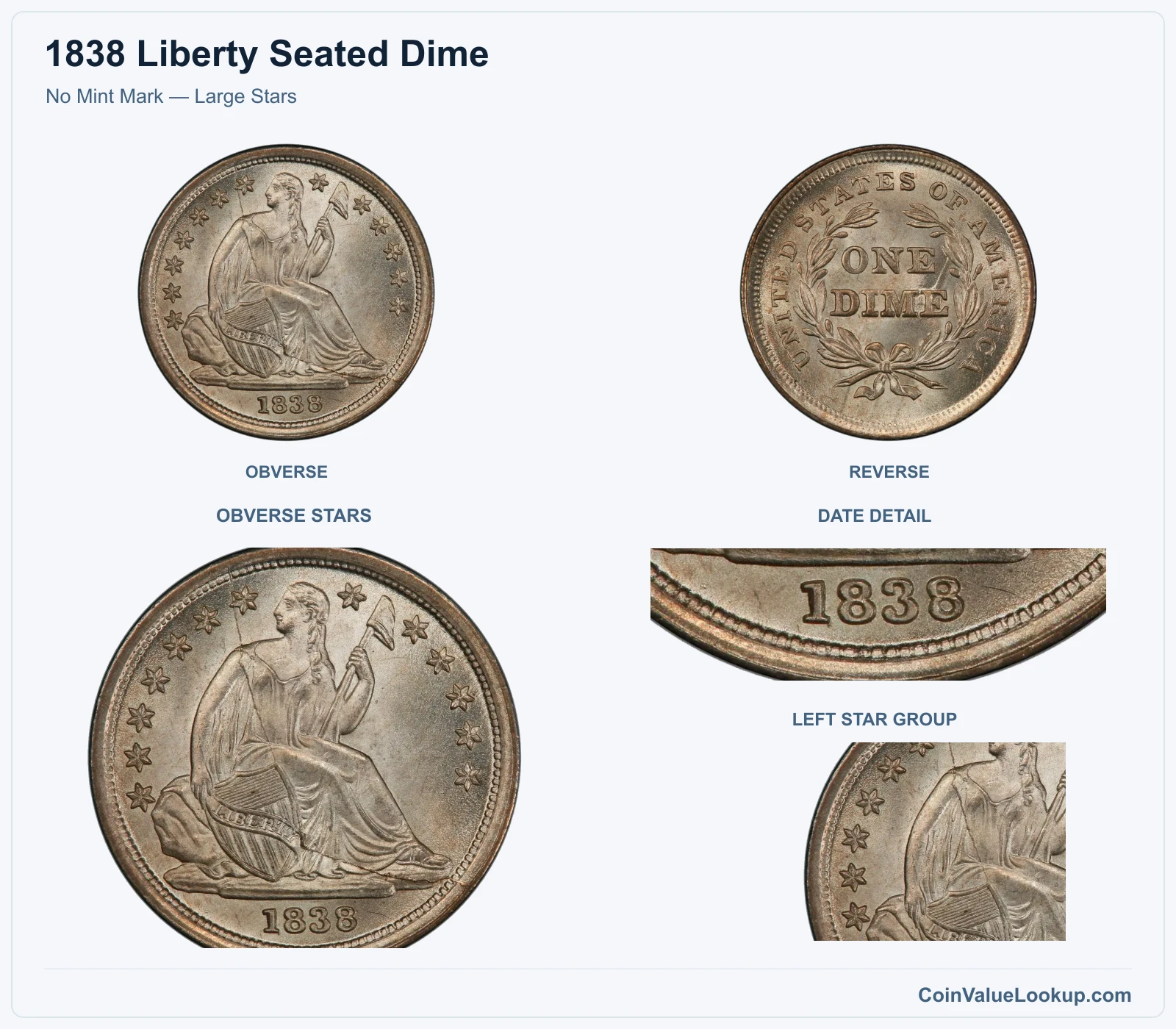
Large Stars Philadelphia dimes feature visibly bigger star punches than the Small Stars variety. The stars crowd closer to Liberty and to the rim.
No mintmark appears on the reverse.
Coin Value Lookup is a good starting point if you want to compare this branch against other Liberty Seated Dime years and types. Guide estimates from USA Coin Book list the Large Stars version at about $42 in G4 and $1,067 in MS63, the lowest MS63 figure among the three Philadelphia business-strike branches.
Range Grade
Price Auction Records Appraisal PO PO 1
—
Coin Identifier FR FR 2
—
Coin Identifier AG AG 3
—
Coin Identifier G G 4
—
Coin Identifier
G 6
Coin Identifier VG VG 8
—
Coin Identifier
VG 10
—
Coin Identifier F F 12
—
Coin Identifier
F 15
—
Coin Identifier VF VF 20
Coin Identifier
VF 25
Coin Identifier
VF 30
Coin Identifier
VF 35
Coin Identifier XF XF 40
Coin Identifier
XF 45
Coin Identifier AU AU 50
Coin Identifier
AU 53
Coin Identifier
AU 55
Coin Identifier
AU 58
Coin Identifier MS MS 60
Coin Identifier
MS 61
Coin Identifier
MS 62
Coin Identifier
MS 63
Coin Identifier
MS 64
Coin Identifier
MS 65
Coin Identifier
MS 66
Coin Identifier
MS 67
Coin Identifier
MS 68
—
—
—
MS 69
—
—
—
MS 70
—
—
—
1838 Liberty Seated Dime — No Mint Mark — Partial Drapery
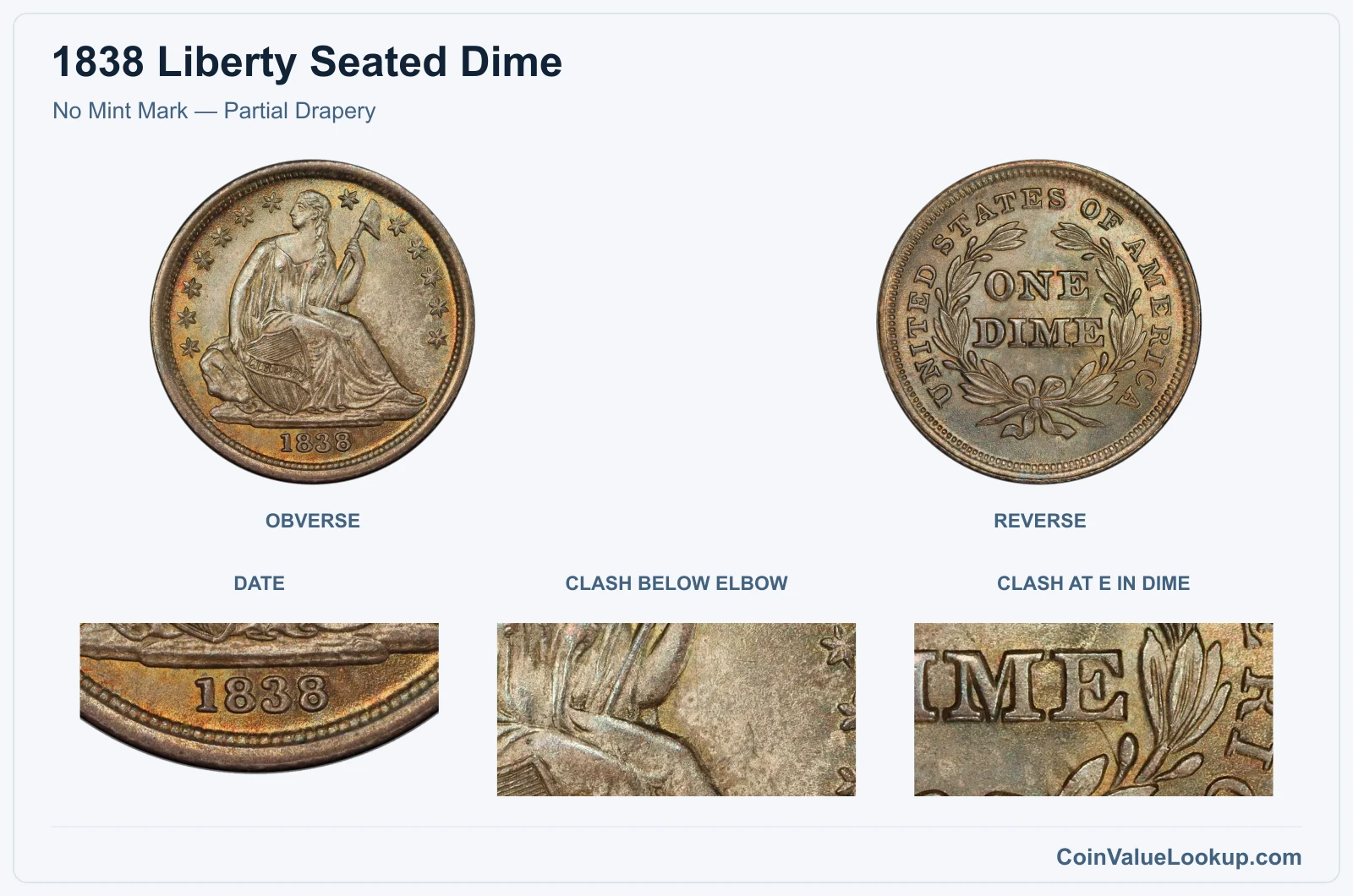
This is probably the trickiest 1838 Philadelphia variety to understand. The Partial Drapery refers to extra fabric-like detail near Liberty's elbow, but it was not an intentional design addition.
It is a die-clash artifact, meaning the obverse die picked up an impression from the reverse die during a mistrike, and that transferred detail appears on subsequent coins.
Do not confuse this with the formal "With Drapery" design introduced on Seated dimes starting in 1840. That was a deliberate engraving change.
The 1838 Partial Drapery is a production anomaly specific to certain die pairs.
USA Coin Book lists this branch at about $42 in G4 and $1,882 in MS63, the highest MS63 figure among the three Philadelphia business-strike branches. Look carefully near Liberty's left elbow for the extra detail.
Range Grade
Price Auction Records Appraisal PO PO 1
—
Coin Identifier FR FR 2
—
Coin Identifier AG AG 3
—
Coin Identifier G G 4
—
Coin Identifier
G 6
—
Coin Identifier VG VG 8
—
Coin Identifier
VG 10
—
Coin Identifier F F 12
—
Coin Identifier
F 15
—
Coin Identifier VF VF 20
—
Coin Identifier
VF 25
—
Coin Identifier
VF 30
—
Coin Identifier
VF 35
Coin Identifier XF XF 40
Coin Identifier
XF 45
Coin Identifier AU AU 50
—
Coin Identifier
AU 53
Coin Identifier
AU 55
Coin Identifier
AU 58
Coin Identifier MS MS 60
—
Coin Identifier
MS 61
—
Coin Identifier
MS 62
Coin Identifier
MS 63
Coin Identifier
MS 64
Coin Identifier
MS 65
Coin Identifier
MS 66
Coin Identifier
MS 67
Coin Identifier
MS 68
—
—
—
MS 69
—
—
—
MS 70
—
—
—
1838 Liberty Seated Dime — No Mint Mark — Proof Regular Issue
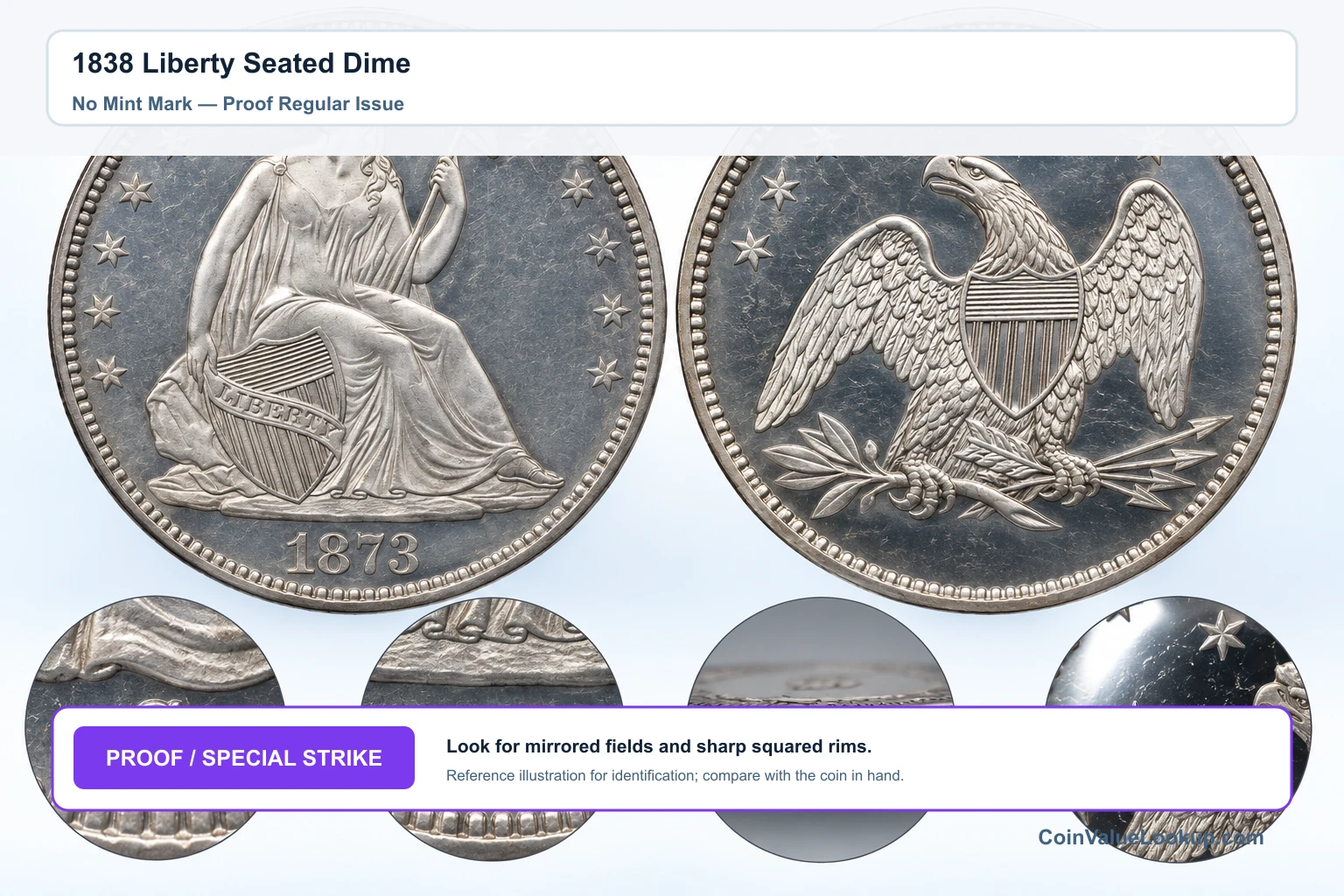
Proof 1838 Liberty Seated Dimes are genuinely rare. These are not ordinary annual collector products; early Proof coinage from this era was produced in tiny numbers, often for presentation or special request.
A real Proof shows fully mirrored fields and exceptionally sharp design details. The PCGS guide places a PR65 example at around $150,000.
That is a single grade anchor, not a market range, and actual realization depends on the specific coin.
Polished circulation strikes are not Proofs. If the fields look reflective but the rims are soft and the devices lack the crispness of a Proof die, you almost certainly have a cleaned business strike.
Professional attribution from a major grading service is essential before claiming Proof status on any 1838 dime.
1838 Liberty Seated Dime Proof Value by Grade
Reliable grade-by-grade prices are not currently available. A Proof attribution is distinct from a circulation strike; the current price feed has no usable values for the confirmed Proof catalogue entry. Individual specimens need specialist assessment.
1838 Liberty Seated Dime Error List
1. 1838 Liberty Seated Dime — Repunched Mintmark
Repunched mintmark varieties are reported for the 1838 dime. Since only the New Orleans issue carries a mintmark, this error applies to "O" mint coins.
To check, examine the mintmark area below the wreath under magnification. You are looking for traces of a second "O" punch in a slightly different position beneath or beside the final mintmark.
The remnant may appear as a partial letter or a shadow outline.
Do not confuse a repunched mintmark with machine doubling, which produces flat shelf-like doubling rather than a distinct second impression. Die chips or corrosion near the mintmark can also mimic the look.
The value of a repunched mintmark depends on the visibility of the remnant, the specific die pair involved, and the coin's overall condition.
2. 1838 Liberty Seated Dime — Doubled Die Reverse
Doubled die reverse varieties are reported for the 1838 dime. This error shows up as a doubled impression on reverse design elements such as the lettering, wreath, or denomination.
Compare your coin's reverse legends and contours against a normal example at the same magnification. Genuine hub doubling produces a second, slightly offset image with full rounded contours on the affected elements.
Machine doubling is the most common lookalike. It creates flat, shelf-like distortion rather than the crisp secondary image of a true doubled die.
Reflections from die polish or random post-strike damage can also trick the eye. Condition, the strength of the doubling, and the specific die pair all factor into any premium this variety might carry.
3. 1838 Liberty Seated Dime — Die Crack / Die Chip
Die cracks and die chips are reported on 1838 dimes. These show up as raised lines or small raised blobs on the coin's surface, caused by fractures or breakage in the steel die during production.
A die crack typically runs as a thin raised line, sometimes connecting design elements or running from the rim inward. A die chip appears as a small raised lump where a piece of the die face broke away.
A larger break connected to the rim is sometimes called a cud.
Do not confuse these with incuse scratches, which are recessed into the surface rather than raised. Corrosion or foreign material stuck to the coin can also mimic a chip.
The premium, if any, depends on the crack's size, location, and visual impact, plus the coin's overall grade.
4. 1838 Liberty Seated Dime — Clashed Dies
Clashed dies are reported for 1838 dimes. This happens when the obverse and reverse dies strike each other without a planchet between them, transferring ghost impressions of each design onto the opposite die.
Subsequent coins struck from those dies show faint traces of the wrong design on each side.
Look for outlines of the wreath or lettering ghosted onto the obverse, or traces of Liberty's figure faintly visible on the reverse. The transferred images align with where the opposing design would have contacted the die face.
Scratches, random raised lines, or a brockage (where a struck coin acts as a die) can look similar. True clash marks follow a predictable pattern matching the opposing design.
Value depends on the clarity of the clash, the die pair, and the coin's condition.
5. 1838 Liberty Seated Dime — Repunched Date
Repunched date varieties are reported for the 1838 dime. In this era, date numerals were punched into the working die by hand, and sometimes the engraver's first attempt was slightly off.
The correction leaves remnants of the earlier position visible beside or beneath the final digits.
Check each numeral of the date under magnification. Look for traces of a second impression, especially at the tops or bases of the 1, 8, 3, and 8.
The remnants may appear as partial serifs, shadows, or offset outlines.
This is different from machine doubling, which affects the entire design uniformly and produces flat shelf-like distortion. A damaged or corroded date can also create confusing extra outlines.
The variety's value depends on how visible the repunching is and the coin's overall condition.