1884 Liberty Seated Dime Coin Value: How Much Is It Worth?
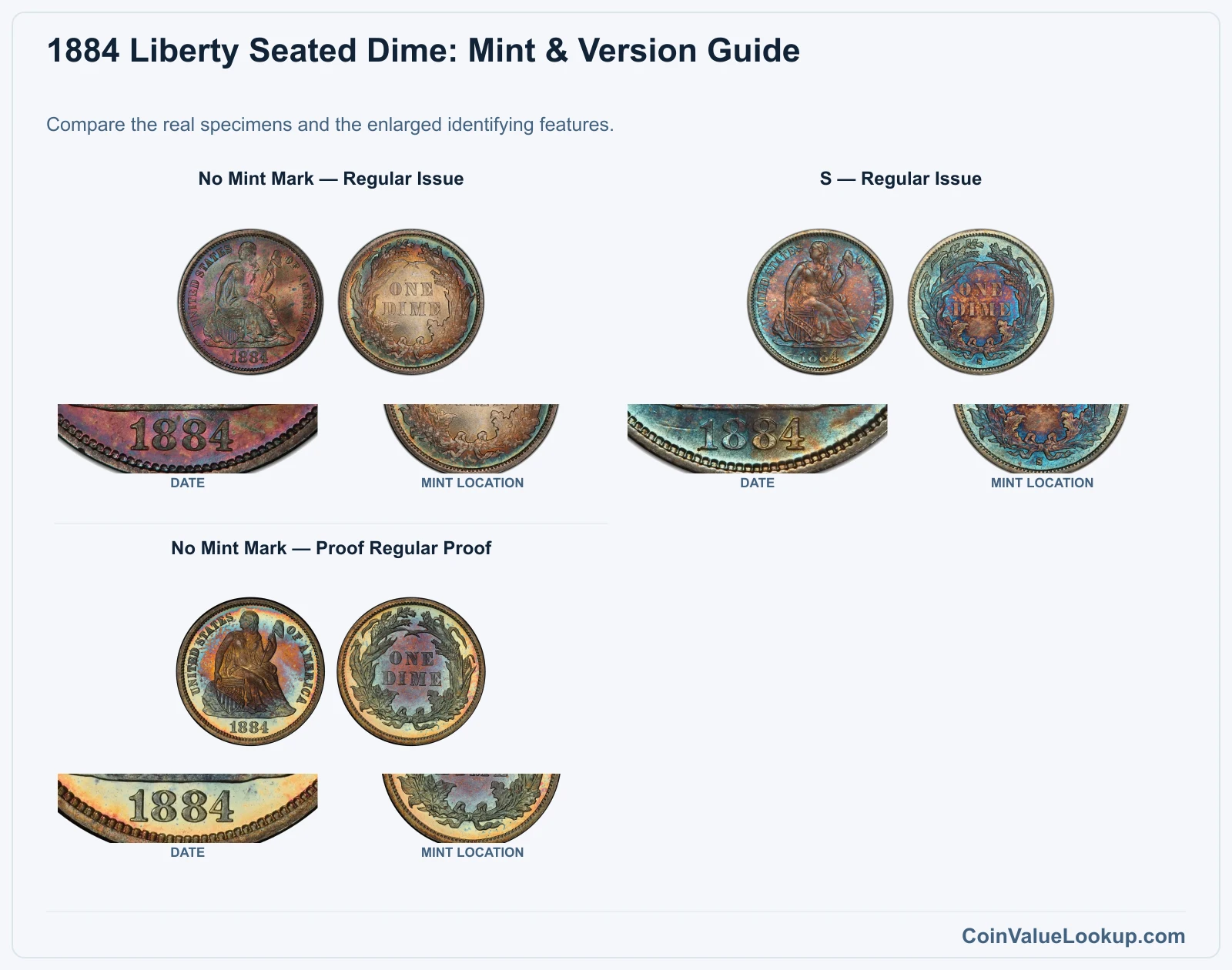
The 1884 Liberty Seated Dime was struck at Philadelphia and San Francisco, with Philadelphia also producing Proofs. Retail guide estimates from USA Coin Book range from about $22 at G4 to $1,348 at MS63 across the regular circulation strikes, while Proofs carry their own scale.
Original surfaces, correct mint identification and finish all matter when placing your coin on the right price chart.
Fast Way to Identify Your 1884 Liberty Seated Dime
Want a quick read on what you have? Upload clear photos of the front and back of your 1884 dime, and our identifier can help with a preliminary look at the mint, finish and version.
It is not a substitute for professional grading or authentication, but it is a solid starting point before you dig deeper.
1884 Liberty Seated Dime Value
Upload both sides of your 1884 Liberty Seated Dime.
Front Obverse
Upload photo
Back Reverse
Upload photo
Which 1884 Liberty Seated Dime Versions Are Worth Money?
- The 1884-S (San Francisco) regular issue lists up to about $1,348 at MS63 per USA Coin Book, making higher-grade survivors worth careful examination.
- Philadelphia Proofs at PR63 guide around $725; confirm true Proof surfaces rather than prooflike business strikes before assuming this value.
- Doubled die obverse varieties with doubling in UNITED STATES and the date are reported for 1884 and can carry premiums tied to visibility and condition.
- Repunched date examples, where remnants of an earlier punch position appear beside the final numerals, are known and collected as die varieties.
- Die cracks and clashed dies have been cataloged for 1884 Philadelphia strikes; dramatic examples in higher grades draw variety collector interest.
Step 1: Identify Your 1884 Liberty Seated Dime Mint Mark and Version
The 1884 Liberty Seated Dime shows the seated Liberty figure on the obverse with the legend UNITED STATES OF AMERICA and the date below. The reverse reads ONE DIME inside an agricultural wreath.
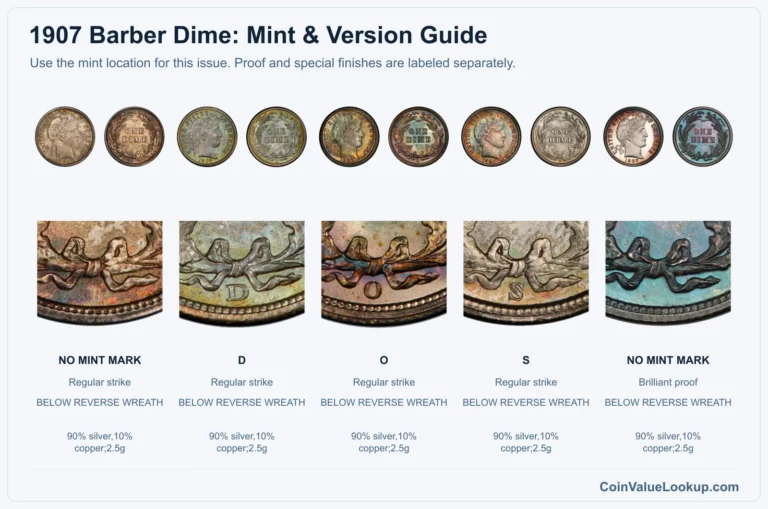
Philadelphia coins carry no mintmark. San Francisco pieces have a small "S" on the reverse near the wreath.
Do not confuse this denomination with the smaller half dime series.
All regular issues are struck in 90% silver and 10% copper, measuring 17.9mm with a reeded edge and a nominal weight of 2.50 grams. If yours is lighter or the wrong diameter, it may be damaged or a different coin entirely.
A key trap: some Philadelphia strikes have prooflike fields that look mirror-bright. That alone does not make a coin a Proof.
Proof finish involves deliberate die preparation, and confirming it requires careful comparison of field quality, strike sharpness and edge characteristics. Polished coins are definitely not Proofs.
Step 2: Check Your 1884 Liberty Seated Dime Grade
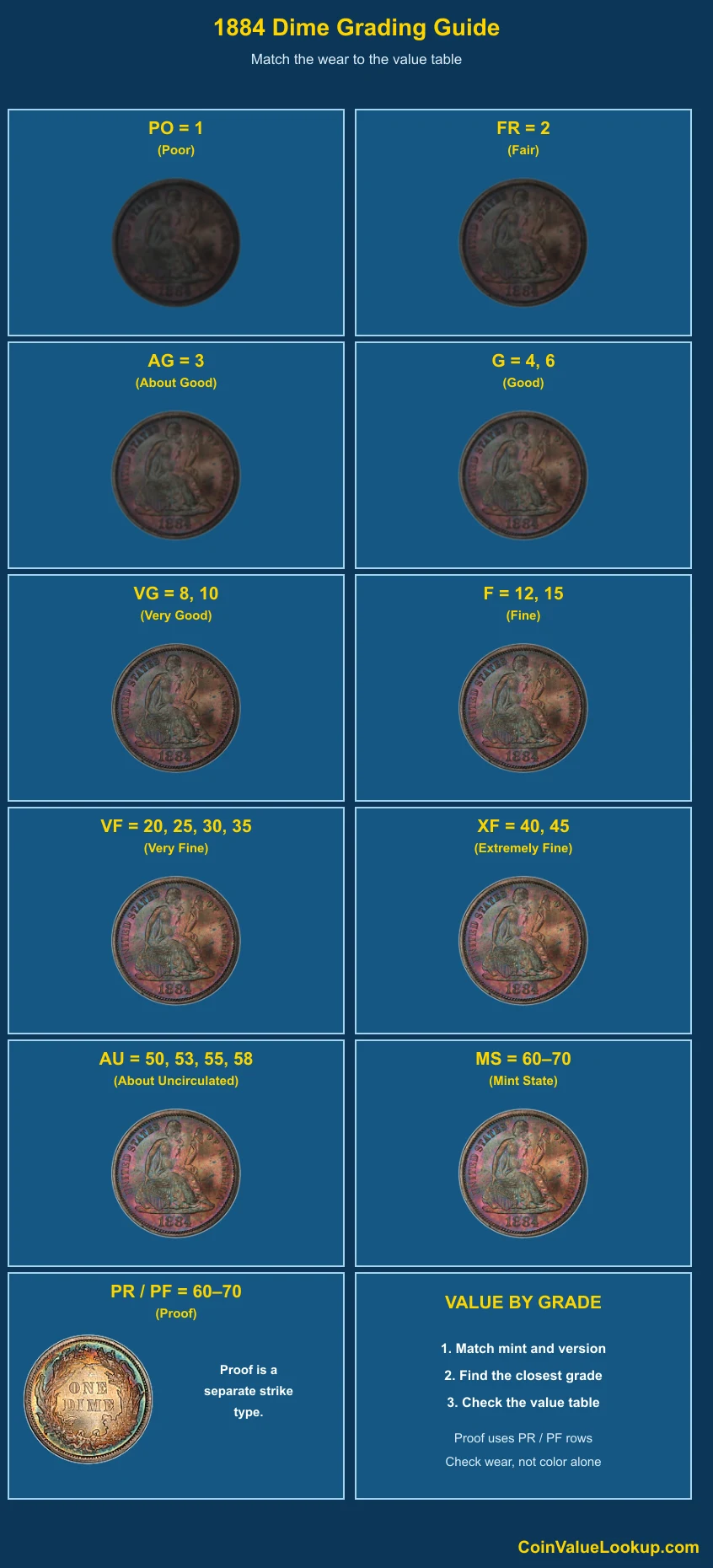
Start with Liberty's head on the obverse. In lower grades the hair detail above her forehead wears first, followed by the breast and knee areas of the seated figure.
The shield on her arm and the highest wreath leaves on the reverse also lose definition early.
Compare your coin to the reference image. A coin grading around Good (G4) will show a clear outline of Liberty but most interior detail is gone.
At higher grades like MS63, full luster and sharp design elements should be present with only minor contact marks.
Do not confuse a weak strike or tired dies with actual wear. Some coins left the mint soft in spots, especially on the head or wreath tips, without ever circulating.
Judge surviving luster alongside detail loss to separate the two.
Always keep Proof strikes separate from business strikes when grading. A business strike with heavy cleaning or polishing is not a Proof, no matter how shiny it looks.
Step 3: Check 1884 Liberty Seated Dime Value by Mint and Version
1884 Liberty Seated Dime — No Mint Mark — Regular Issue
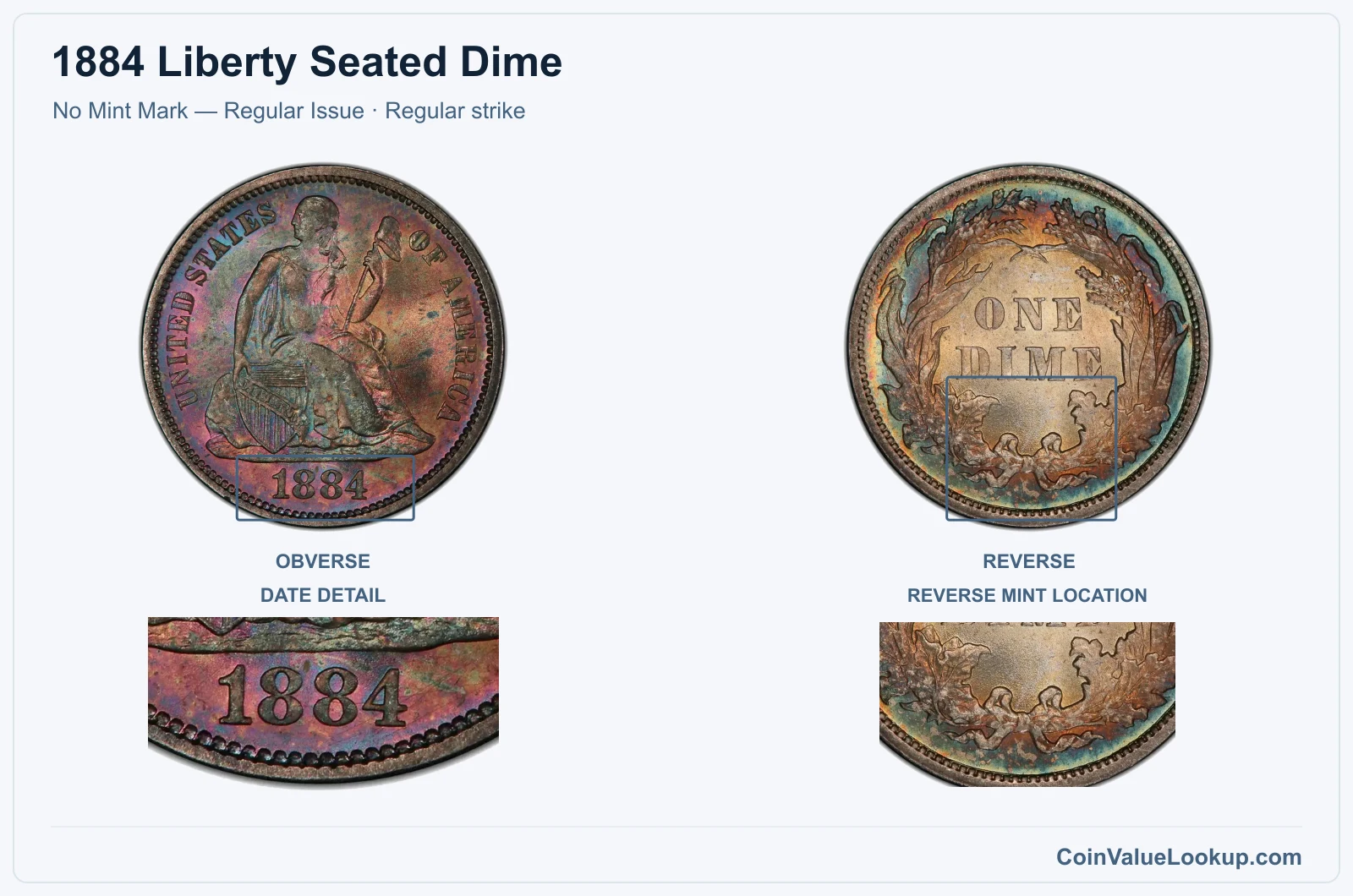
The 1884 Philadelphia dime has no mintmark anywhere on the coin. It features the Legend Obverse design paired with the agricultural wreath reverse, struck in 90% silver at a nominal weight of 2.50 grams.
USA Coin Book guide estimates place this issue at about $22 in G4 and around $316 at MS63. That is a wide spread, so grade matters a lot here.
Circulated examples are common enough, but fully lustrous Mint State coins with clean surfaces command the upper end of the range.
Coin Value Lookup is a handy place to look up guides for other dates and mints in the Liberty Seated Dime series if you are working through a collection.
Range Grade
Price Auction Records Appraisal PO PO 1
—
Coin Identifier FR FR 2
—
Coin Identifier AG AG 3
—
Coin Identifier G G 4
—
Coin Identifier
G 6
—
Coin Identifier VG VG 8
—
Coin Identifier
VG 10
—
Coin Identifier F F 12
—
Coin Identifier
F 15
—
Coin Identifier VF VF 20
—
Coin Identifier
VF 25
—
Coin Identifier
VF 30
Coin Identifier
VF 35
—
Coin Identifier XF XF 40
—
Coin Identifier
XF 45
—
Coin Identifier AU AU 50
Coin Identifier
AU 53
Coin Identifier
AU 55
Coin Identifier
AU 58
Coin Identifier MS MS 60
—
Coin Identifier
MS 61
Coin Identifier
MS 62
Coin Identifier
MS 63
Coin Identifier
MS 64
Coin Identifier
MS 65
Coin Identifier
MS 66
Coin Identifier
MS 67
Coin Identifier
MS 68
Coin Identifier
MS 69
—
—
—
MS 70
—
—
—
1884 Liberty Seated Dime — S — Regular Issue
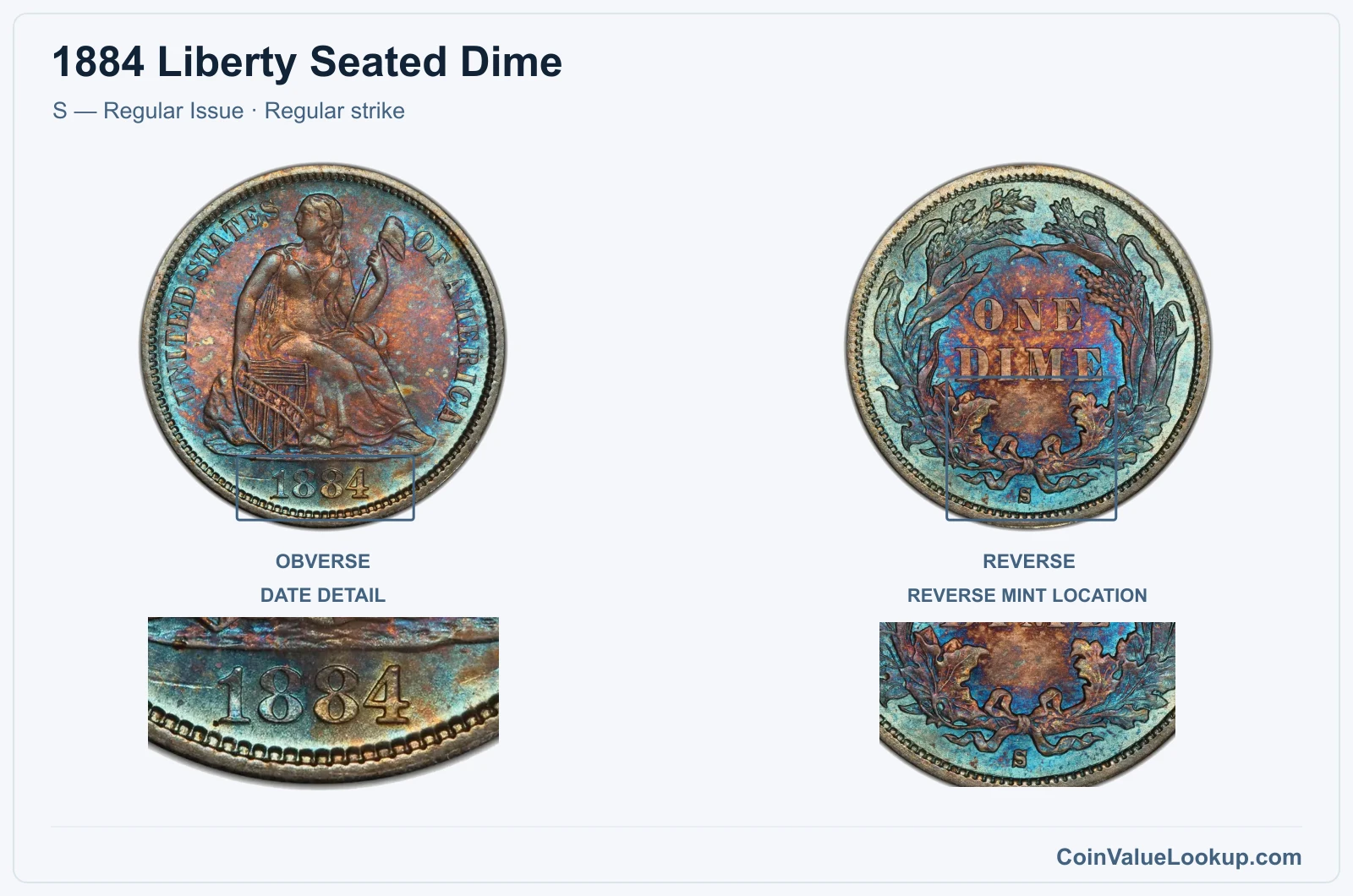
Look for the small "S" mintmark on the reverse to confirm a San Francisco strike. Same composition as Philadelphia: 90% silver, 10% copper, 2.50 grams nominal.
The 1884-S carries higher guide estimates than its Philadelphia counterpart. USA Coin Book lists about $29 at G4 and roughly $1,348 at MS63.
That steep jump reflects the difficulty of finding well-preserved San Francisco dimes from this period. Many saw heavy commercial use in the West.
Even a mid-grade example with honest original surfaces is worth a closer look. Cleaned or damaged coins lose much of the premium, so inspect for signs of tooling or harsh cleaning before getting excited about the mintmark alone.
Range Grade
Price Auction Records Appraisal PO PO 1
—
Coin Identifier FR FR 2
—
Coin Identifier AG AG 3
—
Coin Identifier G G 4
—
Coin Identifier
G 6
—
Coin Identifier VG VG 8
—
Coin Identifier
VG 10
Coin Identifier F F 12
Coin Identifier
F 15
Coin Identifier VF VF 20
—
Coin Identifier
VF 25
—
Coin Identifier
VF 30
—
Coin Identifier
VF 35
Coin Identifier XF XF 40
Coin Identifier
XF 45
Coin Identifier AU AU 50
Coin Identifier
AU 53
Coin Identifier
AU 55
Coin Identifier
AU 58
Coin Identifier MS MS 60
Coin Identifier
MS 61
Coin Identifier
MS 62
Coin Identifier
MS 63
Coin Identifier
MS 64
Coin Identifier
MS 65
Coin Identifier
MS 66
Coin Identifier
MS 67
Coin Identifier
MS 68
Coin Identifier
MS 69
—
—
—
MS 70
—
—
—
1884 Liberty Seated Dime — No Mint Mark — Proof Regular Proof
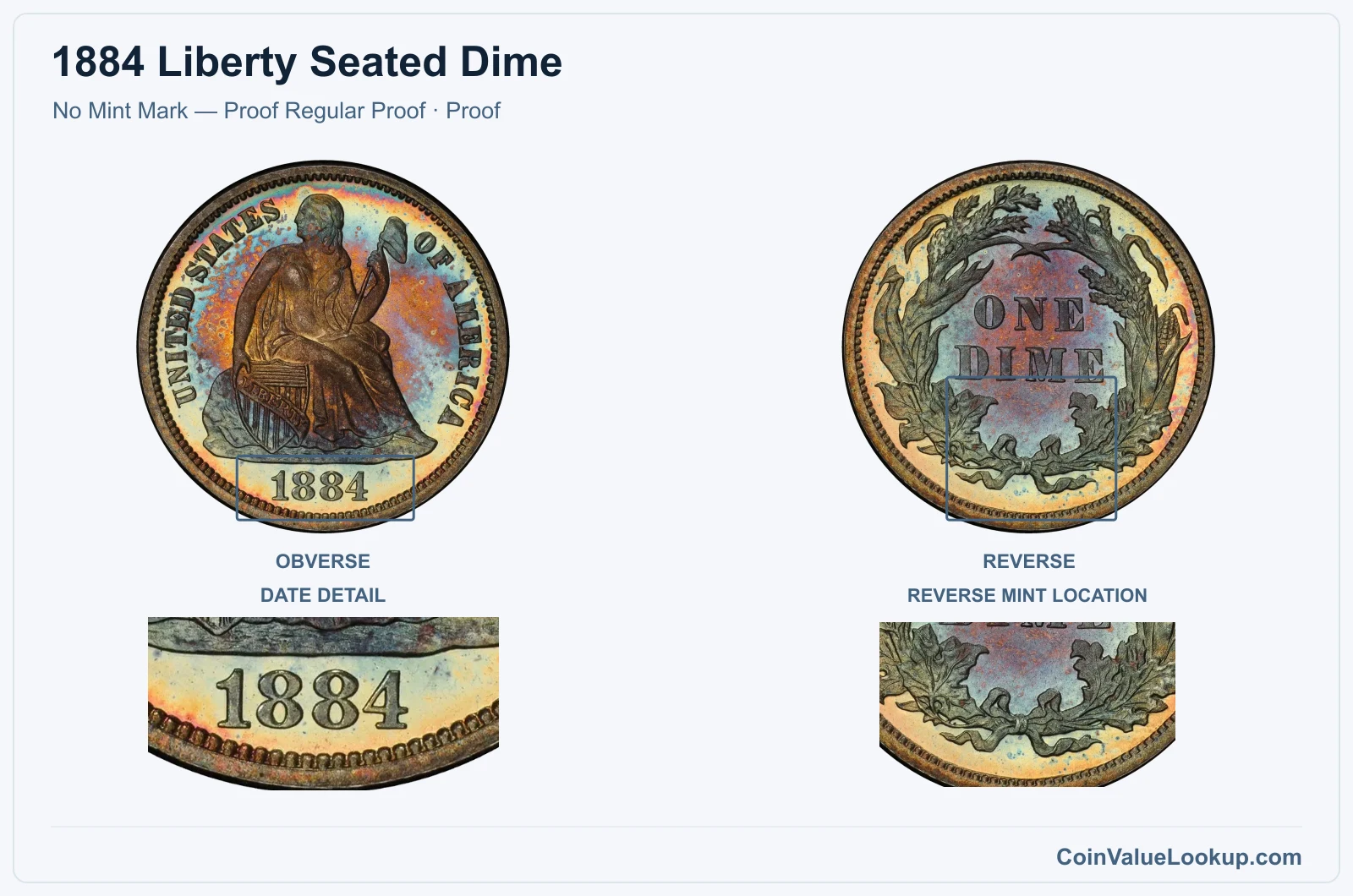
Philadelphia Proofs were struck from specially prepared dies on polished planchets. The result is mirror-like fields with sharply defined design elements.
These were made for collectors, not commerce.
At PR63 the USA Coin Book guide estimate is about $725. Hairlines from handling or improper storage are the most common issue that keeps Proofs from higher grades.
Light hairlines visible under magnification are typical at the PR63 level.
Confirming a genuine Proof requires more than brightness. True Proofs show squared, knife-like rims and deeply mirrored fields distinct from any business strike.
A polished or dipped circulation coin will not replicate the deliberate die preparation visible on a real Proof. Professional authentication is the safest route if you believe you have one.
Range Grade
Price Auction Records Appraisal PR PR 1
—
Coin Identifier
PR 2
—
Coin Identifier
PR 3
—
Coin Identifier
PR 4
—
Coin Identifier
PR 6
—
Coin Identifier
PR 8
—
Coin Identifier
PR 10
—
Coin Identifier
PR 12
—
Coin Identifier
PR 15
—
Coin Identifier
PR 20
—
Coin Identifier
PR 25
—
Coin Identifier
PR 30
—
Coin Identifier
PR 35
—
Coin Identifier
PR 40
—
Coin Identifier
PR 45
—
Coin Identifier
PR 50
—
Coin Identifier
PR 53
—
Coin Identifier
PR 55
—
Coin Identifier
PR 58
—
Coin Identifier
PR 60
Coin Identifier
PR 61
—
Coin Identifier
PR 62
Coin Identifier
PR 63
Coin Identifier
PR 64
Coin Identifier
PR 65
Coin Identifier
PR 66
Coin Identifier
PR 67
Coin Identifier
PR 68
Coin Identifier
PR 69
—
—
—
PR 70
—
—
—
1884 Liberty Seated Dime Error List
1. 1884 Liberty Seated Dime — Repunched Date
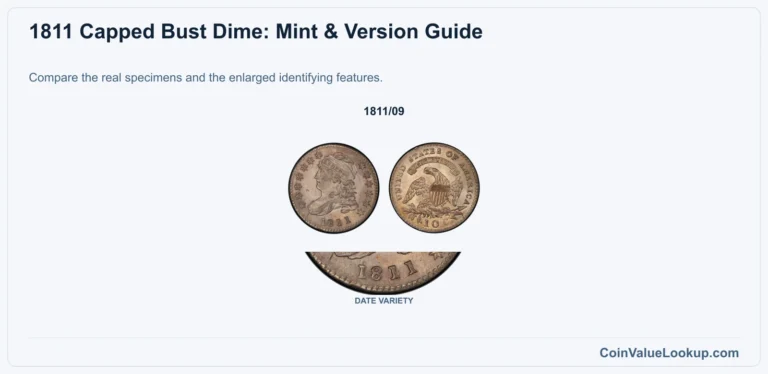
A repunched date on an 1884 Seated Dime shows remnants of an earlier position of one or more date numerals alongside the final placement. Under magnification you may see a shadow or partial outline of a digit slightly offset from where it was ultimately punched into the die.
This is a die variety, not a striking error, and it results from the mintmark or date punch being applied more than once during die production. Each repunched date is unique to the specific die that created it.
Do not confuse this with machine doubling, which produces a flat, shelf-like distortion rather than distinct separated outlines. Damage to the date area from post-mint hits can also mimic a repunched date.
The value of a repunched date example depends on the visibility of the remnant punching and the coin's overall condition.
2. 1884 Liberty Seated Dime — Die Crack / Die Chip
Die cracks appear as thin raised lines on the coin's surface, running from one design element to another or from the rim inward. Small raised blobs, called die chips, indicate localized breakage inside the die face.
Both are reported for 1884 Philadelphia Seated Dimes.
A crack connected to the rim that produces a raised blob of metal is sometimes called a cud, which is a more dramatic form of the same phenomenon. Interior cracks tend to be thinner and can cross lettering or Liberty's figure.
Do not mistake incuse scratches, corrosion lines or foreign material stuck to the surface for die cracks. A genuine die crack is raised above the field and appears on every coin struck from that damaged die.
Condition, crack size and location all affect any potential premium, and no specific price range is adopted here.
3. 1884 Liberty Seated Dime — Clashed Dies
Clashed dies occur when the obverse and reverse dies strike each other without a planchet between them. The impact transfers faint impressions of each die's design onto the opposite die.
After the clash, every coin struck from those dies carries ghostly traces of the wrong design in the fields.
On an 1884 Philadelphia dime you might see faint outlines of wreath elements in the obverse field around Liberty, or traces of Liberty's figure appearing in the reverse field near the wreath. These impressions align with where the opposite design would contact during a normal strike.
Random scratches, raised lines from debris, or brockage errors look different. Clash marks follow the geometry of the opposing die and repeat consistently across the affected area.
Value depends on how bold the clash is and the coin's grade; no adopted price range is available for this variety.
4. 1884 Liberty Seated Dime — Doubled Die Obverse
The 1884 doubled die obverse has been described with doubling visible in the UNITED STATES legend and a medium-level date showing separation in the numerals. Under magnification, look for distinct separated contours on the affected lettering, where each letter appears to have two overlapping impressions slightly offset from each other.
This is a hub doubling variety created during die production, not a press error. Compare your coin directly to a normal 1884 example to see the difference.
Machine doubling is the most common lookalike. It produces a flat, shelf-like distortion without the rounded, separated profiles of a true doubled die.
Worn die contours or light reflections can also trick the eye. The premium for a doubled die obverse depends on the strength of the doubling and the coin's condition, but no specific price range is adopted here.
5. 1884 Liberty Seated Dime — Defective Planchet
A defective planchet error means the silver blank itself had a flaw before it was fed into the press. This can show up as voids, cracks, lamination splits or irregular edges in the finished coin.
The struck design will typically be present over or around the flaw, confirming it existed before striking.
On an 1884 Seated Dime, check both sides and the edge for areas where metal appears missing, split or uneven in a way that does not match post-mint damage. A genuine planchet flaw usually has a smooth, aged appearance within the defect.
Post-mint gouges, corrosion pitting or deliberate metal removal can look similar but tend to show sharper edges, tool marks or chemical discoloration. Both faces and the edge need examination for proper context.
Value depends on the severity, visual impact and the coin's overall condition; no adopted price is available for this category.