1861 Liberty Seated Quarter Coin Value: How Much Is It Worth?
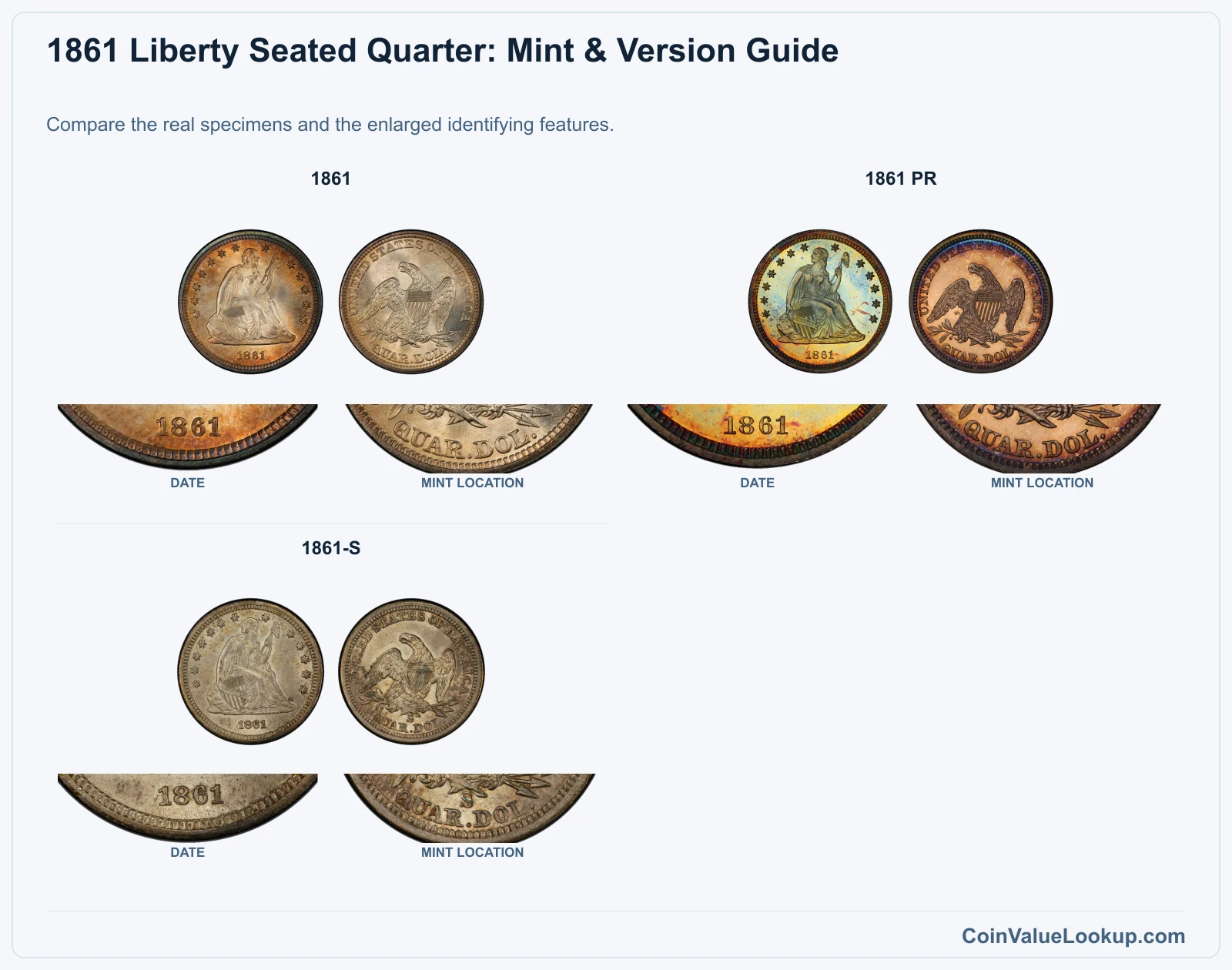
The 1861 Liberty Seated Quarter was struck during the first year of the Civil War, and these coins carry both numismatic and historical weight. Guide estimates for the listed versions range from about $51.00 to $42,846.00 depending on mint, finish and condition.
That is not one blanket price — your specific coin's mint origin, whether it is a proof, and its grade determine where it falls.
Fast Way to Identify Your 1861 Liberty Seated Quarter
The quickest way to start figuring out what you have is to snap clear photos of both sides of your coin and upload them here for a preliminary identification. Good lighting and a steady hand help.
This step can narrow down the mint, version and approximate condition so you know which part of the guide to look at.
1861 Liberty Seated Quarter Value
Upload both sides of your 1861 Liberty Seated Quarter.
Front Obverse
Upload photo
Back Reverse
Upload photo
Which 1861 Liberty Seated Quarter Versions Are Worth Money?
- 1861-S (San Francisco): Guide estimate reaches $42,846.00 at MS60 — scarce in any grade and genuinely rare above Fine.
- 1861 Proof: Guide estimate of $1,453.00 at PR63; low original mintages make authenticated proofs desirable.
- 1861 Philadelphia business strike: Up to $903.00 at MS63 per the guide; even circulated examples carry a solid base value of $51.00 at G4.
Step 1: Identify Your 1861 Liberty Seated Quarter Mint Mark and Version
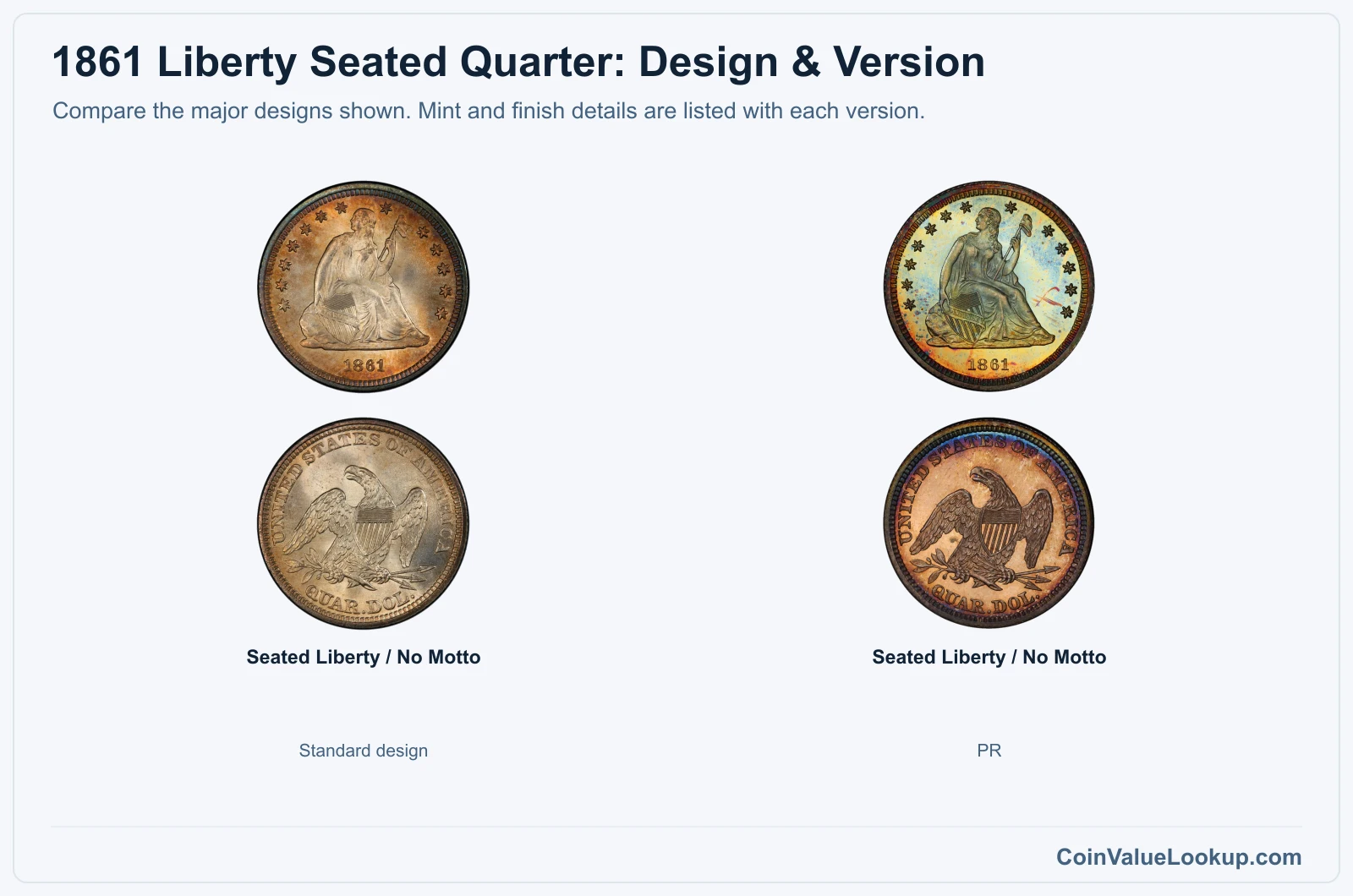
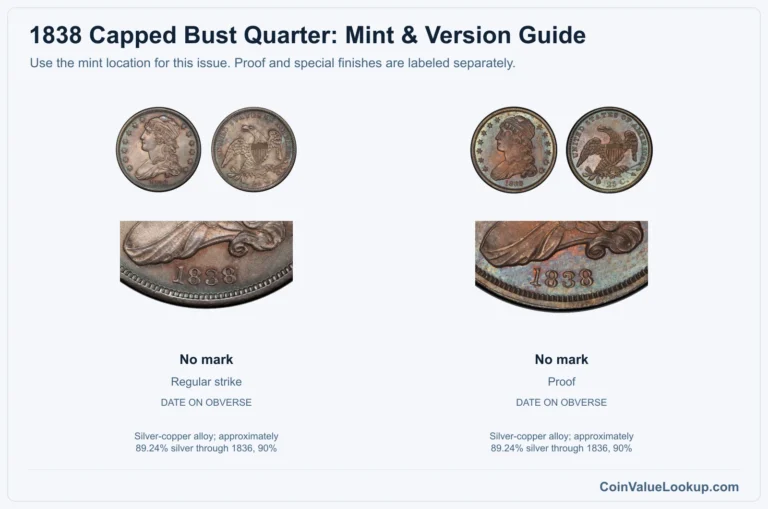
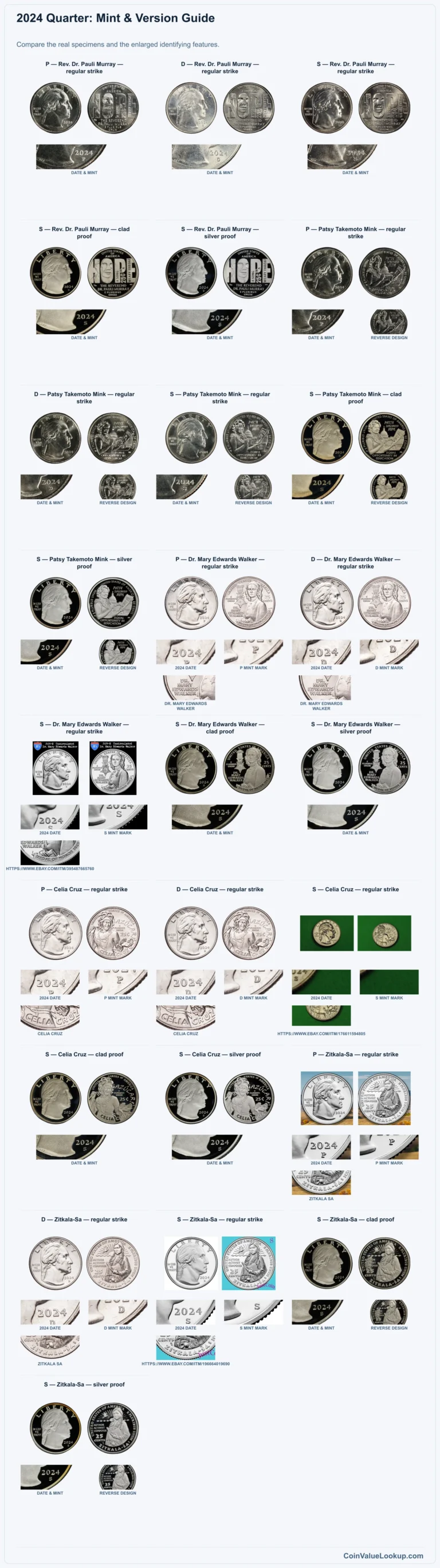
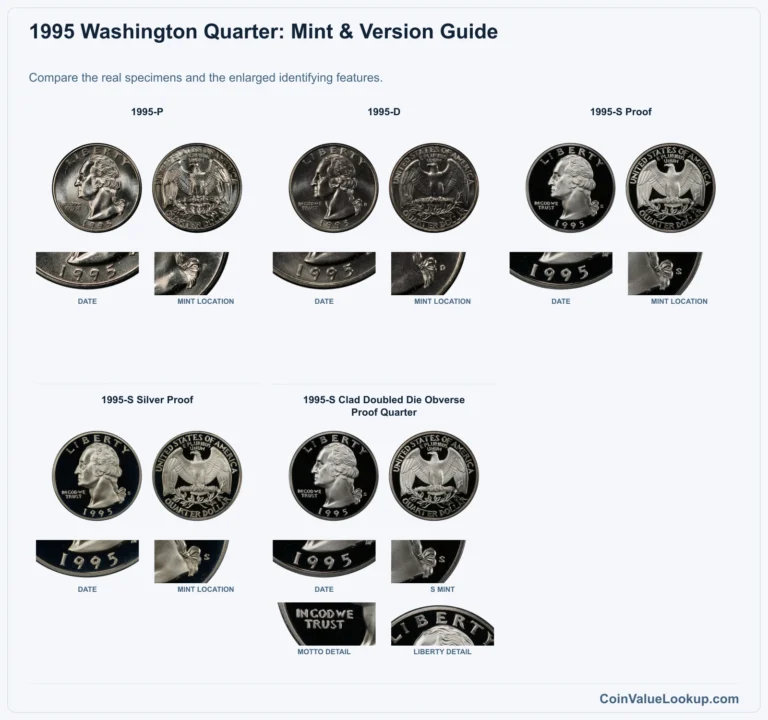
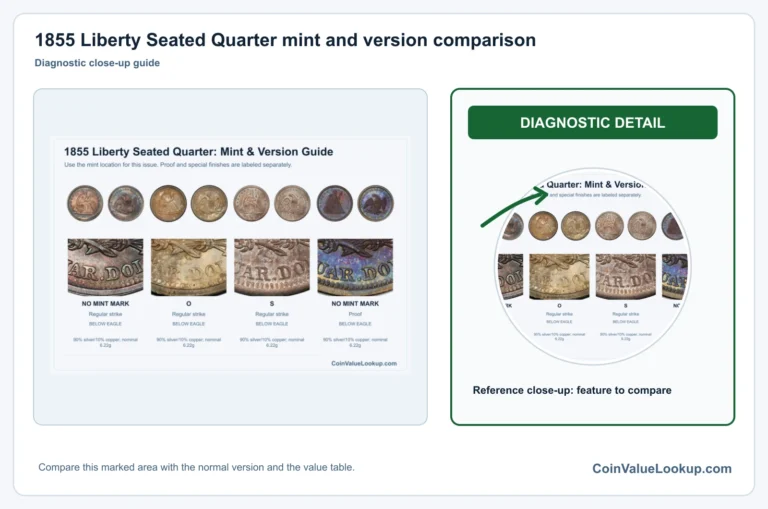
First, flip the coin to the reverse and look below the eagle. A Philadelphia-minted coin has no mintmark at all.
If you see an "S," that is the San Francisco issue — a much scarcer coin for this date.
There is no O or CC mintmark for 1861 quarters in the versions covered here, so do not assume one exists just because those mints struck other denominations that year. The design is the Seated Liberty obverse paired with an eagle reverse without the "In God We Trust" motto (that motto was added to quarters starting in 1866).
All three versions — 1861, 1861 Proof and 1861-S — are struck in 90% silver and 10% copper at a standard weight of 6.22 grams. A magnet test and a precise scale can quickly rule out fakes made from base metals.
Proof coins were specially manufactured with polished dies and planchets; they look fundamentally different from a business strike that simply happens to be shiny or lightly circulated.
Step 2: Check Your 1861 Liberty Seated Quarter Grade
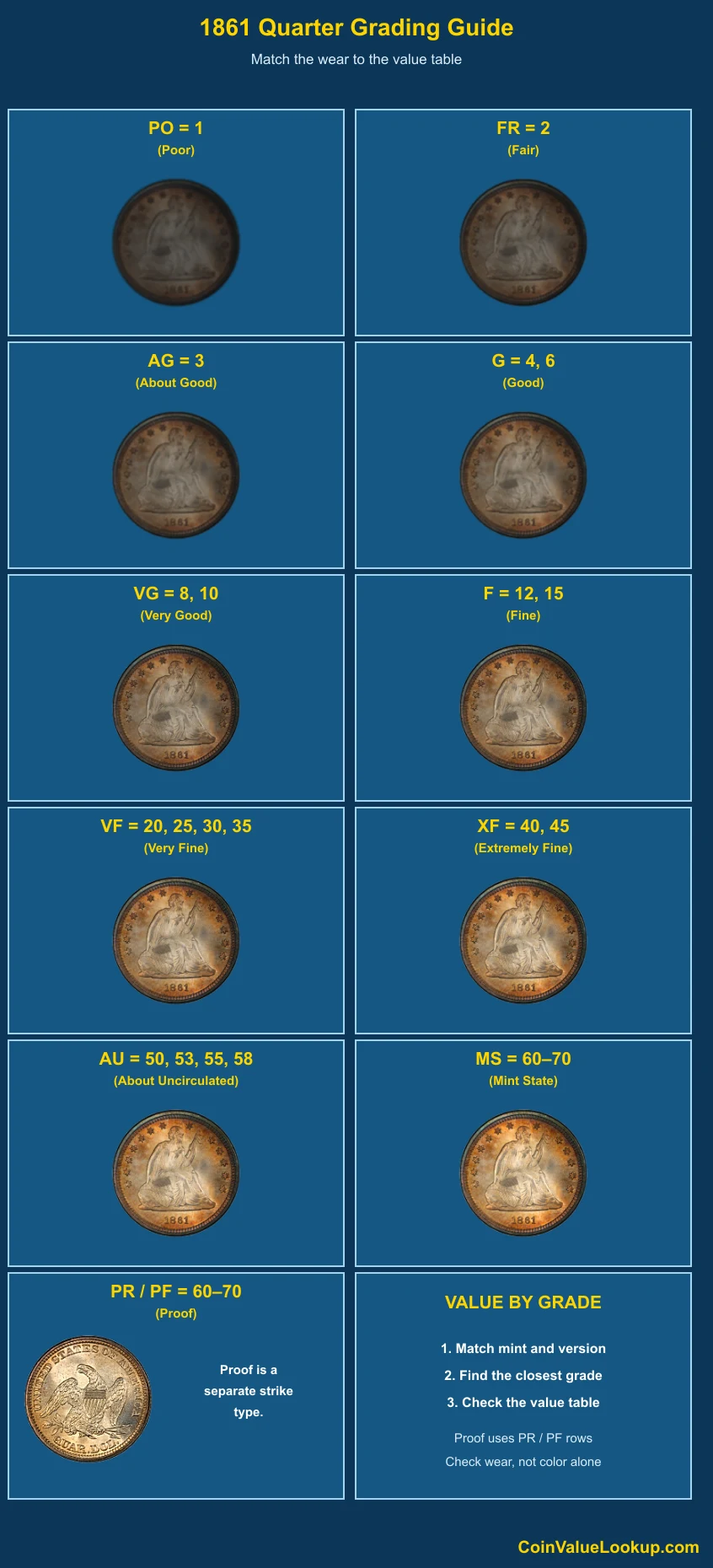
Start with Liberty herself. On a well-worn coin (around Good-4), her outline is visible but most interior detail — the head, breast, knee and shield lines — is flat.
As grade improves, those features sharpen progressively.
On the reverse, check the eagle's breast feathers and the tops of the wings. These are the first areas to soften with wear.
Compare your coin's surfaces against the reference comparison image to place it on the wear scale. A coin can look sharp in the centers yet still grade lower if it has been cleaned, whizzed or has rim damage.
Weak strikes are common on Seated quarters, especially from certain mints. A softly struck but unworn coin may lack full head or star detail even in mint state — do not confuse strike weakness with circulation wear.
Look at the high points and the fields together: luster in the protected areas is a better indicator of grade than sharpness of a single design element.
Step 3: Check 1861 Liberty Seated Quarter Value by Mint and Version
1861 Liberty Seated Quarter
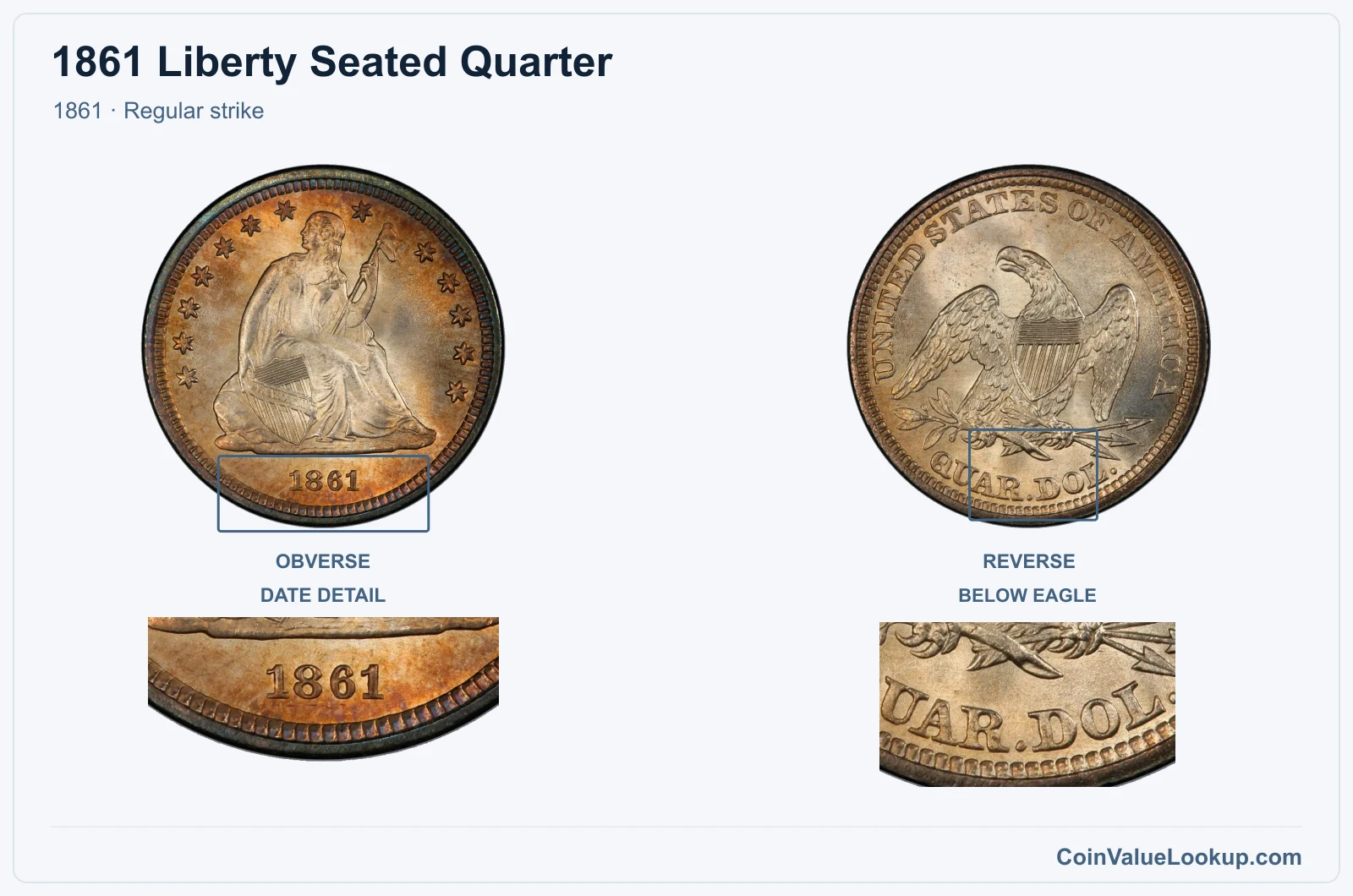
The 1861 Philadelphia quarter has no mintmark. It is the most available version of the three for this year.
In Good-4 condition, USA Coin Book estimates about $51.00, climbing to $446.00 at MS60 and $903.00 at MS63.
Look for original, untouched surfaces — gray or blue-gray toning is typical for genuine pieces that have not been dipped or polished. Cleaning may make a coin look brighter, but it usually lowers the collectible value.
Match the design (Seated Liberty, no motto on the reverse) and confirm no mintmark before comparing grades.
Range Grade
Price Auction Records Appraisal PO PO 1
—
Coin Identifier FR FR 2
—
Coin Identifier AG AG 3
—
Coin Identifier G G 4
—
Coin Identifier
G 6
—
Coin Identifier VG VG 8
—
Coin Identifier
VG 10
—
Coin Identifier F F 12
—
Coin Identifier
F 15
—
Coin Identifier VF VF 20
Coin Identifier
VF 25
Coin Identifier
VF 30
Coin Identifier
VF 35
Coin Identifier XF XF 40
Coin Identifier
XF 45
Coin Identifier AU AU 50
Coin Identifier
AU 53
Coin Identifier
AU 55
Coin Identifier
AU 58
Coin Identifier MS MS 60
Coin Identifier
MS 61
Coin Identifier
MS 62
Coin Identifier
MS 63
Coin Identifier
MS 64
Coin Identifier
MS 65
Coin Identifier
MS 66
Coin Identifier
MS 67
Coin Identifier
MS 68
Coin Identifier
MS 69
—
—
—
MS 70
—
—
—
1861 Liberty Seated Quarter — PR
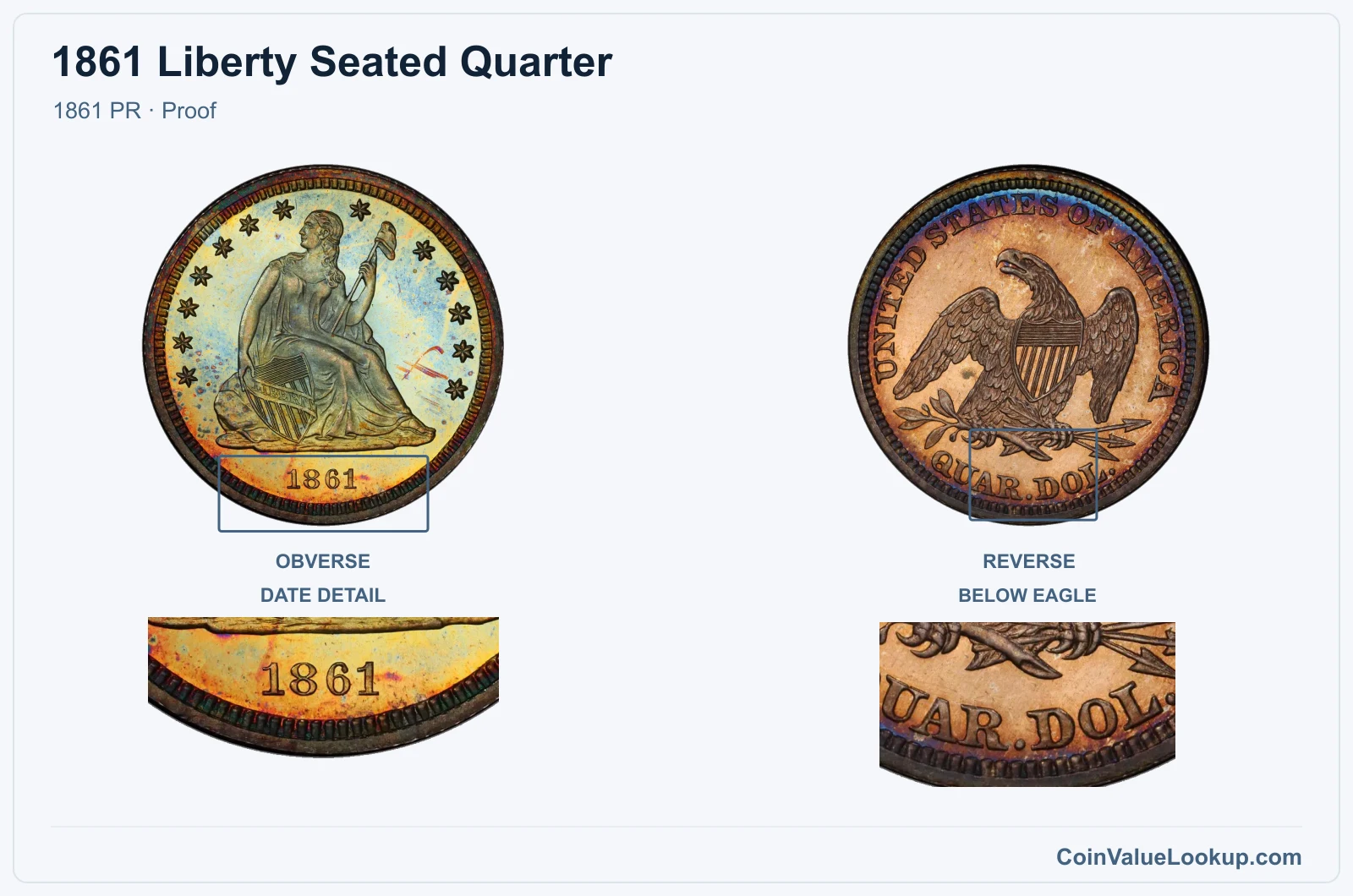
The 1861 Proof quarter was struck at Philadelphia for collectors, using specially prepared dies and planchets. There is no mintmark, same as the business strike, so telling the two apart requires examining the surfaces rather than looking for a letter.
A genuine proof will show mirror-like fields and sharply squared rims that a regular strike cannot replicate. Hairlines, haze and toning all factor into proof grades.
USA Coin Book lists the PR63 guide estimate at $1,453.00.
Coin Value Lookup is a useful starting point if you want to compare this proof against values for other Liberty Seated Quarter dates and mints. It can help you zero in on the right guide for your specific coin.
Do not assume your coin is a proof just because it is shiny. Lightly circulated business strikes and cleaned coins can mimic proof surfaces to an untrained eye.
Third-party certification is the safest way to confirm proof status.
Range Grade
Price Auction Records Appraisal PR PR 1
—
Coin Identifier
PR 2
—
Coin Identifier
PR 3
—
Coin Identifier
PR 4
—
Coin Identifier
PR 6
—
Coin Identifier
PR 8
—
Coin Identifier
PR 10
—
Coin Identifier
PR 12
—
Coin Identifier
PR 15
—
Coin Identifier
PR 20
—
Coin Identifier
PR 25
—
Coin Identifier
PR 30
—
Coin Identifier
PR 35
—
Coin Identifier
PR 40
—
Coin Identifier
PR 45
—
Coin Identifier
PR 50
—
Coin Identifier
PR 53
—
Coin Identifier
PR 55
—
Coin Identifier
PR 58
—
Coin Identifier
PR 60
Coin Identifier
PR 61
Coin Identifier
PR 62
Coin Identifier
PR 63
Coin Identifier
PR 64
Coin Identifier
PR 65
Coin Identifier
PR 66
Coin Identifier
PR 67
Coin Identifier
PR 68
—
—
—
PR 69
—
—
—
PR 70
—
—
—
1861 Liberty Seated Quarter — S
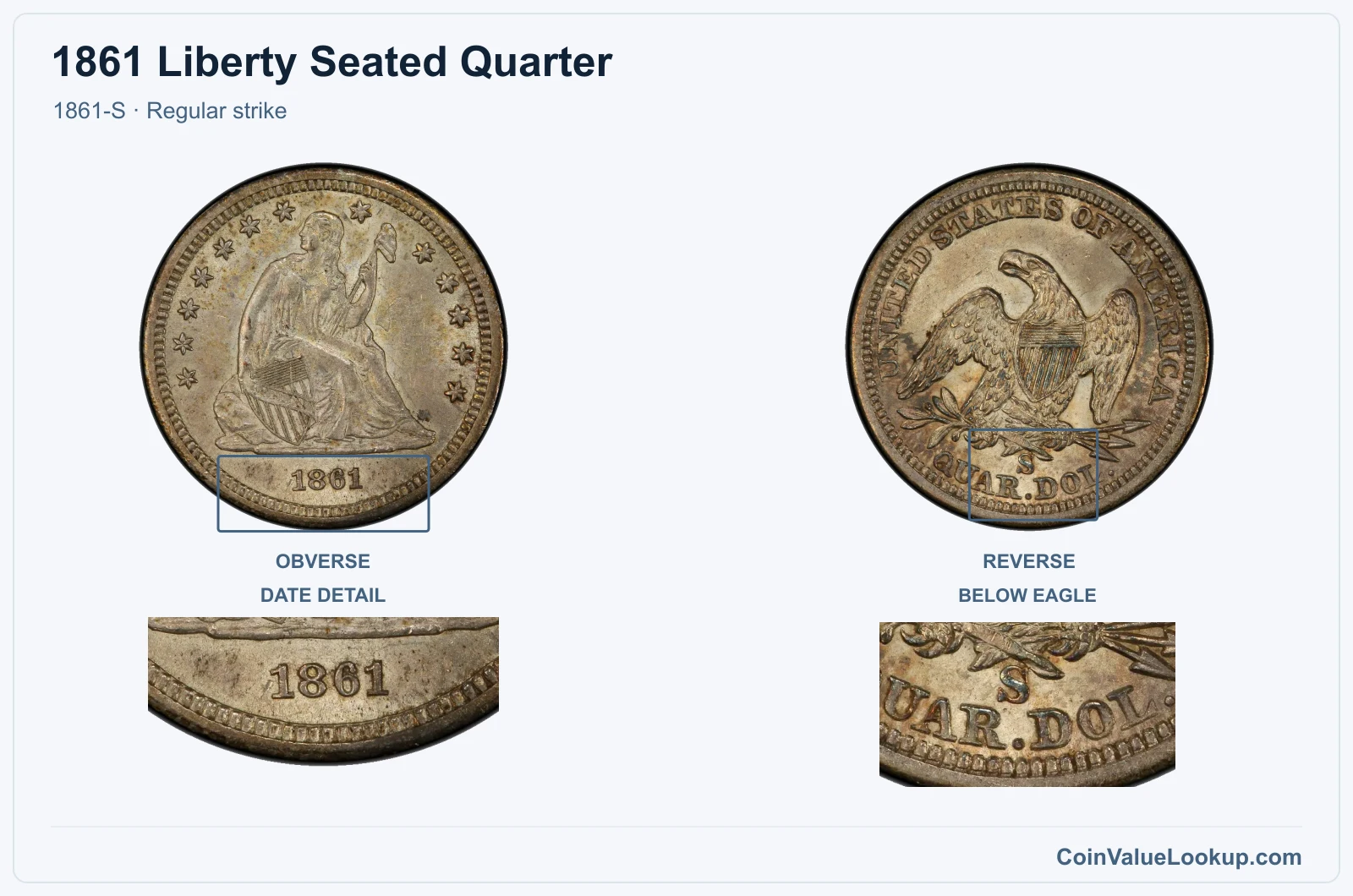
The 1861-S carries an "S" mintmark on the reverse beneath the eagle. San Francisco quarters from this date are genuinely scarce, and the guide numbers reflect that.
USA Coin Book estimates $799.00 even at G4, jumping to $42,846.00 at MS60.
That enormous leap between circulated and uncirculated grades tells you something: survivors in mint state are exceptionally rare. Most known examples show moderate to heavy wear, and even those command strong premiums over the Philadelphia issue.
Original surfaces matter enormously here. A cleaned or damaged 1861-S will still draw attention because of its rarity, but it will not approach the values of a problem-free example.
Confirm the S mintmark with magnification and verify the coin weighs close to 6.22 grams in 90% silver before getting too excited.
Range Grade
Price Auction Records Appraisal PO PO 1
—
Coin Identifier FR FR 2
Coin Identifier AG AG 3
—
Coin Identifier G G 4
Coin Identifier
G 6
Coin Identifier VG VG 8
Coin Identifier
VG 10
Coin Identifier F F 12
Coin Identifier
F 15
Coin Identifier VF VF 20
Coin Identifier
VF 25
Coin Identifier
VF 30
Coin Identifier
VF 35
Coin Identifier XF XF 40
Coin Identifier
XF 45
Coin Identifier AU AU 50
Coin Identifier
AU 53
Coin Identifier
AU 55
Coin Identifier
AU 58
Coin Identifier MS MS 60
—
—
—
MS 61
—
—
—
MS 62
—
—
—
MS 63
—
—
—
MS 64
—
—
—
MS 65
—
—
—
MS 66
—
—
—
MS 67
—
—
—
MS 68
—
—
—
MS 69
—
—
—
MS 70
—
—
—
1861 Liberty Seated Quarter Error List
1. 1861 Liberty Seated Quarter — Doubled Die Reverse
A Doubled Die Reverse has been reported for the 1861 Liberty Seated Quarter in regular strike form. This variety shows doubling on the reverse design elements — the lettering and contours may appear slightly spread or thickened compared to a normal coin.
To check yours, compare the reverse legends and eagle details closely against a known normal example under magnification. The doubling should be consistent and raised, not flat or shelf-like.
Be careful with lookalikes. Machine doubling (also called strike doubling) creates a flat, shelf-like distortion that is mechanically different and far less collectible.
Random contact marks, reflections or worn-die mushiness can also mimic doubling at first glance.
No specific price data is available for this variety in the supplied references, so individual assessment based on the coin's condition and the strength of the doubling would be needed. Third-party grading services can attribute the variety if the diagnostics match.